








Portal:Classical music
The Classical Music Portal


Classical music generally refers to the art music of the Western world, considered to be distinct from Western folk music or popular music traditions. It is sometimes distinguished as Western classical music, as the term "classical music" can also be applied to non-Western art musics. Classical music is often characterized by formality and complexity in its musical form and harmonic organization, particularly with the use of polyphony. Since at least the ninth century, it has been primarily a written tradition, spawning a sophisticated notational system, as well as accompanying literature in analytical, critical, historiographical, musicological and philosophical practices. (Full article...)
Selected articles -
-


Portrait by Anton Depauly, of Schubert at the end of his life
Franz Schubert's last three piano sonatas, D 958, 959 and 960, are his last major compositions for solo piano. They were written during the last months of his life, between the spring and autumn of 1828, but were not published until about ten years after his death, in 1838–39. Like the rest of Schubert's piano sonatas, they were mostly neglected in the 19th century. By the late 20th century, however, public and critical opinion had changed, and these sonatas are now considered among the most important of the composer's mature masterpieces. They are part of the core piano repertoire, appearing regularly on concert programs and recordings.
One of the reasons for the long period of neglect of Schubert's piano sonatas seems to be their dismissal as structurally and dramatically inferior to the sonatas of Beethoven. In fact, the last sonatas contain distinct allusions and similarities to works by Beethoven, a composer Schubert venerated. Nevertheless, musicological analysis has shown that they maintain a mature, individual style. The last sonatas are now praised for that mature style, manifested in unique features such as a cyclical formal and tonal design, chamber music textures, and a rare depth of emotional expression. (Full article...) -

Evensong rehearsal by Blue Coat CE School Choir, Coventry, in the quire of York Minster, showing carved choirstalls
A choir (/kwaɪər/ KWIRE), also known as a chorale or chorus (from Latin chorus, meaning 'a dance in a circle'), is a musical ensemble of singers. Choral music, in turn, is the music written specifically for such an ensemble to perform or in other words is the music performed by the ensemble. Choirs may perform music from the classical music repertoire, which spans from the medieval era to the present, or popular music repertoire. Most choirs are led by a conductor, who leads the performances with arm, hand, and facial gestures.
The term choir is very often applied to groups affiliated with a church (whether or not they actually occupy the quire), whereas a chorus performs in theatres or concert halls, but this distinction is not rigid. Choirs may sing without instruments, or accompanied by a piano, accordion, pipe organ, a small ensemble, or an orchestra. (Full article...) -
Giacomo Antonio Domenico Michele Secondo Maria Puccini (22 December 1858 – 29 November 1924) was an Italian composer known primarily for his operas. Regarded as the greatest and most successful proponent of Italian opera after Verdi, he was descended from a long line of composers, stemming from the late Baroque era. Though his early work was firmly rooted in traditional late-nineteenth-century Romantic Italian opera, it later developed in the realistic verismo style, of which he became one of the leading exponents.
His most renowned works are La bohème (1896), Tosca (1900), Madama Butterfly (1904), and the unfinished Turandot (posthumously completed by Franco Alfano), all of which are among the most frequently performed and recorded in the entirety of the operatic repertoire. (Full article...) -
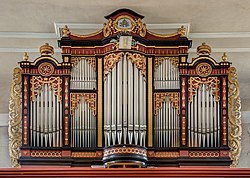
The pipe organ is a musical instrument that produces sound by driving pressurised air (called wind) through the organ pipes selected from a keyboard. Because each pipe produces a single tone and pitch, the pipes are provided in sets called ranks, each of which has a common timbre, loudness (volume), and construction throughout the keyboard compass. In other words, a rank is a set of pipes all having the same tonal quality, but having a range of different pitches. Most organs have many ranks of pipes of differing pitch, timbre, and volume that the player can employ singly or in combination through the use of controls called stops.
A pipe organ has one or more keyboards (called manuals) played by the hands, and most have a pedalboard played by the feet; each keyboard controls its own division (group of stops). The keyboard(s), pedalboard, and stops are housed in the organ's console. The organ's continuous supply of wind allows it to sustain notes for as long as the corresponding keys are pressed, unlike the piano and harpsichord whose sound begins to dissipate immediately after a key is depressed. The smallest portable pipe organs may have only one or two dozen pipes and one manual; the largest pipe organs can have over 33,000 pipes and seven manuals. A list of some of the most notable and largest pipe organs in the world can be viewed at List of pipe organs. A ranking of the largest organs in the world—based on the criterion constructed by Michał Szostak, i.e. 'the number of ranks and additional equipment managed from a single console'—can be found in the quarterly magazine The Organ and in the online journal Vox Humana. (Full article...) -

Shinobue and other flutes
The flute is a member of a family of musical instruments in the woodwind group. Like all woodwinds, flutes are aerophones, producing sound with a vibrating column of air. Flutes produce sound when the player's air flows across an opening. In the Hornbostel–Sachs classification system, flutes are edge-blown aerophones. A musician who plays the flute is called a flautist or flutist.
Paleolithic flutes with hand-bored holes are the earliest known identifiable musical instruments. A number of flutes dating to about 53,000 to 45,000 years ago have been found in the Swabian Jura region of present-day Germany, indicating a developed musical tradition from the earliest period of modern human presence in Europe. While the oldest flutes currently known were found in Europe, Asia also has a long history with the instrument. A playable bone flute discovered in China is dated to about 9,000 years ago. The Americas also had an ancient flute culture, with instruments found in Caral, Peru, dating back 5,000 years and in Labrador dating back about 7,500 years. (Full article...) -
Petrushka (French: Petrouchka; Russian: Петрушка) is a ballet by Russian composer Igor Stravinsky. It was written for the 1911 Paris season of Sergei Diaghilev's Ballets Russes company; the original choreography was by Michel Fokine and stage designs and costumes by Alexandre Benois, who assisted Stravinsky with the libretto. The ballet premiered at the Théâtre du Châtelet on 13 June 1911 with Vaslav Nijinsky as Petrushka, Tamara Karsavina as the lead ballerina, Alexander Orlov as the Moor, and Enrico Cecchetti the charlatan.
Petrushka tells the story of the loves and jealousies of three puppets. The three are brought to life by the Charlatan during the 1830 Shrovetide Fair (Maslenitsa) in Saint Petersburg. Petrushka is in love with the Ballerina, but she rejects him as she prefers the Moor. Petrushka is angry and hurt, and curses the Charlatan for bringing him into the world with only pain and suffering in his miserable life. Because of his anger, he challenges the Moor as a result. The Moor, who is both bigger and stronger than Petrushka, kills him with his sword (scimitar). The crowd watching is horrified, and the Charlatan is called to the scene as well as a police officer. The Charlatan reminds everyone that Petrushka is nothing but a puppet made of straw and cloth, and that he has no real emotion nor 'life'. As the crowd disperses, the Charlatan is left alone on the stage. At that moment, Petrushka's ghost rises above the puppet theatre as night falls. He shakes his fist and thumbs his nose at the Charlatan, making him flee, terrified. Petrushka then collapses in a second death. (Full article...) -
Giovanni Pierluigi da Palestrina (between 3 February 1525 and 2 February 1526 – 2 February 1594) was an Italian composer of late Renaissance music. The central representative of the Roman School, with Orlande de Lassus and Tomás Luis de Victoria, Palestrina is considered the leading composer of late 16th-century Europe. Palestrina was one of the few Renaissance composers never entirely forgotten, but it was the so-called "Palestrinian style" of counterpoint—especially as codified by Johann Joseph Fux—rather than his individual compositions that exerted the greatest influence.
Born in the town of Palestrina in the Papal States, Palestrina moved to Rome as a child and underwent musical studies there. In 1551, Pope Julius III appointed him maestro di cappella of the Cappella Giulia at St. Peter's Basilica. He left the post four years later, unable to continue as a layman under the papacy of Paul IV, and held similar positions at St. John Lateran and Santa Maria Maggiore in the following decade. Palestrina returned to the Cappella Giulia in 1571 and remained at St Peter's until his death in 1594. (Full article...) -
Wolfgang Amadeus Mozart (27 January 1756 – 5 December 1791) was a prolific and influential composer of the Classical period. Despite his brief life, his rapid pace of composition and proficiency from an early age resulted in more than 800 works representing virtually every classical genre of his time. Many of these compositions are acknowledged as pinnacles of the symphonic, concertante, chamber, opera, and choral repertoires. Mozart is widely regarded as one of the greatest composers in the history of Western music, with his music admired for its "melodic beauty, its formal elegance and its richness of harmony and texture".
Born in Salzburg, Mozart showed prodigious ability from his earliest childhood. At age five, he was already competent on keyboard and violin, had begun to compose, and performed before European royalty. His father, Leopold Mozart, took him on a grand tour of Europe and then three trips to Italy. At 17 he was a musician at the Salzburg court but grew restless and travelled in search of a better position. Mozart's fruitless journey in search of employment led him to Paris, Mannheim, Munich, and eventually back to Salzburg. During this time he wrote his five violin concertos, the Sinfonia Concertante, and Concerto for Flute and Harp, as well as sacred pieces and masses, the motet Exsultate Jubilate, and the opera Idomeneo, among other works. (Full article...) -
Madama Butterfly (Italian pronunciation: [maˈdaːma ˈbatterflai]; Madame Butterfly) is an opera in three acts (originally two) by Giacomo Puccini, with an Italian libretto by Luigi Illica and Giuseppe Giacosa.
It is based on the short story "Madame Butterfly" (1898) by John Luther Long, which in turn was based on stories told to Long by his sister Jennie Correll and on the semi-autobiographical 1887 French novel Madame Chrysanthème by Pierre Loti. Long's version was dramatized by David Belasco as the one-act play Madame Butterfly: A Tragedy of Japan, which, after premiering in New York in 1900, moved to London, where Puccini saw it in the summer of that year. (Full article...) -
Eine kleine Nachtmusik (Serenade No. 13 for strings in G major), K. 525, is a 1787 composition for a chamber ensemble by Wolfgang Amadeus Mozart (1756–1791). The German title means "a little night music" and it is one of the most famous pieces of classical music.
The reasoning behind this piece is unknown. The extant piece contains four movements: Allegro, Romance, Menuetto, and Finale. However, another movement is now believed to be lost. (Full article...) -
The Piano Concerto No. 2 in B♭ major, Op. 83, by Johannes Brahms is separated by a gap of 22 years from his first piano concerto. Brahms began work on the piece in 1878 and completed it in 1881 while in Pressbaum near Vienna. It took him three years to work on this concerto, which indicates that he was always self-critical. He wrote to Clara Schumann: "I want to tell you that I have written a very small piano concerto with a very small and pretty scherzo." He was ironically describing a huge piece. This concerto is dedicated to his teacher, Eduard Marxsen. The public premiere of the concerto was given in Budapest on 9 November 1881, with Brahms as soloist and the Budapest Philharmonic Orchestra, and was an immediate success. He proceeded to perform the piece in many cities across Europe.
The piece is scored for 2 flutes (1st also piccolo), 2 oboes, 2 clarinets (B♭), 2 bassoons, 4 horns (initially 2 in B♭ bass, 2 in F), 2 trumpets (B♭), timpani (B♭ and F, A and D in second movement) and strings. (The trumpets and timpani are used only in the first two movements, which is unusual.) (Full article...) -

Lithograph by Chatinière of the ballerina Rita Sangalli in the title rôle of Sylvia from the ballet's original production of 1876. This image was created for the original issue of Delibes's score by the publisher Heugel & Fils.
Sylvia, originally Sylvia, ou La nymphe de Diane, is a full-length classical ballet in two or three acts, first choreographed by Louis Mérante to music by Léo Delibes.
The ballet's premiere took place on 14 June 1876 at the Palais Garnier, but was largely unnoticed by the critics. The first seven productions were commercially unsuccessful, but the 1952 revival, choreographed by Frederick Ashton, popularized the work. Productions in 1997, 2004, 2005, and 2009 productions were all based on Ashton's choreography. (Full article...)


_(14585145288).jpg)
General images -
-

-

-
-
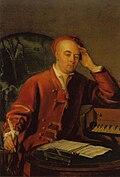
 1875 oil painting of Franz Schubert by Wilhelm August Rieder, after his own 1825 watercolor portrait (from Classical period (music))
 -
 Balakirev (top), Cui (upper left), Mussorgsky (upper right), Rimsky-Korsakov (lower left), and Borodin (lower right). (from Romantic music)
 -
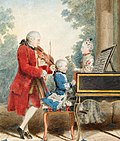 Wolfgang Amadeus Mozart, a representative composer of the Classical period, seated at a keyboard. (from Classical period (music))
 -
 Wanderer above the Sea of Fog, by Caspar David Friedrich, is an example of Romantic painting. (from Romantic music)
 -
 Musicians from 'Procession in honour of Our Lady of Sablon in Brussels.' Early 17th-century Flemish alta cappella. From left to right: bass dulcian, alto shawm, treble cornett, soprano shawm, alto shawm, tenor sackbut. (from Renaissance music)
 -
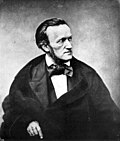 Richard Wagner in Paris, 1861
 -
 Portion of Du Fay's setting of Ave maris stella, in fauxbourdon. The top line is a paraphrase of the chant; the middle line, designated "fauxbourdon", (not written) follows the top line but exactly a perfect fourth below. The bottom line is often, but not always, a sixth below the top line; it is embellished, and reaches cadences on the octave.Play (from Renaissance music)
 -
 Josef Danhauser's 1840 painting Liszt at the Piano featuring Franz Liszt at the piano surrounded by (from left to right) Alexandre Dumas, Hector Berlioz, George Sand, Niccolò Paganini, Gioachino Rossini and Marie d'Agoult, with a bust of Ludwig van Beethoven on the piano (from Romantic music)
 -
 Painting by Evaristo Baschenis of Baroque instruments, including a cittern, viola da gamba, violin, and two lutes (from Baroque music)
 -
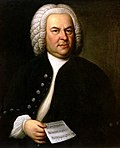 Johann Sebastian Bach, 1748 (from Baroque music)
 -
 Portrait of the Mozart Family, dated 1780–81 (from Classical period (music))
 -
 Gustav Mahler, photographed in 1907 by Moritz Nähr at the end of his period as director of the Vienna Hofoper (from Romantic music)
 -
 Hummel in 1814 (from Classical period (music))
 -
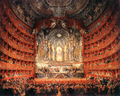 A large instrumental ensemble's performance in the lavish Teatro Argentina, as depicted by Panini (1747) (from Baroque music)
 -
-
 View of Vienna in 1758, by Bernardo Bellotto (from Classical period (music))
 -
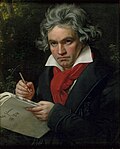
Portrait of Beethoven, 1820 (from Classical period (music))
-
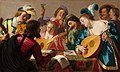 Gerard van Honthorst, The Concert (1623), National Gallery of Art, Washington D.C. (from Renaissance music)
 -
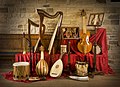 Selection of Renaissance instruments (from Renaissance music)
 -
 Claudio Monteverdi in 1640 (from Baroque music)
 -
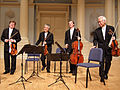 A modern string quartet. In the 2000s, string quartets from the Classical era are the core of the chamber music literature. From left to right: violin 1, violin 2, cello, viola (from Classical period (music))
 -

-
 Franz Liszt in 1858, by Franz Hanfstaengl (from Romantic music)
 -
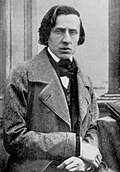 Daguerreotype of Chopin, c. 1849 (from Romantic music)
 -
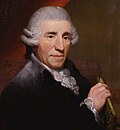 Haydn portrait by Thomas Hardy, 1792 (from Classical period (music))
 -
 Fortepiano by Paul McNulty after Walter & Sohn, c. 1805 (from Classical period (music))
 -
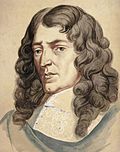
-
 The opening bars of the Commendatore's aria in Mozart's opera Don Giovanni. The orchestra starts with a dissonant diminished seventh chord (G# dim7 with a B in the bass) moving to a dominant seventh chord (A7 with a C# in the bass) before resolving to the tonic chord (D minor) at the singer's entrance. (from Classical period (music))
 -
 Wolfgang Amadeus Mozart, posthumous painting by Barbara Krafft in 1819 (from Classical period (music))
 -
 Gluck, detail of Portrait of Christoph Willibald Gluck by Joseph Duplessis, dated 1775 (Kunsthistorisches Museum, Vienna) (from Classical period (music))
 -
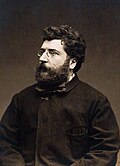 Bizet photographed by Étienne Carjat (1875) (from Romantic music)
 -
 Bernhard Crusell, a Swedish-Finnish composer and clarinetist, in 1826 (from Classical period (music))
 -
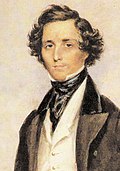


.jpg)


Quotes -
| “ | Music conveys a prophetic message, revealing a higher form of life towards which mankind evolves. | ” |
| — Arnold Schoenberg | ||
Related portals


WikiProjects




 Selected composers -


-

Britten in 1968, by Hans Wild
Edward Benjamin Britten, Baron Britten OM CH (22 November 1913 – 4 December 1976) was an English composer, conductor, and pianist. He was a central figure of 20th-century British music, with a range of works including opera, other vocal music, orchestral and chamber pieces. His best-known works include the opera Peter Grimes (1945), the War Requiem (1962) and the orchestral showpiece The Young Person's Guide to the Orchestra (1945).
Britten was born in Lowestoft, Suffolk, the son of a dentist. He showed talent from an early age. He studied at the Royal College of Music in London and privately with the composer Frank Bridge. Britten first came to public attention with the a cappella choral work A Boy Was Born in 1934. With the premiere of Peter Grimes in 1945, he leapt to international fame. Over the next 28 years, he wrote 14 more operas, establishing himself as one of the leading 20th-century composers in the genre. In addition to large-scale operas for Sadler's Wells and Covent Garden, he wrote chamber operas for small forces, suitable for performance in venues of modest size. Among the best known of these is The Turn of the Screw (1954). Recurring themes in his operas include the struggle of an outsider against a hostile society and the corruption of innocence. (Full article...) -

Sir John Stainer
Sir John Stainer (6 June 1840 – 31 March 1901) was an English composer and organist whose music, though seldom performed today (with the exception of The Crucifixion, still heard at Passiontide in some Anglican churches), was very popular during his lifetime. His work as choir trainer and organist set standards for Anglican church music that are still influential. He was also active as an academic, becoming Heather Professor of Music at Oxford.
Stainer was born in Southwark, London, in 1840, the son of a schoolmaster. He became a chorister at St Paul's Cathedral when aged ten and was appointed to the position of organist at St Michael's College, Tenbury, at the age of sixteen. He later became organist at Magdalen College, Oxford, and subsequently organist at St Paul's Cathedral. When he retired owing to his poor eyesight and deteriorating health, he returned to Oxford to become Professor of Music at the university. He died unexpectedly while on holiday in Italy in 1901. (Full article...) -

Jean Sibelius (/sɪˈbeɪliəs/; Finland Swedish: [ˈʃɑːn siˈbeːliʉs] ⓘ; born Johan Julius Christian Sibelius; 8 December 1865 – 20 September 1957) was a Finnish composer of the late Romantic and early modern periods. He is widely regarded as his country's greatest composer, and his music is often credited with having helped Finland develop a stronger national identity when the country was struggling from several attempts at Russification in the late 19th century.
The core of his oeuvre is his set of seven symphonies, which, like his other major works, are regularly performed and recorded in Finland and countries around the world. His other best-known compositions are Finlandia, the Karelia Suite, Valse triste, the Violin Concerto, the choral symphony Kullervo, and The Swan of Tuonela (from the Lemminkäinen Suite). His other works include pieces inspired by nature, Nordic mythology, and the Finnish national epic, the Kalevala; over a hundred songs for voice and piano; incidental music for numerous plays; the one-act opera The Maiden in the Tower; chamber music, piano music, Masonic ritual music, and 21 publications of choral music. (Full article...) -
Wilhelm Richard Wagner (/ˈvɑːɡnər/ VAHG-nər; German: [ˈvɪlˌhɛlm ˈʁɪçaʁt ˈvaːɡnɐ] ⓘ; 22 May 1813 – 13 February 1883) was a German composer, theatre director, essayist, and conductor, best known for his operas, although his mature works are often referred to as music dramas. Unlike most composers, Wagner wrote both the libretti and the music for all of his stage works. He first achieved recognition with works in the Romantic tradition of Carl Maria von Weber and Giacomo Meyerbeer, but revolutionised the genre through his concept of the Gesamtkunstwerk ("total work of art"), which sought to unite poetic, musical, visual, and dramatic elements. In this approach, the drama unfolds as a continuously sung narrative, with the music evolving organically from the text rather than alternating between arias and recitatives. Wagner outlined these ideas in a series of essays published between 1849 and 1852, most fully realising them in the first half of his four-opera cycle Der Ring des Nibelungen (The Ring of the Nibelung).
Wagner's compositions, particularly in his later period, have complex textures, rich harmonies and orchestration, and elaborate leitmotifs—musical phrases associated with individual characters, places, ideas, or plot elements. His advances in musical language, such as extreme chromaticism and quickly shifting tonal centres, greatly influenced the development of classical music; his Tristan und Isolde is regarded as an important precursor to modernist music. Later in life, he softened his ideological stance against traditional operatic forms (e.g., arias, ensembles and choruses), reintroducing them into his last few stage works, including Die Meistersinger von Nürnberg (The Mastersingers of Nuremberg) and Parsifal. (Full article...) -
Garry Schyman is an American film, television, and video game music composer. He graduated from the University of Southern California with a degree in music composition in 1978, and began work in the television industry, writing music for television series such as Magnum, P.I. and The A-Team. By 1986, he was composing for movies such as Judgement and Hit List. At the request of a friend in 1993, he composed the music for the video game Voyeur, but after creating the music for two more games he left the industry, citing the low budgets and poor quality of video game music at the time. He continued to compose for film and television, only to return to video games for 2005's Destroy All Humans!. Finding that in his absence the quality and perceived importance of video game music had risen substantially, he has since composed for several games, writing the scores to BioShock and Dante's Inferno among others. He still composes for film however, his latest being Brush with Danger directed by young Indonesian director Livi Zheng. He has won numerous awards for his video game scores, including several "soundtrack of the year" awards. During his career, he has worked on over 25 television shows, 10 films, and 13 video games. (Full article...) -
Frederik Reesen Magle (Danish pronunciation: [ˈfʁeðˀʁek ˈmɑwlə, ˈfʁæðˀʁæk -]; born 17 April 1977) is a Danish composer, concert organist, and pianist. He writes contemporary classical music as well as fusion of classical music and other genres. His compositions include orchestral works, cantatas, chamber music, and solo works (mainly for organ), including several compositions commissioned by the Danish royal family. Magle has gained a reputation as an organ virtuoso, and as a composer and performing artist who does not refrain from venturing into more experimental projects – often with improvisation – bordering jazz, electronica, and other non-classical genres.
His best-known works include his concerto for organ and orchestra The Infinite Second, his brass quintet piece Lys på din vej (Light on your path), composed for the christening of Prince Nikolai, The Hope for brass band and choir, his symphonic suite Cantabile, a collection of improvisations for organ titled Like a Flame, and his fanfare for two trumpets and organ The Fairest of Roses. (Full article...) -

First page of The Pilgrim: Grand Overture by Douglass
John Thomas Douglass (1847–1886) was an American composer, virtuoso violinist, conductor and teacher. He is best known for composing Virginia's Ball (1868), which is generally regarded as the first opera written by a Black American composer. The work is now lost, and his only extant composition is The Pilgrim: Grand Overture (1878) for piano. His biography from James Monroe Trotter's Music and Some Highly Musical People (1878)—in which The Pilgrim survives—reports that he wrote many now lost pieces for piano, orchestra and particularly guitar, which he was known to play.
A highly regarded violinist, Douglass's violin playing received high praise during his lifetime. In addition to his solo career, he traveled with various groups throughout the 1870s, including the Hyers Sisters. He settled in New York by the 1880s and conducted both a music studio and string ensemble. Later in life he led a teaching studio, and among his students was David Mannes who became the concertmaster of the New York Symphony Orchestra. Nearly 30 years after Douglass's death at age 38–39, Mannes founded the Colored Music Settlement School in the memory of his teacher. (Full article...) -

Map showing the Grand Tour, 1763–1766. Black line shows outward journey to London, 1763–1764. Red line shows homeward journey to Salzburg, 1765–1766. Occluded line shows travel in each direction.
The Mozart family grand tour was a journey through western Europe, undertaken by Leopold Mozart, his wife Anna Maria, and their children Maria Anna (Nannerl) and Wolfgang Theophilus (Wolferl) from 1763 to 1766. At the start of the tour the children were aged eleven and seven respectively. Their extraordinary skills had been demonstrated during a visit to Vienna in 1762, when they had played before the Empress Maria Theresa at the Imperial Court. Sensing the social and pecuniary opportunities that might accrue from a prolonged trip embracing the capitals and main cultural centres of Europe, Leopold obtained an extended leave of absence from his post as deputy Kapellmeister to the Prince-Archbishopric of Salzburg. Throughout the subsequent tour, the children's Wunderkind status was confirmed as their precocious performances consistently amazed and gratified their audiences.
The first stage of the tour's itinerary took the family, via Munich and Frankfurt, to Brussels and then on to Paris where they stayed for five months. They then departed for London, where during a stay of more than a year Wolfgang made the acquaintance of some of the leading musicians of the day, heard much music, and composed his first symphonies. The family then moved on to the Netherlands, where the schedule of performances was interrupted by the illnesses of both children, although Wolfgang continued to compose prolifically. The homeward phase incorporated a second stop in Paris and a trip through Switzerland, before the family's return to Salzburg in November 1766. (Full article...) -

A 1611 woodcut of Josquin des Prez, possibly copied from a now-lost oil painting made during his lifetime. There have been doubts concerning whether this depiction is an accurate likeness, see § Portraits.
Josquin Lebloitte dit des Prez (c. 1450–1455 – 27 August 1521) was a composer of Renaissance music, who is variously described as French or Franco-Flemish. Considered one of the greatest composers of the Renaissance, he was a central figure of the Franco-Flemish School and had a profound influence on the music of 16th-century Europe. Building on the work of his predecessors like Johannes Ockeghem, he developed a complex style of expressive—and often imitative—movement between independent voices (polyphony) which informs much of his work. He further emphasized the relationship between text and music, and departed from the early Renaissance tendency towards lengthy melismatic lines on a single syllable, preferring to use shorter, repeated motifs between voices. Josquin was a singer, and his compositions are mainly vocal. They include masses, motets and secular chansons.
Josquin's biography has been continually revised by modern scholarship. Little is known of his early years; he was born in the French-speaking area of Flanders, and he may have been an altar boy and have been educated at the Cambrai Cathedral. By 1477 he was in the choir of René of Anjou and then probably served under Louis XI of France. In the 1480s Josquin traveled Italy with the Cardinal Ascanio Sforza, may have worked in Vienna for the Hungarian king Matthias Corvinus, and wrote the motet Ave Maria ... Virgo serena, and the popular chansons Adieu mes amours and Que vous ma dame. He served Pope Innocent VIII and Pope Alexander VI in Rome, Louis XII in France, and Ercole I d'Este in Ferrara. Many of his works were printed and published by Ottaviano Petrucci in the early 16th century, including the Missa Hercules Dux Ferrariae. In his final years in Condé, Josquin produced some of his most admired works, including the masses Missa de Beata Virgine and Missa Pange lingua; the motets Benedicta es, Inviolata, Pater noster–Ave Maria and Praeter rerum seriem; and the chansons Nimphes, nappés and Plus nulz regretz. (Full article...) -
Franz Peter Schubert (/ˈʃuːbərt/; German: [fʁants ˈpeːtɐ ˈʃuːbɐt]; 31 January 1797 – 19 November 1828) was an Austrian composer of the late Classical and early Romantic eras. Despite his short life, Schubert left behind a vast oeuvre, including more than 600 Lieder (art songs in German) and other vocal works, seven complete symphonies, sacred music, operas, incidental music, and a large body of piano and chamber music. His major works include the songs "Erlkönig", "Gretchen am Spinnrade", and "Ave Maria"; the Trout Quintet; the Symphony No. 8 in B minor (Unfinished); the Symphony No. 9 in C major (The Great); the String Quartet No. 14 in D minor (Death and the Maiden); the String Quintet in C major; the Impromptus for solo piano; the last three piano sonatas; the Fantasia in F minor for piano four hands; the opera Fierrabras; the incidental music to the play Rosamunde; and the song cycles Die schöne Müllerin, Winterreise, and Schwanengesang.
Born in the Himmelpfortgrund suburb of Vienna, Schubert showed uncommon gifts for music from an early age. His father gave him his first violin lessons and his elder brother gave him piano lessons, but Schubert soon exceeded their abilities. In 1808, at the age of eleven, he became a pupil at the Stadtkonvikt school, where he became acquainted with the orchestral music of Joseph Haydn, Wolfgang Amadeus Mozart, and Ludwig van Beethoven. He left the Stadtkonvikt at the end of 1813 and returned home to live with his father, where he began studying to become a schoolteacher. Despite this, he continued his studies in composition with Antonio Salieri and still composed prolifically. In 1821, Schubert was admitted to the Gesellschaft der Musikfreunde as a performing member, which helped establish his name among the Viennese citizenry. He gave a concert of his works to critical acclaim in March 1828, the only time he did so in his career. He died eight months later at the age of 31, the cause officially attributed to typhoid fever, but believed by some historians to be syphilis. (Full article...) -

Delius, photographed in 1907
Frederick Theodore Albert Delius CH (born Fritz Theodor Albert Delius; /ˈdiːliəs/; 29 January 1862 – 10 June 1934) was an English composer. Born in Bradford in the north of England to a prosperous mercantile family, he resisted attempts to recruit him to commerce. He was sent to Florida in the United States in 1884 to manage an orange plantation. He soon neglected his managerial duties, and in 1886 returned to Europe.
Having been influenced by African-American music during his short stay in Florida, he began composing. After a brief period of formal musical study in Germany beginning in 1886, he embarked on a full-time career as a composer in Paris and then in nearby Grez-sur-Loing, where he and his wife Jelka lived for the rest of their lives, except during the First World War. (Full article...) -

The organ at Exeter Cathedral, which Gibbons may have played
Edward Gibbons (bapt. 21 March 1568 – in or before July 1650) was an English choirmaster and composer of the late Renaissance and early Baroque periods. Born in Cambridge, Gibbons's youth is completely unknown, but he later received degrees from the Universities of Cambridge and Oxford. From 1591/92 to 1598 he worked at King's College, Cambridge, as a lay clerk and choirmaster. During his tenure he married Jane, with whom he had six children. Gibbons's whereabouts the next few years remain uncertain; he may have lived in Acton, Bristol or Exeter, but by 1607 he was the choirmaster of the Exeter Cathedral, where the choristers included Matthew Locke. By 1609 Gibbons received a special dispensation to become a priest vicar, becoming the head of the college of priest-vicars and succentor. Jane died in 1628, and Edward married Mary Bluet; the family was evicted from their home during the English Civil War, but moved to their estate in Dunsford.
A few compositions of Gibbons survive: an organ prelude, two verse anthems, two works for viol consorts, and some sacred music. Of these, commentators have mainly praised the verse anthems, How hath ye City sate solitary and What Strikes the Clocke? Musicologist John Harley called the former particularly moving, and it was likely written for the 1603 London plague outburst to which Gibbons's brother Ellis may have succumbed to. Edward is the elder brother of the better-known Orlando; after the early deaths of Orlando and his wife, Edward cared for their son, Christopher, who also became a noted composer. (Full article...) -
Johann Baptist Strauss II (/straʊs/; German: [ˈjoːhan bapˈtɪst ˈʃtʁaʊs]; 25 October 1825 – 3 June 1899), also known as Johann Strauss Jr., the Younger or the Son (German: Johann Strauß Sohn), was an Austrian composer of light music, particularly dance music and operettas, as well as a violinist. He composed over 500 waltzes, polkas, quadrilles, and other types of dance music, as well as several operettas and a ballet.
In his lifetime, he was known as "The Waltz King", as he played a major role in popularizing the waltz in the 19th century. Some of Johann Strauss's most famous works include "The Blue Danube", "Kaiser-Walzer" (Emperor Waltz), "Tales from the Vienna Woods", "Frühlingsstimmen", and the "Tritsch-Tratsch-Polka". Among his operettas, Die Fledermaus and Der Zigeunerbaron are the best known. (Full article...) -
Guto Pryderi Puw (born 1971) is a Welsh composer, university lecturer and conductor. He is considered to be one of the most prominent Welsh composers of his generation and a key figure in current Welsh music. Puw's music has been broadcast on BBC Radio 3 and been featured on television programmes for the BBC and S4C. He has twice been awarded the Composer's Medal at the National Eisteddfod.
Puw's works include pieces for unusual combinations of instruments, such as a tuba quartet or a trio consisting of harp, cello and double-bass, as well as more traditional forces such as solo baritone and piano, choir or orchestra. He was associated with the BBC National Orchestra of Wales as its Resident Composer, the first holder of this title, from 2006 to 2010. Puw's own Welsh identity is a recurrent theme in his music: some of his pieces set Welsh-language poetry to music and one of his pieces, Reservoirs, is written about the flooding of Welsh valleys to provide water for England. (Full article...) -

Portrait of Mozart, aged 13, in Verona, 1770, attributed to Giambettino Cignaroli
Between 1769 and 1773, the young Wolfgang Amadeus Mozart and his father Leopold made three Italian journeys. The first, an extended tour of 15 months, was financed by performances for the nobility and by public concerts, and took in the most important Italian cities. The second and third journeys were to Milan, for Wolfgang to complete operas that had been commissioned there on the first visit. From the perspective of Wolfgang's musical development, the journeys were a considerable success, and his talents were recognised by honours which included a papal knighthood and memberships in leading philharmonic societies.
Leopold Mozart had been employed since 1747 as a musician in the Archbishop of Salzburg's court, becoming deputy Kapellmeister in 1763, but he had also devoted much time to Wolfgang's and his sister Nannerl's musical education. He took them on a European tour between 1763 and 1766, and spent some of 1767 and most of 1768 with them in the imperial capital, Vienna. The children's performances had captivated audiences, and the pair had made a considerable impression on European society. By 1769, Nannerl had reached adulthood, but Leopold was anxious to continue 13-year-old Wolfgang's education in Italy, a crucially important destination for any rising composer of the 18th century. (Full article...)
.jpg)

.jpg)


.jpg)


.jpg)


.jpg)

Did you know (auto-generated) -

- ... that WFMT classical music radio host Don Tait owned such a large collection of recordings that he had to buy a house and have its floor reinforced to accommodate the weight?
- ... that opera singer Charles Holland spent much of his career in Europe as opportunities in classical music for African Americans were limited?
- ... that in 1994, Anthony Pople created two computer programs to analyse classical music?
Selected image
-
 Photograph credit: Eugène Pirou; restored by Adam CuerdenJules Massenet (12 May 1842 – 13 August 1912) was a French composer of the Romantic era, best known for his operas. Between 1867 and his death, he wrote more than forty stage works in a wide variety of styles, from opéra comique to grand depictions of classical myths, romantic comedies and lyric dramas, as well as oratorios, cantatas and ballets. Massenet had a good sense of the theatre and of what would succeed with the Parisian public. Despite some miscalculations, he produced a series of successes that made him the leading opera composer in France in the late 19th and early 20th centuries. By the time of his death, he was regarded as old-fashioned; his works, however, began to be favourably reassessed during the mid-20th century, and many have since been staged and recorded. This photograph of Massenet was taken by French photographer Eugène Pirou in 1875.
 -
 Stradivarius is one of the violins, violas, cellos and other string instruments built by members of the Italian Stradivari family, particularly Antonio Stradivari.
 -
 Photo: Guillaume PiolleThe anatomy of a Périnet piston valve, this one taken from a B♭ trumpet. When depressed, the valve diverts the air stream through additional tubing, thus lengthening the instrument and lowering the harmonic series on which the instrument is vibrating (i.e., it lowers the pitch). Trumpets generally use three valves, with some variations, such as a piccolo trumpet, having four. When used singly or in combination, the valves make the instrument fully chromatic, or capable of playing all twelve pitches of classical music. Trumpets may also use rotary valves instead.
 -

A picture of the first theatre drawn shortly before it burned down in 1808.
The Royal Opera House is an opera house and major performing arts venue in the London district of Covent Garden. The large building, often referred to as simply "Covent Garden", is the home of The Royal Opera, The Royal Ballet and the Orchestra of the Royal Opera House. -
 The Teatro alla Scala (or La Scala, as it is known), in Milan, Italy, is one of the world's most famous opera houses. The theatre was inaugurated on 3 August 1778, under the name Nuovo Regio Ducal Teatro alla Scala with Salieri's Europa riconosciuta.
 -
 Photo: W. J. Mayer; Restoration: Lise BroerA bust of the German composer and pianist Ludwig van Beethoven (1770–1827), made from his death mask. He was a crucial figure in the transitional period between the Classical and Romantic eras in Western classical music, and remains one of the most acclaimed and influential composers of all time. Born in Bonn, of the Electorate of Cologne and a part of the Holy Roman Empire of the German Nation in present-day Germany, he moved to Vienna in his early twenties and settled there, studying with Joseph Haydn and quickly gaining a reputation as a virtuoso pianist. His hearing began to deteriorate in the late 1790s, yet he continued to compose, conduct, and perform, even after becoming completely deaf.
 -
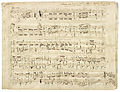 Sheet music for the Polonaise in A-flat major, Op. 53, a solo piano piece written by Frédéric Chopin in 1842. This work is one of Chopin's most admired compositions and has long been a favorite of the classical piano repertoire. The piece, which is very difficult, requires exceptional pianistic skills and great virtuosity to be interpreted. A typical performance of the polonaise lasts seven minutes.
 -
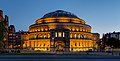 Photograph: David IliffThe Royal Albert Hall is a concert hall, seating a maximum of 5,272, on the northern edge of South Kensington, London. Constructed beginning in 1867, the hall was inaugurated on 29 March 1871. Since 1941 it has held The Proms, an eight-week summer season of daily orchestral classical music concerts and other events.
 -
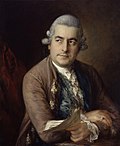 Painting: Thomas GainsboroughJohann Christian Bach (5 September 1735 – 1 January 1782) was a composer of the Classical era, the eighteenth child of Johann Sebastian Bach, and the youngest of his eleven sons. Bach was taught by his father and then, after the latter's death, by his half-brother C. P. E. Bach. Bach moved to Italy in 1754, and then to London in 1762, where he became known as the "London Bach". Bach's compositions include eleven operas, as well as chamber music, orchestral music and compositions for keyboard music. In 1764 Bach met Wolfgang Amadeus Mozart, who was eight at the time, and spent five months teaching him composition. He had considerable influence on Mozart, and was later described by scholars as his "only, true teacher".
This portrait of Bach was painted in 1776 by Thomas Gainsborough, as part of a collection started by Bach's former teacher Padre Martini. It now hangs in the National Portrait Gallery, London. -
 Ballet is a formalized form of dance with its origins in the French court, further developed in France and Russia as a concert dance form.
 -
 Photograph credit: William P. Gottlieb; restored by Adam CuerdenBilly Strayhorn (November 29, 1915 – May 31, 1967) was an American jazz composer, pianist, lyricist, and arranger, best remembered for his long-time collaboration with bandleader and composer Duke Ellington that lasted nearly three decades. Though classical music was Strayhorn's first love, his ambition to become a classical composer went unrealized because of the harsh reality of a black man trying to make his way in the world of classical music, which at that time was almost completely white. He was introduced to the music of pianists like Art Tatum and Teddy Wilson at age 19, and the artistic influence of these musicians guided him into the realm of jazz, where he remained for the rest of his life. This photograph of Strayhorn was taken by William P. Gottlieb in the 1940s.


.jpg)
Topics
Things you can do
 |
Here are some tasks awaiting attention:
|
Categories

Associated Wikimedia
The following Wikimedia Foundation sister projects provide more on this subject:
-
 Commons
Free media repository -
 Wikibooks
Free textbooks and manuals -
 Wikidata
Free knowledge base -
 Wikinews
Free-content news -
 Wikiquote
Collection of quotations -
 Wikisource
Free-content library -
 Wikiversity
Free learning tools -
 Wiktionary
Dictionary and thesaurus
-

-

-

-

-

-

-

-

-

-

-
 Random portal
 -


