









White-throated robin
| White-throated robin | |
|---|---|

| |
| Adult male in Saudi Arabia | |
Scientific classification 
| |
| Kingdom: | Animalia |
| Phylum: | Chordata |
| Class: | Aves |
| Order: | Passeriformes |
| Family: | Muscicapidae |
| Genus: | Irania de Filippi, 1863 |
| Species: | I. gutturalis
|
| Binomial name | |
| Irania gutturalis (Guérin-Méneville, 1843)
| |
| Synonyms | |
| |

The white-throated robin or irania (Irania gutturalis) is a small, migratory passerine bird in the Old World flycatcher family Muscicapidae, and the only member of the genus Irania.[2] It breeds on high-altitude mountain slopes with dense scrub in western Asia and winters in East Africa. Males have lead-grey upperparts and bright orange underparts with a namesake white throat patch. Females are duller, with greyer underparts, orange sides, and a fainter white throat compared to the males.
Taxonomy
The vernacular and generic name Irania alludes to Iran, its type locality, while the specific name gutturalis is Medieval Latin for "of the throat", referring to the male's white throat.[3]
The white-throated robin belongs to a group of passerines called chats, which were, as traditionally defined, all formerly thought to be members of the thrush family Turdidae, but are now classified as Old World flycatchers, Muscicapidae. Within the Muscicapidae family, the chats (as traditionally defined) make up the subfamily Saxicolinae, together with other species that were not traditionally labeled as chats/thrushes, such as the Ficedula flycatchers. The white-throated robin is sister to the genus Luscinia, containing the nightingales and their relatives.[4]
Description
.jpg)
This species is larger than the European robin, having a length of 16 centimetres (6.3 in) and a wingspan of 28 centimetres (11 in).[5] The breeding male has lead-grey upperparts, a black face with a white throat and supercilium, and orange underparts. The tail is black, as is the strong bill. Females are plainer, mainly grey apart from a black tail, hints of orange on the flanks, and some white throat streaks.
The male's song is a fast twittering, given from a bush or in flight. The call of this species is a chis-it double note, like that of the white wagtail.
Behavior
The white-throated robin is mostly insectivorous. It has been observed foraging for small invertebrates on the ground or in low vegetation, particularly during the breeding season when protein is important for the chicks' development.[5] During autumn, fruits are also taken.[6]
It is a seasonal breeder, breeding from May to June. It nests low to the ground in a bush or tree cavity or on a stump or log, laying a clutch of 4–6 eggs. Nests are flat and cup-shaped and made out of cereal stalks, twigs, hair, and feathers.[6]
Distribution and habitat
The white-throated robin is a migratory species, breeding from Turkey to Afghanistan in western Asia, and wintering in East Africa. In East Africa they are found in closed thickets in dry country, typically Acacia-Commiphora woodland on the dry central plateau. Small numbers reach the Usangu Plains of Ruaha National Park in Tanzania, which is normally their southern limit. In dry years however, some may move still further south, and reach moister uplands at 1,600 metres.[7] The species is also a very rare vagrant to Europe, with observations as far northwest as Norway, the United Kingdom,[8] and Sweden.[9]
The white-throated robin's main breeding habitat is dry rocky slopes dominated by scrub, often at high altitudes, usually 1,000 metres (3,300 ft) to 2,200 metres (7,200 ft) above sea level. Other breeding habitats include semi-desert and mountain steppes, but also less arid habitats such as ravines with mountain streams.[6]
Media gallery
-
Video of foraging male in Saudi Arabia, 1993
-
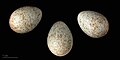 Eggs of Irania gutturalis - MHNT
 -
 Male during migration, near Abha, Saudi Arabia


References
- ^ BirdLife International (2024). "Irania gutturalis". IUCN Red List of Threatened Species. 2024 e.T22709758A264550012. doi:10.2305/IUCN.UK.2024-2.RLTS.T22709758A264550012.en. Retrieved 4 January 2026.
- ^ ITIS.gov
- ^ Jobling, James A. (2010). The Helm Dictionary of Scientific Bird Names. London, United Kingdom: Christopher Helm. pp. 182, 207. ISBN 978-1-4081-2501-4.
- ^ Zhao, M.; Gordon Burleigh, J.; Olsson, U.; Alström, P.; Kimball, R.T. (2023). "A near-complete and time-calibrated phylogeny of the Old World flycatchers, robins and chats (Aves, Muscicapidae)". Molecular Phylogenetics and Evolution. 178 107646. Bibcode:2023MolPE.17807646Z. doi:10.1016/j.ympev.2022.107646. PMID 36265831.
- ^ a b BirdFacts British Trust for Ornithology
- ^ a b c "White-throated Robin". BirdLife DataZone. Retrieved 4 January 2026.
- ^ Tanzania Bird Atlas, preliminary data
- ^ "The British List". British Ornithologists' Union. Retrieved 4 January 2026.
- ^ "Vitstrupig näktergal / White-throated Robin". BirdLife Sverige. Retrieved 4 January 2026.
External links
- Irania gutturalis in Field Guide: Birds of the World on Flickr
- "Irania gutturalis". Avibase.
- Photos at BirdGuides.com
- Photos and videos on Birds of the world
