









Caddo Parish, Louisiana
Caddo Parish | |
|---|---|
| Parish of Caddo Paroisse de Caddo (French) | |
.jpg) Caddo Parish Courthouse in Shreveport | |
 Flag  Seal | |
 Location within the U.S. state of Louisiana | |
 Louisiana's location within the U.S. | |
| Country |  United States United States |
| State | Louisiana |
| Region | North |
| Founded | January 18, 1838 |
| Named after | Caddo Native Americans |
| Parish seat (and largest city) | Shreveport |
| Incorporated municipalities | 11 (total)
|
| Area | |
• Total | 937 sq mi (2,430 km2) |
| • Land | 879 sq mi (2,280 km2) |
| • Water | 58 sq mi (150 km2) |
| • percentage | 6.2 sq mi (16 km2) |
| Population (2020) | |
• Total | 237,848 |
| • Density | 271/sq mi (104/km2) |
| Time zone | UTC-6 (CST) |
| • Summer (DST) | UTC-5 (CDT) |
| Area code | 318 |
| Congressional district | 4th, 6th |
| Website | official website |
.jpg)
Caddo Parish (/ˈkædoʊ/; French: Paroisse de Caddo) is a parish located in the northwestern corner of the U.S. state of Louisiana. According to the 2020 U.S. census, the parish had a population of 237,848.[1] The parish seat and largest city is Shreveport, which developed along the Red River.[2]
The city of Shreveport is the economic and cultural center for the tri-state region of the Ark-La-Tex containing Caddo Parish. Caddo Parish is included in the Shreveport–Bossier City metropolitan statistical area.
History
In 1838, Caddo Parish was created by territory taken from Natchitoches Parish; the legislature named it for the indigenous Caddo Indians who had lived in the area. Most were forced out during Indian Removal in the 1830s.
With European-American development, the parish became a center of cotton plantations. Planters developed these along the waterways, with clearing and later cultivation and processing by thousands of enslaved African-American laborers. Shreveport, the parish seat, became a center of government, trade and law.
An armory was constructed in Shreveport before the American Civil War. This city served as the state capital after Union forces had seized Baton Rouge. Locals have referred to the armory as "Fort Humbug".
After the Civil War, and particularly after Reconstruction, whites in the parish used violence and intimidation against blacks to suppress Republican voting and re-establish white supremacy. The parishes in northwestern Louisiana had a high rate of violence and lynchings. From 1877 through the early 20th century, there were 48 lynchings of African Americans in Caddo Parish; this was the second-highest total in the state after Lafourche Parish, and nearly twice as high as the lowest parishes among the top six.[3] The victims included Jennie Steers, a domestic servant hanged by a white lynch mob in July 1903, for allegedly poisoning her employer's daughter.[4]
In 1920 the Daughters of the Confederacy, who were memorializing the Civil War, designated the armory as "Fort Turnball". During World War II, the government used it as a mobilization site for men who had been drafted and recruited.
In the early twentieth century, the oil industry developed here, with a concentration of related businesses in Shreveport. Numerous oil wells were constructed across southern Arkansas and northern Louisiana.[5]
Geography
According to the U.S. Census Bureau, the parish has a total area of 937 square miles (2,430 km2), of which 978 square miles (2,530 km2) is land and 58 square miles (150 km2) (6.2%) is water.[6]
Major highways
 Interstate 20
 Interstate 49
 Future Interstate 69
 U.S. Highway 71
 U.S. Highway 79
 U.S. Highway 80
 U.S. Highway 171
 Louisiana Highway 1
 Louisiana Highway 2
 Louisiana Highway 168
 Louisiana Highway 511
 Louisiana Highway 523
 Louisiana Highway 526
 Louisiana Highway 3094
 Louisiana Highway 3132


.svg)


.svg)
.svg)
.svg)
.svg)
.svg)
.svg)
.svg)
.svg)
Adjacent counties and parishes
- Miller County, Arkansas (north)
- Lafayette County, Arkansas (northeast)
- Bossier Parish (east)
- Red River Parish (southeast)
- De Soto Parish (south)
- Panola County, Texas (southwest)
- Harrison County, Texas (west)
- Marion County, Texas (west)
- Cass County, Texas (northwest)
National protected area
Communities
City
- Shreveport (parish seat and largest municipality)
Towns
Villages
Unincorporated areas
Census-designated place
- Lakeview (suburb of Shreveport)
Other communities
- Bethany (partly in Panola County, Texas)
- Caspiana
- Conn
- Dixie
- Forbing
- Keithville
- Mira
- Mrytis
- North Rodessa
- Zylks
Demographics
| Census | Pop. | Note | %± |
|---|---|---|---|
| 1840 | 5,282 | — | |
| 1850 | 8,884 | 68.2% | |
| 1860 | 12,140 | 36.7% | |
| 1870 | 21,714 | 78.9% | |
| 1880 | 26,296 | 21.1% | |
| 1890 | 31,555 | 20.0% | |
| 1900 | 44,499 | 41.0% | |
| 1910 | 58,200 | 30.8% | |
| 1920 | 83,265 | 43.1% | |
| 1930 | 124,670 | 49.7% | |
| 1940 | 150,203 | 20.5% | |
| 1950 | 176,547 | 17.5% | |
| 1960 | 223,859 | 26.8% | |
| 1970 | 230,184 | 2.8% | |
| 1980 | 252,358 | 9.6% | |
| 1990 | 248,253 | −1.6% | |
| 2000 | 252,161 | 1.6% | |
| 2010 | 254,969 | 1.1% | |
| 2020 | 237,848 | −6.7% | |
| U.S. Decennial Census[7] 1790-1960[8] 1900-1990[9] 1990-2000[10] 2010-2019[11] | |||
2020 census
As of the 2020 census, the parish had a population of 237,848. The median age was 39.4 years, 23.3% of residents were under the age of 18, and 18.3% of residents were 65 years of age or older. For every 100 females there were 89.4 males, and for every 100 females age 18 and over there were 85.6 males age 18 and over.[13]
The racial makeup of the parish was 43.5% White, 48.5% Black or African American, 0.5% American Indian and Alaska Native, 1.3% Asian, 0.1% Native Hawaiian and Pacific Islander, 1.6% from some other race, and 4.6% from two or more races. Hispanic or Latino residents of any race comprised 3.5% of the population.[14]
84.0% of residents lived in urban areas, while 16.0% lived in rural areas.[15]
There were 99,029 households in the parish, of which 29.5% had children under the age of 18 living in them. Of all households, 34.8% were married-couple households, 20.8% were households with a male householder and no spouse or partner present, and 38.1% were households with a female householder and no spouse or partner present. About 33.1% of all households were made up of individuals and 13.4% had someone living alone who was 65 years of age or older.[13]
There were 112,323 housing units, of which 11.8% were vacant. Among occupied housing units, 60.5% were owner-occupied and 39.5% were renter-occupied. The homeowner vacancy rate was 2.0% and the rental vacancy rate was 11.8%.[13]
Racial and ethnic composition
| Race / Ethnicity (NH = Non-Hispanic) | Pop 1980[16] | Pop 1990[17] | Pop 2000[18] | Pop 2010[19] | Pop 2020[20] | % 1980 | % 1990 | % 2000 | % 2010 | % 2020 |
|---|---|---|---|---|---|---|---|---|---|---|
| White alone (NH) | 153,467 | 144,885 | 131,527 | 121,969 | 101,727 | 60.81% | 58.36% | 52.16% | 47.84% | 42.77% |
| Black or African American alone (NH) | 94,023 | 99,101 | 111,984 | 119,697 | 114,769 | 37.26% | 39.92% | 44.41% | 46.95% | 48.25% |
| Native American or Alaska Native alone (NH) | 387 | 516 | 904 | 976 | 895 | 0.15% | 0.21% | 0.36% | 0.38% | 0.38% |
| Asian alone (NH) | 844 | 1,095 | 1,718 | 2,653 | 3,179 | 0.33% | 0.44% | 0.68% | 1.04% | 1.34% |
| Native Hawaiian or Pacific Islander alone (NH) | x [21] | x [22] | 65 | 118 | 120 | x | x | 0.03% | 0.05% | 0.05% |
| Other race alone (NH) | 259 | 61 | 169 | 246 | 856 | 0.10% | 0.02% | 0.07% | 0.10% | 0.36% |
| Mixed race or Multiracial (NH) | x [23] | x [24] | 2,044 | 3,181 | 7,921 | x | x | 0.81% | 1.25% | 3.33% |
| Hispanic or Latino (any race) | 3,378 | 2,595 | 3,750 | 6,129 | 8,381 | 1.34% | 1.05% | 1.49% | 2.40% | 3.52% |
| Total | 252,358 | 248,253 | 252,161 | 254,969 | 237,848 | 100.00% | 100.00% | 100.00% | 100.00% | 100.00% |
2010 census
At the 2010 United States census, there were 254,969 people, 119,502 households, and 68,900 families residing in the parish. In 2010, there were 119,502 households, out of which 30.90% had children under the age of 18 living with them, 42.20% were married couples living together, 19.80% had a female householder with no husband present, and 33.70% were non-families. A total of 28.90% of all households were made up of individuals, and 10.50% had someone living alone who was 65 years of age or older. The average household size was 2.51 and the average family size was 3.11. As of 2010, the population density was 286 inhabitants per square mile (110/km2).
At the 2010 census, the parish population was spread out, with 26.80% under the age of 18, 10.20% from 18 to 24, 27.40% from 25 to 44, 22.00% from 45 to 64, and 13.70% who were 65 years of age or older. The median age was 35 years. For every 100 females there were 89.70 males. For every 100 females age 18 and over, there were 84.90 males.
Economy

The economy of the parish is primarily centered in the city of Shreveport, with international corporations including Amazon and Walmart stimulating the economy alongside nationwide chains such as Best Buy, Target, and others.[25] While maintaining these companies in the parish, however, Caddo includes some of the poorest areas in Louisiana by ZIP code. Statistics from 2014 show West Shreveport (71103) was the poorest ZIP code in the state with a per capita income of just $22,267; Queensborough, Shreveport (71109) was the fourth-poorest with $24,966; Caddo Heights/South Highlands (71108) was the fifth-poorest with $25,334; and Rodessa (71069) was the twenty-fourth-poorest with $34,346.[26] In 2020, an estimated 22.9% of the parish population lived at or below the poverty line with 33.9% of its impoverished population being under 18 years of age.[27]
Parishwide, the median household income was $42,003 as of 2020's American Community Survey; families had a median income of $55,719; married-couple families $81,114; and nonfamily households $26,204.[28] Despite the poverty within the parish, however, the Shreveport–Bossier City metropolitan statistical area and entire Northwest Louisiana region gained three projects valued at over $750 million in the early 2020s to offset its population and economic decline, and increase recognition.[29]
The largest employers in the region as of 2017 were:[30]
| Employer | Employees | Note | |
|---|---|---|---|
| 1 | Caddo Parish Public Schools (CPPS) | 9,416 | |
| 2 | Willis-Knighton Medical Center | 6,732 | |
| 3 | University Health | 6,372 | |
| 4 | LSU Health Shreveport | 2,762 | |
| 5 | City of Shreveport | 2,569 |
Law and government
As parish seat, Shreveport is the site of the parish courthouse. Caddo Parish comprises the 1st Judicial District. Located downtown on Texas Street, the courthouse contains both civil and criminal courts. The current elected judges are: Ramon Lafitte, Craig O. Marcotte, Michael A. Pitman, Karelia R. Stewart, Robert P. Waddell, Erin Leigh W. Garrett, Katherine C. Dorroh, John Mosely, Jr., Brady O'Callaghan, Ramona Emanuel, Charles G. Tutt, and Roy Brun. The Clerk of Court is Mike Spence. Caddo Parish like all parishes in Louisiana utilizes Justices of the Peace and Constables particularly when civil suits below $5,000 or an eviction has been filed.
Caddo Parish has the highest rate of death penalty convictions in the United States.[31]
Politics
| Year | Republican | Democratic | Third party(ies) | |||
|---|---|---|---|---|---|---|
| № | % | № | % | № | % | |
| 1912 | 34 | 1.55% | 1,946 | 88.45% | 220 | 10.00% |
| 1916 | 151 | 4.63% | 3,109 | 95.25% | 4 | 0.12% |
| 1920 | 401 | 8.60% | 4,264 | 91.40% | 0 | 0.00% |
| 1924 | 1,062 | 17.73% | 4,517 | 75.41% | 411 | 6.86% |
| 1928 | 3,665 | 34.58% | 6,934 | 65.42% | 0 | 0.00% |
| 1932 | 1,309 | 9.66% | 12,159 | 89.71% | 85 | 0.63% |
| 1936 | 1,697 | 12.25% | 12,156 | 87.72% | 4 | 0.03% |
| 1940 | 3,124 | 15.36% | 17,192 | 84.50% | 29 | 0.14% |
| 1944 | 5,885 | 31.29% | 12,896 | 68.56% | 29 | 0.15% |
| 1948 | 4,777 | 21.60% | 5,985 | 27.06% | 11,355 | 51.34% |
| 1952 | 27,850 | 65.68% | 14,554 | 34.32% | 0 | 0.00% |
| 1956 | 23,432 | 60.32% | 10,780 | 27.75% | 4,637 | 11.94% |
| 1960 | 25,139 | 54.29% | 11,481 | 24.80% | 9,681 | 20.91% |
| 1964 | 42,197 | 80.60% | 10,158 | 19.40% | 0 | 0.00% |
| 1968 | 21,224 | 31.51% | 17,675 | 26.24% | 28,463 | 42.25% |
| 1972 | 47,215 | 71.68% | 15,649 | 23.76% | 3,003 | 4.56% |
| 1976 | 42,627 | 57.34% | 30,593 | 41.15% | 1,120 | 1.51% |
| 1980 | 51,202 | 57.41% | 36,422 | 40.84% | 1,560 | 1.75% |
| 1984 | 63,429 | 63.68% | 35,727 | 35.87% | 445 | 0.45% |
| 1988 | 54,498 | 57.73% | 39,204 | 41.53% | 700 | 0.74% |
| 1992 | 42,665 | 41.55% | 47,733 | 46.49% | 12,280 | 11.96% |
| 1996 | 38,445 | 38.69% | 55,543 | 55.89% | 5,391 | 5.42% |
| 2000 | 46,807 | 48.94% | 47,530 | 49.70% | 1,302 | 1.36% |
| 2004 | 54,292 | 50.93% | 51,739 | 48.54% | 564 | 0.53% |
| 2008 | 52,228 | 48.07% | 55,536 | 51.11% | 896 | 0.82% |
| 2012 | 52,459 | 46.94% | 58,042 | 51.93% | 1,264 | 1.13% |
| 2016 | 49,006 | 46.32% | 53,483 | 50.55% | 3,315 | 3.13% |
| 2020 | 48,021 | 45.77% | 55,110 | 52.53% | 1,781 | 1.70% |
| 2024 | 44,471 | 46.96% | 48,864 | 51.60% | 1,364 | 1.44% |
Since the late 20th century, most conservative whites in Louisiana have shifted into the Republican Party. Politics largely follows ethnic patterns, as most African Americans have supported national Democratic candidates since regaining the power to vote and other civil rights under Democratic national administrations. Some urban liberal whites also vote Democratic. Since 1992, Caddo Parish has voted for the Democratic nominee in presidential campaigns except for 2004 when George W. Bush won the parish narrowly over John Kerry. Notably the city of Shreveport is the base for Democratic strength, while surrounding white-majority suburban areas are aligned with the Republican Party.[33]
Education
The Caddo Parish School Board, which operates public schools, covers the entire parish.[34]
The parish also has fourteen private schools as of 2018.[35] It is in the service area of Bossier Parish Community College,[36] though the private Centenary College of Louisiana and LSU's Shreveport campus are also prominent institutions of higher education.
Correction center
The Louisiana Department of Public Safety & Corrections operated the Forcht-Wade Correctional Center in Keithville, an unincorporated section of Caddo Parish.[37] As the state succeeded in reducing the number of prisoners, it closed this facility in July 2012.[38]
The Caddo Correctional Center is a full-service parish jail rated at a capacity of 1,500 beds. Constructed in 1994, this facility was designed to successfully manage a large number of inmates with a minimum of personnel. The Caddo Correctional Center is the largest jail in the Ark-La-Tex and the only "direct supervision" facility in the state.[citation needed]
See also
- National Register of Historic Places listings in Caddo Parish, Louisiana
- USS Caddo Parish (LST-515)
- Jasper K. Smith, former member of the Louisiana House of Representatives 1944–1948 and 1952–1964, and former city attorney of Vivian
References
- ^ "QuickFacts: Caddo Parish, Louisiana". U.S. Census Bureau. Retrieved August 19, 2021.
- ^ "Find a County". National Association of Counties. Archived from the original on May 31, 2011. Retrieved June 7, 2011.
- ^ Lynching in America, Third Edition: Supplement by County Archived October 23, 2017, at the Wayback Machine, p. 6, Equal Justice Initiative, Mobile, AL, 2017
- ^ Michael James Pfeifer, Rough Justice: Lynching and American Society, 1874-1947, University of Illinois Press, 2004, p. 198, Footnote #104
- ^ Fairclough (1999), pp. 7-8
- ^ "2010 Census Gazetteer Files". United States Census Bureau. August 22, 2012. Archived from the original on September 28, 2013. Retrieved August 27, 2014.
- ^ "U.S. Decennial Census". United States Census Bureau. Archived from the original on April 26, 2015. Retrieved August 27, 2014.
- ^ "Historical Census Browser". University of Virginia Library. Retrieved August 27, 2014.
- ^ "Population of Counties by Decennial Census: 1900 to 1990". United States Census Bureau. Retrieved August 27, 2014.
- ^ "Census 2000 PHC-T-4. Ranking Tables for Counties: 1990 and 2000" (PDF). United States Census Bureau. Retrieved August 27, 2014.
- ^ "State & Parish QuickFacts". United States Census Bureau. Archived from the original on July 15, 2011. Retrieved August 20, 2013.
- ^ "Population and Housing Unit Estimates". Retrieved March 26, 2020.
- ^ a b c "2020 Decennial Census Demographic Profile (DP1)". United States Census Bureau. 2021. Retrieved January 3, 2026.
- ^ "2020 Decennial Census Redistricting Data (Public Law 94-171)". United States Census Bureau. 2021. Retrieved January 3, 2026.
- ^ "2020 Decennial Census Demographic and Housing Characteristics (DHC)". United States Census Bureau. 2023. Retrieved January 3, 2026.
- ^ "1980 Census of Population - General Population Characteristics - Louisiana - Table 14 - Persons by Race and Table 15 - Total Persons and Spanish Origin Persons by Type of Spanish Origin and Race (p. 20/12-20/20)" (PDF). United States Census Bureau.
- ^ "1990 Census of Population - General Population Characteristics - Louisiana - Table 6 - Race and Hispanic Origin" (PDF). United States Census Bureau. p. 15-38.
- ^ "P004: Hispanic or Latino, and Not Hispanic or Latino by Race – 2000: DEC Summary File 1 – Caddo Parish, Louisiana". United States Census Bureau.
- ^ "P2: Hispanic or Latino, and Not Hispanic or Latino by Race – 2010: DEC Redistricting Data (PL 94-171) – Caddo Parish, Louisiana". United States Census Bureau.
- ^ "P2: Hispanic or Latino, and Not Hispanic or Latino by Race – 2020: DEC Redistricting Data (PL 94-171) – Caddo Parish, Louisiana". United States Census Bureau.
- ^ included in the Asian category in the 1980 Census
- ^ included in the Asian category in the 1990 Census
- ^ not an option in the 1980 Census
- ^ not an option in the 1990 Census
- ^ "$200M Shreveport Amazon fulfillment center announced". KTBS. May 7, 2021. Retrieved May 4, 2022.
- ^ "The 50 poorest places in Louisiana, by ZIP code". New Orleans Times-Picciune. March 15, 2017. Retrieved December 13, 2017.
- ^ "2020 ACS Annual Poverty Statistics". data.census.gov. Retrieved May 11, 2022.
- ^ "2020 ACS Annual Income Estimates". data.census.gov. Retrieved May 11, 2022.
- ^ Wright, Robert J. (December 22, 2021). "3 Big Reasons the Shreveport, Bossier Economy is About to Explode". News Radio 710 KEEL. Retrieved May 11, 2022.
- ^ "Leading Employers in Caddo Parish". North Louisiana Economic Partnership. Retrieved December 15, 2017.
- ^ Rachel Aviv (July 6, 2015). "Revenge Killing, Race and the Death Penalty in a Louisiana Parish". The New Yorker. Retrieved April 12, 2023.
- ^ Leip, David. "Dave Leip's Atlas of U.S. Presidential Elections". uselectionatlas.org. Retrieved March 7, 2018.
- ^ "2004 Presidential General Election Results - Louisiana, Caddo Parish". uselectionatlas.org.
- ^ Geography Division (December 18, 2020). 2020 Census - School District Reference Map: Caddo Parish, LA (PDF) (Map). U.S. Census Bureau. Retrieved July 31, 2022. - Text list
- ^ "Caddo Parish, LA Private Schools". Private School Review. Retrieved January 28, 2018.
- ^ "Our Colleges". Louisiana's Technical and Community Colleges. Retrieved June 3, 2021.
- ^ "Forcht-Wade Corr. Center Archived 2008-09-15 at the Wayback Machine." Louisiana Department of Public Safety and Corrections. Accessed September 14, 2008.
- ^ "Forcht-Wade Correctional Center Archived 2012-11-02 at the Wayback Machine." (Archive) Louisiana Department of Public Safety & Corrections. Retrieved on October 23, 2012.
External links
Places adjacent to Caddo Parish, Louisiana | |
|---|---|


Municipalities and communities of Caddo Parish, Louisiana, United States | ||
|---|---|---|
| City | 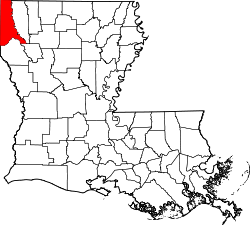 | |
| Towns | ||
| Villages | ||
| CDP | ||
| Other communities |
| |
| Ghost town |
| |
| Footnotes | ‡This populated place also has portions in an adjacent parish or parishes | |

32°35′N 93°53′W / 32.58°N 93.88°W
| International | |
|---|---|
| National | |
| Geographic | |
| Other | |
