








Cucumber
| Cucumber | |
|---|---|

| |
| Cucumbers growing on vines | |

| |
| A single cucumber fruit | |
Scientific classification 
| |
| Kingdom: | Plantae |
| Clade: | Tracheophytes |
| Clade: | Angiosperms |
| Clade: | Eudicots |
| Clade: | Rosids |
| Order: | Cucurbitales |
| Family: | Cucurbitaceae |
| Genus: | Cucumis |
| Species: | C. sativus
|
| Binomial name | |
| Cucumis sativus | |
The cucumber (Cucumis sativus) is a widely-cultivated creeping vine plant in the family Cucurbitaceae that bears cylindrical to spherical fruits, used as culinary vegetables. Considered an annual plant, there are three main types of cucumber—slicing, pickling, and seedless.
The cucumber originates in Asia, in a region extending from India, Nepal, Bangladesh, China (Yunnan, Guizhou, Guangxi), and Northern Thailand, but now grows on most continents, and many different types of cucumber are grown commercially and traded on the global market. In North America, a 'wild cucumber' is a plant in the genera Echinocystis and Marah, though these are not closely related to the cucumber.
They have been cultivated for at least 3,000 years, and were eaten all year round by the Roman Emperor Tiberius. In the Middle Ages, Charlemagne had them grown for him, and the Spanish brought them to the Americas in the Columbian exchange in 1494. World production is led by China with over three quarters of the total.
Description
The cucumber is an annual[1] creeping vine that roots in the ground and grows up trellises or other supporting frames, wrapping around supports with thin, spiraling tendrils.[2][3] The plant can root in a soilless medium, then sprawl along the ground in the absence of a supporting structure. The vine has large leaves that form a canopy over the fruits.[4]
The fruit of typical cultivars of cucumber is roughly cylindrical, but elongated with tapered ends, and may be as large as 62 centimeters (24 in) long and 10 centimeters (4 in) in diameter.[5]
Cucumber fruits consist of 95% water (see nutrition table). In botanical terms, the cucumber is classified as a pepo, a type of botanical berry with seeds and an outer rind.[6] In a culinary context, it is considered a vegetable.[6]
.jpg)


Cultivars and pollination
Most cucumber cultivars are seeded and require pollination. For this purpose, thousands of honey beehives are carried to cucumber fields each year just before bloom. Cucumbers can be pollinated by bumblebees and several other wild bee species. Most cucumbers that require pollination are self-incompatible, thus requiring the pollen of another plant in order to form seeds and fruit.[7] Some self-compatible cultivars exist that are related to the 'Lemon cucumber' cultivar.[7]
Some cultivars are parthenocarpic, creating seedless fruit without pollination; these are often grown in greenhouses. However, fruit set is significantly higher when bees visit the flowers.[8]
Traditional cultivars produce male blossoms first, then female, in about equivalent numbers. Newer gynoecious hybrid cultivars produce almost all female blossoms. They may have a pollenizer cultivar interplanted, and the number of beehives per unit area is increased, but temperature changes induce male flowers even on these plants, which may be sufficient for pollination to occur.[7]
- Example cultivars
-
 Salad cucumber
 -
 An Indian yellow cucumber
 -
 Komkommer (Cucumis sativus 'Gele Tros')
 -
 A varietal grown by the Hmong people with textured skin and large seeds
 -
 Lemon cucumber


.jpg)


Herbivore defense
Phytochemicals in cucumbers may discourage natural foraging by herbivores, such as insects, nematodes or wildlife.[9] As a possible defense mechanism, cucumbers produce cucurbitacin C,[10] which causes a bitter taste in some cucumber varieties. This potential mechanism is under preliminary research to identify whether cucumbers are able to deter herbivores and environmental stresses by using an intrinsic chemical defense, particularly in the leaves, cotyledons, pedicel, carpopodium, and fruit.[10][11]
| NCBI ID | 3659 |
|---|---|
| Ploidy | diploid |
| Genome size | 323.99 Mb |
| Sequenced organelle | mitochondrion |
| Organelle size | 244.82 Mb |
| Year of completion | 2011 |
Taxonomy and genetics
Cucumis sativus was described by Carl Linnaeus in 1753 in his Species Plantarum.[12] As of October 2022, Plants of the World Online accepted 61 species in the genus Cucumis, also created by Linnaeus.[13]
C. sativus is the sole member of the genus to have 2N=14 chromosomes.[14] In 2009, the cucumber genome was sequenced.[15] A study of genetic recombination during meiosis provided a high resolution landscape of meiotic DNA double strand-breaks and genetic crossovers in the species.[16]
Production
 China China |
68.6 |
 Turkey Turkey |
1.7 |
 Russia Russia |
1.7 |
 Uzbekistan Uzbekistan |
1.0 |
 Mexico Mexico |
0.96 |
| World | 87.8 |
| Source: FAOSTAT of the United Nations[17] | |
In 2024, world production of cucumbers and gherkins was 88 million tonnes, led by China with 78% of the total (table).
Consumption
Nutrition
| Nutritional value per 100 g (3.5 oz) | |||||||||||||||||||||||||||||||||||||||||||||
|---|---|---|---|---|---|---|---|---|---|---|---|---|---|---|---|---|---|---|---|---|---|---|---|---|---|---|---|---|---|---|---|---|---|---|---|---|---|---|---|---|---|---|---|---|---|
| Energy | 65 kJ (16 kcal) | ||||||||||||||||||||||||||||||||||||||||||||
3.63 g | |||||||||||||||||||||||||||||||||||||||||||||
| Sugars | 1.67 | ||||||||||||||||||||||||||||||||||||||||||||
| Dietary fiber | 0.5 g | ||||||||||||||||||||||||||||||||||||||||||||
0.11 g | |||||||||||||||||||||||||||||||||||||||||||||
0.65 g | |||||||||||||||||||||||||||||||||||||||||||||
| |||||||||||||||||||||||||||||||||||||||||||||
| Other constituents | Quantity | ||||||||||||||||||||||||||||||||||||||||||||
| Water | 95.23 g | ||||||||||||||||||||||||||||||||||||||||||||
| †Percentages estimated using US recommendations for adults,[18] except for potassium, which is estimated based on expert recommendation from the National Academies.[19] | |||||||||||||||||||||||||||||||||||||||||||||
Raw cucumber (with peel) is 95% water, 4% carbohydrates, 1% protein, and contains negligible fat (table). In a reference amount of 100 grams (3.5 oz), raw cucumber provides 16 calories of food energy, and has a low content of micronutrients notable only for vitamin K at 14% of the Daily Value (table).
Aroma and taste

Depending on variety, cucumbers may have a mild melon aroma and flavor, in part resulting from unsaturated aldehydes, such as (E,Z)-nona-2,6-dienal, and the cis- and trans- isomers of 2-nonenal.[20] The slightly bitter taste of cucumber rind results from cucurbitacins.[21] The polyphenol content is higher in unpeeled cucumbers.[22]
Culinary uses
In horticulture, cucumbers are classified into three main cultivar groups: slicing, pickling, and seedless/burpless. Cucumbers grown to eat fresh are called slicing cucumbers. The main varieties of slicers mature on vines with large leaves that provide shading.[4][23] Slicers grown commercially for the North American market are generally longer, smoother, more uniform in color, and have much tougher skin. In contrast, those in other countries, often called European cucumbers, are smaller and have thinner, more delicate skin, often with fewer seeds, thus are often sold in plastic skin for protection. This variety is called a 'telegraph cucumber' in Australasia.[24]
Pickling with brine, sugar, vinegar, and spices creates flavored products from cucumbers and other foods.[25] Cucumbers grown for pickling are shorter, thicker, and thinner-skinned than other varieties.[26] Gherkins, cornichons,[27] or baby pickles, are small cucumbers, typically those 2.5 to 12.5 centimetres (1 to 5 in) in length, often with bumpy skin, which are typically used for pickling.[28][29][30] The word gherkin comes from the early modern Dutch gurken or augurken ('small pickled cucumber').[31] The term is used in the name for Cucumis anguria, the West Indian gherkin, a closely related species.[32]
Burpless cucumbers are sweeter and have a thinner skin than other varieties of cucumber. They are reputed to be easy to digest and to have a pleasant taste. They can grow as long as 60 centimeters (2 ft), are nearly seedless, and have a delicate skin. Most commonly grown in greenhouses, these parthenocarpic cucumbers are often found in grocery markets, shrink-wrapped in plastic. They are marketed as either burpless or seedless, as the seeds and skin of other varieties of cucumbers are said to give some people gas.[33]
Cucumber shoots are regularly consumed as a vegetable, especially in rural areas. In Thailand they are often served with a crab meat sauce. They can be stir fried or used in soups.[34]
-

-
 A Scandinavian cucumber in slices
 -
 Grated cucumber
 -

-
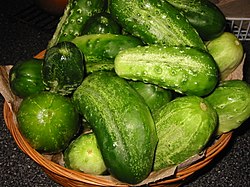 Pickling cucumbers
 -
 Gherkins


Cultivation history

Cultivated for at least 3,000 years, "Cucumis sativus" were domesticated in India from wild "C. sativus var. hardwickii".[35][36][37] where a great many varieties have been observed, along with its closest living relative, Cucumis hystrix.[38] The three main cultivar groups of cucumber are Eurasian cucumbers (slicing cucumbers eaten raw and immature), East Asian cucumbers (pickling cucumbers), and Xishuangbanna cucumbers. Based on demographic modelling, the East Asian C. sativus cultivars diverged from the Indian cultivars about 2,500 years ago.[39] It was probably introduced to Europe by the Greeks or Romans. Records of cucumber cultivation appear in France in the 9th century, England in the 14th century, and in North America by the mid-16th century.[40][41][42][43]
Roman Empire
According to Pliny the Elder, the Emperor Tiberius had the cucumber on his table daily during summer and winter. In order to have it available for his table every day of the year, the Romans reportedly used artificial growing methods (similar to the greenhouse system) using mirrorstone, Pliny's lapis specularis, believed to have been sheet mica: "Indeed, he was never without [cucumbers]; for he had raised beds made in frames upon wheels, by means of which the cucumbers were moved and exposed to the full heat of the sun; while, in winter, they were withdrawn, and placed under the protection of frames glazed with mirrorstone."[44][45] They were cultivated in specularia, cucumber houses glazed with oiled cloth.[44] Pliny describes the vegetable as very small, probably like a gherkin. Separately, he describes the preparation of a medication known as elaterium, but this may have been Ecballium elaterium, known in pre-Linnean times as Cucumis silvestris or Cucumis asininus ('wild cucumber' or 'donkey cucumber'), a different species.[46] Pliny writes about several other varieties of cucumber, including the cultivated cucumber,[47] and remedies from the different types (9 from the cultivated; 5 from the "anguine;" and 26 from the "wild").[citation needed]
Middle Ages
Charlemagne had cucumbers grown in his gardens in the 8th/9th century. They were reportedly introduced into England in the early 14th century, lost, then reintroduced approximately 250 years later. The Spaniards (through the Italian Christopher Columbus) brought cucumbers to Haiti in 1494. In 1535, Jacques Cartier, a French explorer, found "very great cucumbers" grown on the site of what is now Montreal.[48]
Early-modern era

Throughout the 16th century, European trappers, traders, bison hunters, and explorers bartered for the products of American Indian agriculture. The tribes of the Great Plains and the Rocky Mountains learned from the Spanish how to grow European crops. The farmers on the Great Plains included the Mandan and Abenaki. They obtained cucumbers and watermelons from the Spanish, and added them to the crops they were already growing, including several varieties of corn and beans, pumpkins, squash, and gourd plants.[49] The Iroquois were growing them when the first Europeans visited them.[50] In 1630, the Reverend Francis Higginson wrote in his book New-Englands Plantation that "The countrie aboundeth naturally with store of roots of great varietie and good to eat. Our turnips, parsnips, and carrots are here both bigger and sweeter than is ordinary to be found in England. Here are store of pompions, cowcumbers, and other things of that nature which I know not".[51] In New England Prospect (1633, England), William Wood wrote that "The ground affords very good kitchin gardens, for Turneps, Parsnips, Carrots, Radishes, and Pompions, Muskmillons, Isquoter-squashes, coucumbars, Onyons, and whatever grows well in England grows as well there, many things being better and larger."[52]
Age of Enlightenment
Samuel Pepys wrote in his diary on 22 August 1663 that "this day Sir W. Batten tells me that Mr. Newburne is dead of eating cowcumbers, of which the other day I heard of another, I think.[53] John Evelyn in 1699 wrote that the cucumber, "however dress'd, was thought fit to be thrown away, being accounted little better than poyson".[54][55] According to the 18th-century British lexicographer and wit Samuel Johnson, it was commonly said among English physicians that a cucumber "should be well sliced, and dressed with pepper and vinegar, and then thrown out, as good for nothing."[56]
See also
- Armenian cucumber, a variety of melon that resembles a cucumber
- Cucumber blessing
- Cucumber cake
- Cucumber juice
- Cucumber sandwich
- Cucumber soda
- Cucumber soup
- Sea cucumber, named for its resemblance to the fruit
References
- ^ Silvertown, Jonathan (1985). "Survival, Fecundity and Growth of Wild Cucumber, Echinocystis Lobata". Journal of Ecology. 73 (3): 841–849. Bibcode:1985JEcol..73..841S. doi:10.2307/2260151. JSTOR 2260151.
- ^ Mariod, Abdalbasit Adam; Mirghani, Mohamed Elwathig Saeed; Hussein, Ismail Hassan (2017). Cucumis sativus, Cucumber; Chapter 16 in: Unconventional Oilseeds and Oil Sources. Academic Press. p. 89. ISBN 978-0128134337.
- ^ "Cucumis sativus L." Plants of the World Online. Royal Botanic Gardens, Kew. Retrieved 23 February 2023.
- ^ a b "Cucumis sativus". North Carolina State University, Extension Gardener. 2025. Retrieved 12 October 2025.
- ^ Zhang, Tingting; Li, Xvzhen; Yang, Yuting; Guo, Xiao; Feng, Qin; Dong, Xiangyu; Chen, Shuxia (2019). "Genetic analysis and QTL mapping of fruit length and diameter in a cucumber (Cucumber sativus L.) recombinant inbred line (RIL) population". Scientia Horticulturae. 250: 214–222. Bibcode:2019ScHor.250..214Z. doi:10.1016/j.scienta.2019.01.062. S2CID 92837522.
- ^ a b "Is a Cucumber a Fruit or a Vegetable and Why?". European Food Information Council. 4 March 2020. Retrieved 12 October 2025.
- ^ a b c Nonnecke, I.L. (1989). Vegetable Production. Springer. ISBN 9780442267216.
- ^ Nicodemo, Daniel; Malheiros, Euclides Braga; Jong, David De; Couto, Regina Helena Nogueira (6 December 2013). "Enhanced production of parthenocarpic cucumbers pollinated with stingless bees and Africanized honey bees in greenhouses". Semina: Ciências Agrárias. 34 (6Supl1): 3625. doi:10.5433/1679-0359.2013v34n6Supl1p3625. Retrieved 11 March 2026.
- ^ Shang, Yi; Ma, Yongshuo; Zhou, Yuan; et al. (28 November 2014). "Biosynthesis, regulation, and domestication of bitterness in cucumber". Science. 346 (6213): 1084–1088. doi:10.1126/science.1259215.
- ^ a b Liu, Zhiqiang; Li, Yawen; Cao, Chunyu; Liang, Shan; Ma, Yongshuo; Liu, Xin; Pei, Yanxi (February 2019). "The role of H2S in low temperature-induced cucurbitacin C increases in cucumber". Plant Molecular Biology. 99 (6): 535–544. Bibcode:2019PMolB..99..535L. doi:10.1007/s11103-019-00834-w. PMID 30707394. S2CID 73431225.
- ^ He, Jun (2022). "Terpene Synthases in Cucumber (Cucumis sativus) and Their Contribution to Herbivore-induced Volatile Terpenoid Emission". New Phytologist. 233 (2): 862–877. Bibcode:2022NewPh.233..862H. doi:10.1111/nph.17814. hdl:11245.1/e4b87361-6747-409a-a897-0e3939f560c0. PMC 9299122. PMID 34668204. S2CID 239035917.
- ^ Linnaeus, Carl (1753). Species Plantarum. p. 1012.
- ^ "Cucumis L." Plants of the World Online. Royal Botanic Gardens, Kew. Retrieved 1 October 2022.
- ^ Yang, Luming; Koo, Dal‐Hoe; Li, Yuhong; Zhang, Xuejiao; Luan, Feishi; Havey, Michael J.; Jiang, Jiming; Weng, Yiqun (2012). "Chromosome rearrangements during domestication of cucumber as revealed by high‐density genetic mapping and draft genome assembly". The Plant Journal. 71 (6): 895–906. doi:10.1111/j.1365-313X.2012.05017.x.
- ^ Huang, S.; Li, R.; Zhang, Z.; et al. (2009). "The genome of the cucumber, Cucumis sativus L". Nature Genetics. 41 (12): 1275–81. doi:10.1038/ng.475. PMID 19881527.
- ^ Wang, Yanling; Dong, Zhaonian; Ma, Yalin; Zheng, Yi; Huang, Sanwen; Yang, Xueyong (26 October 2023). "Comprehensive dissection of meiotic DNA double-strand breaks and crossovers in cucumber". Plant Physiology. 193 (3): 1913–1932. doi:10.1093/plphys/kiad432. ISSN 0032-0889. PMC 10602612. PMID 37530486. Retrieved 10 March 2026.
- ^ "Cucumber and gherkin production in 2024, Crops/Regions/World list/Production Quantity/Year (pick lists)". UN Food and Agriculture Organization, Corporate Statistical Database (FAOSTAT). 2026. Retrieved 11 March 2026.
- ^ United States Food and Drug Administration (2024). "Daily Value on the Nutrition and Supplement Facts Labels". FDA. Archived from the original on 27 March 2024. Retrieved 28 March 2024.
- ^ "TABLE 4-7 Comparison of Potassium Adequate Intakes Established in This Report to Potassium Adequate Intakes Established in the 2005 DRI Report". p. 120. In: Stallings, Virginia A.; Harrison, Meghan; Oria, Maria, eds. (2019). "Potassium: Dietary Reference Intakes for Adequacy". Dietary Reference Intakes for Sodium and Potassium. pp. 101–124. doi:10.17226/25353. ISBN 978-0-309-48834-1. PMID 30844154. NCBI NBK545428.
- ^ Schieberle, P.; Ofner, S.; Grosch, W. (1990). "Evaluation of Potent Odorants in Cucumbers (Cucumis sativus) and Muskmelons (Cucumis melo) by Aroma Extract Dilution Analysis". Journal of Food Science. 55 (1): 193–195. Bibcode:1990JFooS..55..193S. doi:10.1111/j.1365-2621.1990.tb06050.x.
- ^ Shang, Y.; Ma, Y.; Zhou, Y.; et al. (2014). "Plant science. Biosynthesis, regulation, and domestication of bitterness in cucumber". Science. 346 (6213): 1084–8. Bibcode:2014Sci...346.1084S. doi:10.1126/science.1259215. PMID 25430763. S2CID 206561241.
- ^ Yunusa, Alkasim Kabiru; Dandago, Munir Abba; Ibrahim, Sa’adatu Mukhtar; Abdullahi, Nura; Rilwan, Abdulrashid; Barde, Aminu (1 December 2018). "Total Phenolic Content and Antioxidant Capacity of Different Parts of Cucumber ( Cucumis sativus L.)". Acta Universitatis Cibiniensis. Series E: Food Technology. 22 (2): 13–20. doi:10.2478/aucft-2018-0008.
- ^ "Cucumbers: Planting, growing, and harvesting cucumbers". Old Farmer's Almanac, Yankee Publishing, Inc., Dublin, NH. 2016. Retrieved 11 August 2016.
- ^ "Telegraph cucumber, unpeeled, raw". Australian Food Composition Database, Food Standards Australia New Zealand. 2025. Retrieved 12 October 2025.
- ^ Avey, Torey (3 September 2014). "History in a jar: The story of pickles". Public Broadcasting Service. Retrieved 13 November 2017.
- ^ "How do pickling and slicing cucumbers differ?". Mississippi State University Extension. Retrieved 11 March 2026.
- ^ "What's The Deal With Cornichons?". Kitchn. The Kitchn. 2017. Retrieved 13 November 2017.
- ^ "Gherkins". Venlo, Netherlands: Zon. 2017. Archived from the original on 14 November 2017. Retrieved 13 November 2017.
- ^ "Cucumbers" (PDF). University of California-Davis: Western Institute for Food Safety and Security, US Department of Agriculture. May 2016. Retrieved 13 November 2017.
- ^ "Cucumbers and gherkins". Agricultural and Processed Food Products Export Development Authority, Government of India. 2015. Retrieved 13 November 2017.
- ^ "Word origin and history for gherkin". Dictionary.com. 2017. Retrieved 13 November 2017.
- ^ "West Indian gherkin, Cucumis anguria L." Plants for a Future. 2012. Retrieved 13 November 2017.
- ^ Jordan-Reilly, Melissa (15 September 2013). "Why do cucumbers upset my digestion?". LiveStrong.com.
- ^ Hutton, Wendy (2004). A Cook's Guide to Asian Vegetables. Singapore: Periplus Editions. pp. 42–43. ISBN 0794600786.
- ^ >Chomicki, Guillaume; Schaefer, Hanno; Renner, Susanne S. (June 2020). "Origin and domestication of Cucurbitaceae crops: insights from phylogenies, genomics and archaeology". New Phytologist. 226 (5): 1240–1255. Bibcode:2020NewPh.226.1240C. doi:10.1111/nph.16015. PMID 31230355.
- ^ Weng, Yiqun (7 January 2021). "Cucumis sativus Chromosome Evolution, Domestication, and Genetic Diversity: Implications for Cucumber Breeding". Plant Breeding Reviews. Wiley. pp. 79–111. doi:10.1002/9781119717003.ch4. ISBN 978-1-119-71700-3.
- ^ Bisht, I. S.; Bhat, K.V.; Tanwar, S. P. S.; Bhandari, D. C.; Joshi, Kamal; Sharma, A. K. (January 2004). "Distribution and genetic diversity of Cucumis sativus var. hardwickii (Royle) Alef in India". The Journal of Horticultural Science and Biotechnology. 79 (5): 783–791. Bibcode:2004JHSB...79..783B. doi:10.1080/14620316.2004.11511843.
- ^ Asian News International. 21 July 2010. "Cucumber, melon's common ancestor originated in Asia." NewsTrack India. Retrieved on 4 June 2020.
- ^ Chomicki, Guillaume; Schaefer, Hanno; Renner, Susanne S. (June 2020). "Origin and domestication of Cucurbitaceae crops: insights from phylogenies, genomics and archaeology". New Phytologist. 226 (5): 1240–1255. Bibcode:2020NewPh.226.1240C. doi:10.1111/nph.16015. ISSN 0028-646X. PMID 31230355.
- ^ "Cucumber." Encyclopædia Britannica. [1998] 2019.
- ^ Renner, S.S.; Schaefer, H.; Kocyan, A. (2007). "Phylogenetics of Cucumis (Cucurbitaceae): Cucumber (C. sativus) belongs in an Asian/Australian clade far from melon (C. melo)". BMC Evolutionary Biology. 7 (1): 58. Bibcode:2007BMCEE...7...58R. doi:10.1186/1471-2148-7-58. PMC 3225884. PMID 17425784.
- ^ Doijode, S. D. 2001. Seed storage of horticultural crops. Haworth Press. ISBN 1-56022-901-2. p. 281.
- ^ Zhuang, Fei-Yun; Chen, Jin-Feng; Staub, Jack E.; Qian, Chun-Tao (2006). "Taxonomic Relationships of A Rare Cucumis Species (C. hystrix Chakr.) and Its Interspecific Hybrid with Cucumber". HortScience. 41 (3): 571–574. doi:10.21273/HORTSCI.41.3.571.
- ^ a b James, Peter J.; Thorpe, Nick; Thorpe, I. J. (1995). "Ch. 12, Sport and Leusure: Roman Gardening Technology". Ancient Inventions. Ballantine Books. p. 563. ISBN 978-0-345-40102-1.
- ^ Pliny the Elder. [77–79 AD] 1855. "Vegetables of a Cartilaginous Nature—Cucumbers. Pepones Archived 5 June 2020 at the Wayback Machine." Ch. 23 in The Natural History XIX, translated by J. Bostock and H. T. Riley. London: Taylor & Francis. – via Perseus under PhiloLogic, also available via Perseus Project.
- ^ Pliny the Elder, Natural History XX.iii Archived 5 June 2020 at the Wayback Machine.
- ^ Pliny the Elder, Natural History XX.iv Archived 5 June 2020 at the Wayback Machine–v Archived 5 June 2020 at the Wayback Machine.
- ^ "A Brief History of Cucumbers, From Producing Vegetable Crops by Swiader et al; and A History of Horticulture in America to 1860 by U.P. Hedrick". B's Cucumber Pages. Archived from the original on 1 October 2007.
- ^ Buchanan, David (2012). Taste, Memory: Forgotten Foods, Lost Flavors, and why They Matter. VT, USA: Chelsea Green Publishing. p. 109. ISBN 9781603584401.
- ^ Kuhnlein, H. V.; Turner, N. J. (1996). Traditional Plant Foods of Canadian Indigenous Peoples: Nutrition, Botany and Use. Amsterdam, Netherlands: Gordon and Breach. p. 159. ISBN 978-2881244650.
- ^ Higginson, Francis. [1630] 1906. New-Englands Plantation. Salem, MA: Essex Book and Print Club. OCLC 1049892552. p. 5.
- ^ Wood, William. (1634). "Of the Hearbes, Fruites, Woods, Waters and Mineralls", pp. 13–18 in New England Prospect. London.
- ^ Saturday 22 August 1663 (Pepys' Diary). Pepysdiary.com. Retrieved on 25 November 2012.
- ^ Evelyn, John (2009). Acetaria: A Discourse of Sallets (original 1699). Prospect Books. ISBN 978-0907325123.
- ^ Davidson, Jan (15 July 2018). Pickles: A Global History (Edible). Reaktion Books. ISBN 978-1780239194.
- ^ Boswell, James (1832). The Life of Samuel Johnson: Including A Journal of a Tour to the Hebrides, Volume 1. Carter, Hendee and Company. p. 423. Retrieved 29 March 2024.
| International | |
|---|---|
| National | |
| Other | |
