







Rancho Cordova, California
Rancho Cordova, California | |
|---|---|
 Hagan Community Park | |
 Seal | |
| Motto: "City Life Reinvented" | |
 City in Sacramento County | |
  Rancho Cordova, California  Rancho Cordova, California | |
| Coordinates: 38°35′21″N 121°18′10″W / 38.58917°N 121.30278°W | |
| Country |  United States United States |
| State |  California California |
| County | Sacramento |
| Incorporated | July 1, 2003[1] |
| Government | |
| • Type | Council–manager[2] |
| • Mayor | Garett Gatewood[3] |
| • Vice mayor | Linda Budge[3] |
| • City manager | Micah Runner[2] |
| Area | |
• Total | 34.88 sq mi (90.33 km2) |
| • Land | 34.57 sq mi (89.53 km2) |
| • Water | 0.31 sq mi (0.80 km2) 0.88% |
| Elevation | 89 ft (27 m) |
| Population (2020) | |
• Total | 79,332 |
| • Density | 2,295/sq mi (886.1/km2) |
| Time zone | UTC-8 (Pacific) |
| • Summer (DST) | UTC-8 ([[Pacific Standard Time|PDT]}) |
| ZIP codes | 95827, 95670, 95741, 95742 |
| Area codes | 916, 279 |
| FIPS code | 06-59444 |
| GNIS feature ID | 1659466 |
| Website | www |
Rancho Cordova is a city in Sacramento County, California, United States. Incorporated in 2003, it is part of the Sacramento Metropolitan Area. The population was 79,332 at the 2020 census. In 2010 and 2019, Rancho Cordova received the All-America City Award.
History
Originally called Mayhew's Crossing and Hangtown Crossing (c. 1855) during the Gold Rush era, the area was renamed Mayhew Station and Mills Station (c. 1900), respectively.[6] The city itself was named for the Cordova Vineyard, which was located in the center of the Rancho Rio de los Americanos land grant. Other names of the town included Cordova Vineyards and Cordova Village, before it was officially named Rancho Cordova when a post office was established in the community in 1955.[7]
In the Gold Rush era of mid-19th-century California, placer mining took place around Rancho Cordova, and some traces of it can still be found. The elevation of the generally level terrain is approximately 118 feet (36 m) above mean sea level.[8] Lone Star Gravel Company and other companies have historically extracted younger gravels at depths of 30 to 40 feet (12 m) without encountering groundwater, which is characteristically found at about 100 feet (30 m). Partially confined groundwater generally flows to the southwest.[9]
In 1844, the Mexican governor of California granted 35,000 acres on the south bank of the American River to the American entrepreneur William Leidesdorff. He died in 1848[10] and the property, which he called Rancho Río de los Americanos, passed to his mother, Anne Marie Spark. Captain Joseph Folsom purchased the Rancho from the heirs and founded a town in 1855 which was named after himself – Folsom.[11] The old Leidesdorff adobe was constructed in 1846 in the vicinity of Routier Station.
As the miners left Sacramento traveling to the foothills in search of gold, way stations grew up along the first dirt trails, and later more formal roads, that took travelers east. Commercial establishments, hotels, or ‘stations’ were developed at one-mile intervals along the route. Many of the stations ultimately also became the US Post Office for their area, and many of these early settlers served as postmaster or postmistress.
Travelers and miners apparently headed out L Street from Sacramento (the approximate alignment of present-day Folsom Blvd) along a plank, or macadam, road that ended at present day Bradshaw Road. Brighton, also called Five Mile Station, was the site of three inns. One inn, the Magnolia House, established in 1849, was the first stop on the Pony Express Route. The location is today marked by the old Brighton Station building, visible on the south side of Folsom Boulevard where the overpasses for Highway 50 and the light rail are located. One closer stop, at four miles, was known as Hoboken or Norristown, in the vicinity of CSUS. The old Perkins building, where the Jackson Highway leaves Folsom Boulevard, and Manlove were both locations for way stations.
The vicinity of Bradshaw was Ten Mile Station, the Patterson's "American Fork House", established in 1852, and the beginning of large farms, vineyards, and orchards. Up the road was Routier Station, established in 1871. Mrs. Mayhew left Mayhew Station to take over as Post Mistress at Routier Station when the post office opened in 1887. Mr. Patterson was Postmaster there for a while also. Joseph Routier was widely renowned for many years for the quality of his produce. In 1866 the railroad built the train station between Folsom Boulevard and the tracks due to the size and dependability of the crop, and the need for a formal packing shed to house the produce waiting for the train. (The station still exists as Pfingst Realty Mr. Pfingst died in 2007; the structure is owned by his daughter.)
At eleven miles, the road forked. The Coloma Road went north along the river to Coloma and the northern mines, very close to its present location; the southerly fork headed for White Rock and the Southern Mines. The area was first known as Hangtown Crossing, referencing the route to Old Hangtown – or Placerville. The southerly fork was the White Rock Road, known at that time as the White Rock – Clarksville Immigrant Road. The outcropping of white rock marked the entry into El Dorado County, and Clarksville was the first sizable settlement over the hill. 15 Mile House was built in 1850, and is commemorated with a brick cairn on White Rock Road in front of the CalTrans Emergency Ops building. It was managed by A.M. Plummer until purchased in 1857 by its most famous innkeeper, H.F.W. Deterding. His son Charles ran the hotel until at least 1890, and their hospitality was known far and wide. 15 Mile House was the second official Pony Express remount station. Eleven miles east of that, the third remount station was located at Sportsman Hall at Mormon Island, before the express riders went over the mountains headed for St. Joseph, Missouri. The Mormon Island ruins surface from under Folsom Lake at Dike 8 during low water years.
There were also way stations along the Coloma Road, such as the 14 Mile House, built on the Coloma Road in 1850 by Mr. Rush, the original builder of Deterding's 15 Mile House. In 1852 early settlement of the Mills area included a two-story inn owned by Louis Lepetit. Four stage lines came through there, and split, with two going southeast to Placerville, and two following the river to Coloma. In the 1880s a fire destroyed the inn, and Mr. Lepetit may have rebuilt across the road on the north side.
A strong community of vineyards and orchards had grown up between the 1850s and the 1880s. Maps of the area show the familiar names of Studarus, Williamson, Mendonca, Kelley, Carroll, Shields, Dauenhauer, Lauridson, Kilgore, and Deterding. The list goes on with names that to a small extent, have been preserved as place names. John Studarus was one of the early settlers. He had thirteen children. The presumed eldest, Charles, operated the family farms; John Jr., the second or third eldest, purchased five acres of land at Hangtown Crossing, near Lepetit's site, and built a hotel. In 1911, he built the present day Mills Station. It was a general commercial building, housing a tavern and grocery store. The second floor was a large ballroom, where he celebrated the opening of the building by issuing an open invitation to everyone around to attend a grand ball. The building also housed the Post Office, and two of his children, William Henry and Helen, both ran the Post Office at various times.
The agricultural heritage of Rancho Cordova fell onto hard times in the 1930s and 1940s. Along with Joseph Routier's nationally recognized produce, wine from Roland Federspiel's Cordova Vineyards had been served at White House table during the Teddy Roosevelt presidency. Unfortunately, northern California went through a lengthy period of drought. Making things worse, the State Legislature raised property tax rates, setting values at "the highest and best use" as opposed to the actual use of the land. It became more and more difficult for farmers to keep their land in production.
Many young men returning from World War II were looking for places to settle down, find a job, buy a home, and raise their families. Roland Federspiel formed a partnership with Glenn Ahlstrom and a contractor named Jacobsen to build homes on land that had previously been vineyards. Up until that point after the War, there had not been any production housing in the United States. Homes had been constructed individually or in small numbers.
Construction began at the intersection of Folsom Boulevard and Zinfandel Drive. The first three homes on the west side of the street were the model homes. Duplexes on the opposite corners originally housed the sales office and post office, then the first office of Rancho Cordova Grapevine-Independent.
Federspiel had chosen the name Cordova Vineyards with a nod to the Cordoba Region in Spain, and wanted to preserve the Cordova name. Glenn Ahlstrom drove down to San Francisco in his old woodie station wagon and physically brought back the first ‘post box’. The US Postal Service agreed to let them use the name Rancho Cordova as it was just the right size to fit around the circle of the old postal franking stamp. They named the streets for wine grapes. It is a treat to find some of those old grapes coming back into production again, with wines like Malbec and Barbera. In recognition of that heritage, Elliott Homes named all of the streets in the Villages of Zinfandel at Stonecreek for wineries around the world when they began to build at the south end of Zinfandel in 2000.
The community grew, and Folsom Boulevard began to fill in with commercial enterprise. Early structures included the Cordova Village Shopping Center and George E. Johnson's Cordova Inn.
There were attempts to incorporate Rancho Cordova in 1961 and in 1978. The 1978 effort was kept alive over the next 20 years, finally getting on the ballot in November 2002. It passed with a record 77% of voters in support, a record that still stands today.
On February 16, 2000, Emery Worldwide Flight 17 crashed in Rancho Cordova. All three crew members, the only occupants of the aircraft, were killed.[12]
Geography
According to the United States Census Bureau, the CDP has a total area of 34.9 square miles (90 km2), of which 34.6 square miles (90 km2) of it is land and 0.3 square miles (0.78 km2) of it (0.88%) is water. Rancho Cordova lies within the Sacramento Valley.
Climate
As part of the greater Sacramento area, Rancho Cordova experiences a hot-summer Mediterranean climate (Köppen: Csa). Summers are hot and dry, while winters are cool and rainy. Monthly mean high temperatures range from 56.0 °F (13.3 °C) in January to 92.6 °F (33.7 °C) in July, while lows range from 39.2 °F (4.0 °C) in January to 59.2 °F (15.1 °C) in July.[13] Yearly precipitation totals around 18.14 in (46.1 cm), with the majority of precipitation falling between December and March.
Transportation
Regional highway access is provided by U.S. Route 50 and State Route 16.
Rancho Cordova is served by Sacramento Regional Transit's various bus lines and the Gold Line light rail line. According to the US Census Burea's American Community Survey for 2021, fewer than 0.5 percent of Rancho Cordova commuters employ public transportation.[14] Students enrolled in a FCUSD school can get a free bus pass.
Demographics
| Census | Pop. | Note | %± |
|---|---|---|---|
| 1960 | 7,429 | — | |
| 1970 | 30,451 | 309.9% | |
| 1980 | 42,881 | 40.8% | |
| 1990 | 48,731 | 13.6% | |
| 2000 | 55,060 | 13.0% | |
| 2010 | 64,776 | 17.6% | |
| 2020 | 79,332 | 22.5% | |
| U.S. Decennial Census[15] 1850–1870[16][17] 1880-1890[18] 1900[19] 1910[20] 1920[21] 1930[22] 1940[23] 1950[24] 1960[25] 1970[26] 1980[27] 1990[28] 2000[29] 2010[30] | |||
Ranch Cordova first appeared as an unincorporated community in the 1960 U.S. census;[25][24] and as a census designated place in the 1980 U.S. census.[27] It was deleted prior to the 2010 U.S. census after being incorporated as a city.[30] The Mather CDP was created at the same time as it was not part of the incorporation..[30]
2020
The 2020 United States census reported that Rancho Cordova had a population of 79,332. The population density was 2,294.9 inhabitants per square mile (886.1/km2). The racial makeup of Rancho Cordova was 48.8% White, 9.3% African American, 1.2% Native American, 15.6% Asian, 1.1% Pacific Islander, 10.5% from other races, and 13.5% from two or more races. Hispanic or Latino of any race were 21.6% of the population.[31]
The census reported that 99.1% of the population lived in households, 0.8% lived in non-institutionalized group quarters, and 0.1% were institutionalized.[31]
There were 27,737 households, out of which 36.8% included children under the age of 18, 46.0% were married-couple households, 8.0% were cohabiting couple households, 27.5% had a female householder with no partner present, and 18.4% had a male householder with no partner present. 22.7% of households were one person, and 8.2% were one person aged 65 or older. The average household size was 2.83.[31] There were 19,178 families (69.1% of all households).[32]
The age distribution was 24.9% under the age of 18, 8.3% aged 18 to 24, 30.5% aged 25 to 44, 23.4% aged 45 to 64, and 12.9% who were 65 years of age or older. The median age was 35.5 years. For every 100 females, there were 95.9 males.[31]
There were 28,614 housing units at an average density of 827.7 units per square mile (319.6 units/km2), of which 27,737 (96.9%) were occupied. Of these, 56.4% were owner-occupied, and 43.6% were occupied by renters.[31]
In 2023, the US Census Bureau estimated that the median household income was $89,120, and the per capita income was $37,822. About 7.9% of families and 11.2% of the population were below the poverty line.[33]
2010
The 2010 United States census[34] reported that Rancho Cordova had a population of 64,776. The population density was 1,912.3 inhabitants per square mile (738.3/km2). The racial makeup of Rancho Cordova was 39,123 (60.4%) White, 8,561 (13.1%) African American, 668 (1.0%) Native American, 7,831 (12.1%) Asian (3.6% Filipino, 2.0% Indian, 1.6% Vietnamese, 1.4% Chinese, 1.0% Korean, 0.4% Japanese, 2.0% Other), 556 (0.9%) Pacific Islander, 5,517 (8.5%) from other races, and 4,520 (7.0%) from two or more races. Hispanic or Latino of any race were 12,740 persons (19.7%).
The Census reported that 64,451 people (99.5% of the population) lived in households, 170 (0.3%) lived in non-institutionalized group quarters, and 155 (0.2%) were institutionalized.
There were 23,448 households, out of which 8,722 (37.2%) had children under the age of 18 living in them, 10,521 (44.9%) were opposite-sex married couples living together, 3,815 (16.3%) had a female householder with no husband present, 1,431 (6.1%) had a male householder with no wife present. There were 1,751 (7.5%) unmarried opposite-sex partnerships, and 198 (0.8%) same-sex married couples or partnerships. 5,815 households (24.8%) were made up of individuals, and 1,604 (6.8%) had someone living alone who was 65 years of age or older. The average household size was 2.75. There were 15,767 families (67.2% of all households); the average family size was 3.30.
The population was spread out, with 17,011 people (26.3%) under the age of 18, 6,441 people (9.9%) aged 18 to 24, 19,508 people (30.1%) aged 25 to 44, 15,182 people (23.4%) aged 45 to 64, and 6,634 people (10.2%) who were 65 years of age or older. The median age was 33.1 years. For every 100 females, there were 95.8 males. For every 100 females age 18 and over, there were 92.3 males.
There were 25,479 housing units at an average density of 752.2 units per square mile (290.4 units/km2), of which 12,948 (55.2%) were owner-occupied, and 10,500 (44.8%) were occupied by renters. The homeowner vacancy rate was 3.3%; the rental vacancy rate was 8.9%. 34,907 people (53.9% of the population) lived in owner-occupied housing units and 29,544 people (45.6%) lived in rental housing units.
Pre-incorporation

Following the adoption of the 1978 Cordova Community Plan, the Sacramento County Local Agency Formation Commission adopted a sphere of influence for Rancho Cordova. This is one of the defining documents of the actual community boundary for the community.[citation needed]
Economy
According to Rancho Cordova's 2020 Comprehensive Annual Financial Report,[35] the top employers in the city are:
| # | Employer | # of Employees |
|---|---|---|
| 1 | State of California | 3,000 |
| 2 | Centene | 2,100 |
| 3 | Delta Dental of California | 1,600 |
| 4 | Sacramento County Office of Education | 1,300 |
| 5 | Franklin Templeton Investments | 1,000 |
| 6 | VSP Global | 1,000 |
| 7 | Foundation Health Special Services | 900 |
| 8 | J P Aerospace | 709 |
| 9 | Mather Aerospace Modelers Inc. | 709 |
| 10 | Dignity Health | 600 |
Arts and culture
Points of interest
The City of Rancho Cordova has a growing arts scene, a unique Barrel District, 26 miles of bike and pedestrian trails, 70 acres of creek channels and tributaries, and many free events. Rancho Cordova has six miles of the American River, as well as Soil Born Farms and Rancho Roots, the only working urban farms in the region.
- American River Parkway
- Sacramento Children's Museum
- The MACC: Mills Station Arts and Culture Center
- Barrel District
- Soil Born Farms
- Rancho Roots
- Aerojet/Rocketdyne
- Edward Kelley School
Government
City government
The City of Rancho Cordova has a council-manager form of government with five members elected to the council. Each year, the position of mayor is appointed to a council member, chosen by their peers in the city council. The mayor's post is thus simply that of "chief among equals for a time". Rancho Cordova's mayor is Garett Gatewood, and Linda Budge is vice mayor. The other council members are David Sander, Joe Little, and Siri Pulipati. Each Council Member represents of the five districts.[3]
Its sound financial status has been recognized by the rating agency Standard and Poor (S&P). On November 1st, 2016, S&P's Rating Services updated the City of Rancho Cordova's Credit Rating to AA-, noting the city's outlook is positive and strong manegment policy as well as sound budgeting practices.[36] The city has also been the recipient of GFOA Certificate of Achievement Award for Excellence in Financial Reporting for 14 straight years.[37]
County government
Rancho Cordova is represented by Pat Hume and Rich Desmond on the Sacramento County Board of Supervisors.
State representation
In the California State Senate, Rancho Cordova is in the 6th senatorial district, represented by Republican Roger Niello. In the California State Assembly, it is in the 7th Assembly district, represented by Republican Josh Hoover.[38]
Federal representation
As of 2023, in the United States House of Representatives, Rancho Cordova is in California's 6th congressional district, represented by Democrat Ami Bera.[39]
Education
Rancho Cordova students are served by four different school districts and 21 post-secondary schools that provide a broad spectrum of learning opportunities.
The largest portion of the city's area is in the Folsom-Cordova Unified School District,[40] which has three high schools: Cordova High School, Walnutwood High School, and Kinney High School.
Other portions are in the Elk Grove Unified School District and the Sacramento Unified School District.[40] Two elementary schools and one high school in Sacramento USD serve students in the western portion of Rancho Cordova, and students in the recently[when?] developed Sunrise Boulevard and Douglas Road area are served by Elk Grove USD.
A small number of students attend schools in the San Juan Unified School District, which does not cover any territory of Rancho Cordova.[citation needed]
Data on the educational status of Rancho Cordovans shows that approximately 85% of residents 25 years or older have a high school education and 22% of residents hold some type of college or post-secondary school degree. In Sacramento County, 85% of residents 25 years or older have a high school education and 28% of residents hold some type of college or post-secondary school degree. In California, 80% of residents 25 years or older have a high school education and 30% of residents hold some type of college or post-secondary school degree.
Infrastructure
Utilities
The city is served by four water agencies and one sewage treatment agency.[41]
Electricity is provided by Sacramento Municipal Utility District and natural gas is provided by Pacific Gas and Electric Company.
Public safety
Since incorporating in 2003, Rancho Cordova has maintained a law enforcement services contract with the Sacramento County Sheriff's Department and formed the Rancho Cordova Police Department. While deputies assigned to the Rancho Cordova Police Department wear unique "Rancho Cordova" uniform patches and drive police vehicles with "Rancho Cordova" markings, they are, in fact, sheriff's deputies. The structure of the contracted Rancho Cordova Police Department closely mirrors that of an independent police department and includes detectives, traffic enforcement, community service officers, patrol, and administration functions. Per the contract, the City of Rancho Cordova pays the salaries for 55 sworn and 7 non-sworn staff.[42] This arrangement for contracted law enforcement services is fairly common among California cities because it requires fewer overhead costs than running an independent police department and allows the city to avoid long-term pension obligations for police employees.[43]
The Rancho Cordova Police Department's force is hand-picked because of their skill and passion for the community. The Rancho Cordova Police Department uses a four-pronged policing approach to keep the community safe: community-oriented policing, crime prevention, problem-oriented policing and intelligence-led policing.
Sacramento Metropolitan Fire District provides fire/EMS services.
Notable people
- Chris Bosio, MLB pitcher with the Milwaukee Brewers and Seattle Mariners.[44]
- Maelyn Dean, author of "Real Life" comics[45]
- Lester Holt, NBC television journalist[46]
- Geoff Jenkins, former MLB outfielder[47]
- Neal Jimenez, screenwriter and director
- Robbie Jones, actor, One Tree Hill and Hellcats
- Jerry Manuel, former MLB player and manager[48]
- Billy Marshall Stoneking, Australian-American poet and filmmaker
- Max Venable, 10-year MLB outfielder[49]
- Seneca Wallace, NFL quarterback[50][51]
- Gerald Willhite, former running back for the Denver Broncos[52]
- Ken Cooley, politician
Sister cities

References
- ^ "California Cities by Incorporation Date". California Association of Local Agency Formation Commissions. Archived from the original (Word) on November 3, 2014. Retrieved August 25, 2014.
- ^ a b "City Manager's Office". City of Rancho Cordova. Retrieved October 12, 2025.
- ^ a b c "City Council". City of Rancho Cordova. Retrieved October 12, 2025.
- ^ "2020 U.S. Gazetteer Files". United States Census Bureau. Retrieved October 30, 2021.
- ^ "USGS—Rancho Cordova, California". Retrieved May 24, 2007.
- ^ Erwin G. Gudde (1998). California Place Names: The Origin and Etymology of Current Geographical Names. University of California Press. ISBN 978-0-520-21316-6.
- ^ "The Rancho Cordova Index". Prosper Magazine. August 2007. p. 82.
- ^ U.S. Geological Survey, Carmichael Quadrangle, 7.5″ Quadrangle, 1967, photorevised 1980
- ^ Phase I Environmental Site Assessment, APN 072-0580-018, Rancho Cordova, California, Earth Metrics Report No. 10235, October 31, 1989
- ^ "Key Points in Black History and the Gold Rush - Instructional Materials (CA Dept of Education)". www.cde.ca.gov. Retrieved February 12, 2026.
- ^ "Folsom History | Folsom, CA". www.folsom.ca.us. Archived from the original on February 24, 2025. Retrieved February 12, 2026.
- ^ Aircraft Accident Report: Loss of Pitch Control on Takeoff, Emery Worldwide Airlines, Flight 17, McDonnell Douglas DC-8-71F, N8079U, Rancho Cordova, California, February 16, 2000 (PDF). National Transportation Safety Board. August 5, 2003. NTSB/AAR-03/02.
- ^ US Department of Commerce, NOAA. "Climate". www.weather.gov. Retrieved November 15, 2022.
- ^ "Rancho Cordova; American Community Survey". United States Census Bureau. Retrieved June 1, 2023.
- ^ "Decennial Census by Decade". United States Census Bureau.
- ^ "1870 Census of Population - Population of Civil Divisions less than Counties - California - Almeda County to Sutter County" (PDF). United States Census Bureau.
- ^ "1870 Census of Population - Population of Civil Divisions less than Counties - California - Tehama County to Yuba County" (PDF). United States Census Bureau.
- ^ "1890 Census of Population - Population of California by Minor Civil Divisions" (PDF). United States Census Bureau.
- ^ "1900 Census of Population - Population of California by Counties and Minor Civil Divisions" (PDF). United States Census Bureau.
- ^ "1910 Census of Population - Supplement for California" (PDF). United States Census Bureau. Archived from the original (PDF) on August 23, 2024. Retrieved October 29, 2025.
- ^ "1920 Census of Population - Number of Inhabitants - California" (PDF). United States Census Bureau.
- ^ "1930 Census of Population - Number and Distribution of Inhabitants - California" (PDF). United States Census Bureau.
- ^ "1940 Census of Population - Number of Inhabitants - California" (PDF). United States Census Bureau.
- ^ a b "1950 Census of Population - Number of Inhabitants - California" (PDF). United States Census Bureau.
- ^ a b "1960 Census of Population - General population Characteristics - California" (PDF). United States Census Bureau.
- ^ "1970 Census of Population - Number of Inhabitants - California" (PDF). United States Census Bureau.
- ^ a b "1980 Census of Population - Number of Inhabitants - California" (PDF). United States Census Bureau.
- ^ "1990 Census of Population - Population and Housing Unit Counts - California" (PDF). United States Census Bureau.
- ^ "2000 Census of Population - Population and Housing Unit Counts - California" (PDF). United States Census Bureau.
- ^ a b c "2010 Census of Population - Population and Housing Unit Counts - California" (PDF). United States Census Bureau.
- ^ a b c d e "Rancho Cordova city, California; DP1: Profile of General Population and Housing Characteristics - 2020 Census of Population and Housing". US Census Bureau. Retrieved July 2, 2025.
- ^ "Rancho Cordova city, California; P16: Household Type - 2020 Census of Population and Housing". US Census Bureau. Retrieved July 2, 2025.
- ^ "Rancho Cordova city, California; DP03: Selected Economic Characteristics - 2023 ACS 5-Year Estimates Comparison Profiles". US Census Bureau. Retrieved July 2, 2025.
- ^ "2010 Census Interactive Population Search: CA - Rancho Cordova city". U.S. Census Bureau. Archived from the original on July 15, 2014. Retrieved July 12, 2014.
- ^ City of Rancho Cordova CAFR
- ^ "City of Rancho Cordova's Credit Rating Has Increased". 2016.
{{cite web}}: CS1 maint: url-status (link) - ^ OpenGov. "Budget Snapshot". Budget Snapshot. Retrieved February 2, 2026.
- ^ "Final Maps | California Citizens Redistricting Commission". Retrieved October 12, 2025.
- ^ "California's 6th Congressional District - Representatives & District Map". Civic Impulse, LLC. Retrieved April 21, 2024.
- ^ a b "2020 CENSUS - SCHOOL DISTRICT REFERENCE MAP: Sacramento County, CA" (PDF). U.S. Census Bureau. Retrieved August 28, 2024. - Text list
- ^ "Rancho Cordova, California Official Website". Archived from the original on October 10, 2006. Retrieved February 5, 2007.
- ^ "Rancho Cordova PD". Archived from the original on June 30, 2018. Retrieved June 30, 2018.
- ^ Nelligan, Peter J.; Bourns, William (2011). "Municipal Contracting with County Sheriffs for Police Services in California: Comparison of Cost and Effectiveness". Police Quarterly. 14: 70–95. doi:10.1177/1098611110393133. S2CID 144751926.
- ^ "A'S Update". Sacramento Bee. August 25, 1991. Retrieved August 14, 2009.
- ^ "Protesting stories they thought were in Bee but weren't". Sacramento Bee. May 19, 2002. Retrieved August 14, 2009.
- ^ "Anchor Lester Holt: MSNBC's face in wartime". Sacramento Bee. April 7, 2003. Retrieved August 14, 2009.
- ^ Eymer, Rick (April 12, 2004). "Homecoming for Jenkins". MLB.com. Archived from the original on November 3, 2012. Retrieved June 6, 2020.
- ^ "Jerry Manuel leads effort for University Baseball at William Jessup". Rocklin & Roseville Today. February 14, 2007. Retrieved August 14, 2009.
- ^ "Bergman Traded A's, Giant's Face Roster Moves". Sacramento Bee. March 25, 1984. Retrieved August 14, 2009.
- ^ "OK Wallace readies for first NFL start". ESPN.com. Associated Press. October 27, 2006. Retrieved August 14, 2009.
- ^ Matthew, Barrows (September 13, 2008). "49ers notes: Will Holmgren return for good?". Sacramento Bee. Archived from the original on September 22, 2008. Retrieved August 14, 2009.
- ^ Dave, Woolford (December 15, 1981). "San Jose's Willhite Grows Into Star". Toledo Blade. Retrieved August 14, 2009.
- ^ "Archived copy" (PDF). Archived from the original (PDF) on October 24, 2018. Retrieved May 20, 2020.
{{cite web}}: CS1 maint: archived copy as title (link)
External links
Places adjacent to Rancho Cordova, California | ||||||||||||||||
|---|---|---|---|---|---|---|---|---|---|---|---|---|---|---|---|---|
| ||||||||||||||||


Municipalities and communities of Sacramento County, California, United States | ||
|---|---|---|
| Cities | 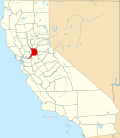 | |
| CDPs | ||
| Unincorporated communities | ||
| Ghost towns | ||
| International | |
|---|---|
| National | |
| Geographic | |
