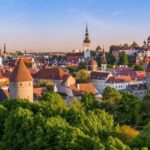






Noah's Mausoleum (Nakhchivan, Azerbaijan)
Nuh peyğəmbərin türbəsi | |
.jpg) | |
 Interactive map of Noah's Mausoleum | |
| Location | Nakhchivan, Azerbaijan |
|---|---|
| Type | Mausoleum |
| Beginning date | 8th century |
| Dedicated to | Noah |
The Tomb of Prophet Noah (Azerbaijani: Nuh peyğəmbər türbəsi) or Noah's Mausoleum (Armenian: Նոյի գերեզման) is a mausoleum in the city of Nakhchivan, Azerbaijan. As, according to Armenian tradition, Nakhchivan was founded by Noah.[1]
Noah's tomb is located in the town of Nakhchivan. The mausoleum was originally part of a medieval Armenian church structure, monastery, and pilgrimage site dating back to the 12th or 13th-century.[2] 19th century Russian and European sources such as the Brockhaus and Efron Encyclopedic Dictionary and John Foster Fraser noted that the local Armenians considered it a holy place, describing it as a "featureless, mud-covered building that the Armenians regard as holy".[3][4] James Theodore Bent in his 1986 The Contemporary Review described the site as a popular Christian Armenian shrine.[5] The original Armenian structure was destroyed by the Soviets in 1953.
The current mausoleum was built in 2006 over the destroyed remains of the tomb-mausoleum.[2] The tomb consists of the remains of the lower story of a former temple. There is a ladder leading to a burial vault. There is a stone column in the middle of the vault. According to legend, relics of Noah are under this column. A portrait describing the mausoleum of Noah 100 years ago painted by Bahruz Kangarli is saved in the National Art Museum of Azerbaijan.
Gallery
-
 Postcard of the Russian Empire
 -
 Postcard of the Russian Empire
 -
 Mausoleum in the portrait by Behruz Kangarli, the early 20th century
 -
 Postage stamp of Azerbaijan, 2010


See also
- İlandağ of the Lesser Caucasus
- Nuh
References
- ^ "A Regime Conceals Its Erasure of Indigenous Armenian Culture". 18 February 2019.
- ^ a b Esche-Ramshorn, Christiane (2021). "4 Colonies: A Mercantile "Colonisation"". East-West Artistic Transfer Through Rome, Armenia and the Silk Road: Sharing St. Peter's. United Kingdom: Routledge. doi:10.4324/9781003204619-5. ISBN 9781000434637.
- ^ Fraser, John Foster (1925) [1899]. Round the World on a Wheel (5th ed.). London: Methuen. p. 90.
In time we reached Nachitchevan and visited Noah's tomb. It is a featureless, mud-covered building that the Armenians regard as holy.
- ^ Massalski, Władysław [in Russian] (1897). "Нахичевань". Brockhaus and Efron Encyclopedic Dictionary Volume XXa (in Russian). pp. 704–705. online view "По преданию, основан Ноем, гробница которого показывается местными армянами."
- ^ "A Regime Conceals Its Erasure of Indigenous Armenian Culture". 18 February 2019.
External links
- "В Нахичевани будет отреставрирован мавзолей пророка Ноя". Interfax. Archived from the original on 2018-01-22. Retrieved 2013-01-07.