








Brown–Peterson cohomology
In mathematics, Brown–Peterson cohomology is a generalized cohomology theory introduced by Edgar H. Brown and Franklin P. Peterson (1966), depending on a choice of prime p. It is described in detail by Douglas Ravenel (2003, Chapter 4). Its representing spectrum is denoted by .

Complex cobordism and Quillen's idempotent
Brown–Peterson cohomology is a summand of MU(), which is complex cobordism MU localized at a prime . In fact MU() is a wedge product of suspensions of .

For each prime , Daniel Quillen showed there is a unique idempotent map of ring spectra ε from MUQ() to itself, with the property that is [CP] if is a power of , and otherwise. The spectrum is the image of this idempotent ε.
![{\displaystyle \epsilon _{*}([CP^{n}])}](https://wikimedia.org/api/rest_v1/media/math/render/svg/8e4ddb0f1ee99ac8943ddab280f19ffab643b48e)


Structure of
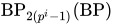
The coefficient ring is a polynomial algebra over on generators in degrees for .


is isomorphic to the polynomial ring over with generators in of degrees .

![{\displaystyle \pi _{*}({\text{BP}})[t_{1},t_{2},\ldots ]}](https://wikimedia.org/api/rest_v1/media/math/render/svg/96889f39af80cfaabf5b308f9ac6aca70d8f6db0)


The cohomology of the Hopf algebroid is the initial term of the Adams–Novikov spectral sequence for calculating -local homotopy groups of spheres.

is the universal example of a complex oriented cohomology theory whose associated formal group law is -typical.
See also
References
- Adams, J. Frank (1974), Stable homotopy and generalised homology, University of Chicago Press, ISBN 978-0-226-00524-9
- Brown, Edgar H. Jr.; Peterson, Franklin P. (1966), "A spectrum whose Zp cohomology is the algebra of reduced pth powers", Topology, 5 (2): 149–154, doi:10.1016/0040-9383(66)90015-2, MR 0192494.
- Quillen, Daniel (1969), "On the formal group laws of unoriented and complex cobordism theory" (PDF), Bulletin of the American Mathematical Society, 75 (6): 1293–1298, doi:10.1090/S0002-9904-1969-12401-8, MR 0253350.
- Ravenel, Douglas C. (2003), Complex cobordism and stable homotopy groups of spheres (2nd ed.), AMS Chelsea, ISBN 978-0-8218-2967-7
- Wilson, W. Stephen (1982), Brown-Peterson homology: an introduction and sampler, CBMS Regional Conference Series in Mathematics, vol. 48, Washington, D.C.: Conference Board of the Mathematical Sciences, ISBN 978-0-8219-1699-5, MR 0655040