




Bagri language
| Bagri | |
|---|---|
| बागड़ी | |
 The word "Bagri" written in Devanagari script | |
| Native to | India |
| Region | Bagar |
| Ethnicity | Rajasthani |
Native speakers | 8,556,652 (2011 census)[1] |
| Devanagari, | |
| Official status | |
Recognised minority language in | |
| Language codes | |
| ISO 639-3 | bgq |
| Glottolog | bagr1243 |
 Map Bagar Region | |
Bagri (IPA: [baːɡɽiː]) is an Indo-Aryan language of Rajasthani languages group that takes its name from the Bagar tract region of Northwestern India in the states of Rajasthan, Punjab and Haryana.[3] It is closely related to other Rajasthanic languages and Haryanvi with SOV word order. The most striking phonological feature of Bagri is the presence of three lexical tones: high, mid, and low, akin to Rajasthani, Haryanvi, and Punjabi. Bagri is a language of earlier Bikaner state which included district Sri Ganganagar, Hanumangarh, Churu, Bikaner of Rajasthan and Sirsa (Haryana), Hisar (Haryana), Fazilka (Punjab) at a point in time.
The speakers are mostly in India, with a minority of them in Bahawalpur and Bahawalnagar areas in modern day Pakistan. According to the 2011 census of India, there are 234,227 speakers of Bagri in Rajasthan and 1,656,588 speakers of Bagri in Punjab and Haryana.[4] However, reported speaker numbers for Rajasthani languages, including Bagri, can be misleading due to classification practices in the Indian census.
None of the Rajasthani languages—including major varieties such as Marwari, Mewari, Dhundhari, Hadauti, Malvi, and Bagri—possess official status in India. They are not recognized in the Eighth Schedule of the Indian Constitution, nor do they hold the position of an official language at the state or national level.[5] Hindi serves as the official language of Rajasthan.[6]
In the Census of India, most speakers of Rajasthani varieties are categorized under the broader "Hindi" umbrella as mother tongues. This practice groups numerous distinct Indo-Aryan languages and dialects spoken in Rajasthan (and adjacent regions) with Hindi, resulting in an underrepresentation of the actual number of Rajasthani language users.[7]
Geographical distribution

| States | Districts and tehsils |
|---|---|
| Rajasthan |
|
| Punjab |
|
| Haryana |
|
Features
Phonology
Bagri distinguishes 31 consonants including a retroflex series, 10 vowels, 2 diphthongs, and 3 tones.
| Labial | Dental | Retroflex | Palatal | Velar | Glottal | ||
|---|---|---|---|---|---|---|---|
| plosive | Voiceless | p | t | ʈ ⟨ṭ⟩ | c | k | |
| Aspirated | pʰ | tʰ | ʈʰ ⟨ṭh⟩ | cʰ | kʰ | ||
| Voiced | b | d | ɖ ⟨ḍ⟩ | ɟ ⟨j⟩ | g | ||
| Breathy | bʰ | dʰ | ɖʰ ⟨ḍh⟩ | ɟʰ ⟨jh⟩ | gʰ | ||
| fricative | s | h | |||||
| sonorant | Nasal | m | n | ɳ ⟨ṇ⟩ | |||
| Approximant | l | ɭ ⟨ḷ⟩ | j ⟨y⟩ | w | |||
| Flap | ɽ ⟨ṛ⟩ | ||||||
| Trill | r | ||||||
/ɳ/, /ɭ/ and /ɽ/ do not occur word initially.
| Front | Central | Back | |
|---|---|---|---|
| Close | iː ⟨ī⟩ | uː ⟨ū⟩ | |
| Near-close | ɪ ⟨i⟩ | ʊ ⟨u⟩ | |
| Close-mid | eː ⟨e⟩ | ə ⟨a⟩ | oː ⟨o⟩ |
| Open-mid | ɛː ⟨ai⟩ | ɔː ⟨au⟩ | |
| Open | aː ⟨ā⟩ |
All vowels have their nasalised counterpart, marked with ◌̃ (ँ in Devanagari).
Bagri has 3 tones in a similar way to the Punjabi language. A rising-falling tone ◌́, a rising tone ◌̀, and an unmarked mid tone.[12]
Declension
- There are two numbers: singular and plural.
- Two genders: masculine and feminine.
- Three cases: simple, oblique, and vocative. Case marking is partly inflectional and partly postpositional.
- Nouns are declined according to their final segments.
- All pronouns are inflected for number and case but gender is distinguished only in the third person singular pronouns.
- The third person pronouns are distinguished on the proximity/remoteness dimension in each gender.
- Adjectives are of two types: either ending in /-o/ or not.
- Cardinal numbers up to ten are infected.
- Both present and past participles function as adjectives.
Verbs
- There are three tenses and four moods.
Syntax
- Sentence types are of traditional nature.[clarification needed]
- Coordination and subordination are very important in complex sentences.
- Parallel lexicon are existing and are very important from sociolinguistic point of view.[clarification needed]
Samples
रोळो
roļo
है
hai
के
ke
कोई
koī
तेरै
terai
Do you have any problem?
तू
tū
कठ्ठै
katthe
गयैड़ो
gayairo
हो
ho
Where did you go?
घोड़ो
Ghodo
होवै
hovai
जियां
jiyan
Like a horse
ब्या
Byāh
म
ma
कुण
kun
आयो
āyo
Who came in the marriage?
टाबरों,
tabaron,
के
ke
करो
karo
हो
ho
What are you doing kids?
दोफारां
Dophārān
गी
gi
मेरी
meri
आसंग
āsang
कोनी
koni
I'm not well since afternoon.
भांडा
Bhanda
Utensils
बैद
Baid
Doctor
कोजवाड़
kojwād
Embarrassing.
Official status
Bagari is language of Bagar region of Rajasthan extended to some parts of Punjab and Haryana and Pakistan also. Bagri is spoken by Kumawats, Jats, Rajputs, Bagri Kumhars, Suthar, Meghwal, Chamars and others casts residing there. Bagri derives its roots from Marwari when bhati dynasty ruled over the region from Bhatner, modern day Hanumangarh which is epicentre of Bagri language. Bagri culture is also same in this region .
[13]
Work on Bagri
- Grierson, G. A. 1908. (Reprint 1968). Linguistic Survey of India. Volume IX, Part II. New Delhi: Motilal Banarasidass
- Gusain, Lakhan. 1994. Reflexives in Bagri. M.Phil. dissertation. New Delhi: Jawaharlal Nehru University
- Gusain, Lakhan. 1999. A Descriptive Grammar of Bagri. Ph.D. dissertation. New Delhi: Jawaharlal Nehru University
- Gusain, Lakhan. 2000a. Limitations of Literacy in Bagri. Nicholas Ostler & Blair Rudes (eds.). Endangered Languages and Literacy. Proceedings of the Fourth FEL Conference. University of North Carolina, Charlotte, 21–24 September 2000
- Gusain, Lakhan. 2000b. Bagri Grammar. Munich: Lincom Europa (Languages of the World/Materials, 384)
- Gusain, Lakhan. 2008. Bagri Learners' Reference Grammar. Ann Arbor, Michigan: Northside Publishers
- Wilson, J. 1883. Sirsa Settlement Report. Chandigarh: Government Press
Gallery
Regions where Bagri is spoken:
-
 Bagri is the First language of Sri Ganganagar district, Hanumangarh district, Churu district, Bikaner district and a major language in north-western part of Jhunjhunu district in Rajasthan.
 -
 Bagri is the First language in Sirsa district.
 -

-
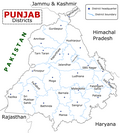 Bagri is the major language in Fazilka district and as a minor language in southern villages of Muktsar district of Southern Punjab (India).

.svg)
.svg)

See also
- Rajasthani language
- List of winners of Sahitya Akademi Awards for writing in Rajasthani language
- List of Rajasthani poets
- List of Indian poets#Rajasthani
References
- ^ "Statement 1: Abstract of speakers' strength of languages and mother tongues - 2011". www.censusindia.gov.in. Office of the Registrar General & Census Commissioner, India. Retrieved 7 July 2018.
- ^ https://dspace.gipe.ac.in/xmlui/bitstream/handle/10973/18895/GIPE-070453.pdf?sequence=3&isAllowed=y%7CBagri is classified under Rajasthani languages since census 1931 according to Government of India which is available in the provided official pdf
- ^ "Revised Land and Revenue Settlement of Hisar District 9006-9011" (PDF). Archived from the original (PDF) on 17 May 2017. Retrieved 26 March 2016.
- ^ Census of India 2011
- ^ "The Eighth Schedule" (PDF). mha.gov.in.
- ^ "THE RAJASTHAN OFFICIAL LANGUAGE ACT, 1956" (PDF). indiacode.in.
- ^ "The Linguistic Survey of India, Rajasthan Part-1" (PDF). language.census.gov.in.
- ^ a b c Gusain, Lakhan: Reflexives in Bagri. Jawaharlal Nehru University, New Delhi, 1994
- ^ a b Gusain, Lakhan: Limitations of Literacy in Bagri. Nicholas Ostler & Blair Rudes (eds.). Endangered Languages and Literacy. Proceedings of the Fourth FEL Conference. University of North Carolina, Charlotte, 21–24 September 2000
- ^ Census India 2001
- ^ a b c "The map shows study area and the Eco-cultural regions of Haryana... | Download Scientific Diagram".
- ^ a b c Gusain, Lakhan. A Descriptive Grammar of Bagri. pp. 165–198.
- ^ "LANGUAGE - INDIA, STATES AND UNION TERRITORIES (Table C-16)" (PDF). Census of India 2011. Archived from the original (PDF) on 12 July 2018.
Bibliography
- Gusain, Lakhan (1999). A Descriptive Grammar of Bagri (PhD). Jawaharlal Nehru University. hdl:10603/16847.
- Gusain, Lakhan (2000). Bagri. Languages of the world. Materials. Munich: LINCOM Europa. ISBN 978-3-89586-398-1.