New South Wales (commonly abbreviated as NSW) is a state on the east coast of Australia. It borders Queensland to the north, Victoria to the south, and South Australia to the west. Its coast borders the Coral and Tasman Seas to the east. The Australian Capital Territory and Jervis Bay Territory are enclaves within the state. New South Wales' state capital is Sydney, which is also Australia's most populous city. In December 2024, the population of New South Wales was over 8.5 million, making it Australia's most populous state. Almost two-thirds of the state's population, 5.3 million, live in the Greater Sydney area.
Entries here consist of Good and Featured articles, which meet a core set of high editorial standards.
Image 1
The Glasshouse arts and entertainment centre was central to the dismissal of Port Macquarie-Hastings Council The dismissal of the Port Macquarie-Hastings Council on 27 February 2008 marked the end of a series of events involving a project which was initiated in 2001 in the New South Wales coastal town of Port Macquarie to build a cultural and entertainment centre, known to locals as the Glasshouse. The project, initially a joint venture with the management of the neighbouring shopping centre, Port Central, was originally expected to cost the Council A$7.3 million. However, by late 2007, despite the centre not yet having opened, the costs had blown out to over A$41.7 million, with interest repayments likely to extend the council's liability to A$66 million.
On 27 July 2007, a full public inquiry was announced by the Minister for Local Government, Paul Lynch. The inquiry reported its findings in February 2008. It found that the council had failed to provide appropriate financial and project management and had lost control of the costs, that the project costs had harmed the council's ability to provide services and amenities to the community, and that the council's communications management strategy had resulted in inadequate consultation with the public and inappropriate regard to their concerns. The Minister for Local Government dismissed the council and its mayor, Rob Drew, and appointed an administrator upon receiving the inquiry's report. Drew was critical of the process throughout, maintaining that errors had been made and misinformation had been accepted as fact; however, the New South Wales Urban Task Force, a property development lobby group, believed the sacking served as a warning to other councils to stick to "core responsibilities". (Full article...)
The bridge was constructed over a three-year period from 1925. The project was not originally planned to take as long, but there were delays due to problems with a contractor, and industrial action. The bridge was designed to carry the Mildura railway line over the Murray River and into New South Wales, to service significant cross-border traffic arising from the fruit-growing industry, but the line was never extended beyond the terminus at Yelta. The bridge currently carries a single lane of road controlled by traffic lights. (Full article...)
Both teams had played in their regional qualifiers to qualify for the play-off. The Canadians played in twelve matches in North American qualifying across two rounds. After finishing second in their second-round group to El Salvador, they qualified to the final round where they finished second by three points to Mexico. Australia played in six matches across two rounds in Oceania qualifying. After winning their group, they defeated New Zealand across two legs to make it to the play-off. (Full article...)
Image 4
Pulsford c. 1900s
Edward Pulsford (29 September 1844 – 29 September 1919) was an English-born Australian politician and free-trade campaigner.
Pulsford established a successful business with his father as commission agents in Yorkshire before moving his interests to New South Wales in 1883. There he became a vigorous campaigner for free trade, and was a co-founder of the Free Trade and Liberal Association in that colony, the body that would later become the machine behind the Free Trade Party. Although his attempts to enter the New South Wales Legislative Assembly were abortive, he was appointed to the Legislative Council in 1895 and served until 1901, when he was elected to the Senate. An uncompromising opponent of all forms of protectionism, following the 1909 Fusion of the anti-Labour forces he joined the Liberal Party only with reluctance. (Full article...)
Image 5
The green and golden bell frog (Ranoidea aurea), also named the green bell frog, green and golden swamp frog and green frog, is a species of ground-dwelling tree frog native to eastern Australia. Despite its classification and climbing abilities, it does not live in trees and spends almost all of its time close to ground level. It can reach up to 11 cm (4.5 in) in length, making it one of Australia's largest frogs.
Coloured gold and green, the frogs are voracious eaters of insects, but will also eat larger prey, such as worms and mice. They are mainly diurnal, although this is mostly to warm in the sun. They tend to be less active in winter except in warmer or wetter periods, and breed in the warmer months. Males reach maturity after around 9 months, while for the larger females, this does not occur until they are two years old. The frogs can engage in cannibalism, and males frequently attack and injure one another if they infringe on one another's space. (Full article...)
Walker was born in Edinburgh, Scotland. He spent his early childhood in New South Wales, before returning to Scotland with his family to study finance. Joining the Bank of New South Wales, he returned to Australia and held various financial positions in New South Wales and Queensland. Gaining a public reputation for financial expertise, he was active in the Federationist cause and was a delegate to the 1897 Constitutional Convention, where he was a significant figure in the development of Commonwealth finance schemes. After assisting the successful "Yes" campaign for the 1898 referendum, he was elected to the Senate in 1901 as a Free Trader. (Full article...)
Map of the far southeast of Australia, with Monaro Highway highlighted in red
Monaro Highway is a 285-kilometre-long (177 mi) highway in Victoria, New South Wales, and the Australian Capital Territory, in Australia, linking Cann River in Victoria to Canberra in the Australian Capital Territory (ACT) via the Monaro region. From its southern terminus, it follows the nearby Cann River upstream towards the New South Wales border through heavily forested terrain. Within New South Wales (NSW), it makes its way through further forest before reaching the pastures typical of the Monaro. There are multiple towns and villages along the highway, including Bombala, Nimmitabel and Cooma. The terrain within the Monaro is largely hilly, and there are numerous crossings. The road also parallels the former Bombala railway line in several locations. Within the ACT, the road becomes a high volume roadway and serves the southern suburbs of Canberra. The highway has more recently had a grade-separated dual carriageway extension constructed within Canberra, as part of the Eastern Parkway construction project. It is designated part of route M23, and route A23 within Canberra, and route B23 within Victoria and New South Wales, with a concurrency where it also carries route B72 between the two sections of Snowy Mountains Highway. (Full article...)
In 1935, he was dropped from the ministry but was later elected as the Speaker of the New South Wales Legislative Assembly in 1937, holding office until the Mair Government lost power in 1941. Weaver then witnessed the death of the United Australia Party in 1943 and became the leader of the new Democratic Party in 1944. He was then involved in the negotiations to form the New South Wales branch of the Liberal Party, with Weaver becoming the first leader of the state Liberal Party in April 1945. He served only briefly until dying of a heart attack in November 1945. (Full article...)
Image 11
The Pacific blue-eye (Pseudomugil signifer) is a species of fish in the subfamilyPseudomugilinae native to eastern Australia. Described by Austrian naturalist Rudolf Kner in 1866, it comprises two subspecies that have been regarded as separate species in the past and may be once again with further study. It is a common fish of rivers and estuaries along the eastern seaboard from Cape York in North Queensland to southern New South Wales, the Burdekin Gap in central-north Queensland dividing the ranges of the two subspecies.
A small silvery fish averaging around 3.25 cm in total length (1+1⁄8–1+3⁄8 in), the Pacific blue-eye is recognisable by its blue eye-ring and two dorsal fins. It forms loose schools of tens to thousands of individuals. It eats water-borne insects as well as flying insects that land on the water's surface, foraging for them by sight. The Pacific blue-eye adapts readily to captivity. (Full article...)
Image 12
The murder of Leigh Leigh, born Leigh Rennea Mears, occurred on 3 November 1989 while she was attending a 16-year-old boy's birthday party at Stockton Beach, New South Wales, on the east coast of Australia. The 14-year-old girl from Fern Bay was assaulted by a group of boys after she returned distressed from a sexual encounter on the beach that a reviewing judge later called non-consensual. After being kicked and spat on by the group, Leigh left the party. Her naked body was found in the sand dunes nearby the following morning, with severe genital damage and a crushed skull.
Matthew Grant Webster, an 18-year-old who acted as a bouncer at the event, pleaded guilty to her murder and was sentenced to 20 years in prison with a 14-year non-parole period. He was released on parole in June 2004, after serving 14½ years. Guy Charles Wilson, the other bouncer and only other person aged over 18 at the party, pleaded guilty to assault; a third male (aged 15) pleaded guilty to having sex with a minor. The investigation of Leigh's murder proved controversial, however, as several people who admitted to various crimes, including assaulting Leigh, were never charged; nor was anyone ever charged with her sexual assault. Webster's confession did not match the forensic evidence. The murder investigation was reviewed by the New South Wales Crime Commission in 1996, and by the Police Integrity Commission in 1998, with the latter recommending the dismissal of the detective in charge of the investigation. (Full article...)
Although he was initially selected for Australia as a leg-spinningall-rounder in all formats in 2010, Smith was always earmarked as a batting prospect following successful batting campaigns in domestic cricket early in his career. After playing five Test matches from 2010 to 2011 as a bowling all-rounder, he was recalled to the Australian Test team in 2013 as a batsman and took over the captaincy from Michael Clarke in late 2015. Smith now plays primarily as a batsman, and has predominantly batted at number 4 in Test cricket and number 3 in ODIs and T20Is. (Full article...)
While the museum as an institution was established in 1991, its roots go back a half-century earlier. Expatriate Australian artist JW Power provided for a museum of contemporary art to be established in Sydney in his 1943 will, bequeathing both money and works from his collection to the University of Sydney, his alma mater. The works, along with others acquired with the money, were exhibited mainly as a travelling collection in the decades afterward, stored in two different university buildings. This collection was known as the Power Gallery of Contemporary Art. (Full article...)
Image 15
Library punchbowl showing beach where Circular Quay is now located The Sydney punchbowls, made in China during the Jiaqing Emperor's reign (1796–1820) over the mid-Qing dynasty, are the only two known examples of Chinese export porcelain hand painted with Sydney scenes and dating from the Macquarie era. The bowls were procured in Canton about three decades after the First Fleet's arrival at Port Jackson where the British settlement at Sydney Cove was established in 1788. They also represent the trading between Australia and China via India at the time. Decorated punchbowls were prestigious items used for drinking punch at social gatherings during the 18th and 19th centuries, but it is not known who commissioned these bowls or what occasion they were made for.
The punchbowls are a 'harlequin pair', similar but not exactly matching. They were donated independently of each other, one to the State Library of New South Wales (SLNSW) in 1926 and the other to the Australian National Maritime Museum (ANMM) in 2006. The Library bowl is the more widely known of the pair. Its earliest provenance places it in England in the late 1840s, where it is said to have been commissioned for William Bligh; another source suggests Henry Colden Antill. It passed through several owners in Britain before it was presented to the State Library. The Museum bowl's first provenance is from England in 1932 and it has been suggested that it was made to the order of Arthur Phillip. Its whereabouts were unknown until it appeared in the Newark Museum, United States, in 1988, on loan from Peter Frelinghuysen Jr. Through donations, the Maritime Museum later acquired the punchbowl from Frelinghuysen. (Full article...)
The Sydney Opera House is a multi-venue performing arts centre in Sydney, New South Wales, Australia. Located on the foreshore of Sydney Harbour, it is widely regarded as one of the world's most famous and distinctive buildings, and a masterpiece of 20th-century architecture.
Designed by Danish architect Jørn Utzon and completed by an Australian architectural team headed by Peter Hall, the building was formally opened by Queen Elizabeth II on 20 October 1973, 16 years after Utzon's 1957 selection as winner of an international design competition. The Government of New South Wales, led by the premier, Joseph Cahill, authorised work to begin in 1958 with Utzon directing construction. The government's decision to build Utzon's design is often overshadowed by circumstances that followed, including cost and scheduling overruns as well as the architect's ultimate resignation. (Full article...)
The COVID-19 pandemic in New South Wales, Australia was part of the worldwide pandemic of the coronavirus disease 2019 (COVID-19) caused by severe acute respiratory syndrome coronavirus 2 (SARS-CoV-2). The first confirmed case in New South Wales was identified on 19 January 2020 in Sydney where three travellers returning from Wuhan, Hubei, China, tested positive for the virus. As of 1 April 2022, there had been over 1,863,186 confirmed cases in NSW: 1,149,142 confirmed cases from PCR testing, and nearly 714,044 positive rapid antigen tests (RAT) since mid-January 2022. 17,509,209 vaccines have been administered. (Full article...)
The Darling River (or River Darling; Paakantyi: Baaka or Barka), is the third-longest river in Australia, measuring 1,472 kilometres (915 mi) from its source in northern New South Wales to its confluence with the Murray River at Wentworth. Including its longest contiguous tributaries, it is 2,844 km (1,767 mi) long, making it the longest river system in Australia. The Darling River is the outback's most famous waterway.
As of the early 2020s, the Darling is in poor health, suffering from over-allocation of its waters to irrigation, pollution from pesticide runoff, and prolonged drought. During drought periods in 2019 it barely flowed at all. The river has a high salt content and declining water quality. Increased rainfall in its catchment in 2010 improved its flow, but the health of the river will depend on long-term management. (Full article...)
Image 6
Elizabeth Farm, the first item inscribed on the Register
The register was created in 1999 and includes items protected by heritage schedules that relate to the State, and to regional and to local environmental plans. As a result, the register contains over 20,000 statutory-listed items in either public or private ownership of historical, cultural, and architectural value. Of those items listed, approximately 1,785 items are listed as significant items for the whole of New South Wales; with the remaining items of local or regional heritage value. The items include buildings, objects, monuments, Aboriginal places, gardens, bridges, landscapes, archaeological sites, shipwrecks, relics, bridges, streets, industrial structures and conservation precincts. (Full article...)
Image 7
The Three Sisters sandstone rock formation, one of the region's best-known attractions
The Blue Mountains (Gundungurra/Dharug: Colomatta or Gulumada) are a mountainous region and a mountain range located in New South Wales, Australia. The region is considered to be part of the western outskirts of the Greater Sydney area. The region borders on Sydney's main metropolitan area, its foothills starting about 50 kilometres (31 mi) west of centre of the state capital, close to Penrith. The public's understanding of the extent of the Blue Mountains is varied, as it forms only part of an extensive mountainous area associated with the Great Dividing Range. As defined in 1970, the Blue Mountains region is bounded by the Nepean and Hawkesbury rivers in the east, the Coxs River and Lake Burragorang to the west and south, and the Wolgan and Colo rivers to the north. Geologically, it is situated in the central parts of the Sydney Basin.
The Blue Mountains Range comprises a range of mountains, plateau escarpments extending off the Great Dividing Range about 4.8 kilometres (3.0 mi) northwest of Wolgan Gap in a generally southeasterly direction for about 96 kilometres (60 mi), terminating at Emu Plains. For about two-thirds of its length it is traversed by the Great Western Highway, the Main Western railway line and the proposed Blue Mountains tunnel. Several established towns are situated on its heights, including Katoomba, Blackheath, Mount Victoria, and Springwood. The range forms the watershed between Coxs River to the south and the Grose and Wolgan rivers to the north. The range contains the Explorer Range and the Bell Range. (Full article...)
The Sydney Conservatorium of Music (SCM) — formerly the New South Wales State Conservatorium of Music, and known by the moniker "The Con" — is the music school of the University of Sydney. It is one of the oldest and most prestigious music schools in Australia, founded in 1915 by Belgian conductor and violinist Henri Verbrugghen.
Tamworth (/ˈtæmwəɹθ/TAM-werth) is a city and administrative centre of the north-eastern region of New South Wales, Australia. Situated on the Peel River within the local government area of the Tamworth Regional Council, it is the largest and most populated city in the region, with a population of 43,874 in 2021, making it the third largest inland city in New South Wales (after Wagga Wagga and Albury). Tamworth is 318 km (198 mi) from the Queensland border and is located almost midway between Brisbane and Sydney.
The city is known as the "First Town of Lights", being the first place in Australia to use electric street lights in 1888. Tamworth is also famous as the "Country Music Capital of Australia" and "Australia's answer to Nashville", annually hosting the Tamworth Country Music Festival in late January; the second-biggest country music festival in the world after Nashville. The city is recognised as the National Equine Capital of Australia because of the high number of equine events held in the city and the construction of the world-class Australian Equine and Livestock Events Centre, the biggest of its kind in the Southern Hemisphere. (Full article...)
Visitors interacting with Wedding Cake Rock, pictured in December 2014, prior to the landmark’s closure to the public.Wedding Cake Rock, also known as White Rock, is a sandstone rock formation located in the Royal National Park near Bundeena in Sydney, New South Wales, Australia, accessible via the Royal National Park Coast Track. The rock is one of many formations that appear north of Marley Beach, and is suspended 25 metres (82 ft) above sea level. Wedding Cake Rock is noted for its scenic location and popularity with bushwalkers and tourists, as an attractive location for photography. Its reputation, however, was damaged after the landmark saw a sudden spike in popularity in 2015, and subsequently fell victim to vandalism. The rock was closed off from public access in May 2015 by the New South Wales National Parks and Wildlife Service, citing the dangerous behavior of recent visitors, and later, safety concerns, after a survey conducted the following month determined that the rock was unstable, and that it would collapse into the Tasman Sea within the next decade. (Full article...)
The New South Wales Police Force, commonly abbreviated as NSW Police Force, is the primary law enforcement agency in the Australian state of New South Wales. Established in 1862, the organisation has more than 17,000 police officers and is the largest police force in Australia. The force has a jurisdiction covering 801,600 square kilometres and more than 8.2 million people.
In 2020, the police force had 21,455 employees – 17,348 police officers and 4,107 support staff, 432 police stations, 3,300 vehicles, 52 boats, 9 aircraft and a budget of AUD $4.8 billion. It is organised into police area commands (PACs) in metropolitan areas, police districts (PDs) in rural areas and specialist commands. (Full article...)
Image 14
The University of Sydney (USYD) is a publicresearch university in Sydney, Australia. Founded in 1850, it is the oldest university in both Australia and Oceania. One of Australia's six sandstone universities, it was one of the world's first universities to admit students solely on academic merit, and opened its doors to women on the same basis as men. The university comprises eight academic faculties and university schools, through which it offers bachelor, master and doctoral degrees.
There are a few other sedimentary basins, the Great Artesian Basin can be broken into the Eromanga Basin in the west and the Surat Basin to the east. The Sydney Basin extends north into the Gunnedah Basin, which goes even further north into the Bowen Basin which extends into Queensland, under the Surat Basin. The New England Orogen has a few small Basins included, such as the Lorne Basin, the Myall Syncline, and Gloucester Basin. The Oaklands Basin is in the south of the state under the Murray Basin. The Darling Basin is in the state's west, but mostly covered by the Murray Basin. Gilgandra Sub-Basin and Paka Tank Trough are potential places for coal and gas. (Full article...)
... that the jury of matrons who assessed whether Ann Davis was pregnant after she was sentenced to death were the first civilian jurors for a criminal trial in New South Wales?
Image 7A General Chart of New Holland including New South Wales & Botany Bay with The Adjacent Countries and New Discovered Lands, published in An Historical Narrative of the Discovery of New Holland and New South Wales, London, Fielding and Stockdale, November 1786 (from History of New South Wales)
Image 21Mr E.H. Hargraves, The Gold Discoverer of Australia, returning the salute of the gold miners - Thomas Tyrwhitt Balcombe, 1851 (from History of New South Wales)






 Recognized content -


.jpg)

.jpg)
.jpg)
.jpg)


.jpg)


.jpg)


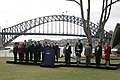 World leaders with Prime Minister John Howard in Sydney for the 2007 APEC conference (from History of New South Wales)
 Dry paddocks in the Riverina region during the 2007 drought (from History of New South Wales)
 Olympic colours on the Sydney Harbour Bridge in the year 2000 (from History of New South Wales)
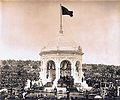 Federation Pavilion, Centennial Park, Sydney, 1 January 1901. (from History of New South Wales)
 Sydney Opera House was opened in 1973. (from History of New South Wales)
 Murray Grey cows and calves (from Economy of New South Wales)
 A General Chart of New Holland including New South Wales & Botany Bay with The Adjacent Countries and New Discovered Lands, published in An Historical Narrative of the Discovery of New Holland and New South Wales, London, Fielding and Stockdale, November 1786 (from History of New South Wales)
 A chart of part of the interior of New South Wales by John Oxley, Surveyor General, 1822 (from History of New South Wales)
 Autumn colour at Mount Wilson (from Geography of New South Wales)
 Hyde Park, Sydney with the Australian Museum under construction in the distance, 1842 (from History of New South Wales)
 Landing of Lieutenant James Cook at Botany Bay, 29 April 1770, by E. Phillips Fox (from History of New South Wales)
 Bondi Beach circa 1900 (from History of New South Wales)
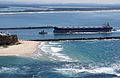 A bulk carrier entering the Port of Newcastle, New South Wales, 2009 (from Economy of New South Wales)
 Early expeditions of Charles Sturt (from History of New South Wales)
 Tumut 3 Power Station was constructed as part of the vast Snowy Mountains Scheme in New South Wales (1949–1974). Construction necessitated the expansion of Australia's immigration program. (from History of New South Wales)
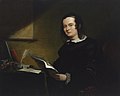 Humanitarian Caroline Chisholm provided support to poverty-stricken women migrants (from History of New South Wales)
 A 630 lb gold specimen from Hill End, unearthed in 1872 (from History of New South Wales)
 Köppen climate types in New South Wales (from Geography of New South Wales)
 Mr E.H. Hargraves, The Gold Discoverer of Australia, returning the salute of the gold miners - Thomas Tyrwhitt Balcombe, 1851 (from History of New South Wales)
 Ribbon ceremony to open the Sydney Harbour Bridge on 20 March 1932. Breaking protocol, the soon to be dismissed Premier Jack Lang cuts the ribbon while Governor Philip Game looks on. (from History of New South Wales)
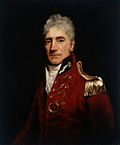 The 5th Governor of New South Wales, Lachlan Macquarie, was influential in establishing civil society in Australia (from History of New South Wales)
 William Wentworth was key in the establishment of self-governance in New South Wales (from History of New South Wales)
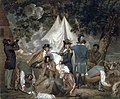 Founding of the settlement of Port Jackson at Botany Bay in New South Wales in 1788, by Thomas Gosse (from History of New South Wales)

.jpg)


.jpg)


.jpg)


 Commons
 Wikibooks
 Wikidata
 Wikinews
 Wikiquote
 Wikisource
 Wikiversity
 Wikivoyage
 Wiktionary


