






Persian clothing
.jpg)
.jpg)
Traditional Persian clothing is the historical costume of the Persian people, and of ancient Persia (Iran) before the 1930s Pahlavi dynasty. Historically, the fabric and color of clothing was very important.[1] During the Achaemenian period (550–330 BC), Persian clothing started to reflect social status and eminence, the climate of the region, and the season. The design philosophy for ancient clothing was a marriage of both function and aesthetics.[1]
Images of Persian clothing examples can be seen in ancient art and Persian miniature paintings.[2] Persian miniatures can employ both vivid and muted colors for clothing, although the colors of paint pigment often do not match the colors of dyes. Traditional Persian clothing is seldom worn in urban areas in modern times but has been well preserved in texts and paintings throughout history.[citation needed]
History
Clothing in Persia is divided into several historical periods, however little is known about the earliest history.[3][4] The exact date of the emergence of weaving in Iran is not yet known, but it is likely to coincide with the emergence of civilization.[5]
There are historical discoveries in northern Iran from about 6,000 BC that refer to wool weaving at the time. Other discoveries in central Iran dating back to 4200 BC have shown that the animals' skin has not been the only clothing worn on the Iranian plateau since those years. The clothing of ancient Iran took an advanced form, with the fabric and color of clothing becoming very important at that time. During the Achaemenian period, clothing varied depending on social status, eminence, the climate of the region, and the season.
-
 The 3rd–4th century during the Sassanian-era
 -
 Safavid-era Persian Zoroastrian clothing
 -
 Nader Shah (r. 1736–47) and his sons
 -
 Sasanian plate depicting a hunting scene


Achaemenid Period
Persians
Pleated Robes

The pleated robe is formed from a rectangular cloth, typically with a width of about 120–150 cm and a length exceeding the wearer’s height. It is tailored with two main components: the pleated outer garment and a lower skirt or underpiece. The main cloth is pleated in the chest and shoulder areas, leaving the arms free and forming a flowing drape down the body.[6] It is usually tied at the waist and gathered in the back, where it creates tiered waves or ridged folds, giving it both volume and shape. Some depictions suggest a front-slit design or a V-shaped neckline, while others show it as completely wrapped. The lower section consists of either one or two additional pieces that wrap around the waist and hips, often secured with a leather belt or cord, resulting in a skirt-like appearance underneath the pleated top layer.[7] In some cases, the robe may be worn in a single-piece configuration, but it also appears as a combination of upper and lower garments, creating a layered effect. Achaemenid Persian clothing was a structured and symbolic extension of the wearer’s rank, function, and geography. The garments varied in color, fabric, and cut based on social class, region, climate, and the season. Clothes were made from fine materials such as silk, linen, or wool, and were often dyed in vibrant colors like saffron, white, purple, and orange, each signifying different social or symbolic meanings. Notably, purple was reserved for royalty and those of elevated rank, often decorated with golden threads.[8]

The structure of the robes are contested in various sources, with some describing them as one piece and others as two piece, but Mehrasa Gheibi gives the following description of the garments:
"It is my opinion that Achaemenid robes were likely made from a single rectangular cloth, sewn closed at the sides except for an underarm opening. The sleeves and pleats were shaped by structured stitching and tucking, creating layered folds similar to those seen in stone reliefs. Horizontal pleats on the chest do not indicate a two-piece garment but rather a continuous design with added front panels."[9]
Despite the existence of their own distinct costume, the Persians frequently wore Median attire.[10]
Headwear


The seven types of Achaemenid court headwear mentioned are as follows: Type I.1 was a simple, twisted headband worn by the royal guard; Type I.2 was a circlet or fillet, commonly worn by Elamites and many Persian soldiers; Type I.3 was a wider fillet used by soldiers, royal attendants, and mythical heroes, often decorated with floral embroidery or metal appliqué; Type I.4 was a long scarf of wool, linen, or silk wrapped tightly around the head or neck, with only the facial center exposed (bashliq/tiara/kyrbasia). This type appears on figures like the royal towel bearer and various stairway attendants; Type I.5 was a plain cylindrical hat worn by royalty and featured in the "Treasury relief"; Types I.6 and I.7 were shorter and taller fluted hats respectively, strongly associated with Persian dignitaries. Both I.6 and I.7 were types of the mītra, a term used by Herodotus.[7]
The primary royal crown of the Achaemenid Empire was the mitra, a tall, cylindrical or fluted symbolic headdress often referred to as a “semi-crown” or “helmet-crown.” It resembled a stylized cylinder with 18 to 22 vertical flutings or ribs and was secured with a cloth band (ribbon or turban) tied around it. Though appearing ceremonial, this structure was tightly bound and firmly seated on the wearer’s head. In artistic depictions, especially on reliefs from Persepolis—the cylinder is often shown worn by the Shah and high-ranking individuals during official ceremonies. In wartime, a sturdier version was fashioned for the king, functioning like a helmet or protective headgear, distinguishing it from general noble headwear. This war-version was likely made of bronze or hard leather, showing durability and symbolic authority.[8]
Women's clothing
The primary garment of women, similar to men, was the Persian robe. The robe could vary in form: some versions lacked diagonal front folds, while others had broad panels falling behind the back like a cape, possibly gathered or tied. Hair was typically worn long and fastened with a wide barrette, while headgear ranged from decorated tiaras and diadems to bordered veils and serrated headscarves, though full veiling was uncommon among noblewomen. Accessories included neckbands, bracelets, penannular earrings, and, in domestic contexts, perfume birds and incense burners. Decorative elements such as dog-tooth borders, gold embroidery, spangles, and stitched trims embellished the robes, and silk or light wool, dyed in Mesopotamian fashion, was likely used. While the robe could be adapted for different occasions, its consistent structural complexity and ornamental detail made it a clear marker of class, hierarchy, and ceremonial function within the empire's upper stratum, distinguishing noblewomen from flower-carrying attendants or handmaidens, who wore simpler versions and often lacked ornate tiaras.[11]
-
 Impression of Achaemenid seal depicting Persian women
 -
 Depiction of Persian women on saddle cloth
 -
 Achaemenid women in Persepolis - wearing pleated robes and short mitras
 -
 Sketch of Xerxes depicted wearing the pleated robe and a mitra - Persepolis
 -
 A modern two-piece dress inspired by the Achaemenid style - Queen Farrah Pahlavi


Medes
The candys also written as kandys was a Median qabā[12] and a ceremonial Persian outer garment, likely derived from Old Persian kandu- (“to cover”), with related forms in Elamite, and Parthian languages. It was a full-length cloak with long, often unused sleeves, draped over the shoulders rather than worn like a fitted coat. Made from fine materials, sometimes edged with fur, and dyed in purples or mixed royal colors (red, blue, white), the candys signified noble or royal status.[7]


Although in its earliest known form in 4th–5th century BC it was shaped more like a cloak which could have decorative sleeves, only used formal settings.[13] The Persian candys were often purple color, or made from leather and skins.[14] Encyclopædia Iranica has stated many scholars believe candys, along with a long-sleeved tunic called a sárapis and long trousers called anaxyrides, formed the riding dress of the Median people; which was portrayed in the Persepolis reliefs.[14] It's possible it was an article of clothing associated with nobility.[14]
Headwear
The various Median forms of headwear largely consisted of simple bands, a variety of bashliq and tiara (kurpasa), and felt caps which were also popular among the satraps[15] and often part of the infantry uniform.[16]
Bashliq (Persian: باشلیق/باشلِق, Turkish: Başlık), which was also prevalent among various Turkic peoples, often overlaps and is confused with the kurpasa used in the Achaemenid period.[17] It was later adopted and modified in Europe as the Phrygian cap.[18] At the top it usually had a sharp and tall tip shaped like a conical sack bent backward or forward. On the back, it had a short tail-like extension that covered the neck, and on both sides it included additional flaps for covering the ears. This cap, during travel, horseback riding, or speaking with the king, was used (to prevent the breath from being exhaled toward the king's face).[6][16] Sometimes with a band wrapped around the head which fell down the back[18] Studies in Turkology and Iranology suggest continuity in the use of the bashliq between the ancient Iranian and Turkic peoples.[19] The bashliq was widespread from Tibet to the Hellenistic world, the Middle East, and various nomadic peoples.[18]
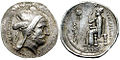
The kurpāsa,[20] or kyrbasía[20][21] -- which may or may not have been identical to the kídaris, tiara, kítaris (Lat. cidaris) -- was a head covering made from felt, leather, silk, or soft fabric.[22] The kurpasa looked like a hood and was often lined with fine animal fur inside. Most people wore it flat, either folded into three bumps at the front or hanging down on the sides. Only the Great King could wear his kurpasa standing upright, probably supported from the inside.[23][24] The earflaps were tied under the chin or hung loose, and the bonnet was encircled with a diadem.[25] Additionally, the Magi wore a loose cloth over the nose and mouth to prevent their breath from defiling the sacred fire.[26] the kurpasa is variously identified by scholars as a satrapal headdress or Persian cap.[27]
-
-

-
 A relief in Persepolis depicting guests wearing bashliq (sides) and kurpasa (middle)
 -
 3 types of Saka bashliqs depicted in Xerxes's relief
 -
 An ornate, tall Saka bashliq -golden man
 -
 Alexander Sarcophagus depicting Achaemenid soldiers wearing the kurpasa
 -

-
 Coin of Vahbarz, wearing a kurpasa
 -
 Depiction of a Persian (right) on a Greek vase - wearing a bashliq
 -
 An Achaemenid satrap wearing the kurpasa


.jpg)


,_governor,_c._mid_3rd_century_BC.jpg)
_MET_DT229458.jpg)


Bodywear
The Median dress consisted of a plain, unpleated tunic that was closed in the front and had no seams, reaching as far as the knees, with tight sleeves, a simple hem, and no collar; it was pulled over the head to wear.[6] Later, a more detailed version made of cloth became common. This new style had long sleeves, a wide V-shaped collar, and is clearly seen in artworks like the Alexander Mosaic and Sarcophagus. The belt sat high on the waist, and the lower part of the tunic could be tucked into it during battle. Some Greek vases also show Persians wearing sleeveless versions of the tunic.[28] The tunic is referred to as chitón by the Greeks and the Persian equivalent for the term is believed to be sárapis.[29] Possibly that as early as the end of the 2nd millennium BCE, the migrating Iranians brought with them the sarapis that had been developed in Eurasia, where the climate fluctuated sharply and life depended on cattle raising and the use of the horse, particularly in fighting[30]
Shalvar (Persian: شلوار, Old Persian: šaravāra) is a form of trousers introduced from Persia to other Middle Eastern regions.[31][32] The Greeks often referred to the colorful trousers of the various Iranian peoples as anaxyrides.[33] The Median trousers are long, and the width of each leg tapers gradually as it approaches the ankle, becoming narrower and more fitted. A thin strip of cloth is wrapped around the lower part of the trousers, allowing the fabric to be gathered and secured. This strip is tied around each leg, on either side of the trousers, providing a complete fit below the knee and preventing creases or folds. This style is similar to what is seen in modern tapered trousers. The simplicity of this design, combined with the use of belts or sashes, results in a very soft and finely tailored garment. These trousers typically feature a waistband twice the width of the belt.[8][34]
Middle Iranian Period
Kulāf
,_Ecbatana_mint.jpg)
The kulāf (Persian: کلاف, Middle Persian: kwl'p)[35] or kulah, also referred to as a miter or tiara in modern scholarship, was a form of elite headgear used in the Middle Iranian period. It functioned as a marker of royal, noble, and official status and underwent significant formal variation over time. Variations in style and structure of the kulāf exist simultaneously in the Phrygian-like, Sassanian, Arsacid Miter, and Hatran designs.[36][37][38]

The Arsacid style kulāf (or Miter) is best known from coinage and is characterized by a tall, rounded form, sometimes equipped with earflaps and sometimes without. These caps were commonly made of felt with certain examples showing additional decorative projections along the border or upper sides, extending downward to cover the back of the head and ears.[39][40] The ceremonial Miter first appears in the late coinage of Mithradates II as an original royal creation. It was outlined by rows of pearls or scalloped bands and decorated laterally with six- or eight-pointed stars, while retaining the diadem as a constant element. Although the basic form of the miter and the use of the diadem remained stable, crests, side devices, and color schemes were altered by successive rulers, indicating that these headpieces were personalized rather than hereditary; when a form was reused, its color was typically changed to preserve individual distinction.[40]
,_excavated_in_Northern_Syria,_5th_century_CE_British_Museum_135071.jpg)
A related but regionally distinct form is the Hatran style, visible in royal sculpture from Hatra. These miters appear tall, narrow, and tapering, sometimes almost pointed when viewed from the front. Scholarly interpretations differ regarding their construction. some suggest they were made of soft material and reflect a Semitic tradition, while comparable Arsacid representations on coins imply the use of rigid or reinforced fabrics, possibly derived from helmet forms.[41][42] Over time, the ribboned diadem associated with earlier forms was in some contexts replaced by rigid bands composed of rows of gems positioned above an ear-and neck-covering guard. Sculptural representations, such as Hatran royal statues with flame-shaped medial crests, may reflect simplified versions of more elaborate crown designs known from coinage rather than literal depictions of everyday court attire.[43]

.jpg)
The Sasanian style kulāf shows further structural development, particularly in the treatment of the ears and hair. Reliefs and sculptures depict felt caps constructed to descend downward and obliquely, enclosing or covering the ears and overlapping the hair. In some cases, a guard-like extension protected the neck. These features suggest a combination of ceremonial display and functional coverage, reinforcing the role of the kulāf as a visual marker of noble or official authority in Sasanian Iran.[38] Another variant is the Phrygian kulāf style, which took the form of a soft cap with a bent-forward or drooping tip. This type could be worn independently or combined with a taller conical structure and was frequently ornamented to indicate rank or royal ideology. In elite or symbolic contexts, the terminal point of the cap could be shaped into animal or bird forms, while thin ribbons, knots, or insignia were occasionally attached as markers of social distinction [36]
Deyhīm

The diadem or deyhīm (Persian: دیهیم).[44] was a ribboned headband that functioned as a visible marker of royal authority in the Iranian world. In its basic form, a deyhīm consisted of a ribbon ending in a knot with two fringe strips, often wrapped around the head and allowed to drape down the back or shoulders.[45] From the Parthian to the Sasanian periods, the deyhīm developed from a Hellenistic-derived insignia into a distinctively Iranian emblem of kingship and rank.[46]

_coin_transparent.png)
One of the essential outward signs of Arsacid royal power was the deyhīm, which served as a primary insignia of kingship.[47][48] Early Parthian rulers adopted the Greek deyhīm as heirs to Seleucid traditions.[49] Beginning with the reign of Phraates III, however, the Parthian deyhīm became distinct from its Hellenistic-inspired predecessors, marking a shift toward an independent Arsacid royal visual language.[40] Over time, the Parthian deyhīm increased in complexity, consisting of multiple bands wrapped around the head and worn with longer ribbons.[50] These longer ribbons were sometimes looped at the back of the head rather than hanging freely.[50] In later Parthian representations, kings wore the multi-band deyhīm in conjunction with a curled topknot and globular bunches of hair over the ears, a configuration regarded as a precursor to later Sasanian royal hairstyles.[50][51]
Under the Sasanians, the deyhīm with floating pleated ribbons became a constant element of royal crowns, typically shown flying outward at the sides.[52] In contrast to Parthian practice, where floating ribbons were often attributed to divine figures, the Sasanian deyhīm firmly established such ribbons as markers of royal authority.[53] Shorter ribbons in the Sasanian period signified lesser rank and could be beaded or jeweled, indicating hierarchical differentiation within the court.[54][55][56] Ribbon symbolism extended beyond headgear, as Sasanian royal figures are also depicted wearing leggings or trousers gathered at the ankles and tied around the insteps with fluttering ribbons similar in form and function to the deyhīm, reinforcing their association with royal authority.[57]
Paymōg

Upper garments worn in the Sasanian period, broadly referred to as paymōg (Middle persian: ptmwg)[35] formed part of a broader category of clothing encompassing tunics, coats, and cloaks worn over trousers. These garments were constructed in layered systems and shared decorative conventions including patterned triple circles, stippled triangles, and trellis designs.[58] Clothes were also trimmed with beads and square gems and strewn with ovoid gems dangling from smaller beads and disks, as well as gold settings and pearls.[59] The principal forms of paymōg were the tunics, coats, qabā and cloaks.
The ǰāmag (Middle Persian: yʾmk)[60] was a short tunic bloused at the waist and worn over trousers, fastened with a ribbon belt secured by round clasps . It became standard royal attire under Shapur I and appears consistently in early Sasanian reliefs and sculpture.[54] The ǰāmag exhibited several structural variants. By the late fourth century, one form gathered the hem at the sides with rings and ribbons, producing a rounded apron like panel at the front.[59] Other variants included tunics with decorated folded hems at the sides and front, and constructions employing semicircular lower hems formed from large front and back panels with quarter circle extensions.[61] These variations reflect both chronological development and rank differentiation within the court.
The Parthian Jamāg was sleeved, loose-belted at the waist and covered with horizontal folds. It was worn by both royal and non royal figures and could be worn either by itself or beneath a qabā . The garment was patterned with diamond shaped designs and ornamented with bands, embroidery, or woven decoration at the wrists and neckline.[62] One to three ornamental strips often ran vertically down the front of the tunic.[53] In some Parthian examples, the hem of the jamāg was shaped in a semicircular form rather than falling straight.ref name=":8" />

The kabāh (Middle Persian: kpʾh )[35] was a long sleeved coat descended from the Median kandys.[63] It was worn over the ǰāmag with trousers and fastened at the waist.[64] The earliest known depiction of the kabāh appears in the Babak graffiti at Persepolis, where the coat is tied at the breast with ribbons and ornamented with radial medallions at the shoulders,[65][54] A common variant was a lighter coat worn open over a long tunic and leggings, fastened at the breast with circular clasps or ribbons, as seen in reliefs of Shapur I and Bahram II.[66][67] A further development of the kabāh is the Sasanian kaftan, a front opening garment constructed as a single piece split vertically, with overlapping panels left open at the front and belted at the waist. These coats often employed a four gore arrangement and were ornamented at the waist or with additional fabric.[61] High collars with central fastenings, long fitted sleeves, and embroidered and jeweled cuffs are characteristic features,[68] made of heavy materials with dipping and pointed hems.[54]

Another staple of Sassanian and Parthian garment was a light cloak secured at the front with short ribbons and clasps at the breasts, and was closely associated with power and authority.[67] It may derive from the Greek himation,[69] though an alternative origin has been proposed in Parthian Elymais, where longer and more elaborately ornamented cloaks fastened at the front with elaborate clasps are attested.[70] In the early Sasanian period, the royal cloak was worn together with a broad jeweled collar interpreted as a chain of office, sometimes composed of flat jewels or disks similar to Parthian neck ornaments.[71] From the reign of Shapur I onward, this chain of office was replaced by necklaces of round gems or pearls, which became a mark of royalty until the end of the dynasty, and the cloak was fastened with deyhīm ribbons.[41] From the fifth century onward, the necklace could be replaced by a heavy collar with two rows of beads and a central pendant.[54]
The harness was the most important symbol of royalty and consisted of a set of bands worn on the upper torso. It was composed of diagonal shoulder straps attached to a horizontal strap encircling the upper chest, with the junction at the front marked by a central boss or rosette that served as a mark of high rank. The straps could be beaded or banded and were tied at the back with two long ribbons ending in jewels or bells, a feature consistently represented in Sasanian royal imagery.[54] On the two earliest rock reliefs of Ardeshir I, the king is shown wearing crossed bands with a central boss, indicating the early canonical form of the harness.[72]
The qabā in the Sasanian period took the form of a tunic with a diagonal closing edged with beads.[73] This style, worn with or without an inner shirt, had earlier been used in Parthian and Kushan contexts.[49] Despite its earlier prevalence, the diagonally closing qabā never became truly popular in Sasanian dress and appears only sporadically in Sasanian visual material.[73] In the Arsacid period, the qabā was similarly sleeved and closed at the front, typically short and hip length and wrapped diagonally across the chest. It was particularly suited for activities such as hunting and horseback riding.[53] A variant of the Arsacid qabā extended to knee length and was worn open at the chest front to reveal the tunic worn beneath.[53]
-
 Statue depicted with Parthian qabā
 -
 Sassanian plate depicting figure wearing a jamāg with a curved hem
 -
 Example of Parthian jamāg with a cloak and curved hem
 -
 Investiture of Anushirvan depicting Sassanian dress decorations
 -
 Coronation of Ardeshir I, figures depicted with kabāh
 -
 Sassanian jamāg (right) with decorated shoulder medallions and apron hem
 -
 Example of Sassanian chest harness
 -
 Phrygian Kulāf of Shapur I with earflaps and an animal tip
 -
 Investiture of Bahram I depicting Sassanian cloaks
 -
 Example of Sassanid qabā
_Statue_in_Iran-e_Bastan_Museum.jpg)

.jpg)
_(cropped).jpg)


.jpg)


Guarded domains of Iran
Sarpūsh (headwear)
Taj-e Haydari
.jpg)
The Taj-e Haydari (Persian: تاج حیدری, "Crown of Haydar"), was twelve-gored cap with a tall, pointed top, symbolizing the twelve Shiʿite imams[74] The hat was typically red, though other colors were also used to match the rest of the outfit. It might be adorned with nothing more than gold chains or feathers, but more often it was wrapped in a turban made from a long white scarf, draped in elegant layers and finished with a fan-shaped ornament. This scarf, woven from silk or fine cotton, could be plain with decorated ends or entirely embellished with intricate embroidery.[75]
The Jeghe
Jeqeh (Persian: جقه), jighe, parak or til, named after paisley is an ornamental piece made of feathers and jewels that was used atop the crowns, hats, and turbans of Iranian Shahs and several other rulers of the Islamic world, including the sultans of the Ottoman Empire and the Mamluks of Egypt.[76][77] The Jeghe, featuring the motif of a bent cypress (a symbol of humility), represents Iran and the Iranian people.[78] Jeghe was heavily used in earlier Qajar headwear for both men and women.
Kolāh-e Shāterī
The Kolāh-e Shāterī (Persian:کلاه شاطری) was a special felt cap worn by shāters (royal runners) and related service personnel and was designed to fit firmly and securely on the head. It could be decorated with feathers or flowers, reflecting a broader Safavid practice in which feathers, plants, pearls, and similar elements were commonly used as headgear ornaments.[79] Some forms of the Kolah-e Shāterī were made with a broad brim, allowing the wearer’s face to be protected from the sun during long journeys. As part of its symbolic function, a feather was often attached to the cap as a sign of agility and swift service, qualities associated with the role of the shāters.[80]

Another variant of sarpūsh was the bork, a fur cap that became especially popular during the reign of Shah Abbas I.[81] Rather than a single fixed type, bork caps shared a common construction principle in which an outer cloth layer was combined with an inner lining of fur or leather. These caps were generally small and soft, often conical in profile with a narrow or pointed top and slightly wider sides, and they sat low on the head without a brim. In some examples, the fur lining protruded subtly at the top due to the pointed shape, while the lower edge was folded outward, making the layered construction visible at the rim. In appearance, bork caps were typically plain and functional, emphasizing utility and service rather than ornamentation.[80]
Khalil-Khani

The khalīl-khānī (Persian: خلیل خانی) was a type of turban worn by court officials in the latter years of the Safavid dynasty and functioned as a marker of high administrative and courtly status. These turbans were made of gold-brocaded silk or richly embroidered fabrics and were often adorned at the front with feathers or fan-like ornaments.[82] Wealthy individuals further decorated their turbans with gold coins and precious stones, and the price of such turbans could reach between 700 and 800 gold coins, reflecting their exceptional value.[83]
The Khalīl-Khānī was also known as dolband or mandīl and was considered among the most valuable items of Iranian dress. Contemporary observers report that these turbans were so heavy that they could scarcely be borne on the head, with some examples exceeding twelve to fifteen livres in weight.[84] Their length typically measured sixteen to eighteen cubits, while even the lightest versions weighed no less than half that amount.[85] In general construction, the turban consisted of a base made from coarse white cloth, over which a finer silk or silk-cotton fabric was wrapped, sometimes woven with gold-thread patterns, and in certain cases gold threads were inserted beneath the outer fabric to enhance its splendor.[86]
Kolāh-e Nāderī


Among Nader Shah's reforms reforms was the introduction of what came to be known as the kolāh-e nāderī (Persian: کلاه نادی) This was a red hat with four peaks which symbolized the first four caliphs of Islam.[87] Alternatively, it has also been recorded that the four peaks symbolized the territories of Persia, India, Turkestan, and Khwarazm.[88] to replace the Taj-e Haydari, which was pieced with twelve gores (evocative of the twelve Shiʿite Imams)[89]
Shāl-Kolāh
Shal-kolah (Persian: شال کلاه)[90] consisted of various types of hand-woven shawls (Shāl) that wrapped around tall rounded Kolāhs in a manner inherited from Safavid traditions, with the shawl’s end tucked upward and to one side of the hat. Wealthy men of high social status favored Kermani or Kashmiri shawls, since the wrapping style of these expensive textiles visibly reflected one’s social rank in the community. Men of lower status, however, used cheaper Chinese shawls in imitation of the elite, but the difference in material and wrapping distinguished their lower class position. This headwear appears predominantly in Zand and Qajar periods.[91]
The Taj
_-_BL_Add_Or_MS_1239.jpg)
During the early years of the Qajar dynasty, fashion was distinguished by the lavish use of gems and pearls to adorn clothing. A notable example is the Kiani Crown, a tall velvet headdress extensively decorated with diamonds, emeralds, rubies, and pearls.[92] This was utilized not just by the shah, but by the foremost Princes of the realm. This type of crown consists of four parts, arranged from bottom to top: the headband section, the pearl section, the battlements, and at the very top, a red velvet cap. The second section features 1,800 pearls forming a white background for green emeralds and red rubies. Excluding the Jeghe of the crown, the height of the cap is 32 centimeters and its width is 19.5 centimeters.[93]
Kolāh
_(14596977917).jpg)
The kolāh (Persian: کلاه) was the standard form of male headgear in the Qajar period and typically took the form of a black cap worn by men across social classes.[94] A prominent variant was the Hashtarkhānī (Persian: هشترخانی), also known as Hāji-Tarkhānī (Persian: حاجیطرخانی),[95] a tall black kolāh angled at the top and covered along the slanted surface with striped fabric.[94] These caps were commonly constructed dressed animal skin, often sourced from Bukhara, and were characterized by stiff, vertically rising walls and a subtly tapering, conical tip that could be sewn or reinforced with red velvet.[96]

Social differentiation was expressed through material quality rather than basic form, as wealthier individuals wore Hashtarkhānī kolāhs while ordinary people more often wore the kolāh-e namadī, a cheaper felt version. The hashtarkhānī variant was typically pointed, tall, and black, while namadī versions were more rounded and associated with rural populations and peasants.[97][98] Structurally, felt kolāhs were made from sheep, camel, or goat hair compressed with heat and water, with binders such as starch, oil, grease, eggs, or soap used in the molding process, and the term kolāh-e namadī primarily referred to the egg-shaped felt type [8]. Later versions of kolāhs were often named after patrons or trend-setters who popularized particular styles.[99]

In the Qajar era, tall black kolāhs replaced earlier turbans as the dominant form of headwear, a change associated with the dress reforms of Aqa Mohammad Khan Qajar, which aimed to promote national unity and reduce visible class distinctions. While all men were expected to wear kolāhs, variations in the quality of skins distinguished social rank, with the Shah’s kolāh made from newborn lambskin and elite men sometimes wrapping embroidered Kashmir shawls around their hats for distinction.[94] Contemporary observers and later commentators note that headwear carried strong symbolic weight in Iranian culture, with going bareheaded considered disrespectful, and those unable to afford a kolāh covering their heads with cloth or shawls instead.[100][101] Over time, under Western influence, the height of the kolāh was gradually reduced to approximately fifteen to twenty centimeters, despite resistance from the population, who continued to regard the taller kolāh as a sign of rank and social status.[102]
Ammameh

The amāmeh (Persian: عمامه) is a piece of cloth that Shiʿi clerics wrap around the head.[103] The turban is regarded as a distinctive garment of Shiʿite religious authority and is tied in two colors: black for sayyids and white for non-sayyids.[104] Turbans are wrapped in various ways depending on their form and size and the method of tying; on this basis they are classified into several types.[105] These include: tabarestānī, qomī, najafī, and arabī.[106]
The amāmeh-gozārī (turban-donning) ceremony is a ritual according to which every seminary student, after completing the preliminary stages of study (five years of education)[107] and fulfilling specific scholarly and ethical requirements, is recognized in a ceremony under the title of "talabbos" and formally identified as a cleric.[108] In Iran, this ceremony is conducted under the supervision of the Office for Guidance and Education of the Islamic Seminaries, through the Talabbos Unit, which is responsible for assessing students’ eligibility. Students who meet the conditions of the seminary and demonstrate the required competencies are officially clothed in clerical attire.[109]
Tanpūsh (bodywear)
Qabā

.jpg)
The Qabā (Persian: قَبا) is a traditional Iranian outer garment historically worn by men across different social classes and professions, from Shahs and nobles to clerics, merchants, and farmers.[110][111] Structurally, it is a long tunic-like coat, open at the front, worn over a shirt and trousers, and sometimes secured with buttons running down the front.[112] Some qabās have hidden buttons under the arm, and others use a belt or sash for fastening. The garment’s sleeves can vary in length and width, and it is often equipped with large inner pockets, which served both practical and ceremonial purposes, such as washing the hem for ritual purity.[113]
Qabā fabrics varied according to climate and social rank. In winter, thicker and warmer materials like wool were common, while lighter fabrics like cotton and linen were used in summer.[114] Wealthier individuals often wore qabās made of silk, velvet, or fine wool. There were seasonal variations too: light “spring” or “summer” qabās (Bahāri, Persian: بهاری) and heavier “autumn” or “winter” ones (Zemestāni, Persian: زمستانی). Fabrics such as Atlas, Zari, and imported European materials were used for elite garments.[115] The colors of qabās also reflected status. Black or dark hues were common among clerics, while affluent men often chose bright colors like green, blue, or gold. Among the general populace, subdued tones were prevalent for practicality. The qabā was a unifying garment in Iranian culture, worn by virtually all men regardless of class, though with significant variation in fabric quality and decoration. It served as a marker of respectability and was often bestowed as a Khil'at to dignitaries, officials, or as diplomatic gifts.[116] In certain variations of the buttoned qabā from the late Safavid to early Qajar period, the front panel is visible extending beneath the buttoned side, creating the appearance of a secondary layer integrated under the garment.[117]
,_Tehran_or_environs,_Iran,_circa_1810-20.jpg)
The qabā in the Qajar court and was closely associated with elite male appearance and regalia. It was commonly worn together with jeweled armbands known as bāzū-band, which functioned as a notable accessory of rank, while the shah and his nobles favored full beards and moustaches carefully dyed black for visual effect when worn in conjunction with the qabā.[118] Courtly versions of the garment were often accompanied by long embroidered shirts with jewel-encrusted sleeves, as well as collars and hems densely set with gems, emphasizing display and hierarchy.[119][120]
The qabā was distinguished from the jobbeh by the presence of a waist sash, which was used exclusively with the qabā and served both functional and symbolic purposes.[121] In its earlier Qajar form, the garment was worn with a long hem reaching to the ankles, with the upper section fitted closely to the waist and the lower portion flaring outward to fall in the form of a skirt. During the reign of Nāṣer al-Dīn Shāh, the hem length was progressively reduced to above the knee, and multiple variants of the qabā came into use, including forms reaching the ankles or calves as well as shorter versions. Some qabās opened from the side or from the front right and were fastened with a waist sash, while others were adorned with decorative buttons, and sleeves in certain examples became narrow and tightly fitted, reflecting changing fashions within the court.[61]
Qajar qabās were generally produced in monochrome colors such as yellow, green, red, blue, and purple and were made of silk or qadak, with textile production centered in Yazd and Kashan. Brocaded fabrics with floral motifs woven in gold and silver thread were especially favored for elite garments.[122] Surviving visual and material evidence, including representations of Fath-Ali Shah, show sleeves heavily embellished with jewels and diamonds, reflecting a conscious tendency to adopt ancient royal models inspired by Sasanian precedents.[123]

Labbādeh
The Labbādeh (Persian: لَبّاده) is a type of qabā, historically signifying a higher social rank and often associated with horsemen and shepherds. It is considered a prestigious garment that, unlike more common outerwear, conveys elegance and formality. A refined variant of the labbādeh is the Tabbādeh (Persian: تَبَاده), which is designed to be worn over the qabā.[124] The tabbādeh features a circular collar that completely covers the shoulders and chest, creating a layered and sophisticated appearance. Unlike the qabā, which is more comfortable for daily use, the tabbādeh is tighter and requires careful tailoring, making it less practical but visually more striking. It has long sleeves and two vertical slits that serve as hidden pockets, but the lower part lacks buttons and is made as a single piece of fabric.[125] Today, the tabbādeh is primarily worn by Shi’a clerics, religious students in seminaries, and some political elites, serving as a marker of scholarly and spiritual prestige. In cities like Qom, Najaf, Mashhad, and Isfahan, specialized tailors craft these garments, often requiring high skill due to the garment’s intricate structure.[126]
-
 Man from Bushehr - Simple Labbādeh
 -
 Man from Bushehr - Simple, sashed qabā
 -
 Mohammad Shah Qajar - Sashed black qabā with jeweled armlets
 -
 Asker khan, Persian ambassador - A golden qabā with open buttons, sashed at the waist
 -
 Court scene of Shah Abbas II - Examples of buttoned qabā
 -
 Karim Khan-e Zand - Sashed qabā with open golden buttons
 -

-
 Portrait of Abbas Mirza wearing an Iranian qabā with the characteristic extended front panel.


Radā
Radā (Persian: رَدا) is traditionally referring to any upper-body covering such as a cloak, mantle, or robe, typically worn over other clothing like the qabā. In historical Persian sources, it was also used as a general term for garments that drape over the shoulders and cover the body completely, similar to a chādor.[127][128]
Abā

Abā (Persian: عبا) is a long and loose radā woven of pre-fluffed wool with an open, unbuttoned front,[129] draped over the shoulders, either sleeveless or with wide, false sleeves that do not cover the arms. In the Safavid period, it was worn in the form of a short-sleeved cloak by the Sufis and ascetics. Its material varied depending on the season and the wearer’s status; it could be made of fine, lightweight fabrics or of coarse wool and hair.[130] Historically it was a common attire in Iranian society but today the Abā is a symbol of the Shia clergy.[131]

Mohsen Sadrolashraf, one of the prime ministers during Reza Shah’s reign, writes in his memoirs that before the Pahlavi era, half of the people of Iran wore the abā, either regularly or occasionally (for example, for prayer).[132] However, during the reign of Reza Shah, a law was passed that prohibited the general public from using the abā and ammāmeh, restricting their use exclusively to the clergy. According to the law enacted by the National Consultative Assembly, wearing the abā and ammāmeh was permitted only for mujtahids, prayer leaders (pishnamazan), seminary students (talabeh), and religious instructors.[133]
Kaftan

Kaftān (Arabic: قفطان, qafṭān; Turkish: Kaftan; Persian: کفتان) sometimes referred to as Jobbeh, Radā or Bālāpush, was a long, ornate, unlined upper garment made of fabric, regarded as a robe of honor[134] (not to be confused with Khaftān (Persian: خفتان), used to denote a tunic-like gambeson)[135] Its value was often indicated by the colors, decorative ribbons, and buttons it featured. Many kaftans crafted from luxurious textiles were adorned with gold-threaded bands and cords along the front and sleeves.[136] Believed to have originated in ancient Mesopotamia.[137] It was characterized as a long robe that reached the calves or sometimes fell just below the knee, open at the front and, with sleeves that were slightly shortened at the wrists or even cut back to the mid-arm, sometimes sleeveless[138] and buttons running down the front. kaftans featured diverse sleeve styles to display luxury and craftsmanship. The Ottoman sultan and his court wore kaftans with short sleeves over long-sleeved entari (qabā) to highlight contrasting fabrics. Basic kaftans had short, kimono-style sleeves, but unlike kimonos, the sleeves and bodice were separate pieces joined with straight seams. Gusset-like patterns curved the underarm, and short sleeves were often curved at the hem, allowing easier elbow movement and revealing the rich inner linings for added visual appeal.[139]

Open at the front with side vents, the kaftan showcased ornate linings and facings made from bright fabrics like atlas and taffeta. Collarless versions had bias binding at the neck, while seams were finished with tack and overcast stitching. Decorations included silk cords, and applique techniques, with even unlined kaftans adorned by trims to cover seams and enhance their luxurious appearance.[139]
Kolijeh
.jpg)
The Kātebi (Persian: کاتبی; earlier form of the garment later known as the Kolijeh; Persian: کلیجه) was a short outer garment worn in the Safavid, Afsharid, Zand and Qajar period.[75] In Safavid usage, the kātebī was a short jacket with long sleeves, fitted closely over the torso and stiffened at the hips and cuffs through quilting, while the lower portion flared outward to form a bell-shaped skirt. The sleeves could terminate in pointed cuffs, a feature frequently noted in contemporary descriptions. Fur was widely used for lining such jackets and as facing on lapels, with marten and sable imported from Russia and fox fur and sheepskin also commonly employed.[85] By the eighteenth century and thereafter, decorative schemes increasingly favored floral boteh motifs and stripes, which were applied prominently along the sleeves and the slits of the skirt, enhancing the visual richness of outer garments such as the kātebi.[140] The short fur-lined outer coat and related robes with long, pointed sleeves are repeatedly described in Safavid and early modern accounts as characteristic elements of elite dress.[141]

By the Qajar period, the same type of garment became widely known as the kolijeh, a short outer coat lined with fur and worn over long-sleeved qabās or sardāris.[75] It was generally worn in the cold season due to its fur lining, and functioned as a ceremonial garment.[94] Kolijehs were made from shawl fabric, bork, or various woolen fabric, namely camel, while the hem, sleeve ends, and collar were commonly decorated with fur.[142] In Qajar society, the kolijeh was sometimes worn as an additional coat over the qabā and could be bestowed as a khil'at, particularly when made of costly Kashmir shawl and Bukhara fur, making it a garment of considerable value.[122] Decorative embroidery frequently employed vegetal designs and botte jeghe motifs, continuing earlier ornamental traditions in a Qajar idiom/[121]
Jobbeh


Jobbeh (Persian: جُبه) was a very loose, baggy radā with an open front, and long, wide sleeves that tightened from the elbow down, and was considered as a luxury garment.[143][144] The material usually camel wool or a mixture of thread and silk, and in the Qajar period paisley-patterned termeh was used for the jobbeh of nobility.[145] Fur-edged cuffs and elaborate decorative bands were characteristic of the jobbeh, giving the arms a formal, luxurious finish. Its structure includes richly adorned front flaps running vertically and horizontally, embroidered with gold thread bands and metallic trims. The lower flaps of the robe are further embellished with chains and pearls[146][147]
jobbeh were given to certain high ranking officials as signifiers of their rank[148] Expensive jobbeh were used as khil'at.[149][150][151] In the Qajar era, the jobbeh became a key outer garment for ministers, clerics, judges, and high-ranking officials, often made from luxurious imported fabrics and especially prominent during Naser al-Din Shah’s reign. In Kerman, the local wool jobbehs gained fame, with some pieces valued at thousands of pounds. Jobbehs were often passed down as heirlooms, with fine termeh varieties reserved for senior family members, and were classified into rich designs with elaborate floral patterns, mid-grade ones with simpler motifs, and plain examples for lower ranks. Observers described courtyards filled with men in magnificent jobbehs, fur-lined shawls, and tall kolah namadis.[152]

Sardāri

Sardāri (Persian: سرداری) refers to a radā with a pleated waistband that Qajar men wore over other garments. From the mid-Qajar era (particularly during and after Naser al-Din Shah’s reign), men’s overgarment (bālāpush) included a coat-like garment that extended from the shoulders to below the knees.[61] Over time, the outer robes of men in the late Qajar period became shorter and looser, resulting in a style where the waist area featured multiple pleats. These pleats were often made from luxurious materials such as silk, cashmere, and fine wool. Wealthy men favored Sardari garments with elaborate and colorful floral and paisley patterns, while poorer men wore simpler versions using cheaper materials like chintz and linen.[153][154] The sardari became a popular bālāpush (overgarment) worn by all social classes, especially princes, military officers, and younger officials. Initially made from luxurious materials like wool, shawl fabrics, Kerman’s fine termeh, and silks. However unlike the richly patterned qabā or jobbeh, sardaris graduated towards a typically plain, factory-made style, devoid of intricate designs, embodying a modernized, understated elegance.[155] This shift accelerated as plain, factory-made fabrics with muted tones, especially black, became prevalent among urban elites, physicians, and even Naser al-Din Shah’s own entourage.[156] Sardaris in somber colors like dark gray or navy reflected the spread of European taste. Shahs and princes increasingly adopted these simplified sardaris for court and travel, and eventually the style trickled down to merchants and commoners. By the late Qajar era, sardaris were so common that even provincial governors, tribal leaders, and rural notables wore them in place of the once-dominant qabā and jobbeh.[157][158]
-
 Allamah Majlesi with a black, striped aba and Khalil-Khani turban
 -
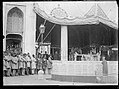 Shah's attendants wearing Sardāri coats (bottom left)
 -
 Naser al-Din Shah's attendants wearing sardāri
 -
 Zand-style Kolijeh and Shal-Kolah
 -
 Afsharid Kolijeh
 -

-
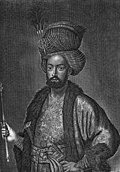 Painting of Shah Soltan Hoseyn, Safavid Kātebi worn over qabā and jeghe-decorated Khalil-Khani and


._Unfinished_watercolor._Private_collection.jpg)
.jpg)


Pants
A wide belt was often worn called Kamarband, from which English gets the word "cummerbund".[159]
Chaqchur

Chaqchur (footed trousers, or čāqčūr), were long pants often in thin black fabric, primarily worn by women, but in later history, they were worn by men.[34] Chaqchur came in two distinct styles, the first style was loose wide-legged trousers with a waistband, ending in stockings (a balloon leg), which covers the body from waist to toes; the second style was similar to a stirrup legging.[34] By the late Qajar era (early 20th century), chaqchur were no longer in style.
Tonoka
Tonoka (tonbān) was a leather pant worn for traditional wrestling and athletics, the style is tight at the waist and just below the knees, and sometimes it had decorative details. The tonoka could have details such as small mirrors sewn over the kneecaps (to display the pant wearer's confidence in their win), or embroidered loops of rough cotton cord to chafe the opponent.[34]
Coats and cloaks
Chador, hijab, and jilbab
Some scholars argue that it was Cyrus the Great who, more than a thousand years before Islam, began the practice of covering women to protect their chastity. The theory holds that the veil then passed from the Achaemenids to the Seleucids and was in turn adopted by the Byzantines, and finally transformed into the hijab by the Arabs, who spread it all over the Muslim world.[160]
The Safavid dynasty centralised Iran and declared Shia Islam as the official religion, which led to the widespread adoption of the hijab by women in the country. Shia Islam served as a tool for the Safavids to consolidate the diverse ethnic groups under their authority and to differentiate themselves from their Sunni Muslim adversaries.[161] Covering the hair has thus long been customary for women in Iran. Iranians generally refer to jilbab by the Persian appellation chador.
-
 18th century silk coat

Footwear

Galesh
Galesh (Persian: گالش) are an ancient style of handwoven shoes, that were once found in Northern Iran.[162]
Persian heeled boots
Ancient Persians used to wear shagreen horse leather high-heeled boots.[163] These heeled boots were created for a strong grip in the stirrup while horse riding, and they were not used for walking.[163] The Achaemenid Empire cavalry had used these boots, and they can be traced as far back as the 10th century.[163][164]
Westernization of Iranian attire
_and_a_military_banner.jpg)
The first reforms occurred in military attire under orders from Abbas Mirza, the Qajar crown prince, as part of efforts to modernize Iran’s armed forces by adopting Western military advancements. Influenced by European models, he introduced new uniforms that were simpler and more practical than the traditional long garments previously worn. These included a white cotton tunic and loose trousers inspired by Russian and Ottoman styles, although initially these changes faced resistance. Critics accused Abbas Mirza of undermining Iranian customs by favoring European coats, boots, and even chairs, which were seen as inappropriate for Persian nobility.[165]
.jpg)
Growing contact with the West exposed Iranians to new fashions, highlighting stark contrasts between traditional Iranian attire and European styles. Over time, European influences grew, leading to debates among officials and intellectuals over adopting Western-style uniforms for comfort, practicality, and economic reasons. Abbas Mirza’s military reforms encouraged simple, functional dress, but conservatives resisted, seeing the abandonment of traditional garments as dishonorable. Under Naser al-Din Shah, the kolāh nezami (military cap) made of Bukhara lambskin became common for soldiers, and reforms introduced fitted coats and trousers, replacing flowing robes and turbans. By the late Qajar era, Western-style short coats and trousers became widespread, especially among the urban elite and military, while rural and tribal populations retained older styles.[165]
the ulama and Shi’a clerical class retained their traditional attire as a marker of religious and social distinction. The garments of the clergy—primarily the qabā, abā, and ammama—carried deep symbolic meaning, signifying piety, continuity, and authority inherited from pre-Islamic and Islamic traditions. These garments became especially significant amidst the domination of urban life by western fashion, further setting the clergy apart. The maintenance of this attire, even as modernizing forces pushed for uniformity in dress, reinforced the clergy’s role as guardians of tradition and allowed them to resist cultural assimilation. Over time, this distinct dress developed into a codified uniform for Shi’a clerics.[166]
-
 Ayatollah Khomeini wearing a qabā under his black abā
 -
 Mullahs in a Friday prayer, wearing traditional clothing
 -
 A cleric wearing a qabā


See also
- Korymbos (headgear)
- Gorjiduz, leather shoe craftsman
- Zardozi
- Central Asian clothing
- Clothing in ancient Greece
- Sasanian dress
- Tocharian clothing
References
- ^ a b پوشاک در ایران باستان، فریدون پوربهمن/ت: هاجر ضیاء سیکارودی، امیرکبیر. 2007. pp. 24, 25, 57.
- ^ Price, Massoume; Waibel, Zohreh (December 2010). Iran: 5000 Years of Clothing, Jewellery and Cosmetics. Anahita Productions Limited. ISBN 978-0-9809714-4-6.
- ^ Houston, Mary G. (2012-03-08). Ancient Egyptian, Mesopotamian & Persian Costume. Courier Corporation. pp. 162–166. ISBN 978-0-486-14265-4.
- ^ Z̤iyāʼpūr, Jalīl (1964). پوشاک باستانی ایرانیان: از کهن ترین زمان تا پایان شاهنامۀ ساسانیان [Ancient Clothing of Iranians: from the Earliest Times to the End of the Sasanian Shahnameh] (in Persian). Idārah-ʹi Kull-i Mūzihʹhā va Farhang-i ʻĀmmah.
- ^ An Encyclopaedia of Textiles from the Earliest Times to the Beginning of the 19th Century. Ernest Flemming (introduction). New York City, NY; Berlin, DE: E. Weyhe and Ernest Wasmuth. 1927. pp. XV–XVI.
{{cite book}}: CS1 maint: others (link) - ^ a b c غیبی، مهرآسا. تاریخ پوشاک اقوام ایرانی. تهران: نشر هیرمند، ۱۳۸۴. ISBN 964-408-050-5.
- ^ a b c "CLOTHING ii. In the Median and Achaemenid periods". Encyclopaedia Iranica. Retrieved 2025-07-25.
- ^ a b c پوربهمن، فریدون؛ ترجمهٔ هاجر ضیاء سِکارودی، ویرایش علمی دنیا مملکتدوست، پوشاک در ایران باستان، تهران: فرهنگستان هنر، مؤسسه تألیف، ترجمه و نشر آثار هنری (متن)، چاپ دوم، ۱۳۸۶،.
- ^ غیبی، مهرآسا. تاریخ پوشاک اقوام ایرانی. تهران: نشر هیرمند، ۱۳۸۴. شابک: ۵-۰۵۰-۴۰۸-۹۶۴.
- ^ Herodotus, Histories, Book 1, chapter 135; Book 7, chapters 61–62.
- ^ Goldman, Bernard (1991). "Women's Robes: The Achaemenid Era". Bulletin of the Asia Institute. 5: 83–103. ISSN 0890-4464. JSTOR 24048288.
- ^ Motevalian, Peyman. Pooshak dar Iran-e Zamin [Clothing in the Land of Iran]. In Maqālāt-e Dāneshnāmeh-ye Iranica [Essays from the Encyclopaedia Iranica Series], 3rd ed. Tehran: Amir Kabir Publications, 1391 [2012].
- ^ Miller, Margaret C. (2004). Athens and Persia in the fifth century B.C.: a study in cultural receptivity (1st pbk. ed.). Cambridge: Cambridge University Press. pp. 165–168. ISBN 0521607582.
- ^ a b c Schmitt, Rüdiger (December 15, 1990). "Candys". Encyclopædia Iranica, Vol. IV. Encyclopaedia Iranica.
- ^ Canepa, Matthew P., The Iranian Expanse: Transforming Royal Identity through Architecture, Landscape, and the Built Environment, 550 BCE – 642 CE, University of California Press, 2018, p. 252. ISBN 9780520290037.
- ^ a b علیرضا شاپور شهبازی، ترجمهٔ محمد حیدرزاده، «پوشاک در دورهٔ مادها و هخامنشیان»، نشریهٔ جُندیشاپور، فصلنامه تخصصی تاریخ دانشگاه شهید چمران اهواز، شمارهٔ ۱۸، تابستان ۱۳۹۸، ص. ۹۰.
- ^ Strootman, Rolf, “Imperial Persianism: Seleukids, Arsakids, Fratarakā”, in R. Strootman & M. J. Versluys (eds.), Persianism in Antiquity, Oriens et Occidens 25, Stuttgart: Franz Steiner Verlag, 2017, p. 188, note 50.
- ^ a b c O. M. Dalton, The Treasure of the Oxus, 3rd ed., London, 1964.
- ^ Vgl. z. B. Heidemarie Koch: Achämeniden-Studien. Wiesbaden 1993, S. 118–134, wo die Kopfbedeckungen der Reliefstatuen von Persepolis beschrieben werden
- ^ a b W. Bailey, “Ariana,” in Donum Natalicium H. S. Nyberg Oblatum, Uppsala, 1954, pp. 1-16.
- ^ R. Schmitt, “Perser und Persisches in der alten attischen Komödie,” Orientalia J. Duchesne-Guillemin Emerito Oblata, Acta Iranica 23, Leiden, 1984, pp. 459-72.
- ^ Strabo. Geographica. Book XV, Chapter 3, Section 15. Translated by H.L. Jones. Loeb Classical Library. Harvard University Press, 1928.
- ^ Xenophon, Anabasis, 2.5.23.
- ^ Plutarch, Life of Artaxerxes, 26, 28.
- ^ D. R. Sear, Greek Coins and Their Values. Asia and North Africa II, London, 1979.
- ^ Boyce, Mary, A History of Zoroastrianism, Volume II: Under the Achaemenians, Handbuch der Orientalistik, Leiden / Köln: Brill, 1982. ISBN 9004065067. pp. 146–147.
- ^ M. A. R. Colledge, Parthian Art, London, 1977.
- ^ A. S. F. Gow, “Notes on the Persae of Aeschylus,” The Journal of Hellenic Studies 48, 1928, pp. 133-58.
- ^ G. Widengren, “Some Remarks on Riding Costume and Articles of Dress among Iranian Peoples in Antiquity,” in Arctica, Studia Ethnographica Upsaliensia 11, 1956, pp. 228-76.
- ^ M. G. Houston, Ancient Egyptian, Mesopotamian and Persian Costume and Decoration, 2nd ed., London, 1954.
- ^ "Sirwāl" in Walther Björkman (1997), Encyclopaedia of Islam, 2nd ed., volume IX: San–Sze, edited by C. E. Bosworth, E. van Donzel, W. P. Heinrichs and the late G. Lecomte, Leiden: E. J. Brill, ISBN 90-04-10422-4, page 676
- ^ عمران, عبدالله (July 2008). "الثقافة الشعبية". www.folkculturebh.org (2). Retrieved 17 August 2018.
- ^ Herodotus, Histories, 1.71; 7.61; 7.64.
- ^ a b c d Ḡolām-Ḥosayn, Yūsofī (December 15, 1992). "Clothing, XXVII. Historical Lexicon of Persian Clothing". Encyclopædia Iranica, Vol. V. pp. 856–865. ISSN 2330-4804.
- ^ a b c MacKenzie, D. N. A Concise Pahlavi Dictionary. Oxford: Oxford University Press, 1971
- ^ a b Ziyābari, Manouchehr. “Pūšāk dar Īrān-zamīn.” In Majmūʿe-ye maqālāt-e Dānešnāme-ye Īrānikā, vol. 1. Tehran: Amir Kabir Publishers, 1382 [2003], p. 133.
- ^ Lerner, Judith A.; Sims-Williams, Nicholas. Seals, Sealings and Tokens from Bactria to Gandhara: 4th to 8th Century CE. Vienna: Verlag der Österreichischen Akademie der Wissenschaften, 2011, pp. 35, 100–101.
- ^ a b Pourbahman, Fereydoun. Pūšāk dar Īrān-e Bāstān. Tehran: Amirkabir, 2006, p. 176.
- ^ ضیاءپور، جلیل. پوشاک باستانی ایرانیان: از کهنترین زمان تا پایان شاهنشاهی ساسانیان. تهران: اداره کل موزهها و فرهنگ عامه، ۱۳۴۳.
- ^ a b c Von Gall, H. “Beobachtungen zum arsakidischen Diadem und zur parthischen Bildkunst.” Istanbuler Mitteilungen 19–20 (1969–1970): 299–318.
- ^ a b Ghirshman, Roman. Iran: Parthians and Sassanians. London: Thames and Hudson, 1962, figs. 100–102.
- ^ Homès-Fredericq, Dorothy. Recherches sur l’iconographie royale parthe. Brussels, p. 18, p. 47.
- ^ "Crown ii. From the Seleucids to the Islamic conquest". Encyclopaedia Iranica. Retrieved 2025-12-30.
- ^ persianacademy.ir https://web.archive.org/web/20131020161224/http://persianacademy.ir/UserFiles/File/NF/09/NF-09-08.pdf. Archived from the original (PDF) on 2013-10-20. Retrieved 2025-12-31.
{{cite web}}: Missing or empty|title=(help) - ^ Whitney, William Dwight. The Century Dictionary: An Encyclopedic Lexicon of the English Language. New York: The Century Company, 1889, p. 3772.
- ^ Von Gall, Hans. “Beobachtungen zum arsakidischen Diadem und zur parthischen Bildkunst.” Istanbuler Mitteilungen 19–20 (1969–1970): 301–309.
- ^ Dio Cassius. Roman History. Book 49, chapter 27, section 4.
- ^ Winkelmann, Jürgen. Die parthische Königsideologie und ihre Darstellung. Pages 139–141
- ^ a b Sellwood, David. An Introduction to the Coinage of Parthia. London: Spink.
- ^ a b c Wroth, Warwick. Catalogue of the Coins of Parthia. London: British Museum, pls. XIII/2–3; XXIV/7; XXV/5–6; XXX/7–14.
- ^ Perkins, Ann. “Parthian Court Dress and Royal Iconography.” p. 105, pl. 46.
- ^ Göbl, Robert. Dokumente zur Geschichte der iranischen Hunnen. pl. 2/21–32.
- ^ a b c d Kawami, Trudy S. Monumental Art of the Parthian Period in Iran. Leiden: Brill, 1987, p. 142, pls. 7, 11, 37–38.
- ^ a b c d e f Harper, Prudence O. The Royal Hunter: Art of the Sasanian Empire. New York: Asia Society, 1978; Silver Vessels of the Sasanian Period I: Royal Imagery. New York: Metropolitan Museum of Art, 1981.
- ^ Meyers, Pieter. Sasanian Court Dress and Insignia. p. 34.
- ^ Lukonin, Vladimir G. Iran in the Early Islamic Period. 1967, pl. 59.
- ^ Vanden Berghe, Louis. Reliefs rupestres d’Élymaïde. pl. 21.
- ^ Grabar, Oleg. Sasanian Silver: Late Antique and Early Mediaeval Arts of Luxury from Iran. Ann Arbor, Mich.: University of Michigan Press, 1967.
- ^ a b Fukai, Shinji; Horiuchi, Kiyoko. Taq-i-Bustan. 2 vols. Tokyo: 1969–1972.
- ^ "FĀRS viii. Dialects". Encyclopaedia Iranica. Retrieved 2025-12-31.
- ^ a b c d Gheybi, Mehrasa (1385 [2006]). *Hašt Hezār Sāl-e Tārikh-e Pošāk-e Aghvām-e Irāni* [Eight Thousand Years of the Clothing History of Iranian Peoples]. Tehran: Hirmand.
- ^ Trilling, James. The Language of Ornament. New York: Thames and Hudson, 2001, pp. 47–49, 64–72, 77.
- ^ Canepa, Matthew. "Dress, Persian." In The Oxford Dictionary of Late Antiquity, edited by Oliver Nicholson. Oxford: Oxford University Press, 2018. ISBN 978-0-19-866277-8.
- ^ Ghirshman, Roman. Persian Art: The Parthian and Sassanian Dynasties. New York: Golden Press, 1962; The Arts of Ancient Iran. New York: Golden Press, 1964.
- ^ Herzfeld, Ernst. Iran in the Ancient East. New York: Oxford University Press, 1941.
- ^ Rosenfield, John M. The Dynastic Arts of the Kushans. Los Angeles: University of California Press, 1967.
- ^ a b Herrmann, Georgina. “The Dārābgird Relief—Ardashīr or Shāhpūr? A Discussion in the Context of Early Sasanian Sculpture.” Iran 7 (1969): 63–88; “The Sculptures of Bahrām II.” Journal of the Royal Asiatic Society 1970/2: 165–171.
- ^ Ingholt, Harald. Studier over palmyrensk skulptur. Copenhagen, 1928.
- ^ Houston, M. G. Ancient Egyptian, Mesopotamian and Persian Costume. 2nd ed. London, 1954.
- ^ Vanden Berghe, Louis; Haerinck, Ernie. Reliefs rupestres de l’Iran ancien. Brussels, 1983.
- ^ Rostovtzeff, Michael. Dura-Europos and Its Art. Oxford: Clarendon Press, 1938.
- ^ W. Hinz, “Das sassanidische Felsrelief von Salmās,” Iranica Antiqua 5, 1965, pp. 148-60.
- ^ a b Frye, Richard N. ed. Sasanian Remains from Qasr i Abu Nasr. Seals, Sealings and Coins. Cambridge Mass.: Harvard University Press, 1973, pl. VIII.
- ^ Scarce, Jennifer M. Women’s Costume of the Near and Middle East. London: Unwin Hyman/HarperCollins, 1987. ISBN: 0-04-391011-4 (9780043910115). Later reprints: Routledge 1995 (ISBN 0700703446) and 2003 (ISBN 0700715606).
- ^ a b c Diba, Layla S. “Clothing x. In the Safavid and Qajar periods.” Encyclopaedia Iranica. Accessed October 23, 2025. https://iranicaonline.org/articles/clothing-x.
- ^ جقه. لغتنامه دهخدا، واژهیاب. دریافتشده در ۱۸ آبان ۱۴۰۰
- ^ «تاج». دانشنامه جهان اسلام، کتابخانه مدرسه فقاهت. دریافتشده در ۱۸ آبان ۱۴۰۰.
- ^ http://vajje.com/search/جقه
- ^ Shahshahani, Sohail. History of Clothing in Iran. Tehran: Modabber, 1995; Ziapour, Jalil. Women’s Clothing of Iran. Tehran: Ministry of Culture and Arts, 1968.
- ^ a b Mir-Sadat Nafavi; Moradi, Mohsen. "A Typological Study of Men’s Headgear in Safavid Travelogues and Paintings, with Emphasis on the Wall Paintings of Chehel Sotoun Palace in Isfahan." Scientific–Research Quarterly of Art Studies (Applied Studies of Islamic Art), Year 2, Issue 3, Autumn–Winter 2012.
- ^ Taqavi Baghan, Malijeh. "A Study of Types of Men’s and Women’s Head Coverings in the Safavid Period." Shekā Journal (Specialized Academic Journal), Year 6, Issue 4 (Serial no. 55), Mehr 1399 [October 2020]. ISSN 2476-3667.
- ^ Keyvani, Mehdi. Artisans and Guild Life in the Later Safavid Period. Tehran, p. 83.
- ^ Careri, Giovanni Francesco. Viaggi. Tehran edition, 1388 [2009], p. 159.
- ^ Olearius, Adam. Iran in the Safavid Period as Seen by a German. Translated by Ahmad Behpour. Tehran: Ebtekar-e No, 2006.
- ^ a b Chardin, Jean. The Travels of Sir John Chardin, vols. II and V. Translated by Eghbal Yaghmaei. Tehran: Tous, 2014.
- ^ Della Valle, André. The Beauties of Iran. Translated by Mohsen Saba. Tehran: Anjoman-e Dustdaran-e Ketab, 1976.
- ^ Tucker 2006a.
- ^ Axworthy 2009, p. 76.
- ^ "Nader Shah". Encyclopaedia Iranica. Retrieved 2025-10-23.
- ^ Rezvani Naraghi, Ashkan. A Social History of Modern Tehran: Space, Power, and the City. Cambridge: Cambridge University Press, 2023, p. 289.
- ^ Gheibi, Mohammad (2008). Tarāhī va Pādoš-e Poshāk dar Irān [Design and Function of Clothing in Iran]. Tehran: Markaz-e Asnād-e Farhangī. p. 490.
- ^ Javaherāt-e Saltanati-ye Iran [Royal Jewels of Iran]. Tehran: Central Bank of Iran, Banknote Printing and Minting Organization. (in Persian).
- ^ تاج بخش پنجم، دورههای قاجار و پهلوی». دانشنامه ایرانیکا
- ^ a b c d Morier, James Justinian. A Journey through Persia, Armenia, and Asia Minor, to Constantinople, in the Years 1808 and 1809. London: Longman, Hurst, Rees, Orme, and Brown, 1812
- ^ Masaharu, Yoshida. Safar-nāmeh-ye Yoshida Masaharu. Translated by Mohammad Rajabzadeh. Tehran: Astan-e Quds-e Razavi, 1373 SH.
- ^ Michel, Joseph. Lettres sur la Perse et la Turquie d’Asie. Paris: Dentu, 1810.
- ^ Ursul. The Travelogue of Ursul. Translated by A. A. Saeidi. Offset edition, n.p., n.d.
- ^ Dieulafoy, Jane. The Travelogue of Madame Dieulafoy. Translated by Farreh-Vashi. Tehran: Qesseh-Pardaz.
- ^ Balland, Daniel; Digard, Jean-Pierre. “Felt.” Encyclopaedia Iranica, vol. IX, fasc. 5 (2012): 484–489.
- ^ Shahri, Jaʿfar. “تصاویر سفر به تهران قدیم؛ چگونه سر همه تهرانیها کلاه گذاشتند؟ چرا لباس متحدالشکل؟” Faradeed, 26 February 2025.
- ^ Yaghoubzadeh, Hadi; Mafi-Tabar, Ameneh. “A Study on the Main Causes of Distinction of Turban as the Dress of Shiite Clergy in the Qajar Era.” Quarterly Journal of Discourse of History 17, no. 43 (Autumn 2023): 7–32. DOI 10.22034/SKH.2023.14550.1349.
- ^ Jangjou Gholenji, Shahnaz. “Investigating the Process of Changing in Men’s Clothing Styles during the Qajar Era.” Scientific Quarterly of Culture Studies – Communication 26, no. 69 (Spring 2025): 252.
- ^ «معنی عمامة | لغتنامه دهخدا». واژه یاب. دریافتشده در ۲۰۲۵-۰۹-۰۷.
- ^ "چند متر پارچه روی سر آخوندهاست؟". ایندیپندنت فارسی (in Persian). 2021-03-18. Retrieved 2026-01-02.
- ^ "عمامه طلبه ها نشانه چیست؟". مشرق نیوز (in Persian). 2012-11-28. Retrieved 2026-01-02.
- ^ "همه چیز درباره لباس روحانی ها". fa (in Persian). 2009-08-24. Retrieved 2026-01-02.
- ^ نیوز, اخبار روز ایران و جهان | آفتاب. "تاریخچه عمامه / چرا روحانیان عمامه بر سر می گذارند؟". fa (in Persian). Retrieved 2026-01-02.
- ^ ایران, عصر. "شرایط و مقررات عمامه گذاری چیست؟". fa (in Persian). Retrieved 2026-01-02.
- ^ "درباره ما". معاونت تهذیب و تربیت حوزه های علمیه (in Persian). Retrieved 2026-01-02.
- ^ «انواع قبا»، وبسایت ربیع.
- ^ سعادتی نیک، «تاریخچه لباس روحانیت»، وبسایت مرکز دائره المعارف بزرگ اسلامی.
- ^ Scientific Information Database (SID), https://www.sid.ir/fa/journal/ViewPaper.aspx?id=498708. Accessed 9 October 2023.
- ^ یعقوبزاده و مافیتبار، «بازیابی زمینههای تحدید قبا و عبا به روحانیت شیعه در عصر قاجار»، 1400ش، ص137-139.
- ^ حاتمی، «لباس روحانیت از ابتدای پیدایش تاکنون»، وبسایت شفقنا.
- ^ یعقوبزاده و مافیتبار، «بازیابی زمینههای تحدید قبا و عبا به روحانیت شیعه در عصر قاجار»، 1400ش، ص138-150.
- ^ یعقوبزاده و مافیتبار، «بازیابی زمینههای تحدید قبا و عبا به روحانیت شیعه در عصر قاجار»، 1400ش، ص135-136.
- ^ "CLOTHING x. In the Safavid and Qajar periods". Encyclopaedia Iranica. Retrieved 2025-07-22.
- ^ "CLOTHING x. In the Safavid and Qajar periods". Encyclopaedia Iranica. Retrieved 2026-01-03.
- ^ Qasemi, Zahra; Houshyar, Mehran; Khanakeh, Mehdi. "A Comparative Study of Motifs and Types of Embroidery in the Clothing of Women and Men at the Qajar Court." Hasti Scientific Journal, no. 22, 2022, pp. 160–162. doi:10.22052/HSL.2022.243618.0.
- ^ Negārestān Museum, Tehran, no. 75.4.1, pl. CXXI.
- ^ a b Mafi-Tabar, Ameneh. “Clothing of Social Classes in Isfahan during the Reign of Shah Suleiman Safavi, According to Genre Paintings (Cultural Narratives) in Engelbert Kaempfer’s Travelogue.” Rahpouyeh Journal of Visual Arts, Vol. 8, No. 2, Summer 1404 [2025], pp. 17–31.
- ^ a b Polak, Jakob Eduard. Travelogue of Polak. Translated by Keykavus Jahandari. 2nd ed. Tehran: Kharazmi, 1368 [1989].
- ^ Dal Zendeh, Siamak. Transformations of Visual Art in Iran. Tehran: Cheshmeh Cultural Institute, 1396 [2017].
- ^ "معنی "لبادة" در "لغتنامۀ دهخدا"".
- ^ Yaseri, Somayeh; Karimi, Maryam. Pūshāk-i sunnatī bih nām-i qabā dar jāmi‘a-yi Īrān [Traditional clothing called qaba in Iranian society]. Samnan University, Faculty of Art and Textile Design, 2019. Retrieved from https://www.sid.ir/fa/journal/ViewPaper.aspx?id=498708.
- ^ مستند خیاطی که برای روحانیون لباس میدوزد، خبرگزاری ایسنا.
- ^ Shirazi, Mohammad Ali Khan (1894). Nazem al-Atibba (ناظمالاطباء) (in Persian). Tehran: Dar al-Taba'eh al-Amirah.
- ^ Dehkhoda, Ali Akbar. Loghatnameh-ye Dehkhoda (لغتنامه دهخدا) (in Persian). Tehran: Tehran University Press.
- ^ "عبا | مرکز دائرةالمعارف بزرگ اسلامی". www.cgie.org.ir (in Persian). Archived from the original on 2024-04-30. Retrieved 2025-07-22.
- ^ Yousefi, Gholamhossein (1371). Yaddasht-hayi dar zamine-ye farhang va tarikh [Notes on Culture and History]. Tehran: Sokhan Publications. pp. 723–724.
- ^ Yaseri, Somayeh; Karimi, Maryam (2018). “Poushak-e sonati be nam-e qaba dar jame’a-ye Iran” [Traditional clothing called Qaba in Iranian society]. Journal of Traditional Iranian Culture, received: 2018-09-10, approved: 2018-12-25.
- ^ خاطرات صدرالاشراف، صفحه 618.
- ^ حمیدرضا فرهمند. «لباس بهانه ای بیش نبود».
- ^ ^ "KFtan". TDV İslâm Ansiklopedisi. 23 Eylül 2020 tarihinde kaynağından arşivlendi. Erişim tarihi: 24 Ocak 2023.
- ^ Ali Akbar Dehkhoda, Loghatnāmeh-ye Dehkhodā [Dehkhoda Dictionary], entry "Khaftān (خفتان)", University of Tehran Press, available online at vajehyab.com.
- ^ Cosman, Madeleine Pelner; Jones, Linda Gale (2009). Handbook to Life in the Medieval World, 3-Volume Set. Infobase Publishing. ISBN 978-1-4381-0907-7.
- ^ Adler, Cyrus; Casanowicz, Immanuel M. (1898). Biblical Antiquities: A Description of the Exhibit at the Cotton States International Exposition, Atlanta, 1895. U.S. Government Printing Office.
- ^ Gratta, Delia (2016). Garments in Safavid Iran: The Visual Narratives that Claimed Power (Thesis). University of California, Santa Barbara. p. 7.
- ^ a b Moore, Jennifer Grayer, ed. Patternmaking History and Theory. London: Bloomsbury Publishing, 2019, p. 209. ISBN 9781350049507
{{isbn}}: Checkisbnvalue: checksum (help). - ^ Hauptmann von Gladiss, A.; Kröger, J. Museum für Islamische Kunst II: Metall, Stein, Stuck, Holz, Elfenbein, Stoffe. Berlin: Staatliche Museen Preussischer Kulturbesitz; Mainz, 1985.
- ^ Hanway, Jonas. An Historical Account of the British Trade over the Caspian Sea. 2nd ed., 2 vols. London, 1754.
- ^ Wills, Charles James. In the Land of the Lion and Sun: or, Modern Persia. London: Macmillan and Co., 1883.
- ^ Charles James Wills, *Iran dar Yek Qarn-e Pish: Safarnameh-ye Dr. Wills*, vol. 1, trans. Gholamhossein Qaragozlou, Tehran: 1989 [1368 SH], p. 360.
- ^ Jaburi, Yahya Wahib. al-Malabis al-‘Arabiyya fi al-Shi‘r al-Jahili. Vol. 1. Beirut, 1989.
- ^ Gluck, Jay; Gluck, Sumi Hiramoto (1977). A Survey of Persian Handicraft: A Pictorial Introduction to the Contemporary Folk Arts and Art Crafts of Modern Iran. Survey of Persian Art.
- ^ Akbar Shirazadeh, “A Study on Termeh Design and Its Relation to Rulers and Kings,” Tarikh-e Nassaji [Textile History], Part 7.
- ^ Nasim Keyhani, Farhang-e Estelahat-e Parché va Pooshak dar Iran (az Doran-e Bastan ta Aghaz-e Asr-e Pahlavi), Tehran: Institute for Humanities and Cultural Studies, 2008 [1387 SH], pp. 42–43.
- ^ Fereydoun Adamiyat, *Amirkabir and Iran*, Tehran: Kharazmi Publishing, 1983, p. 41.
- ^ Mohammad Reza Chitsaz, Tarikh-e Poushak-e Iranian: Az Ebteda-ye Eslam ta Hamleh-ye Moghol, Tehran: 2000 [1379 SH], p. 207.
- ^ Ibn Kathir, al-Bidaya wa’l-Nihaya, vol. 12, Beirut: Ali Shiri edition, 1988 [1408 AH], p. 318.
- ^ Mohammad ibn Monavvar, Asrar al-Tawhid fi Maqamat al-Sheikh Abi Sa‘id, vol. 1, Tehran: ed. Mohammad Reza Shafiei Kadkani, 1987 [1366 SH], p. 48.
- ^ Mafi Ghiar, Amena; Sharifzadeh, Sayyid Abdolmajid (2023). "The Effect of Changes in the Form of Men's Outer Garments in the Qajar Era on the Qualitative Characteristics of Practical Textiles (From the Perspective of Design, Pattern, Color, and Material)". Rahpooyeh Honar/Visual Arts (in Persian). 6 (2): 81.
- ^ Brugsch, Heinrich (1374 [1995]). *Dar Sarzamin-e Aftab* [In the Land of the Sun], trans. Majid Jalilvand. Tehran: Markaz.
- ^ Sprey, Wilfrid (1379 [2000]). *Bachehā-ye Darbār* [Children of the Court], trans. F. Shahlouyipour. Tehran: Anjoman-e Qalam-e Iran.
- ^ Mafi Ghiar, Amena; Sharifzadeh, Sayyid Abdolmajid (2023). "The Effect of Changes in the Form of Men's Outer Garments in the Qajar Era on the Qualitative Characteristics of Practical Textiles (From the Perspective of Design, Pattern, Color, and Material)". Rahpooyeh Honar/Visual Arts (in Persian). 6 (2): 84.
- ^ Wills, Charles James. Tarikh-e Ejtemai-ye Iran dar Ahde Qajariyyeh [The Social History of Iran in the Qajar Era] (in Persian). Translated by Seyyed Abdollah. Tehran: Zarrin.
- ^ Durand, E.L.R. Safarnameh-ye Durand [The Travelogue of Durand] (in Persian). Translated by Alimohammad Saki. Khorramabad: Shapurkhast.
- ^ Dieulafoy, Jane. Safarnameh-ye Iran va Kaldeh [The Travelogue of Iran and Chaldea] (in Persian). Translated by Homayoun Farhoushi. Tehran: Khayyam.
- ^ "Cummerbund". Lexico UK English Dictionary. Oxford University Press. Archived from the original on 29 July 2020.
- ^ Mackey, Sandra & Harrop, Scott (1996). The Iranians: Persia, Islam and the Soul of a Nation. Penguin. ISBN 978-0-452-27563-8. OCLC 38995082.
In the endless debate on the origin and practice of veiling in the Islamic world, which many see as symbolic of woman's inferior status to man, some historians argue that it was Cyrus the Great who, ten centuries before Islam, established the custom of covering women to protect their chastity. According to this theory, the veil passed from the Achaemenians to the Seleucids. They, in turn, handed it to the Byzantines, from whom the Arab conquerors inherited it, transmitting it over the vast reaches of the Arab world.
- ^ "Safavid dynasty". Britannica. 2023-10-10. Retrieved 2023-11-06.
- ^ Snodgrass, Mary Ellen (2015-03-17). World Clothing and Fashion: An Encyclopedia of History, Culture, and Social Influence. Routledge. p. 326. ISBN 978-1-317-45167-9.
- ^ a b c Ingevaldsson, Jesper (2020-03-29). "History: Heels". Shoegazing.com. Retrieved 2024-02-21.
- ^ "The fascinating evolution of heels: From men in Persia to a feminine fashion icon". The Economic Times. 2023-10-06. ISSN 0013-0389. Retrieved 2024-02-21.
- ^ a b Jangjou Gholenji, Shahnaz (Spring 2025). "Investigating the Process of Changing in Men's Clothing Styles during the Qajar Era" (PDF). Scientific Quarterly of Culture Studies – Communication. 26 (No. 69): 252.
- ^ Hadi Yaghoubi-Zadeh and Amina Mafi-Niar, “Re-evaluating the Contexts of Renewal of Qaba and Aba for Shi’a Clergy in the Qajar Era,” Studies in Cultural History, vol. 13, no. 50, Winter 2022–2023, pp. 157–175.
Sources
- Axworthy, Michael (2009). The Sword of Persia: Nader Shah, from Tribal Warrior to Conquering Tyrant. I.B. Tauris.
- Tucker, Ernest (2006a). "Nāder Shāh". Encyclopaedia Iranica.