

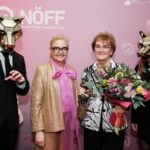
Grekov Odesa Art School
46°29′16″N 30°44′0″E / 46.48778°N 30.73333°E
 | |
Former name | Odessa Art School of Drawing (aka the Odessa Art School) |
|---|---|
| Type | Art School |
| Established | May 29, 1865 |
| Address | Ukraine, Odesa St. Preobrazhenskaya, 14, 14/16 , Odessa , Ukraine 46°29′17″N 30°44′03″E / 46.48816423446883°N 30.734051821450493°E |
| Website | https://grekovka.com.ua/ |
The Grekov Odesa Art School (1865–present) [Ukrainian: Одеське художнє училище імені Митрофана Грекова; abbreviated ОХУ] is an accredited full-time four-year art school in Odesa, Ukraine, with an educational approach focused on small-group learning in one of four fine arts disciplines: Painting (живопис), Sculpture (скульптура), Decorative Art (ceramics, batik) (художнє декорування середовища) and Design (artwork) (дизайн).[1][2]
Founded by the patrons of Odessa's Society of Fine Arts, which included Governor-General P. Kotzebue, Mayor M. Novoselsky, Princes Gagarins (a prominent Russian noble of Rurikid descent), a Count Tolstoy (likely related to the author), the Italian Consul General of Castile, and several renowned architects, including Francesco Boffo, the art school is the oldest in Ukraine.[1] It is most notable, however, for training several generations of artists like David Burliuk, Franz Roubaud, Leonid Pasternak, and Amshei Nurenberg in the "Ukrainian avant-garde, an artistic and cultural movement emerging from the 1900s to the 1930s, a unique combination of Ukrainian folk art and European modernist trends, including Cubism, Futurism, Constructivism, and Symbolism."[3][4][5]
History and Reputation
In the early 1900s, the school blossomed under the leadership of painter and art scholar Kyriak Kostandi.[1] A dedicated Russian realist, and follower of the Peredvizhniki (lit. Itinerants) movement, he ultimately integrated impressionist techniques into his work to fully realize the emotional impact he sought.[6] He encouraged his students to learn foundational techniques at the school, and then study the avant-garde in Paris, the birthplace of Impressionism (c.1860s–1880s), Fauvism (c. 1905), and Cubism (c. 1907-08); and in Munich, the eponymous birthplace of the Munich Secession (c. 1895–1910), Jugendstil (c. 1890–1910) and, in 1920, Bauhaus.
In Munich, artists Wassily Kandinsky and David Burliuk helped sculptor and alumnus Vladimir Izdebsky organize the 1909 and 1910 "Izdebsky Salons"—the first and hugely influential exhibitions of modern Western Art in the Russian Empire.[5] When students returned from abroad, Kostandi also took care to help showcase what they had learned. At the same time, the school was also unique for admitting Jewish students without restriction in an era when that was rare. "Few were able to continue their education at the very conservative Imperial Academy of Arts in Saint Petersburg; the Moscow School of Painting, Sculpture and Architecture would not admit Jews at all," Gregory Vernitsky writes in "Kandinsky's Odessa, Ukraine Context: The Fate of Modern Art in the Russian Empire."[5] By 1904, 60 percent of the student body was Jewish, and a few went on to teach there, furthering the tradition of building on traditional technique in modernist ways.[7][8] Collectively, students came to be called "Odessa Parisians."[9]
Building and Identity
For twenty years, the school survived on donations and had no permanent address. The Vice President of Odesa Society of Fine Arts Franz Morandi became involved in its funding. The first plaster casts, prints, models were discharged to him from the Milan Academy of Fine Arts, with which he had good relations.[1]
On May 22, 1883, outside Preobrazhenska str., the cornerstone of the art school was laid. In 1885, the school moved to its current premises. On December 30, 1899, the sponsor approved the charter and the state of the Art School. Grand Duke Vladimir Alexandrovich was a sponsor of the school for 25 years until he died in 1909. Until 1917, the Odesa Art School had the name of Grand Duke. In 1924 the school was renamed the Polytechnic College of Fine Arts, which prepared muralists, printers and potters. In 1930, Polytechnic College was renamed again to an Art Institute (high education), but in 1934 the Odesa Art Institute once again became a secondary education school.[1]
In 1965, in honour of the school's 100th-anniversary, the school was renamed for painter Mitrofan Grekov, renowned as the "father of military battle painting," who got his start at the Odesa Art School and later attended the St. Petersburg Academy of Arts under the mentorship of painters Ilya Repin and Franz Roubaud.[10]
Alumni Art and Design
(Selection was limited by availability.)
-
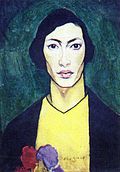 Natan Altman, self-portrait, 1911.
 -
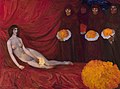 Boris Anisfeld, "The Golden Tribute," ca. 1908.
 -
 Isaak Brodsky, self-portrait, ca. 1917.
 -
 David Burliuk,"Advent of Spring," 1914.
 -
 Yakov Chernikhov, "Composition No. 3," from the color printing book The 101 Architectural Fantasies, ca. 1933.
 -
 Stanisław Chlebowski, "Sultan’s White Camel," sketch - MP 1059 MNW - National Museum in Warsaw, 1871.
 -
 Leonid Mezheritski, self-portrait, 1968.
 -
 Amshey Nurenberg, self-portrait, 1945.
 -
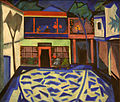 Iosif Shkol'nik, "The Turkish Central Courtyard," 1917.
 -
 Vassily Kandinsky, "Odessa Port," 1898.
 -
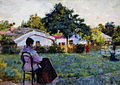 Kyriak Kostandi, "At the Dacha. Noon," 1892.
 -
 Iosif Langbard, "Preliminary design of the Government Center of Kyiv," 1936.
 -
 Oksana Mas, "Altar of Nations," Kyiv, 2012.
 -
 Leonid Mezheritski, "Beach of Bolshoi Fontan," 1961.
 -
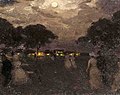 Pyotr Nilus, "Evening Walk," ca. 1943.
 -
 Amshey Nurenberg, "War-Disabled" (Victim of a Jewish Pogrom), 1926.
 -
 Abel Pann, "The Scapegoat and the Black Sheep of Europe," 1915.
 -
 Leonid Pasternak, "A Sun-Beam. Interior." Pastel on paper, n.d.
 -
 "On the Banks of the Kura in Tbilisi," signed, indistinctly dated F. Roubaud 1916, oil on wood, 31 x 44.5 cm.
 -
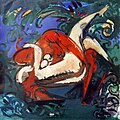 Vasiliy Ryabchenko, "Embrace," oil on canvas, 1986.
 -
 Nikolai Sednin, "Creation," oil on canvas, 1999.
 -
 Joseph Solomonovich Shkolnik, "Joseph the Schoolboy: Still Life with a Yellow Tablecloth," 1926.
.jpg)
.jpg)


.jpg)


.jpg)


Alumni Photos
(Selection was limited by availability.)
-
 Nathan Altman, 1911.
 -
 Bois Anisfeld, 1900.
 -
 Joseph Barsky, 2025.
 -
 David Burliuk, 1914.
 -
 Malarz Stanisław Chlebowski,1879.
 -
 Lucien Dulfan, 2012.
 -
 Vassily Kandinsky, 1913.
 -
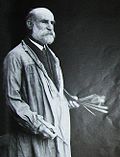 Kiriak Konstantinovich Kostandi, 1910.
 -
 Iosif Grigorevich Langbard, Architect, ca. 1941.
 -
 Oksana Mas, 2009.
 -
 Abel Pann, 1912.
 -
 Leonid Pasternak, 1905.
 -
 Vasyl Andreyevich Ponikarov, 2008.
 -
 Franz Alekseevich Roubard, ca. 1890.
 -
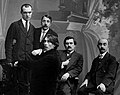 Pavel Filonov, Mikhail Matyushin, Alexei Kruchenykh, Kazimir Malevich, Iosef Shkolnik, 1913.
 -
 Oleksii Shovkunenko, n.d.


Notable alumni
- Nathan Altman
- Boris Anisfeld
- Joseph Barsky
- Isaak Brodsky
- David Burliuk
- Yakov Chernikhov
- Stanisław Chlebowski
- Lucien Dulfan
- Samson Flexor
- Vladimir Gorb
- Wassily Kandinsky[11]
- Valentin Khrushch
- Kyriak Kostandi
- Sasha Krasny
- Iosif Langbard
- Oksana Mas
- Michael Matusevitch
- Lev Meshberg
- Leonid Mezheritski
- Pyotr Nilus
- Amshey Nurenberg
- Abel Pann
- Leonid Pasternak
- Vasyl Ponikarov
- Aleksandr Razumny
- Franz Roubaud
- Vasiliy Ryabchenko
- Yuri Salko
- Sergey Savchenko
- Nikolay Sednin
- Iosif Shkolnik
- Oleksii Shovkunenko
- Alexander Stovbur
- Stanislav I. Sychov
- Alexander Telalim
- Oksana Zhnikrup
References
- ^ a b c d e "Історична Довідка – Одеський художній фаховий коледж ім.М.Б.Грекова" (in Ukrainian). Retrieved 2026-03-12.
- ^ "Grekov Odessa Art school, Ukraine's oldest art college, celebrates 155 years' birthday". odessa-journal.com. 2020-09-12. Retrieved 2023-01-03.
- ^ "Ukrainian Avant-garde. Era of Innovators | Featuring Ukraine". Rukh Art Hub. Retrieved 2026-03-12.
- ^ "The Jewish theme in the works of Odessa artists of the XIX-XXI centuries: from Leonid Pasternak to Aleksandr Roitburd". ART Ukraine. 2011-10-25. Retrieved 2026-03-12.
- ^ a b c "Kandinsky's Odessa, Ukraine Context: The Fate of Modern Art in the Russian Empire | Gregory Vernitsky | Scene4 Magazine | February 2023". www.scene4.com. Retrieved 2026-03-12.
- ^ "Kostandi, Kyriak". www.encyclopediaofukraine.com. Retrieved 2026-03-12.
- ^ "Conclusion: The Peredvizhniki in a Broader European Context". Art and Commerce in Late Imperial Russia: 217–222. 2019. doi:10.5040/9781501335556.ch-010.
- ^ Gray, Susan (2024-06-28). "The art that made Ukraine and the Jewish artists who made it". The Jewish Chronicle. Retrieved 2026-03-12.
- ^ "AMSHEY NURENBERG". www.amshey-nurenberg.com. Retrieved 2026-03-12.
- ^ "Grekov Studio of War Artists | The Tretyakov Gallery Magazine". www.tretyakovgallerymagazine.com. Retrieved 2026-03-12.
- ^ "Kandinsky Sketchbook". UIMA. Retrieved 2023-01-03.
External links
- Grekov Odesa Art School website (in Ukrainian)
- State of the school, March 2015
- Odesa National Fine Arts Museum (in Ukrainian)