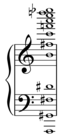
Elektra chord

Elektra chord
Component intervals from root
diminished fourth
minor second
diminished seventh
perfect fifth
root
Forte no. / Complement
5-32 / 7-32
Elektra chord implies an E major and C major chord together (C E G = D F A)
Each chord separately as arpeggio then both simultaneously

The Elektra chord is a "complexly dissonant signature-chord"[1] and motivic elaboration used by composer Richard Strauss to represent the title character of his opera Elektra that is a "bitonal synthesis of E major and C-sharp major" and may be regarded as a polychord related to conventional chords with added thirds,[2] in this case an eleventh chord. It is enharmonically equivalent to a 79 chord, D–F–A–C–E, and a 69 chord, E–G–B-C-F.

 {
\override Score.TimeSignature #'stencil = ##f
\relative c' { 
  \clef treble \time 4/4 <e b' des f aes>1
} }

In the opera, the chord—Elektra's "harmonic signature"—is treated various ways betraying "both tonal and bitonal leanings... a dominant 4
2
over a nonharmonic bass." It is associated as well with its seven-note complement which may be arranged as a dominant thirteenth[1] while other characters are represented by other motives or chords, such as Klytämnestra's contrasting harmony. The Elektra chord's complement appears at important points and the two chords form a 10-note pitch collection, lacking D and A, which forms one of Elektra's "distinctive 'voices'."[3]

Motivic elaboration of Elektra chord

Use in other works

The chord is also found in Claude Debussy's Feuilles mortes, where it may be analyzed as an appoggiatura to a minor ninth chord, Franz Schreker's Der ferne Klang, and Alexander Scriabin's Sixth Piano Sonata.[2]

See also

References

  1. ^ a b Lawrence Kramer. "Fin-de-siècle Fantasies: Elektra, Degeneration and Sexual Science", Cambridge Opera Journal, vol. 5, no. 2. (July 1993), pp. 141–165.
  2. ^ a b H. H. Stuckenschmidt; Piero Weiss. "Debussy or Berg? The Mystery of a Chord Progression", The Musical Quarterly, vol. 51, no. 3. (July 1965), pp. 453–459. JSTOR 740834
  3. ^ Carolyn Abbate, "Music and Language in Elektra", in Richard Strauss: Elektra, ed. Derrick Puffett, Cambridge Opera Guides (Cambridge, 1989), 107–127. Cited in Kramer (1993), p. 156.