:::::'''Create the page "<span class="plainlinks">[https://en.wikivoyage.org/w/index.php?title=Aaron_Swartz&action=edit&redlink=1 <span style="color:#CC2200">Aaron Swartz</span>]</span>" on this wiki!''''
:::::'''Create the page "<span class="plainlinks">[https://en.wikivoyage.org/w/index.php?title=Aaron_Swartz&action=edit&redlink=1 <span style="color:#CC2200">Aaron Swartz</span>]</span>" on this wiki!''''
::::This is humiliating! They clicked the link to know more about. We shouldn't offer to given anything if we have nothing on it! This is just disruptive. (I was hurt by the Wikiquote links, and felt really embarrassed. It also left me a bad impression of the site. The same would happen to that unfortunate fellow) And suppose that the user were ''inspired'' to create it. You can guess what would happen! If he keeps his ''inspiration'' up, he would soon get blocked. If we are looking to ''advertise'' the project or ''recruit'' more members, we should think of better ways, not by hurting the readers.<span style="text-shadow:gray 0.2em 0.3em 0.2em">···[[User:Vanischenu|'''V<span style="color:green;">ani</span>s<span style="color:green;">che</span>nu''']][[Special:Contributions/Vanischenu|<sup>「m</sup>]]/[[User_talk:Vanischenu|<sub>Talk」</sub>]]</span> 19:54, 16 March 2013 (UTC)
::::This is humiliating! They clicked the link to know more about. We shouldn't offer to given anything if we have nothing on it! This is just disruptive. (I was hurt by the Wikiquote links, and felt really embarrassed. It also left me a bad impression of the site. The same would happen to that unfortunate fellow) And suppose that the user were ''inspired'' to create it. You can guess what would happen! If he keeps his ''inspiration'' up, he would soon get blocked. If we are looking to ''advertise'' the project or ''recruit'' more members, we should think of better ways, not by hurting the readers.<span style="text-shadow:gray 0.2em 0.3em 0.2em">···[[User:Vanischenu|'''V<span style="color:green;">ani</span>s<span style="color:green;">che</span>nu''']][[Special:Contributions/Vanischenu|<sup>「m</sup>]]/[[User_talk:Vanischenu|<sub>Talk」</sub>]]</span> 19:54, 16 March 2013 (UTC)
:::::Finally, the template reads "Find more about '''<nowiki>{{PAGENAME}}</nowiki>''' at Wikipedia's [[Wikipedia:Wikimedia sister projects|sister projects]]"<span style="text-shadow:gray 0.2em 0.3em 0.2em">···[[User:Vanischenu|'''V<span style="color:green;">ani</span>s<span style="color:green;">che</span>nu''']][[Special:Contributions/Vanischenu|<sup>「m</sup>]]/[[User_talk:Vanischenu|<sub>Talk」</sub>]]</span> 20:04, 16 March 2013 (UTC)
:::::Finally, the template reads "Find more about '''<nowiki>{{PAGENAME}}</nowiki>''' at Wikipedia's [[Wikipedia:Wikimedia sister projects|sister projects]]" and not as "check if there is anything about..."<span style="text-shadow:gray 0.2em 0.3em 0.2em">···[[User:Vanischenu|'''V<span style="color:green;">ani</span>s<span style="color:green;">che</span>nu''']][[Special:Contributions/Vanischenu|<sup>「m</sup>]]/[[User_talk:Vanischenu|<sub>Talk」</sub>]]</span> 20:04 & 20:08, 16 March 2013 (UTC)
I noted that a user removed {{Commons cat}} due the concurring presence of {{Sister project links}}. In my opinion it should not affect or discurage the use of {{Commons category}} or {{Commons}} because {{Sister project links}} simply "provides links to the 'Search' page on the various Wikimedia sister projects". It does not grant that any related content actually exist, it is just a (blind) guess. {{Commons}} and {{Commons cat}} instead state that Wikimedia Commons actually has media related to the subject and provide a link to it. This is a precious information. It is the difference between the search function and a link. -- Basilicofresco (msg) 15:23, 21 November 2010 (UTC)[reply]
I'm seeing this with {{wikivoyage}} and {{sister project links|voy...}} as well, what needs to happen (instead of having two templates for the same siblings, one of which launches a pointless search) is that this template needs to link directly to a page whenever a pagename or category name is fed as a parameter. No reason to invoke special:search at all if the target is already provided and in the crosshairs. K7L (talk) 18:54, 13 November 2012 (UTC)[reply]
ELNO?
Can someone explain to my why this whole template doesn't run afoul of WP:ELNO #9? The entries in the box created by this template consist only of search engine links, and ELNO#9 disallows "links to any search results pages, such as links to individual website searches, search engines, search aggregators, or RSS feeds." —David Eppstein (talk) 18:21, 20 August 2012 (UTC)[reply]
I also dislike Special:Search’es as a permanent solution – EL or ELNO, but it is just a silly complication in the worst tradition of 21th-century technology. Replace all of these to direct links, yeah. Resulting dead links, IMHO, can be reduced with bots. Incnis Mrsi (talk) 19:12, 2 September 2012 (UTC)[reply]
If the user explicitly specified a target, such as {{sister project links|voy=Europe}}, the template needs to send them directly to that page... launching a search is superfluous. The same applies if the user specifies a Commons category or anything else specified right in a parameter. I could explicitly set every parameter to a specific page or category and still have them all become search links... why? Perhaps fr:modèle:autres projets (where the links go to only the projects listed, and the target pages are specified by name) would be a proper example of what needs to happen in any case other than this being arbitrarily dropped on the page with no parameters at all. K7L (talk) 18:47, 13 November 2012 (UTC)[reply]
Create a new template?
It looks like other-language versions of this template, like fr:modèle:autres projets, default to all-links-off and most do *not* use blind links to Special:Search on other projects. If a destination page is explicitly specified, the template links there; if not, the template does nothing. This is an important distinction as fr: has already scrapped {{commons category}} and the like to put everything in "autres projects" while pt: has deprecated the individual templates (and will remove them from pages with the same link in the "correlatos" box, which looks like this one but with all links off until a destination is explicity specified). We can't do that because the presence of a project in this box tells the user nothing as to whether the destination page exists. The link to Special:Search is also an SEO blunder as special: pages are flagged in robots.txt as something spiders should not index, making these hard to follow for search engines. I'm thinking there should be a version of "correlatos"/"autres projets" in en: which is not a look-alike of this template and does not link to Special:Search (but only to actual extant, usable destination pages).
I don't believe this template *can* be salvaged as it has already been randomly dumped on too many pages with no parameters at all. There should be two versions of the template; one should have "Search for {PAGENAME} in other Wikimedia projects" and do what this one is currently doing, the other should have "These wikis have more info on {PAGENAME}" and link directly to only destination pages which were explicitly specified (much like dropping {{commons category}} on a page links directly to a named category, not a search page). Get rid of Special:Search for all instances where the destination page is already indicated (and not merely defaulted to {PAGENAME}). We already have the manually-specified name, link there.
The only place where any template should blindly link Special:Search/{PAGENAME} is if that template is called with no parameters at all.
The problem with templates which blindly invoke a search is that they're being proposed as replacements for individual links directly to projects like {{wiktionary}} or {{wikivoyage}}. If they neither indicate to the reader whether the destination page exists nor provide a direct link (without going through Special:Search) to get to that page, they are no substitute for the individual templates currently in use and any replacement of individual link templates with {{sister project links}} in its current form is very inadvisable. K7L (talk) 18:05, 11 February 2013 (UTC)[reply]
Now that Wikivoyage has launched, should the link to there be opt-out instead of opt-in? I've boldly made it so, but feel free to revert (and explain here) if you disagree. MER-C10:47, 15 January 2013 (UTC)[reply]
I see one potentially-major problem... while the {{wikivoyage}} and {{wikivoyage-inline}} templates point directly to the specified article on the destination wiki, this kludge of a "sister project links" template instead blindly and arbitrarily links to Special:Search on each targeted project. This is ugly.
It might be a bit late for that. This template was designed with the theory that it could be randomly and indiscriminately dumped on pages without parameters and used to blindly launch Special:Search on a long list of random projects with {PAGENAME} as an implicit target. That's not the same as the individual {{commons category}}, {{wikivoyage}} or other individual-sibling links where the target is named explicitly, is a mainspace page instead of Special:Search, has actually been verified to exist and to contain usable content (and not a stub, outline, empty category or page nominated for deletion). I realise that fr: scrapped and deleted all of their individual-sibling templates in favour of {{fr:modèle:autres projets}} a few months ago, but that template was a direct link to manually-selected interwiki targets only... no projects inserted by default, no interwiki calls to Special:Search. This template is clearly not a drop-in replacement for "autres projets" nor for the individual sibling templates. Fixing it now could be awkward as something would need to be done with all the pages already calling it with missing parameters.
Maybe creating a new template that actually is an English-language equivalent to "autres projets" is a viable option. This template, however, is not an "modèle:autres projets" but a series of blind calls to Special:Search. Until that is resolved, a 'bot run would be premature. K7L (talk) 17:25, 8 February 2013 (UTC)[reply]
I just made a bold edit, which changed Wikidata links from Special:Search/FooBar to Special:ItemByTitle/enwiki/FooBar. This way, the template will lead directly to a relevant WD entry if possible. Admittedly, this would be worse if there is no such entry (and therefore a totally unhelpful page linked to), but the solution is just to not include any links to WD for articles without entries. I'm open for discussion. -- YPNYPN✡01:38, 3 February 2013 (UTC)[reply]
Wikivoyage hidden by default
I think the way Wikivoyage is handled in this template is inappropriate. Only 3 sister sites are automatically omitted unless manually added: Wikidata, Wikispecies and Wikivoyage.
Wikidata is omitted because an automatic link would never work; the item number must be entered manually. I also believe that the Wikipedia community is as of yet unsure whether it wants to link directly to Wikidata, a computer readable database.
Wikispecies isn't auto-linked for a similar reason: because they're articles have species under their scientific names while Wikipedia articles take vernacular names. Scientific names must be entered manually.
But Wikivoyage? There's really no valid reason.
It could be said that we shouldn't add links to a travel guide from an article on say, a person. But then there's an inconsistent approach. You don't "define" people in a dictionary (Wiktionary). You can't have "quotations" by a building (Wikiquote). You can't have up-to-date "news" on an event that took place 100 years ago (Wikinews). There shouldn't be a double standard. I believe that Wikivoyage should be automatically included in the template, like most of the other fairly low-traffic projects. It's pretty clear to people when a travel guide is and isn't relevant. It will also save Wikivoyage and Wikipedia editors having to go through tens of thousands of location articles adding voy=location. Regards, JamesA>talk07:30, 8 February 2013 (UTC)[reply]
How do we determine if the topic is travel related? We have this "sister link" template on some medical topics to which Wikivoyage of course does not apply?Doc James (talk · contribs · email) (if I write on your page reply on mine) 09:01, 8 February 2013 (UTC)[reply]
In response to Doc James, this change would make Wikivoyage appear on those medical topics by default. It is possible to manually exclude it using voy=no, just like you can do for any other sister project. While Wikivoyage is irrelevant to medical topics, it is the same situation with other sister sites with so many other topics. The only way this can be circumvented is addition of the "no" tag. As I said, I don't think it's far to auto-include other sites which are often irrelevant, yet exclude Wikivoyage. As a means of removing irrelevant links, we could always run a bot or use AWB to mark all "people" articles (using categories) as voy=no, therefore reducing a lot of unneeded links. This could be done with any other categories people can think of. JamesA>talk12:33, 8 February 2013 (UTC)[reply]
Yes I guess. I typically do not add the full sister link template do to that reason :-) Doc James (talk · contribs · email) (if I write on your page reply on mine) 18:19, 8 February 2013 (UTC)[reply]
(edit conflict) Comment. I think a sister project link provides the search results in a sister project for the title of the Wikipedia article in question. If so, even seemingly irrelevant searches can provide useful results. Take Giordano Bruno, for example: A search of his name on Wikivoyage turns up two very relevant results—articles about the places that was the scene of parts of his life. That is something a reader clicking the link to a travel site from a biographical article would expect, I'd guess. – Vidimian (talk) 18:40, 8 February 2013 (UTC)[reply]
Support In the interest of full disclosure everyone who has commented in this discussion so far, myself included, are active Wikivoyagers and this discussion was mentioned over there. While I'm quite certain there has been any bad faith involved in this discussion (any attempt at WP:Votestacking), there should be some input from non-Wikivoyagers before any action is taken (see: Wikipedia:Canvassing). I've dropped a line at the Village Pump to solicit comments. AHeneen (talk) 19:42, 8 February 2013 (UTC)[reply]
Week support - after new information below.....Oppose - the reason its hidden (as per previous talks) is because only a very very small portion of the article were the template is used is actually a location were people can visit. The majority of articles are not places - but topics.Moxy (talk) 20:02, 8 February 2013 (UTC)[reply]
I agree with the basic idea that Wikivoyage should not be omitted, but I think I can guess the reason: articles on Wikivoyage are named differently. For example the article on my hometown here Homer, Alaska. The Wikivoyage article is just called Homer], which has basically nothing to do with the WP article by that name. So I don't think it will even work in a lot of cases but maybe I am missing something. Beeblebrox (talk) 22:58, 8 February 2013 (UTC)[reply]
If naming conventions are the issue, then redirects should be set up at Wikivoyage prior to implementing an auto unhide. It would be counter productive to the Wikivoyage project to teach everyone at Wikipedia that all those brand new links to Wikivoyage are pointless. Jeepday (talk) 00:10, 9 February 2013 (UTC)[reply]
So to be clear the change would add thousand of red links to articles that have nothing to do with places. Not sure this proposal is though-out well at all?. Have informed the template project about this.Moxy (talk) 00:55, 9 February 2013 (UTC)[reply]
Nope, this would not. It would search Wikivoyage for information. I'm sure there are tourist sites related to both Abe Lincoln and nuclear power. --Rschen775400:58, 9 February 2013 (UTC)[reply]
Support Wikiquotes / Wikitionary is equally applicable for most articles so way not.Doc James (talk · contribs · email) (if I write on your page reply on mine) 03:09, 9 February 2013 (UTC)[reply]
Support - This sounds like a good idea. I'd actually assumed this was the case anyway (I don't really look at the templates that often unless; I usually just hack the URL). With the precedent of wiktionary et al mentionad above, I can't see any other reason why this shouldn't be in place. - AdamBMorgan (talk) 01:42, 10 February 2013 (UTC)[reply]
Notice - With unanimous support and no opposes, over 2 weeks of discussion, along with engagement with the Wikivoyage community, the Wikipedia Village Pump and the Template Wikiproject, I will be making the change in the next day or so. If there is any concerns that have not yet been raised, please speak now. JamesA>talk01:39, 23 February 2013 (UTC)[reply]
Done - I've also changed the wording so that when "voy" is defined on destination articles, it will be Travel guide, and when "voy" is not defined on articles like Abraham Lincoln, it will be Travel information. Makes a bit more sense. I will also go through with AWB when I get a chance and remove instances where Wikivoyage will never be useful, and encourage others to do so using voy=noJamesA>talk07:48, 25 February 2013 (UTC)[reply]
special:search
Why is Special:Search being called for links where the destination has already explicitly been manually specified? One example: Adelaide#External links has {{Sister project links|voy=Adelaide|Adelaide}} pointing to voy:Special:Search/Adelaide instead of directly to voy:Adelaide. Launching this sort of unnecessary search will cause problems for Google-style spiders as they're normally told not to index links to special pages. K7L (talk) 01:47, 12 February 2013 (UTC)[reply]
In cases where the name is manually defined, it should not default to Special:Search. I don't think that's a very controversial issue, so do you know what the code would be to change that? JamesA>talk06:48, 12 February 2013 (UTC)[reply]
I'd presume that [[commons:Special:Search/{{{commons|{{{1|{{PAGENAME}}}}}}}}|Media]] from Commons should be [[commons:{{{commons|{{{1|Special:Search/{{PAGENAME}}}}}}}}|Media]] from Commons (with the same change to each of the others) so the Special:Search kludge is only used when trying to "guess" the destination by using the name of the current page. K7L (talk) 17:14, 12 February 2013 (UTC)[reply]
I'm afraid I can't answer your question directly, but I would like to suggest that you may be better off asking at WP:VPT or maybe even at mw:, since this isn't a English Wikipedia issue as such. It Is Me Heret / c23:29, 23 February 2013 (UTC)[reply]
It seems my bold edit to set the default to no was reverted, as I was unaware of earlier consensus to have it enabled. I believe it should be off, as other transclusions before this option existed did not know about this option, and having it on by default now has the link in a lot of articles where it is not applicable. Regardless of whether the other options that are enabled are worthy of their default setting, at least an editor could manually disable them when they added the template and saw the unwanted option(s). In the case of older additions of "Sister project links", is anyone signing up to fix any of the 4000+ transclusions. This breaks the concept of backwards compatability, where old settings with new template functionality is not providing same display anymore.—Bagumba (talk) 09:40, 7 March 2013 (UTC)[reply]
As discussed above, there are instances where Wikivoyage may not seem relevant in an article, but it can be useful. The Wikivoyage link at Abraham Lincoln links to search results with information about his birthplace, hometowns, where he started his political career, etc. For that reason, I modified the wording so that when voy= is not used, it says "Travel information" rather than "Travel guide". I don't see any particular harm from the current default; everything takes time and the voy=no can be done gradually. Already, I have had a go with AWB at removing some irrelevant Wikivoyage links, though I believe the task is better done by everyday users as they come across them. Is the default causing any display issues or irregularities? JamesA>talk04:05, 8 March 2013 (UTC)[reply]
I just dont see the need to force Wikivoyage upon users of this template. Some earlier options chose to (IMO wrongly) do so, but applying WP:OTHERSTUFFEXISTS seems like a bad precedent as a way to legitimize Wikivoyage's standing with those projects. I saw the voyage link in Andrew Bynum, which makes no sense as a reader, and makes even less sense after I click on the results. There must be 1000's others like it. It's too bad Wikipedia:Bots/Requests for approval/The Anonybot didnt also mark all previously existing "Sister project links" with voy=no at least to keep the display of all old instances the same. It provides no benefit to the reader, and only lessens people's perception (even more) of Wikipedia content if non-sense spam-like links such as in Bynum's article exist.—Bagumba (talk) 06:45, 8 March 2013 (UTC)[reply]
I don't even know why the Sister project links template is being used on Andrew Bynum, considering that there are only two projects being displayed. Wouldn't it have been more logical to use two of the specific templates? And there is much benefit to both readers and Wikipedia as a whole. It supplies readers with useful travel information not available on Wikipedia, while also encourages travel edits on that Wikivoyage rather than on Wikipedia where it is out of scope. I don't think the links can be called "nonsense" and "spam", and I don't see how it can be said that the links denigrate Wikipedia's image. JamesA>talk00:42, 13 March 2013 (UTC)[reply]
I'm not especially concerned with any one article; they can be fixed individually. The worry is that 1000's of articles that did not expect a voyage link because they just didnt exist before now get them by default, and can have issues like Bynum or Sun mentioned below by Vanischenu. re: "encourages travel edits on that Wikivoyage": I don't think we need a link to every sister project merely to encourage edits.—Bagumba (talk) 03:37, 13 March 2013 (UTC)[reply]
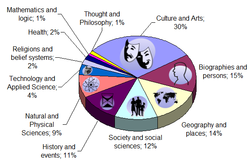
Hide it:Only 14% geographical articles. Wikivoyage's inclusion criteria makes things even worser; on the other hand, Wikipedia can have articles on almost every noteworthy thing found in an area. Wikipedia is a general encyclopedia, while Wikivoyage is a guide on a single topic. At present, the link to Wikivoyage is on articles like Sun and Pluto, Ancient Egypt, Cardiac arrest, Mathematics and Chemistry, and so on. Do they offer tour to such places? It would be cool! Whether or not Wikiquote is shown by default is out of scope here. The inclusion criteria for Wikivoyage is too tight, and tries to merge nearby places into a single one. Also, we have around 4500 articles using this template, and only a small fraction are related to geography; setting parameter to no by default would make it easier and saves a lot of edits and time.···Vanischenu「m/Talk」17:37, 9 March 2013 (UTC)[reply]
Agree with Vanischenu, after seeing this deployed I will have to agree not the best idea. Also concerned that Template:Wikivoyage and Template:Wikivoyage-inline that are much more predominate (thus seen more) are being removed. I would guess they are being removed because of this interrogation so they are not duplicated on pages. If the template goes back to hidden by default there are many many pages that will have to be fixed ...meaning Template:Wikivoyage and Template:Wikivoyage-inline have to be placed back.Moxy (talk) 19:13, 9 March 2013 (UTC)[reply]
I'm not a Wikivoyager but from what I've seen the project is more than just geographical locations. I admit it is mostly locations but it has things like travel topics and itineraries which provide a wider range of coverage. "Ancient Egypt", to take one example, could be the basis for an itinerary linked to the Egypt page: a tour, or tours, of important sites relevant to Ancient Egypt and for making plans to see these sites. I don't think that page exists yet but perhaps someone following the link would be inspired to start it. The other examples could be relevant to itineraries based on the history of science. - AdamBMorgan (talk) 22:39, 10 March 2013 (UTC)[reply]
Take an example, a user goes to Aaron Swartz, gets surprised to see a tour guide on it, and clicks on it to get into a search for Aaron Swartz on Wikivoyage. They would see is:
This is humiliating! They clicked the link to know more about. We shouldn't offer to given anything if we have nothing on it! This is just disruptive. (I was hurt by the Wikiquote links, and felt really embarrassed. It also left me a bad impression of the site. The same would happen to that unfortunate fellow) And suppose that the user were inspired to create it. You can guess what would happen! If he keeps his inspiration up, he would soon get blocked. If we are looking to advertise the project or recruit more members, we should think of better ways, not by hurting the readers.···Vanischenu「m/Talk」19:54, 16 March 2013 (UTC)[reply]







 Done - I've also changed the wording so that when "voy" is defined on destination articles, it will be Travel guide, and when "voy" is not defined on articles like Abraham Lincoln, it will be Travel information. Makes a bit more sense. I will also go through with AWB when I get a chance and remove instances where Wikivoyage will never be useful, and encourage others to do so using