Situation Room, the operations center at the White House with advanced communications equipment for the president to maintain command and control of U.S. forces around the world.
This is an index of lists detailing military conflicts involving the United States, organized by time period.
Although the United States has formally declared war only five times and these declarations cover a total of 11 separate instances against specific nations, there are currently 199 non-colonial military conflicts included in these lists, eight of which are ongoing. Between all six lists, there are currently 237 military conflicts.[1]
4. These lists may include operations against piracy, if it involves the United States military, but generally should cover a whole operation and not a single action or battle, unless that particular operation was wide but only consisted of one major battle. For example, Operation Ocean Shield included several conflicts such as the Dai Hong Dan incident and the Maersk Alabama hijacking. Operation Ocean Shield can be included, because it is part of a wider conflict, but the Dai Hong Dan incident and the Maersk Alabama hijacking would not. Similarly, the Aegean Sea anti-piracy operations of the United States had several battles, but only one more thoroughly reported (Battle of Doro Passage). These operations would be included, but not the Battle of Doro Passage. An exception to the rule of single battles is if a conflict is a punitive action or hostage rescue mission and marks a single operation that only involved one battle, such as the Battle of Ty-ho Bay.
^The United States provides military support, training, or shares intelligence with one or more parties in a conflict without directly engaging in combat with its own troops.
^Please go to the colonial wars lists for more specifics about the criteria for those lists.
^Unless there is an active U.S. military defense or response in an isolated incident.
^A form of military conflicts that takes place in cyberspace with cyber weapons.
^If it is demonstrated that an evacuation which is isolated from any other conflict, became a fighting withdrawal whereby U.S. forces came under fire and/or fired at an enemy while retreating then this may be considered a military conflict. A loose example of this would be Operation Libelle, however this operation itself would not be included as it did not involve the U.S. military.
^These conflicts may be considered a type of rebellion, even if the United States military were involved.
^For the purposes of these lists mutinies will be considered rebellions and will not be included on these lists.
^If it can be demonstrated that the U.S. military participated in a posse conflict and if it is either sizable enough to be considered a war or was considered a military conflict, then this criterion does not apply. For example the Posey War.
^Before this act Native American Nations were considered sovereign Domestic dependent nations by the U.S. Federal government. After the Indian Citizenship Act native Americans were further granted American citizenship, albeit deprived of many civil rights in the year 1924. Currently Native American Nations still are federally held to be Domestic dependent nations, they possess suzerainty to the Federal government, but are territorially sovereign as among the individual United States. Thus any post 1924 are considered to be some category of an incident of civil unrest, and not a military conflict in of itself for the purposes and criteria of this list.
^The Civil War and Bleeding Kansas taken together were wider conflicts than the average rebellion. As such, editors mark these as exceptions to the general no-rebellion policy. In addition, all territorial rebellions such as the Philippine–American War, Moro War, Mormon Wars or the Puerto Rican Nationalist Party insurgency are exceptions as well.
^Even if the United States military were involved for riot control.
^It must be verified that private military contractors were operating in a conflict under American military and/or intelligence employment and engaged in an exchange of fire and/or international hostage rescue mission to be included. Conflicts involving Private Military companies where it is unclear if the United States hired a (PMC) such as the 2003 Transocean offshore oil rig strike and hostage situation, should not be included unless proven otherwise. Furthermore, similar to stipulations in criteria's 4 and 7 if this incident is part of a wider conflict and not a stand alone incident it should not be included.
^Space Incidents for the purposes of these lists are to be distinguished between any future hypothetical space based military actions that involve military strikes against a foreign adversary and that are isolated to just the space domain. Strikes such as the latter can be included on these lists.
^If a peacekeeping mission turns into a conflict, it can be added to the lists.









.jpg)


 The White House, the seat of the president of the United States in Washington, D.C.. The president is the commander-in-chief of the U.S. Armed Forces.
 The United States Department of Defense headquarters at the Pentagon in Washington, D.C. USDOD coordinating and supervising the 6 U.S. armed services: the Army, Navy, Marines, Air Force, Space Force, and the Coast Guard.
 Central Intelligence Agency (CIA) headquarters at the George Bush Center for Intelligence in Langley, Virginia. CIA collecting and analyzing intelligence from around the world and conducting covert operations.
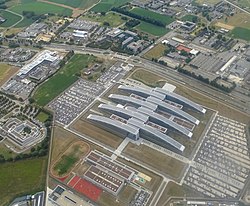 North Atlantic Treaty Organization (NATO) headquarters in Brussels, Belgium. The United States is the leading power in the world's most powerful military alliance.
.jpg)


 United States portal