








Napoléon Louis Bonaparte
| Louis II | |
|---|---|
 Portrait by Félix Cottrau after Jean-Baptiste Wicar | |
| King of Holland | |
| Reign | 1 – 13 July 1810 |
| Predecessor | Louis I |
| Successor | William I as King of Netherlands |
| Grand Duke of Berg | |
| Reign | 3 March 1809 – 1 December 1813 |
| Predecessor | Joachim I |
| Regent | Napoleon I |
| Born | 11 October 1804 Paris, French Empire |
| Died | 17 March 1831 (aged 26) Forlì, Papal States |
| Burial | |
| Spouse | |
| House | Bonaparte |
| Father | Louis Bonaparte |
| Mother | Hortense de Beauharnais |
| Royal styles of Louis II of Holland | |
|---|---|
.svg) | |
| Reference style | His Majesty |
| Spoken style | Your Majesty |
Napoléon-Louis Bonaparte (11 October 1804 – 17 March 1831) was King of Holland for less than two weeks in July 1810 as Louis II (Dutch: Lodewijk II). He was a son of Louis Bonaparte (King Louis I) and Queen Hortense. His father was the younger brother of Napoleon I of France who ruled the Napoleonic Kingdom of Holland from 1806 to 1810. His mother was the daughter of Josephine de Beauharnais, Napoleon's first wife. His younger brother, Louis-Napoléon, became Emperor of the French in 1852 as Napoleon III.
Biography
Napoléon Louis's brother, Napoléon Charles, died in 1807 at the age of four.[1] On his death, Napoléon Louis became Prince Royal of Holland.[2] It also made Napoléon Louis the second eldest nephew of Emperor Napoléon I, who at the time had no legitimate children, and he was regarded as his uncle's likely eventual successor.[3] He lost this presumptive status on 20 March 1811 when Napoléon I's second wife, Marie Louise, gave birth to a son, Napoléon François Joseph Charles Bonaparte, who was styled the King of Rome and later Duke of Reichstadt.[4]
In 1809, Napoléon I appointed him Grand Duke of Berg, a position he held until 1813.[5]
On 1 July 1810, Louis I of Holland abdicated his throne in favour of Napoléon Louis.[6] For the nine days between his father's abdication and the fall of Holland to the advancing French army in July 1810, Napoléon Louis reigned as Lodewijk II, King of Holland.[7]
When Napoléon I was deposed in 1815 after the Battle of Waterloo, the House of Bourbon was restored to the French throne.[8] Napoléon Louis fled into exile, although the Bonaparte family never abandoned hopes of restoring the Napoleonic Empire.[9]
On 23 July 1826 Napoléon Louis married his first cousin, Charlotte, the daughter of Joseph Bonaparte, eldest brother of Napoléon I.[10] He and his younger brother Louis-Napoléon Bonaparte settled in Italy, where they embraced liberal politics and became involved with the Carbonari, who opposed Austrian domination of northern Italy.[11]
On 17 March 1831, while fleeing Italy during a crackdown on revolutionary activity by Papal and Austrian forces, Napoléon Louis, who was suffering from measles, died in Forlì.[12] The French Empire was eventually restored by his younger brother Louis-Napoléon, who became Napoléon III in 1852.[13]
Napoléon Louis is buried at Saint-Leu-la-Forêt, Île-de-France.[14]
Gallery
-
 Portrait by François Kinson, c. 1810
 -
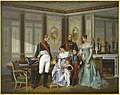 With family and Emperor Alexander I of Russia at Château de Malmaison
 -
 Portrait with his father, Louis Bonaparte, by Jean-Baptiste Wicar
 -
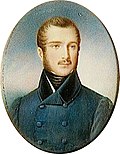 Posthumous portrait, 1858
 -
 Coat of arms of Napoleon Louis Bonaparte as Grand Duke of Cleves and Berg
 -
 Coat of arms of Napoleon Louis Bonaparte as King of Holland


.jpg)

References
- ^ "Napoléon Charles Bonaparte". Napoleon.org. Fondation Napoléon. Retrieved 2 December 2025.
- ^ "Louis Bonaparte, King of Holland". Napoleon.org. Fondation Napoléon. Retrieved 2 December 2025.
- ^ "Dynastic Succession Under Napoleon I". Napoleon.org. Fondation Napoléon. Retrieved 2 December 2025.
- ^ "Napoleon II (Duke of Reichstadt)". Encyclopaedia Britannica. Retrieved 2 December 2025.
- ^ "Grand Duchy of Berg". Encyclopaedia Britannica. Retrieved 2 December 2025.
- ^ "Louis Bonaparte Abdication, 1810". Napoleon Series. Retrieved 2 December 2025.
- ^ "The Kingdom of Holland (1806–1810)". Holland.com. Netherlands Board of Tourism. Retrieved 2 December 2025.
- ^ "Restoration, France (1814–1830)". Encyclopaedia Britannica. Retrieved 2 December 2025.
- ^ "Bonapartist Movement". Encyclopaedia Britannica. Retrieved 2 December 2025.
- ^ "Charlotte Bonaparte". Napoleon.org. Fondation Napoléon. Retrieved 2 December 2025.
- ^ Grab, Alexander (2000). "The Politics of the Carbonari". Journal of Modern Italian Studies. 5 (1): 1–20. doi:10.1080/135457100363972.
- ^ "Napoléon Louis Bonaparte (1804–1831)". Napoleon.org. Fondation Napoléon. Retrieved 2 December 2025.
- ^ "Napoleon III". Encyclopaedia Britannica. Retrieved 2 December 2025.
- ^ "Burial Sites of the Bonaparte Family". International Napoleonic Society. Retrieved 2 December 2025.
| Kingdom of Holland (1806–1810) |  | |
|---|---|---|
| Kingdom of the Netherlands1 (1815–present) | ||
1. See also the Sovereign Principality of the United Netherlands (1813–1815) and the United Kingdom of the Netherlands (1815–1839). | ||
2.svg)
