







Coat of arms of Puerto Rico
 | |
| Versions | |
|---|---|
.svg) Variant | |
| Armiger | Estado Libre Asociado de Puerto Rico (Commonwealth of Puerto Rico) |
| Adopted | 1511 |
| Motto | Joannes Est Nomen Eius, Latin "John is his name". |
The coat of arms of Puerto Rico was first granted by the Spanish Crown on November 8, 1511, making it the oldest heraldic achievement in use in the Americas.[1] The territory was seized from Spain and ceded to the United States as a result of the Treaty of Paris that put an end to the Spanish–American War in 1899, after which two interim arms were adopted briefly. A law was passed in 1905 that reestablished the historical armorial bearings as the arms of the territory. Then in 1976, after numerous investigations and amendments, the current version was adopted.[2]
History

_Coat_of_arms.jpg)
The main element of the coat of arms of Puerto Rico is the Lamb of God. Despite Puerto Rico being a US territory, the shield continues to have elements reminiscent of Spain's presence in the New World. There have been different variations of the coat of arms throughout Puerto Rico's history.[3] On March 1, 1902, a new coat of arms was approved by Governor William H. Hunt with the intention of reflecting the United States’ involvement in Puerto Rico. [4] This was the coat of arms that became the substitute for the oldest heraldic achievement in use in the Americas. This coat of arms was referred to as the “Escudo Intruso” (Intruder Coat of Arms or Intruding Coat of Arms) by the Puerto Rican people. Governor Regis H. Post re-introduced the historical coat of arms which includes the lamb on March 9, 1905.[5] The current version was officially readopted by the government of Puerto Rico on June 3, 1976.
| 1767 | 1873–74 | 1902–1905 | 1905 | 1976–present |
|---|---|---|---|---|
.svg) |
.svg) |
.svg) |
.svg) |
|
| 1767 Design | First Spanish Republic | "Americanized" coat of arms | Reintroduction of the historical arms | Corrected coat of arms |
Features
| ||||||||||||||||||||||||||
| Latin motto:
"JOANNES EST NOMEN EJUS" (a quotation from the Vulgate of Luke 1:63) means "John is his name", referring to St. John the Baptist or San Juan Bautista, the original Spanish name of the island.[6] |
.svg)


Great Seal
| Great Seal of Puerto Rico | |
|---|---|
 | |
| Armiger | Estado Libre Asociado de Puerto Rico (Commonwealth of Puerto Rico) |
| Motto | Joannes Est Nomen Ejus, Latin "John is his name". |
.png)
All of the states and territories of the United States employ a seal to authenticate and ratify documents, thus accordingly a seal of Puerto Rico exists, but the traditional coat of arms is used as the main emblem of the territory. The Great Seal has most of the elements of the coat of arms, but many religious elements have been largely stripped away in accordance with the separation of church and state in the United States. In the seal, the lamb representing Christ, which no longer has a halo, carries a plain white banner instead of one with a red Saint George's Cross (despite the finial retaining a golden Cross, and two large red Cross charges flanking the field). Also, the book the lamb sits on does not bear the seals of the Book of Revelation (nor book-clasps).
The first Governors used the Great Seal as their emblem, but in recent years the usage of the seal has apparently been limited as the official emblem used to represent Puerto Rico on its legal documents when they are sealed.
Seal of the governor
The seal of the governor is the official symbol of the executive head of Puerto Rico. It follows the design used by the seal of the president of the United States. There are several variants of the governor's seal in use.
-
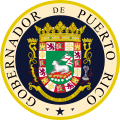 Seal of the governor of Puerto Rico
 -
 A variant of the governor's seal
 -
 Seal of the governor elect

.svg)

Seals of the government of Puerto Rico
There are several seals of the different sections of the Puerto Rican government.
-
 Seal of the secretary of state of Puerto Rico
 -
 Seal of the Legislative Assembly of Puerto Rico
 -
 Seal of the House of Representatives of Puerto Rico
 -
 Seal of the Senate of Puerto Rico
 -
 A variant of the seal of the Senate
 -
 Seal of the government of Puerto Rico


.svg)

See also


References
- ^ "PR.GOV – Escudo". pr.gov. Archived from the original on January 23, 2010. Retrieved 2021-07-01.
- ^ Blanco, Enrique T. (2016-02-26). "Escudo y Banderas de Puerto Rico" [Coats of arm and Flags of Puerto Rico]. Revista del Instituto de Cultura Puertorriqueña (in Spanish). Instituto de Cultura Puertorriqueña. pp. 20–21. Retrieved 2021-07-01.
- ^ Ramirez Brau, Enrique (1937). "Investigación Histórica acerca del Escudo de Armas de Puerto Rico (1937)". Retrieved July 8, 2023 – via Issuu.
- ^ Rivera, J.O. (2008). BORICUAZO: Tu orgullo nacional (in Spanish) (2nd ed.). Publicaciones Boricuazo. ISBN 978-1-60530-501-1.
- ^ "El escudo intruso". Primera Hora (in Spanish). 2008-06-04. Retrieved 2025-10-18.
- ^ Grabowski, John F. (1992). U.S. Territories and Possessions (State Report Series). Chelsea House Pub. Page 7. ISBN 9780791010532.
.svg)
