






Garland E. Allen
Garland E. Allen | |
|---|---|
 | |
| Born | Garland Edward Allen III February 13, 1936 Louisville, Kentucky, U.S. |
| Died | February 10, 2023 (aged 86) |
| Education | University of Louisville (BA 1957) Harvard University (PhD 1966) |
| Known for | Writings on the life of Thomas Hunt Morgan Work on the history of eugenics |
| Awards | 2017 George Sarton Medal from the History of Science Society |
| Scientific career | |
| Fields | History of science Philosophy of science |
| Institutions | Washington University in St. Louis (1967–2014) |
| Thesis | Thomas Hunt Morgan: The Relation of Genetic and Evolution Theory, 1900–1925 (1966) |
| Doctoral advisors | Ernst Mayr Everett Mendelsohn |
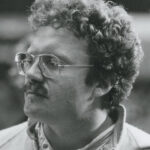
Garland Edward Allen III (February 13, 1936 – February 10, 2023) was an American historian of science and biographer at Washington University in St. Louis. His research interests lied primarily in the history of genetics, eugenics, and evolution. He was a longtime senior editor of the Journal of the History of Biology (1998–2006) and he won the 2017 Sarton Medal for lifetime achievement in the history of science.
Early life and education
Garland Edward Allen III was born on February 13, 1936, in Louisville, Kentucky.[1] He graduated from the University of Louisville in 1957 after studying English and biology.[2] He completed his PhD in the history of science at Harvard Faculty of Arts and Sciences in 1966 under the direction of Ernst Mayr and Everett Mendelsohn after spending four years as a high school biology teacher at Northfield Mount Hermon School.[3][4]
Career
In 1967 he was hired to join the faculty of Arts and Sciences at Washington University in St. Louis,[2] where he remained until retiring emeritus in 2014.[5] He was recruited by Descartes scholar Thomas Hall, and he later organized a series of Thomas Hall Lectures at Washington University to invite other historians of biology to speak, beginning in 1978.[2] He held several visiting professorships at Harvard.
In 1998, Allen and Jane Maienschein succeeded Allen's former advisor Everett Mendelsohn as the second senior editors of the Journal of the History of Biology, which they continued together until passing the responsibility to Paul Farber (1944–2021) in 2006.[6]
Allen won the 2017 George Sarton Medal of the History of Science Society; he was named as "the preeminent historian of biology today" in his award commendation.[5]
Personal life and death
Allen was a Marxist in his personal life and wrote several articles on its influence on his thought.[2][5] In November 1969 he went to Cuba as part of the Venceremos Brigade and spent about 5 months harvesting sugar cane.[2][7]
He lived with his partner and husband Larry Bennet in St. Louis, where they worked together on the restoration of Lafayette Square and ran a bed and breakfast. He had two daughters.[2]
Allen died of cancer on February 10, 2023, at the age of 86.[2][8]
Work
Thomas Hunt Morgan
Allen offered the fullest treatment of the life and work of Thomas Hunt Morgan, himself a Kentucky native. Allen's extensive review of Morgan presented the story of an experimentalist who staunchly avoided open political ties to science for fear of biasing the research. His discussion of the fly room, first at Columbia University, then at California Institute of Technology, suggests that the collaborative environment within which Morgan worked with his students, H.J. Muller, Alfred Sturtevant, Calvin Bridges, and Theodosius Dobzhansky played an important role in establishing Drosophila melanogaster as a model organism for genetics, and launching the careers of these titans of 20th century genetics.[9] Allen's work contributes to the body of history chronicling the emergence of American science.
Eugenics
Allen was an international leader on the history of eugenics.[10] His work suggests that eugenics movements were not merely localized to Germany, Britain and America, but rather that eugenics constituted an international ideological shift from Social Darwinism, whereby nature would weed out people with poor heredity, to an ideology where humanity must control its own genetic stock.[11] He suggested that with the unveiling of the human genome, we should be cautious of a new wave of the eugenics movement.[12]
Selected publications
- Matter, Energy, and Life (4 Editions)
- Life Sciences in the 20th Century (1975)
- Thomas Hunt Morgan: The Man and His Science (1978)[13]
- Biology: Scientific Process and Social Issues (2002)
Accolades
- 2011: Fellow of American Association for the Advancement of Science[14]
- Trustee and Chairman of the history committee at the Marine Biological Laboratory
- President of the International Society for the History, Philosophy, and Social Studies of Biology
- 2017: George Sarton Medal[5]
References
- ^ "Who's Who Missouri" (PDF). Washington University in St.Louis. Archived from the original (PDF) on 2015-04-05. Retrieved 2018-09-18.
- ^ a b c d e f g Kleinman, Kim (April 13, 2023). "In Memoriam: Garland E. Allen". Newsletter, History of Science Society.
- ^ MacLeod, Roy M. (2002). Science, history, and social activism: a tribute to Everett Mendelsohn. Springer. p. 416. ISBN 9048159687.
- ^ Maienschein, Jane (2023). "Garland Allen's Last Book Project". Journal of the History of Biology. 56 (2): 239–250. doi:10.1007/s10739-023-09726-8. PMC 10533620. PMID 37552370.
- ^ a b c d Maienschein, Jane; Richmond, Marsha; Mike, Dietrich; Creath, Richard; Beatty, John (June 2018). "History of Science Society Annual Meeting, 2017: Sarton Medal". Isis. 109 (2): 351–353. JSTOR 26500798.
- ^ Maienschein, Jane; Allen, Garland E.; Dietrich, Michael; Mendelsohn, Everett; Richmond, Marsha; Rader, Karen (Winter 2021). "In Memory of Paul Farber (1944–2021), Third Editor of the Journal of the History of Biology". Journal of the History of Biology. 54 (4): 549–550. JSTOR 48762664.
- ^ Allen, Garland E. (1974). "Science, Education, and Culture in Revolutionary Cuba". The American Biology Teacher. 36 (5): 267–291. doi:10.2307/4444793. JSTOR 4444793.
- ^ "Obituary: Garland Allen, professor emeritus of biology, 86". Washington University in St. Louis. 24 February 2023. Retrieved 8 September 2023.
- ^ Coleman, William (Dec 1979). "Reviewed Work: Thomas Hunt Morgan: The Man and His Science by Garland E. Allen". The American Historical Review. 84 (5): 1494. doi:10.2307/1861696. JSTOR 1861696.
- ^ Fitzpatrick, Tony (May 4, 2004). "Social problems such as obesity can't be solved through genetics alone, warns biologist". Washington University in St. Louis. Retrieved February 3, 2017.
- ^ Allen, Garland (2002). "Eugenics as an International Movement". International Encyclopedia of the Social & Behavioral Sciences: 4882–4889. doi:10.1016/B0-08-043076-7/03396-9. ISBN 9780080430768.
- ^ Allen, Garland (October 2001). "Is a New Eugenics Afoot?". Science. 294 (5540): 59–71. doi:10.1126/science.1066325. PMID 11588239.
- ^ Darden, Lindley (1980). "review of Thomas Hunt Morgan, the Man and His Science by Garland E. Allen". Philosophy of Science. 47 (4): 662–666. doi:10.1086/288971.
- ^ "AAAS - Sections - History and Philosophy of Science (Section L)". Archived from the original on 2012-07-02. Retrieved 2012-04-04.
