






Audience risers
Audience risers are elevated platforms for people in a theater, classroom, or other venue.
The origin of the audience riser can be dated back to original amphitheaters, such as the Colosseum.[1]
Differences from Bleachers
Audience risers are different from bleachers in that the seats for bleachers are integrated into the structure itself; audience risers are primarily platforms first, to which a variety of chairs, tables, cameras, spot lights, etc. may be used on. While bleachers provide fixed aisle ways and may not provide a solid floor, audience risers are designed so that each level presents a flat, unbroken surface.
Configurations
Audience risers may be configured to hold convention seating, theater seating, classroom table seating or dinner table seating. Although primarily rectangular in overall shape, audience risers may include angled or curved sections as space allows.
The lighting and configuration must match. For a "lecture-performance", any "light is equally distributed in the audience risers and the stage."[2] In lighting design, one must remember to work around any visual obstructions.[3]
One drama textbook recommends against a gap before traditional theater risers, which is similar to a 'classroom riser': "The optimal performance space for real-time acting is a flat or level-floor theater, one in which the audience risers begin on the same level as the acting space, permitting no separation between actor and audience."(italics in original)[4]
-
 Audience Riser
 -
 Traditional Theater Riser
 -
 Dinner Riser
 -
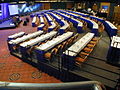 Classroom Riser, also known as a flat or level-floor riser


Construction
Audience risers may be temporary (purpose-built) or a permanent part of a facility. They may be commercially built, or designed and crafted by the theater staff.[5] Audience risers are primarily constructed using stage decks, although construction with lumber and framing, or plywood, are not uncommon.[5]
See also
References
- ^ Kogler Carver, Rita (2023). Stagecraft Fundamentals: A Guide and Reference for Theatrical Production. Taylor & Francis. p. 7. ISBN 9781000844351. Retrieved November 3, 2025.
- ^ Sabisch, Petra (2011). Choreographing Relations: Practical Philosophy and Contemporary Choreography in the Works of Antonia Baehr, Gilles Deleuze, Juan Dominguez, Félix Guattari, Xavier Le Roy and Eszter Salamon. p. 44. Retrieved November 3, 2025.
- ^ Weber, Jason E. (2020). The Lighting Supervisor's Toolkit: Collaboration, Interrogation, and Innovation Toward Engineering Brilliant Lighting Designs. Taylor & Francis. ISBN 9781000335132. Retrieved November 3, 2025.
- ^ Binnerts, Paul (2012). Acting in Real Time. University of Michigan Press. p. 258. ISBN 9780472035038. Retrieved November 3, 2025.
- ^ a b Collins, Owen M. (2012). Technical Design Solutions for Theatre: The Technical Brief Collection Volume 2. Taylor & Francis. p. 158. ISBN 9781136082771. Retrieved November 3, 2025.