








Maclaurin's inequality
In mathematics, Maclaurin's inequality, named after Colin Maclaurin, is a refinement of the inequality of arithmetic and geometric means.
Let be non-negative real numbers, and for , define the averages as follows:



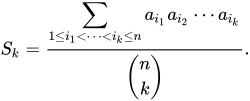
The numerator of this fraction is the elementary symmetric polynomial of degree in the variables , that is, the sum of all products of of the numbers with the indices in increasing order. The denominator is the number of terms in the numerator, the binomial coefficient Maclaurin's inequality is the following chain of inequalities:


- ,
![{\textstyle S_{1}\geq {\sqrt {S_{2}}}\geq {\sqrt[{3}]{S_{3}}}\geq \cdots \geq {\sqrt[{n}]{S_{n}}}}](https://wikimedia.org/api/rest_v1/media/math/render/svg/68d90551003d2087a8ff0241a371f824550acc95)
with equality if and only if all the are equal.

Maclaurin's inequality can be proved using Newton's inequalities or a generalised version of Bernoulli's inequality.
Examples
For , Maclaurin's inequality gives the arithmetic mean-geometric mean inequality for two non-negative numbers.

For , Maclaurin's inequality states:

![{\begin{aligned}&\quad {\frac {a_{1}+a_{2}+a_{3}+a_{4}}{4}}\\[8pt]&\geq {\sqrt {\frac {a_{1}a_{2}+a_{1}a_{3}+a_{1}a_{4}+a_{2}a_{3}+a_{2}a_{4}+a_{3}a_{4}}{6}}}\\[8pt]&\geq {\sqrt[{3}]{\frac {a_{1}a_{2}a_{3}+a_{1}a_{2}a_{4}+a_{1}a_{3}a_{4}+a_{2}a_{3}a_{4}}{4}}}\\[8pt]&\geq {\sqrt[{4}]{a_{1}a_{2}a_{3}a_{4}}}.\end{aligned}}](https://wikimedia.org/api/rest_v1/media/math/render/svg/eaf1d18b1da7798015ddc58485701232bc878747)
See also
- Bernoulli's inequality
- Bonferroni inequality
- Generalized mean inequality
- Muirhead's inequality
- Newton's inequalities
References
- Biler, Piotr; Witkowski, Alfred (1990). Problems in mathematical analysis. New York, N.Y.: M. Dekker. ISBN 0-8247-8312-3.
This article incorporates material from MacLaurin's Inequality on PlanetMath, which is licensed under the Creative Commons Attribution/Share-Alike License.
letter| 30 Apr 1729 IV. A second letter from Mr. Colin McLaurin, Professor of Mathematicks in the University of Edinburgh and F. R. S. to Martin Folkes, Esq; concerning the roots of equations, with the demonstration of other rules in algebra; being the continuation of the letter published in the Philosophical Transactions, N° 394 Free Colin MacLaurin Author & article information Phil. Trans. R. Soc. (1729) 36 (408): 59–96.