






Archaeology of the Americas
.jpg)
The archaeology of the Western Hemisphere, including North America (Mesoamerica), Central America, South America and the Caribbean, includes the study of pre-historic/pre-Columbian and historic indigenous American peoples, as well as historical archaeology of more recent eras, including the trans-Atlantic slave trade and European colonization.
Chronology
The pre-Columbian era is the term generally used to encompass all time period subdivisions in the history of the Americas spanning the time from the original settlement of the Americas in the Upper Paleolithic until the European colonization of the Americas during the early modern period. While technically referring to the era before the voyages of Christopher Columbus from AD 1492 to 1504, in practice the term usually includes the history of American indigenous cultures until the 18th or 19th century. In more recent decades, archaeological scholarship has extended to include enslaved Africans and European and Asian migrant populations.
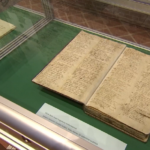
The pre-Columbian archaeological record in the Americas has conventionally been divided into five phases based on an enduring system established by Gordon Willey and Philip Phillips's 1958 book Method and Theory in American Archaeology.[1] Their chronology differs from old world prehistory from Europe and Asia which uses the three-age system, with the Stone Age divided into Paleolithic, Mesolithic, Neolithic, and Chalcolithic, followed by the Bronze Age and Iron Age, remain in general use.

National Park Service, c. 1961
Numerous regional and sub-regional divisions have since been defined to distinguish various cultures through time and space, as later archaeologists recognized that these generalised stages did not adequately correspond to the cultural variation that existed in different locations in the Americas.[1]
- Defined by the ostensible prevalence of big-game hunting. In most places, this can be dated to before 8000 BCE, starting most probably around 16,500 BCE (see Paleo-Indians). Examples include the Clovis culture and Folsom tradition groups.
- The Archaic stage
- Defined by the increasingly intensive gathering of wild resources with the decline of the big-game hunting lifestyle. Typically, Archaic cultures can be dated from 8000 to 1000 BCE. Examples include the Archaic Southwest, the Arctic small tool tradition, the Poverty Point culture, and the Chan-Chan culture in southern Chile.
- The Formative stage
- Defined as "village agriculture" based. Most of these can be dated from 1000 BCE to 500 CE. Examples include the Dorset culture, Zapotec civilization, Mimbres culture, Olmec, Woodland, and Mississippian cultures.
- The Classic stage

- Defined as "early civilizations", and typically dating from 500 to 1200 CE. Willey and Phillips considered only cultures from Mesoamerica and Peru to have achieved this level of complexity. Examples include the early Maya and the Toltec.
- Defined as "later prehispanic civilizations" and typically dated from 1200 CE until the advent of European colonisation. The late Maya, the Incan civilization, and the Aztec cultures were Post-Classic.
Today, for Meso- and Andean South America, the later periods are more often classified using the "Horizon" terminology, with "Early Horizon" typically broadly equating to the Late Formative stage. "Horizons" are periods of cultural stability and political unity, with "Intermediate periods" covering the politically fragmented transition between them. In the Andes, there are three Horizon periods, with two Intermediate periods between them. The Horizons, and their dominant cultures are: Early Horizon, Chavin; Middle Horizon, Tiwanaku and Wari culture; Late Horizon, Inca.[2]
Major regions
North America
NAGPRA
Since 1990, in the United States, physical anthropology and archaeological investigations based on the study of human remains are influenced by the Native American Graves Protection and Repatriation Act, (NAGPRA), which provides for the bodies of Native Americans and associated grave goods to be turned over to the recognized tribal body most legally affiliated with the remains; the law applies only to culturally identifiable remains and artefacts found on federally owned public land. In some cases, notably, that of Kennewick Man, these laws have been subject to close judicial scrutiny and great intellectual conflict.[3]

Mesoamerica
Mesoamerica is a region and cultural area in the Americas, extending approximately from central Mexico to Honduras and Nicaragua, within which a number of pre-Columbian societies flourished before the Spanish colonization of the Americas in the 15th and 16th centuries.[4][5] Prehistoric groups in this area are characterized by agricultural villages and large ceremonial and politico-religious capitals[6] This culture area included some of the most complex and advanced cultures of the Americas, including the Olmec, Teotihuacan, the Maya, and the Aztec, the most powerful tribe of Mesoamerica in their time.
South America
Important South American societies include the Moche, the Inca, the Wari.
Important South American archaeological sites include: Chavín de Huántar, Pikillaqta, Machu Picchu, Tiwanaku, Monte Verde, and the Upano Valley sites.
Central America
Central America is a region and cultural area in the Americas located south of Mesoamerica extending from Nicaragua to the southern border of Panama. Important sites include the Stone Spheres of Costa Rica.
Archaeogenetics
Molecular genetics study suggests that surviving Amerindian populations derived from a theoretical single founding population, possibly from only 50 to 70 genetic contributors.[7] Preliminary research, restricted to only 9 genomic regions (or loci) have shown a genetic link between original Americas and Asia populations. The study does not address the question of separate migrations for these groups, and excludes other DNA data-sets.[8]
The American Journal of Human Genetics released an article in 2007 stating, "Here we show, by using 86 complete mitochondrial genomes, that all Indigenous American haplogroups, including Haplogroup X (mtDNA), were part of a single founding population."[9] Amerindian groups in the Bering Strait region exhibit perhaps the strongest DNA or mitochondrial DNA relations to Siberian peoples. The genetic diversity of Amerindian indigenous groups increase with distance from the assumed entry point into the Americas.[10][11] Certain genetic diversity patterns from West to East suggest at least some coastal migration events.[12] Geneticists have variously estimated that peoples of Asia and the Americas were part of the same population from 42,000 to 21,000 years ago.[13]
Archaeological finds
.jpg)
.jpg)

In February 2021, archaeologists from the University of Buenos Aires–National Scientific and Technical Research Council announced the discovery of 12 graves dated to 6,000–1,300 years ago in Argentine Northwest. Researchers also revealed necklaces and pendants next to some of the bodies. According to archaeologist Leticia Cortés, there were many kinds of burial methods, in individual or collective graves, and also in the posture of the bodies. Some were hyperflexed, like squatting, with the shoulders touching the knees.[14][15]
In 2018, 9000-year-old remains of a female hunter along with a toolkit of projectile points and animal processing implements were discovered at the Andean site of Wilamaya Patjxa, Puno District in Peru.[16][17]
In September 2021, archaeologists announced the remains of eight 800-year-old bodies nearby ancient town of Chilca. Bodies included adults and children who were covered in plant material before being buried. Some dishes and musical instruments were uncovered as well. Researchers think remains belong to the Chilca culture, which was apart from other pre-Hispanic cultures in the area.[18][19][20]
A mummy that is approximately 800 years old that is believed to be of pre-Inca cultures was found at the site of Cajamarquilla in Peru in November 2021. Researchers reported that the mummy was tied with strings, covering his face with his hands, so they assumed it was a southern Peruvian funeral custom.[21][22] In February 2022, archaeologists announced the discovery of six mummified children thought to have been sacrificed, probably to accompany a dead elite man to the afterlife. According to archaeologist Pieter Van Dalen, 1,000-1,200 years old mummies were probably relatives and placed one above the other in different parts of the tomb.[23][24]
In May 2022, archaeologists reported the discovery of 1,400-year-old remains of the Mayan site so-called Xiol on the outskirts of Mérida. They also uncovered a large central plaza and at least 12 buildings, workshops, burial places of adults and children, and an altar that served a ritual purpose.[25][26]
In June 2022, archaeologists from the Mexico's National Institute of Anthropology and History (INAH) announced the discovery of a 1,300-year-old nine-inch-tall plaster head statue indicating a young Hun Hunahpu, the Maya's mythological maize god. The figure's semi-shaved haircut that resembles ripe corn gives reason to the possibility that it is a young maize god. Researchers assume that the Mayan inhabitants of Palenque possibly placed a large stone statuette over a pond to represent the entrance to the underworld. According to archaeologist Arnoldo González Cruz, the Mayan people symbolically shuttered the pool by breaking up some of the plaster and filling it with animal remains, including pottery fragments, carved bone remains, shells, obsidian arrowheads, beads, vegetables, and others.[27][28]
In May 2025, archaeologists uncovered a 5,000-year-old fire altar at the Era de Pando site in Peru's Supe Valley, part of the Caral Archaeological Zone, revealing new insights into the ceremonial practices of the Caral–Supe civilization. The altar, located within a pyramidal structure known as Building C1, measures approximately 7 meters in diameter and is preceded by a rectangular courtyard, suggesting its role in elite ritual activities involving offerings such as beads, quartz fragments, fish, mollusks, and agricultural produce.[29][30]
In May 2025, a joint archaeological mission from Slovakia's Comenius University and the Guatemalan Ministry of Culture and Sports identified a large Mayan urban complex in the Petén jungle of northern Guatemala. Primarily dated to the Middle Preclassic period, the site consists of an "urban triangle" formed by three distinct centers: Los Abuelos, Petnal, and Cambrayal. Covering an area of approximately six square miles, the complex represents an early example of sophisticated architectural planning and socio-political organization in the Maya lowlands.[31][32]
In July 2025, a prehistoric urban center named Peñico, dating back approximately 3,500 years, was identified in northern Peru by a team of Peruvian and international archaeologists. Located approximately 600 m above sea level, the site consists of 18 structures including a circular ceremonial plaza, temples, and residential buildings constructed between 1800 and 1500 BC. According to the archaeologists, the settlement demonstrates that early Andean societies engaged in complex societal organization, serving as a cultural bridge between coastal and Amazonian communities during the early Formative stage.[33][34][35]
In July, 2025, a pre-Incan tomb dating back around 1,000 years, attributed to the Chancay culture was discovered in the Puente Piedra district of Lima, Peru. The burial contained a body wrapped in a torn funerary bundle, seated with legs drawn in, accompanied by four clay vessels and three pumpkin-shell artifacts. A similar grave, found nearby just two meters from a home’s entrance, contained the remains of a man wrapped in burial cloths alongside pottery, suggesting the presence of a broader burial complex.[36][37][38]
In July 2025, archaeologists from the National Institute of Anthropology and History (INAH) uncovered a pre-Hispanic mortuary cave within the Ocampo Natural Protected Area in Coahuila, Mexico. The discovery was made following reports of looting in the mountainous region, leading researchers to a vertical shaft approximately 50 centimeters wide. The subterranean chamber contained the skeletal remains of at least 17 individuals, including men, women, and 12 complete skulls, five of which belonged to children. The site is attributed to nomadic desert cultures of the Aridoamerica region and is estimated to be at least 500 years old. In addition to human remains, the team recovered 15 textile fragments, as well as remnants of baskets and mats, suggesting the deceased were originally interred in mortuary bundles.[39][40]
In July 2025, archaeologists in Lima, uncovered an ancient pre-Hispanic grave beneath a residential street in the Carabayllo district. The burial, which dates back approximately 800 to 1,000 years, is attributed to the Ichma culture, a society that flourished on the central coast of Peru before the expansion of the Inca Empire. The site contained the remains of an individual interred in a seated position, wrapped in traditional funerary fabrics known as fardos. Alongside the human remains, researchers recovered several artifacts, including ceramic vessels and wooden tools, which were placed as funerary offerings.[41][42]
In October 2025, archaeologists from the National Institute of Anthropology and History (INAH) announced the discovery of a pre-Hispanic urban center, or "lost city," on the Costa Chica of Guerrero, Mexico. Researchers have identified architectural features and ceramic fragments that suggest the site was occupied during the Epiclassic period, a time of a cultural transition following the decline of Teotihuacán.Among the artifacts recovered were stone carvings with anthropomorphic features and evidence of a complex hydraulic system designed to manage the region’s water resources.[43][44]
In January 2026, the Metropolitan Institute of Heritage (IMP) of Quito announced the discovery of an extensive pre-Hispanic archaeological landscape in the Andean Chocó region of Ecuador. The findings were the result of a LiDAR survey conducted in December 2025.The survey identified more than 200 mounds and 100 terraces across an area of approximately 600 hectares. Prior to the use of LiDAR technology, traditional ground surveys had recorded 40 mounds and 10 terraces in the same vicinity.[45][46]
In January 2026, a well-preserved 1,400-year-old Zapotec tomb was discovered in Oaxaca during an investigation by the National Institute of Anthropology and History (INAH). There is a large frieze of an owl head decorating the entrance to the burial chamber, with the bird's beak curving over the painted stucco face of a Zapotec lord, symbolizing the connection between the deceased and the underworld. The interior contains rare polychrome murals depicting a procession of figures carrying bags of copal, along with stone-carved guardians at the threshold.[47][48]
In February 2026, archaeologists from the San Marcos National University identified a 4,000-year-old polychrome mural at the Los Corrales site in Peru's Supe Valley. The mural, which dates to the Formative period, depicts complex iconographic figures, including an anthropomorphic character associated with agricultural fertility and celestial cycles.[49][50]
In February 2026, archaeologists from the Templo Mayor Project (PTM) in Mexico City announced the discovery of a colossal Mexica offering dating to the reign of Motecuhzoma Ilhuicamina. The discovery involves three newly identified ritual deposits (Offerings 186, 187, and 189) that mirror three others found in previous decades. The chests contained 83 greenstone figurines carved in the Mezcala style. These 1,000-year-old relics were captured as war plender from the northern highlands of Guerrero following Mexica military conquests and were ritually re-consecrated with facial paint associated with the rain god Tlaloc. The deposits also yielded over 4,000 marine elements, including shells and snails from the Atlantic coast.[51]
In February 2026, the Chicama Archaeological Program announced several monumental discoveries including a massive two-kilometer-long geoglyph, a ceremonial temple, and a 100-hectare agricultural complex in Peru's Chicama Valley.[52]
In March 2026, underwater archaeologists in Mexico announced the discovery of a prehistoric human skeleton in a submerged cave system on the Yucatán Peninsula, between Tulum and Playa del Carmen, which likely represents an 8,000-year-old burial site. The deliberate positioning of the bones on a sediment dune in a narrow passage suggests a formal funerary deposit or ritual burial rather than an accidental death.[53]
See also
References
- ^ a b "Method and Theory in American Archaeology". Gordon Willey and Philip Phillips. University of Chicago. 1958. Archived from the original on 2012-06-28.
- ^ Essential Humanities. "History of Precolonial Meso/South America". Accessed 9 May 2017. Archived 2017-06-25 at the Wayback Machine.
- ^ Bones, Discovering the First Americans Elllaine Dewar, Carroll & Graf Publishers, New York, 2002, ISBN 0-7867-0979-0
- ^ "Meso-America." Oxford English Reference Dictionary, 2nd ed. (rev.) 2002. (ISBN 0-19-860652-4) Oxford, UK: Oxford University Press; p. 906.
- ^ (2000): Atlas del México Prehispánico. Revista Arqueología mexicana. Número especial 5. Julio de 2000. Raíces/ Instituto Nacional de Antropología e Historia. México.
- ^ Gregonis, Linda M.; Reinhard, Karl J. "Glossary". Hohokam Indians of the Tucson Basin. The University of Arizona Press. Archived from the original on 2011-06-05.
- ^ Hey, J (2005). "On the Number of New World Founders: A Population Genetic Portrait of the Peopling of the Americas". PLOS Biology. 3 (6): e193. doi:10.1371/journal.pbio.0030193. PMC 1131883. PMID 15898833.
- ^ "Nomenclature for Incompletely Specified Bases in Nucleic Acid Sequences". NC-IUB. 1984. Retrieved 2009-11-19.
- ^ Meltzer, David J. (2010). First Americans. University of California Press. ISBN 9780520267992. Retrieved 2009-11-17.
- ^ "The peopling of the Americas: Genetic ancestry influences health". Scientific American. Retrieved 2009-11-22.
- ^ "First Americans Endured 20,000-Year Layover - Jennifer Viegas, Discovery News". Archived from the original on 2012-03-13. Retrieved 2009-11-18.
- ^ Wang, Sijia; Lewis, Cecil M.; Jakobsson, Mattias; Ramachandran, Sohini; Ray, Nicolas; Bedoya, Gabriel; Rojas, Winston; Parra, Maria V.; Molina, Julio A.; Gallo, Carla; Mazzotti, Guido; Poletti, Giovanni; Hill, Kim; Hurtado, Ana M.; Labuda, Damian; Klitz, William; Barrantes, Ramiro; Bortolini, Maria Cátira; Salzano, Francisco M.; Petzl-Erler, Maria Luiza; Tsuneto, Luiza T.; Llop, Elena; Rothhammer, Francisco; Excoffier, Laurent; Feldman, Marcus W.; Rosenberg, Noah A.; Ruiz-Linares, Andrés (2007). "Genetic Variation and Population Structure in Native Americans". PLOS Genetics. 3 (11): 3(11). doi:10.1371/journal.pgen.0030185. PMC 2082466. PMID 18039031.
- ^ Fagundes, Nelson J.R.; Kanitz, Ricardo; Eckert, Roberta; Valls, Ana C.S.; Bogo, Mauricio R.; Salzano, Francisco M.; Smith, David Glenn; Silva, Wilson A.; Zago, Marco A.; Ribeiro-dos-Santos, Andrea K.; Santos, Sidney E.B.; Petzl-Erler, Maria Luiza; Bonatto, Sandro L. (2008). "Mitochondrial Population Genomics Supports a Single Pre-Clovis Origin with a Coastal Route for the Peopling of the Americas" (PDF). American Journal of Human Genetics. 82 (3): 583–592. doi:10.1016/j.ajhg.2007.11.013. PMC 2427228. PMID 18313026. Archived from the original (PDF) on 2009-03-25. Retrieved 2009-11-19.
- ^ "Prehistoric Burials Excavated in Argentina - Archaeology Magazine". www.archaeology.org. Retrieved 2021-03-02.
- ^ "Six thousand-year-old tombs found in northwest Argentina". Radio Cadena Agramonte. Archived from the original on 2021-03-02. Retrieved 2021-03-02.
- ^ Wei-Haas, Maya (2020-11-04). "Prehistoric female hunter discovery upends gender role assumptions". National Geographic. Archived from the original on 2021-02-17. Retrieved 2021-06-13.
- ^ Haas, Randall; Watson, James; Buonasera, Tammy; Southon, John; Chen, Jennifer C.; Noe, Sarah; Smith, Kevin; Llave, Carlos Viviano; Eerkens, Jelmer; Parker, Glendon (2020-11-06). "Female hunters of the early Americas". Science Advances. 6 (45). Bibcode:2020SciA....6..310H. doi:10.1126/sciadv.abd0310. ISSN 2375-2548. PMC 7673694. PMID 33148651. S2CID 226261247.
- ^ Paul, Jacob (2021-09-24). "Gas pipe workers uncover remains of eight people buried inside 800-year-old tomb". Express.co.uk. Retrieved 2021-09-27.
- ^ "Gas pipe workers find 800-year-old bodies in Peru". France 24. 2021-09-22. Retrieved 2021-09-27.
- ^ "800-Year-Old Tomb Discovered in Peru - Archaeology Magazine". www.archaeology.org. Retrieved 2021-09-27.
- ^ Jeevan Ravindran (28 November 2021). "Peruvian mummy at least 800 years old found by archeologists in Lima". CNN. Retrieved 2022-02-20.
- ^ "Archaeologists unearth mummy estimated to be at least 800 years old in Peru". The Guardian. Reuters. 2021-11-27. Retrieved 2022-02-20.
- ^ "Ancient mummies of children, likely sacrificed, unearthed in Peru". France 24. 2022-02-14. Retrieved 2022-02-20.
- ^ "Update on Mummified Human Remains Uncovered in Peru - Archaeology Magazine". Archaeology Magazine. Retrieved 2022-02-20.
- ^ Kuta, Sarah. "Construction Crew Stumbles on 1,400-Year-Old Ruins of Maya City". Smithsonian Magazine. Retrieved 2022-08-14.
- ^ "Archaeologists discover ancient Mayan city on construction site". Reuters. 2022-05-27. Retrieved 2022-08-14.
- ^ Kuta, Sarah. "1,300-Year-Old Corn God Statue Shows How the Maya Worshipped Maize". Smithsonian Magazine. Retrieved 2022-08-10.
- ^ Marsden, Ariella (2022-06-04). "Sculpted head of Mayan maize god uncovered in Mexico". The Jerusalem Post. Retrieved 2022-08-10.
- ^ Milligan, Mark (2025-05-24). "5,000-year-old fire altar discovery at oldest centre of civilisation in the Americas". HeritageDaily - Archaeology News. Retrieved 2025-05-30.
- ^ "Archaeologists Stunned by 5,000-Year-Old Fire Altar Found in Lost American Civilization". 2025-05-26. Retrieved 2025-05-30.
- ^ Diaz, Alysha Bibi, Diego Mendoza (2025-05-30). "Nearly 3,000-year-old Mayan complex discovered, featuring pyramids and canals". CNN. Retrieved 2026-02-05.
{{cite web}}: CS1 maint: multiple names: authors list (link) - ^ France-Press, Agence (2025-05-29). "Remains of Mayan city nearly 3,000 years old unearthed in Guatemala". The Guardian. ISSN 0261-3077. Retrieved 2026-02-05.
- ^ "Archaeologists discover 3,500-year-old city in Peru". www.bbc.com. 2025-07-06. Retrieved 2025-07-08.
- ^ "Archaeologists unveil 3,500-Year-old city in northern Peru". The Jerusalem Post. 2025-07-04. ISSN 0792-822X. Retrieved 2025-07-08.
- ^ Henderson, Cameron (2025-07-06). "Archaeologists find 3,500-year-old lost city in Peru". The Telegraph. ISSN 0307-1235. Retrieved 2025-07-08.
- ^ "Arbeiders Peru vinden graf met resten van 1000 jaar oud". nos.nl (in Dutch). 2025-08-01. Retrieved 2025-08-29.
- ^ Valdez, Carlos (2025-08-01). "Ancient pre-Hispanic grave unearthed under residential Lima street". Reuters. Retrieved 2025-08-29.
- ^ "Utility workers in Peru unearth pre-Incan tomb with 1,000-year-old remains". CTVNews. 2025-07-31. Retrieved 2025-08-29.
- ^ "50 cm. shaft leads archaeologist to hidden cave and secret burial site". The Jerusalem Post. 2025-07-05. ISSN 0792-822X. Retrieved 2026-02-05.
- ^ "MSN". www.msn.com. Retrieved 2026-02-05.
- ^ "Utility workers in Peru unearth pre-Incan tomb with 1,000-year-old remains". CTVNews. 2025-07-31. Retrieved 2026-02-05.
- ^ "Arbeiders Peru vinden graf met resten van 1000 jaar oud". nos.nl (in Dutch). 2025-08-01. Retrieved 2026-02-05.
- ^ Milligan, Mark (2025-10-16). "Lost city discovered on Guerrero's Costa Chica". HeritageDaily - Archaeology News. Retrieved 2026-02-05.
- ^ Amazouz, Lydia (2025-10-18). "Archaeologists Discover Lost City on Guerrero's Costa Chica: A Window into Ancient Mesoamerica". indiandefencereview.com. Retrieved 2026-02-05.
- ^ Milligan, Mark (2026-01-04). "LiDAR reveals lost ancient landscape in Andean Chocó". HeritageDaily - Archaeology News. Retrieved 2026-02-05.
- ^ Mendoza, Luis (2026-01-06). "Hundreds of Ancient Structures Found in Ecuador's Rainforest". GreekReporter.com. Retrieved 2026-02-05.
- ^ Killgrove, Kristina (2026-01-26). "1,400-year-old Zapotec tomb discovered in Mexico features enormous owl sculpture symbolizing death". Live Science. Retrieved 2026-02-05.
- ^ Guy, Jack (2026-01-29). "Astonishing 1,400-year-old tomb featuring giant owl sculpture discovered in Mexico". CNN. Retrieved 2026-02-05.
- ^ Milligan, Mark (2026-02-06). "4,000-year-old mural reveals complex worldview of ancient Peru". HeritageDaily - Archaeology News. Retrieved 2026-02-16.
- ^ Collyns, Dan (2025-09-02). "Archaeologists in Peru discover 3D mural that could date back 4,000 years". The Guardian. ISSN 0261-3077. Retrieved 2026-02-16.
- ^ Milligan, Mark (2026-02-27). "Colossal Mexica offering linked to Motecuhzoma Ilhuicamina uncovered at Templo Mayor". HeritageDaily - Archaeology News. Retrieved 2026-02-28.
- ^ Milligan, Mark (2026-02-23). "Archaeologists make several monumental discoveries in the Chicama Valley". HeritageDaily - Archaeology News. Retrieved 2026-03-01.
- ^ Milligan, Mark (2026-03-01). "Submerged cave remains point to an 8,000-year-old burial site". HeritageDaily - Archaeology News. Retrieved 2026-03-02.
| Pre-history | .svg) | ||||||||||
|---|---|---|---|---|---|---|---|---|---|---|---|
| Mythology/Religion |
| ||||||||||
| Culture |
| ||||||||||
| European colonization | |||||||||||
| Modern groups by country |
| ||||||||||
| Related topics | |||||||||||
.jpg)
| History | |||||||||
|---|---|---|---|---|---|---|---|---|---|
| Method and theory | |||||||||
| Sub-disciplines |
| ||||||||
| Lists | |||||||||

