








Tuba
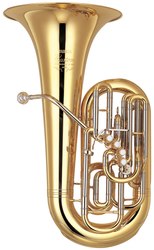 A bass tuba in F with front-action piston valves | |
| Brass instrument | |
|---|---|
| Classification | |
| Hornbostel–Sachs classification | 423.232 (Valved lip-reed aerophone with wide conical bore) |
| Inventor(s) | Wilhelm Friedrich Wieprecht and Johann Gottfried Moritz |
| Developed | 1835 in Prussia |
| Playing range | |
 | |
| Related instruments | |
| Musicians | |
| List of tubists | |
| Sound sample | |
The tuba (Latin, "trumpet";[2] UK: /ˈtjuːbə/;[3] US: /ˈtuːbə/) is a large brass instrument in the bass-to-contrabass range with a wide, bugle-like conical bore and between three and six (usually four or five) valves. It first appeared in 1835 in Prussia as the Baß-Tuba, an application of five valves to a bugle scaled up to 12-foot (12′) F, providing a fully chromatic contrabass range with a deep, full timbre.[4][5] Subsequently, the Paris maker Adolphe Sax developed the E♭ and B♭ band tubas with piston valves as members of his saxhorn family by the 1850s, and Václav František Červený in Austria-Hungary developed contrabass tubas in 16′ C and 18′ B♭ with rotary valves in the 1870s.
As with any brass instrument, sound is produced with a lip vibration or "buzz" in the mouthpiece. A person who plays the tuba is called a tubaist or tubist,[6] or simply a tuba player. In British brass bands and military bands, they are known as a bass player.
History


The early history of the tuba was the search for a practical valved brass instrument with a bass and contrabass voice, suitable for use in bands and the orchestra brass section.[7] Before the emergence of the first valves in the 1820s, brass instruments were either restricted to a single harmonic series like the natural trumpet or bugle, or used a slide like the trombone, or used keys and tone holes like the keyed bugle or serpent.
Origins
For the earliest low-pitched brass instruments, none of these solutions were ideal. Natural instruments can only approach diatonic or chromatic scales in their high register, bass trombones had long slides with handles which were unwieldy for rapid passages, and the timbre of the serpent was often criticized.[8]
To replace the serpent and its various upright derivatives, the Paris-based maker Jean Hilaire Asté invented the ophicleide in 1817, extending the keyed bugle into the bass register with a folded, bassoon-like form.[9] It was a sufficient improvement, in both intonation and timbre, that it was widely adopted in brass and military bands. It was also used in the orchestra particularly by French composers, most notably Hector Berlioz.[10] Although the ophicleide was initially successful, and serpents were still being used in bands and church ensembles, neither instrument could play much below C₂ into the contrabass range.[10]
The first tubas
.jpg)

In the 1820s soon after the invention of valves, instruments with the same overall layout as the ophicleide but replacing its keys with valves appeared. These instruments were called valved ophicleides (German: Ventilophikleide; French: ophicléide à piston).[11] In Prussia, the military bandmaster Wilhelm Friedrich Wieprecht required an instrument capable of a secure contrabass compass for his bands, and with the Berlin-based instrument maker Johann Gottfried Moritz invented the Baß-Tuba in F (Prussian patent 9121, granted 12 September 1835). It used five Berlinerpumpen valves (forerunners of the modern Périnet piston valves) to provide a chromatic compass down to F1, its first fundamental or pedal tone.[12] Berlin valves, invented by Wieprecht two years earlier, were capable of operating on the wider bore tubing of larger instruments than the earlier Stölzel and Vienna valve designs, which made the Baß-Tuba the first successful contrabass valved brass instrument.[13]
Paris-based instrument maker Adolphe Sax, like Wieprecht, was interested in marketing families of instruments ranging from soprano to bass, and developed his saxhorn series of brass instruments, pitched in E♭ and B♭. Sax's instruments gained dominance in French military bands, and later in Britain and America. Their widespread success was a result of the movements of popular instrument makers, notably Gustave Auguste Besson, who moved from Paris to London, and Henry Distin, who started manufacturing them in London, and later moved his business to the United States.[14][15] The E♭ and B♭ saxhorns constitute almost the whole instrumentation of the modern British brass band, with the addition of cornets, trombones and a flugelhorn. The modern band tubas with top-action piston valves, compared to their 19th century contrabass saxhorn ancestors, are little-changed except for an expansion of bore and fourth compensating valve.[16]
The helicon is thought to have first appeared in Russia in the mid-1840s, and first patented in 1848 in Vienna by Stowasser. Like the Ancient Roman buccina, its tubing is wrapped under the right arm with the bell resting on the player's left shoulder. The helicon also became popular throughout Europe and North America, particularly for its suitability for marching and mounted bands.[17]
Early American tubas

.jpg)
In the United States saxhorns had become popular by the mid-19th century, particularly in military and brass bands. In 1838, the New York maker Allen Dodworth patented his "over-the-shoulder" (OTS) instruments, with bells pointing backwards over the player's left shoulder, that included an E♭ bass model.[18] This design allowed soldiers, usually marching behind the band, to better hear the music.[19] Demand for bugles and OTS saxhorns grew, particularly in the early 1860s during the American Civil War, and tens of thousands were made in the United States or imported from Europe. After the war, the bands and their music remained popular, and manufacturing demand remained strong.[20] From these ensembles and musicians emerged the American drum and bugle corps tradition,[21] and the mixed-winds concert bands popularised by Patrick Gilmore and John Philip Sousa.[22]
In 1893, Sousa, unhappy with the sound from his BB♭ contrabass helicon tubas, had the Philadelphia instrument maker J. W. Pepper build a helicon with an upward-pointing bell, to better diffuse the sound. This sousaphone model was later made by the American manufacturers Holton and C. G. Conn, who some time in the early 20th century turned the bell forward to create the iconic modern form.[23]
The tuba in Italy
The Italian word cimbasso, thought to be a contraction of the term corno basso (lit. 'bass horn'), first appeared in scores as c. basso or c. in basso in the 1820s. Initially the cimbasso was a form of upright serpent or bass horn, but over the course of the 19th century the term was used loosely to refer to the lowest bass instrument available in the brass family, including the ophicleide and early Italian valved instruments such as the pelittone and bombardone.[24] The Italian opera composer Giuseppe Verdi, dissatisfied with the sound of these instruments, commissioned a valved contrabass trombone, built in the 1880s for his late operas.[25] By the early 20th century this instrument, which he and Giacomo Puccini called simply the trombone basso in their scores, had disappeared from Italian orchestras, replaced by the tuba. The modern cimbasso, commonly called for in film and video game soundtracks, was revived from Verdi's instrument, via the German contrabass trombone in F, in the early 1980s.[26]
Twentieth century developments


In Britain, the English F tuba was first produced in 1887 with 5 valves, similar to existing E♭ band instruments. Harry Barlow, appointed to Hallé Orchestra in 1894, had his F tuba built c. 1897 by Higham of Manchester, which survives in the University of Edinburgh collection.[27] By the 1960s, the scarcity and expense of these "Barlow" model F tubas, combined with the illegality of importing foreign instruments, meant that British orchestral players switched to the readily available brass band E♭ tuba, with four compensating valves.[28]
In France, the orchestral tuba from the late 19th century until around the 1950s was the small, euphonium-sized French C tuba. It was based on the bass saxhorn, built in 8′ C with six piston valves. This instrument quickly became standard in French orchestras, and was the tuba written for by French composers of that time.[29] The difficult high orchestral excerpts for tuba are often French tuba parts from this time, for example the "Bydło" tuba solo in Maurice Ravel's 1922 orchestration of Mussorgsky's Pictures at an Exhibition, though elsewhere the part also descends into the low register, to low F♯1 in other movements.[30]
In the early days of recorded music in the 1920s, recording tubas were made with the bell pointing forward (pavillon tournant) so their sound could more easily be directed towards the recording microphone. Extra players with recording tubas were sometimes brought in to play string section double bass parts, to compensate for the poor bass response of early microphones.[31]
In 1933 Alfred Johnson, the production chief at the Michigan-based York Band Instrument Company, made two large C tubas for the conductor Leopold Stokowski, who wanted an organ-like tuba sound for the Philadelphia Orchestra.[32] One of these instruments ended up in the hands of Arnold Jacobs, then a student, who later became principal tubist at the Chicago Symphony Orchestra and an influential 20th century tuba pedagogue and player.[33] Both instruments, known as the "Chicago Yorks", were purchased by the orchestra and used by the current principal tubist Gene Pokorny. Due to the quality of their sound and ease of playing, they are described by many American players and technicians as "the greatest tubas ever made", and the subject of much measurement, analysis and several attempts to recreate them.[34] Replicas include the "Yorkbrunner" HB50 and HBS510 models by the Swiss instrument company Hirsbrunner[33] (now made by the Dutch maker Adams Musical Instruments),[35] the Yamaha YCB-822 "Yamayork" model,[36] the B&S 3198,[37] and the Wessex TC-695 "Chicago York" tuba.[38] In 2009, samples from old York tubas revealed they were made from brass with a higher than usual copper content of 80 percent,[39] and about 100 York-inspired tubas were built by Kanstul in Anaheim, California before the business closed in 2019.[40]
Construction
In organology, the tuba is classified as a bass valved bugle. The valved bugles are a large family of brass instruments that includes the euphonium, flugelhorn, and the wider-bored members of the saxhorn family, distinguished by having valves and a wide conical bore.[41] The conical bore of bugles is wider than other conical brass instruments, like the horn or cornet, or the cylindrical-bore trumpet and trombone. The bore diameter increases as a function of the tubing distance from the mouthpiece. This causes the instrument to favor lower spectral content, producing a mellow, warm timbre. The wide rate of taper of the last portion of the tubing leading to the bell, combining with the bell's large diameter, amplifies these lower frequencies and produces a deep contrabass sound.[42]
Sizes
Tubas are made in four pitches, determined by the length of the open tubing with no valves engaged. The smaller bass tuba is built in 12-foot (12′) F or 13′ E♭, while the larger contrabass tuba is built in 16′ C or 18′ B♭. Often the contrabass tubas are called "CC" or "BB♭" tubas, based on an archaic English variant of the Helmholtz pitch notation. The terms bass and contrabass are largely not used by composers, with the choice of instrument left to the player, often based on the desired timbre rather than the range required by the part.[43]
The original 1835 Baß-Tuba in F survives as various much-modified models of F tuba. It is commonly used by professional players as a solo instrument, or to play higher parts in the classical repertoire in orchestras where a C tuba would be the usual instrument. In most of Europe, the F tuba is the standard orchestral instrument, supplemented by the C or B♭ tuba only when the extra weight is desired.[44] In Vienna, the Wienerkonzerttuba is an F tuba with six rotary valves, in two groups of three for each hand. In Britain from the late 19th century until the 1950s, the standard orchestral tuba was in F with four or five piston valves, and a narrower bore profile closer to the euphonium.[45]
The E♭ tuba is most commonly found in brass and military bands, in saxhorn form with three top-mounted piston valves and usually with a fourth compensating valve on the side. In British orchestras, the E♭ tuba displaced the old British F tuba in the 1960s, and is still found in British orchestras today, although some players favor larger C instruments since the 1990s.[45] The E♭ tuba is occasionally found in German form with five rotary valves, mostly in Scandanavian orchestras.[46]
The C tuba is the most widely used orchestral tuba outside of Germany and Russia, and all professional models have five non-compensating valves.[47] It is also found in concert bands in the US. On piston valve instruments, the fifth valve is usually a rotary valve.[48]
The largest, the contrabass tuba in B♭, is the tuba of choice in German, Austrian, and Russian orchestras, usually with rotary valves. In the United States, the B♭ tuba is the most common in schools, largely due to the use of B♭ sousaphones in high school marching bands. The B♭ saxhorn-style tuba, with three top-mounted piston valves and usually a fourth compensating valve on the side, is standard in British brass bands.[47]
Quarter designation
Even within instruments of the same pitch, tubas also vary in size: the overall width of the tubing sections, the bell diameter, and rate of bell taper. The size is usually denoted in quarters, with 4/4 designating a normal, full-size tuba.[49] Smaller instruments, often student or intermediate models with only three valves, may be described as 3/4 or even 1/2 instruments. These are common in schools for use by young players where a full-size tuba may be too large, or for marching to reduce weight.[50] Larger instruments are denoted as 5/4, or 6/4 for the largest tubas, sometimes known as grand orchestral tubas. These include the Conn 36J "Orchestra Grand Bass" from the 1930s, and the replicas made by several manufacturers of the well known large York C tubas, played and popularised by the Chicago Symphony Orchestra tuba player and teacher, Arnold Jacobs.[34]
The designations have no standardised measurements. Between manufacturers, they do not consistently correlate with reported bore or bell diameter specifications, so they are only useful for making comparisons between models within a single manufacturer's catalog.[49]
Other sizes
The euphonium, pitched in 9′ B♭ a fourth above the bass tuba in F, is sometimes referred to as a tenor tuba, particularly by British composers.[51] This term can also refer more specifically to the German Baryton, a similar instrument in B♭ with rotary valves.[52] These instruments are used to play tenor tuba parts, and often ophicleide parts and the high tuba parts written for the similarly sized small French tuba.[53][54][29]
A small number of very large novelty subcontrabass tubas have been built, and four playable instruments with functioning valves survive, mostly in museums.[55] Two in 36′ B♭, an octave below the B♭ contrabass, were built by Gustave Besson on the suggestion of Patrick Gilmore, and the surviving Harvard University Band instrument was restored in 2019 and features occasionally in concerts.[56] Another with four valves now owned by Amati Kraslice was originally exhibited by the Czech maker Bohland & Fuchs in 1928.[57] In 1956, a 32′ C tuba built c. 1899 by the German maker Rudolf Sander featured in the first comedy Hoffnung Music Festival.[56] In 2010, a fully playable Riesentuba in 36′ B♭ with four rotary valves was built and resides in Germany at the Markneukirchen Musical Instrument Museum.[58]
Variations


The development of tubas took place in several regions throughout the 19th and 20th centuries, which has resulted in many different forms with different bores, bell tapers and sizes, and different types and number of valves.[59] Broadly, tubas can be divided into two main groups.[60]
The saxhorn-derived, "French style" tubas have piston valves mounted vertically and operated from the top of the instrument ("top action"), and from the player's viewpoint the leadpipe from the mouthpiece is attached to the left side of the bell, with the valves and tubing positioned to the right of the bell. These are common in France, Britain, and throughout the British Commonwealth, particularly in brass and military bands.[48]
The "German style" tubas, derived from the Baß-Tuba and later Červený Kaiser tubas, have the leadpipe attached to the right side of the bell, and the tubing and valves to the left, with the valves mounted in the middle and operated from the front ("front action").[48] German style tubas usually have rotary valves, although American models based on early 20th century York tubas use piston valves, oriented horizontally so the finger buttons are operated in the same position.[61] In either group the valves are operated by the right hand, although saxhorn-style instruments with a fourth compensating valve often place the fourth valve on the side, operated by the left hand.[48]
Tubas for marching
.jpg)
_crop.jpg)
_crop1.jpg)
.jpg)
Standard tubas can be played whilst standing and marching, which is the usual practice in British brass bands and military bands. For player comfort and to avoid serious injury, a strap joined to metal rings on the tuba or a leather harness for the bottom bow are used to take the weight, via an over-shoulder strap or waist band.
In North America most marching bands use the sousaphone, wrapped under one arm with the bell resting on the opposite shoulder, which is easier to carry and play while marching.[62][17] The earlier helicon, from which the sousaphone is derived, is also used by bands in Europe and other parts of the world.
Some tubas, known as marching tubas, are capable of being converted into a marching configuration, where it rests on the left (or occasionally, right) shoulder with the bell facing directly in front of the player. The leadpipe can be manually screwed on next to the valves, or can swivel between the marching position and a normal upright "concert" position. Some marching tubas, the contrabass bugles, are made only for marching. These were invented in the 1960s for use in modern drum and bugle corps. Originally built in 21′ G with only two valves, since 2000 they are built with three or four, in 16′ C or 18′ B♭.
Valves
Tubas are made with either piston or rotary valves.[48] Rotary valves, patented in Prussia by Joseph Riedl in 1835, were first used on tubas in the 1850s by the Austro-Hungarian maker Václav František Červený. Around the same time in France and Britain, the modern piston valve developed by François Périnet in 1839 had begun to replace the Berlin valves used on early saxhorn instruments.[63]
Pistons can be top-action, oriented vertically so the buttons are operated from the top of the instrument, or front-action or side-action, oriented horizontally so the buttons are at the front of the instrument, operated from the side.[48] Piston valves require regular oiling to keep them freely operating, while rotary valves are sealed, and seldom require oiling. Piston valves are easy to dismantle and reassemble, while rotary valves disassembly and reassembly generally requires an experienced instrument technician.

Tubas usually have four or five valves, but can range from three to six. Three-valve tubas are usually inexpensive student models or smaller marching instruments to conserve weight; the sousaphone usually has three valves. Among professional players, four and five valve tubas are the most common. F tubas usually have five or six valves,[48] including the six-valved Wiener Konzerttuba (Vienna concert tuba) used in Austria.[64]
A valve works by adding a loop of tubing of a certain length to the main tubing of the instrument, thus lowering its fundamental pitch. On modern tubas, the first three valves work the same way as other valved brass instruments: the first lowers the pitch by two semitones (whole step), the second by one semitone (half step), and the third by three semitones (minor third).
Fourth, fifth, and sixth valves
The fourth valve lowers the pitch by five semitones (a perfect fourth), and used instead of the combination of valves 1 and 3 which is too sharp. When tuned properly, it helps solve the intonation of valve combinations of valves 1, 2, and 3. Using valve 4 with valves 1, 2, and 3 extends the range down to the fundamental pitch, but as with other valve combinations, some of these lower notes will be too sharp.
The fifth and sixth valves, if fitted, provide alternative fingering possibilities to improve intonation, particularly in the octave between the fundamental pitch (pedal tone) and the second partial, and for smooth trills and ease of playing. Usually, the fifth valve is tuned to two and a half semitones (flattened whole step), and the sixth to one and a half semitones (flattened half step). In C tubas with five valves, the fifth valve may be tuned as a flattened whole step or as a minor third, depending on the instrument. The B♭ rarely has a fifth valve, but if fitted is tuned similarly to that of a C tuba.
Compensating valves
Most high-end saxhorn-style tubas in E♭ and B♭, instead of providing a fifth or sixth valve, provide a compensating system on the fourth valve to adjust intonation when using valves in combination.[65] This reduces the need to constantly adjust tuning slides while playing, and also simplifies fingering. The compensating piston valve was invented in the 1870s by David Blaikley, the factory manager at Boosey & Co., who patented it in 1878.[66] The tubing of the fourth valve is re-routed back through the other three valves to add an extra set of small correcting tubing loops.[67] This achieves correct intonation in the lower range of the instrument when using the fourth valve.[68]
The patent limited its application outside of Britain, and tubas with compensating valves are mainly found in Britain and British Commonwealth countries. Compensating valves can make the instrument significantly more "stuffy" or resistant to air flow when compared to a non-compensating tuba, and it also makes the instrument heavier.[69]
Materials and finish

The tuba is generally constructed of brass, which is either electro-plated with silver or coated with a thin transparent lacquer.[70] Unfinished brass will eventually tarnish and must be periodically polished to maintain its appearance.[71]
To reduce weight, tubas can be made using fiberglass, ABS plastic, or carbon-fiber composite for the bell and major tubing.[72][73] This is useful for increased durability, portability, and use while marching, especially sousaphones, which have been made with fibreglass bells since the 1960s. These materials also allow the instrument to be produced in many colors.[74]
Manufacturers
There are many types of tubas that are manufactured in Europe, the United States, and Asia. In Europe, the predominant models that are professionally used are Meinl-Weston (Germany) and Miraphone (Germany). Asian brands include the Yamaha Corporation (Japan) and Jupiter Instruments (Taiwan). Holton Instrument Company and King Musical Instruments are some of the most well known brands from the United States.[75]
Performance
Notation
In orchestras, concert bands, and US military bands, the tuba is written at concert pitch in the bass clef as a non-transposing instrument, like the orchestral trombone, cello, and bassoon. Tuba players reading music in bass clef must therefore learn the different valve fingerings for each different size of tuba. Unlike other bass clef instruments, high passages for tuba are not usually written in tenor clef, and players are used to reading up to five leger lines above and below the bass staff.[76]
In British brass bands, all instruments except the bass trombone are transposing instruments using the treble clef notation popularized in France by the instrument maker Adolphe Sax for his families of instruments.[77] Thus the tuba parts are notated in treble clef, sounding an octave and a sixth below written for E♭ tuba, like the baritone saxophone, or two octaves and a second for B♭ tuba, like the contrabass clarinet.[78] This allows band musicians to change instruments without having to learn new fingerings for the same written music.
![\relative {
\cadenzaOn
\clef treble \key c \major
c'8[ ^ \markup \tiny "written, transposing" d e f] g4 c
s4 \bar "|"
\clef bass \key bes \major \time 4/4
bes,,,!8[ ^ \markup \tiny "sounds (B♭ tuba)" c d ees!] f4 bes!
\bar "|"
\clef bass \key ees \major \time 4/4
ees,!8[ ^ \markup \tiny "(E♭ tuba)" f g aes!] bes4 ees!
}](https://upload.wikimedia.org/score/2/q/2qgg11plwigv2q5ygqfq92p6bke6ypv/2qgg11pl.png)
Concert band music sometimes provides tuba parts in E♭ and B♭ treble clef as well, to accommodate players from either background, although professional players are usually familiar with either notation.[79]
Range
The written range of the tuba is large, partly because different sized instruments have been used at different times and in different regions. The C or B♭ contrabass tubas called for by Wagner and later German composers could scarcely reach middle C, while the range of the euphonium-like French C tuba built an octave higher reaches the C5 above middle C. On any tuba, the range from F1 to C4 (middle C) is easily accessible, but the full working range from contemporary solo repertoire includes the pedal range to at least B♭0, and extends up to at least C5.[1][80]

Higher notes are possible ,since the upper range is limited only by the fitness of the players' embouchure, although notes above the bell cutoff frequency around the tenth harmonic are difficult to centre; continuous glissandi are possible, making valve fingering largely redundant.[81] The wide bore profile of the tuba means that pedal tones are easily produced, compared to other brass instruments.[82]
Resonance and false tones
Some tubas have a strong, useful resonance that deviates from the instrument's principal harmonic series. For example, most large B♭ tubas have a strong resonance around the low E♭1 between the B♭0 pedal and its second partial an octave above. These alternative resonances are often known as false, factitious or privileged tones, and allow the instrument to play chromatically from E1 down to the B♭ pedal of the open horn using only three valves.[83]
Jazz

While the New Orleans Blue Book of ragtime standards from c. 1900 contained parts for tuba, they were only as a unison alternative to the string bass parts, likely for outdoor performances. The tuba did not appear in early jazz bands until the 1920s, usually as the sousaphone, playing only oom-pah with occasional short solo breaks.[84] The earliest known recordings with tuba were of the New Orleans Rhythm Kings in 1923, with Jelly Roll Morton on piano and Chink Martin on tuba.[85] This continued to be the main role for jazz tuba through the dance era of the 1920s and 30s, and its association with banjo in the Dixieland and trad-jazz revival of the 1940s.[86]
The poor bass sensitivity of early recording technology meant that many jazz string bass players were expected to also play tuba. In the 1920s, New York musician Joe Tarto, adept at both, performed and recorded with almost every jazz musician of the time, including Bix Beiderbecke and Tommy Dorsey.[85] Later he played with the Paul Whiteman Orchestra and published his jazz bass method, Basic Rhythms and the Art of Jazz Improvisation.[87]
As the recording technology improved in the 1930s, players moved back to string bass.[85] The big bands that became prevalent in the swing era during World War II did not include the tuba in their standard instrumentation of trumpets, trombones, saxophones and rhythm.[84]

In the late 1940s, the tuba was reintroduced into cool jazz by the jazz trumpeter Miles Davis, who organised an ensemble of nine players that included Bill Barber on tuba. Barber features on several Miles Davis recordings in arrangements by Gerry Mulligan and Gil Evans, including the session compilation Birth of the Cool (1948), and later albums Miles Ahead (1957) and Sketches of Spain (1960).[88] In the 1950s, Stan Kenton explored using different instruments like the mellophonium to create a warm enveloping sound especially in ballads, and in 1955 made his fifth trombonist double on tuba to make use of its distinct timbre.[89]
Although still not commonly found as a solo instrument in modern jazz, it has featured in ensembles and recordings since the 1970s. The Matteson-Phillips Tubajazz Consort was set up in 1976 by the tubist Harvey Phillips and euphoniumist Rich Matteson. The New York jazz musician Howard Johnson was a leading tuba soloist and band leader, including the NBC Saturday Night Live Band.[90] The New York City-based tubist Marcus Rojas performed frequently with Henry Threadgill.[91] In the 1980s and 90s, the Los Angeles tubist Jim Self and Samuel Pilafian of The Empire Brass Quintet recorded several jazz CDs.[92]
Repertoire
A symphony orchestra typically includes a single tuba, although a second is sometimes called for in large works, such as Stravinsky's ballet The Rite of Spring (1913), and Havergal Brian's Symphony No. 1 (1927). The tuba serves as the bass of the orchestral brass section, and it can reinforce the bass voices of the strings and woodwinds.[93]
The tuba is the principal bass instrument in concert bands and military bands, usually two to four in number. British-style brass band music has two tuba parts, one each for E♭ and B♭ tuba. With usually two players on each part, they can sometimes be marked divisi.[94][95] Tubas, often as sousaphones, are also used in jazz bands and marching bands, and as contrabass bugles in drum and bugle corps.
In chamber music, the tuba provides the bass of the brass quintet, a genre first popularised in the 1950s by the Philip Jones Brass Ensemble and the New York Brass Quintet.[96]
The first "serious" composition for solo tuba was the Sonate für Baßtuba und Klavier (1957) by the German-American composer Paul Hindemith.[97][98] Since then, a considerable body of repertoire has amassed for tuba as a solo instrument,[99] both unaccompanied, and with ensemble or piano accompaniment.[100][101]
The first tuba concerto was the Concerto in F minor for Bass Tuba and Orchestra, written in 1954 by the British composer Ralph Vaughan Williams. Since then many tuba concertos have been written, by Edward Gregson, John Williams, Alexander Arutiunian, Eric Ewazen, James Barnes, Joseph Hallman, Martin Ellerby, Philip Sparke,[102] Kalevi Aho, Josef Tal, Bruce Broughton, John Golland, Roger Steptoe, David Carlson, Jennifer Higdon (Tuba Concerto), and Marcus Paus (Tuba Mirum).[103]
See also
References
- ^ a b c Herbert, Myers & Wallace 2019, p. 484, Appendix 2: The Ranges of Labrosones.
- ^ "tuba definition". Latin Dictionary. Archived from the original on 22 June 2015. Retrieved 4 February 2018.
- ^ "tuba (noun): Pronunciation". Oxford Advanced Learner's Dictionary. Oxford Learner's Dictionaries. Retrieved 18 April 2021.
- ^ O'Connor 2007, p. 1–3.
- ^ Forsyth 1914, p. 530.
- ^ "Tuba". Merriam-Webster. Retrieved 2012-05-26.
- ^ O'Connor 2007, p. 1.
- ^ Yeo 2021, pp. 128–31, "serpent".
- ^ Herbert, Myers & Wallace 2019, p. 303, "Ophicleide".
- ^ a b Bevan 1996, p. 2.
- ^ Morley-Pegge, Reginald (2001). "Ophicleide". Grove Music Online (8th ed.). Oxford University Press. doi:10.1093/gmo/9781561592630.article.40954. ISBN 978-1-56159-263-0. (subscription, Wikilibrary access, or UK public library membership required)
- ^ Bevan 2000, p. 202–207.
- ^ Bevan 1996, p. 3.
- ^ Bevan 2000, p. 427.
- ^ O'Connor 2007, p. 10.
- ^ Bevan 1996, p. 4.
- ^ a b Bevan 2000, p. 450–451.
- ^ Bevan 2000, p. 427–429.
- ^ Villanueva, Jari. "Brass Bands of the Civil War". JV Music - Musical Arrangements. Archived from the original on 2025-05-05. Retrieved 2025-05-05.
- ^ Pirtle 2002, p. 70–71.
- ^ Pirtle 2002, p. 71.
- ^ Bevan 2000, p. 429–30.
- ^ Bevan 2000, p. 456–457.
- ^ Meucci 1996, p. 144–5.
- ^ Bevan 2000, p. 414.
- ^ Bevan 1997, p. 297–298.
- ^ Bevan 2000, pp. 375–385.
- ^ Bevan 2000, p. 385.
- ^ a b Kleinsteuber, Carl (2017). An Argument in Favor of the Saxhorn Basse (French Tuba) in the Modern Symphony Orchestra (DMA thesis). University of North Texas. Archived from the original on 5 October 2022. Retrieved 9 May 2019.
- ^ Bevan 2000, p. 347-348.
- ^ Bevan 2000, p. 448.
- ^ Quinones 2025, p. 18.
- ^ a b Yeo 2021, p. 171, "Yorkbrunner".
- ^ a b Quinones 2025, pp. 17–19.
- ^ "CC 6/4 tuba". Together in Music. Ittervoort: Adams Musical Instruments. Retrieved 7 January 2026.
- ^ "C Tubas: YCB-822". Tokyo: Yamaha Corporation. Retrieved 7 January 2026.
- ^ "CC-Tuba 3198 - Lacquer". Markneukirchen: B&S. Retrieved 7 January 2026.
- ^ "TC695 HP: CC 6/4 Front-Piston Tuba 'Chicago-York'". Andover: Wessex Tubas. Retrieved 7 January 2026.
- ^ Quinones 2025, p. 228.
- ^ Quinones 2025, pp. 307–311.
- ^ Bevan 2000.
- ^ Adler-McKean 2020.
- ^ Adler-McKean 2020, pp. 33–34.
- ^ Adler-McKean 2020, p. 39.
- ^ a b Bevan 1996, p. 8.
- ^ Adler-McKean 2020, p. 40.
- ^ a b Adler-McKean 2020, p. 41.
- ^ a b c d e f g Adler-McKean 2020, p. 49.
- ^ a b Adler-McKean 2020, p. 36.
- ^ Bevan 2000, p. 277.
- ^ Bevan, Clifford (2001). "Euphonium". Grove Music Online (8th ed.). Oxford University Press. doi:10.1093/gmo/9781561592630.article.09077. ISBN 978-1-56159-263-0. (subscription, Wikilibrary access, or UK public library membership required)
- ^ O'Connor 2007, p. 10–11.
- ^ Bevan 2000, p. 232.
- ^ Bowman 2007, p. 251.
- ^ Detwiler, Dave (6 February 2021). "Gallery: Known Subcontrabass Tubas". Strictly Oompah. Retrieved 18 December 2025. The 26′ E♭ specimen in the Henri Selmer Paris museum is technically a contrabass.
- ^ a b Yeo 2021, p. 141-2, subcontrabass tuba.
- ^ "Bohland & Fuchs Show Largest Brass Bass Horn". The Music Trade Review. 87 (8): 16. 25 August 1928. Retrieved 23 December 2025.
- ^ Detwiler, Dave (31 May 2019). "The wonderful world of Giant Tubas!". Strictly Oompah. Retrieved 13 September 2024.
- ^ Adler-McKean 2020, pp. 31–33.
- ^ Bevan 2000, p. 212, Fig. 4.9.
- ^ Bevan 2000, p. 198.
- ^ Detwiler, Dave (2015). "Heritage: Marching Through the Early History of the Sousaphone". ITEA Journal. 42 (2): 27–29.
- ^ Adler-McKean 2020, p. 47.
- ^ Adler-McKean 2020, p. 43–44.
- ^ "Compensating System". Dwerden.com. Retrieved 4 February 2018.
- ^ O'Connor 2007, p. 6.
- ^ Adler-McKean 2020, p. 51.
- ^ Herbert, Myers & Wallace 2019, pp. 436–437, "Valve".
- ^ Adler-McKean 2020, p. 51–52.
- ^ Adler-McKean 2020, p. 34.
- ^ Winter, James (1975). "Brass". Music Educators Journal. 62 (2): 34–37. doi:10.2307/3394871. JSTOR 3394871. S2CID 221063884.
- ^ Bevan 2000, p. 289.
- ^ "Carbon Fiber Sousaphone". Hindlingen: Jérôme Wiss. 21 December 2024. Retrieved 9 January 2026.
- ^ Bevan 2000, p. 292–293.
- ^ "Instruments and Equipment". Music Educators Journal. 55 (9): 101–102. 1969. doi:10.2307/3392572. JSTOR 3392572. S2CID 221060268.
- ^ Adler-McKean 2020, pp. 67–68.
- ^ Adler-McKean 2020, p. 27.
- ^ Adler-McKean 2020, pp. 69–70.
- ^ Adler-McKean 2020, p. 68.
- ^ Adler-McKean 2020, p. 182.
- ^ Adler-McKean 2020, pp. 60–63.
- ^ Adler-McKean 2020, p. 32, 58.
- ^ Bevan 2000, p. 58.
- ^ a b Bevan 2000, p. 441.
- ^ a b c Call 1996, p. 529.
- ^ Bevan 2000, pp. 440–441.
- ^ Graves 2006, p. 458.
- ^ Call 1996, pp. 530–531.
- ^ Russonello, Giovanni (14 January 2021). "Howard Johnson, 79, Dies; Elevated the Tuba in Jazz and Beyond". The New York Times. Retrieved 8 December 2025.
- ^ Call 1996, pp. 531–32.
- ^ William, Pryor. "New Orleans Jazz and the Trad Jazz Movement". IAJRC Journal. 49: 61–65.
- ^ Call 1996, pp. 532.
- ^ Kennan & Grantham 2023, p. 155.
- ^ Bevan 2000, pp. 430–431.
- ^ Odello, Denise (2014). "British Brass Band Periodicals and the Construction of a Movement". Victorian Periodicals Review. 47 (3): 432–453. Retrieved 8 December 2025.
- ^ Bevan 2000, pp. 435–436.
- ^ Bevan 2000, p. 437.
- ^ Hindemith, Paul (1957). "Sonate für Baßtuba und Klavier". London: Schott & Co. Archived from the original on 22 August 2025. Retrieved 12 January 2025 – via International Music Score Library Project.
- ^ Skillen & Goldstein 2006, pp. 1–2.
- ^ Northcut & Gray 2006, pp. 173–4.
- ^ Sinder & Funderburk 2006, pp. 217–8.
- ^ Sisk 2017, pp. 3–20.
- ^ Northcut & Gray 2006, pp. 173–187.
Bibliography
- Adler-McKean, Jack (2020). The Techniques of Tuba Playing (in multiple languages). Kassel: Bärenreiter. ISBN 978-3-7618-2421-4. OCLC 1201192145. Wikidata Q134349391.
- Bevan, Clifford (1996). "A Brief History of the Tuba". In Morris, R. Winston; Goldstein, Edward R. (eds.). The Tuba Source Book. Bloomington: Indiana University Press. pp. 1–9. ISBN 978-0-253-32889-2. OCLC 31737584. Wikidata Q135911601.
- Bevan, Clifford (1997). "Special NEH report: Cimbasso Research and Performance Practice: An Update". In Stewart Carter (ed.). Perspectives in Brass Scholarship: Proceedings of the International Historic Brass Symposium, Amherst, 1995. Bucina: The Historic Brass Society Series. Stuyvesant: Pendragon Press. p. 289–299. ISBN 978-0-945193-97-5. OCLC 37398029. Wikidata Q127092138.
- Bevan, Clifford (2000). The Tuba Family (2nd ed.). Winchester: Piccolo Press. ISBN 1-872203-30-2. OCLC 993463927. OL 19533420M. Wikidata Q111040769.
- Bowman, Brian (2007). "Band and Orchestral Excerpts". In Bone, Lloyd E.; Paull, Eric; Morris, R. Winston (eds.). Guide to the Euphonium Repertoire: The Euphonium Source Book. Bloomington: Indiana University Press. pp. 251–255. ISBN 0-253-34811-0. Wikidata Q135963380.
- Call, R. Steven (1996). "The Tuba in Jazz: A Historical View". In Morris, R. Winston; Goldstein, Edward R. (eds.). The Tuba Source Book. Bloomington: Indiana University Press. pp. 529–532. ISBN 978-0-253-32889-2. OCLC 31737584. Wikidata Q135911601.
- Forsyth, Cecil (1914), Orchestration, London: Macmillan Publishers, LCCN a14002863, OCLC 408500, OL 177040M, Wikidata Q121879329
- Graves, David D. (2006). "Methods and Studies". In Morris, R. Winston; Perantoni, Daniel (eds.). Guide to the Tuba Repertoire: The New Tuba Source Book. Bloomington: Indiana University Press. pp. 435–462. ISBN 978-0-253-34763-3. LCCN 2006005242. OCLC 704679837. Wikidata Q135911410.
- Herbert, Trevor; Myers, Arnold; Wallace, John, eds. (2019). The Cambridge Encyclopedia of Brass Instruments. Cambridge University Press. doi:10.1017/9781316841273. ISBN 978-1-316-63185-0. OL 34730943M. Wikidata Q136027509.
- Kennan, Kent; Grantham, Donald (2023). The Technique of Orchestration (7th ed.). New York: Routledge. doi:10.4324/9781003130680. ISBN 978-0-367-67296-6. LCCN 2022053871. Wikidata Q137766238.
- Meucci, Renato (1996). "The Cimbasso and Related Instruments in 19th-Century Italy". The Galpin Society Journal. 49. Translated by William Waterhouse (published March 1996): 143–179. ISSN 0072-0127. JSTOR 842397. Wikidata Q111077162.
- Northcut, Timothy J.; Gray, Skip (2006). "Music for Tuba and Orchestra". In Morris, R. Winston; Perantoni, Daniel (eds.). Guide to the Tuba Repertoire: The New Tuba Source Book. Bloomington: Indiana University Press. pp. 173–187. ISBN 978-0-253-34763-3. LCCN 2006005242. OCLC 704679837. Wikidata Q135911410.
- O'Connor, Michael (2007). "A Short History of the Euphonium and Baritone Horn". In Bone, Lloyd E.; Paull, Eric; Morris, R. Winston (eds.). Guide to the Euphonium Repertoire: The Euphonium Source Book. Bloomington: Indiana University Press. pp. 1–17. ISBN 0-253-34811-0. Wikidata Q135963380.
- Pirtle, Scooter (2002), "The evolution of the bugle", in Vickers, Steve (ed.), A History of Drum & Bugle Corps, vol. 1, Madison: Sights & Sounds, OCLC 50171582, Wikidata Q136465477
- Quinones, Sam (2025). The Perfect Tuba: Forging Fulfillment from the Bass Horn, Band, and Hard Work. New York: Bloomsbury Publishing. ISBN 978-1-63973-548-8. OCLC 1537965188. Wikidata Q136771010.
- Sinder, Philip; Funderburk, Jeffrey L. (2006). "Music for Unaccompanied Tuba". In Morris, R. Winston; Perantoni, Daniel (eds.). Guide to the Tuba Repertoire: The New Tuba Source Book. Bloomington: Indiana University Press. pp. 217–247. ISBN 978-0-253-34763-3. LCCN 2006005242. OCLC 704679837. Wikidata Q135911410.
- Sisk, Robin A. (2017), Three 21st Century Tuba Concertos for British-Style Brass Band: Performance Considerations for the Solo Tubist (DMA thesis), University of Hartford, Wikidata Q137209576
- Skillen, Joseph; Goldstein, Edward R. (2006). "Music for Tuba and Keyboard". In Morris, R. Winston; Perantoni, Daniel (eds.). Guide to the Tuba Repertoire: The New Tuba Source Book. Bloomington: Indiana University Press. pp. 1–149. ISBN 978-0-253-34763-3. LCCN 2006005242. OCLC 704679837. Wikidata Q135911410.
- Solomonson, Glen Terrance (1978), The History of the Tuba to 1860: A Study of the Development of the Tuba through its Ancestors (MME thesis), University of Louisville, Wikidata Q137205099
- Yeo, Douglas (2021). An Illustrated Dictionary for the Modern Trombone, Tuba, and Euphonium Player. Dictionaries for the Modern Musician. Illustrator: Lennie Peterson. Lanham: Rowman & Littlefield. ISBN 978-1-5381-5966-8. LCCN 2021020757. OCLC 1249799159. OL 34132790M. Wikidata Q111040546.
External links
- ITEA — The International Tuba Euphonium Association
 Media related to the tuba at Wikimedia Commons
 The dictionary definition of tuba at Wiktionary
- TubeNet, TubaForum.net — online forums
- The Vincent and Ethel Simonetti Historic Tuba Collection — Durham, North Carolina
- History of the Tuba Podcast — Jake Kline & Jack Adler-McKean
- International Tuba Day — first Friday in May
- Tuba Christmas — official site for the annual Tubachristmas concerts
- Chisholm, Hugh, ed. (1911). . Encyclopædia Britannica (11th ed.). Cambridge University Press.


| Instruments |  | |
|---|---|---|
| Performance/ notation | ||
| Sound reproduction | ||
