









Schwartz–Zippel lemma
In mathematics, the Schwartz–Zippel lemma (also called the DeMillo–Lipton–Schwartz–Zippel lemma) is a tool commonly used in probabilistic polynomial identity testing. Identity testing is the problem of determining whether a given multivariate polynomial is the 0-polynomial, the polynomial that ignores all its variables and always returns zero. The lemma states that evaluating a nonzero polynomial on inputs chosen randomly from a large-enough set is likely to find an input that produces a nonzero output.
it was discovered independently by Jack Schwartz,[1] Richard Zippel,[2] and Richard DeMillo and Richard J. Lipton, although DeMillo and Lipton's version was shown a year prior to Schwartz and Zippel's result.[3] The finite field version of this bound was proved by Øystein Ore in 1922.[4]
Statement and proof of the lemma
Theorem 1 (Schwartz, Zippel). Let
![{\displaystyle P\in R[x_{1},x_{2},\ldots ,x_{n}]}](https://wikimedia.org/api/rest_v1/media/math/render/svg/c10f062b8098b89d4b46ad58f59178b725e40383)
be a non-zero polynomial of total degree d ≥ 0 over an integral domain R. Let S be a finite subset of R and let r1, r2, ..., rn be selected at random independently and uniformly from S. Then
![{\displaystyle \Pr[P(r_{1},r_{2},\ldots ,r_{n})=0]\leq {\frac {d}{|S|}}.}](https://wikimedia.org/api/rest_v1/media/math/render/svg/4363fb0d270ade7071c0d5b273f956fa4f970f36)
Equivalently, the Lemma states that for any finite subset S of R, if Z(P) is the zero set of P, then

Proof. The proof is by mathematical induction on n. For n = 1, P can have at most d roots by the fundamental theorem of algebra. This gives us the base case. Now, assume that the statement holds for all polynomials in n − 1 variables. We can then consider P to be a polynomial in x1 by writing it as

Since P is not identically 0, there is some i such that is not identically 0. Take the largest such i. Then , since the degree of is at most d.



Now we randomly pick from S. By the induction hypothesis,

![{\displaystyle \Pr[P_{i}(r_{2},\ldots ,r_{n})=0]\leq {\frac {d-i}{|S|}}.}](https://wikimedia.org/api/rest_v1/media/math/render/svg/43d3686708de518c76338eeff89392dd67207131)
If , then is of degree i (and thus not identically zero) so


![{\displaystyle \Pr[P(r_{1},r_{2},\ldots ,r_{n})=0|P_{i}(r_{2},\ldots ,r_{n})\neq 0]\leq {\frac {i}{|S|}}.}](https://wikimedia.org/api/rest_v1/media/math/render/svg/604c0bf8b629c43277ed40b5c15145b671558264)
If we denote the event by A, the event by B, and the complement of B by , we have



![{\displaystyle {\begin{aligned}\Pr[A]&=\Pr[A\cap B]+\Pr[A\cap B^{c}]\\&=\Pr[B]\Pr[A|B]+\Pr[B^{c}]\Pr[A|B^{c}]\\&\leq \Pr[B]+\Pr[A|B^{c}]\\&\leq {\frac {d-i}{|S|}}+{\frac {i}{|S|}}={\frac {d}{|S|}}\end{aligned}}}](https://wikimedia.org/api/rest_v1/media/math/render/svg/3e9838641759db8e41a529b4166427d72d8e5dc2)
Remark. The Schwartz-Zippel lemma is tight in the following sense. Let be a finite subset and let . Choose any distinct elements from . Then define by . Let be selected uniformly at random from . Then so that the bound stated in the Schwartz-Zippel lemma is exactly matched.


![{\displaystyle P\in R[x_{1},\ldots ,x_{n}]}](https://wikimedia.org/api/rest_v1/media/math/render/svg/29b6df1e577fcd5d042cde7993b68585dc173435)


![{\displaystyle \Pr[P(r_{1},\ldots ,r_{n})=0]=\Pr[r_{1}\in \{s_{1},\ldots ,s_{d}\}]={\frac {d}{|S|}}}](https://wikimedia.org/api/rest_v1/media/math/render/svg/4948a279322fcdc97138b9cb3fbaf7c07a5e7273)
Applications
The Schwartz–Zippel lemma is used to obtain algorithms for problems which are reducible to polynomial identity testing.
Zero testing
One of the most common applications of the Schwartz-Zippel lemma in theoretical computer science is to testing whether a polynomial (given in terms of an arithmetic circuit or formula) is identically 0. For example, consider asking whether the arithmetic formula below is identically 0

To solve this problem deterministically, we can multiply all the terms and check whether the coefficient of every monomial is nonzero. However, this can take exponential time in the number of variables since a degree polynomial in variables has up to monomials. Instead, we can evaluate the polynomial at a random tuple of points over a sufficiently large field and if the result is indeed 0, we can use the Schwartz-Zippel lemma to conclude the formula is identically 0 with high probability.


Comparison of two polynomials
Given a pair of polynomials and , is


- ?
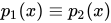
This problem, also known as polynomial identity testing, can be solved by reducing it to the above problem of testing whether a polynomial is identically 0. Specifically, is equivalent to
![{\displaystyle [p_{1}(x)-p_{2}(x)]\equiv 0.}](https://wikimedia.org/api/rest_v1/media/math/render/svg/5e84d3ce371a60c82f8fdec60f80d59bb6b06994)
Hence if we can determine that

where

then we can determine whether the two polynomials are equivalent.
Comparison of polynomials has applications for branching programs (also called binary decision diagrams). A read-once branching program can be represented by a multilinear polynomial which computes (over any field) on {0,1}-inputs the same Boolean function as the branching program, and two branching programs compute the same function if and only if the corresponding polynomials are equal. Thus, identity of Boolean functions computed by read-once branching programs can be reduced to polynomial identity testing.
Comparison of two polynomials (and therefore testing polynomial identities) also has applications in 2D-compression, where the problem of finding the equality of two 2D-texts A and B is reduced to the problem of comparing equality of two polynomials and .


Primality testing
Given , is a prime number?

A simple randomized algorithm developed by Manindra Agrawal and Somenath Biswas can determine probabilistically whether is prime and uses polynomial identity testing to do so.
They propose that all prime numbers n (and only prime numbers) satisfy the following polynomial identity:

This is a consequence of the Frobenius endomorphism.
Let

Then iff n is prime. The proof can be found in [4]. However, since this polynomial has degree , where may or may not be a prime, the Schwartz–Zippel method would not work. Agrawal and Biswas use a more sophisticated technique, which divides by a random monic polynomial of small degree. The AKS algorithm uses a similar technique but runs in deterministic polynomial time.


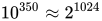
Prime numbers are used in a number of applications such as hash table sizing, pseudorandom number generators and in key generation for cryptography. Therefore, finding very large prime numbers (on the order of (at least) ) becomes very important and efficient primality testing algorithms are required.
Perfect matching
Let be a graph of n vertices where n is even. Does G contain a perfect matching?

Theorem 2 (Tutte 1947): A Tutte matrix determinant is not a 0-polynomial if and only if there exists a perfect matching.
A subset D of E is called a matching if each vertex in V is incident with at most one edge in D. A matching is perfect if each vertex in V has exactly one edge that is incident to it in D. Create a Tutte matrix A in the following way:
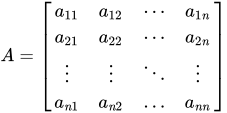
where
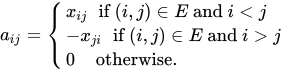
The Tutte matrix determinant (in the variables xij, ) is then defined as the determinant of this skew-symmetric matrix which coincides with the square of the pfaffian of the matrix A and is non-zero (as polynomial) if and only if a perfect matching exists. One can then use polynomial identity testing to find whether G contains a perfect matching. There exists a deterministic black-box algorithm for graphs with polynomially bounded permanents (Grigoriev & Karpinski 1987).[5]

In the special case of a balanced bipartite graph on vertices this matrix takes the form of a block matrix

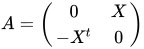
if the first m rows (resp. columns) are indexed with the first subset of the bipartition and the last m rows with the complementary subset. In this case the pfaffian coincides with the usual determinant of the m × m matrix X (up to sign). Here X is the Edmonds matrix.
Notes
- ^ Schwartz 1980.
- ^ Zippel 1979.
- ^ DeMillo & Lipton 1978.
- ^ Ö. Ore, Über höhere Kongruenzen. Norsk Mat. Forenings Skrifter Ser. I (1922), no. 7, 15 pages.
- ^ Grigoriev & Karpinski 1987.
References
- Agrawal, Manindra; Biswas, Somenath (2003-02-21). "Primality and Identity Testing via Chinese Remaindering". Journal of the ACM. 50 (4): 429–443. doi:10.1145/792538.792540. S2CID 13145079. Retrieved 2008-06-15.
- Berman, Piotr; Karpinski, Marek; Larmore, Lawrence L.; Plandowski, Wojciech; Rytter, Wojciech (2002). "On the Complexity of Pattern Matching for Highly Compressed Two-Dimensional Texts" (ps). Journal of Computer and System Sciences. 65 (2): 332–350. doi:10.1006/jcss.2002.1852. Retrieved 2008-06-15.
- Grigoriev, Dima; Karpinski, Marek (1987). "The matching problem for bipartite graphs with polynomially bounded permanents is in NC". Proceedings of the 28th Annual Symposium on Foundations of Computer Science (FOCS 1987), Los Angeles, California, USA, 27-29 October 1987. IEEE Computer Society. pp. 166–172. doi:10.1109/SFCS.1987.56. ISBN 978-0-8186-0807-0. S2CID 14476361.
- Moshkovitz, Dana (2010). An Alternative Proof of The Schwartz-Zippel Lemma. ECCC TR10-096
- DeMillo, Richard A.; Lipton, Richard J. (1978). "A probabilistic remark on algebraic program testing". Information Processing Letters. 7 (4): 193–195. doi:10.1016/0020-0190(78)90067-4.
- Rudich, Steven (2004). AMS (ed.). Computational Complexity Theory. IAS/Park City Mathematics Series. Vol. 10. ISBN 978-0-8218-2872-4.
- Schwartz, Jacob T. (October 1980). "Fast probabilistic algorithms for verification of polynomial identities" (PDF). Journal of the ACM. 27 (4): 701–717. CiteSeerX 10.1.1.391.1254. doi:10.1145/322217.322225. S2CID 8314102. Retrieved 2008-06-15.
- Tutte, W.T. (April 1947). "The factorization of linear graphs". J. London Math. Soc. 22 (2): 107–111. doi:10.1112/jlms/s1-22.2.107. hdl:10338.dmlcz/128215.
- Zippel, Richard (1979). "Probabilistic algorithms for sparse polynomials". In Ng, Edward W. (ed.). Symbolic and Algebraic Computation, EUROSAM '79, An International Symposiumon Symbolic and Algebraic Computation, Marseille, France, June 1979, Proceedings. Lecture Notes in Computer Science. Vol. 72. Springer. pp. 216–226. doi:10.1007/3-540-09519-5_73. ISBN 978-3-540-09519-4.
- Zippel, Richard (February 1989). "An Explicit Separation of Relativised Random Polynomial Time and Relativised Deterministic Polynomial Time" (ps). Retrieved 2008-06-15.
- Zippel, Richard (1993). Springer (ed.). Effective Polynomial Computation. The Springer International Series in Engineering and Computer Science. Vol. 241. ISBN 978-0-7923-9375-7.