







Portal:Phoenicia
THE PHOENICIA PORTAL

Phoenicians were an ancient Semitic people who inhabited city-states in Canaan along the Levantine coast of the eastern Mediterranean, primarily in present-day Lebanon and parts of coastal Syria. Their maritime civilization expanded and contracted over time, with its cultural core stretching from Arwad to Mount Carmel. Through trade and colonization, the Phoenicians extended their influence across the Mediterranean, from Cyprus to the Iberian Peninsula, leaving behind thousands of inscriptions.
The Phoenicians emerged directly from the Bronze Age Canaanites, their cultural traditions survived the Late Bronze Age collapse and continued into the Iron Age with little interruption. They referred to themselves as Canaanites and their land as Canaan, though the territory they occupied was smaller than that of earlier Bronze Age Canaan. The name Phoenicia is a Greek exonym that did not correspond to a unified native identity. Modern scholarship generally views the distinction between Canaanites and Phoenicians after c. 1200 BC as artificial.
Renowned for seafaring and trade, the Phoenicians established one of antiquity's most extensive maritime networks, active for over a millennium. This network facilitated exchanges among cradles of civilization such as Mesopotamia, Egypt, and Greece. They founded colonies and trading posts throughout the Mediterranean; among these, Carthage in North Africa developed into a major power by the 7th century BC.
Phoenician society was organized into independent city-states, notably Byblos, Sidon, and Tyre. Each retained political autonomy, and there is no evidence of a shared national identity. While kingship was common, powerful merchant families likely exercised influence through oligarchies. The Phoenician cities flourished most in the 9th century BC, but subsequently declined under the expansion of empires such as the Neo-Assyrian and Achaemenid. Their influence nevertheless endured in the western Mediterranean until the Roman destruction of Carthage in the mid-2nd century BC. — Read more about Phoenicia, its mythology and language
 Featured article
•
Featured article
•
A Featured article represents some of the best content on Wikipedia


The Roman temple of Bziza is a well-preserved first century AD building dedicated to Azizos, a personification of the morning star in ancient Arab polytheism. This Roman temple lends the modern Lebanese town of Bziza its current name, as Bziza is a corruption of Beth Azizo meaning the house or temple of Azizos. Azizos was identified as Ares by Emperor Julian.
The tetrastyle prostyle building has two doors that connect the pronaos to a square cella. To the back of the temple lie the remains of the adyton where images of the deity once stood. The ancient temple functioned as an aedes, the dwelling place of the deity. The temple of Bziza was converted into a church and underwent architectural modification during two phases of Christianization; in the Early Byzantine period and later in the Middle Ages. The church, colloquially known until modern times as the Lady of the Pillars, fell into disrepair. Despite the church's condition, Christian devotion was still maintained in the nineteenth century in one of the temple's niches. The temple of Bziza is featured on multiple stamps issued by the Lebanese state. (Full article...)
Phoenician mythology •

Resheph (also Reshef and many other variants, see below; Eblaite 𒀭𒊏𒊓𒀊, Rašap, Ugaritic: 𐎗𐎌𐎔, ršp, Egyptian ršpw, Phoenician: 𐤓𐤔𐤐, ršp, Hebrew: רֶשֶׁף Rešep̄) was a god associated with war and plague, originally worshiped in Ebla in the third millennium BCE. He was one of the main members of the local pantheon, and was worshiped in numerous hypostases, some of which were associated with other nearby settlements, such as Tunip. He was associated with the goddess Adamma, who was his spouse in Eblaite tradition. Eblaites considered him and the Mesopotamian god Nergal to be equivalents, most likely based on their shared role as war deities.
In the second millennium BCE, Resheph continued to be worshiped in various cities in Syria and beyond. He is best attested in texts from Ugarit, where he was one of the most popular deities. While well attested in ritual texts and theophoric names, he does not play a large role in Ugaritic mythology. An omen text describes him as the doorkeeper of the sun goddess, Shapash, and might identify him with the planet Mars. He was also venerated in Emar and other nearbly settlements, and appears in theophoric names as far east as Mari. The Hurrians also incorporated him into their pantheon under the name Iršappa, and considered him a god of commerce. Through their mediation, he also reached the Hittite Empire. He was also introduced to Egypt, possibly by the Hyksos, and achieved a degree of prominence there in the Ramesside period, with evidence of a domestic cult available from sites such as Deir el-Medina. The Egyptians regarded him as a warlike god, but he could also be invoked as a protective healer. He was associated with gazelles and horses, and in art appears as an armed deity armed with a bow, shield and arrows. (Full article...)
Images
-
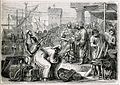 19th-century depiction of Phoenician sailors and merchants. The importance of trade to the Phoenician economy led to a gradual sharing of power between the King and assemblies of merchant families. (from Phoenicia)
 -
 Mortise and tenon joinery in the Mazarron 1 Phoenician shipwreck. Phoenicians pioneered the pegged mortise and tenon joinery, which came to be known as Phoenician joints (from Phoenicia)
 -
 aDNA of ancient Mediterranean (incl. 30 Punic) samples clustering with contemporary populations (from Punic people)
 -
 Sicily at the beginning of the Peloponnesian War (from Punic people)
 -
 Earring from a pair, each with four relief faces; late fourth–3rd century BC; gold; overall: 3.5 x 0.6 cm; Metropolitan Museum of Art (from Phoenicia)
 -
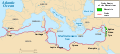 Major Phoenician trade networks (c. 1200–800 BC) (from Phoenicia)
 -
 Phoenician metal bowl with hunting scene (8th century BC). The clothing and hairstyle of the figures are Egyptian. At the same time, the subject matter of the central scene conforms with the Mesopotamian theme of combat between man and beast. Phoenician artisans frequently adapted the styles of neighboring cultures. (from Phoenicia)
 -

-
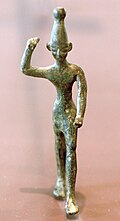 Ba'al with raised arm, 14th–12th century BCE, found at Ras Shamra (ancient Ugarit), Louvre (from Canaanite religion)
 -
 Oinochoe; 800–700 BC; terracotta; height: 24.1 cm; Metropolitan Museum of Art (New York City, US) (from Phoenicia)
 -
 Tomb of King Hiram I of Tyre, located in the village of Hanaouay, in southern Lebanon (from Phoenicia)
 -
 Achaemenid-era coin of Abdashtart I of Sidon, who is seen at the back of the chariot, behind the Persian King (from Phoenicia)
 -
 A naval action during Alexander the Great's Siege of Tyre (332 BC). Drawing by André Castaigne, 1888–89. (from Phoenicia)
 -
 Phoenicians build pontoon bridges for Xerxes I of Persia during the second Persian invasion of Greece in 480 BC (1915 drawing by A. C. Weatherstone). (from Phoenicia)
 -
Figure of Ba'al with raised arm, 14th–12th century BC, found at ancient Ugarit (Ras Shamra site), a city at the far north of the Phoenician coast. Musée du Louvre. (from Phoenicia)
-
 Female figurines from Tyre (c. 1000–550 BC). National Museum of Beirut. (from Phoenicia)
 -
 Face bead; mid-4th–3rd century BC; glass; height: 2.7 cm; Metropolitan Museum of Art (from Phoenicia)
 -
 Phoenician faces. Glass from Olbia, 4th century BC. The bold pools of color and detailed hair give a Greek impression. (from Phoenicia)
 -

-
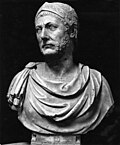
-

-
 Ruins of the Punic and then Roman town of Tharros (from Punic people)
 -
 Reconstruction of the Young Man of Byrsa (from Punic people)
 -

-
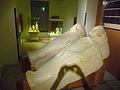 Phoenician sarcophagi found in Cádiz, Spain, thought to have been imported from the Phoenician homeland around Sidon. Archaeological Museum of Cádiz. (from Phoenicia)
 -
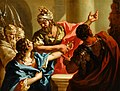 Painting by Giovanni Antonio Pellegrini (1731) titled Young Hannibal Swears Enmity to Rome (from Punic people)
 -
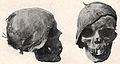 Skull of King Tabnit of Sidon (reigned c. 549 BC – c. 539 BC), now in the Istanbul Archaeology Museums (from Phoenicia)
 -
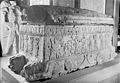 Sarcophagus of Ahiram, which bears the oldest inscription of the Phoenician alphabet. National Museum of Beirut. (from Phoenicia)
 -

-
 Map of Phoenician (yellow labels) and Greek (red labels) colonies around 8th to 6th century BC (with German legend) (from Phoenicia)
 -


.svg)


.jpg)
.jpg)


.jpg)


._2_sides._Paris,_1892.jpg)


 Good article
•
Good article
•
A Good article meets a core set of high editorial standards


The Battle of Ibera, also known as the Battle of Dertosa, was fought in the spring of 215 BC on the south bank of the Ebro River near the town of Ibera and was part of the Second Punic War. A Roman army, under the command of the brothers Gnaeus and Publius Scipio, defeated a similarly sized Carthaginian army under Hasdrubal Barca. The Romans, under Gnaeus Scipio, had invaded Iberia in late 218 BC and established a foothold after winning the Battle of Cissa. This lodgement, on the north-east Iberian coast, between the Ebro and the Pyrenees, blocked the route of any reinforcements from Iberia for the army of Hannibal, who had invaded Italy from Iberia earlier in the year. Hasdrubal attempted to evict the Romans in 217 BC, but this ended in defeat when the Carthaginian naval contingent was mauled at the Battle of Ebro River.
Hasdrubal spent the rest of 217 BC and all of 216 BC subduing rebellious indigenous Iberian tribes, largely in the south. Under pressure from Carthage to reinforce Hannibal, and having been strongly reinforced, Hasdrubal marched north again in early 215 BC. Meanwhile, Scipio, who had also been reinforced, and joined by his brother Publius, had crossed the Ebro to besiege the Carthaginian-aligned town of Ibera. Hasdrubal approached and offered battle, which the Scipios accepted. Both armies were of similar sizes, about 25,000 men. When they clashed, the centre of Hasdrubal's army – which consisted of locally recruited Iberians – fled without fighting. The Roman legions pushed through the gap, turned to each side against the remaining Carthaginian infantry and enveloped them. Both sides are reported to have suffered heavy casualties; the Carthaginians' may have been very heavy. The Carthaginian camp was sacked, but Hasdrubal escaped with most of his cavalry. (Full article...)
Phoenician inscriptions & language •
The Baal Lebanon inscription, known as KAI 31, is a Phoenician inscription found in Limassol, Cyprus in eight bronze fragments in the 1870s. At the time of their discovery, they were considered to be the second most important finds in Semitic palaeography after the Mesha stele.
It was purchased in 1874–75 by a Limassol merchant named Laniti from a scrap metal dealer, who did not know of their previous provenance. A copy was passed to Julius Euting, and after Charles Simon Clermont-Ganneau secured its acquisition by the Cabinet des Médailles, the inscription was published in full by Ernest Renan in 1877.
It is particularly notable for having mentioned Hiram II. It is the only Phoenician inscription to suggest a "colonial" system amongst the Phoenician domains. (Full article...)
Did you know (auto-generated) •

- ... that according to second-century AD Greek rhetorician Athenaeus, the Phoenicians played a flute-like instrument called the gingras in their mourning rituals?
- ... that the sarcophagus of Eshmunazar II, the Phoenician king of Sidon, is one of only three ancient Egyptian sarcophagi unearthed outside Egypt?
- ... that alongside a 7th-century BC Phoenician shipwreck, two additional wrecks from various historical periods were unearthed in Bajo de la Campana, situated off the coast of Cartagena, Spain?
- ... that the Mazarrón I shipwreck combines Phoenician and local Iberian shipbuilding techniques?
- ... that archaeological excavations in the historic town of Kharayeb revealed a rural settlement with a complex system of cisterns and a Phoenician temple?
- ... that Muhammad Khaznadar's museum was said to have "surpassed every other museum in the world" in Phoenician and Carthaginian antiquities?
Related portals


Categories

Wikiproject
Other Wikimedia and Wikiportals
The following Wikimedia Foundation sister projects provide more on this subject:
-
 Commons
Free media repository -
 Wikibooks
Free textbooks and manuals -
 Wikidata
Free knowledge base -
 Wikinews
Free-content news -
 Wikiquote
Collection of quotations -
 Wikisource
Free-content library -
 Wikiversity
Free learning tools -
 Wikivoyage
Free travel guide -
 Wiktionary
Dictionary and thesaurus
Parent portal: Lebanon
-

-

-

-

-

-

-

-

-

-

-
 Random portal
 -


