








People's Armed Police
| People's Armed Police Force | |
|---|---|
 Flag of the Force (since 10 January 2018) | |
 Roundel of People's Armed Police helicopters | |
![Badge of the Force (since 1 August 2021)[a]](https://en.wikipedia.org/wiki/File:Chinese_People%27s_Armed_Police_Force_(CAPF)_cap_insignia_(2021).svg) Badge of the Force (since 1 August 2021)[a] | |
 Sleeve badge of the Force | |
| Common name | 武警部队 (Wǔjǐng Bùduì; 'Armed Police Force') |
| Abbreviation | PAP ("People's Armed Police") Wujing (武警; Wǔjǐng; 'Armed Police'), or WJ as on vehicle license plates |
| Motto | 为人民服务 (Serve the People) |
| Agency overview | |
| Formed |
|
| Employees | 1.5 million |
| Jurisdictional structure | |
| National agency (Operations jurisdiction) | China |
| Operations jurisdiction | China |
| Legal jurisdiction | People's Republic of China |
| Governing body | Central Military Commission |
| Constituting instrument |
|
| General nature | |
| Specialist jurisdictions |
|
| Operational structure | |
| Overseen by | Central Military Commission |
| Headquarters | Haidian District, Beijing |
| Agency executives |
|
| Parent agency | Central Military Commission |
| Child agencies |
|
| Notables | |
| Anniversaries |
|
| Website | |
| chinamil.com.cn | |
| Chinese People's Armed Police Force | |||||||
|---|---|---|---|---|---|---|---|
| Simplified Chinese | 中国人民武装警察部队 | ||||||
| Traditional Chinese | 中國人民武裝警察部隊 | ||||||
| |||||||
| People's Armed Police | |||||||
| Simplified Chinese | 人民武装警察 | ||||||
| Traditional Chinese | 人民武裝警察 | ||||||
| |||||||
| China Armed Police | |||||||
| Simplified Chinese | 中国武警 | ||||||
| Traditional Chinese | 中國武警 | ||||||
| |||||||
| Armed Police [Force] | |||||||
| Simplified Chinese | 武警[部队] | ||||||
| Traditional Chinese | 武警[部隊] | ||||||
| |||||||
.svg) |
|---|
State representative
Executive organ Military organ
Supervisory organ |
 China portal China portal |

_cap_insignia.svg)
.png)
The People's Armed Police Force[3][b] is a Chinese gendarmerie organization[4]: 121 primarily responsible for internal security, riot control, counter-terrorism, disaster response, law enforcement and maritime rights protection[5] as well as providing support to the People's Liberation Army (PLA) during wartime.[6]: 87
Unlike the civilian People's Police,[c] the PAP[d] is a specialized paramilitary force reporting directly to the Central Military Commission (CMC) of the Chinese Communist Party (CCP). PAP officers and soldiers wear dark olive green uniforms, different from pine green uniforms of the People's Liberation Army Ground Force (PLAGF) or the light blue and black uniforms of the People's Police. Additionally, People's Armed Police police officers are active duty service members and receive veteran's benefits.[7]
The PAP is estimated to have a total strength of 1.5 million. It was established in its current form in 1982, but similar security forces have operated since the founding of the People's Republic of China in 1949. During the Maoist era, the PAP's predecessors were the Chinese People's Public Security Force, initially under the MPS, and later the Public Security Corps which was under the command of the PLA.[8]
History
The history of the People's Armed Police is as long as that of the People's Republic, and its origin can be traced back to the People's Liberation Army, which was responsible for both defending the nation from foreign invasions and maintaining internal security. Although the force was officially established in 1982, its constituent units stretch back to 1949.[9]
People's Public Security Force
In July 1949, the CMC decided to establish the Ministry of Public Security (MPS) with Luo Ruiqing as its minister to organize the public security forces in the nation.[8] In August 1949, several security and public order units of the Fourth Field Army were consolidated into the Central Column of the Chinese People's Public Security Force (PSF) to guard the Party and State leaders and to keep the public order in the capital.[8] The Central Column provided security for the inauguration ceremony of the People's Republic.[8] From December 1949 to May 1950, regional security forces, along with the now dissolved Central Column, had been consolidated into divisions under the PSF.[8]
The PSF was assigned to the PLA and became the PLA Public Security Force in September 1950, and the PLA Public Security Corps in July 1955, reporting under the Central Military Commission of the CCP and the National Defense Council of the People's Republic.[8][4] Luo Ruiqing was appointed as the commander and political commissar of the PSF in September 1950 and remained on the posts until 1959, retaining the command of the PSF.[8][10]
As of 1960, the Public Security Corps was organized in 8,200-strong Public Security Divisions, which were deemed not capable of independent, sustained, full-scale combat operations.[11]
People's Armed Police Force
After numerous reorganizations and transfers of control between the PLA and the MPS, the People's Armed Police was created on 19 June 1982, combining the previous armed police, border guards and China Fire Services.[8] The headquarter was set up in the MPS as a subordinate department.[12] The establishment of the PAP highlighted the efforts to increase the professionalization of the security apparatus, as well as the absorption of numerous PLA demobilized personnel,[13]: 228–229 in the wake of growing unrest.[13]: 229 The PAP was officially founded on April 5, 1983.[14]
The PAP was led by both the local government and superior PAP forces, which is called "Dual-Leadership" (双重领导). In practice, the local government (including the local party committee, local people's government and the local public security bureau) carries more weight. However, there were many confusions and loopholes caused by this ambiguous organization structure.
In the mid and late 1990s, CCP general secretary Jiang Zemin significantly expanded and strengthened the PAP, with more than 100,000 new troops.[15] Jiang praised the PAP, describing it as "a major force for maintaining state security and social stability, the People's Armed Police shoulders a massive and formidable burden" and deployed it extensively in Xinjiang and Tibet.[15]
Up until 2013, the Border Defense Corps Coast Guard was a part of the PAP. In 2013, it was separated and transferred to the direct control of the Ministry of Public Security and the State Oceanic Administration. However, in March 2018, it was announced that the Coast Guard would be placed under the People's Armed Police Force once again since the State Oceanic Administration was disbanded, but now as an independent branch reporting directly to PAP headquarters.[16]
2017–2018 Reform
Until 31 December 2017, the People's Armed Police had a dual command structure including the Central Military Commission (CMC) and the State Council through the Ministry of Public Security (MPS).[6]: 18
Prior to the 2018 reform, the People's Armed Police was further divided into eight corps: Internal Guard, Gold, Forestry, Hydropower, Transportation, Border Defense, Firefighting, and Safeguard Corps.[13]: 232 The Internal Guard Corps, which makes up for the bulk of PAP, is under the PAP Headquarters and reports thus to the party central committee and the CMC (Central Military Commission). The Gold, Forestry, Hydropower, and Transportation Corps, collectively known as the Specialist Corps, were by then under the joint leadership of PAP Headquarters and their respective ministries in the State Council.[13]: 232 The Border Defense, Firefighting, and Guard Corps, collectively known as the Public Security Corps, were then under the direct supervision of the Ministry of Public Security (MPS).[13]: 232
By law however, the PAP operates separately from the PLA.[6]: 18 and, in terms of conducting public security operations and relevant capability building, the PAP Headquarters is under the leadership and command of the Ministry of Public Security (MPS).
From 1 January 2018, command of the People's Armed Police is jointly held by the CCP central committee and the Central Military Commission (CMC), with the PAP no longer subordinate to the State Council.[17]
The reform was reportedly carried out in order to deprive the local Chinese Communist Party authorities of the power to use the PAP units to commit abuses or against the leadership in Beijing, especially after the Wang Lijun incident in which the PAP was allegedly abused by provincial party secretary Bo Xilai to surround the US Consulate in Chongqing after a falling out with Wang, the police chief of Chongqing at the time. Under the 2018 reforms, local authorities now need central approval in order to deploy the PAP.[18]
On 10 January 2018, the PAP received a new flag following the design of the branch flags of the PLA with three olive stripes at the bottom. The three olive stripes represents the People's Armed Police responsible for the three main tasks and force composition of maintaining national political security and social stability, maritime rights protection and law enforcement, and defense operations.[19]
On 21 March 2018, the Central Committee of the Chinese Communist Party unveiled a reform plan for the People's Armed Police Force as part of the deepening the reform of the Party and state institutions.[20] Under this plan, the non-combatant elements of the PAP, the Gold, Forestry, Hydropower, Border Defense, Firefighting, and Guard Corps, are to be removed and the CCG is to be consolidated with PAP.[21] As of March 2018, the PAP is working with the Central Committee and the relevant organs for the transfer of non-combatant elements into civil service.[21] The Transportation Corps is the only remaining component of the Specialist Corps.
Until 2018, the Specialist Corps were responsible in constructing and maintaining highways and roads, surveying mineral deposits, fighting forest fires, and constructing large scale [22] waterworks like dams and levees as well as for water works maintenance.[23] The PAP is also called upon in emergency rescue and disaster relief operations within the PRC via the specialist and public security forces which can be forward deployed during such operations.[23]
Organizational changes
With the 2018 reforms, Specialist Corps other than the Transportation Corps have been placed under other ministries. China Coast Guard (CCG) was transferred from State Council to PAP command, and the Transportation Corps has some units under the Mobile Corps.[22]: 15
The Border Defense Corps and Guards Corps have been absorbed by the Ministry of Public Security (MPS). The Forestry Corps were merged with the China Fire Services (also known as the firefighting corps) of the MPS and reorganized as China Fire and Rescue (CF&R), it was placed under the Ministry of Emergency Management. The Gold Corps and Hydropower Corps have been transformed into state-owned enterprises under the supervision of the relevant State Council ministries (Ministry of Natural Resources and China National Gold Group Corporation and China Aneng Construction Corporation, respectively).[22]: 15 [24]
Chronology
From the establishment of the People's Republic of China in 1949, the paramilitary public security force has been reorganized numerous times. The current designation since 1982, the People's Armed Police, was first used between 1959 and 1963.[4][25]
- 1949–1950: Chinese People's Public Security Force, under the Ministry of Public Security (MPS)
- 1950–1955: Public Security Force, under the People's Liberation Army (PLA)
- 1955–1959: Public Security Corps, under the PLA
- 1959–1963: People's Armed Police, under the joint leadership of the MPS and the PLA
- 1963–1966: Chinese People's Public Security Force, under the joint leadership of the MPS and the PLA
- 1966–1982: PLA Internal Guard, absorbed into the PLA in an integrated structure. In 1971 and 1973, some units were transferred to the MPS
- 1982–present: People's Armed Police (PAP)
Mission and operations

The People's Armed Police is formally regulated by the People's Armed Police Law of the People's Republic of China (中华人民共和国人民武装警察法), adopted and effective since 27 August 2009.[26]
The People's Armed Police's primary mission is internal security. The Law on the People's Armed Police Force (PAPF), passed in August 2009, giving it statutory authority to respond to riots, terrorist attacks or other emergencies.[5][27] Such units guard government buildings at all levels (including party and state organizations, foreign embassies and consulates), provide security to public corporations and major public events, as well as counter-terrorism and handling of public emergencies.[28] Some units guard civilian prisons and provide executioners for the state. The PAP also maintains tactical counter-terrorism (CT) units such as the Snow Wolf Commando Unit and various Special Operations/Police units.[29]
In the Chinese policing system, the PAP is tasked with managing protests (otherwise referred to as "mass incidents") and protecting important facilities and events, while public security police investigates crime and maintain public order.[4]: 119 The PAP assists the regular police in high-risk operations, set up roadblocks and protects crime scenes. It also conducts preventive patrol under the leadership of the public security bureaus, sometimes in conjunction with them. When dealing with mass incidents and armed offenders, responsibility shifts to the People's Armed Police.[4]: 123–125
The PAP maintains units tasked with responding to any possible armed mutinies by PLA soldiers. In wartime deployments the PAP can assist the Ground Force and the Navy.[6]: 87
International operations
While the People's Armed Police is principally charged with internal security and guarding key facilities and installations, it also operates as part of the international security efforts of the People's Republic of China, against both terrorism and organized crime. Mathieu Duchâtel for The National Bureau of Asian Research identifies the legal basis of the PAP missions abroad in Article 71 of the 2015 Counter-terrorism Law. According Armed Police Force University professor Zhou Jian, counterterrorism is a task provided by law for the People's Armed Police and operating missions abroad is an "irreplaceable means".[30]: 14–15
The People's Armed Police send personnel abroad to receive training or provide training and participates in counter-terrorism exercises, especially across Central Asia in bilateral and multilateral agreements.[30]: 65 [31]: 26 [32] PAP special operations forces are also deployed in the Chinese embassies of Baghdad and Kabul for the purposes of protection of diplomatic staff and property.[30]: 15
Since 2011, the People's Armed Police has also conducted operations along the Mekong river with the security forces of Thailand, Myanmar and Cambodia. These operations are aimed against organized crime.[30]: 13
Since 2014, the People's Republic of China established a security cooperation with Tajikistan and Afghanistan on Afghan border, near the Wakhan Corridor and in Gorno-Badakhshan Autonomous Region. The People's Armed Police is the main force for both bilateral and trilateral counterterrorism operations (mainly reconnaissance patrols in remote areas), being deployed south of Shaymak; the PAP has also conducted training for Tajik security forces.[30]: 13, 84–87
The Border Defense Corps has also been deployed in UN Peacekeeping operations. Between 2006 and 2018, the Border Defense Corps was deployed in peacekeeping 10 times, with a total of 1325 officers being deployed for peacekeeping.[33] This includes MINUSTAH, where out of eight Chinese peacekeeping deaths in the 2010 Haiti Earthquake three were Border Defense Corps officers. The Border Defense Corps was also deployed in UNMIL, where on October 28, 2017, where the 5th PAP Deployment to Liberia (part of the Guangxi Border Defense Corps) was awarded the "Liberia National Outstanding Contribution Award" by the Liberian Government.[33][34]
Comparisons to foreign agencies
The PAP has been compared by both Chinese and foreign scholars with the gendarmerie forces found in many countries, most famously the French Gendarmerie,[35] but the main inspiration for the PAP's establishment and operation came from the Internal Troops of the Soviet Union and related paramilitary forces of the Eastern Bloc such as the East German Alert Units, adapted to the specific military-political culture and thinking of the Chinese Communist Party (CCP) leadership.[36] It has also sometimes been compared by Chinese media to the US National Guard.[37]
Leadership
Commander:
| Commander | Took office | Left office | notice |
|---|---|---|---|
| Li Gang | January 1983 | October 1984 | [38] |
| Li Lianxiu | October 1984 | January 1990 | [38] |
| Zhou Yushu | January 1990 | December 1992 | [38] |
| Ba Zhongtan | December 1992 | February 1996 | [38] |
| Yang Guoping | February 1996 | December 1999 | [38] |
| Wu Shuangzhan | December 1999 | December 2009 | [39] |
| Wang Jianping | December 2009 | December 2014 | [40] |
| Wang Ning | December 2014 | December 2020 | [41] |
| Wang Chunning | December 2020 | July 2025 | [42] |
| Cao Junzhang | July 2025 | [43] |
Political Commissar:
| Political Commissar | Took office | Left office | notice |
|---|---|---|---|
| Zhao Cangbi | January 1983 | July 1983 | [38] |
| Liu Fuzhi | July 1983 | October 1984 | [38] |
| Li Zhenjun | October 1984 | November 1985 | [38] |
| Zhang Xiufu | November 1985 | January 1990 | [38] |
| Xu Shouzeng | January 1990 | December 1992 | [38] |
| Zhang Shutian | December 1992 | February 1996 | [38] |
| Xu Yongqing | February 1996 | December 2003 | [38] |
| Sui Mingtai | December 2003 | September 2007 | [44] |
| Yu Linxiang | September 2007 | July 2010 | [45] |
| Xu Yaoyuan | July 2010 | September 2014 | [40] |
| Sun Sijing | December 2014 | January 2017 | [40] |
| Zhu Shengling | January 2017 | March 2019 | [46] |
| An Zhaoqing | March 2019 | January 2022 | [47] |
| Zhang Hongbing | January 2022 | December 2025 | [48] |
Training
The People's Armed Police has a number of training institutions, likely overseen by the Training Bureau of the Staff Department.[22]: 32 [49]
- Engineering University of People's Armed Police (Corps Leader Grade, led by a Major General)
- People's Armed Police Command Academy (Corps Leader Grade, led by a Major General)
- Logistics University of People's Armed Police Force (Corps Leader Grade, led by a Major General)
- Officers college of People's Armed Police (Deputy Corps Leader Grade, led by a Major General)
- People's Armed Police Special Police Academy (Deputy Corps Leader Grade, led by a Major General)
- China Coast Guard Academy
- Non-commissioned Officer School of the People's Armed Police
New constables of the People's Armed Police are drawn from the general military conscription pool, but they are trained in the People's Armed Police basic training units.[50]: 28
According to Zi Yang, the state of the education and training system as of 2016 suffered of issues which negatively affected the quality of education.[51]
People's Armed Police Academy
The People's Armed Police Academy tasked with officer education and training for duties related to the missions entrusted to the People's Armed Police, including, since 2001, UN peacekeeping.[52] The People's Armed Police Academy is headquartered in Langfang, of Hebei. The People's Armed Police Academy started to recruit cadets in 1984; since 1997, it has begun to issue bachelor's degrees; in 2003 it was allowed to issue master's degrees. According to a 2019 source, it is subordinate to the Ministry of Public Security.[52] The PAP Academy is a Corps Leader Grade command, and thus it is led by a major general who serves as Superintendent.[22]: 32 [49] All graduates to the academy are commissioned into the PAP as Second Lieutenants (equivalent of Ensigns for those commissioned into the Coast Guard).
People's Armed Police Logistics Academy
The People's Armed Police Logistics Academy is a training body aimed to train People's Armed Police personnel in handling logistics. According to Unit Tracker, the university include subjects as applied economics, military and paramilitary logistics, as well as engineering.[53] The Logistics Academy is a Corps Leader Grade command, and thus it is led by a major general.[22]: 32 [49]
Organization
Headquarters
The People's Armed Police Headquarters is the leading and commanding organ that directs and administers all the units and provides guidance to it. The PAP has a commander, a political commissar and several deputy commanders and deputy political commissars.[23] The PAP also has departments responsible for logistical and political matters and several speciality departments.
Following adjustment and reorganization, the People's Armed Police is mainly composed of the territorial forces, the mobile forces, and the Coast Guard.[54]
The People's Armed Police Headquarters, placed at Theater Command Grade, include five Departments directly under the Headquarters:[22]: 10, 32
- Staff Department (Deputy Theater Command Grade);
- Training Bureau (Division Leader Grade);
- Intelligence Bureau (Division Leader Grade), led by Zhang Xiaoqi;
- Political Work Department (Deputy Theater Command Grade): led by Director Lieutenant general Gao Wei;[55]
- Propaganda Bureau (Division Leader Grade);
- Soldier and Civilian Personnel Bureau (Division Leader Grade);
- Discipline Inspection Commission (Deputy Theater Command Grade);
- Logistics Department (Corps Leader Grade);
- Equipment Department (Corps Leader Grade).
Being of Theatre Command Grade, the People's Armed Police is led by a full General.[49]
Mobile corps
Mobile corps[56] (Chinese: 机动总队; pinyin: jīdòng zǒngduì), often mistranslated as "Contingents" are large formations without fixed areas of responsibility. Two were created after the 2018 reforms; most of the subordinate units came from the 14 disbanded mobile divisions. Mobile corps are corps leader grade formations[22]: 12–13 commanded by major generals.[49]
The mobile corps are mainly responsible for dealing with terrorism, violent crime, riots, and public security threats.[13]: 233 The 1st Mobile Corps is based in Shijiazhuang, Hebei, south of Beijing. The Corps covers northern and central China, including Beijing.[57] The 2nd Mobile Corps is headquartered in Fuzhou, with units concentrated in Fujian and surrounding provinces along the coast (covering eastern and southern China).[22]: 13
Internal security forces
The major part of the PAP is the nèiwèi bùduì (Chinese: 内卫部队); translations include "internal security forces",[22]: 2 "internal security troops",[51] and "internal guards corps".[13]: 232 Internal security forces are divided into provincial-level formations[22]: 11–12 with geographical areas of responsibility.[22]: 2 They are subordinated to PAP headquarters;[22]: 10 the 2017-2018 reforms removed control of PAP units from local government.[22]: 11–12 Internal security forces are focused on domestic security missions, maintaining stability in western China, guarding government compounds, disaster relief, and responding to major anti-government unrest.[22]: 2
The public security zǒngduì (Chinese: 总队) is the provincial formation. They are called "corps" by the PAP;[58][59][60] Western analysts have used "contingent",[22]: 32 "general corps", and "detachment".[13]: 234 Most are corps deputy leader grade formations. The exceptions are the Beijing and Xinjiang corps which are corps leader grade; their subordinate entities, except for the logistics and equipment bureaus, are one grade higher than in the other corps.[22]: 32 Hong Kong and Macau do not have corps.[51] Corps have mobile detachments and duty detachments (Chinese: 执勤支队; pinyin: zhíqín zhīduì).[22]: 22
Duty detachments protect government compounds and perform routine duties; they may exist because the CCP lacks confidence in the ability of local public security forces to handle "mass incidents".[22]: 22
Mobile police detachments (Chinese: 机动支队; pinyin: jīdòng zhīduì) are rapid reaction units roughly corresponding to PLAGF regiments or brigades.[22]: 12 Some were existing corps mobile units before the reforms.[22]: 36 Most were transferred from the disbanded mobile divisions.[22]: 12 Most corps have one.[22]: 12 In general, western provinces with large non-Han population have more than those in China's interior.[61]: 16
Corps are further subdivided at lower administrative levels. Regimental or brigade-level police detachments (Chinese: 支队; pinyin: zhīduì) are found in provinces, prefectures, and specifically designated cities. Battalions (Chinese: 大队; pinyin: dadui) are located in districts of the important cities and counties. Companies (Chinese: 中队; pinyin: zhōngduì) are found in counties.[13]: 234 [22]: 7 All corps have subordinate elementary command colleges.[23]
Transportation units
Prior to the 2018 reforms, the People's Armed Police Transportation Corps (Chinese: 武警交通部队) was its own independent corps under the dual command of the PAP and the Ministry of Transport.[62] During the 2018 reforms, the Transportation Corps was reorganized into part of the 1st and 2nd mobile corps.[62][22] The mission of Transport units of the People's Armed Police is to conduct disaster relief and emergency repair on highways, bridges, tunnels, seaports railways and airports, security to construction projects related to national security along with law enforcement duties on highways in border regions.[63]
History
The lineage of the 1st Transportation Detachment, 2nd Mobile Corps dates back to the 2nd World War, when it was known as the Laiyuan guerilla detachment of the Jin-Cha-Ji Military district. It participated in the Chinese civil war, WW2 and the Korean war. After becoming part of the PLA Basic Engineering Corps it was deployed to build the Duku Highway in 1974 in which 47 personnel lost their lives.[62]
Prior to 1984, the transportation corps was part of the People's Liberation Army Basic Engineering Corps.[62]
The 7th Transportation Detachment assisted in disaster relief after the 2015 Tianjin explosions.[64]
The 6th Detachment of the transportation corps deployed 105 officers and 48 vehicles for urban search and rescue duties during the 2015 Shenzhen landslide.[65]
Organization (Post-2018)
After the 2018 reforms, the transportation corps was reorganized into 5 detachments in the 1st and 2nd Mobile Corps:[22][62]
- 1st Transportation Detachment, 1st Mobile Corps - Stationed in Beijing
- 2nd Transportation Detachment, 1st Mobile Corps - Stationed in Chang'an District, Xi'an[22][66]
- 1st Transportation Detachment, 2nd Mobile Corps- Stationed in Hefei, Anhui[62]
- 2nd Transportation Detachment, 2nd Mobile Corps - Stationed in Mianyang, Sichuan[22][67]
- 3rd Transportation Detachment, 2nd Mobile Corps - Stationed in Bomê County, Nyingchi, Tibet Autonomous Region[62]
Controversy
In 2015, ex-Transportation corps commander Major General Liu Zhanqi, ex-Transportation corps Political commissar Major General Wang Xin and ex-Transportation Corps Chief engineer Major General Miao Guirong were arrested on June 16, July 31 and September 15 respectively on corruption-related charges as part of the anti-corruption campaign under Xi Jinping. As of September 16, 2015, a total of 43 people were arrested in relation to the case.[68]
China Coast Guard
The Chinese People's Armed Police Force Coast Guard Bureau, also abbreviated as China Coast Guard is the agency for maritime search and rescue and law enforcement in the territorial waters of the People's Republic of China. The China Coast Guard was formerly the maritime branch of the People's Armed Police (PAP) Border Security Force under the Ministry of Public Security until 2013. In March 2013, China announced it would form a unified Coast Guard commanded by the State Oceanic Administration. This renewed Coast Guard has been in operation since July 2013. As of July 1, 2018, the China Coast Guard was transferred from civilian control of the State Council and the State Oceanic Administration, to the People's Armed Police, ultimately placing it under the command of the Central Military Commission (CMC).
According to Joel Wuthnow, the Coast Guard Command within the People's Armed Police possibly is of Corps Leader Grade, led by a Commandant who is usually holding Major General (Rear Admiral) rank.[22]: 32
In June 2018, China Coast Guard was granted maritime rights and law enforcement akin civilian law enforcement agencies in order to carry out contrast of illegal activities, keep peace and order, as well as safeguarding security at sea, when performing duties related to the use of marine resources, protection of marine environment, regulation of fishery, and anti-smuggling.[69]
Special Operations units
The People's Armed Police maintains several Special Operations Units,[70][71][72] also known by Western sources as "Special Police units". They were established in Beijing in early 1980s and in 1983 the first of them was transferred to the People's Armed Police as the People's Armed Police Special Police Group. In 1985 the Group became People's Armed Police Special Police School and, in 2002, it became the People's Armed Police Special Police Academy.[4]: 123 [73] In 2002, the Snow Wolf Commando Unit, since 2007 Snow Leopard Commando Unit, was established in Beijing as the second special police unit.[4]: 123 [73] According to Joel Wuthnow, the Snow Leopard Commando Unit was moved from the Beijing Corps to the 2nd Mobile Corps in 2018.[22]: 36
The special operations units are tasked to carry out counter terrorism missions, riot control, anti-hijacking and bomb disposal.[73]
Local special operations units receive Explosive Ordinance Disposal (EOD) training,[74] fast roping,[75] counterinsurgency tactics,[71] along with training in hostage rescue and hostage negotiation.[72]
Structure of Special operational units

Special Police Units/Special operations units are organized and placed at the Municipal[71] and Provincial level.[73]
In addition, the 1st and 2nd Mobile Corps maintain a total of 5 Special Operations Detachments.[22]: 12–13
Municipal detachments each have their own Special Operations Company, which is typically placed under the municipal mobile battalion.[76][72] Each provincial corps (Chinese: 总队; pinyin: Zǒngduì) establishes and maintains a special operations detachment as part of its own territorial organization.[73][74] The provincial special operations detachment of the Xinjiang Corps is the Mountain Eagle Commando Unit.[22] In some provincial corps, the special operations unit is battalion[77] or company sized and is placed under the mobile detachment.[77]
The Hebei Corps Mobile Detachment's 1st Special Operations Company is known as the "Sky Sword" unit (Chinese: 天剑突击队). It can trace its lineage back to the 7th Company, 3rd Battalion of the 28th Group Army's 84th Infantry Division's 251st Regiment which was involved in the Battle of Jinan and the Huaihai campaign. In its entire history, it was deployed to approximately 50 law enforcement/disaster relief operations, won gold or silver in 100+ competitions and was awarded first class meritorious service medals 1 time, 2nd class meritorious service medals 5 times and 3rd class meritorious service medals 12 times.[78][70]
The Shenzhen Detachment's Special Operations Company is known as the "Wild Wolf" unit (Chinese: 野狼特战队). It was founded in 2005 and given the name in 2008.[79]
The Jinan Detachment's Special Operations Company is known as the "Lightning Commando Unit" (Chinese: 闪电突击队) it was founded in 2009 and only had 30 members at the start.[76][80]
Border Defense Corps Special Operations units
| Badge of the Snowy Eagle Female Special Service team | |
|---|---|
 https://photo.81.cn/pla/2015-03/19/content_6398233_5.htm https://photo.81.cn/pla/2015-03/19/content_6398233_5.htm |
| Flag of the Snowy Eagle Female Special Service team | |
|---|---|
| https://photo.81.cn/pla/2015-03/19/content_6398233_8.htm |
In April 2012, the Xinjiang Border Defense Corps Female Special Service team (新疆公安边防总队女子特勤分队) was founded. In March 2015 it was renamed to the "Snowy Eagle Female Special Service team" (雪鹰女子特勤分队) at the Xinjiang Border Corps Training Base.[81][82] At its founding in 2012, it only had 6 members, and by March 2015 it had 34 members.[83] It assisted in security at the China Eurasia Expo multiple times.[84]
The Shenzhen Border Defense Detachment operated the Maritime Special Service Team (Nicknamed "Maritime Jiaolongs"), a police tactical unit which is dedicated to maritime anti-terrorism, search and rescue, combat diving and VBSS.[85]
Communications
Using the national information infrastructure, the PAP has established a preliminary system of three-level integrated information networks, linking general headquarters with the grass-roots squadrons.[23]
Equipment
In response to the needs of the People's Armed Police, the service provides for the use of many types of weapons. Special Operation Forces of People's Armed Police uses various kind of weapons according to necessity of missions.
| Name | Country of origin | Type | Notes |
|---|---|---|---|
| QSZ-92 | China
|
Semi-automatic pistol | Standard issue sidearm[86] |
| QCW-05 | Personal defense weapon | [86] | |
| QCQ-171 | Submachine gun | [87] | |
| QBZ-95 | Assault rifle | [86][88] | |
| QBZ-191 | |||
| Norinco CQ | |||
| Type 81 | [79][33][89] | ||
| QBZ-03 | [90] | ||
| QBS-06 | Underwater assault rifle | Used by Snow Leopard Commando Unit[91] | |
| QBS-09 | Shotgun | [72] | |
| QBU-88 | Sniper rifle | [92] | |
| Type 85 sniper rifle | [93] | ||
| Remington M700 |  United States United States
|
[94] | |
| CS/LR4 | China
|
[95] | |
| Type 69 RPG | Rocket launchers | [96] | |
| PF-98 | Used by Snow Leopard Commando Unit[91] | ||
| Crossbows | Used due to crossbows being more silent than firearms[72] | ||
| QBB-95 | Light machine gun | [91] | |
| Heavy machine guns | Heavy machine gun | [37] | |
| Mortars | Mortar | [37] |
In addition, the People's Armed Police makes use of remotely-controlled technologies such as unmanned aerial vehicles, advanced surveillance technology and bomb disposal robots, as well as intelligent unmanned systems.[97][98] K9s and ballistic shields are also used.[99][87]
Drones and Mini UGVs are often used for recon.[72]
Vehicles
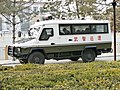
People's Armed police vehicles can be identified with their Vehicle registration plates which start with WJ.
- NJ2046 armored van
- Dongfeng EQ2102 truck (Also used by China Fire Services)
- FAW Jiefang trucks[100]
- Dongfeng EQ2050 light utility vehicle[100]
- ZSL-92A Armored Personnel Carrier[100]
- CSK-181 Infantry mobility vehicle[101]
- CSZ-181 Infantry mobility vehicle - Used by Snow Leopard Commando Unit[91]
- Iveco power daily patrol van[102]
- Ford Transit police van(sometimes unmarked)
- Roewe W5 police car
- Unmarked Mitsubishi Pajero police car
- Unmarked Toyota Land Cruiser police car
- Unmarked Toyota Coaster minibus
- Foton Toano military ambulance
- Excavators[103]
- Bulldozers[104]
- Bridge-laying vehicle[105]
- Hyundai Trago dump truck[106]
- Wheel loaders[107]
Vessels
The PAP Ganzhou Detachment have been seen with speedboats for search and rescue during floods.[108] The Snow Leopard Commando Unit also uses speedboats when raiding terrorist hideouts in islands.[91]
Helicopters
- Harbin Z-20 - Used by Gansu Corps and 2nd Mobile Corps[109][110]
- Changhe Z-8 - Used by Hunan Corps and Forestry Corps (defunct; 8 operated; handed over to National Fire and Rescue Administration)[111][112]
- Harbin Z-9 - Used by Hunan Corps since September 2015[111]
- Mil Mi-17[75]
-
 Guangdong Corps Shenzhen Detachment Iveco Power Daily police van
 -
 WZ-551 armored personnel carrier
 -
-

-
 A Sichuan Corps CSK-181 near Sichuan Science and Technology Museum
 -
 Guangdong Corps Foton Toano Ambulance
 -
 Guangdong Corps unmarked Toyota Land Cruiser (right)
 -
 Guangdong Corps unmarked Toyota Coaster
 -
 Guangdong Corps Ford Transit
 -
 Beijing Corps unmarked Ford Transit
 -
 Beijing Corps FAW Jiefang truck
 -
 Guangdong Corps Dongfeng EQ2102
 -
 Jiangsu Corps Roewe W5

.jpg)


Retired Equipment
Helicopters
- Avicopter AC313 - used by People's Armed Police Forestry Corps - transferred to China Fire and Rescue when the Forestry Corps was disbanded and transferred to the China Fire and Rescue;[24] 10 ordered[112]
Vehicles
- YD801 firefighting vehicle- Seen in use with defunct People's Armed Police Forestry Corps[113][114]
- All terrain vehicle - seen in use with defunct People's Armed Police Forestry Corps[115]
-
 Forestry Corps Changhe Z-8WJS
 -
 Hydropower corps Excavators providing aid after the 2014 Ludian earthquake


Line of duty deaths
Ranks and insignia
Due to its history with the PLA, the PAP has a similar rank structure to the PLA and also obeys its regulations. PAP guards are also recruited at the same time and through the same procedures as PLA soldiers. However, the PAP has its own education and training system separate from the PLA. Like the PLA, the PAP also celebrates Army Day on August 1 of every year, and enjoys the same services as the PLA.
Officers
| Title[116] | 武警上将 Wǔjǐng shàng jiàng |
武警中将 Wǔjǐng zhōng jiàng |
武警少将 Wǔjǐng shàojiàng |
武警大校 Wǔjǐng dàxiào |
武警上校 Wǔjǐng shàngxiào |
武警中校 Wǔjǐng zhong xiao |
武警少校 Wǔjǐng shàoxiào |
武警上尉 Wǔjǐng shàngwèi |
武警中尉 Wǔjǐng zhōngwèi |
武警少尉 Wǔjǐng shàowèi |
武警学员 Wǔjǐng xuéyuán |
|---|---|---|---|---|---|---|---|---|---|---|---|
| Equivalent Translation | General | Lieutenant general | Major general | Senior colonel | Colonel | Lieutenant colonel | Major | Captain | 1st lieutenant | 2nd lieutenant | Officer cadet |
| Shoulder Insignia | 
|

|

|

|

|

|

|

|

|

|

|
| Collar Insignia | 
|

|

|

|

|

|

|

|

|

|

|
Non-commissioned officers and enlisted
| Title[116][117] | 武警一级警士长 Wǔjǐng yī jí jǐng shì zhǎng |
武警二级警士长 Wǔjǐng èr jí jǐng shì zhǎng |
武警三级警士长 Wǔjǐng sān jí jǐng shì zhǎng |
武警一级上士 Wǔjǐng yī jí shàng shì |
武警二级上士 Wǔjǐng èr jí shàng shì |
武警中士 Wǔjǐng zhōng shì |
武警下士 Wǔjǐng xiàshì |
武警上等兵 Wǔjǐng shàngděngbīng |
武警列兵 Wǔjǐng lièbīng |
|---|---|---|---|---|---|---|---|---|---|
| Equivalent translation | Master Sergeant 1st class | Master Sergeant 2nd class | Master Sergeant 3rd class | Staff sergeant 1st Class | Staff sergeant 2nd Class | Sergeant | Corporal | Private 1st class | Private |
| Shoulder Insignia | 
|

|

|

|

|

|

|

|

|
| Collar Insignia | 
|

|

|

|

|

|

|

|

|
See also
Notes
- ^ The Badge of the Chinese PAP Force (中国人民武装警察部队徽) was determined by the Central Military Commission and officially put into use on August 1, 2021, in accordance with the 2020 revision of the National Defense Law's Article 28.[1] Traditionally subject to the Public Security system, the PAP used the Police Badge of the Chinese People's Police (1983) as its symbol and cap insignia. But from 2007, the PAP cap insignia is slightly different from the civil People's Police badge by using olive green instead of police blue on the shield and adding the olive branches alongside the pine branches around the shield.[2]
- ^ abbreviation: PAP; Chinese: 中国人民武装警察部队; pinyin: Zhōngguó Rénmín Wǔzhuāng Jǐngchá Bùduì
- ^ Chinese: 人民警察; pinyin: Rénmín Jǐngchá
- ^ Chinese: 武警; pinyin: Wǔjǐng; lit. 'Armed Police'
References
- ^ "武警部队徽将于8月1日启用". People's Liberation Army Daily Press. Ministry of National Defense of the People's Republic of China. 2021-07-29. Archived from the original on 2021-07-29. Retrieved 2021-07-29.
- ^ China Military Web. "解放军军旗、军徽和武警部队旗、徽简史". People's Liberation Army Daily Press. Archived from the original on 2021-10-27. Retrieved 2021-07-31 – via QQ.com.
- ^ "Military Services – Ministry of National Defense". eng.mod.gov.cn. Retrieved 2024-04-20.
- ^ a b c d e f g Sun, Ivan Y.; Wu, Yuning (December 2009). "The Role of the People's Armed Police in Chinese Policing". Asian Journal of Criminology. 4 (2): 107–128. doi:10.1007/s11417-008-9059-y. ISSN 1871-0131. S2CID 143891785.
- ^ a b "Top legislature passes armed police law". China Daily. 2009-08-27. Archived from the original on 2021-08-31. Retrieved 2019-10-04.
- ^ a b c d Blasko, Dennis J. (2006). The Chinese Army today: tradition and transformation for the 21st century (2nd ed.). London: Routledge. ISBN 0415770025. OCLC 68694731.
- ^ "中国人民武装警察部队". Lanzhou Resources & Environment Voc-Tech University. 2025-05-14.
- ^ a b c d e f g h Xia, Mingxing; Zhang, Ning; Zhu, Xiongnan (16 August 2017). "Máozédōng guānxīn wǔjǐng bùduì zǎoqí jiànshè jìshì" 毛泽东关心武警部队早期建设纪事 [Mao Zedong cares about the early construction of the armed police force]. People's Daily (in Chinese). Archived from the original on 28 December 2017. Retrieved 23 June 2019.
- ^ Shambaugh, David L. (2002). Modernizing China's military: progress, problems, and prospects. Berkeley: University of California Press. pp. 170. ISBN 0520225074. OCLC 49225216.
- ^ Chu, Fang (1998). Gun barrel politics : party--army relations in Mao's China. Boulder, CO: Westview Press. pp. 40–41. ISBN 081333456X. OCLC 38286530.
- ^ Army, United States Department of the (1960). Handbook on the Chinese Communist Army. Washington: The Department. pp. 43–44. Retrieved 2 November 2019.
- ^ 张, 海华 (29 December 2017). "Wǔjǐng bùduì lìshǐ yángé - zhōngguó jūn wǎng" 武警部队历史沿革 - 中国军网 [Historical Evolution of the People's Armed Police Force - China Military Network] (in Chinese). 中国军网. Archived from the original on 2017-12-29. Retrieved 1 February 2023.
- ^ a b c d e f g h i Guo, Xuezhi (August 2012). China's security state: philosophy, evolution, and politics. Cambridge: Cambridge University Press. ISBN 9781107688841. OCLC 874118926.
- ^ Zhang, Jiaoying (2016-04-05). "Lìshǐ shàng de jīntiān 4.5: Wǔjǐng chénglì" 历史上的今天4.5:武警成立 [Today in history April 5 - the establishment of the PAP]. Xinhua News Agency (in Chinese). Retrieved 2025-03-18.
- ^ a b Eckholm, Erik (28 March 1999). "A Secretive Army Grows to Maintain Order in China". The New York Times. ISSN 0362-4331. Archived from the original on 4 March 2020. Retrieved 25 June 2019.
- ^ "China's Coast Guard is Now a Military Police Unit". The Maritime Executive. 2018-03-21. Archived from the original on 2019-08-15. Retrieved 2019-10-04.
- ^ Zhao, Lei (28 December 2017). "Command of Armed Police Force to be unified - Chinadaily.com.cn". China Daily. Archived from the original on 26 January 2018. Retrieved 26 January 2018.
- ^ Zhou, Viola (28 December 2017). "Why China's armed police will only take orders from Xi's army elite". South China Morning Post. Archived from the original on 27 January 2018. Retrieved 26 January 2018.
- ^ "Guófáng bù xīnwén fāyán rén wú qiān jiù wǔjǐng bùduì qí yùyì dá wèn" 国防部新闻发言人吴谦就武警部队旗寓意答问 [Ministry of National Defense spokesperson Wu Qian answers questions about the symbolism of the People's Armed Police Force flag] (in Chinese). Ministry of National Defense of the People's Republic of China. 2018-01-10. Archived from the original on 2020-10-04. Retrieved 2018-01-10.
- ^ Zi, Yang (22 March 2018). "Party plan for reform unveiled". China News Service. China Daily. Archived from the original on 22 March 2018. Retrieved 21 March 2018.
- ^ a b Ni, Wei (2018-04-06). "Wǔjǐng gǎigé de chū yǔ jìn: Bādà jǐng zhǒng shòushēn jiàn tǐ" 武警改革的出与进: 八大警种瘦身健体 [The Coming and Going of the PAP Reform: Eight Corps Slimming Down]. The Beijing News. Archived from the original on 2018-06-19. Retrieved 2018-06-19.
- ^ a b c d e f g h i j k l m n o p q r s t u v w x y z aa ab ac ad ae af Wuthnow, Joel (16 April 2019). China's Other Army: The People's Armed Police in an Era of Reform (PDF). Washington: Institute for National Strategic Studies. Archived (PDF) from the original on 4 July 2020. Retrieved 3 October 2019.
- ^ a b c d e Information Office of the State Council (2006). "V. People's Armed Police Force". China's National Defense In 2006. Beijing: Government of China. Archived from the original on 28 April 2015. Retrieved 22 September 2015.
- ^ a b Runping, Yao (23 March 2018). "Zhìjìng! Zàijiànle gōng'ān biānfáng, xiāofáng, jǐngwèi, wǔjǐng huángjīn, sēnlín, shuǐdiàn" 致敬!再见了公安边防、消防、警卫,武警黄金、森林、水电 [Salutations! Goodbye to the border defense, MPS firefighting corps, MPS guard corps, PAP gold, forestry and hydropower corps]. Xinhua News Agency (in Chinese). Archived from the original on 23 August 2025. Retrieved 17 March 2025.
- ^ Lu, Gengsong (September 2006), China's Armed Police and Nationalization of the Police Force, Beijing Spring
- ^ "People's Armed Police Law". NPC Observer. 17 April 2020. Retrieved 18 April 2020.
- ^ Wines, Michael (2009-08-27). "China Approves Law Governing Armed Police Force". The New York Times. ISSN 0362-4331. Archived from the original on 2019-09-07. Retrieved 2019-10-04.
- ^ "Armed Police Force". Ministry of National Defense. Archived from the original on 23 September 2015. Retrieved 22 September 2015.
- ^ Chatterji, Manas (2013). Cooperation for a peaceful and sustainable world. Bingley, U.K.: Emerald. p. 70. ISBN 9781781906569. Archived from the original on 1 November 2023. Retrieved 2 September 2021.
- ^ a b c d e Rolland, Nadège; van der Kley, Dirk; Rolland, Nadège; Duchâtel, Mathieu; Chase, Michael S.; Gunness, Kristen; Xue, Guifang (Julia); Pantucci, Raffaello; Arduino, Alessandro (September 2019). securing the belt and road initiativeChina's Evolving Military Engagement Along the Silk Roads (PDF). The National Bureau of Asian Research. pp. 13, 14–15, 65, 84–87. Archived (PDF) from the original on 1 July 2020. Retrieved 28 April 2020.
- ^ Heath, Timothy R. (2018). China's Pursuit of Overseas Security (PDF). Santa Monica, California: RAND Corporation. p. 26. Archived (PDF) from the original on 28 April 2019. Retrieved 16 October 2019.
- ^ Umarov, Temur (30 March 2020). "China Looms Large in Central Asia". Carnegie Moscow Center. Archived from the original on 2 May 2020. Retrieved 28 April 2020.
- ^ a b c "再见,武警边防,你好,人民警察" [Goodbye, PAP Border Defense, Hello, People's Police]. The Paper. 2018-12-25. Retrieved 2025-03-22.
- ^ Baoping, Zhang; Zunping, Chen (2017-11-02). Shuang, Ren (ed.). "Zhōngguó dì wǔ zhī zhù lìbǐlǐyǎ wéihé jǐngchá fángbào duì huò "lìbǐlǐyǎ guójiā jiéchū gòngxiàn jiǎng"" 中国第五支驻利比里亚维和警察防暴队获"利比里亚国家杰出贡献奖" [Chinese 5th Deployment to Liberia awarded "Liberia National Outstanding Contribution Award"]. Chinese Military (in Chinese). Retrieved 2025-03-23.
- ^ Bao Xiaoyan and Zhang Tingyu: "Comparison of the Leadership System of the Armed Police Force and the French Gendarmerie", in "Journal of the Armed Police Command Academy" 2010, Issue 5
- ^ Xia Yong, Gendarmerie as a Law Enforcement Force: Type Comparison and Enlightenment, "Rules of Law Research", 2016, Issue 3, page 110
- ^ a b c "Wǔjǐng gǎigé duì biāo měiguó guómín jǐngwèi duì? Kànle tāmen de F22 fāng zhī rènzhòngdàoyuǎn" 武警改革对标美国国民警卫队?看了他们的F22方知任重道远 [Is the PAP equivalent to the US National Guard?]. The Paper. 2017-11-14. Retrieved 2025-04-01.
- ^ a b c d e f g h i j k l "期刊库内容页". www.hprc.org.cn. Archived from the original on 2017-02-23. Retrieved 2025-10-18.
- ^ "中国新增15上将". news.xinhuanet.com. Archived from the original on 2008-05-27. Retrieved 2025-10-18.
- ^ a b c "解放军高层调动大幕拉开 五正大军区级将领履新_大公资讯_大公网". news.takungpao.com (in Chinese (China)). Archived from the original on 2014-12-25. Retrieved 2025-10-18.
- ^ Zhiyue, Bo. "The Rise of the 31st Army in Chinese Politics". thediplomat.com. Retrieved 2025-10-18.
- ^ "中央军委举行晋升上将军衔警衔仪式 习近平颁发命令状并向晋衔的军官警官表示祝贺-新华网". www.xinhuanet.com. Archived from the original on 2021-08-18. Retrieved 2025-10-18.
- ^ "人事观察|接替62岁王春宁 曹均章出任武警部队代理司令员". china.caixin.com. Retrieved 2025-10-18.
- ^ "汪洋会见武警部队政委隋明太-搜狐新闻". news.sohu.com. Retrieved 2025-10-18.
- ^ "原兰州军区政委喻林祥上将出任武警部队政委_资讯_凤凰网". news.ifeng.com. Retrieved 2025-10-18.
- ^ "朱生岭:国防动员部首任政委,64岁仍在抗洪一线救人,被授啥军衔". www.sohu.com. Retrieved 2025-10-18.
- ^ "中央委员中将安兆庆已出任武警部队政委". news.sina.com.cn. 2 May 2019. Archived from the original on 2020-08-06. Retrieved 2025-10-18.
- ^ "中央军委举行晋升上将军衔警衔仪式 习近平颁发命令状并向晋衔的军官警官表示祝贺-新华网". www.news.cn. Archived from the original on 2022-01-21. Retrieved 2025-10-18.
- ^ a b c d e Allen, Kenneth (30 January 2017). "China Announces Reform of Military Ranks". Jamestown Foundation. Archived from the original on 13 October 2019. Retrieved 13 October 2019.
- ^ Blasko, Dennis J. (2012). Chinese Army today : tradition and transformation for the 21st century (2nd ed.). New York, NY: Routledge. p. 28. ISBN 9780415783217. Retrieved 9 October 2019.
- ^ a b c Zi, Yang (24 March 2016). "The Chinese People's Armed Police in a Time of Armed Forces Restructuring". China Brief. 16 (6). Jamestown Foundation. Archived from the original on 16 October 2019. Retrieved 16 October 2019.
- ^ a b "International Law Enforcement Training Programme, MPS". www.lecamps.org.cn. 2019. Archived from the original on 13 December 2019. Retrieved 13 December 2019.
- ^ "Logistics University of the People's Armed Police Force". Chinese Defence Universities Tracker. 7 December 2019. Archived from the original on 8 December 2019. Retrieved 8 December 2019.
- ^ "White paper gives overview of reshuffled armed forces". Xinhua News Agency. 24 July 2019. Archived from the original on 24 July 2019. Retrieved 4 October 2019.
- ^ Liu Zhen (15 December 2019). "China's armed police sees leadership overhaul under reform process". South China Morning Post. Beijing. Archived from the original on 7 April 2020. Retrieved 6 April 2020.
- ^ "Armed Police Troops Conduct Comprehensive Training". Chinese MOD. 2025-03-28.
- ^ Boyd, Henry; Nouwens, Meia (21 June 2019). "China's People's Armed Police: reorganized and refocused". www.iiss.org. International Institute for Strategic Studies. Archived from the original on 26 September 2019. Retrieved 3 October 2019.
- ^ "Chinese Armed Police Force soldiers enhance emergency response capability - Ministry of National Defense". eng.mod.gov.cn. Retrieved 2025-02-23.
- ^ "Armed Police Soldiers Take Military Training Assessment - Ministry of National Defense". eng.mod.gov.cn. Retrieved 2025-02-23.
- ^ "Special operations soldiers in counter-terrorism training - Ministry of National Defense". eng.mod.gov.cn. Retrieved 2025-02-23.
- ^ Carrdus, Ben (13 December 2023). "Policing East Turkistan" (PDF). uhrp.org. Washington, DC: Uyghur Human Rights Projects. p. 16. Archived (PDF) from the original on 16 December 2023. Retrieved 3 January 2024.
- ^ a b c d e f g "武警第二机动总队及所属多个机动支队和交通支队集中亮相". The Paper. 2018-07-18. Retrieved 2025-03-24.
- ^ Yaoqian, Wu (2015-01-07). Wang, Xiaoyi (ed.). "傅凌、许世宏分别任武警交通部队司令员、政委". NetEase. The Paper. Archived from the original on 2017-08-21. Retrieved 2025-03-24.
- ^ "武警交通七支队救援先锋 "金刚钻"能手陈载州". Phoenix Television. 2016-10-07. Retrieved 2025-05-21.
- ^ Wang, Yao, ed. (2015-12-22). "武警交通部队官兵全方位展开专业搜救" [PAP Transport corps soldiers conduct SAR mission]. Xinhua News Agency. Archived from the original on 2025-03-25. Retrieved 2025-03-25.
- ^ "武警第一机动总队交通第二支队招标代理机构及造价咨询遴选". Bidchane.com. 2nd Transportation Detachment, 1st Mobile Contingent. 2018-02-08. Archived from the original on 2018-02-23. Retrieved 2025-03-24.
- ^ "武警第二机动总队交通第二支队2018年度采购代理机构其它". Chinese Government Procurement. 2018-01-08. Archived from the original on 2020-11-04. Retrieved 2025-03-24.
- ^ "Wǔjǐng jiāotōng zhǐhuī bù yuán zǒng gōngchéngshī móuguìróng shè yánzhòng wéijì luòmǎ" 武警交通指挥部原总工程师缪贵荣涉严重违纪落马 [Miao Guirong, former chief engineer of the Armed Police Transportation Command, has been dismissed from his post for serious violations of discipline]. People's Daily (in Chinese). 16 September 2015. Archived from the original on 1 November 2025. Retrieved 6 May 2025.
- ^ Wei, Changhao (22 June 2018). "NPCSC Defers Vote on E-Commerce Law, Grants Law Enforcement Powers to Military-Controlled Coast Guard". NPC Observer. Archived from the original on 29 November 2020. Retrieved 16 October 2019.
- ^ a b ""天剑"出鞘——记武警河北总队机动支队特战一中队". Xinhua. 2019-12-25.
- ^ a b c Chen, Guangyu; Zhao, Mingjun. Chen, Yu; Deng, Zhihui (eds.). "震撼來襲!武警特戰力量野外駐訓" [PAP Special Operations Units conduct training in the wild]. People's Daily. Retrieved 2025-03-19.
- ^ a b c d e f 动真格的!中国武警发布实战视频 与"暴恐分子"激烈交锋!新一代防护型突击车实现静音行驶?隐蔽性能极强!从部署到执行 看中国武警应对最棘手任务! (video) (in Chinese). CCTV-7. 2025-03-28.
- ^ a b c d e "People's Armed Police (PAP) Special Operations Forces". Boot Camp & Military Fitness Institute. 13 June 2017. Archived from the original on 23 June 2019. Retrieved 8 October 2019.[better source needed]
- ^ a b "Special operations soldiers in counter-terrorism training - Ministry of National Defense". Ministry of National Defense. Retrieved 2025-02-23.
- ^ a b 砺剑天山:第一次直升机训练武警特战队状况频出 他们能否通过考核? (Video) (in Chinese). CCTV-7. 2019.
- ^ a b "为救战友而牺牲的烈士王成龙"回家",战友曾画黑板报纪念". The paper.
- ^ a b "2024年第三季度见义勇为勇士榜名单". Supreme People's Procuratorate. 2024-10-09. Retrieved 2025-04-01.
- ^ ""天劍"鋒從磨礪出——記武警河北總隊機動支隊特戰一中隊". Chinese military. 2019-12-31.
- ^ a b "武警深圳支队野狼特战队风采". Shenzhen Municipal National Defense Education Office. 2012-02-24. Retrieved 2025-04-02.
- ^ "特警"黑豹突击队"战练结合反恐防暴". Sina. Qilu Evening News. 2009-05-29.
- ^ "边防部队首支"雪鹰女子特勤分队"正式成立". Chinese Military. 2015-03-19.
- ^ "公安边防首支 女子"特种部队"成立". People's Daily. 2015-03-13.
- ^ "公安边防部队首支"雪鹰女子特勤分队"正式成立". Phoenix television. 2015-03-15.
- ^ "组图:边防部队雪鹰女子特勤分队正式成立". Xinhua.
- ^ "深圳:海上特勤隊舉行海上反恐演習". Central government of the PRC. Retrieved 2013-11-18.
- ^ a b c Mizokami, Kyle (16 January 2020). "The Amazing Way China Has Modernized Its Military—and Its Guns". The National Interest. Archived from the original on 10 August 2020. Retrieved 7 April 2020.
- ^ a b Guo, Yanfei, ed. (2025-03-12). "武警四川总队某支队官兵开展战术训练". Chinese Military. Archived from the original on 2025-03-12. Retrieved 2025-03-25.
- ^ "The Chinese CQA – Small Arms Defense Journal". Retrieved 2023-03-21.
- ^ "永远的"81杠":81-1式步枪经典经得起考验". Chinese Military. 2014-09-11. Retrieved 2025-04-03.
- ^ Dai, Xusheng; Yang, Hao (2021-06-21). "武警青海总队执勤支队二大队:驻扎无人区,守护青藏铁路" [PAP Qinghai Corps Patrol Detachment 2nd Battalion: Stationed in a dead zone and protecting the Qinghai Tibet railway]. Chinese Military.
- ^ a b c d e 独家!解码中国武警雪豹突击队 多型反恐作战装备满足近距离作战 "2510"射击训练现场演示!看"雪豹"队员如何用单兵火箭筒一招制敌! (in Chinese). CCTV-7.
- ^ 网易 (2023-06-25). "武警第一、二机动总队,编制序列有什么特点?有多少位少将?". www.163.com. Retrieved 2025-01-08.
- ^ "130287号"高精狙"的清明追思". Chinese Military. 2017-04-02.
- ^ "狙击手载誉归来 ——访国际军警狙击手射击锦标赛武警代表队 总教官王宝来 - 本刊专递 - QBQ-轻兵器". Archived from the original on November 24, 2018. Retrieved November 24, 2018.
- ^ "武警秦皇岛支队学习党的二十大报告强信念铸忠诚担使命 - 中国军网". www.81.cn. Retrieved 2025-02-13.
- ^ "高清:武警携火箭筒在滇南山地作战 披草叶伪装--军事--人民网". military.people.com.cn. Retrieved 2025-02-12.
- ^ Boyd, Henry (21 June 2019). "China's People's Armed Police: reorganised and refocused". International Institute for Strategic Studies. Archived from the original on 25 October 2019. Retrieved 16 October 2019.
- ^ Li, Jiayao (6 November 2019). "Chinese armed police force launches intelligent unmanned system challenge - China Military". eng.chinamil.com.cn. Archived from the original on 7 November 2019. Retrieved 1 December 2019.
- ^ Wang, Xiaofeng (2015-07-29). "索马里遇难武警被称为"许三多"中弹拒绝回国休养" [Chinese PAP officer killed in action - refused medical discharge when previously injured]. People's Daily Online. Archived from the original on 2025-02-21. Retrieved 2025-02-21.
- ^ a b c 中国武警超豪华装备!直击新型防暴装甲车测试现场 车载重机枪行进间射击火力十足!轻松突破防线 势如破竹! (Television production) (in Chinese). CCTV-7. 2024-01-19.
- ^ Chen, Zhuo (2025-02-22). "Special operations soldiers in counter-terrorism training". Ministry of Defense of China. Retrieved 2025-02-23.
- ^ She, Haofang, ed. (2020-04-15). "景泰:公安、武警联合武装巡逻强化社会面管控" [Jingtai PSB and Armed Police Battalion conduct armed patrol]. Baiyin Municipal Political and Legal Affairs Commission. Jingtai County Public Security Bureau. Retrieved 2025-04-07.
- ^ Wang, Yao, ed. (2015-12-22). "武警交通部队官兵全方位展开专业搜救". Xinhua News Agency. Retrieved 2025-03-25.
- ^ "武警某部交通三支隊組織搶險救援主戰裝備訓練". Ministry of National Defense.
- ^ "武警某部交通三支隊組織搶險救援主戰裝備訓練". Ministry of National Defense.
- ^ "武警某部交通三支隊組織搶險救援主戰裝備訓練". Ministry of National Defense. 2018-04-02.
- ^ "武警某部交通三支隊組織搶險救援主戰裝備訓練". Chinese Ministry of Defense.
- ^ "江西赣州:武警支队举行防汛抗洪演练 - 图片 - 海外网". news.haiwainet.cn. Retrieved 2025-02-19.
- ^ Wang, Yuan (2024-05-30). Wang, Can (ed.). "武警甘肅總隊機動支隊開展協同訓練" [PAP Gansu Corps Mobile Detachment conducts exercise]. Ministry of National Defense. Archived from the original on 2025-03-26. Retrieved 2025-03-25.
- ^ "武警直20苦练夜间飞行 罕见展示飞行头盔夜视仪". China Internet Information Center. 2023-04-21. Retrieved 2025-03-27.
- ^ a b "武警湖南省总队直升机接装仪式直8直9现身". Public Security Equipment. 2015-12-07. Archived from the original on 2025-01-21. Retrieved 2025-01-07.
- ^ a b "江西造AC313直升机获10架订单 每年将投产600架民用无人机" [Jiangxi made AC313 gets 10 orders; It will also produce 600 civilian]. Nanchang Municipal Industries and Communications Bureau. Retrieved 2025-03-17.
- ^ "Huígù wǔjǐng sēnlín bùduì 70 nián: Céng bèi yù wèi"hóng hái'ér gǎnsǐduì"" 回顾武警森林部队70年:曾被誉为"红孩儿敢死队" [Revisiting the 70 years history of the PAP Forestry corps; Once nicknamed the "Fearless red boys"]. The Paper (in Chinese). 22 March 2018. Retrieved 18 March 2025.
- ^ Chen, Siqiang; Liu, Hang. "武警森林部队多功能森林消防车酷似坦克" [PAP Forestry Corps Fire Truck looks like tank]. Chinese Military. Retrieved 2025-03-18.
- ^ Chen, Siqiang; Liu, Hang (2016-04-26). "武警森林部队多功能森林消防车酷似坦克" [PAP Forestry Corps Fire Truck looks like tank]. Chinese Military.
- ^ a b Xu, Ping (2005). 中国百年军服 [China's Military Uniforms: A Century of History] (in Chinese). Beijing: Jincheng Publishing House. ISBN 9787800846793.
- ^ "全国人大常委会拟作出决定,对现役士兵衔级制度作出明确规定 - 中华人民共和国国防部". Ministry of National Defense. Retrieved 2024-01-10.
