







Flags of the Ottoman Empire
.svg) The crescent and star flag of the Ottoman Empire, an early 19th-century design officially adopted in 1844 | |
| Use | National flag and ensign |
|---|---|
| Proportion | 2:3 |
| Adopted | 1844 |
| Relinquished | 1923 (Proclamation of the Republic of Turkey) |
| Design | A red field charged with a white crescent and star slightly left-of-center.[1] |
The Ottoman Empire used various flags and naval ensigns during its history. The crescent and star came into use in the second half of the 18th century. A buyruldu (decree) from 1793 required that the ships of the Ottoman Navy were to use a red flag with the star and crescent in white. In 1844, a version of this flag, with a five-pointed star, was officially adopted as the Ottoman national flag. The decision to adopt a national flag was part of the Tanzimat reforms which aimed to modernize the Ottoman state in line with the laws and norms of contemporary European states and institutions.
The star and crescent design later became a common element in the national flags of Ottoman successor states in the 20th century. The current flag of Turkey is essentially the same as the late Ottoman flag, but has more specific legal standardizations (regarding its measures, geometric proportions, and exact tone of red) that were introduced with the Turkish Flag Law on 29 May 1936. Before the legal standardization, the star and crescent could have slightly varying slimness or positioning depending on the rendition.
Early flag
Pre-modern Ottoman armies used the horse-tail standard or tugh rather than flags. Such standards remained in use alongside flags until the 19th century. A depiction of a tugh appears in the Relation d'un voyage du Levant by Joseph Pitton de Tournefort (1718).[2] War flags came into use by the 16th century. During the 16th and 17th centuries, Ottoman war flags often depicted the bifurcated Zulfiqar sword, often misinterpreted in Western literature as showing a pair of scissors.[3]
The crescent symbol appears in flags attributed to Tunis from as early as the 14th century (Libro de conoscimiento), long before Tunis fell under Ottoman rule in 1574. But the crescent as a symbol also had 14th-century associations with the Ottoman military[4] and millennium-long associations with the city of Istanbul,[5][6] which became the Ottoman capital after its conquest in 1453. The Spanish Navy Museum in Madrid shows two Ottoman naval flags dated 1613; both are swallow-tailed, one green with a white crescent near the hoist, the other white with two red stripes near the edges of the flag and a red crescent near the hoist.[7]
-
 Various Ottoman flags and tughs displayed before the Siege of Szigetvár in 1566
 -
 Plain red banners for the Sultan's retinue. From the Turkish Costume Book by Lambert de Vos, 1574.
 -
 Ottoman flags in a 1581 fresco by Matteo Pérez depicting the Great Siege of Malta
 -
 Zulfikar flag typically in use during the 16th and 17th centuries. The design is a rough approximation of the Zulfikar flag used by Selim I in the 1510s.
 -
 Zulfiqar flag captured during the Battle of Guruslău in 1601
 -
 Sokulluzade Hasan Pasha leading in troops with a Zulfiqar flag in 1590. Divan of Mahmud Abd al-Baki, 1590–95
 -
 Coat of arms of Moldavia, c. 1812. As supporters, flags which Sultan Mahmud II (r. 1808–1839) may have granted to Scarlat Callimachi (r. 1806–1819).


.svg)
_leading_in_troops_in_1590._Divan_of_Mahmud_Abd_al-Baki,_1590%E2%80%9395.jpg)

Crescent flag

The simple crescent flag started to appear in the Ottoman Empire from its foundation in 1453, and was reported as late as 1780 in the Battle of Kagul.[18]
-
 Siege of Rhodes, 1480
 -
 Ottoman ship, 1487
 -
 Portolan chart, 1590
 -
 Slave market, 1684
 -
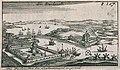 Dardanels, 1686
 -
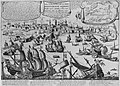 Alger, 1688-1700
 -
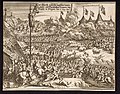 Ottoman flag in 1696

_Gr%C3%BCnenberg,_Beschreibung_der_Reise_von_Konstanz_nach_Jerusalem,_dated_to_around_1487._Baden_State_Library_Karlsruhe,_Cod._St._Peter_pap._32,_Fol._50r.jpg)

_-_Sandrart_Jacob_Von_-_1686.jpg)


Naval standards
.jpg)
Numerous authors, especially in the 18th and 19th centuries reported on the variety of naval flags in the Ottoman Empire, starting with Bowles's "Universal display of the naval flags of all nations in the world" (1783). The designs of the flags depended on the rank or geographical base of their owners.[19]
-
!["Grand standard of the Grand Turk": one of the several types of Ottoman naval standards in the 17–18th centuries.[20][21][22][23][24][25][26][27][28][29]](https://upload.wikimedia.org/wikipedia/commons/thumb/5/51/%22Grand_Standard_of_the_Grand_Turk%22_naval_flag%2C_according_to_Bowles_%281783%29.svg/120px-%22Grand_Standard_of_the_Grand_Turk%22_naval_flag%2C_according_to_Bowles_%281783%29.svg.png)
-
 Naval flag of Constantinople, also in Bowles's Universal Display of the Naval Flags of all Nations (1783)
 -
 "Blue Turks' flag", also in Bowles's Universal Display of the Naval Flags of all Nations (1783)
 -
 "Turkish Purple flag", also in Bowles's Universal Display of the Naval Flags of all Nations (1783)
!["Grand standard of the Grand Turk": one of the several types of Ottoman naval standards in the 17–18th centuries.[20][21][22][23][24][25][26][27][28][29]](https://en.wikipedia.org/wiki/File:%22Grand_Standard_of_the_Grand_Turk%22_naval_flag,_according_to_Bowles_(1783).svg)


.svg)
Crescent and star flag
.svg)
The star and crescent design is reported as early as 1526 at the Battle of Mohács,[32] or the Siege of Wien in 1683,[33] and continues to appear more systematically after 1793, on Ottoman flags of the 19th century. The white star and crescent moon with a red background was introduced as the flag of the Ottoman Empire in 1844.[34][35]
-
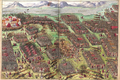 Battle of Mohács in 1526, by Johann Schreier (1555)
 -
 Siege of Wien, 1683
 -
 Army banner with crescent, as depicted in a 1721 illustration to 'Ata'i's Hamse
 -
 Crescent flag reported during the war with Austria in 1788 by Lucas Hochenleitter


.svg)
Source of the Star and Crescent symbol
It has been suggested that the star-and-crescent used in Ottoman flags of the 19th century had been adopted from the Byzantine. Franz Babinger (1992) suggests this possibility, noting that the crescent alone has a much older tradition also with Turkic tribes in the interior of Asia.[36] The crescent and star is found on the coinage of Byzantium since the 4th century BC[37] and was depicted on Byzantine Empire's coins and shields of Christian warrior saints till the 13th century.[38] Parsons (2007) notes that the star and crescent was not a widespread motive on the coinage of Byzantium at the time of the Ottoman conquest.[39] Turkish historians tend to stress the antiquity of the crescent (not star-and-crescent) symbol among the early Turkic states in Asia.[40]
Imperial standards
.svg)
The imperial standard displayed the sultan's tughra, often on a pink or bright red background.
-
![Imperial Standard of the Ottoman Sultan[42]](https://upload.wikimedia.org/wikipedia/commons/thumb/2/22/Imperial_standard_of_the_Ottoman_Sultan.svg/120px-Imperial_standard_of_the_Ottoman_Sultan.svg.png) Imperial Standard of the Ottoman Sultan[42]
Imperial Standard of the Ottoman Sultan[42] -
 Naval Standard of the Ottoman Sultan
 -
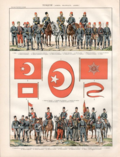 Standards used by the Ottoman Army in 1900
![Imperial Standard of the Ottoman Sultan[42]](https://en.wikipedia.org/wiki/File:Imperial_standard_of_the_Ottoman_Sultan.svg)


The standard used by the last Caliph, Abdulmejid II (between 19 November 1922 – 3 March 1924) consisted of a green flag with a star and crescent in white on a red oval background within a rayed ornament, all in white.
-
![Caliphate Standard of Abdulmejid II[43]](https://upload.wikimedia.org/wikipedia/commons/thumb/e/e4/Caliphate_standard_of_Abdulmejid_II_%281922%E2%80%931924%29.svg/120px-Caliphate_standard_of_Abdulmejid_II_%281922%E2%80%931924%29.svg.png) Caliphate Standard of Abdulmejid II[43]
Caliphate Standard of Abdulmejid II[43]
![Caliphate Standard of Abdulmejid II[43]](https://en.wikipedia.org/wiki/File:Caliphate_standard_of_Abdulmejid_II_(1922%E2%80%931924).svg)
Army Flags and Standards with Shahada
The Ottoman army often used verses from the Quran and Shahada on their flags. This tradition continued during the First World War. When Ottoman Turkey joined the war on the side of the Central Powers in 1914, it declared a jihad against the Entente States. The modern Ottoman Turkish army used the Ottoman state coat of arms on one side of their standard regimental flags and Shahada on the other. The Ottoman regimental flags consisted of gold writings and the state emblem on a red background. After the empire was abolished in 1922, this practice continued for a while in modern Turkey.[44][45]
-
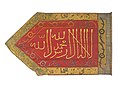 Standard of the Ottoman Army at Battle of Vienna (1683)
 -
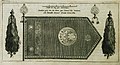 Ottoman Flag at Morea (1690)
 -
 Ottoman Regimental Standards with Ottoman National Flag
 -
 One Side of Ottoman Turkish Regimental Standard with Shahada which was used in World War I (1914)
 -
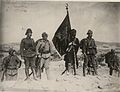 Ottoman Turkish Regimental Standard with Shahada in Gallipoli campaign (1915)


.jpg)


See also

References
- ^ "Türk Bayrağı Kanunu" [Law on Turkish Flag] (PDF). Tbmm.gov.tr. Retrieved 12 December 2017.
- ^ Lors des campagnes, la marche du Grand Vizir (1er ministre nommé par le Sultan de Constantinople) est précédée par trois Étendards ou Queues de cheval terminées chacune par une pomme dorée, ils sont l'enseigne militaire des Othomans appelée Thou ou Thouy. On dit qu'un Général de cette nation, ne sachant comment rallier ses troupes qui avaient perdu tous ses Étendards, s'avisa de couper la queue d'un cheval et de l'attacher au bout d'une lance; les soldats coururent à ce nouveau signal et remportèrent la victoire... cited after Marc Pasquin, 22 November 2004, crwflags.com; cf. also a facsimile image hosted at the website of the Bibliothèque nationale de France.
- ^ For example: Jacques-Nicolas Bellin, Tableau des pavillons que la pluspart des nations arborent à la mer (1756).
- ^
Ramchandani, Indu (2000). Hoiberg, Dale (ed.). Students' Britannica India. Vol. 1 A to C (Abd Allah ibn al-Abbas to Cypress). Encyclopaedia Britannica (India). p. 373. Retrieved 18 March 2020.
the crescent ... appeared on the standards of [Ottoman] infantry under Sultan Orhan (1324-1360)
- ^
Chwalkowski, Farrin (2016). Symbols in Arts, Religion and Culture: The Soul of Nature. Newcastle upon Tyne: Cambridge Scholars Publishing. p. 85. ISBN 9781443857284. Retrieved 18 March 2020.
The city of Byzantium, also known as Constantinople and, in modern times, as Istanbul, was dedicated to Diana, goddess of the hunt, and the crescent was the symbol of Diana. In 330 AD, the Emperor Constantine rededicated the city to the Virgin Mary whose star symbol was added to the previous crescent. When the Turks took possession of Constantinople, they found many crescent flags and adopted the crescent as a symbol of the Ottoman Empire in about 1453 AD.
- ^
Bordeleau, André G. (2013). "Moon-Bearing Flags". Flags of the Night Sky: When Astronomy Meets National Pride. SpringerLink : Bücher. New York: Springer Science & Business Media. p. 233. ISBN 9781461409298. Retrieved 18 March 2020.
The city of Byzantium (later known as Constantinople and then Istanbul) adopted the crescent moon as its symbol long before the birth of Islam. ... When the Turks conquered Constantinople in 1453, they adopted the city's existing flag and symbol.
- ^ Nozomi Karyasu & António Martins, 8 October 2006 on Flags of the World.
- ^ año 1590, Joan Riezo figlo de mastro dominico [Olives] in missina (1590), English: 1590 Portolan chart of the Mediterranean Sea and Europe, retrieved 2025-11-17
{{citation}}: CS1 maint: numeric names: authors list (link) - ^ English: 1559 Portolan chart of the Aegean Sea and the Sea of Marmara by Diogo Homem, 1559, retrieved 2025-11-17
- ^ Sailko (2017-01-23), Italiano: Palazzo dei Diamanti (Ferrara), retrieved 2025-11-17
- ^ "[Portolan chart of the Mediterranean Sea, the North Atlantic Ocean, the Baltic Sea, and the northwestern African coast]. - Yale University Library". collections.library.yale.edu. Retrieved 2025-11-17.
- ^ English: Siege of Rhodes Written by the Grand Master of the Order of Saint John and illustrated with 52 full-page miniatures: a pictorial account of the successful defense of Rhodes against the Turks in 1480, 1480, retrieved 2025-11-17
- ^ "BLB: Profil". www.blb-karlsruhe.de (in German). Retrieved 2025-11-17.
- ^ ÖSTERREICH, Johann Schreier, EHRENSPIEGEL DES HAUSES (16 June 1555), العربية: تصوير لمعركة موهاكس بريشة يوهان شراير يُبين توزيع الجيوش بحسب البيارق المبينة على الرسم، وتُرى مواقع المدافع العثمانية والمجريةEnglish: The most detailed depiction of the battle of Mohács., retrieved 2025-11-17
{{citation}}: CS1 maint: multiple names: authors list (link) - ^ Français : Carte de la Mer Méditerranée, de la Mer Noire, de la Mer Rouge et de l'Océan Atlantique nord-est. Georgio Sideri dicto Calapoda Cretensis fecit nel anno Domini 1565 die ... Iugai, 1565, retrieved 2025-11-17
- ^ Salvatore, Oliva (1635), Atlas nautique de la Mer Méditerranée, d'une partie de la Mer Noire et de la Mer Rouge. 1, Atlas nautique de la Méditerranée / Salvatori Oliva facit in civitate Marsila anno 1535; Salvatori Oliva fecit in civitate Marsila anno 1535 sic, retrieved 2025-11-17
- ^ Marché aux esclaves à Constantinople, fondé vers 1460 par le sultan Mehmet II (gravure de 1684)., 1684, retrieved 2025-11-17
- ^ 1780 Battle of Kagul
- ^ Ottoman naval flags according to Bowles's "Universal display of the naval flags of all nations in the world" (1783)
- ^ Bowles, Carington (1783), English: Bowles's universal display of the naval flags of all nations in the world. Printed for the proprietor Carington Bowles, at his Map & Print Warehouse, No. 69 in St. Pauls Church Yard, London., retrieved 2025-11-17
- ^ Erol Özbilgen, Bütün Yönleriyle Osmanlı, Ădab-ı Osmaniyye, s, 144–145.
- ^ "Nieuwe Tafel van alle de Scheeps Vlaggen des Gehele Water-Waerelds op Nieus Vermeerdert en Verbeeterdt". Rijksmuseum.nl (in Dutch). Retrieved 2025-11-17.
- ^ Table des pavillons que l'on arbore dans toutes les parties du monde connu, consernant la marine = Nieuwe Tafel van al de zee-vaarende vlagge des weerelts, 1686–1719, retrieved 2025-11-17
- ^ "Vlaggenkaart met 139 genummerde vlaggen van zeevarende naties". collectie.hetscheepvaartmuseum.nl. Retrieved 2025-11-17.
- ^ Pavillons de diverse nations, retrieved 2025-11-17
- ^ "[Early Appearance of the Flag of New England] Schouw-park aller Scheeps-Vlaggen des geheelen Water-Waerelds . . . / Tableau des Pavillons de Mer, qui se trouvent dans tous les lieux du Monde Aquatique Augmente de 50 aui n ont jamais ete mis en lumiere . . . 1711 - Barry Lawrence Ruderman Antique Maps Inc". www.raremaps.com. Retrieved 2025-11-17.
- ^ Schenk, Pieter (1711), Schouw-park aller Scheeps-vlaggen des geheelen Water-Waerelds, retrieved 2025-11-17
- ^ "original 18th century flag chart antique engraving". Inter Antiquariaat. Retrieved 2025-11-17.
- ^ English: flag chart, 1760, retrieved 2025-11-17
- ^ According to the information conveyed by M. Zeki Pakalın from page 242 of the first volume of Lütfi Efendi, one of the 19th century Ottoman chroniclers (official historians of the state), his work titled Lütfi Tarihi (History of Lütfi); the five-pointed crescent-star flag with a red background, which is still used by the Republic of Turkey today, was first officially used during the reign of Sultan Mahmud II in accordance with official notifications published in 1242 AH and 1826 AD. Mehmet Zeki Pakalın, Osmanlı Tarih Deyimleri ve Terimleri Sözlüğü, s.119.
- ^ Tabell Öfver Alla Nationers nu brukeliga Flaggor År 1805, retrieved 2025-11-17
- ^ Battle of Mohács 1526
- ^ Siege of Wien, 1683
- ^ Raw, Laurence (2013-09-18). The Silk Road of Adaptation: Transformations across Disciplines and Cultures. Cambridge Scholars Publishing. p. 42. ISBN 9781443852890.
- ^ Marshall, Tim (2017-07-04). A Flag Worth Dying For: The Power and Politics of National Symbols. Simon and Schuster. ISBN 978-1-5011-6833-8.
- ^ "It seems possible, though not certain, that after the conquest Mehmed took over the crescent and star as an emblem of sovereignty from the Byzantines. The half-moon alone on a blood red flag, allegedly conferred on the Janissaries by Emir Orhan, was much older, as is demonstrated by numerous references to it dating from before 1453. But since these flags lack the star, which along with the half-moon is to be found on Sassanid and Byzantine municipal coins, it may be regarded as an innovation of Mehmed. It seems certain that in the interior of Asia tribes of Turkish nomads had been using the half-moon alone as an emblem for some time past, but it is equally certain that crescent and star together are attested only for a much later period. There is good reason to believe that old Turkish and Byzantine traditions were combined in the emblem of Ottoman and, much later, present-day Republican Turkish sovereignty." Franz Babinger (William C. Hickman Ed., Ralph Manheim Trans.), Mehmed the Conqueror and His Time, Princeton University Press, 1992, p 108
- ^ Nigel Wilson (2013). "Byzantium". Encyclopedia of Ancient Greece. Routledge. p. 136. ISBN 978-1-136-78800-0.
- ^ Piotr Grotowski (2010). Arms and Armour of the Warrior Saints: Tradition and Innovation in Byzantine Iconography (843–1261). Brill. pp. 249, 250. ISBN 978-90-04-18548-7.
- ^ John Denham Parsons, The Non-Christian Cross, BiblioBazaar, 2007, p 69: "Moreover, the question is what the symbol of Constantinople was at the time it was captured by the Turks. And an inspection of the coins issued by the Christian rulers of that city during the thousand years and more it was in their hands, will reveal to the enquirer that though the crescent with a cross within its horns appears occasionally upon the coins of the Emperors of the East, and in one or two instances we see a cross of four equal arms with each extremity piercing a crescent, it is doubtful if a single example of the so-called "star and crescent" symbol can be found upon them."
- ^ "It is clear, however, that, whatever the origin, the crescent was used by Turkish states in various regions of Asia, and there is absolutely no reason to claim that it passed to the Ottomans from Byzantium" Mehmet Fuat Köprülü, Gary Leiser (Trans.), Some Observations on the Influence of Byzantine Institutions on Ottoman institutions, Türk Tarih Kurumu, 1999, p 118
- ^ Sosyal Medyada Şeriat Bayrağı Diye Paylaşılan Bayrağın Aslında Rumeli'den Gelmesi (in Turkish)
- ^ "Ottoman Empire: Standard of the Sultan" at Flags of the World.
- ^ "The Caliphate Ensign of the Yacht Söğütlü". Naval Museum Command.
- ^ "Regimental standard the 46th Turkish Infantry Regiment captured near Damascus, 1918". Australian War Memorial.
The other side of the standard is also embroidered in gold and shows two texts from the Koran written in arabic script. They translate as 'There is no god but God' and 'Mohammed, the Messenger of God'. The standard would originally have been attached to a pole surmounted by a nickel plated crescent moon and brass star. Two gold bullion and crimson silk cords and tassels would also have been attached to the pole. The side of the standard bearing the sultan's toghra has been damaged by over-exposure to light.
- ^ "Ottoman regimental standard". New Zealand History Website of New Zealand Ministry for Culture and Heritage.
Regimental standard of the Ottoman 80th Infantry Regiment captured at Magdhaba by Quartermaster Sergeant Dennis Walker, 2nd Australian Light Horse Regiment, on 23 December 1916.Beneath is a scroll of leaves from which are suspended embroidered representations of five medals. The other side of the standard is also embroidered in gold and shows two texts from the Koran written in Arabic script. They translate as 'There is no god but God' and 'Mohammed, the Messenger of God'.
External links
 Media related to Flags of the Ottoman Empire at Wikimedia Commons
- Ottoman Empire at Flags of the World
