





Erebia
| Erebia | |
|---|---|

| |
| Arran brown (type species) | |
Scientific classification 
| |
| Kingdom: | Animalia |
| Phylum: | Arthropoda |
| Class: | Insecta |
| Order: | Lepidoptera |
| Family: | Nymphalidae |
| Subtribe: | Erebiina |
| Genus: | Erebia Dalman, 1816 |
| Type species | |
| Papilio ligea Linnaeus, 1758
| |
| Diversity | |
| Around 100 species | |
| Synonyms | |
|
Atercoloratus Bang-Haas, 1938 | |
_male_Bulgaria.jpg)
_female_Bulgaria_2.jpg)
_underside_Bulgaria.jpg)
_Bulgaria.jpg)
_underside_Bulgaria_3.jpg)
_Erebia_theano_theano_-_Kazakhstan,_Ulbinskyi_Mt._Range_-_male_ventral.jpg)
Erebia is a Holarctic genus of brush-footed butterflies, family Nymphalidae. Most of the about 90–100 species (see also below) are dark brown or black in color, with reddish-brown to orange or more rarely yellowish wing blotches or bands. These usually bear black spots within, which sometimes have white center spots.
This genus has found it easy to adapt to arid and especially cold conditions. Most of its members are associated with high-altitude lands, forest clearings or high latitude and tundra. Erebia species are frequent in the Alps, Rocky Mountains, subarctic and even Arctic regions, and the cooler parts of Central Asia. In fact, the North American term for these butterflies is alpines. Palearctic species are collectively known as ringlets or arguses. However, none of these terms is used exclusively for this genus.
Taxonomy and systematics
The genus Erebia was erected by Johan Wilhelm Dalman in 1816. As type species, the Arran brown—described as Papilio ligea by Carl Linnaeus in 1758—was chosen. This is a very complex genus with over 1300 taxa, but a massive proportion of these are junior synonyms. Some of the available names are listed by Vladimir Lukhtanov.[1] A fully comprehensive taxonomic checklist (i.e., without discussing synonymy and relationships) was published in 2008.[2]
Only three years after the genus' inception, the known species were reviewed by Jacob Hübner.[3] He established no less than five new genera for a fraction of what would eventually be named as "species" of Erebia. But things hardly improved as more and more of the diversity of these butterflies came to note. In Europe, a large number of Erebia taxa was described from the Alps. In the 19th and early 20th century the Alps were a popular destination for butterfly collectors and specimens of Alpine butterflies were very profitable for dealers. The dealers, mostly German, not only sold specimens, but were entomologists, entomological book dealers, entomological authors and publishers. Examples are Fritz Rühl, Alexander Heyne, Otto Staudinger, Andreas and Otto Bang-Haas and, in Paris, Achille and Émile Deyrolle.
This, together with the then-popular, even obsessive study of variation by entomologists – examples are James William Tutt, George Wheeler, Felix Bryk and Brisbane Charles Somerville Warren – led to very many names being applied to what may be or much more likely may not be biological species or subspecies. A further problem is the use of the term "variety". Authors of that time used this for an individual variant, a group of individuals morphologically but not otherwise related, seasonal forms, temperature-related forms, or geographic races; it was later usually taken to mean the last subspecies though this is often suspected to have been premature.
Eventually, it became common to arrange supposed species and subspecies to "species groups" (not superspecies, but an informal phenetic arrangement) as pioneered by B.C.S. Warren,[4] and attempt to resolve their true nature by and by. As molecular phylogenetic studies add to the available data, it is becoming clear that most "varieties" that have at least been commonly considered subspecies in the latter 20th century are indeed lineages distinct enough to warrant some formal degree of recognition. Another result of recent research is confirmation of the theory that this genus contains many glacial relict taxa, e.g., in the brassy ringlet group (E. tyndarus and similar species).[5]
The number of currently recognized Erebia species is given variously around 90-100, as developments happen so fast that it is hard for authors to remain up to date regarding the newest changes.[5]

Erebia, like some other genera of butterflies, has been known to consume blood.
Species list
As of early 2008, the following good species and some rather distinct subspecies are listed:[6]
- Erebia aethiopella (Hoffmannsegg, 1806) – false Mnestra ringlet
- Erebia aethiops (Esper, 1777) – Scotch argus
- Erebia ajanensis Ménétriés, 1857
- Erebia alberganus (Prunner, 1798) – almond ringlet or almond-eyed ringlet
- Erebia alcmena Grum-Grshimailo, 1891 Tibet, West China, Japan [7]
- Erebia alini (Bang-Haas, 1937) (disputed) Manchuria [8]
- Erebia anyuica Kurenzov, 1966 – scree alpine
- Erebia arctica R.Poppius, 1906 Kanin Peninsula, Arkhangelsk Region [9]
- Erebia atramentaria O.Bang-Haas, 1927 China [10]
- Erebia calcaria Lorković, 1949 – Lorkovic's brassy ringlet
- Erebia callias Edwards, 1871
- Erebia (callias) altajana Staudinger, 1901
- Erebia (callias) callias – Colorado alpine
- Erebia (callias) sibirica Staudinger, 1881
- Erebia (callias) simulata Warren, 1933
- Erebia cassioides (Reiner & Hohenwarth, 1792) – common brassy ringlet
- Erebia (cassioides) arvernensis Oberthür 1908 – western brassy ringlet
- Erebia (cassioides) carmenta Fruhstorfer, 1907 – western brassy ringlet
- Erebia (cassioides) macedonica Buresch, 1918
- Erebia christi Rätzer, 1890 – Raetzer's ringlet
- Erebia claudina (Borkhausen, 1789) – white speck ringlet
- Erebia cyclopius (Eversmann, 1844)
- Erebia dabanensis Erschoff, 1871
- Erebia disa (Thunberg, 1791) – Arctic ringlet or disa alpine
- Erebia discoidalis Kirby, 1837 – red-disked alpine
- Erebia dromulus Staudinger, 1901 Caucasus to North Iran, Turkey, Armenia[11]
- Erebia edda Ménétriés, 1851
- Erebia embla (Thunberg, 1791) – Lapland ringlet
- Erebia epiphron (Knoch, 1783) – mountain ringlet or small mountain ringlet
- Erebia epipsodea Butler, 1868 – common alpine
- Erebia epistygne (Hübner, 1819) – spring ringlet
- Erebia erinnyn Warren, 1932 Sayan, Transbaikala [12]
- Erebia eriphyle (Freyer, 1836) – eriphyle ringlet
- Erebia eugenia Churkin, 2000 Tian-Shan [13]
- Erebia euryale (Esper, 1805) – large ringlet
- Erebia fasciata Butler, 1868 – banded alpine
- Erebia flavofasciata Heyne, 1895 – yellow-banded ringlet
- Erebia fletcheri Elwes, 1899
- Erebia gorge (Esper, 1805) – silky ringlet
- Erebia gorgone – Gavarnie ringlet
- Erebia graucasica Jachontov, 1909 Caucasus [14]
- Erebia haberhaueri Staudinger, 1881 Kazakhstan [15]
- Erebia hewitsoni Lederer, 1864 Turkey, Iran, Transcausia, Armenia [16]
- Erebia hispania Butler, 1868 – Spanish brassy ringlet
- Erebia inuitica Wyatt, 1966 (disputed) [17]
- Erebia iranica Grum-Grshimailo, 1895
- Erebia jeniseiensis Trybom, 1877
- Erebia kalmuka Alphéraky, 1881 Tian-Shan [18]
- Erebia kefersteinii (Eversmann, 1851)
- Erebia kindermanni Staudinger, 1881
- Erebia kozhantshikovi Sheljuzhko, 1925 Transbaikalia, Chukot Peninsula,Mongolia [19]
- Erebia lafontainei (Troubridge & Philip, 1983) – reddish alpine
- Erebia lefebvrei (Boisduval, [1828]) – Lefèbvre's ringlet
- Erebia ligea (Linnaeus, 1758) – Arran brown
- Erebia mackinleyensis (Gunder, 1932) – Mt. McKinley alpine
- Erebia magdalena Strecker, 1880 – Magdalena alpine
- Erebia mancinus Doubleday, [1849] – taiga alpine
- Erebia manto ([Schiffermüller], 1775) – yellow-spotted ringlet
- Erebia maurisius Lukhtanov & Lukhtanov, 1994 (might be Erebia brimo (Böber, 1809))
- Erebia medusa (Denis & Schiffermüller, 1975) – woodland ringlet
- Erebia medusa polaris Staudinger, 1871 – Arctic woodland ringlet
- Erebia melampus (Fuessli, 1775) – lesser mountain ringlet
- Erebia melancholica Herrich-Schäffer, [1846] Asia Minor, Caucasus, Transcaucasia [20]
- Erebia melas (Herbst, 1796) – black ringlet
- Erebia meolans (Prunner, 1798) – Piedmont ringlet
- Erebia meta Staudinger, 1886
- Erebia mopsos Staudinger, 1886 synonym of meta
- Erebia mnestra (Hübner, [1803-1804]) – Mnestra's ringlet
- Erebia montana (de Prunner, 1798) – marbled ringlet
- Erebia neoridas (Boisduval, [1828]) – autumn ringlet
- Erebia neriene (Böber, 1809)
- Erebia niphonica Janson, 1877
- Erebia nivalis Lorković & Lesse, 1954 – de Lesse's brassy ringlet
- Erebia occulta Roos & Kimmich, 1983 – Eskimo alpine Alaska, Siberia, Russian Far East [21]
- Erebia ocnus (Eversmann, 1843) Dzungarian Alatau, Tian-shan [22]
- Erebia oeme (Hübner, [1803-1804]) – bright-eyed ringlet
- Erebia orientalis Elwes, 1900 Bulgaria [23]
- Erebia ottomana Herrich-Schäffer, [1851] – Ottoman brassy ringlet
- Erebia (ottomana) benacensis Warren, 1933
- Erebia palarica Chapman, 1905 – Chapman's ringlet Cantabria, Spain [24]
- Erebia pandrose (Borkhausen, 1788) – dewy ringlet
- Erebia pawlowskii Ménétriés, 1859 – yellow-dotted alpine or Theano alpine[25]
- Erebia pharte (Hübner, [1803-1804]) – blind ringlet
- Erebia pluto (de Prunner, 1798) – sooty ringlet
- Erebia pawlowskii Ménétriés, 1859 – yellow-dotted alpine or Theano alpine[25]
- Erebia progne Grum-Grshimailo, 1890 Pamir-Alay mountain system [26]
- Erebia pronoe (Esper, 1780) – water ringlet
- Erebia radians Staudinger, 1886 Trans-Alay Range, Tian-shan [27]
- Erebia rhodopensis Nicholl, 1900 - Nicholl's ringlet
- Erebia rondoui Oberthür 1908 (previously in E. cassioides)
- Erebia rossii (Curtis, 1835) – Arctic–alpine or Ross's alpine
- Erebia rurigena (disputed) Tat-sien-lu [Sichuan, China] [28]
- Erebia sachaensis Dubatolov, 1992 Russian Far East [29]
- Erebia scipio Boisduval, 1832 – larche ringlet
- Erebia serotina Descimon & de Lesse, 1953 – Descimon's ringlet Pyrenees [30]
- Erebia sibirica Staudinger, 1881 Tarbagatai Mountains [31] see E. callias
- Erebia sibo (Alphéraky, 1881)
- Erebia sokolovi Lukhtanov, 1990 Alatau, Tian-Shan [32]
- Erebia sthennyo Graslin, 1850 – false dewy ringlet
- Erebia stirius (Godart, [1824]) – Styrian ringlet
- Erebia stubbendorfii Ménétriés, 1846 Siberia, Altai [33]
- Erebia styx (Freyer, 1834) – Stygian ringlet
- Erebia sudetica Staudinger, 1861 – Sudeten ringlet
- Erebia theano (Tauscher, 1806) – Theano alpine
- Erebia tianschanica Heyne, [1894] Alatau [34]
- Erebia transcaucasica Warren, 1950 (previously in E. graucasica) Caucasus [35]
- Erebia triarius (de Prunner, 1798) – de Prunner's ringlet
- Erebia troubridgei (Dubatolov, 1992) Yakutia [36]
- Erebia turanica Erschoff, [1877] Altai, Tian-Shan [37]
- Erebia tyndarus (Esper, 1781) – Swiss brassy ringlet
- Erebia usgentensis Heyne, [1894] Uzgensky Mountains, Kirghizia [38]
- Erebia vidleri Elwes, 1898 – northwest alpine or Vidler's alpine
- Erebia wanga Bremer, 1864
- Erebia youngi Holland, 1900 – Yukon alpine or four-dotted alpine
- Erebia zapateri Oberthür, 1875 – Zapater's ringlet
Gallery
-
 First of the three Erebia plates in the 1915 Macrolepidoptera of the World, edited by Adalbert Seitz. This work was published near the height of taxonomic confusion about these butterflies.
 -
 Another Macrolepidoptera of the World plate, showing larger species.
 -
 Third Macrolepidoptera of the World plate, of the 31 named taxa depicted, probably less than 10 are actual species.


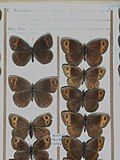
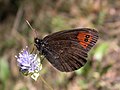
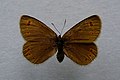
Erebia comparison
-
-

-

-

-

-

-

-

-

-

-
-

-
-

-

-

-
-
 Erebia oeme
underside ♂ -
 Erebia oeme
underside ♀ -

-
 Erebia pronoe
underside ♀ -

-
 Erebia pluto
underside -

-
 Erebia pandrose
underside -

-
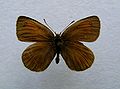
 Erebia stirius
underside -
-
 Erebia nivalis
underside -

-
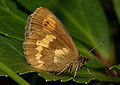 Erebia manto
underside ♀ -

-
 Erebia gorge f. triopes
 -
 Erebia gorge f. erynis
 -
Erebia gorge
underside -

-
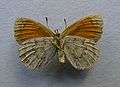 Erebia tyndarus
underside -

-
 Erebia claudina
underside -

-
 Erebia cassioides
underside ♀ -

-

-

-
-
 Erebia mnestra
underside -

-

-
-

-

-

-

-

-
 Erebia theano ♂
 -
 Erebia triarius ♂
_Erebia_ligea_ligea_-_Saint-Cergue_Suisse_-_female.jpg)

_Erebia_euryale_adyte_-_Lac_de_Tignes_Savoie_France_-_male.jpg)

_Erebia_aethiops_-_Bossey_Haute-Savoie_France_-_male.jpg)
_Erebia_aethiops_-_Bossey_Haute-Savoie_France_-_female.jpg)


.jpg)


_Erebia_alberganus_-_Champol%C3%A9on_France_-_male.jpg)


_Erebia_pharte_-_Lac_de_Tignes_Savoie_France_-_female.jpg)


_Erebia_theano_theano_-_Kazakhstan,_Ulbinskyi_Mt._Range_-_male.jpg)
_Erebia_triarius_-_Etang_d%27%C3%89vol_-_male.jpg)
See also
- Other Lepidoptera genera with excessive named taxa:
- Species concept
Footnotes
- ^ Lukhtanov [2008]
- ^ Tennent (2008)
- ^ Hübner [1819]
- ^ Warren (1936)
- ^ a b Albre et al. (2008)
- ^ Brower (2006), Albre et al. (2008), and see Savela (2008) for more sources
- ^ Grum-Grshimailo, G. Y. 1891 Lepidoptera nova in Asia centrali novissime lecta et descripta Horae Soc. ent. Ross. 25 (3-4) : 445-465
- ^ Bang-Haas, 1938 Neubeschreibungen und Berichtigungen der Palaearaktischen Macrolepidoptera. XXXVI Int. Ent. Zs. 52 (22) : 177-180
- ^ Poppius, K. R 1906 Acta Fauna & Fl. Fenn. 28 (3): 5
- ^ Bang-Haas, O. 1927 Horae Macrolepidopterologicae Regionis Palaearcticae 1 : 1-128, pl. 1-11
- ^ Staudinger in Staudinger, O. & Rebel, H. 1901 Catalog der Lepidopteren des palaearktischen Faunengebiets. I. Famil. Papilionidae - Hepialidae 1 : 1-411
- ^ Warren, G.. 1932 Notes on Erebiid species Ent. Rec. J. Var. 44 (12) : 165-167
- ^ Churkin, S.V. 2000 New species of Erebia Dalman (Lepidoptera, Satyridae) from Tian-Shan Helios 1: 29-32
- ^ Jachontov, A.A. 1909 [Notice sur les Lèpidoptères Rhopalocères du Caucase] Revue Russe Ent. 8 : 282-292
- ^ Staudinger, O 1881 Beitrag zur Lepidopterenfauna Central-Asiens Stettin ent. Ztg 42 (7-9): 253-300, (10-12): 393-424
- ^ Lederer, J. 1864 Zur Lepidopteren-Fauna von Imeretien und Grusien Wien. ent. Monats. 8 (5) : 165-172, pl. 3
- ^ Wyatt, C.W., 1966 Eine neue Erebia-art aus Alaska Zs. Wiener ent. Ges. 51 (7) : 93-94
- ^ Alphéraky, S. 1881 Lépidoptères du district de Kouldjà et des montagnes environnantes. (1-3) Horae Soc. ent. Ross. 16 (3-4): 334-435, pl. 14-15 (1881), 17 (1-2): 15-103, pl. 1-3 (1882), 17 (3-4): 156-227, pl. 8-9 (1883)
- ^ Sheljuzhko, L.A. 1925 Neue Erebien aus Sibirien Ent. Anz. 5 (1): 1-3, (2): 9-10
- ^ Herrich-Schäffer, G.A.W. [1846] Systematische Bearbeitung der Schmetterlinge von Europa, zugleich als Text, Revision und Supplement zu J. Hübner's Sammlung europäischer Schmetterlinge, 1843 (-1855)
- ^ Roos, P. & Kimmich, H.W. 1983 Eine neue Art der Erebia alberganus-Gruppe aus Nordkanada (Lep: Satyridae) Ent. Zs. 93 (6): 69-75
- ^ Eversmann, E. 1843 Quaedam lepidopterorum species novae in montibus Uralensibus et Altaicus habitantes nunc descriptae et depictae Bull. Soc. Imp. Nat. Moscou 16 (3) : 535-553, pl. 7-10
- ^ Elwes, H. J. 1900 On the Butterflies of Bulgaria Trans. ent. Soc. Lond. 1900 (2) : 183-206, pl. 4
- ^ Chapman,T.A. 1905 On Erebia palarica, n. sp., and Erebia stygne; chiefly in regard to its association with E. evias, in Spain Trans. ent. Soc. Lond. 1905 (1) : 9-35, pl. 2-6
- ^ a b Brock, Jim P. and K. Kaufman (2003). Kaufman Field Guide to Butterflies of North America. New York, NY:Houghton Mifflin.
- ^ Grum-Grshimailo, G. 1890 Le Pamir et sa faune lépidoptérologique in Romanoff,Mém. Lép. 4 : 1-576, pl. A,1-21
- ^ Staudinger, O. 1886 Centralasiatische Lepidopteren Stett. Ent. Ztg. 47 (4-6): 193-215, (7-9): 225-256
- ^ Leech, J.H. 1890. New species of Rhopalocera from China. Parts 1-4. Entomologist 23: 26–50; 81-83;109-114; 187–192.
- ^ Dubatolov, A. A. 1992 New subspecies of Nymphalidae and Satyridae from Yakutia [in Russian] Vestn. Zool. 6 : 40-45
- ^ Descimon, N. H. et de Lesse, H., 1953. Découverte d' un nouvel Erebia dans les Hautes-Pyrénées. Rev. Fr Lépidoptérologie, 14: 119-1 22, pl. VI
- ^ Staudinger, O 1881 Beitrag zur Lepidopterenfauna Central-Asiens Stettin ent. Ztg. 42 (7-9): 253-300, (10-12): 393-424
- ^ Lukhtanov, V. A. 1990 New taxa of Satyrid and Lycaenid from the Middle Asia and Kazakhstan Vestn. zool. 6 : 13-23
- ^ Ménétriés, E. 1847 Sur quelques papillons de Sibérie recueillis par M. Stubendorff Bull. Acad. Imp. Sci. St.-Pétersb.. (2) 5 (16-17) : 262-265
- ^ Heyne, [1894] Rühl, F. 1892–1902. Die palaearktischen Grossschmetterlinge und ihre Naturgeschichte. Bearbeitet von Fritz Rühl. Fortgesetzt von Alexander Heyne. Leipzig, Ernst Heyne, 8vo Bd 1, Tagfalter, (Lief l-16); [2]+857 pp, 7 figs
- ^ Warren, B.C.S. 1950. Supplementary data on problems relating to Erebiid butterflies. The Entomologist 83: 225–230.
- ^ Dubatolov, A.A. 1992 New subspecies of Nymphalidae and Satyridae from Yakutia [in Russian] Vestn. Zool. 6 : 40-45
- ^ Erschoff, N.G. [1877] Diagnosen neuer Lepidopteren aus den verschiedene Provinzen des Russischen Reiches Horae Soc. ent. Ross. 12 (4) : 336-348
- ^ Heyne, [1894] Rühl, F. 1892–1902. Die palaearktischen Grossschmetterlinge und ihre Naturgeschichte. Bearbeitet von Fritz Rühl. Fortgesetzt von Alexander Heyne. Leipzig, Ernst Heyne, 8vo Bd 1, Tagfalter, (Lief l-16); [2]+857 pp, 7 figs
References
- Albre, Jerome; Gers, Charles & Legal, Luc (2008). Molecular phylogeny of the Erebia tyndarus (Lepidoptera, Rhopalocera, Nymphalidae, Satyrinae) species group combining CoxII and ND5 mitochondrial genes: A case study of a recent radiation. Mol. Phylogenet. Evol. 47(1): 196–210. doi:10.1016/j.ympev.2008.01.009 (HTML abstract)
- Brower, Andrew V.Z. (2006). Tree of Life Web Project - Erebia. Version of 28 November 2006. Retrieved 11 August 2008.
- Hübner, Jacob [1819]. [Several new genera for Erebia]. In: Verzeichniss bekannter Schmettlinge [sic] (Vol.4): 62-64.
- Lukhtanov, Vladimir [2008]. Palaearctic Butterfly Checklist - Nymphalidae: Satyrinae. Version of 4 February 2008. Retrieved 11 August 2008.
- Savela, Markku (2008). Markku Savela's Lepidoptera and Some Other Life Forms - Erebia. Version of 15 March 2008. Retrieved 11 August 2008.
- Tennent, W. John (2008). A checklist of the satyrine genus Erebia (Lepidoptera) (1758–2006). Zootaxa 1900: 1-109. PDF contents, abstract and first page text
- Warren, Brisbane Brisbane Charles Somerville (1936). Monograph of the genus Erebia. British Museum of Natural History, London.
External links
- Nearctica Images of some Nearctic species.
- Nearctic species
- European species
- Rusinsects Former U.S.S.R. Erebia photographs, accurate text.
- Kulfan pdf Erebia fauna of the Tatras
- Zipcode Zoo
- [1] Archived 4 October 2011 at the Wayback Machine Pdf from Nagy et al. Alpine Biodiversity in Europe (Arctic–Alpine Butterflies).
- Flickr images