

Playing a string harmonic (a flageolet) is a string instrument technique that uses the nodes of natural harmonics of a musical string to isolate overtones. Playing string harmonics produces high pitched tones, often compared in timbre to a whistle or flute.[1][2] Overtones can be isolated "by lightly touching the string with the finger instead of pressing it down" against the fingerboard (without stopping).[2] For some instruments this is a fundamental technique, such as the Chinese guqin, where it is known as fan yin (泛音, lit. "floating sound"), and the Vietnamese đàn bầu.
Overtones
When a string is plucked or bowed normally, the ear hears the fundamental frequency most prominently, but the overall sound is also colored by the presence of various overtones (frequencies greater than the fundamental frequency). The fundamental frequency and its overtones are perceived by the listener as a single note; however, different combinations of overtones give rise to noticeably different overall tones (see timbre).[3] A harmonic overtone has evenly spaced nodes along the string, where the string does not move from its resting position.
Nodes

The nodes of natural harmonics are located at the following points along the string, matching the Harmonic series. Harmonic interval names are given from Huygens-Fokker institute list of intervals[4].
| Harmonic | Harmonic interval heard | Frequence ratio reduced to one octave | Closest equal temperament interval | Octave from open string | Cents above open string | Cents reduced to one octave | String length fraction | Audio |
|---|---|---|---|---|---|---|---|---|
| 2 | Octave | 1:1 | Octave (P8) | +1 | 1,200.0 | 0.0 | 1⁄2 | ⓘ |
| 3 | Just perfect fifth | 3:2 | Perfect fifth (P5) | +1 | 1,902.0 | 702.0 | 1⁄3, 2⁄3 | ⓘ |
| 4 | Octave | 1:1 | Octave (P8) | +2 | 2,400.0 | 0.0 | 1⁄4, 3⁄4 | ⓘ |
| 5 | Just major third | 5:4 | Major third (M3) | +2 | 2,786.3 | 386.3 | 1⁄5, 3⁄5 | ⓘ |
| 6 | Just perfect fifth | 3:2 | Perfect fifth (P5) | +2 | 3,102.0 | 702.0 | 1⁄6, 3⁄6, 5⁄6 | |
| 7 | Harmonic seventh | 7:4 | Minor seventh (m7) | +2 | 3,368.8 | 968.8 | 1⁄7 to 6⁄7 | ⓘ |
| 8 | Octave | 1:1 | Octave (P8) | +3 | 3,600.0 | 0.0 | 1⁄8, 3⁄8, 5⁄8, 7⁄8 | |
| 9 | Major whole tone | 9:8 | Major second (M2) | +3 | 3,803.9 | 203.9 | 1⁄9, 2⁄9, 4⁄9, 5⁄9, 7⁄9, 8⁄9 | ⓘ |
| 10 | Just major third | 5:4 | Major third (M3) | +3 | 3,986.3 | 386.3 | 1⁄10, 3⁄10, 7⁄10, 9⁄10 | |
| 11 | Undecimal semi-augmented fourth | 11:8 | Between perfect fourth (P4) and diminished fifth (♭5, aka tritone) | +3 | 4,151.3 | 551.3 | 1⁄11 to 10⁄11 | ⓘ |
| 12 | Just perfect fifth | 3:2 | Perfect fifth (P5) | +3 | 4,302.0 | 702.0 | 1⁄12, 5⁄12, 7⁄12, 11⁄12 | |
| 13 | Tridecimal neutral sixth | 13:8 | Between minor sixth (m6) and major sixth (M6) | +3 | 4,440.5 | 840.5 | 1⁄13 to 12⁄13 | ⓘ |
| 14 | Harmonic seventh | 7:4 | Minor seventh (m7) | +3 | 4,568.8 | 968.8 | 1⁄14, 3⁄14, 5⁄14, 9⁄14, 11⁄14, 13⁄14 | |
| 15 | Classic major seventh | 15:8 | Major seventh (M7) | +3 | 4,688.3 | 1,088.3 | 1⁄15, 2⁄15, 4⁄15, 7⁄15, 8⁄15, 11⁄15, 13⁄15, 14⁄15 | ⓘ |
| 16 | Octave | 1:1 | Octave (P8) | +4 | 4,800.0 | 0.0 | 1⁄16, 3⁄16, 5⁄16, 7⁄16, 9⁄16, 11⁄16, 13⁄16, 15⁄16 | |
| 17 | 17th harmonic | 17:16 | Minor second (m2, aka semitone) | +4 | 4,905.0 | 105.0 | 1⁄17 to 16⁄17 | |
| 18 | Major whole tone | 9:8 | Major second (M2) | +4 | 5,003.9 | 203.9 | 1⁄18, 5⁄18, 7⁄18, 11⁄18, 13⁄18, 17⁄18 |
Above, the length fraction is the point, with respect to the length of the whole string, the string is lightly touched. It is expressed as a fraction n/m, where m is the mode (2 through 18 are given above), and n the node number. The node number for a given mode can be any integer from 1 to m − 1. However, certain nodes of higher harmonics are coincident with nodes of lower harmonics, and the lower sounds overpower the higher ones. For example, mode number 4 can be fingered at nodes 1 and 3; it will occur at node 2 but will not be heard over the stronger first harmonic. Ineffective nodes to finger are not listed above.
The fret number, which shows the position of the node in terms of half tones (or frets on a fretted instrument) then is given by:
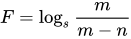
With s equal to the twelfth root of two, notated s because it's the first letter of the word "semitone".
Artificial harmonics


When a string is only lightly pressed by one finger (that is, isolating overtones of the open string), the resulting harmonics are called natural harmonics.[5] However, when a string is held down on the neck in addition to being lightly pressed on a node, the resulting harmonics are called artificial harmonics.[5] In this case, as the total length of the string is shortened, the fundamental frequency is raised, and the positions of the nodes shift accordingly (that is, by the same number of frets), thereby raising the frequency of the overtone by the same interval as the fundamental frequency.
Guitar

There are a few harmonic techniques unique to guitar.
Pinch harmonics

A pinch harmonic (also known as squelch picking, pick harmonic, or squealy) is a guitar technique to achieve artificial harmonics in which the player's thumb or index finger on the picking hand slightly catches the string after it is picked,[11] canceling (silencing) the fundamental frequency of the string, and letting one of the overtones dominate. This results in a high-pitched sound which is particularly discernible on an electrically-amplified guitar as a "squeal". Zakk Wylde (Ozzy Osbourne guitarist) is best known for this sound.
Tapped harmonics
Tapped harmonics were popularized by Eddie Van Halen. This technique is an extension of the tapping technique. The note is fretted as usual, but instead of striking the string the excitation energy required to sound the note is achieved by tapping at a harmonic nodal point. The tapping finger bounces lightly on and off the fret. The open string technique can be extended to artificial harmonics. For instance, for an octave harmonic (12-fret nodal point) press at the third fret, and tap the fifteenth fret, as 12 + 3 = 15.
Flicked and struck harmonics
Some players, such as Dimebag Darrell, used a less common technique to play natural harmonics. His variation consists of "flicking the string, dumping the [whammy] bar (...), [making] the string kinda flap, and just tap a harmonic"[12] on the corresponding nodal point before releasing the bar.
Mattias Eklundh has a similar technique, but it does not require flicking the string first. Instead, he uses his middle finger to strike the string on any nodal point, hard enough to make the string ring but without letting the finger press down on the fretboard.[13] The vibrato bar can be used in a similar way Dimebag used it, making it easier to make the harmonics ring, but it is not required. Eklundh also frequently uses such harmonics in combination with normal notes, allowing him to use them in a more musical way.[14]
String harmonics driven by a magnetic field
This technique is used by effect devices producing a magnetic field that can agitate fundamentals and harmonics of steel strings. There are harmonic mode switches as provided by newer versions of the EBow and by guitars built in sustainers like the Fernandes Sustainer and the Moog Guitar. Harmonics control by harmonic mode switching and by the playing technique is applied by the Guitar Resonator where harmonics can be alternated by changing the string driver position at the fretboard while playing.
See also
References
- ↑ Kamien, Roger (2008). Music: An Appreciation, p.13. Sixth "brief" edition. McGraw Hill. ISBN 978-0-07-340134-8.
- 1 2 Palisca, Claude V.; ed. (1996). Norton Anthology of Western Music, Volume 1: Ancient to Baroque, glossary, p.601. Third edition. W. W. Norton. ISBN 0-393-96906-1.
- ↑ "The Physics of Everyday Stuff - The Guitar". www.bsharp.org. Archived from the original on 2010-12-09. Retrieved 2015-08-03.
- ↑ "Stichting Huygens-Fokker: List of intervals". www.huygens-fokker.org. Retrieved 2026-07-26.
- 1 2 MasterClass (Jun 7, 2021). "Learn How to Play Natural Harmonics on Guitar". MasterClass. Retrieved May 14, 2024.
- ↑ Grove, George (1879). A Dictionary of Music and Musicians (A.D. 1450-1889), Vol. 2, p.665. Macmillan. [ISBN unspecified].
- ↑ Sevsay, Ertuğrul (2013). The Cambridge Guide to Orchestration, unpaginated. Cambridge. ISBN 9781107067486.
- ↑ Potter, Louis (1995). The Art of Cello Playing, p.194. Alfred Music. ISBN 9781457400353.
- 1 2 3 Grimson, Samuel B. and Forsyth, Cecil (1920). Modern Violin-Playing, p.79-80. New York: H. W. Gray (Novello). [ISBN unspecified].
- ↑ Hurwitz (2006), p.87.
- ↑ "Guitar Techniques: Pick Harmonic". XtremeMusician.com. Archived from the original on March 8, 2016. Retrieved December 19, 2017.
- ↑ Overdrive (2021-09-10). Dimebag's Squeals Lesson. Retrieved 2025-06-18 – via YouTube.
- ↑ Musicoff - Where Music Matters (2014-05-07). Harmonics #2 - Mattias Eklundh Guitar Lesson. Retrieved 2025-06-18 – via YouTube.
- ↑ Musicoff - Where Music Matters (2014-04-10). Harmonics #3 - Mattias Eklundh Guitar Lesson. Retrieved 2025-06-18 – via YouTube.
| Playing | |
|---|---|
| By type (six string) | |
| Additional strings | |
| Ancillary | |
| Related topics | |

 | ||
| Instruments |
| ||||||||
|---|---|---|---|---|---|---|---|---|---|
| Parts | |||||||||
| Techniques |
| ||||||||
| Ensembles and genres of music | |||||||||
| Related instruments | |||||||||
| Other | |||||||||