





Copeland–Erdős constant: Difference between revisions
Phil Boswell (talk | contribs) Adding/improving reference(s) |
Phil Boswell (talk | contribs) Adding/improving reference(s) |
||
| Line 7: | Line 7: | ||
By a similar argument, any constant created by concatenating "0." with all primes in an [[arithmetic progression]] ''dn'' + ''a'', where ''a'' is [[coprime]] to ''d'' and to 10, will be irrational. E.g. primes of the form 4''n'' + 1 or 8''n'' + 1. By Dirichlet's theorem, the arithmetic progression ''dn''·10<sup>''m''</sup> + ''a'' contains primes for all ''m'', and those primes are also in ''cd'' + ''a'', so the concatenated primes contain arbitrarily long sequences of the digit zero. |
By a similar argument, any constant created by concatenating "0." with all primes in an [[arithmetic progression]] ''dn'' + ''a'', where ''a'' is [[coprime]] to ''d'' and to 10, will be irrational. E.g. primes of the form 4''n'' + 1 or 8''n'' + 1. By Dirichlet's theorem, the arithmetic progression ''dn''·10<sup>''m''</sup> + ''a'' contains primes for all ''m'', and those primes are also in ''cd'' + ''a'', so the concatenated primes contain arbitrarily long sequences of the digit zero. |
||
In base 10, the constant is a [[normal number]], a fact proven by [[Arthur Herbert Copeland]] and [[Paul Erdős]] in 1946 (hence the name of the constant). |
In base 10, the constant is a [[normal number]], a fact proven by [[Arthur Herbert Copeland]] and [[Paul Erdős]] in 1946 (hence the name of the constant).<ref>{{harvnb|Copeland|Erdős|1946}}</ref> |
||
The constant is given by |
The constant is given by |
||
| Line 32: | Line 32: | ||
{{reflist}} |
{{reflist}} |
||
===Sources=== |
===Sources=== |
||
*{{citation|last1=Copeland|first1= A. H.|last2= Erdős|authorlink1=Arthur Herbert Copeland|first2= P. |authorlink2=Paul Erdős|title=Note on Normal Numbers|journal= [[Bulletin of the American Mathematical Society]]|volume= 52|pages= 857-860|date= 1946|doi=10.1090/S0002-9904-1946-08657-7}}. |
|||
*{{citation|author1-link=G. H. Hardy|last1=Hardy|first1=G. H.|author2-link=E. M. Wright|first2=E. M.|last2=Wright|date=1979|origyear=1938|title=An Introduction to the Theory of Numbers|publisher=Oxford University Press|edition=5th|isbn=0-19-853171-0}}. |
*{{citation|author1-link=G. H. Hardy|last1=Hardy|first1=G. H.|author2-link=E. M. Wright|first2=E. M.|last2=Wright|date=1979|origyear=1938|title=An Introduction to the Theory of Numbers|publisher=Oxford University Press|edition=5th|isbn=0-19-853171-0}}. |
||
Revision as of 10:13, 22 August 2018
The Copeland–Erdős constant is the concatenation of "0." with the base 10 representations of the prime numbers in order. Its value is approximately
The constant is irrational; this can be proven with Dirichlet's theorem on arithmetic progressions or Bertrand's postulate (Hardy and Wright, p. 113) or Ramare's theorem that every even integer is a sum of at most six primes. It also follows directly from its normality (see below).
By a similar argument, any constant created by concatenating "0." with all primes in an arithmetic progression dn + a, where a is coprime to d and to 10, will be irrational. E.g. primes of the form 4n + 1 or 8n + 1. By Dirichlet's theorem, the arithmetic progression dn·10m + a contains primes for all m, and those primes are also in cd + a, so the concatenated primes contain arbitrarily long sequences of the digit zero.
In base 10, the constant is a normal number, a fact proven by Arthur Herbert Copeland and Paul Erdős in 1946 (hence the name of the constant).[1]
The constant is given by
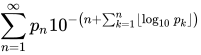
where pn is the nth prime number.
Its continued fraction is [0; 4, 4, 8, 16, 18, 5, 1, …] (OEIS: A030168).
Related constants
In any given base b the number

which can be written in base b as 0.0110101000101000101…b where the nth digit is 1 if n is prime, is irrational.[2]
See also
- Smarandache–Wellin numbers: the truncated value of this constant multiplied by the appropriate power of 10.
- Champernowne constant: concatenating all natural numbers, not just primes.
References
- ^ Copeland & Erdős 1946
- ^ Hardy & Wright 1979, p. 112
Sources
- Copeland, A. H.; Erdős, P. (1946), "Note on Normal Numbers", Bulletin of the American Mathematical Society, 52: 857–860, doi:10.1090/S0002-9904-1946-08657-7.
- Hardy, G. H.; Wright, E. M. (1979) [1938], An Introduction to the Theory of Numbers (5th ed.), Oxford University Press, ISBN 0-19-853171-0.