



George Town, Penang: Difference between revisions
m →Suburbs |
Herman Jaka (talk | contribs) Reverted to revision 717560545 by DumbBOT (talk): Revert to last stable version. Revert from damages by block evasion user. (TW) |
||
| Line 3: | Line 3: | ||
{{Infobox settlement |
{{Infobox settlement |
||
| official_name = George Town |
| official_name = George Town |
||
| |
| other_name = Tanjung Penaga |
||
| translit_lang1 = Other |
|||
| nickname = Pearl of the Orient<ref>{{cite web|url=http://asiancorrespondent.com/2012/08/exploring-georgetown-penang/|title=Exploring Georgetown, Penang|author=Mike Aquino|publisher=[[Asian Correspondent]]|date=30 August 2012|accessdate=1 January 2016}}</ref> |
|||
| translit_lang1_type1 = [[Simplified Chinese character|Chinese]] |
|||
| translit_lang1_info1 = 乔治市 |
|||
| translit_lang1_type2 = [[Malaysian Tamil|Tamil]] |
|||
| translit_lang1_info2 = ஜோர்ஜ் டவுன் |
|||
| nickname = ''Bandaraya Mutiara''<br />Pearl of the Orient City<ref>{{cite web|url=http://asiancorrespondent.com/2012/08/exploring-georgetown-penang/|title=Exploring Georgetown, Penang|author=Mike Aquino|publisher=[[Asian Correspondent]]|date=30 August 2012|accessdate=1 January 2016}}</ref> |
|||
| image_skyline = George Town composite.png |
| image_skyline = George Town composite.png |
||
| imagesize = |
| imagesize = |
||
| Line 15: | Line 20: | ||
| pushpin_map = Malaysia West |
| pushpin_map = Malaysia West |
||
| pushpin_label_position = right |
| pushpin_label_position = right |
||
| pushpin_map_caption = Location |
| pushpin_map_caption = Location in the [[Peninsula Malaysia]] |
||
| pushpin_map1 = Malaysia |
| pushpin_map1 = Malaysia |
||
| pushpin_label_position1 = right |
| pushpin_label_position1 = right |
||
| Line 31: | Line 36: | ||
| established_title3 = Granted city status |
| established_title3 = Granted city status |
||
| established_date3 = 1 January 1957<ref name="receive">{{cite web|url=http://www.thesundaily.my/node/252772|title=The Penang Island City agenda|author=Goh Ban Lee|publisher=[[The Sun (Malaysia)|The Sun]]|date=19 May 2014|accessdate=25 January 2016}}</ref> |
| established_date3 = 1 January 1957<ref name="receive">{{cite web|url=http://www.thesundaily.my/node/252772|title=The Penang Island City agenda|author=Goh Ban Lee|publisher=[[The Sun (Malaysia)|The Sun]]|date=19 May 2014|accessdate=25 January 2016}}</ref> |
||
| established_title4 = Regain city status |
|||
| established_date4 = 10 March 2015<ref name="regain">{{cite web|url=http://www.themalaysianinsider.com/malaysia/article/george-town-a-city-again|title=George Town a city again|author=Looi Sue-Chern|publisher=[[The Malaysian Insider]]|date=24 March 2015|accessdate=24 January 2016|archiveurl=http://web.archive.org/web/20150326180134/http://www.themalaysianinsider.com/malaysia/article/george-town-a-city-again|archivedate=26 March 2015|deadurl=yes}}</ref> |
|||
| leader_title = Mayor |
| leader_title = Mayor |
||
| leader_name = Patahiyah Ismail |
| leader_name = Patahiyah Ismail |
||
| Line 38: | Line 45: | ||
| area_footnotes = <ref name="mayor and area">{{cite web|url=http://www.thestar.com.my/news/nation/2015/03/25/penangs-first-mayor-a-woman/|title=Penang’s first mayor a woman|author=Cavina Lim|publisher=[[The Star (Malaysia)|The Star]]|date=25 March 2015|accessdate=24 January 2016}}</ref> |
| area_footnotes = <ref name="mayor and area">{{cite web|url=http://www.thestar.com.my/news/nation/2015/03/25/penangs-first-mayor-a-woman/|title=Penang’s first mayor a woman|author=Cavina Lim|publisher=[[The Star (Malaysia)|The Star]]|date=25 March 2015|accessdate=24 January 2016}}</ref> |
||
| population_as_of = 2010 |
| population_as_of = 2010 |
||
| population_total = 500,000<ref name="pop">{{cite web|url=http://www.latimes.com/travel/la-tr-d-16-places-20151227-story.html|title=Looking for a 2016 vacation? Here are 16 must-see destinations|publisher=[[Los Angeles Times]]|date=26 December 2015|accessdate=1 January 2016|archiveurl=https://web.archive.org/web/20160101042941/http://www.latimes.com/travel/la-tr-d-16-places-20151227-story.html|archivedate=1 January 2016|deadurl=yes}}</ref> |
|||
| population_total = 529,400<ref name="pop">{{cite web|url=http://penanginstitute.org/v3/resources/data-centre/122-population|publisher=Penang Institute}}</ref> |
|||
| population_footnotes = |
| population_footnotes = |
||
| population_density_km2 = |
| population_density_km2 = |
||
| population_metro = |
| population_metro = |
||
| population_blank1_title = [[List of adjectivals and demonyms for cities|Demonym]] |
|||
| population_blank1 = George Townians<ref name="gt">{{cite web|url=http://www.tropicalsky.co.uk/far-east-holidays/malaysia/penang/penang-beach-holidays|title=Penang Beach Holiday|author=Toni Marie Ford|publisher=Tropical Sky|accessdate=1 January 2016}}</ref> |
|||
| timezone = [[Malaysian Standard Time|MST]] |
| timezone = [[Malaysian Standard Time|MST]] |
||
| utc_offset = +8 |
| utc_offset = +8 |
||
| Line 65: | Line 74: | ||
}} |
}} |
||
'''George Town''' ({{zh|c=乔治市|p=Qiáozhì Shì}}, [[Malaysian Tamil|Tamil]]: ஜோர்ஜ் டவுன்) is the [[List of capitals in Malaysia|capital city]] of the Malaysian state of [[Penang]], located on the |
'''George Town''' ({{zh|c=乔治市|p=Qiáozhì Shì}}, [[Malaysian Tamil|Tamil]]: ஜோர்ஜ் டவுன்) is the [[List of capitals in Malaysia|capital city]] of the Malaysian state of [[Penang]], located on the north-east corner of the island. It had an estimated population of 500,000 {{As of|2010|lc=y}}.<ref name="pop"/> The [[George Town Conurbation|metropolitan area]] (which consists of [[Jelutong]], [[Sungai Pinang]], [[Sungai Nibong]], [[Gelugor]], [[Air Itam]], [[Tanjung Bungah]] and [[Tanjung Tokong]]) has a population of 2.5 million, which makes it the second largest metropolitan area and the biggest northern metropolis in Malaysia.<ref name="eff">{{cite web|url=http://web.usm.my/km/31(2)2013/KM31_2_3_37-64.pdf|title=The Process and Effects of Demographic Transition in Penang, Malaysia|author1=Usman Haji Yaakob|author2=Nik Norliati Fitri Md Nor|work=School of Humanities|publisher=[[University of Science, Malaysia]]|year=2013|accessdate=25 January 2016|pages=42, 45 6, 9/28|format=PDF}}</ref><ref name="development">{{cite web|url=http://www.thinkcity.com.my/positioningpenang/files/PositioningPenang_LORES_.pdf|title=Cities, People & the Economy — A Study on Positioning Penang|author1=Homi Kharas|author2=Albert Zeufack|author3=Hamdan Majeed|work=[[Khazanah Nasional]], [[World Bank]]|publisher=ThinkCity|date=September 2010|accessdate=26 January 2016|pages=5, 12/105|format=PDF|isbn=978-983-44193-3-2|archiveurl=http://web.archive.org/web/20160126034302/http://www.thinkcity.com.my/positioningpenang/files/PositioningPenang_LORES_.pdf|archivedate=26 January 2016|deadurl=yes}}</ref><ref>{{cite web|url=http://siteresources.worldbank.org/INTCHD/Resources/430063-1310571283698/MalaysiaBBL2.pdf|title=Urban Regeneration : The Case of Penang, Malaysia (Putting Policy into Practice) - The Penang Metropolitan Region (George Town Conurbation)|author=Hamdan Abdul Majeed|work=Khazanah Nasional|publisher=World Bank|date=11 April 2012|accessdate=4 January 2016|pages=10/20|format=PDF|archiveurl=https://web.archive.org/web/20160104014144/http://siteresources.worldbank.org/INTCHD/Resources/430063-1310571283698/MalaysiaBBL2.pdf|archivedate=4 January 2016|deadurl=yes}}</ref> Excluding the metropolitan area, the area of George Town is the seventh largest city by population in Malaysia.<ref group="note">Excluding the population in the whole administration area of [[Penang Island City Council]], the city stand as [[List of cities in Malaysia#Population|the seventh largest city in Malaysia]].</ref> Together with [[Alor Setar]] and [[Malacca City]], it is [[List of cities by time of continuous habitation|one of the Malaysian oldest cities]] in the [[Straits of Malacca]] since its foundation by [[Francis Light]], who was a captain and trader for the [[British East India Company]] (EIC) after being instructed by his company, Jourdain Sullivan and de Souza to establish presence in the [[Malay Archipelago]]. |
||
Light gained control of [[Penang Island]] through a treaty negotiated with the [[Sultan of Kedah]], although in the early stages of negotiation the Sultan refused to cede the island. The [[Fort Cornwallis]] was then established and he was successful in increasing the island import values and settlement population especially with the free trade policy the British used at the time. The Sultan of Kedah tried to regain control of the area when he saw the British had failed to provide protection to them as promised earlier in the treaty they had signed when the Sultan was attacked by the [[Rattanakosin Kingdom|Siamese]], the plan was however ended with a failure when Light implemented night raids on the Sultan's fortress. Prior to its successful trading post, many [[Overseas Chinese|Chinese]] traders began to settle in the town as well to other areas in Penang Island to participate in |
|||
Although [[Penang Island]] had been inhabited since the early 18th. century, it was Captain [[Francis Light]] who founded the settlement of George Town, having landed on [[Penang Island|the island]] on 17 July 1786. The settlement became the first capital of the [[Crown colony|British crown colony]] of the [[Straits Settlements]], which was established in 1826 and included [[Singapore]] and [[Malacca]]. As an [[entrepôt]], George Town grew rapidly and served as a melting pot for the various cultures which traded on its shores. The [[Japanese Empire|Japanese]] briefly occupied the town during [[World War II]], before reverting to British rule upon the end of the war. In 1957, George Town was declared a city by Her Majesty [[Elizabeth II|Queen Elizabeth II]], becoming the first city in the [[Federation of Malaya]]. |
|||
agriculture and to manage plantations.<ref name="Gungwu2003">{{cite book|author=Wang Gungwu|title=Anglo-Chinese Encounters Since 1800: War, Trade, Science and Governance|url=https://books.google.com/books?id=A97-5ftvJFoC&pg=PA121|date=7 April 2003|publisher=Cambridge University Press|isbn=978-0-521-53413-0|pages=121–}}</ref><ref name="urban pop">{{cite web|url=http://www.ritsumei.ac.jp/acd/re/k-rsc/hss/book/pdf/vol04_05.pdf|title=Ninety Years of Urbanization in Malaysia: A Geographical Investigation of Its Trends and Characteristics|author1=Usman Yaakob|author2=Tarmiji Masron|author3=Fujimaki Masami|work=University of Science, Malaysia and [[Ritsumeikan University]], Japan|publisher=Ritsumeikan|date=11 October 2015|accessdate=25 January 2016|pages=90, 99/23|format=PDF|archiveurl=http://web.archive.org/web/20160125061819/http://www.ritsumei.ac.jp/acd/re/k-rsc/hss/book/pdf/vol04_05.pdf|archivedate=25 January 2016|deadurl=yes}}</ref> This was continued under the administration of [[Straits Settlements]] with the migration of more Chinese together with [[Non-resident Indian and person of Indian origin|Indian]] workers prior to the [[Economic history of the United Kingdom|Industrial Revolution in Britain]]. |
|||
The situation during the [[World War I]] did not directly impact the town daily activities, although the Imperial German Cruiser ''Emden'' sank a French destroyer and a Russian cruiser before shelling the oil storage tanks near the city in the [[Battle of Penang]]. During [[World War II]], however, the town suffered greatly, since as it was heavily bombed first by the Japanese and later by the [[Allies of World War II|Allies]]. After the war, the town remained as the capital of Penang until the formation of Malaysia in 1963. In 2008, it was listed together with Malacca City as one of Malaysian [[UNESCO]] [[World Heritage Site]] for its long history as a cosmopolitan city.<ref name="UNESCO Heritage">{{cite web|url=http://whc.unesco.org/en/news/450|title=Eight new sites, from the Straits of Malacca, to Papua New Guinea and San Marino, added to UNESCO’s World Heritage List|publisher=[[UNESCO]] ([[World Heritage Site]])|date=7 July 2008|accessdate=8 July 2008|archiveurl=https://web.archive.org/web/20150906101950/http://whc.unesco.org/en/news/450/|archivedate=6 September 2015|deadurl=yes}}</ref> Today, George Town is well known for its unique street foods, culture and heritage as well with its position as a [[medical tourism]] hub with many patients from neighbouring Sumatra in Indonesia frequently visiting the city to undergoing treatment.<ref name="creative city">{{cite web|url=http://www.ukm.my/geografia/images/upload/3ok.geografia-julai2014-christina-edam1.pdf|title=Issues and challenges of a liveable and creative city: The case of Penang, Malaysia|author1=Christina Oon Khar Ee|author2=Khoo Suet Leng|work=Development Planning and Management Programme, School of Social Sciences, University of Science, Malaysia|publisher=|year=2004|accessdate=26 January 2016|page=1/11|issue=3|format=PDF|issn=2180-2491|archiveurl=http://web.archive.org/web/20160126012116/http://www.ukm.my/geografia/images/upload/3ok.geografia-julai2014-christina-edam1.pdf|archivedate=26 January 2016|deadurl=yes}}</ref><ref name="treatment">{{cite web|url=http://health.kompas.com/read/2014/02/07/1506415/Mengapa.Pasien.Puas.Berobat.ke.Penang.|title=Mengapa Pasien Puas Berobat ke Penang?|author=Wardah Fajri|language=Indonesian|publisher=[[Kompas]]|date=17 February 2014|accessdate=20 January 2016|archiveurl=http://web.archive.org/web/20160120105700/http://health.kompas.com/read/2014/02/07/1506415/Mengapa.Pasien.Puas.Berobat.ke.Penang.|archivedate=20 January 2016|deadurl=yes}}</ref><ref name="affordable">{{cite web|url=http://www.acehkita.com/tamasya-ke-george-town-situs-warisan-dunia/|title=Tamasya ke George Town|language=Indonesian|publisher=Aceh Kita|date=29 October 2013|accessdate=26 January 2016|archiveurl=http://web.archive.org/web/20160126013700/http://www.acehkita.com/tamasya-ke-george-town-situs-warisan-dunia/|archivedate=26 January 2016|deadurl=yes}}</ref> |
|||
Aside from being one of the most popular tourist destinations in [[Malaysia]], George Town now serves as Malaysia's most important medical tourism hub and northern financial centre. The city receives more than 50% of medical tourist arrivals in [[Malaysia]], contributing about 70% of [[Malaysia]]'s medical tourism revenue.<ref name="medical tourism The Sun">http://www.thesundaily.my/news/1260128</ref><ref name="penangmonthly.com">http://penangmonthly.com/medical-tourism-a-billion-ringgit-industry-for-penang/</ref> |
|||
==Etymology== |
==Etymology== |
||
George Town was |
The George Town area was once known as ''Tanjung'' ([[Cape (geography)|Cape]]) in [[Malay language]] by the [[Ethnic Malays|Malay community]] living there as it was situated on a cape area on the island northeast.<ref name="Ahmad2014">{{cite book|author=Abu Talib Ahmad|title=Museums, History and Culture in Malaysia|url=https://books.google.com/books?id=krl1BgAAQBAJ&pg=PA233|date=10 October 2014|publisher=NUS Press|isbn=978-9971-69-819-5|pages=233–}}</ref> The name is derived from the older name of the town, ''Tanjung Penaga'' (Cape Penaigre).<ref name="Salleh2015">{{cite book|author=Editor Muhammad Haji Salleh|title=Early History of Penang (Penerbit USM)|url=https://books.google.com/books?id=gPekCgAAQBAJ&pg=PT40|date=27 August 2015|publisher=Penerbit USM|isbn=978-983-861-657-7|pages=39–40}}</ref> As a settlement was soon established and founded by British [[Sea captain|Captain]] [[Francis Light]] in 1786, it was named after King [[George III of the United Kingdom|George III]].<ref name="Ahmad2014"/><ref name="Jackson2013">{{cite book|author=Ashley Jackson|title=Buildings of Empire|url=https://books.google.com/books?id=_Rv7AAAAQBAJ&pg=PA7|date=November 2013|publisher=OUP Oxford|isbn=978-0-19-958938-8|pages=7–}}</ref> |
||
The city was also once known as ''Tanjung'' ([[Cape (geography)|Cape]]) in [[Malay language|Malay]], as it is situated on the northeastern cape of [[Penang Island]].<ref name="Ahmad2014">{{cite book|author=Abu Talib Ahmad|title=Museums, History and Culture in Malaysia|url=https://books.google.com/books?id=krl1BgAAQBAJ&pg=PA233|date=10 October 2014|publisher=NUS Press|isbn=978-9971-69-819-5|pages=233–}}</ref> The name is derived from the older name of the town, ''Tanjung Penaga'' (Cape Penaigre).<ref name="Salleh2015">{{cite book|author=Editor Muhammad Haji Salleh|title=Early History of Penang (Penerbit USM)|url=https://books.google.com/books?id=gPekCgAAQBAJ&pg=PT40|date=27 August 2015|publisher=Penerbit USM|isbn=978-983-861-657-7|pages=39–40}}</ref> |
|||
==History== |
==History== |
||
===Founding of George Town=== |
===Founding of George Town=== |
||
[[File:Georgetown FrancisLight.JPG|thumb|left| |
[[File:Georgetown FrancisLight.JPG|thumb|left|Statue of [[Francis Light]] in the present-day city, he was regarded as the founder of George Town.]] |
||
As the [[Dutch East India Company]] had dominated the Far East [[spice trade]] |
As the [[Dutch East India Company]] had dominated the Far East [[spice trade]], the British were determined to establish their presence in the region to control the trade route between [[mainland China]] and the [[Indian subcontinent]] through the archipelago, and to set up a base to repair British Navy ships.<ref name="eff"/><ref name="vp">{{cite web|url=http://www.visitpenang.gov.my/portal3/about-penang/history.html|title=History of Penang|publisher=Penang State Government|date=14 September 2008|accessdate=8 January 2016|archiveurl=http://web.archive.org/web/20160102075051/http://www.visitpenang.gov.my/portal3/about-penang/history.html|archivedate=2 January 2016|deadurl=yes}}</ref> Because of this, [[Francis Light]], who was a captain and a trader for the [[British East India Company]] (EIC) was instructed by his company, Jourdain Sullivan and de Souza in [[Madras]], [[British Raj|India]] to establish trade relations in the [[Malay archipelago]].<ref name="pc">{{cite web|url=http://www.thehindu.com/todays-paper/tp-features/tp-metroplus/the-penang-connection/article6326817.ece|title=The Penang connection|publisher=[[The Hindu]]|date=18 August 2014|accessdate=8 January 2016|archiveurl=http://web.archive.org/web/20160108131217/http://www.thehindu.com/todays-paper/tp-features/tp-metroplus/the-penang-connection/article6326817.ece|archivedate=8 January 2016|deadurl=yes}}</ref> He arrived on [[Penang Island]] on 17 July 1786.<ref name="vp"/> |
||
As Penang was still under the control of the [[Sultan of Kedah]], Light needed to negotiate with the Sultan [[Abdullah Mukarram Shah]] to grant the island to the EIC in exchange for protection of the Sultanate against [[Rattanakosin Kingdom|Siamese]] and [[Konbaung Dynasty|Burmese]] intrusions.<ref name="pc"/><ref name="question">{{cite web|url=http://quod.lib.umich.edu/g/genpub/APF3019.0001.001?rgn=main;view=fulltext|title=Map to illustrate the Siamese question|author1=Swettenham|author2=Frank Athelstane|work=W. & A.K. Johnston Limited|publisher=[[University of Michigan Library]]|year=1850–1946|accessdate=9 January 2016}}</ref> The early negotiations were problematic because the Sultan did not want to cede the island to the British, but the threat from Siam grew as the five Malay kingdoms of Kedah, [[Sultan of Perak|Perak]], [[Sultan of Terengganu|Terengganu]], [[Sultan of Kelantan|Kelantan]] and [[Pattani Kingdom|Pattani]] were forced to offer ''[[bunga mas]]'' annually as a sign of [[vassal state]].<ref name="question"/> The Sultan was aware that he needed an agreement with the British for protection from the Siamese although he did not realise Light had acted without the approval of [[Monarchy of the United Kingdom|his superiors]].<ref name="vp"/> Following the sealing of agreements by both sides, Light returned to the island on 11 August 1786 to establish possession under the [[Union Jack|flag of the United Kingdom]],<ref name="pc"/> and renamed it Prince of Wales Island after [[George III of the United Kingdom|George III]] who later became the King of the United Kingdom.<ref name="Richmond2010">{{cite book|author=Simon Richmond|title=Malaysia, Singapore & Brunei|url=https://books.google.com/books?id=VMKOuzRxOJsC&pg=PA177|year=2010|publisher=Lonely Planet|isbn=978-1-74104-887-2|pages=177–}}</ref> |
|||
[[Francis Light|Light]] arrived on [[Penang Island]] on 17 July 1786.<ref name="vp"/> |
|||
As [[Penang Island]] was still under the control of the [[Sultan of Kedah]], Light needed to negotiate with the Sultan [[Abdullah Mukarram Shah]] to grant [[Penang Island|the island]] to the EIC in exchange for protection of the Sultanate against [[Rattanakosin Kingdom|Siamese]] and [[Konbaung Dynasty|Burmese]] intrusions.<ref name="pc"/><ref name="question">{{cite web|url=http://quod.lib.umich.edu/g/genpub/APF3019.0001.001?rgn=main;view=fulltext|title=Map to illustrate the Siamese question|author1=Swettenham|author2=Frank Athelstane|work=W. & A.K. Johnston Limited|publisher=[[University of Michigan Library]]|year=1850–1946|accessdate=9 January 2016}}</ref> The early negotiations were problematic because the Sultan did not want to cede [[Penang Island|the island]] to the British, but the threat from Siam grew as Kedah was forced submit to [[Rattanakosin Kingdom|Siam]] as a vassal state by offering ''[[bunga mas]]'' annually.<ref name="question"/> The Sultan was aware that he needed an agreement with the British for protection against the [[Rattanakosin Kingdom|Siamese]], although he did not realise Light had acted without the approval of [[East India Company|his superiors]].<ref name="vp"/> |
|||
[[File:The Map of Early Penang Showing the Malay Town on the South of the Town Center by Popham 1799.jpg|thumb|right|An 1799 map featuring the [[Fort Cornwallis]] after Captain Light acquired the island of [[Penang Island|Prince of Wales]] (present-day Penang).]] |
|||
With the signing of the agreement, Light returned to [[Penang Island]] on 11 August 1786 to establish the possession of the island under the [[Union Jack|flag of the United Kingdom]],<ref name="pc"/> and renamed it the ''Prince of Wales Island'' after [[George III of the United Kingdom|George III]], who later became the King of the United Kingdom.<ref name="Richmond2010">{{cite book|author=Simon Richmond|title=Malaysia, Singapore & Brunei|url=https://books.google.com/books?id=VMKOuzRxOJsC&pg=PA177|year=2010|publisher=Lonely Planet|isbn=978-1-74104-887-2|pages=177–}}</ref> George Town was the first [[British Empire|British]] settlement in [[Southeast Asia]] and this marked the beginning of more than a century of British political intervention in [[British Malaya|Malaya]]. |
|||
At the time of his arrival, the island was inhabited by at least 1,000 Malay fishermen.<ref name="vp"/> He then built [[Fort Cornwallis]] which became the first British presence in the Malay archipelago. The area of present-day George Town was developed from a [[swamp]]y area. Light introduced the island to traders as a [[free port]] to attract them from the Dutch trading post in neighbouring [[Sumatra]].<ref name="vp"/> Although during the early stage of development he had difficulty in defending the island because of the shortage of [[water supply]] and because it was prone to flooding and [[malaria]],<ref>{{cite book|author=Robert K. Home|title=Of Planting and Planning: The Making of British Colonial Cities|url=https://books.google.com/books?id=O2FyRzZ9QHUC&pg=PA69|year=2013|publisher=Routledge|isbn=978-0-415-54053-7|pages=69–}}</ref><ref name="areca">{{cite book|title=Streets of George Town, Penang|url=https://books.google.com/books?id=giWb_8UjPU4C&pg=PA5|year=2007|publisher=Areca Books|isbn=978-983-9886-00-9|pages=5–85}}</ref> Light managed to increase the settlement population to 10,000 and the value of imports to [[Pound sterling|£]]130,000.<ref name="100 years">{{cite web|url=https://archive.org/stream/onehundredyearso01braduoft/onehundredyearso01braduoft_djvu.txt|title=One hundred years of Singapore : being some account of the capital of the Straits Settlements from its foundation by Sir Stamford Raffles on the 6th February 1819 to the 6th February 1919|author1=Walter Makepeace|author2=Gilbert E. Brooke|author3=Roland St. J. Braddell|author4=John Murray|work=[[Library Bureau]], [[University of Toronto Libraries]]|publisher=[[Internet Archive]]|accessdate=9 January 2016}}</ref> In addition to Britain's free trade policy, Light also succeeded in attracting many traders from the Dutch ports in Sumatra where many restrictions and taxes had been imposed.<ref name="Jackson2013"/> |
|||
After the |
After the company failed to provide military protection to the Sultanate of Kedah was attacked by Siam in 1790, the Sultan formed an army at [[Seberang Perai]] (later Province Wellesley) to remove the British as well some Dutch presence, to retake Prince of Wales Island. This action was defeated by Light who implemented night raids on the Sultan's fortress.<ref name="vp"/> The following year, the Sultan was forced to signed a treaty with the British, which stipulated the official handing-over of the island to the British. Light was appointed Superintendent of the island and, to appease the Sultan, he paid [[Spanish dollar|$]]6,000 annually.<ref name="vp"/><ref name="question"/> After Light died of malaria on 21 October 1794,<ref name="100 years"/> Lieutenant-Colonel [[Arthur Wellesley, 1st Duke of Wellington|Arthur Wellesley]] arrived to defend and maintain British control of the island.<ref name="vp"/> Sir [[George Alexander William Leith]] won control of another strip of land across the channel near the island in the Sultan of Kedah's territory in 1800, and named it Province Wellesley (present-day Seberang Perai). This gave the island control over the harbour and ended the problem of water shortage in the town. The annual payment to the Sultan of Kedah was increased to $10,000 after the acquisition and payment continues into the present.<ref name="vp"/><ref name="question"/> |
||
For Light, [[Penang Island]] was a "''convenient magazine for trade''",<ref>http://www.journeymalaysia.com/MI_penang.htm</ref> and an ideal location to curtail further French expansion in [[French Indochina|Indochina]] and to check the Dutch foothold in nearby [[Sumatra]]. [[Penang Island]]'s strategic location at the northern edge of the Strait of Malacca, which was then an important shipping route to [[Qing China]], also compelled him to establish a British trading post on [[Penang Island]]. |
|||
Light founded George Town as a [[free port]] to entice traders away from Dutch trading posts in the region. Trade in George Town soon grew exponentially - incoming ships and boats to [[Penang]] rose from 85 in 1786 to 3,569 in 1802.<ref>http://ci.nii.ac.jp/els/110004067699.pdf?id=ART0006329940&type=pdf&lang=en&host=cinii&order_no=&ppv_type=0&lang_sw=&no=1455505759&cp=</ref> |
|||
Light also encouraged immigrants by firing silver dollars from his ship's cannons into the jungle and promising them as much land as they could clear. By 1792, just six years after Light first arrived on [[Penang Island|the island]], the population of the settlement had grown from under 100 to over 10,000.<ref>http://100pfs.blogspot.my/2015/08/early-penag-society-contd-pg-3.html</ref> |
|||
In addition, Light commissioned the construction of [[Fort Cornwallis]] to defend the [[Penang Island|Prince of Wales Island]] against any invasion. |
|||
Initially, the development of George Town was relatively haphazard and unplanned.<ref>Dr. Huang L.S., ''A Comparison on the Urban Spatial Structures of the British Colonial Port Cities among Calcutta, George Town and Singapore''</ref><ref>http://www.star2.com/living/2016/04/14/too-close-for-comfort-for-penang-folks/</ref> Four streets marked the earliest limits of George Town - Light Street, Pitt Street, Chulia Street and Beach Street.<ref>http://iacenter.ir/uploads/Urban_Landscape_Factors-.pdf</ref> The historic commercial centre around Beach Street, located next to the harbour, was arranged in a grid-like pattern and segmented into banking and trading areas.<ref>Daniel P.S. Goh (2014). Between History and Heritage: Post-Colonialism, Globalisation, and the Remaking of Malacca, Penang, and Singapore</ref><ref name="profile.nus.edu.sg">http://profile.nus.edu.sg/fass/socgohd/trans_2.1.pdf</ref> Government buildings and European residences were erected around Light Street, Farquhar Street and Weld Quay. The Chinese gradually built a 'Chinatown' covering China Street, Muntri Street, Chulia Street and King Street. Meanwhile, Indian Muslims were clustered at Acheen Street, Pitt Street and Armenian Street, whereas the Hindus were concentrated at Queen Street, creating a 'Little India'. Villages dominated the southern part of the town and beyond. |
|||
A committee of assessors was established in George Town in 1800.<ref>http://penangmonthly.com/a-history-of-local-elections-in-penang-part-i-democracy-comes-early/</ref> It was the first local authority established in British Malaya. |
|||
===Colonial Rule=== |
|||
[[File:Penang Museum historical painting N171b.jpg|thumb|left|George Town panoramic view from the sea as been described on a 1811 painting.]] |
[[File:Penang Museum historical painting N171b.jpg|thumb|left|George Town panoramic view from the sea as been described on a 1811 painting.]] |
||
In 1805, the island was elevated from a colonial status to that of a [[Residency (country subdivision)|residency]] on par with the cities of [[Madras]] and [[Bombay]] in [[Company rule in India|India]],<ref name="Richmond2010"/> and by 1832, under the British administration in India, the [[Straits Settlements]] comprising the states of [[Malacca (British Crown colony)|Malacca]], [[Colony of Singapore|Singapore]] and Penang was formed. Penang became its capital from 1826 and maintain its status as a free port but later in 1935 it was replaced by Singapore.<ref name="eff"/><ref name="vp"/><ref name="Richmond2010"/> During this time, many Chinese traders began to settle to participate in agriculture and managing the plantations sector.<ref name="Gungwu2003"/><ref name="urban pop"/> Although the town was increasingly developed, it became dangerous as it turns into a nest for Chinese [[secret society|secret societies]] who notorious for its gambling and brothels which resulting a violence when two rival sides of the secret societies came into fight in 1867 with each groups had allied themselves with similar Malay groups. Once the fight between them been resolved, each group was fined by the British authorities with a huge sum of $10,000 which later became the earlier cause for the establishment of police force in the island.<ref name="Richmond2010"/> The island successfully developed under British rule and became a naval base for the British to protect its interest from [[Dutch East Indies|Dutch]] and [[Cochinchina|French]].<ref name="urban pop"/> At the end of the 19th century, prior to [[tin mining|rich deposits of tin]] from neighbouring state and relentless demands of the [[Economic history of the United Kingdom|Industrial Revolution in Britain]], the island and the town enjoyed an economic boom. At this time, the town was overwhelmed by more immigrants especially those from [[Republic of China (1912–49)|China]] and India.<ref name="vp"/> Many European planters and Chinese ''towkays'' (business leaders) generate their money in the plantations and mines sectors in other northern Malay states but built their homes and sent their children to school in the town.<ref name="vp"/> The continuous town development was however halted when the Japanese arrived in 1941 as part of [[World War II]]. |
|||
In 1796, the [[Penang Island|Prince of Wales Island]] was made a penal settlement when 700 convicts were transferred from the [[Andaman Islands]].<ref>{{cite web|url=http://www.asthabharati.org/Dia_Jan%2009/RVR.htm|title=Penal System in Andaman|publisher=|accessdate=13 September 2014}}</ref> In 1805, [[Penang]] was made a separate presidency (on par with [[Bombay]] and [[Madras]]); and in 1826, George Town was made the capital of the [[Straits Settlements]], which included [[Singapore]] and [[Malacca]]. The capital was later shifted to the fast-booming town of [[Singapore]]. In 1867 the [[Straits Settlements]] became a [[Crown colony]] under direct British rule, in which [[Penang]] was included.<ref>[http://www.1911encyclopedia.org/Penang Penang]. 1911encyclopedia.org (30 August 2006). Retrieved on 11 August 2011.</ref> |
|||
Colonial [[Penang]] thrived from trade in pepper and spices, Indian piece goods, betel nut, tin, opium, and rice. The [[Bengal Presidency]] was aware of [[Penang]]'s potential as an alternative to [[Dutch East India Company|Dutch]] [[Moluccas]] as a source of spice production. Development of the spice trade became the chief means of covering administrative costs in [[Penang]]. The opening of spice plantations also drew Chinese settlers to [[Penang Island|the island]], which was actively encouraged by the British. |
|||
However, George Town's initial pre-eminence was later supplanted by [[Singapore]] owing to the latter's superior geographical location. In spite of this, George Town continued serving as an important feeder to [[Singapore]] – funnelling the exports meant for global shipping lines by ocean-going ships which had bypassed other regional ports. The replacement of sailing vessels by steamships in the mid-19th century cemented George Town's secondary importance after [[Singapore]]. [[Penang]]'s most important trading partners were [[Qing dynasty|China]], [[India]], [[Siam]], the [[Dutch East Indies]] and [[United Kingdom|Britain]], as well as fellow [[Straits Settlements]], [[Singapore]] and [[Malacca]].<ref name="docs.google.com">[https://docs.google.com/viewer?a=v&q=cache:GSesokgCx7cJ:www.thinkcity.com.my/penangstory/images/stories/images/tomo-kawamura%2520penang-and-indian-ocean.pdf+&hl=en&gl=my&pid=bl&srcid=ADGEEShErgxgUFpaUpYC4Ga4RkNadERiYu_4NCexYHejZhfhBzUIyMhZ1g0upXrSRp_3jS1C4cLJ5gJ-5-05dClmBnz03I1n7J9LXY4hR-Vd52LOGcEY7Cf0o8qzjeXZVU79XvelfrWd&sig=AHIEtbSo9_NIaLSnSHlD7uWpGx8nG-YYRQ Google Drive Viewer]. Docs.google.com. Retrieved on 27 September 2013.</ref> |
|||
The Municipal Council of George Town was formed in 1857, when the local government was placed in the hands of five municipal commissioners, three of whom were elected by taxpayers.<ref name="profile.nus.edu.sg"/> It was the first ever local authority to be established in [[British Malaya]]. |
|||
The rapid population growth stemming from economic development created problems such as sanitation, inadequate urban infrastructure, transportation and public health. Main roads were extended from George Town proper into the fertile cultivated spice farms further inland. But to sate the severe labour shortages in public works, the government began the practice of employing Indian convict workers as low-cost labourers. A great number of them worked on the streets of George Town, draining swamps and clearing forests, constructing drainage ditches, and laying pipeworks for clean water.<ref name="docs.google.com"/> Indeed, convict labour was key to [[Penang]]'s successful colonisation as many found employment in the civil service, military, and even as private servants to the colonial officials and private individuals.<ref name="docs.google.com"/> |
|||
For ten days in August 1867, George Town was gripped with civil unrest during what was known as the Penang Riot, which pitted rival Chinese secret societies Kean Teik Tong (the Tua Pek Kong Hoey), led by [[Khoo Thean Teik]] and the Red Flag against the alliance of the [[Ghee Hin Kongsi]] and the White Flag. The British authorities under newly appointed lieutenant-governor [[Edward Anson|Col. Edward Anson]] put down the violence with [[sepoy]] reinforcement after days of chaos.<ref>{{cite web|url=http://www.penangheritagecity.com/influential-muslim-leaders.html |title=Influential Muslim leaders who shaped Penang in its early history |publisher=Penangheritagecity.com |date=4 October 1994 |accessdate=3 January 2011}}</ref> To combat rampant crime in the town, the British fined each group [[Straits dollar|$]]10,000 and used the proceeds to create a police force on [[Penang Island|the island]].<ref name="Richmond2010"/> |
|||
By the end of the 19th. century, the tin mining boom in the [[Malay Peninsula]] and the rapid growth of the rubber industry ushered in a period of economic boom in George Town. The town's harbour was used to export and import these commodities, fuelling the rise of several other small enterprises in George Town. [[Singapore]]-based mercantile companies began to open branches in George Town, while the prosperity also attracted Chinese, Malay, Indian, Ceylonese, Siamese, Burmese, Arab, Jewish, Armenian and Eurasian immigrants.<ref>http://www.thestar.com.my/news/community/2013/07/06/leaving-only-tombs-behind-the-jewish-community-in-penang-is-all-but-gone-with-the-death-of-its-last/</ref><ref>Langdon, M. A Guide to George Town's Historic Commercial and Civic Precints. Penang : George Town World Heritage Incorporated</ref><ref>http://www.penang-traveltips.com/seven-streets-precinct.htm</ref><ref>https://web.archive.org/web/20120131071722/http://rihlah.nl.sg/Paper/Abdur-Razzaq%20Lubis.pdf</ref> |
|||
At the turn of the century, George Town, with a large population of Chinese immigrants, was a natural place for the Chinese nationalist [[Sun Yat-sen]] to raise funds for his revolutionary efforts in [[Qing China]]. These frequent visits culminated in the famous [[1910 Penang conference]] which paved the way to the ultimately triumphant [[Wuchang Uprising]] which overthrew the [[Manchu]] government.<ref>[http://biz.thestar.com.my/news/story.asp?file=/2010/11/13/business/7395949 Dr Sun Yat-sen's historic Penang conference]. Biz.thestar.com.my. Retrieved on 11 August 2011.</ref> |
|||
===World Wars=== |
|||
[[File:GEORGETOWN PENANG ISLAND MALAYSIA JAN 2012 (6815563818).jpg|thumb|left|The [[cenotaph]] in George Town was built in honour of the fallen [[Allies of World War I|Allied]] soldiers in [[World War I]].<ref name="Cheah2013">{{cite book|author=Jin Seng Cheah|title=Penang 500 Early Postcards|url=https://books.google.com/books?id=7ftEFcwwx20C&pg=PT71|date=19 February 2013|publisher=Editions Didier Millet|isbn=978-967-10617-1-8|pages=71–}}</ref><ref group="note">The original cenotaph was destroyed during [[World War II]]. After the war, it was rebuilt to its current form.</ref>]] |
|||
George Town was relatively untouched during [[World War I]], save for the [[Battle of Penang]]. On 28 October 1914, the [[Imperial German Navy]] cruiser [[SMS Emden]] sank the [[Russian cruiser Zhemchug|Imperial Russian Navy cruiser Zhemchug]] off George Town. As SMS Emden was leaving [[Penang Island]], it also sank the [[French destroyer Mousquet|French Navy destroyer Mousquet]].<ref>{{cite web|url=http://rbth.com/arts/2015/05/20/battle_of_penang_when_malay_fishermen_rescued_russian_sailors_46165.html|title=Battle of Penang: When Malay fishermen rescued Russian sailors|author=Ajay Kamalakaran|publisher=[[Russia Beyond the Headlines]]|date=20 May 2015|accessdate=12 January 2016}}</ref> |
|||
[[World War II]], on the other hand, was a devastating period of time for George Town. Beginning 11 December 1941, Japanese warplanes bombarded George Town. The [[Royal Australian Air Force]] [[No. 453 Squadron RAAF|No. 453 Squadron]] with sixteen-[[Brewster F2A Buffalo|F2A Buffalo]] valiantly fought the Japanese, but failed. Many of the outgunned Australian pilots flying the obsolete and lumbering Buffalos were killed during [[dog-fights]] with the more agile Japanese fighter aircraft such as the [[Mitsubishi A6M Zero|Zeroes]]. |
|||
{{quote|''Eighty Japanese fighters and bombers had flown over Georgetown unopposed... Thousands of people had filled the streets to watch the spectacle, which turned to tragedy when the bombs began to fall. Aircraft had then wheeled down to dive-bomb and strafe. Mass panic was the result of the bombing, and [[Penang]] had no anti-aircraft guns and few air raid shelters. Most of the bombs fell by design on Georgetown's densely populated Chinatown...''<ref name="Shepley2015">{{cite book|author=Nick Shepley|title=Red Sun at War Part II: Allied Defeat in the Far East|url=https://books.google.com/books?id=mKW-BAAAQBAJ&pg=PT21|date=7 December 2015|publisher=Andrews UK Limited|isbn=978-1-78166-301-1|pages=21–}}</ref>|[[Allen Warren (historian)|Allen Warren]], British historian.}} |
|||
As casualties mounted from the indiscriminate aerial raids, the British authorities decided to silently evacuate [[Penang]]'s European population, leaving the rest of [[Penang]]'s Asian population to their fates.<ref>http://trove.nla.gov.au/ndp/del/article/75131511</ref> The [[British Army]] also abandoned a complex fortification at the southeastern tip of [[Penang Island]] and declared George Town an open city. The defenceless island was left in the hands of a State Committee which had to subdue a three-day civil unrest. |
|||
The British withdrawal and the covert evacuation of Europeans caused much disillusionment and injury to the British prestige and image of invincibility. Historians judge that''the moral collapse of [[British Empire|British]] rule in [[Southeast Asia]] came not at [[Singapore]], but at [[Penang]]''.<ref name="Bayly, C.A. 2005">Bayly, C.A., Harper, T.N., 2005. Forgotten Armies: The Fall of British Asia, 1941-1945. Harvard University.</ref> |
|||
George Town finally fell to the invading [[Imperial Japanese Army]] on 19 December 1941. The Imperial Japanese Army quickly used the only radio station on [[Penang Island]] to broadcast a chilling message - ''"Hello, [[Singapore]], this is [[Penang]] calling. How do you like our bombing?".<ref name="Bayly, C.A. 2005"/> |
|||
The [[Japanese occupation of Malaya|Japanese Occupation]] was marked by widespread fear, hunger and the [[Sook Ching]] massacres which targeted the local Chinese.<ref>http://anilnetto.com/society/malaysian-history/old-penang-the-sook-ching-massacres-of-world-war-ii/</ref> Especially feared was the Japanese military police [[Kempeitai]] and its network of informants. The Japanese also took Malay and Chinese girls as comfort women.<ref>https://www.rt.com/news/330786-japan-sex-slaves-war/</ref> |
|||
George Town also served as a [[U-boat]] base for [[Japanese Empire|Japan]]'s ally, [[Nazi Germany]] during the [[World War II|War]].<ref>http://www.navy.gov.au/history/feature-histories/german-u-boat-operations-australian-waters</ref> |
|||
The United States Army's Twentieth Air Force began bombing raids on George Town in 1944. The destruction of the Penang Secretariat building by Allied bombers in the final months of the occupation caused the loss of the greater part of the British and Japanese records concerning the island, causing enormous difficulties to compile a comprehensive history of [[Penang]]. In addition, the [[Battle of the Malacca Strait]] took place off [[Penang Island]] in May 1945, in which the British [[Royal Navy]] sank an [[Imperial Japanese Navy]] warship. |
|||
On 21 August 1945, the Penang Shimbun published a statement of surrender issued by the [[Hirohito|Emperor of Japan]]. Under [[Operation Zipper]], a [[Royal Navy]] fleet arrived off George Town on 28 August. After the signing of the Japanese surrender document on 2 September, the [[Royal Marines]] occupied [[Penang Island]] on 3 September. A formal ceremony to signify British repossession of [[Penang]] was held at Swettenham Pier on 5 September 1945. |
|||
===Independence=== |
|||
After the war, the [[British Military Administration (Malaya)|British Military Administration]] appointed two successive governors for [[Penang]] and set up a Settlement Advisory Council to revive its ties with the local residents.<ref>{{cite book|author=Kim Hong Tan|title=檳榔嶼華人史圖錄|url=https://books.google.com/books?id=I0ybGqPXZasC&pg=PA123|year=2007|language=Chinese|publisher=Areca Books|isbn=978-983-42834-7-6|pages=123–}}</ref> |
|||
In 1946, the [[Straits Settlements]] were dissolved and the [[British Empire|British]] consolidated the [[British Malaya|Malayan]] states, including [[Penang]] but excluding [[Singapore]], into a single administrative entity called the [[Malayan Union]].<ref>http://eresources.nlb.gov.sg/infopedia/articles/SIP_2014-07-30_084623.html</ref> Opposition to the [[Malayan Union]] resulted in its replacement by the [[Federation of Malaya]] in 1948. |
|||
Nonetheless, the idea of the absorption of the [[British Empire|British]] [[crown colony]] of [[Penang]] into the vast Malay heartland alarmed some quarters of the population. The Penang Secessionist Movement (active from 1948 to 1951) was formed to preclude [[Penang]]'s merger with [[Federation of Malaya|Malaya]], but was ultimately unsuccessful due to British disapproval. Another attempt by the secessionists to join [[Penang]] with [[Singapore]] as a [[crown colony]] was also voted down by British officials.<ref>http://teochiewkia2010.blogspot.my/2010/03/penang-secessionist-movement-1948-1951.html</ref> The movement was spearheaded by, among others, the Penang Chinese Chamber of Commerce, the Penang Indian Chamber of Commerce, and the Penang Clerical and Administrative Staff Union. |
|||
On 1 January 1957, George Town was declared a city by Her Majesty [[Elizabeth II|Queen Elizabeth II]], becoming the first city in the [[Federation of Malaya]], and the only city in [[Malaysia]] (other than [[City of Singapore (historical entity)|Singapore]] between 1963 and 1965) until 1972, when [[Kuala Lumpur]] was granted city status. The first Mayor of George Town was D. S. Ramanathan. |
|||
[[Penang]], as a state in the [[Federation of Malaya]], gained independence in 1957, and subsequently became a member state of [[Malaysia]] in 1963. |
|||
===Post Independence=== |
|||
In 1965, the [[Government of Malaysia|Malaysian federal government]] suspended local elections as a result of the [[Indonesia–Malaysia confrontation|Indonesian Confrontation]].<ref>http://penangmonthly.com/a-history-of-local-elections-in-penang-part-ii-a-legacy-to-protect-3/</ref> By then, the George Town City Council was Malaysia's richest local authority, with annual revenue almost double that of the [[Penang State Legislative Assembly|Penang state government]]. In response to allegations of maladministration and misconduct, a Royal Commission of Enquiry was set up by the federal government under Senator Athi Nahappan, while the functions of the City Council were temporarily transferred to the [[List of Chief Ministers of Penang|Chief Minister of Penang]]. The Royal Commission recommended the restoration of elected local councils. However, this was never carried out. |
|||
The remaining local authorities in Penang, including the Penang Rural District Council, were taken over by the [[Penang State Legislative Assembly|Penang state government]] in 1971. Following the passing of the Local Government Act 1976, local councils on [[Penang Island]] were permanently merged into the Municipal Council of Penang Island.<ref>http://www.thesundaily.my/news/977890</ref> |
|||
===World War, post-independence and present=== |
|||
The merger of [[Penang]]'s local councils led to the controversy of George Town's city status. In the eyes of the [[Government of Malaysia|Malaysian federal government]], George Town no longer existed as a city.<ref>http://www.themalaymailonline.com/malaysia/article/after-four-year-wait-penang-island-to-finally-get-city-status</ref> However, most citizens of [[Penang]] contended that George Town remains a city to this day. In addition, several federal ordinances and acts refer to the City of George Town, such as the City of George Town Ordinance 1957. According to Penang Heritage Trust (PHT) trustee, Datuk Anwar Fazal, a lawyer by profession, George Town ''"legally has been and is still a city because the City of George Town Ordinance 1957 had not been repealed"''.<ref>http://www.themalaymailonline.com/malaysia/article/where-is-george-town</ref> |
|||
[[File:GEORGETOWN PENANG ISLAND MALAYSIA JAN 2012 (6815563818).jpg|thumb|left|A [[cenotaph]] in the city remembering those fallen [[Allies of World War I|Allied]] soldiers in [[World War I]] especially the Russian and French sailors who died in the [[Battle of Penang]].<ref name="areca"/><ref name="Cheah2013">{{cite book|author=Jin Seng Cheah|title=Penang 500 Early Postcards|url=https://books.google.com/books?id=7ftEFcwwx20C&pg=PT71|date=19 February 2013|publisher=Editions Didier Millet|isbn=978-967-10617-1-8|pages=71–}}</ref><ref group="note">The new cenotaph is built in 11 November 1948 as a replaceable to an earlier cenotaph that have been destroyed by both the Japanese and Allied bombings in World War II.</ref>]] |
|||
During [[World War I]], a surprise naval attack against the [[Allies of World War I|Allies]] occurred on 28 October 1914 in the town harbour area when the German cruiser [[SMS Emden]] disguised as the British cruiser [[HMS Yarmouth (1911)|HMS Yarmouth]] fired [[torpedos]] which sank the [[Russian cruiser Zhemchug]]. Subsequently the [[French destroyer Mousquet]] was also sunk. The engagement is known as the [[Battle of Penang]]. The attack resulted in 135 sailors killed while another 157 were wounded, mainly from the Russian and French side. Local Malay fishermen who were doing their daily activities not far from the area reportedly rushed to the site to save any sailors they could.<ref>{{cite web|url=http://rbth.com/arts/2015/05/20/battle_of_penang_when_malay_fishermen_rescued_russian_sailors_46165.html|title=Battle of Penang: When Malay fishermen rescued Russian sailors|author=Ajay Kamalakaran|publisher=[[Russia Beyond the Headlines]]|date=20 May 2015|accessdate=12 January 2016}}</ref> |
|||
At the start of [[World War II]] the Japanese [[Japanese invasion of Malaya|landed in Kelantan]] on 8 December 1941. Following the [[Sinking of Prince of Wales and Repulse]] on 10 December, Japanese forces launched [[Imperial Japanese Army Air Service|airstrikes]] with their planes being sighted near George Town on 11 December.<ref name="Warren2006">{{cite book|author=Alan Warren|title=Britain's Greatest Defeat: Singapore 1942|url=https://books.google.com/books?id=zosKzAoocu8C&pg=PA109|year=2006|publisher=A&C Black|isbn=978-1-85285-597-0|pages=109–}}</ref> The Japanese fighters and bombers arrived in [[V formation|V-formations]]. Amazed George Town residents emerged from their homes and places of business to see the unexpected aircraft formations, as has been described by Historian [[Allen Warren (historian)|Allen Warren]]. The amazement, however, turned to horror as the populace saw the Japanese aircraft dropping bombs.<ref name="Warren2006"/> Exploding bombs hit buildings in the town, and some residents panicked, seeing the dead and injured in the streets and buildings on fire. Many residents began quickly to evacuate the town to save their lives. Looting was reported in the aftermath of the Japanese bombing.<ref name="Warren2006"/> |
|||
Since the first days of British rule, George Town had been a [[free port]]. This [[free port]] status was suddenly revoked by the [[Government of Malaysia|Malaysian federal government]] in 1969, causing massive unemployment in the city, turning away trade and setting the stage for George Town's decline.<ref name="profile.nus.edu.sg"/><ref>Bindloss, J., Brash, C., 2008. Kuala Lumpur, Melaka & Penang. Lonely Planet.</ref> |
|||
{{quote|Eighty Japanese fighters and bombers had flown over Georgetown unopposed... Thousands of people had filled the streets to watch the spectacle, which turned to tragedy when the bombs began to fall. Aircraft had then wheeled down to dive-bomb and strafe. Mass panic was the result of the bombing, and Penang had no anti-aircraft guns and few air raid shelters. Most of the bombs fell by design on Georgetown's densely populated Chinatown...<ref name="Shepley2015">{{cite book|author=Nick Shepley|title=Red Sun at War Part II: Allied Defeat in the Far East|url=https://books.google.com/books?id=mKW-BAAAQBAJ&pg=PT21|date=7 December 2015|publisher=Andrews UK Limited|isbn=978-1-78166-301-1|pages=21–}}</ref>|[[Allen Warren (historian)|Allen Warren]], British historian.}} |
|||
[[File:Komtar.jpg|thumb|left|[[Komtar]] Tower, the tallest skyscraper in [[Penang]].]] |
|||
In 1974, the [[Komtar|KOMTAR]] project was launched to revitalise George Town. Hundreds of historical shophouses, schools and temples were demolished and damaged to build [[Penang]]'s tallest skyscraper, but it failed to revitalise George Town.<ref name="profile.nus.edu.sg"/> |
|||
===Renaissance=== |
|||
{{Infobox World Heritage Site |
{{Infobox World Heritage Site |
||
| WHS = [[Malacca City|Malacca]] and George Town, Historic Cities of the Straits of Malacca |
| WHS = [[Malacca City|Malacca]] and George Town, Historic Cities of the Straits of Malacca |
||
| Line 179: | Line 120: | ||
| Link = http://whc.unesco.org/en/list/1223 |
| Link = http://whc.unesco.org/en/list/1223 |
||
}} |
}} |
||
The [[Royal Australian Air Force]] (RAAF) [[No. 453 Squadron RAAF|No. 453 Squadron]] with sixteen-[[Brewster F2A Buffalo|F2A Buffalo]] valiantly tried to counter the Japanese attacks, but met with failure. Many of the over-matched Australian pilots flying the obsolete and lumbering Buffalos were killed during [[dog-fights]] with the more agile Japanese fighter aircraft. The town burned for days following the Japanese bombing. An estimated 600 town residents were killed and another 1,100 wounded as a result of the Japanese attack.<ref name="Warren2006"/> The Japanese continued their advance with [[Imperial Japanese Army|land attacks]] on 19 December, until on 22 December the first contingent of the Japanese land forces arrived to occupy the town as well as Penang Island. This marked the beginning of the [[Japanese occupation of Malaya|Japanese occupation]] of Penang, and the incorporation of Penang as part of the [[Empire of Japan]].<ref>{{cite book|author1=Salma Nasution Khoo|author2=Alison Hayes|author3=Sehra Yeap Zimbulis|title=Giving Our Best: The Story of St. George's Girls' School, Penang, 1885-2010|url=https://books.google.com/books?id=eVWq9R-P1voC&pg=PA25|year=2010|publisher=Areca Books|isbn=978-967-5719-04-2|pages=25–}}</ref> |
|||
The pre-war houses in the city centre had been protected from urban development by the Rent Control Act, which prohibited landlords from arbitrarily raising rentals, as a measure to provide affordable housing to the low-income population. Its repeal in 2000 led to overnight appreciation of house and real estate prices, forcing out tenants of multiple generations to the city outskirts.<ref>http://scholarship.sha.cornell.edu/cgi/viewcontent.cgi?article=1095&context=crer</ref> Unperturbed development and the dilapidation of the city centre sparked concerns of the continued existence of George Town's collection of pre-war houses ([[Southeast Asia]]'s largest), leading to more vigorous conservation efforts. |
|||
The Japanese had constructed a small [[submarine]] base in Penang for joint use with German [[U-boat]]s,<ref name="Shepley2015"/> and during the extensive Southeast Asian [[Allies of World War II|Allied]] bombing campaign of November 1944 to May 1945, naval facilities in Penang as well as those in Singapore came under attack, and mines were dropped by aircraft to impede Axis shipping.<ref>{{cite book|author=Paul H. Kratoska|title=The Japanese Occupation of Malaya: A Social and Economic History|url=https://books.google.com/books?id=bePxcx7BFLEC&pg=PA296|year=1998|publisher=C. Hurst & Co. Publishers|isbn=978-1-85065-284-7|pages=296–}}</ref> After the surrender of Japan in August 1945, and the end of the Japanese occupation of the peninsula, the [[British Military Administration (Malaya)|British Military Administration]] set up a Settlement Advisory Council to revive its ties with the local residents.<ref>{{cite book|author=Kim Hong Tan|title=檳榔嶼華人史圖錄|url=https://books.google.com/books?id=I0ybGqPXZasC&pg=PA123|year=2007|language=Chinese|publisher=Areca Books|isbn=978-983-42834-7-6|pages=123–}}</ref> On 1 April 1946, the Straits Settlements were dissolved and Penang was incorporated as part of the [[Malayan Union]] along with Malacca (Singapore became a separate crown colony). Subsequently, in 1948, these two former Straits Settlements entities and nine Malay States became part of the [[Federation of Malaya]], which was geographically identical to the Union but embodied some political differences. |
|||
[[File:Pg old n new.jpg|thumb|The symbiotic coexistence of a heritage building with a modern high-rise in George Town reflects the conflicting urban hunger for space to develop and the deep-rooted respect for the past.]] |
|||
The efforts paid off handsomely when, on 7 July 2008, George Town was formally inscribed as a [[UNESCO]] [[World Heritage Site]], due to its ''"unique architectural and cultural townscape without parallel anywhere in East and Southeast Asia"''. |
|||
On 1 January 1957, a [[royal charter]] of [[Queen Elizabeth II]] awarded [[List of cities in Malaysia|city status]] to the town.<ref name="receive"/> Though the island of Penang had long enjoyed the status as a [[free port]], this trading advantage was revoked in 1969, with a decidedly negative impact on Penang's commerce and employment.<ref name="Richmond2010"/> Nevertheless, when the Federation of Malaya, together with [[North Borneo (British Crown colony)|North Borneo]], [[Sarawak (British Crown colony)|Sarawak]] and Singapore formed the Federation of Malaysia in 1963, the city generally enjoyed rapid economic growth, especially in important new industries such as electronics. George Town was maintained as the state capital of Penang.<ref name="Richmond2010"/> It was listed as one of the historical cities in Malaysia, together with [[Malacca City]] on 7 July 2008.<ref name="UNESCO Heritage"/> When the George Town City Council was merged with the Penang Rural District Council to form a local government management board in 1974, the city lost its status as a sister city. The local government management board was replaced with Penang Municipal Council (MPPP) following the enforcement of Local Government Act in 1976.<ref name="mayor and area"/> The city regain its city status on 10 March 2015 after the [[Cabinet of Malaysia]] approves the request of city status for the whole Penang Island and a consent was given by the [[Yang di-Pertuan Agong]].<ref name="regain"/><ref name="approves">{{cite web|url=http://www.themalaysianinsider.com/malaysia/article/cabinet-approves-city-status-for-penang-island|title=Cabinet approves city status for Penang island|author=Himanshu Bhatt|publisher=The Malaysian Insider|date=17 December 2014|accessdate=20 January 2016|archiveurl=http://web.archive.org/web/20150102124512/http://www.themalaysianinsider.com/malaysia/article/cabinet-approves-city-status-for-penang-island|archivedate=2 January 2015|deadurl=yes}}</ref> |
|||
Meanwhile, the [[2004 Indian Ocean earthquake and tsunami|Indian Ocean tsunami]] in 2004 hit the northern coasts of George Town, claiming 52 lives (out of 68 in [[Malaysia]]). |
|||
==Capital city== |
|||
Whilst George Town had been declared a city by Her Majesty [[Elizabeth II|Queen Elizabeth II]] in 1957, the entire [[Penang Island]] was also awarded city status by the [[Government of Malaysia|Malaysian federal government]] in 2015. Thus, George Town is the only city in [[Malaysia]] to have been conferred city status twice, firstly by the [[Monarchy of the United Kingdom|British monarch]], and later, by the [[Government of Malaysia|Malaysian federal government]]. |
|||
{{wide image|Penang Jelutong Night.jpg|800px|align-cap=center|Night scene view of the city's metropolitan}} |
|||
Being the capital city of Penang, George Town plays an important role especially in the political and economic welfare of the population of the entire state. It is the seat of the state government where almost all of their [[Ministry (government department)|ministries]] and [[Government agency|agencies]] are based. Most of the [[Politics of Malaysia|Malaysian federal government]] agencies and departments are also located in George Town. The Penang State Legislative Assembly is located between Light Street and Farquhar Street near Fort Cornwallis. There are six members of parliament (MPs) representing the six [[List of Malaysian electoral districts|parliamentary constituencies]] in the city as well for the whole island: Bukit Bendera (''P.48''), Tanjong (''P.49''), Jelutong (''P.50''), Bukit Gelugor (''P.51''), Bayan Baru (''P.52'') and Balik Pulau (''P.53''). The city also elects 19 representatives to the state legislature from the state assembly districts of Tanjong Bunga, Air Puteh, Kebun Bunga, Pulau Tikus, Padang Kota, Pengkalan Kota, Komtar, Datok Keramat, Sungai Pinang, Batu Lancang, Seri Delima, Air Itam, Paya Terubong, Batu Uban, Pantai Jerejak, Batu Maung, Bayan Lepas, Pulau Betong and Telok Bahang.<ref>{{cite web|url=http://pmr.penerangan.gov.my/index.php/politik/1637-senarai-bahagian-bahagian-pilihan-raya-parlimen-dan-dun-setiap-negeri-negeri.html|title=List of Parliamentary Elections Parts and State Legislative Assemblies on Every States|publisher=Ministry of Information Malaysia|accessdate=24 January 2016|archiveurl=https://web.archive.org/web/20140518200007/http://pmr.penerangan.gov.my/index.php/politik/1637-senarai-bahagian-bahagian-pilihan-raya-parlimen-dan-dun-setiap-negeri-negeri.html|archivedate=18 May 2014|deadurl=yes}}</ref> |
|||
==Governance== |
|||
===Local authority and city definition=== |
|||
===Federal Parliament Constituencies=== |
|||
[[File:Penang City Hall.jpg|thumb|right|The [[City Hall, Penang|City Hall]] building which housing the [[Penang Island City Council]].]] |
|||
* P.48 : Bukit Bendera |
|||
The authority of George Town was originally administer by the Municipal Council of George Town, which was established in 1857. Since the formation of Malaysia, it was changed to George Town City Council which then merged with the Penang Rural District Council to form the Penang Island Municipal Council in 1974.<ref name="mayor and area"/> In 2015, the municipal council status was upgraded into [[Penang Island City Council]] (''Majlis Bandaraya Pulau Pinang'').<ref name="approves"/> Following the upgrade, the city area expands from 297 square kilometres to 305.773 square kilometres.<ref name="mayor and area"/> The present city council is now responsible for regulating traffic and parking, maintaining public parks, upkeeping cleanliness and drainage, managing waste disposal, issuing business licenses, and overseeing public health over the whole island of Penang. The current mayor of George Town is Patahiyah Ismail, who is also known as the first woman to be appointed as mayor in the city's mayor list.<ref name="mayor and area"/> |
|||
* P.49 : Tanjong |
|||
* P.50 : [[Jelutong, Penang|Jelutong]] |
|||
* P.51 : Bukit Gelugor |
|||
===[[Penang State Legislative Assembly|Penang State Legislative Constituencies]]=== |
|||
* N.22 : [[Tanjung Bungah|Tanjong Bunga]] |
|||
* N.23 : Air Puteh |
|||
* N.24 : Kebun Bunga |
|||
* N.25 : [[Pulau Tikus]] |
|||
* N.26 : Padang Kota |
|||
* N.27 : Pengkalan Kota |
|||
* N.28 : [[Komtar]] |
|||
* N.29 : Dato Keramat |
|||
* N.30 : Sungai Pinang |
|||
* N.31 : [[Batu Lanchang]] |
|||
* N.32 : Seri Delima |
|||
* N.33 : [[Air Itam]] |
|||
* N.34 : [[Paya Terubong]] |
|||
===[[Penang Island City Council]]=== |
|||
[[File:Penang City Hall.jpg|thumb|right|250px|Frontal view of the [[City Hall, Penang|City Hall]], in George Town, [[Penang]]. It was built in 1903.]] |
|||
The [[Penang Island City Council]], which administers the entire [[Penang Island]] including George Town, is the successor to the oldest local council in Malaysia, the Municipal Council of George Town. This agency, under the [[Penang State Legislative Assembly|Penang state government]], is responsible, among other things, for urban planning, heritage preservation, public health, sanitation, waste management, traffic management, environmental protection, building control, social and economic development, and general maintenance of urban infrastructure. |
|||
Currently, the mayor of [[Penang Island]] is Patahiyah binti Ismail, the first ever female mayor in the history of Penang. Her two-year term started in 2015. |
|||
===Judiciary=== |
|||
The [[Judiciary of Malaysia|Malaysian legal system]] has its roots in George Town. In 1807, [[George III of the United Kingdom|King George III]] granted a Royal Charter for the [[Penang Island|Prince of Wales Island]] to form a Supreme Court. The following year, the Supreme Court of Penang was established at [[Fort Cornwallis]], with Sir [[Edmond Stanley]] being appointed as the first Recorder (Judge) of the Supreme Court. |
|||
To this day, the Supreme Court of Penang is at the top of the hierarchy of courts in [[Penang]]. It is now located at Light Street. Other courts in George Town include the Magistrates and Sessions Court, also at Light Street. |
|||
Separately, the Syariah Court hears matters of Islamic jurispudence. It is situated at Batu Gantung Road. |
|||
==Geography== |
==Geography== |
||
{{wide image|Penang Jelutong Night.jpg|800px|align-cap=center|George Town at night}} |
|||
[[File:Calflier001 George Town Penang aerial.jpg|thumb|right|Geographic view of the city urban sprawl as seen from an aeroplane.]] |
[[File:Calflier001 George Town Penang aerial.jpg|thumb|right|Geographic view of the city urban sprawl as seen from an aeroplane.]] |
||
As [[Penang Island]] is only slightly ⅓ the size of [[Singapore]] with a population density of 2,559.7 square km,<ref>{{cite web|url=http://www.met.gov.my/web/metmalaysia/publications/reports/presentationpaper/2012/internationalearthquaketsunamitechnicalseminar/presentation/174737/Ms%20Hairunnisa%20Md%20Arus%20(UTHM).pdf|title=Seminar Teknikal Kebangsaan Gempa Bumi dan Tsunami (Study Area) — Implementing Thematic Indices Combination Technique for Tsunami Vulnerability Mapping in West Coast of Peninsula Malaysia using High-Resolution Imagery|author1=Hairunnisa Md Arus|author2=Dr. Mohd Effendi Daud|author3=Najihah Remali|language=English, Malay|work=Faculty of Engineering and Environment, [[Tun Hussein Onn University of Malaysia]], Penang State Government|publisher=[[Malaysian Meteorological Department]]|location=[[Petaling Jaya]], Malaysia|date=13–14 December 2012|accessdate=21 January 2016|pages=7/41|format=PDF|archiveurl=http://web.archive.org/web/20160121031652/http://www.met.gov.my/web/metmalaysia/publications/reports/presentationpaper/2012/internationalearthquaketsunamitechnicalseminar/presentation/174737/Ms%20Hairunnisa%20Md%20Arus%20(UTHM).pdf|archivedate=21 January 2016|deadurl=yes}}</ref> it is one of the densest cities in Malaysia.<ref name="liveable">{{cite web|url=http://www.thestar.com.my/travel/malaysia/2014/07/26/making-penang-more-liveable/|title=Making Penang more liveable|author=Nathaniel Fernandez|publisher=The Star|date=26 July 2014|accessdate=20 January 2016}}</ref> Almost entire of the city area have been extensively developed as a result of urban development. |
As [[Penang Island]] is only slightly ⅓ the size of [[Singapore]] with a population density of 2,559.7 square km,<ref>{{cite web|url=http://www.met.gov.my/web/metmalaysia/publications/reports/presentationpaper/2012/internationalearthquaketsunamitechnicalseminar/presentation/174737/Ms%20Hairunnisa%20Md%20Arus%20(UTHM).pdf|title=Seminar Teknikal Kebangsaan Gempa Bumi dan Tsunami (Study Area) — Implementing Thematic Indices Combination Technique for Tsunami Vulnerability Mapping in West Coast of Peninsula Malaysia using High-Resolution Imagery|author1=Hairunnisa Md Arus|author2=Dr. Mohd Effendi Daud|author3=Najihah Remali|language=English, Malay|work=Faculty of Engineering and Environment, [[Tun Hussein Onn University of Malaysia]], Penang State Government|publisher=[[Malaysian Meteorological Department]]|location=[[Petaling Jaya]], Malaysia|date=13–14 December 2012|accessdate=21 January 2016|pages=7/41|format=PDF|archiveurl=http://web.archive.org/web/20160121031652/http://www.met.gov.my/web/metmalaysia/publications/reports/presentationpaper/2012/internationalearthquaketsunamitechnicalseminar/presentation/174737/Ms%20Hairunnisa%20Md%20Arus%20(UTHM).pdf|archivedate=21 January 2016|deadurl=yes}}</ref> it is one of the densest cities in Malaysia.<ref name="liveable">{{cite web|url=http://www.thestar.com.my/travel/malaysia/2014/07/26/making-penang-more-liveable/|title=Making Penang more liveable|author=Nathaniel Fernandez|publisher=The Star|date=26 July 2014|accessdate=20 January 2016}}</ref> Almost entire of the city area have been extensively developed as a result of urban development. The contiguous hotel and resort belts of [[Tanjung Tokong]], [[Batu Ferringhi]] and [[Tanjung Bungah]] along the northern beaches of Penang Island also form the northwestern edges of George Town. Meanwhile, the central hills, including Penang Hill, serve as a giant green lung for George Town and an important forested catchment area. With the shortage of land for more development, this has resulted more [[land reclamation]] projects been carried out to provide more low-lying land in high-demand areas. |
||
The contiguous hotel and resort belts of [[Tanjung Tokong]], [[Batu Ferringhi]] and [[Tanjung Bungah]] along the northern beaches of [[Penang Island]] also form the northwestern edges of George Town. Meanwhile, the hills to the west of the city, including Penang Hill, serve as a giant green lung for George Town and an important forested catchment area. More suburban development around the southern suburbs of George Town has also linked the city proper with the town and Free Industrial Zone of Bayan Lepas at the southeastern part of [[Penang Island]]; in effect, the entire eastern seaboard of [[Penang Island]] has been urbanised. |
|||
As is evident in other island cities, land shortages necessitates [[land reclamation]] to provide more land for development, especially in areas such as Jelutong and Tanjung Tokong. |
|||
===[[UNESCO]] [[World Heritage Site]]=== |
|||
The historical city centre has been listed as a [[UNESCO]] [[World Heritage Site]] since 2008. It is officially recognised as having a ''"unique architectural and cultural townscape without parallel anywhere in [[East Asia|East]] and [[Southeast Asia]]"''. George Town also has [[Southeast Asia]]'s largest collection of pre-war buildings.<ref>http://www.visitpenang.gov.my/portal3/about-penang.html</ref> |
|||
The zone, which covers 259.42 hectares of the city centre, reflects the city's multicultural and multireligious heritage.<ref>http://www.visitpenang.gov.my/UnescoHeritageBrochure.pdf</ref> Colonial administrative and commercial buildings, such as [[Fort Cornwallis]], the [[City Hall, Penang|City Hall]], the Penang State Museum, the [[Eastern & Oriental Hotel]], the [[Jubilee Clock Tower]], [[St. George's Church, Penang|St. George's Church]] and the banks' headquarters at Beach Street, stand side-by-side with Chinese shophouses and mansions like the Cheong Fatt Tze Mansion, Hindu temples and Muslim mosques. The zone also covers the Esplanade, the Chinese clan jetties at Weld Quay and Penang Road. |
|||
This zone is also said to exude an atmosphere akin to 1960s Singapore, with hawker stalls, bazaars and markets a part of daily life.<ref>http://www.myhoponhopoff.com/pg/index.php?pageid=5</ref> |
|||
Other than that, an 18-metre (five storey) building height restriction is in effect within the zone to preserve the landscape of the heritage zone.<ref>http://whc.unesco.org/en/soc/757</ref> |
|||
===[[List of streets in George Town, Penang|Street Names]]=== |
|||
[[Image:Victoria St, George Town, Penang.jpg|thumb|New multilingual street sign at Victoria Street (''Lebuh Victoria'')]] |
|||
Like [[Singapore]], George Town still retains most of its colonial street names. Many streets within the city were named during British rule, and the original street names are still in common use by Penangites. |
|||
George Town is also the only city in [[Peninsular Malaysia]] to have bilingual street signs. Following George Town's UNESCO listing in 2008, these bilingual street signs with Chinese, Tamil or Arabic names were put up by the [[Penang State Legislative Assembly|Penang state government]] throughout the city.<ref>{{cite web |url=http://thestar.com.my/news/story.asp?file=/2008/11/22/nation/2617837&sec=nation |title=Multilingual road signs put up to boost Penang's tourism |accessdate=2008-12-31 |publisher=[[The Star (Malaysia)]] }}</ref> |
|||
===Suburbs=== |
|||
* [[Batu Ferringhi]] |
|||
* [[Tanjung Bungah]] |
|||
* [[Tanjung Tokong]] |
|||
* [[Pulau Tikus]] |
|||
* [[Air Itam]] |
|||
* [[Paya Terubong]] |
|||
* [[Batu Lanchang]] |
|||
* [[Green Lane, Penang|Green Lane]] |
|||
* [[Jelutong]] |
|||
* [[Gelugor]] |
|||
===[[Greater Penang Conurbation|George Town Conurbation]]=== |
|||
The [[Greater Penang Conurbation|George Town Conurbation]], with an estimated population of 2.5 million, is the second largest metropolitan area in Malaysia after Greater Kuala Lumpur ([[Klang Valley]].<ref name="eff">{{cite web|url=http://www.epu.gov.my/c/document_library/get_file?uuid=30824ff6-932c-4687-bff2-f6d8469e93bc&groupId=283545|title=The George Town Conurbation Plan|author1=Hamdan Abdul Majeed|publisher=Khazanah Nasional|year=2011|format=PDF}}</ref><ref name="development">{{cite web|url=http://www.thinkcity.com.my/positioningpenang/files/PositioningPenang_LORES_.pdf|title=Cities, People & the Economy — A Study on Positioning Penang|author1=Homi Kharas|author2=Albert Zeufack|author3=Hamdan Majeed|work=[[Khazanah Nasional]], [[World Bank]]|publisher=ThinkCity|date=September 2010|accessdate=26 January 2016|pages=5, 12/105|format=PDF|isbn=978-983-44193-3-2|archiveurl=http://web.archive.org/web/20160126034302/http://www.thinkcity.com.my/positioningpenang/files/PositioningPenang_LORES_.pdf|archivedate=26 January 2016|deadurl=yes}}</ref><ref>{{cite web|url=http://siteresources.worldbank.org/INTCHD/Resources/430063-1310571283698/MalaysiaBBL2.pdf|title=Urban Regeneration : The Case of Penang, Malaysia (Putting Policy into Practice) - The Penang Metropolitan Region (George Town Conurbation)|author=Hamdan Abdul Majeed|work=Khazanah Nasional|publisher=World Bank|date=11 April 2012|accessdate=4 January 2016|pages=10/20|format=PDF|archiveurl=https://web.archive.org/web/20160104014144/http://siteresources.worldbank.org/INTCHD/Resources/430063-1310571283698/MalaysiaBBL2.pdf|archivedate=4 January 2016|deadurl=yes}}</ref> The conurbation covers the whole state of [[Penang]] and the southern part of the neighbouring Kedah, including the towns of [[Sungai Petani]] and [[Kulim]]. |
|||
George Town has been ranked as the most liveable city in Malaysia, eighth most liveable in Asia and the 62nd in the world in 2010 by [[ECA International]], an improvement in ranking from recent years.<ref>{{cite web|url=http://thestar.com.my/news/story.asp?file=/2010/5/23/nation/6322593&sec=nation|title=Penang’s capital is eighth most liveable city in Asia, on par with KL and Bangkok|publisher=|accessdate=13 September 2014}}</ref> |
|||
===Climate=== |
===Climate=== |
||
| Line 319: | Line 193: | ||
}} |
}} |
||
== |
==Demographics== |
||
George Town people are commonly referred to as "George Townians".<ref name="gt"/> The [[Adjectivals and demonyms for cities|terms]] "G-Towns" and "G.T-ians" have also been used to a limited extent. While people from the whole Penang state are called [[:wikt:Penangite|Penangites]].<ref>{{cite web|url=http://www.thestar.com.my/opinion/columnists/on-the-beat/2015/10/11/proud-of-being-multiracial-malaysians-are-proud-of-our-plural-society-its-time-everyone-sees-this-fo/|title=Proud of being multiracial|author=Wong Chun Wai|publisher=The Star|date=11 October 2015|accessdate=25 January 2016}}</ref> |
|||
[[File:George Town, Penang, Malaysia.jpg|thumb|left|George Town as the economic centre of Penang.]] |
|||
As the capital city of [[Penang]] and one of the major cities in [[Malaysia]], George Town is one of the top contributors to Malaysia in terms of Gross Domestic Product and taxes.<ref>http://www.thesundaily.my/news/1434515</ref><ref>http://www.penang-traveltips.com/greater-penang-megalopolis.htm</ref> George Town is also one of the most popular tourist destinations in [[Malaysia]]. |
|||
=== |
===Ethnicity and religion=== |
||
{{See also|Malaysian Indian in Penang}} |
|||
[[File:Beach Street Penang Dec 2006 001.jpg|thumb|View of Beach Street with the HSBC building at 1 Downing Street]] |
|||
In 1911, the British Colonial Government Census reported the population of the city was at 101,182,<ref name="urban pop"/> with the main race being the [[Malaysian Chinese|Chinese]], followed by [[Ethnic Malays|Malays]], [[Malaysian Indian|Indian]]- along with other [[bumiputra]]s.<ref name="eff"/> The Malaysian Census in 1970 reported the population had increased to 269,247 before decreasing to 198,298 in 2001 due to the rapid development of housing projects in Air Itam, Gelugor, Tanjong Bunga and Tanjong Tokong which attracted the city residents to migrate there.<ref name="urban pop"/> In 2010, the census saw an increase with the population standing at 500,000.<ref name="pop"/> |
|||
George Town was once the centre of banking in [[Malaysia]] at a time when [[Kuala Lumpur]] was still a small outpost. The oldest bank in Malaysia, [[Standard Chartered Bank]] (then the [[Chartered Bank of India, Australia and China]]) opened its doors in 1875 to cater to the financial requirements of early European traders.<ref>{{cite web|url=http://www.standardchartered.com.my/about-us/en/ |title=About Us – Standard Chartered Bank Malaysia Berhad |publisher=Standardchartered.com.my |date=29 February 1984 |accessdate=3 January 2011}}</ref> [[The Hongkong and Shanghai Banking Corporation]], now known as [[HSBC]], opened its first branch in Penang in 1885. This was followed by the [[Royal Bank of Scotland]] (then [[ABN AMRO]]) in 1888. Most of the older banks still maintain their [[Penang]] headquarters at Beach Street, the historic commercial centre of George Town. |
|||
<gallery> |
|||
Today, George Town remains the northern banking hub with branches of [[Citibank]], [[United Overseas Bank]], [[Bank of China]],<ref>{{cite web|url=http://www.boc.cn/malaysia/Default.htm|title=Bank of China(Malaysia) Berhad|publisher=|accessdate=13 September 2014}}</ref> [[Oversea-Chinese Banking Corporation]] and [[Bank Negara Malaysia]] (the Malaysian central bank) together with local banks such as [[Public Bank]], [[Maybank]], Ambank and [[CIMB|CIMB Bank]]. |
|||
File:Kek Lok Si.JPG|[[Kek Lok Si]], the largest [[Buddhism|Buddhist]] [[Chinese temple|temple]] in [[Southeast Asia]]. |
|||
File:Kapitan Keling Mosque Penang Dec 2006 001.jpg|[[Kapitan Keling Mosque]], the largest mosque in the city. |
|||
File:Mahamariamman Tempel.JPG|[[Sri Mahamariamman Temple, Penang|Sri Mahamariamman Temple]], the oldest [[Hinduism|Hindu]] [[Hindu temple|temple]] in the country. |
|||
File:Church of The Assumption.JPG|[[Church of the Assumption (Penang)|Church of the Assumption]], founded after Francis Light landed on Penang Island, considered as the oldest [[Roman Catholic]] church in the city. |
|||
</gallery> |
|||
=== |
===Languages=== |
||
[[English language|English]] has been the main language for the city community during the British colonial before being changed back to [[Malay language|Malay]] after the formation of Malaysia.<ref>{{cite book|author=Dr. Leo Semashko and 75 GHA co-authors from 26 countries|title=The ABC of Harmony: for World Peace, Harmonious Civilization and Tetranet Thinking: Global Textbook|url=https://books.google.com/books?id=0qOZBQAAQBAJ&pg=PA148|year=2013|publisher=Lulu.com|isbn=978-1-304-11284-2|pages=148–}}</ref> Today, Malay is the main language that connecting every different ethnic backgrounds in George Town, with the city Malay was strongly influenced by [[Tamil language|Tamil speakers]]; especially for the [[Jawi Peranakan]], it remains [[Malay trade and creole languages|distinctly different]] from the Malay in the southern Malay Peninsula.<ref name="Salleh2015"/> As the [[Malaysian Chinese|Chinese]] majority in the city are mainly [[Hoklo people]], the city also has an own variation of [[Hokkien]] language called the [[Penang Hokkien]].<ref>{{cite web|url=http://www.ijhssnet.com/journals/Vol_4_No_3_February_2014/23.pdf|title=An Alternative Architectural Strategy to Preserve the Living Heritage and Identity of Penang Hokkien Language in Malaysia|author1=Teh Chee Jye|author2=Dr. Lim Yong Long|work=International Journal of Humanities and Social Science, Department of Architecture, Faculty of Built Environment|publisher=[[University of Technology, Malaysia]]|date=February 2014|accessdate=30 January 2016|format=PDF|pages=243, 1/6|archiveurl=http://web.archive.org/web/20160129225711/http://www.ijhssnet.com/journals/Vol_4_No_3_February_2014/23.pdf|archivedate=30 January 2016|deadurl=yes}}</ref> While the main language spoken by Indian community is [[Malaysian Tamil]] dialect of Tamil language in addition to the country's official and national language Malaysian (English is also widely spoken and understood). Besides Tamil, Urdu is also spoken by a small number of Indian Muslims and Telugu as well as Punjabi is also spoken by ethnic Telugu and Punjabi community. However, young people are more interested in speaking English and English-Tamil mixture macaronic language, Tanglish. Ethnic Jawi Peranakan, a Muslim creole ethnic group of mixed Indian, Malay and Arab ancestry with predominantly Indian origin mostly use Malay as their first language in addition to English.<ref name="Salleh2015"/><ref>{{cite web|url=http://eresources.nlb.gov.sg/infopedia/articles/SIP_356_2005-01-13.html|title=Jawi Peranakan community|author=Naidu Ratnala Thulaja|publisher=[[National Library Board]]|date=13 January 2005|accessdate=18 February 2016|archiveurl=http://web.archive.org/web/20160218112549/http://eresources.nlb.gov.sg/infopedia/articles/SIP_356_2005-01-13.html|archivedate=18 February 2016|deadurl=yes}}</ref> Another distinct group of Indian Muslims known as Mamak use the Penang Malay (northern slang) variant as their first and daily language. |
|||
The several private hospitals in George Town that offer affordable and quality healthcare services by well-trained professionals, as well as the allure of [[Penang Island]] itself, have made George Town the medical tourism hub of [[Malaysia]]. The city receives more than 50% of medical tourist arrivals in [[Malaysia]], or an average of 1,000 patients a day, contributing about 70% of [[Malaysia]]'s medical tourism revenue.<ref name="medical tourism The Sun"/><ref name="Imran Hilmy">{{cite web|url=http://www.thesundaily.my/news/1260128|title=Penang accounts for 50% of medical tourists|author=Imran Hilmy|publisher=The Sun|date=5 December 2014|accessdate=20 January 2015}}</ref><ref name="penangmonthly.com"/><ref name="OECD2011">{{cite book|author=OECD|title=Higher Education in Regional and City Development Higher Education in Regional and City Development: State of Penang, Malaysia 2011|url=https://books.google.com/books?id=GYV3sptFaP4C&pg=PA87|date=29 March 2011|publisher=OECD Publishing|isbn=978-92-64-08945-7|pages=87–}}</ref> |
|||
==Economy== |
|||
Most medical tourists come from neighbouring countries such as [[Indonesia]] and [[Singapore]]. |
|||
[[File:George Town, Penang, Malaysia.jpg|thumb|left|George Town as the economic centre of Penang.]] |
|||
Historically, the British established George Town as an [[entrepôt]], where products from Britain and [[British Raj|India]] such as [[opium]], [[textile]], [[steel]], [[gunpowder]], and iron |
|||
===Services=== |
|||
goods, were sold to local merchants to be distributed throughout the Malay Archipelago.<ref name="urban pop"/> Today, the city economy is dominated by the [[Tertiary sector of industry|tertiary-based industry]] as George Town has been one of the centre of [[medical tourism]] in Malaysia with an estimated 1,000 tourists travel to the city every day for medical treatment in addition to [[Penang]] as the fifth-largest economy amongst the states and federal territories of Malaysia after [[Selangor]], [[Kuala Lumpur]], [[Johor]] and [[Sarawak]],<ref name="liveable"/><ref>{{cite web|url=http://www.thesundaily.my/news/1260128|title=Penang accounts for 50% of medical tourists|author=Imran Hilmy|publisher=The Sun|date=5 December 2014|accessdate=20 January 2015}}</ref> Most of the patients are come from Sumatra in [[Indonesia]],<ref name="treatment"/><ref name="affordable"/> with the sector have generating about 70% of the country medical tourism revenue.<ref name="OECD2011">{{cite book|author=OECD|title=Higher Education in Regional and City Development Higher Education in Regional and City Development: State of Penang, Malaysia 2011|url=https://books.google.com/books?id=GYV3sptFaP4C&pg=PA87|date=29 March 2011|publisher=OECD Publishing|isbn=978-92-64-08945-7|pages=87–}}</ref> In addition, [[Secondary sector of the economy|secondary-based industry]] of manufacturing also take a presence with the city became the hub for electric and electronics manufacturing.<ref name="creative city"/> |
|||
The services sector is one of the two most important economic sectors in [[Penang]]. More than 60% of [[Penang]]'s workforce are empolyed in this sector<ref>http://www.investpenang.gov.my/files/investment-updates/31/Penang%20Economic%20Indicator%20Q2%202015.1432708522.pdf</ref> and the various services in [[Penang]] contribute almost half of [[Penang]]'s Gross Domestic Product. |
|||
The major sub-sectors include the wholesale and retail sector, accommodation, and food and beverages services. Within George Town proper, the services sector is booming, with numerous shopping malls, boutique cafes and hotels dotting the city. The heritage architecture of the city has also attracted some of these businesses to refurbish and convert old shophouses into trendy establishments, leading to an increase in value of many of the shophouses within the [[UNESCO]] Heritage zone.<ref>http://www.thestar.com.my/business/business-news/2016/04/02/the-allure-of-heritage-properties/</ref> |
|||
==Culture and heritage== |
|||
{{Main|Culture of Penang}} |
|||
[[File:Man at Nine Emperor Gods Festival.jpg|thumb|upright|Penang Nine Emperor Gods Festival]] |
|||
{| class="wikitable" style="float:right; font-size:90%; margin:10px" |
|||
|+ '''Public Holidays in Penang''' |
|||
|- style="background:blue;" |
|||
! style="background:#307D7E;" |<span style="color:white;"><center>Holiday</center></span> |
|||
! style="background:#307D7E;" |<span style="color:white;"><center>Date</center></span> |
|||
|- |
|||
| style="background: #ADDFFF;"|<center><small>'''New Year's Day'''</small></center> |
|||
| style="background:#fff3f3;"|<center><small>1 Jan</small></center> |
|||
|- |
|||
| style="background: #ADDFFF;"|<center><small>'''[[Thaipusam]]'''</small></center> |
|||
| style="background:#fff3f3;"|<center><small>variable</small></center> |
|||
|- |
|||
| style="background: #ADDFFF;"|<center><small>'''[[Chinese New Year]]'''</small></center> |
|||
| style="background:#fff3f3;"|<center><small>2 days in <br/>Jan/Feb</small></center> |
|||
|- |
|||
| style="background: #ADDFFF;"|<center><small>'''[[Mawlid|Prophet Muhammad's <br/>Birthday]]'''</small></center> |
|||
| style="background:#fff3f3;"|<center><small>variable</small></center> |
|||
|- |
|||
| style="background: #ADDFFF;"|<center><small>'''Labour Day'''</small></center> |
|||
| style="background:#fff3f3;"|<center><small>1 May</small></center> |
|||
|- |
|||
| style="background: #ADDFFF;"|<center><small>'''[[Vesakha|Wesak Day]]'''</small></center> |
|||
| style="background:#fff3f3;"|<center><small>variable</small></center> |
|||
|- |
|||
| style="background: #ADDFFF;"|<center><small>'''King's Birthday'''</small></center> |
|||
| style="background:#fff3f3;"|<center><small>1st Sat of Jun</small></center> |
|||
|- |
|||
| style="background: #ADDFFF;"|<center><small>'''George Town World <br/>Heritage City Day'''</small></center> |
|||
| style="background:#fff3f3;"|<center><small>7 Jul</small></center> |
|||
|- |
|||
| style="background: #ADDFFF;"|<center><small>'''Governor's Birthday'''</small></center> |
|||
| style="background:#fff3f3;"|<center><small>2nd Sat of Jul</small></center> |
|||
|- |
|||
| style="background: #ADDFFF;"|<center><small>'''Revelation of <br/> the Koran Day'''</small></center> |
|||
| style="background:#fff3f3;"|<center><small>variable</small></center> |
|||
|- |
|||
| style="background: #ADDFFF;"|<center><small>'''[[Eid al-Fitr|Aidilfitri]]'''</small></center> |
|||
| style="background:#fff3f3;"|<center><small>2 days <br/>(variable)</small></center> |
|||
|- |
|||
| style="background: #ADDFFF;"|<center><small>'''National Day'''</small></center> |
|||
| style="background:#fff3f3;"|<center><small>31 Aug</small></center> |
|||
|- |
|||
| style="background: #ADDFFF;"|<center><small>'''[[Deepavali]]'''</small></center> |
|||
| style="background:#fff3f3;"|<center><small>variable</small></center> |
|||
|- |
|||
| style="background: #ADDFFF;"|<center><small>'''[[Eid al-Adha|Hari Raya Haji]]'''</small></center> |
|||
| style="background:#fff3f3;"|<center><small>variable</small></center> |
|||
|- |
|||
| style="background: #ADDFFF;"|<center><small>'''[[Muharram|Awal Muharram]]'''</small></center> |
|||
| style="background:#fff3f3;"|<center> <small>variable</small></center> |
|||
|- |
|||
| style="background: #ADDFFF;"|<center><small>'''Christmas'''</small></center> |
|||
| style="background:#fff3f3;"|<center> <small>25 Dec</small></center> |
|||
|} |
|||
===Performance Arts=== |
|||
There are two major Western orchestras in [[Penang]] – the Penang Philharmonic (formerly Penang State Symphony Orchestra and Chorus (PESSOC), and the Penang Symphony Orchestra (PSO).<ref>{{cite web|url=http://pessoc.com/ |title=Official Website of Penang Philharmonic |publisher=Pessoc.com |date=23 December 2010 |accessdate=3 January 2011}}</ref><ref>[http://www.woonviolincollections.com/pso.htm woonviolincollections.com]. woonviolincollections.com. Retrieved on 11 August 2011.</ref> The ProArt Chinese Orchestra is an orchestra playing traditional Chinese musical instruments.<ref>{{cite web|url=http://proart.com.my/pgco/en/aboutus.html |title=ProArt Chinese Orchestra :: About Us : Profile |publisher=Proart.com.my |accessdate=3 January 2011}}</ref> There are also many other chamber and school-based musical ensembles. The Actors Studio at Straits Quay is a theatre group which started in 2002.<ref>[http://www.theactorsstudio.com.my/past-venues/green-hall-penang-seating-and-pictures/] {{wayback|url=http://www.theactorsstudio.com.my/past-venues/green-hall-penang-seating-and-pictures/ |date=20101224100630 |df=y }}</ref> Dewan Sri Pinang at the Esplanade and the Performing Arts Centre of Penang (Penangpac) at Straits Quay are two of the major performing venues in George Town. |
|||
Boria is another traditional dance drama indigenous to [[Penang]], featuring singing accompanied by violin, maracas and tabla.<ref>{{cite web|author=Minni Ang |url=http://www.musicmall-asia.com/malaysia/folk/boria.html |title=Boria |publisher=Musicmall-asia.com |accessdate=3 January 2011}}</ref> |
|||
[[Chinese opera]] (usually the [[Teochew dialect|Teochew]] and [[Hokkien]] versions) is frequently performed in George Town, often on makeshift platforms, especially during the annual [[Ghost Festival|Hungry Ghost Festival]]. There are also puppetry performances, although they are rarely performed today. |
|||
=== Street Art === |
|||
In 2012, as part of the Georgetown Festival of Arts and Culture, Lithuanian Artist [[Ernest Zacharevic]] created a series of 6 [http://www.onlypenang.com/where-to-go/penang-street-art-wall-painting-at-penang/ Wall paintings] depicting local culture, inhabitants and lifestyles.<ref>{{cite web|first1=Serene|last1=Lim|title=The good, bad and ugly of street artist Ernest Zacharevic’s murals|url=http://www.todayonline.com/lifestyle/travel/good-bad-and-ugly-street-artist-ernest-zacharevics-murals|website=[[Today (Singapore newspaper)|Today]]|accessdate=2015-04-26|date=24 April 2015}}</ref> They now stand as celebrated cultural landmarks of George Town, with ''[http://www.robynaroundtheworld.com/penang-street-art-where-to-find-the-street-art-in-george-town/ Children on a Bicycle]'' being one of the most photographed spots in the city. |
|||
Since then, the arts scene in the city has blossomed. Cultural centres such as the [https://www.facebook.com/hinbusdepot/ Hin Bus Depot] are now curating exciting exhibitions and inviting international artists to visit and paint murals, building on the existing reputation georgetown is creating for being a vibrant arts and culture centre. The art scene is growing beyond this, too, in the funny and entertaining 'Marking George Town' exhibition of [http://theculturetrip.com/asia/malaysia/articles/iron-caricatures-penang-s-new-street-art/ wrought iron caricatures] waiting to be discovered along the streets of George Town. |
|||
===Museums and galleries=== |
|||
[[File:pg museum.JPG|thumb|The Penang Museum and Art Gallery]] |
|||
The [[Penang Museum and Art Gallery]] at Farquhar Street is the main museum in the city. It houses relics, photographs, maps, and other artefacts that document the history and culture of Penang and its people.<ref>{{cite web|author=asiarooms.com |url=http://www.asiarooms.com/en/travel-guide/malaysia/penang/penang-parks-&-gardens/penang-museums/index.html |title=Penang Museums, Malaysia Travel Information, Penang Travel Guide |publisher=Asiarooms.com |accessdate=3 January 2011}}</ref> |
|||
The [[Penang State Art Gallery]] at [[Dewan Sri Pinang]] showcases a permanent collection of local artists as well as special exhibitions. The birthplace of Malaysia's legendary singer-actor [[P. Ramlee]] has been restored and turned into a museum.<ref>[http://www.p-ramlee.com/p-ramlee/memorial3.htm p-ramlee/gallery penang]. P-ramlee.com. Retrieved on 11 August 2011.</ref> Penang also houses other museums such as the [[Camera Museum]], [[Batik Painting Museum Penang|Batik Painting Museum]] and [[Sun Yat-sen Museum Penang|Sun Yat-sen Museum]] and the [[Penang Islamic Museum]]. |
|||
===Architecture=== |
|||
{{Main|Architecture of Penang}} |
|||
[[File:anson house1.jpg|thumb|A colonial-era house (Anson House) with a Straits-Chinese art deco eclectic architecture]] |
|||
The architecture of Penang is a durable testament of her history – a culmination of over a century and a half of British presence, as well as the confluence of immigrants and the culture they brought with them. [[Fort Cornwallis]] at the Esplanade was the first structure the British built in Penang.<ref>{{cite web|author=Virtual Malaysia |url=http://www.virtualmalaysia.com/destination/fort%20cornwallis.html |title=Fort Cornwallis | Malaysia Destination | Malaysia Tourism |publisher=Virtualmalaysia.com |accessdate=3 January 2011}}</ref><ref>{{cite web|url=http://www.asiaexplorers.com/malaysia/fortcornwallis.htm |title=Fort Cornwallis, Penang Colonial Heritage | Malaysia AsiaExplorers |publisher=Asiaexplorers.com |accessdate=3 January 2011}}</ref> Outstanding examples of colonial period buildings include the Municipal Council and Town Hall buildings, the buildings in the old commercial district, the [[Penang Museum and Art Gallery]], the [[Eastern and Oriental Hotel]], and [[St. George's Church, Penang|St. George's Church]] – all of which are part of a [[UNESCO World Heritage Site]]. |
|||
The [[Suffolk House, Penang|Suffolk House]], the former residence of Penang's British governors, on the banks of the Air Itam river is an example of the Anglo-Indian garden house.<ref>[http://cipa.icomos.org/text%20files/antalya/25.pdf] {{wayback|url=http://cipa.icomos.org/text%20files/antalya/25.pdf |date=20110929115400 |df=y }}</ref> The stately Seri Mutiara (formerly known as the Residency), completed in 1890 as the residence of Penang's British Resident Councillors, is today the official residence of the Governor.<ref>{{cite web|url=http://www.penang-traveltips.com/seri-mutiara.htm|title=Seri Mutiara, Penang|publisher=|accessdate=13 September 2014}}</ref> |
|||
[[File:Kong Hock Keong Penang Dec 2006 002.jpg|thumb|left|The [[Kong Hock Keong Temple]], also known as the [[Goddess of Mercy]] temple, a major Taoist temple in George Town.]] |
|||
[[File:Kek Lok Si.JPG|thumb|The [[Kek Lok Si]], the largest [[Buddhism|Buddhist]] [[Chinese temple|temple]] in [[Southeast Asia]].]] |
|||
Chinese influence is visible at the many ornate clan houses, temples, pre-war shophouses, and mansions such as the [[Cheong Fatt Tze Mansion]] and the [[Kek Lok Si]]. The Clan Jetties are a collection of water villages at Weld Quay. |
|||
Also, the Pinang Peranakan Mansion is the former residence and office of Chinese Kapitan Chung Keng Kwee, and incorporates various [[Peranakan]] architecture. Here you can find more than 1,000 antiques and collectibles.<ref>{{cite web|title=Pinang Peranakan Mansion|url=http://www.tourism.gov.my/en/my/web-page/places/states-of-malaysia/penang/pinang-peranakan-mansion?page=/2|work=Tourism Malaysia|accessdate=22 May 2014}}</ref> |
|||
[[File:Mahamariamman Tempel.JPG|thumb|The [[Sri Mahamariamman Temple, Penang]], is the oldest Hindu temple in [[Malaysia]].]] |
|||
The Indian community built many elaborate temples such as the Mahamariamman temple, while Muslim influence can be seen at the Kapitan Keling Mosque, the Acheh Mosque, and the Penang Islamic Museum. The P. Ramlee Museum is an excellent example of traditional Malay stilt houses. |
|||
[[File:MY-penang-georgetown-masjid-negeri.jpg|thumb|left|[[Penang State Mosque]], is a biggest mosque in Penang]] |
|||
Siamese and Burmese architectural styles can be appreciated at the Sleeping Buddha and Dharmikarama temples. |
|||
Modern structures and skyscrapers also abound in Penang, sometimes side by side with heritage buildings. To this day, the [[Komtar]] Tower is the tallest skyscraper in the city. |
|||
===Festivals=== |
|||
[[File:Songkran penang.jpg|thumb|The [[Songkran (Thailand)|Songkran Festival]] as celebrated in [[Wat Chayamangkalaram]], a [[Culture of Thailand|Thai]] [[Theravada Buddhist]] temple in George Town. ]] |
|||
The cultural mosaic of Penang naturally means that they are a great many number of festivals to celebrate. |
|||
The Chinese celebrate, among others, the [[Chinese New Year]], [[Mid-Autumn Festival]], [[Ghost Festival|Hungry Ghost Festival]], [[Qingming Festival|Qing Ming]], and the feast days of various deities. The Malays and Muslims celebrate [[Eid ul-Fitr|Hari Raya Aidilfitri]], [[Eid al-Adha|Hari Raya Haji]], and Maulidur Rasul while the Indians observe [[Diwali|Deepavali]], [[Thaipusam]] and [[Thai Pongal]]. |
|||
Christmas, [[Good Friday]] and Easter are celebrated by Christians. The annual [[Saint Anne]]'s [[Novena]] and Feast Day draws thousands of Catholics to [[St. Anne's Church, Bukit Mertajam|St. Anne's Church]] in [[Bukit Mertajam]].<ref>{{cite web|url=http://article.wn.com/view/2010/08/02/Candlelight_communion/ |title=Candlelight communion |publisher=Article.wn.com |accessdate=3 January 2011}}</ref><ref>{{cite web|url=http://article.wn.com/view/2010/08/02/Big_turnout_for_St_Annes/ |title=Big turnout for St Anne's |publisher=Article.wn.com |accessdate=3 January 2011}}</ref> Meanwhile, Buddhists observe [[Vesakha|Wesak Day]] and the [[Sikh]]s celebrate [[Vaisakhi]]. These religious celebrations are often celebrated on a massive scale in George Town and are designated public holidays. |
|||
[[Bon Odori]] is an annual event held at the Esplanade by the expatriate Japanese population. |
|||
The [[Penang State Legislative Assembly|Penang state government]] organises the annual George Town Festival which celebrates the city's [[World Heritage Site]] status with arts and live cultural performances throughout the month of July. The famous Pesta Pulau Pinang (Penang Fest) is a combination of trade expo, family-oriented carnival and cultural events held throughout the month of December since the 1960s primarily at the Pesta site in [[Sungai Nibong]] and other locations in the state.<ref>Penang Trade and Commerce http://www.penangtrade.com/1007/</ref> |
|||
===Food=== |
|||
{{Main|Penang cuisine}} |
|||
[[File:rojakstall.jpg|thumb|A hawker stall selling ''rojak'', a fruit dish in shrimp and chilli paste]] |
|||
George Town, long known as ''the food capital of [[Malaysia]]'', is renowned for its good and varied street food.<ref>{{cite web|url=http://www.guardian.co.uk/travel/2005/jul/16/malaysia.travelfoodanddrink.foodanddrink|title=Melting pot - Travel|author=Andrew Catchpole|work=the Guardian|accessdate=13 September 2014}}</ref><ref>Gross, Matt. (5 November 2006) [http://travel2.nytimes.com/2006/11/05/travel/05choice.html?pagewanted=all In Malaysia, Take Many Peoples and Ingredients, Mix, Enjoy – NYTimes.com]. Travel2.nytimes.com. Retrieved on 11 August 2011.</ref><ref>[http://www.audioguidemalaysia.com/blog/?p=543 Tourism Malaysia: Penang Food | Malaysia by a Malaysian]. Audioguidemalaysia.com (12 March 2011). Retrieved on 11 August 2011.</ref><ref>[http://travel.yahoo.com/p-interests-37926474 10 Islands to Explore Before You Die]. Travel.yahoo.com. Retrieved on 11 August 2011.</ref> Penang was recognised as having the Best Street Food in Asia by ''Time'' magazine in 2004, citing that "nowhere else can such great tasting food be so cheap".<ref>{{cite news|last=Fitzpatrick |first=Liam |url=http://www.time.com/time/asia/2004/boa/boa_body_food.html |title=TIMEasia Magazine: Best of Asia – Best Street Food |work=TIME |date=15 November 2004 |accessdate=3 January 2011}}</ref> |
|||
Aside from that, George Town is also ranked among top ten greatest street food cities in Asia, according to CNN Go.<ref name="cnngo.com">{{cite web | url = http://www.cnngo.com/explorations/eat/asia-street-food-cities-612721?page=0%2C1 | title = Asia's 10 greatest street food cities}}</ref> In 2014, the city was voted by [[Lonely Planet]] as the top food destination.<ref>{{cite web|url=http://www.independent.co.uk/travel/news-and-advice/where-are-the-foodies-going-in-2014-9094744.html|title=Where are the foodies going in 2014?}}</ref> |
|||
[[Penang cuisine]] reflects the [[Chinese cuisine|Chinese]], [[Peranakan|Nyonya]], [[Malay people|Malay]] and [[Non-resident Indian and person of Indian origin|Indian]] ethnic mix of Malaysia, but also shows some influence of [[Thailand]]. Its especially famous "[http://www.robynaroundtheworld.com/guide-to-penang-street-food-15-must-eats-while-in-penang/ hawker food]", many served al fresco, strongly features noodles, spices, and fresh seafood. |
|||
The best places to savour [[Penang cuisine]] in George Town include [[Gurney Drive]], [[Pulau Tikus]], [[Air Itam]], New Lane, New World Park, Penang Road and Chulia Street. In addition, several well-established shopsselling traditional biscuits such as the ''tau sar pneah'' (bean paste biscuit) can be found all over the city. |
|||
==Tourism== |
|||
Visited by [[Somerset Maugham]], [[Rudyard Kipling]], [[Noël Coward]], [[Lee Kuan Yew]] and Queen [[Elizabeth II]] among many others, George Town has always been a popular tourist destination, both domestically and internationally.<ref>{{cite news|last=Crossette |first=Barbara |url=http://www.nytimes.com/1985/06/30/travel/correspondent-s-choice-on-penang-island-a-legend-lives.html |title=Correspondent'S Choice – Correspondent'S Choice – On Penang Island, A Legend Lives |location=Penang Island (Malaysia); Malaysia |work=The New York Times |date=30 June 1985 |accessdate=3 January 2011}}</ref><ref>{{cite web|url=http://mattviews.wordpress.com/2007/10/30/following-maughams-footsteps-malaysia/ |title=Following Maugham's Footsteps–Malaysia " A Guy's Moleskine Notebook |publisher=Mattviews.wordpress.com |date=10 April 2009 |accessdate=3 January 2011}}</ref><ref>{{cite web|url=http://www.uplands.org/UPLANDS/History |title=History | 'Respect for self; respect for others' |publisher=Uplands.org |accessdate=3 January 2011}}</ref> In 2009, Penang attracted 5.96 million tourists, ranking third in tourist arrivals in [[Malaysia]].<ref>{{cite web|url=http://www.mysinchew.com/node/40002 |title=Making Penang the Dream Holiday Destination |publisher=My Sinchew |accessdate=3 January 2011}}</ref> |
|||
George Town is known for its rich heritage, multicultural society and its vibrant culture, its hills, parks, and beaches, shopping, and good food. There are a variety of accommodation options from guest houses and budget hotels to four- and five-star hotels. For staying at a room for one night, guests are required to pay a bed tax around RM2 to RM3.<ref>{{cite web|url=http://www.freemalaysiatoday.com/category/nation/2014/06/09/bed-tax-on-penang-hotels/|title=Bed tax on Penang hotels - Free Malaysia Today|work=Free Malaysia Today|accessdate=13 September 2014}}</ref> |
|||
[[Penang Island]] has been ranked by Yahoo! Travel as one of the "10 Islands to Explore Before You Die"<ref>[http://travel.yahoo.com/p-interests-37926474]</ref> and listed in [[Patricia Schultz]]'s best-selling [[1,000 Places to See Before You Die]] travel book.<ref>Patricia Schultz. 1,000 Places to See Before You Die, 2003. ISBN 0-7611-0484-4</ref> In addition, George Town has been listed as one of the top global travel destinations by the likes of The Guardian,<ref>http://www.theguardian.com/travel/2014/jan/03/holiday-hotspots-where-to-go-in-2014</ref> CNN, Los Angeles Times<ref>http://www.latimes.com/travel/la-tr-d-16-places-20151227-story.html</ref> and Forbes.<ref>http://www.thesundaily.my/news/1652607</ref> |
|||
===Beaches=== |
|||
[[File:Romantic sunset at the beach in Malaysia.jpg|thumb|Romantic sunset on a beach at Batu Ferringhi]] |
|||
[[File:BatuFerringhi2006.JPG|thumb|left|Batu Ferringhi]] |
|||
The most popular beaches in George Town are located at [[Tanjung Bungah]], [[Batu Ferringhi]], and [[Teluk Bahang]], and these contiguous beaches are home to [[Penang]]'s famed hotel and resort belt. |
|||
Pollution which has been going on for years taints the beauty of the beaches and increasingly turns tourists away to places like [[Langkawi]] and [[Pangkor]]. Among the identified sources of pollution include inefficient sewage disposal and unchecked commercial activities.<ref>{{cite news|url=http://thestar.com.my/news/story.asp?file=/2007/11/15/nation/19471462&sec=nation|title=Penang to restore and landscape sites in Batu Ferringhi|date=15 November 2007|work=[[The Star (Malaysia)|The Star]]|accessdate=10 July 2008}}</ref><ref name="thestar.com.my">{{cite news|url=http://thestar.com.my/news/story.asp?file=/2007/11/14/nation/19460517&sec=nation|title=Penang's polluted beaches keeping tourists away|date=14 November 2007|work=[[The Star (Malaysia)|The Star]]|accessdate=10 July 2008}}</ref> |
|||
===Food=== |
|||
[[File:Gurney drive food court.jpg|thumb|Hawker food centre at [[Gurney Drive]].]] |
|||
Famed for its food, George Town is a food haven visited by the Malaysian locals as well as foreign tourists. Touted as the food capital of Malaysia, some of the best [[Penang cuisine]] can be found at [[Gurney Drive]]. The hawker centre at the popular seafront promenade offers both delightful street and high-end cuisine. At the food court, you can find local favourites such as Penang [[Laksa]], Bak Kuk Teh (a herbal stew of pork ribs and meat), Oh Chien (fried oyster omelette), grilled squid, and nasi lemak. The food court has both a halal and non-halal section.<ref>{{cite web|title=Gurney Drive|url=http://www.tourism.gov.my/en/my/web-page/places/states-of-malaysia/penang/gurney-drive?page=/2|work=Tourism Malaysia|accessdate=22 May 2014}}</ref> |
|||
Elsewhere in the city, places to try [[Penang cuisine]] include [[Pulau Tikus]], [[Air Itam]], New Lane, New World Park, Penang Road and Chulia Street. |
|||
In 2014, Penang was named the top food destination in the world by Robin Barton of Lonely Planet. According to Barton, "''its food reflects the intermingling of the many cultures that arrived after it was set up as a trading port in 1786, from Malays to Indians, Acehenese to Chinese, Burmese to Thais. State capital Georgetown is its culinary epicentre.''"<ref>{{cite web | url=http://www.independent.co.uk/travel/news-and-advice/where-are-the-foodies-going-in-2014-9094744.html | accessdate=14 February 2015}}</ref> |
|||
Furthermore, George Town is also ranked among top ten greatest street food cities in Asia, according to CNN Go.<ref name="cnngo.com"/> In 2014, the city was voted by [[Lonely Planet]] as the top food destination.<ref>{{cite web|url=http://www.independent.co.uk/travel/news-and-advice/where-are-the-foodies-going-in-2014-9094744.html|title=Where are the foodies going in 2014?}}</ref> |
|||
===Historical=== |
|||
[[Fort Cornwallis]], named after [[Charles Cornwallis]], is one of the most historical landmarks in George Town. The fort's walls are roughly 10 feet tall and shaped like a star. Some of the original structures built over a century ago are still standing, such as a chapel, prison cells, ammunitions storage area, a harbour light once used to signal incoming ships, the original flagstaff and several old bronze cannons, one of which is a Dutch cannon called the [[Seri Rambai]], dated 1603.<ref>{{cite web|title=Fort Cornwallis|url=http://www.tourism.gov.my/en/my/web-page/places/states-of-malaysia/penang/fort-cornwallis?page=/1|work=Tourism Malaysia|accessdate=22 May 2014}}</ref> |
|||
Aside from that, the Heritage zone has several outstanding examples of European architecture, such as the [[City Hall, Penang|City Hall]], [[St. George's Church, Penang|St. George's Church]], the [[Penang Museum and Art Gallery]] and the [[Eastern and Oriental Hotel]]. Each of these buildings highlight the grandeur of British rule over George Town, such as the [[Eastern and Oriental Hotel]], which was established by the same Armenian brothers who built the [[Raffles Hotel]] in [[Singapore]]. |
|||
The Cenotaph at the Esplanade was built in the 1920s to commemorate the fallen Allied soildiers of [[World War I]]. Ironically, it was destroyed by Allied bombardment during [[World War II]]. It was subsequently rebuilt and completed in 1948. |
|||
===Parks, Gardens and Natural History=== |
|||
[[File:Paradise in Penang Island.jpg|thumb|Small waterfall in Penang]] |
|||
[[File:Pg botanic gardens trees.JPG|thumb|The Penang Botanic Gardens]] |
|||
Despite its limited land size and dense population, George Town has managed to conserve a considerable area of natural environment. Located at the fringe of George Town, at the foot of Penang Hill are two adjacent green areas – the Penang Youth Park and the [[Penang Botanic Gardens]]. |
|||
At 735 metres, the [[Penang Hill]] is the tallest point on [[Penang Island]]. The peak is a popular destination for tourists seeking to get a bird's eye view of the enire city. Despite encroaching development, remains thickly forested and lush in vegetation.<ref>{{cite web|url=http://www.emeraldinsight.com/journals.htm?articleid=870939&show=pdf |title=Emerald | Disaster Prevention and Management | Environmental hazards associated with hill land development in Penang Island, Malaysia: some recommendations on effective management |doi=10.1108/09653569810230148 |publisher=Emeraldinsight.com |accessdate=3 January 2011}}</ref> The hill |
|||
===Shopping=== |
|||
{{See also|Category:Shopping malls in Penang}} |
|||
George Town is a major shopping destination in the northern Malaysia. It has several modern shopping malls offering a wide range of merchandise. Among the more popular ones in the city are [[Gurney Plaza]] and Gurney Paragon at the famed [[Gurney Drive]], [http://www.1st-avenue-mall.com.my/ 1st Avenue Penang] and [[Penang Times Square]] (an integrated commercial and residential complex near [[Komtar]]). |
|||
[[File:Beach Street Penang Dec 2006 011.jpg|thumb|right|[[Beach Street, George Town|Beach Street]], the historic commercial heart of the city with the presence of numerous banks such as the picture [[Standard Chartered]] and [[HSBC Bank Malaysia|HSBC]].]] |
|||
Traditional bazaars such as the Chowrasta Market and Campbell Street, and makeshift open-air night markets known as ''pasar malam'' were the precursors to today's shopping malls and are still going strong. They offer goods at bargain prices ranging from modern electronics and textiles to foodstuffs and local produce. |
|||
Since 1800s, international banks, chiefly [[Standard Chartered]],<ref>{{cite web|url=http://www.standardchartered.com.my/about-us/en/|title=About Us – Standard Chartered Bank Malaysia Berhad|publisher=Standard Chartered|accessdate=3 January 2011}}</ref> [[HSBC Bank Malaysia|HSBC]], and the [[Oversea-Chinese Banking Corporation]], have opened branches in the city, with most of the banks still maintain their local headquarters on [[Beach Street, George Town|Beach Street]], the historic commercial centre of George Town. Since the formation of Malaysia, more new banks have establish their presence, including [[ABN AMRO]], [[Citibank]], [[United Overseas Bank]], [[Bank of China]]<ref>{{cite web|url=http://www.boc.cn/malaysia/Default.htm|title=Bank of China (Malaysia) Berhad|publisher=[[Bank of China]]|accessdate=13 September 2014}}</ref> and [[Bank Negara Malaysia]] (Malaysian central bank) together with other local banks such as the [[Public Bank]], [[Maybank]], Ambank and [[CIMB|CIMB Bank]]. |
|||
==Transport== |
==Transport== |
||
{{See also|List of streets in George Town, Penang}} |
{{See also|List of streets in George Town, Penang}} |
||
The earliest modes of transportation in George Town was the horse [[hackney carriage]] which was popular throughout the last quarter of the 18th century until 1935, when the [[Cycle rickshaw|rickshaw]] gained popularity, until it in turn was rapidly superseded by the [[trishaw]] beginning in 1941. |
|||
===Land=== |
===Land=== |
||
[[File:Victoria St, George Town, Penang.jpg|thumb|right|George Town's multilingual street sign on Victoria Street.]] |
|||
The city has an extensive road network since the British colonial rule. Outside the narrow streets of George Town, more modern roads link the city centre with the surrounding suburbs of Tanjung Tokong, Air Itam, Jelutong and Gelugor. The [[Jelutong Expressway]] connects the city to the [[Penang Bridge]], the [[Bayan Lepas]] Free Industrial Zone and the Penang International Airport. As for the whole island, it is connected with the Malay Peninsula through the Penang Bridge and the [[Second Penang Bridge]] in the south area of the island, linking [[Batu Maung]] on the island with [[Batu Kawan]] on the mainland. |
The city has an extensive road network since the British colonial rule. Outside the narrow streets of George Town, more modern roads link the city centre with the surrounding suburbs of Tanjung Tokong, Air Itam, Jelutong and Gelugor. The [[Jelutong Expressway]] connects the city to the [[Penang Bridge]], the [[Bayan Lepas]] Free Industrial Zone and the Penang International Airport. As for the whole island, it is connected with the Malay Peninsula through the Penang Bridge and the [[Second Penang Bridge]] in the south area of the island, linking [[Batu Maung]] on the island with [[Batu Kawan]] on the mainland. |
||
====History==== |
|||
The earliest mode of transportation in George Town was the horse [[hackney carriage]] which was popular throughout the last quarter of the 18th century until 1935, when the [[Cycle rickshaw|rickshaw]] gained popularity, until it in turn was rapidly superseded by the [[trishaw]] beginning in 1941. |
|||
In the past, George Town could boast of a relatively advanced transportation system unheard of in the rest of [[British Malaya]]. |
|||
Since the colonial period, the city has experienced different types of public transportation system with electric [[trams]], [[trolleybuses]] and [[double-decker bus]]es. The first steam [[trams|tramway]] started operations in the 1880s, while electrical [[trams]] were launched in 1905. [[Trolleybuses]] commenced operations in 1925 and they gradually supplanted the [[trams]]. The George Town Municipal Transport (GTMT) operated both the [[trams]] and the [[trolleybuses]], and was famous for having operated the smallest public [[trolleybuses]]. |
|||
In the 1950s, GTMT bought ex-[[London Transport (brand)|London Transport]] [[trolleybuses]]. Despite having purchased new [[Sunbeam (car company)|Sunbeam]] British [[trolleybuses]] in 1956-57, the system was abandoned in 1961.<ref name="FrancisGanley2006">{{cite book|author1=Ric Francis|author2=Colin Ganley|title=Penang Trams, Trolleybuses & Railways: Municipal Transport History, 1880s-1963|url=https://books.google.com/books?id=71SEYVAtqgoC&pg=PA114|year=2006|publisher=Areca Books|isbn=978-983-42834-0-7|pages=114–}}</ref> The use of [[double-decker bus]]es ceased in the 1970s when GTMT ceased to trade, the network being taken over by private bus companies until the early 21st. century. |
|||
====Public transport==== |
====Public transport==== |
||
{{See also|Trolleybuses in George Town, Penang}} |
{{See also|Trolleybuses in George Town, Penang}} |
||
[[File:Rapid Penang.jpg|thumb|left|[[Rapid Penang]] buses at the Weld Quay Bus Terminal.]] |
[[File:Rapid Penang.jpg|thumb|left|[[Rapid Penang]] buses at the Weld Quay Bus Terminal.]] |
||
The [[Rapid Penang]] is the sole bus company |
The [[Rapid Penang]] is the sole bus company for the island of Penang. Almost every bus connects the city with other parts of the island, with Weld Quay being the main terminal while [[KOMTAR]] became the main hub. It is also operates a free daily bus service around the city, taking commuters and tourists on a drive along the heritage sites. Recently, open-air double decker buses, known as Hop-On Hop-Off buses, have been introduced for tourists.<ref>{{cite web|url=http://www.thestar.com.my/news/nation/2014/11/17/free-rides-as-hopon-hopoff-starts/|title=Free rides as ‘Hop-On Hop-Off’ starts|publisher=The Star|date=17 November 2014|accessdate=21 January 2016}}</ref> Most of the express buses stop at the [[Sungai Nibong]] Bus Terminal at the southern suburbs of the city. There are several express bus companies operating round the clock, and the main destinations include [[Genting Highlands]], [[Kuala Lumpur]], [[Singapore]] and southern [[Thailand]]. Since 2015, the [[Uber (company)|Uber]] company has been actively engaging customers for [[taxicabs|taxis]] services.<ref>{{cite web|url=http://www.thestar.com.my/business/business-news/2015/06/27/uber-makes-presence-felt-in-penang/|title=Uber makes presence felt in Penang|author=Arnold Loh|publisher=The Star|date=27 June 2015|accessdate=21 January 2016}}</ref> |
||
George Town also has numerous [[cycle rickshaw]]s and [[trishaw]]s plying its streets. As well with rental bicycles, which are being introduced and marketed by several companies in the city.<ref>{{cite web|url=http://mypenang.gov.my/planneritemlist-527-bicycle_rentals.pgt|title=Bicycle Rentals|publisher=Penang State Government|accessdate=21 January 2016|archiveurl=http://web.archive.org/web/20160121024207/http://mypenang.gov.my/planneritemlist-527-bicycle_rentals.pgt|archivedate=21 January 2016|deadurl=yes}}</ref> More efforts are now being carried out by the Penang state government to make the city as a cyclists' haven and a pedestrian-friendly city by introducing dedicated cycling lanes.<ref>{{cite web|url=http://www.thesundaily.my/news/1305734|title=Penang tourism: Promoting cycle lanes in urban heritage areas|publisher=The Sun|date=24 January 2015|accessdate=21 January 2016}}</ref> The only rail-based transportation in the city is the [[Penang Hill Railway]], a [[funicular|funicular railway]] to the top of [[Penang Hill]]. Since it was completed in 1923, the railway underwent an extensive upgrading in 2010 and was reopened in early 2011.<ref>{{cite web|url=http://www.themalaysianinsider.com/malaysia/article/penang-hill-train-service-to-resume-next-year/|title=Penang Hill train service to resume next year|work=Bernama|publisher=The Malaysian Insider|date=6 October 2010|accessdate=3 January 2011|archiveurl=http://web.archive.org/web/20150428035805/http://www.themalaysianinsider.com/malaysia/article/penang-hill-train-service-to-resume-next-year/|archivedate=28 April 2015|deadurl=yes}}</ref> Since the colonial period, the city has experienced different types of public transportation system with electric [[trams]], [[trolleybuses]] and [[double-decker bus]]es. The first steam tramway started operations in the 1880s, while electrical trams were launched in 1905. Trolleybuses commenced operations in 1925 and they gradually supplanted the trams. The George Town Municipal Transport (GTMT) operated both the [[trams]] and the [[trolleybuses]]. The GTMT is famous for having operated the smallest public service [[trolleybuses]]. In the 1950s, GTMT bought ex-[[London Transport (brand)|London Transport]] [[trolleybuses]]. Despite having purchased new [[Sunbeam (car company)|Sunbeam]] British trolleybuses in 1956-57, the system was abandoned in 1961.<ref name="FrancisGanley2006">{{cite book|author1=Ric Francis|author2=Colin Ganley|title=Penang Trams, Trolleybuses & Railways: Municipal Transport History, 1880s-1963|url=https://books.google.com/books?id=71SEYVAtqgoC&pg=PA114|year=2006|publisher=Areca Books|isbn=978-983-42834-0-7|pages=114–}}</ref> The use of [[double-decker bus]]es ceased in the 1970s when George Town Transport ceased to trade, the network being taken over by private-owned buses. |
|||
Recently, open-air double decker buses, known as Hop-On Hop-Off buses, have been introduced for tourists.<ref>{{cite web|url=http://www.thestar.com.my/news/nation/2014/11/17/free-rides-as-hopon-hopoff-starts/|title=Free rides as ‘Hop-On Hop-Off’ starts|publisher=The Star|date=17 November 2014|accessdate=21 January 2016}}</ref> |
|||
In 2015, there is a planning for the return of trams in the streets of George Town,<ref>{{cite web|url=http://www.thestar.com.my/News/Nation/2015/08/15/Trams-making-comeback-under-RM27bil-Penang-plan/|title=Trams making comeback under RM27bil Penang plan|author=Tan Sin Chow|publisher=The Star|date=15 August 2015|accessdate=15 August 2015}}</ref> The [[Light Rail Transit]] ([[Penang Rapid Transit]]) was also proposed to be built from Komtar passing through the Penang International Airport and the suburbs of Air Itam, Paya Terubong and Tanjung Tokong,<ref name="public infrastructure proposal">{{cite web|url=http://www.thestar.com.my/News/Nation/2015/04/16/First-LRT-project-in-Penang-next-year-Komtar-to-airport-line-supported-by-revamped-stage-bus-system/|title=First LRT project in Penang next year|author=David Tan|publisher=The Star|date=16 April 2015|accessdate=16 April 2015}}</ref> as well with a [[cable car]] project linking Komtar to the Penang Sentral in Butterworth.<ref name="public infrastructure proposal"/><ref>{{cite web|url=http://www.straitstimes.com/asia/se-asia/penang-to-ease-islands-transport-woes|title=Penang to ease island's transport woes|work=The Star/[[Asia News Network]]|publisher=[[The Straits Times]]|date=17 April 2015|accessdate=17 April 2015}}</ref> |
|||
The [[Sungai Nibong]] Bus Terminal, within the southern suburbs of the city, is a dedicated express bus terminal for express buses travelling between southern [[Thailand]], [[Peninsular Malaysia]] and [[Singapore]]. There are several express bus companies operating round the clock, and the main destinations include [[Genting Highlands]], [[Kuala Lumpur]], [[Singapore]] and southern [[Thailand]]. |
|||
Since 2015, the [[Uber (company)|Uber]] company has been actively engaging customers for [[taxicabs|taxis]] services and is gaining popularity on [[Penang Island]].<ref>{{cite web|url=http://www.thestar.com.my/business/business-news/2015/06/27/uber-makes-presence-felt-in-penang/|title=Uber makes presence felt in Penang|author=Arnold Loh|publisher=The Star|date=27 June 2015|accessdate=21 January 2016}}</ref> |
|||
George Town also has numerous [[cycle rickshaw]]s and [[trishaw]]s plying its streets. |
|||
In recent years, rental bicycles have been marketed by several companies in the city for the convenience of tourists.<ref>{{cite web|url=http://mypenang.gov.my/planneritemlist-527-bicycle_rentals.pgt|title=Bicycle Rentals|publisher=Penang State Government|accessdate=21 January 2016|archiveurl=http://web.archive.org/web/20160121024207/http://mypenang.gov.my/planneritemlist-527-bicycle_rentals.pgt|archivedate=21 January 2016|deadurl=yes}}</ref> More efforts are now being carried out by the Penang state government to make the city as a cyclists' haven and a pedestrian-friendly city by introducing dedicated cycling lanes.<ref>{{cite web|url=http://www.thesundaily.my/news/1305734|title=Penang tourism: Promoting cycle lanes in urban heritage areas|publisher=The Sun|date=24 January 2015|accessdate=21 January 2016}}</ref> |
|||
The only rail-based transportation in the city is the [[Penang Hill Railway]], a [[funicular|funicular railway]] to the top of [[Penang Hill]]. Completed in 1923, the railway underwent an extensive upgrading in 2010 and was reopened in early 2011.<ref>{{cite web|url=http://www.themalaysianinsider.com/malaysia/article/penang-hill-train-service-to-resume-next-year/|title=Penang Hill train service to resume next year|work=Bernama|publisher=The Malaysian Insider|date=6 October 2010|accessdate=3 January 2011|archiveurl=http://web.archive.org/web/20150428035805/http://www.themalaysianinsider.com/malaysia/article/penang-hill-train-service-to-resume-next-year/|archivedate=28 April 2015|deadurl=yes}}</ref> |
|||
====Penang Transport Master Plan==== |
|||
Mooted in 2013, the Penang Transport Master Plan, endorsed by the [[Penang State Legislative Assembly|Penang state government]], aims to diversify the public transportation modes within [[Penang]] and reduce traffic congestion.<ref>http://www.thestar.com.my/news/nation/2015/08/15/trams-making-comeback-under-rm27bil-penang-plan/</ref> The plan envisages, among others : |
|||
* the return of [[trams]] in the city centre<ref>{{cite web|url=http://www.thestar.com.my/News/Nation/2015/08/15/Trams-making-comeback-under-RM27bil-Penang-plan/|title=Trams making comeback under RM27bil Penang plan|author=Tan Sin Chow|publisher=The Star|date=15 August 2015|accessdate=15 August 2015}}</ref> |
|||
* a [[Light Rail Transit]] (LRT) line linking [[Komtar]] and the [[Penang International Airport]]<ref name="public infrastructure proposal">{{cite web|url=http://www.thestar.com.my/News/Nation/2015/04/16/First-LRT-project-in-Penang-next-year-Komtar-to-airport-line-supported-by-revamped-stage-bus-system/|title=First LRT project in Penang next year|author=David Tan|publisher=The Star|date=16 April 2015|accessdate=16 April 2015}}</ref> |
|||
* two separate monorail lines, one to link [[Komtar]], Air Itam and Paya Terubong, and the other between [[Komtar]] and Tanjung Tokong |
|||
* an overhead cable car system linking [[Komtar]] and the town of [[Butterworth, Penang|Butterworth]] in [[Seberang Perai]]<ref name="public infrastructure proposal"/><ref>{{cite web|url=http://www.straitstimes.com/asia/se-asia/penang-to-ease-islands-transport-woes|title=Penang to ease island's transport woes|work=The Star/[[Asia News Network]]|publisher=[[The Straits Times]]|date=17 April 2015|accessdate=17 April 2015}}</ref> |
|||
* an undersea tunnel linking [[Gurney Drive]] with [[Seberang Perai]]<ref>http://www.themalaysianinsider.com/citynews/georgetown/article/penang-undersea-tunnel-work-sees-slight-delay/penang-undersea-tunnel-work-sees-slight-delay</ref> |
|||
===Air=== |
===Air=== |
||
[[File:Penang airport checkin.jpg|thumb|right|Inside the [[Penang International Airport]]]] |
[[File:Penang airport checkin.jpg|thumb|right|Inside the [[Penang International Airport]], check-in counters.]] |
||
The [[Penang International Airport]] (PEN, ICAO: WMKP) is one of the oldest airports in |
The [[Penang International Airport]] (PEN, ICAO: WMKP) is one of the oldest airports in Malaysia, being opened in 1935 when Penang was governed under Straits Settlements. It serves as the main airport for the northern part of Malaysia. The airport connects the city with major Asian cities of Kuala Lumpur, Singapore, [[Bangkok]], [[Jakarta]], [[Guangzhou]], [[Taipei]] and recently with a direct flights to [[Ho Chi Minh City]] (Saigon) and [[Yangon]].<ref>{{cite web|url=http://www.themalaysianinsider.com/citynews/georgetown/article/after-ho-chi-minh-yangon-lets-have-hong-kong-says-lim/after-ho-chi-minh-yangon-lets-have-hong-kong-says-lim|title=After Ho Chi Minh, Yangon, let’s have Hong Kong, says Lim|author=Looi Sue-Chern|publisher=The Malaysian Insider|date=25 January 2016|accessdate=30 January 2016|archiveurl=http://web.archive.org/web/20160201232745/http://www.themalaysianinsider.com/citynews/georgetown/article/after-ho-chi-minh-yangon-lets-have-hong-kong-says-lim/after-ho-chi-minh-yangon-lets-have-hong-kong-says-lim|archivedate=1 February 2016|deadurl=yes}}</ref><ref>{{cite web|url=http://www.thestar.com.my/metro/community/2016/01/28/fanfare-as-maiden-flight-touches-down-first-airasia-plane-flies-in-from-ho-chi-minh-city/|title=First AirAsia plane flies in from Ho Chi Minh City|author=N. Trisha|publisher=The Star|date=28 January 2016|accessdate=30 January 2016}}</ref> It is also the hub for two Malaysian low-cost carriers of [[AirAsia]] and [[Firefly (airline)|Firefly]]. As the second busiest Malaysian airport in terms of cargo traffic, it serves as an important cargo hub due to the large presence of multinational factories in the nearby Bayan Lepas Free Trade Zone. |
||
===Water=== |
|||
As the second busiest Malaysian airport in terms of cargo traffic, it serves as an important cargo hub due to the presence of several multinational factories in the nearby Bayan Lepas Free Trade Zone. |
|||
[[File:DSCF4559.JPG|thumb|right|Tanjung City Marina (foreground), with a cruise liner docking at the Swettenham Pier of George Town.]] |
|||
The Port of Penang is one of the major ports of Malaysia with four terminals - one on the city northeastern coast (Swettenham Pier) while three on the mainland Seberang Perai. With Malaysia being one of the largest exporting nations in the world, the Port of Penang plays an important role in the nation's shipping industry, linking the city to more than 200 ports worldwide.<ref>{{cite web|url=http://malaysia.ahk.de/fileadmin/ahk_malaysia/Dokumente/Sektorreports/Market_Watch_2010/Environmental_2010__ENG_.pdf|title="Market Watch 2010" The Environmental Sector in Malaysia|publisher=Malaysian-German Chamber of Commerce and Industry|year=2010|accessdate=24 January 2016|format=PDF|archiveurl=http://web.archive.org/web/20160124113834/http://malaysia.ahk.de/fileadmin/ahk_malaysia/Dokumente/Sektorreports/Market_Watch_2010/Environmental_2010__ENG_.pdf|archivedate=24 January 2016|deadurl=yes}}</ref> The Swettenham Pier Port accommodates [[cruise ship]]s as cruise tourism is one of the major industries in the city. The port serves as to bring tourists into and out of the city towards other regional destinations of Singapore and [[Phuket (city)|Phuket]]. The [[Penang Ferry Service]] connects the city with the half side of Penang of [[Butterworth, Penang|Butterworth]] on the Malay Peninsula, becoming the convenient mode of transportation for local residents to travelling by sea. It is the oldest ferry service in Malaysia since 1920 with four ferries ply the [[Penang Strait]] between George Town and Butterworth daily. Separate ferry services also connect the city with the island of [[Langkawi]] of [[Kedah]] to the north and the Indonesian city of [[Medan]] in Sumatra. |
|||
===Water=== |
|||
{{wide image|Penang Port.jpg|800px|align-cap=center|The city port scene looking from Seberang Perai}} |
{{wide image|Penang Port.jpg|800px|align-cap=center|The city port scene looking from Seberang Perai}} |
||
[[File:DSCF4559.JPG|thumb|right|Tanjung City Marina (foreground), with a cruise liner docking at the Swettenham Pier in George Town.]] |
|||
The Port of Penang is one of the major ports of Malaysia with four terminals - one of which is located at the northeastern tip of the George Town (Swettenham Pier). With [[Malaysia]] being one of the largest exporting nations in the world, the Port of Penang plays an important role in the nation's shipping industry, linking the city to more than 200 ports worldwide.<ref>{{cite web|url=http://malaysia.ahk.de/fileadmin/ahk_malaysia/Dokumente/Sektorreports/Market_Watch_2010/Environmental_2010__ENG_.pdf|title="Market Watch 2010" The Environmental Sector in Malaysia|publisher=Malaysian-German Chamber of Commerce and Industry|year=2010|accessdate=24 January 2016|format=PDF|archiveurl=http://web.archive.org/web/20160124113834/http://malaysia.ahk.de/fileadmin/ahk_malaysia/Dokumente/Sektorreports/Market_Watch_2010/Environmental_2010__ENG_.pdf|archivedate=24 January 2016|deadurl=yes}}</ref> |
|||
The Swettenham Pier also accommodates [[cruise ship]]s.<ref>http://www.penangport.com.my/Services/Swettenham-Pier-Cruise-Terminal</ref> Cruise tourism is one of the major industries George Town; in 2014, 1.2 million tourists passed through the Swettenham Pier and some of the largest cruise ships in the world such as the [[RMS Queen Mary 2]] made their way to the Swettenham Pier.<ref>http://penangmonthly.com/is-penangs-tourism-on-the-right-track/</ref> A number of cruise ships also call the Swettenham Pier their homeport, transporting tourists between George Town and other regional destinations such as [[Singapore]] and [[Phuket (city)|Phuket]]. |
|||
==Other utilities== |
|||
The [[Penang Ferry Service]] connects George Town with the town of [[Butterworth, Penang|Butterworth]] on the [[Malay Peninsula]]. In operation since 1920, it is the oldest ferry service in [[Malaysia]]. Currently, four ferries ply the [[Penang Strait]] between George Town and Butterworth daily. |
|||
===Courts of law and legal enforcement=== |
|||
Separate ferry services also connect the city with the island of [[Langkawi]] to the north and the Indonesian city of [[Medan]] in Sumatra. |
|||
The [[High Courts of Malaysia|city high court]] complex is located along Light Highway,<ref name="gtcourt">{{cite web|url=http://johor.kehakiman.gov.my/?q=node/252|title=Hubungi Kami|language=Malay|publisher=Penang Law Courts Official Website|accessdate=13 February 2016|archiveurl=http://web.archive.org/web/20130501031755/http://ppinang.kehakiman.gov.my/?q=node/140|archivedate=1 May 2013|deadurl=yes}}</ref> along with the Sessions and Magistrate Courts.<ref name="gtcourt"/> While a [[Syariah Court|court]] for [[Sharia]] law is located on Batu Gantung Road.<ref>{{cite web|url=http://www.esyariah.gov.my/portal/page/portal/Portal%20E-Syariah%20BM/Portal%20E-Syariah%20Direktori%20Mahkamah/Portal%20E-Syariah%20Direktori%20P.Pinang|title=Penang Syariah Court Directory|publisher=E-Syariah Malaysia|accessdate=13 February 2016}}</ref> The Penang Police Contingent Headquarters is located on Penang Road,<ref>{{cite web|url=http://www.rmp.gov.my/direktori/direktori-pdrm/pulau-pinang|title=Direktori PDRM (Pulau Pinang)|language=Malay|publisher=[[Royal Malaysia Police]]|accessdate=13 February 2016|archiveurl=http://web.archive.org/web/20140912233317/http://www.rmp.gov.my/direktori/direktori-pdrm/pulau-pinang|archivedate=12 September 2014|deadurl=yes}}</ref> together with the North East District police headquarters.<ref name="Penang District Police HQ">{{cite web|url=http://www.rmp.gov.my/direktori/direktori-pdrm/pulau-pinang|title=Direktori PDRM Pulau Pinang - Timur Laut|language=Malay|publisher=Royal Malaysia Police|accessdate=13 February 2016|archiveurl=http://web.archive.org/web/20140913002700/http://www.rmp.gov.my/direktori/direktori-pdrm/pulau-pinang/timur-laut|archivedate=13 September 2014|deadurl=yes}}</ref> There are around fourteen police stations and six police substations (Pondok Polis) around the city.<ref name="Penang District Police HQ"/> |
|||
==Health care== |
===Health care=== |
||
{{See also|List of hospitals in Malaysia}} |
{{See also|List of hospitals in Malaysia}} |
||
[[File:Pg GH.JPG|thumb|right|Penang General Hospital, the oldest and largest hospital in the state.]] |
[[File:Pg GH.JPG|thumb|right|Penang General Hospital, the oldest and largest hospital in the state.]] |
||
As George Town is one of the centre for medical tourism in Malaysia, it features many hospitals in both public and private. There are one [[public hospital]], eight publics health clinic<ref>{{cite web|url=http://www.penang-traveltips.com/clinics.htm|title=Clinics & Doctors in Penang — Clinics in George Town|publisher=Penang Travel Tips|accessdate=29 January 2016|archiveurl=http://web.archive.org/web/20160129035515/http://www.penang-traveltips.com/clinics.htm|archivedate=29 January 2016|deadurl=yes}}</ref> and two child and mother health clinics<ref>{{cite web|url=http://www2.moh.gov.my/gov_clinics?offset=1884|title=Senarai Klinik Kerajaan (List of Government Clinics)|language=Malay, English|publisher=Ministry of Health, Malaysia|accessdate=29 January 2016|archiveurl=http://web.archive.org/web/20160129040337/http://www2.moh.gov.my/gov_clinics?offset=1884|archivedate=29 January 2016|deadurl=yes}}</ref> in George Town. The Penang General Hospital is one of the oldest and second largest hospital in Malaysia built in 1812 with around 1,198 beds until present.<ref>{{cite web|url=http://hpp.moh.gov.my/v2/modules/content/index.php?id=143|title=Pengenalan (Introduction)|language=Malay, English|publisher=Penang General Hospital|accessdate=29 January 2016|archiveurl=http://web.archive.org/web/20160129043949/http://hpp.moh.gov.my/v2/modules/content/index.php?id=143|archivedate=29 January 2016|deadurl=yes}}</ref> The [[Lam Wah Ee Hospital]] in Jelutong established since 1883 is the oldest and largest [[private hospital]] with 700 beds.<ref>{{cite web|url=http://www.hlwe.com.my/specialties_facilitiesServices.html#title|title=Specialties & Services (Our Facilities & Services)|publisher=[[Lam Wah Ee Hospital]]|accessdate=9 February 2016|archiveurl=http://web.archive.org/web/20160209144702/http://www.hlwe.com.my/specialties_facilitiesServices.html|archivedate=9 February 2016|deadurl=yes}}</ref> The Island Hospital near Peel Highway is the second largest private hospital with 300 beds since 1996.<ref>{{cite web|url=http://www.islandhospital.com/?cpage=MzQ%3D|title=About Us|publisher=Island Hospital|accessdate=9 February 2016|archiveurl=http://web.archive.org/web/20160209153001/http://www.islandhospital.com/?cpage=MzQ%3D|archivedate=9 February 2016|deadurl=yes}}</ref> The [[Penang Adventist Hospital]] is the second oldest private hospital built in 1924, located in Burma Road with 253 beds.<ref>{{cite web|url=http://www.pah.com.my/about/|title=About Us|publisher=[[Penang Adventist Hospital]]|accessdate=9 February 2016|archiveurl=http://web.archive.org/web/20160209145811/http://www.pah.com.my/about/|archivedate=9 February 2016|deadurl=yes}}</ref> The Loh Guan Lye Specialist Centre located in the heart of the city was established in 1975 and has around 273 beds.<ref>{{cite web|url=http://www.lohguanlye.com/about-loh-guan-lye.php|title=Services and Facilities Available|publisher=Loh Guan Lye Specialist Centre|accessdate=9 February 2016|archiveurl=http://web.archive.org/web/20160209141848/http://www.lohguanlye.com/about-loh-guan-lye.php|archivedate=9 February 2016|deadurl=yes}}</ref> The Pantai Hospital in Bayan Lepas has 200 beds.<ref>{{cite web|url=http://www.pantai.com.my/OurHospitals/PantaiHospitalPenang.aspx|title=Our History|publisher=Pantai Hospitals (Gleneagles Hospitals)|accessdate=9 February 2016|archiveurl=http://web.archive.org/web/20160209151008/http://www.gleneagles-penang.com/history/index.htm|archivedate=9 February 2016|deadurl=yes}}</ref> The Gleneagles Medical Centre located in Burma Road was opened on 1 July 1973 with just 70 beds before expanding to a total of 132 beds in 1975.<ref>{{cite web|url=http://www.gleneagles-penang.com/history/index.htm|title=The History - How It All Began|publisher=Gleneagles Penang|accessdate=9 February 2016|archiveurl=http://web.archive.org/web/20160209151008/http://www.gleneagles-penang.com/history/index.htm|archivedate=9 February 2016|deadurl=yes}}</ref> Other private hospitals include the Mount Miriam Cancer Hospital in Tanjung Tokong with 40 beds and the Tropicana Medical Centre in Bayan Lepas with 24 beds, both located in the city suburbs.<ref>{{cite web|url=http://georgetownpenang.com/medical-tourism/penang-hospitals/mount-miriam-cancer-hospital|title=Mount Miriam Cancer Hospital|publisher=Georgetown Penang Attractions|accessdate=9 February 2016|archiveurl=http://web.archive.org/web/20160209154459/http://georgetownpenang.com/medical-tourism/penang-hospitals/mount-miriam-cancer-hospital|archivedate=9 February 2016|deadurl=yes}}</ref><ref>{{cite web|url=http://georgetownpenang.com/medical-tourism/penang-hospitals/tropicana-medical-centre|title=Tropicana Medical Centre|publisher=Georgetown Penang Attractions|accessdate=9 February 2016|archiveurl=http://web.archive.org/web/20160209154733/http://georgetownpenang.com/medical-tourism/penang-hospitals/tropicana-medical-centre|archivedate=9 February 2016|deadurl=yes}}</ref> |
|||
George Town, as the centre of medical tourism in [[Malaysia]], has many hospitals, both public and private. |
|||
===Education=== |
|||
The Penang General Hospital, one of the oldest hospitals in [[Malaysia]], is also the second largest hospital in the country.<ref>{{cite web|url=http://hpp.moh.gov.my/v2/modules/content/index.php?id=143|title=Pengenalan (Introduction)|language=Malay, English|publisher=Penang General Hospital|accessdate=29 January 2016|archiveurl=http://web.archive.org/web/20160129043949/http://hpp.moh.gov.my/v2/modules/content/index.php?id=143|archivedate=29 January 2016|deadurl=yes}}</ref> Meanwhile, the [[Lam Wah Ee Hospital]] was established in 1883 is the oldest and largest [[private hospital]] in George Town, with 700 beds.<ref>{{cite web|url=http://www.hlwe.com.my/specialties_facilitiesServices.html#title|title=Specialties & Services (Our Facilities & Services)|publisher=[[Lam Wah Ee Hospital]]|accessdate=9 February 2016|archiveurl=http://web.archive.org/web/20160209144702/http://www.hlwe.com.my/specialties_facilitiesServices.html|archivedate=9 February 2016|deadurl=yes}}</ref> |
|||
{{See also|List of schools in Penang}} |
|||
Many government or state schools are available in the city. Some of the [[Education in Malaysia#Secondary|secondary schools]] include [[Penang Free School]], [[St. Xavier's Institution]], [[St. George's Girls' School (Penang, Malaysia)|St. George's Girls' School]], [[Methodist Boys' School (Penang)|Methodist Boys' School]], Sekolah Menengah Kebangsaan Convent Green Lane, Sekolah Menengah Kebangsaan Convent Pulau Tikus and Convent Light Street.<ref>{{cite web|title=SENARAI SEKOLAH MENENGAH DI NEGERI PULAU PINANG (List of Secondary Schools in Penang) – See Penang|url=http://emisportal.moe.gov.my/emis/emis2/emisportal2/doc/fckeditor/File/senarai_sekolah_dis2014/Menengah/PenangM.pdf|publisher=Educational Management Information System|accessdate=4 August 2015|archiveurl=http://web.archive.org/web/20150316194153/http://emisportal.moe.gov.my/emis/emis2/emisportal2/doc/fckeditor/File/senarai_sekolah_dis2014/Menengah/PenangM.pdf|archivedate=16 March 2015|deadurl=yes}}</ref> There is also Chinese high schools like the [[Han Chiang High School]], [[Phor Tay High School]], [[Heng Ee High School]], [[Penang Chinese Girls' High School]], [[Convent Datuk Keramat]], [[Chung Ling High School]], [[Chung Hwa Confucian High School]]. The [[University of Science, Malaysia]] has its campus here and the [[Penang Medical College]] is known as the main [[medical college]] in the city. A number of other colleges and universities also has their campus such as the [[KDU University College]] (KDU),<ref>{{cite web|url=http://www.kdupg.edu.my/|title=Our Campuses|publisher=KDU University College|accessdate=18 February 2016|archiveurl=http://web.archive.org/web/20160218154610/http://www.kdu.edu.my/|archivedate=18 February 2016|deadurl=yes}}</ref> [[SEGi College Penang]],<ref>{{cite web|url=http://www.segi.edu.my/en/campus/segi-college-penang|title=About the Campus|publisher=[[SEGi College Penang]]|accessdate=18 February 2016}}</ref> [[Sentral College Penang|Sentral College]],<ref>{{cite web|url=http://sentral.edu.my/sentralv5/|title=Sentral College Penang (Main Page)|publisher=[[Sentral College Penang]]|accessdate=18 February 2016}}</ref> Olympia College,<ref>{{cite web|url=http://www.olympia.edu.my/index.php?task=about&sec=college|title=About Us|publisher=Olympia College|accessdate=19 February 2016|archiveurl=http://web.archive.org/web/20160218162604/http://www.olympia.edu.my/index.php?task=about&sec=college|archivedate=18 February 2016|deadurl=yes}}</ref> INTI University College,<ref>{{cite web|url=http://newinti.edu.my/main/about-inti/campuses|title=Campuses (INTI International College Penang)|publisher=[[INTI International University]]|accessdate=22 February 2016}}</ref> along with the state homegrown colleges of [[Equator Academy of Art]] and [[Han Chiang College]] and university like the [[Wawasan Open University]]. Beside that, the {{nihongo|Penang Japanese (Supplementary) Saturday School|ペナン補習校|Penan Hoshūkō|PJSS}}, a [[hoshuko|supplementary Japanese school]], holds its classes in the Moral Uplifting Society of Penang. Opened since January 2012, the Japanese school had six preschool and 25 primary students as of September 2013.<ref>{{cite web|url=http://www.pjss.info/#!pjss-en/c1hlr|title=ペナン日本人補習授業校 (Penang Japanese Saturday School)|language=Japanese, English|publisher=Penang Japanese Saturday School|accessdate=22 February 2016|archiveurl=http://web.archive.org/web/20160117030005/http://www.pjss.info/#!hosekibako/c15y4|archivedate=17 January 2016|deadurl=yes}}</ref> |
|||
====Libraries==== |
|||
The Island Hospital, with 300 beds, is the second largest private hospital.<ref>{{cite web|url=http://www.islandhospital.com/?cpage=MzQ%3D|title=About Us|publisher=Island Hospital|accessdate=9 February 2016|archiveurl=http://web.archive.org/web/20160209153001/http://www.islandhospital.com/?cpage=MzQ%3D|archivedate=9 February 2016|deadurl=yes}}</ref> |
|||
The Penang State Library Headquarters is located in [[Seberang Jaya]] of Seberang Perai. The city has its branch known as the George Town Branch Library, located in Scotland Road.<ref>{{cite web|url=http://www.penanglib.gov.my/index.php/ms/component/content/article/17-rangkaian-perpustakaan/30-perpustakaan-cawangan|title=Introduction|language=Malay, English|publisher=Penang Public Library Corporation|accessdate=30 January 2016|archiveurl=http://web.archive.org/web/20160130001452/http://www.penanglib.gov.my/index.php/ms/component/content/article/17-rangkaian-perpustakaan/30-perpustakaan-cawangan|archivedate=30 January 2016|deadurl=yes}}</ref><ref>{{cite web|url=http://www.penanglib.gov.my/index.php/ms/perkhidmatan/153-pusat-perkhidmatan|title=Perpustakaan Cawangan (Libraries Branch)|language=Malay, English|publisher=Penang Public Library Corporation|accessdate=30 January 2016|archiveurl=http://web.archive.org/web/20160130001718/http://www.penanglib.gov.my/index.php/ms/perkhidmatan/153-pusat-perkhidmatan|archivedate=30 January 2016|deadurl=yes}}</ref> Other libraries or private libraries can be found in schools, colleges, or universities. |
|||
==Culture and leisure== |
|||
The [[Penang Adventist Hospital]], built in 1924, is the second oldest private hospital. It is located at Burma Road and contains 253 beds.<ref>{{cite web|url=http://www.pah.com.my/about/|title=About Us|publisher=[[Penang Adventist Hospital]]|accessdate=9 February 2016|archiveurl=http://web.archive.org/web/20160209145811/http://www.pah.com.my/about/|archivedate=9 February 2016|deadurl=yes}}</ref> |
|||
===Attractions and recreational spots=== |
|||
The Loh Guan Lye Specialist Centre was established in 1975 and has around 273 beds.<ref>{{cite web|url=http://www.lohguanlye.com/about-loh-guan-lye.php|title=Services and Facilities Available|publisher=Loh Guan Lye Specialist Centre|accessdate=9 February 2016|archiveurl=http://web.archive.org/web/20160209141848/http://www.lohguanlye.com/about-loh-guan-lye.php|archivedate=9 February 2016|deadurl=yes}}</ref> |
|||
{{See also|Architecture of Penang}} |
|||
Much of the attractions inside the city area is part of the [[Penang Heritage Trial]].<ref>{{cite web|url=http://www.visitpenang.gov.my/portal3/what-to-see/heritage-trail.html|title=Heritage Trail Around George Town|publisher=Penang State Government|date=27 July 2009|accessdate=23 February 2016}}</ref><ref>{{cite web|url=https://www.google.com/maps/d/viewer?mid=zN6Bat7ElTLs.kAUF_qAt7szQ&hl=en|title=Penang Heritage Trail|publisher=[[Google Maps]]|accessdate=23 February 2016}}</ref> |
|||
====Cultural==== |
|||
The Gleneagles Medical Centre located in Burma Road was opened on 1 July 1973 with just 70 beds before expanding to a total of 132 beds in 1975.<ref>{{cite web|url=http://www.gleneagles-penang.com/history/index.htm|title=The History - How It All Began|publisher=Gleneagles Penang|accessdate=9 February 2016|archiveurl=http://web.archive.org/web/20160209151008/http://www.gleneagles-penang.com/history/index.htm|archivedate=9 February 2016|deadurl=yes}}</ref> |
|||
As George Town is known as the [[UNESCO World Cultural Heritage]] City, there are a number of cultural venues. The [[Cheong Fatt Tze Mansion]] is an old [[mansion]] located at 14 Leith Street that was built in a traditional [[Chinese architecture|Hakka–Teochew architecture]]. The mansion was erected in the 1880s after a Hakka merchant from China, [[Cheong Fatt Tze]] commissioned its construction.<ref>{{cite web|url=http://www.penang.ws/penang-attractions/cheong-fatt-tze.htm|title=Cheong Fatt Tze Mansion in Penang|author=Penny Wong|publisher=Penang.ws|accessdate=5 March 2016|archiveurl=http://web.archive.org/web/20160305094229/http://www.penang.ws/penang-attractions/cheong-fatt-tze.htm|archivedate=5 March 2016|deadurl=yes}}</ref> Another cultural attraction, the Cheah Kongsi is the first of five Penang Hokkien clan houses. Located in a block beside [[Khoo Kongsi]], the clan house fuses [[Malay architecture|Malay]], traditional Straits Chinese and [[European architecture|European]] cultural architectures. It was established in 1873 by Cheah Yam, an immigrant who came from the Sek Tong village in [[South China]].<ref>{{cite web|url=http://www.penang.ws/penang-attractions/cheah-kongsi.htm|title=Cheah Kongsi in Penang|author=Penny Wong|publisher=Penang.ws|accessdate=5 March 2016|archiveurl=http://web.archive.org/web/20160305095656/http://www.penang.ws/penang-attractions/cheah-kongsi.htm|archivedate=5 March 2016|deadurl=yes}}</ref> The Clan Jetties is a known Chinese settlements in the city. It was built after the construction of the Quay in 1882 with each jetty representing different clans due to constant rivalry over access and monopoly of work consignments. The jetties total are originally seven but one have destroyed by fire leaving it to six.<ref>{{cite web|url=http://www.penang.ws/penang-attractions/clan-jetties.htm|title=Clan Jetties in Penang|author=Penny Wong|publisher=Penang.ws|accessdate=5 March 2016|archiveurl=http://web.archive.org/web/20160305102527/http://www.penang.ws/penang-attractions/clan-jetties.htm|archivedate=5 March 2016|deadurl=yes}}</ref> |
|||
====Historical==== |
|||
The Mount Miriam Cancer Hospital in Tanjung Tokong specialises in advanced cancer treatments.<ref>{{cite web|url=http://georgetownpenang.com/medical-tourism/penang-hospitals/mount-miriam-cancer-hospital|title=Mount Miriam Cancer Hospital|publisher=Georgetown Penang Attractions|accessdate=9 February 2016|archiveurl=http://web.archive.org/web/20160209154459/http://georgetownpenang.com/medical-tourism/penang-hospitals/mount-miriam-cancer-hospital|archivedate=9 February 2016|deadurl=yes}}</ref> |
|||
[[File:Old town of Georgetown..JPG|thumb|right|A part of the old town.]] |
|||
The [[Fort Cornwallis]] is the main historical attraction as it is marking the founding of modern George Town city since the establishment by Francis Light. The Old Georgetown Streets is considered as the oldest heritage in Penang where Chinese and Indian cultures are presented. The area is where many Chinese shoplots, narrow roads, historical colonial-era mansions, clan houses, numerous schools, ornate temples and Little India districts are located.<ref>{{cite web|url=http://www.penang.ws/penang-attractions/georgetown-unesco.htm?|title=Old Georgetown Streets at Penang|author=Penny Wong|publisher=Penang.ws|accessdate=10 March 2016|archiveurl=http://web.archive.org/web/20160310141657/http://www.penang.ws/penang-attractions/georgetown-unesco.htm?|archivedate=10 March 2016|deadurl=yes}}</ref> Some historical religious buildings include the [[Kek Lok Si]], [[Kong Hock Keong Temple]], Han Jiang Ancestral Temple, [[Lebuh Aceh Mosque]], [[Kapitan Keling Mosque]], [[Nattukkottai Chettiar Temple, Penang|Nattukkottai Chettiar Temple]], [[Sri Mahamariamman Temple, Penang|Sri Mahamariamman Temple]], [[Church of the Assumption (Penang)|Church of the Assumption]] and the [[St. George's Church, Penang|St. George's Church]]. Other historical attractions such as the Hainanese Mariners’ Lodge was built during the pre-World War II days when 49 [[Hainanese people|Hainanese]] sailors pooled their resources to set up a common lodge and clubhouse they could stay,<ref>{{cite web|url=http://www.penang.ws/penang-attractions/hainanese-mariners-lodge.htm?|title=Hainanese Mariners’ Lodge in Penang|author=Penny Wong|publisher=Penang.ws|accessdate=10 March 2016|archiveurl=http://web.archive.org/web/20160310162737/http://www.penang.ws/penang-attractions/hainanese-mariners-lodge.htm?|archivedate=10 March 2016|deadurl=yes}}</ref> while the Millionaire’s Row is used to be a European enclave during the British colonisation.<ref>{{cite web|url=http://www.penang.ws/penang-attractions/millionaires-row.htm?|title=Millionaire’s Row in Penang|author=Penny Wong|publisher=Penang.ws|accessdate=10 March 2016|archiveurl=http://web.archive.org/web/20160310163346/http://www.penang.ws/penang-attractions/millionaires-row.htm?|archivedate=10 March 2016|deadurl=yes}}</ref> |
|||
====Leisure and conservation areas==== |
|||
==Education== |
|||
The main leisure attraction in the city is the [[Penang Botanic Gardens]] which featuring a lot of flower species and is the oldest gardens in the city. The gardens was establish by an English [[botanist]] [[Charles Curtis (botanist)|Charles Curtis]] in 1884. Another nature attraction is the Penang Butterfly Farm which also showcases other insects and animals like beetles, lizards, frogs and snails.<ref>{{cite web|url=http://www.visitpenang.gov.my/portal3/what-to-see/nature-attraction-and-beauty/penang-butterfly-farm.html|title=Penang Butterfly Farm|publisher=Penang State Government|date=7 June 2012|accessdate=7 April 2016|archiveurl=http://web.archive.org/web/20160407123839/http://www.visitpenang.gov.my/portal3/what-to-see/nature-attraction-and-beauty/penang-butterfly-farm.html|archivedate=7 April 2016|deadurl=yes}}</ref> The only main [[theme park]] in the city is the SIM Leisure Escape which opened since 2010.<ref>{{cite web|url=http://www.themalaysianinsider.com/features/article/escape-back-to-nature/|title=‘Hanging’ out with nature|author=Opalyn Mok|publisher=The Malaysian Insider|date=5 November 2012|accessdate=7 April 2016|archiveurl=http://web.archive.org/web/20121107120835/http://www.themalaysianinsider.com/features/article/escape-back-to-nature/|archivedate=7 November 2012|deadurl=yes}}</ref> |
|||
{{See also|List of schools in Penang}} |
|||
=== |
====Other attractions==== |
||
[[File:Penang - Little Children on a Bicycle.JPG|thumb|right|A street art of [[Ernest Zacharevic]] featuring a girl with his little brother in a real bicycle.]] |
|||
[[File:Pg museum.JPG|thumb|right|Part of the [[Penang State Museum and Art Gallery|Penang State Museum]] building view.]] |
|||
The [[Jubilee Clock Tower]] was built in 1897 and named after the [[Queen Victoria]]'s 1897 [[Diamond Jubilee]]. The tower is sixty feet tall, with each foot representing a year of the Queen's 60-year reign. The P. Ramlee House located in P. Ramlee Road is the former house of the late Malaysian actor and singer [[P. Ramlee]] and is part of the state heritage.<ref>{{cite web|url=http://www2.arkib.gov.my/english/rumahramlee.html|title=P. Ramlee’s Birthplace|publisher=[[National Archives of Malaysia]]|date=9 June 2009|accessdate=5 April 2016|archiveurl=http://web.archive.org/web/20160405144842/http://www2.arkib.gov.my/english/rumahramlee.html|archivedate=5 April 2016|deadurl=yes}}</ref> The [[Penang Road]] feature a historical views of old shoplots starting from Farquhar Street into Gurdwara Road near the [[KOMTAR]] tower which also another attractions in the city.<ref>{{cite web|url=http://www.penang.ws/penang-attractions/penang-road.htm|title=Penang Road|author=Penny Wong|publisher=Penang.ws|accessdate=5 April 2016|archiveurl=http://web.archive.org/web/20160405145853/http://www.penang.ws/penang-attractions/penang-road.htm|archivedate=5 April 2016|deadurl=yes}}</ref> The [[Penang Islamic Museum]] that was built in 1860 was once the residence of a powerful [[Acehnese people|Acehnese]] pepper merchant. Near the Bahang Bay, located the Batik Factory that present cultural events and handicraft exhibitions.<ref>{{cite book|author1=Joe Bindloss|author2=Celeste Brash|title=Kuala Lumpur, Melaka & Penang. Ediz. Inglese|url=https://books.google.com/books?id=mzDloil93f4C&pg=PA206|year=2008|publisher=Lonely Planet|isbn=978-1-74104-485-0|pages=206–}}</ref> The Penang’s Millionaires’ Row is one of two George Town grand heritage mansions together with Soonstead Mansion.<ref>{{cite web|url=http://www.themalaymailonline.com/malaysia/article/penangs-soonstead-mansion-saved-from-demolition|title=Penang’s Soonstead Mansion saved from demolition|author=Opalyn Mok|publisher=The Malay Mail|date=4 September 2014|accessdate=7 April 2016|archiveurl=http://web.archive.org/web/20160407115327/http://www.themalaymailonline.com/malaysia/article/penangs-soonstead-mansion-saved-from-demolition|archivedate=5 April 2016|deadurl=yes}}</ref> |
|||
The Penang Street Art in Armenian Street created by Lithuanian-artist [[Ernest Zacharevic]] is the main art attractions in the city, with the most popular [[graffiti]] featuring a children on a real [[bicycle]] and a boy on a real motorcycle.<ref>{{cite web|url=http://blogs.wsj.com/scene/2012/06/15/no-sticker-lady-here-malaysia-welcomes-a-new-banksy/|title=No Sticker Lady Here: Malaysia Welcomes a New Banksy|author=Trinna Leong|publisher=[[The Wall Street Journal]]|date=15 June 2012|accessdate=5 April 2016}}</ref> The [[Penang State Museum and Art Gallery]] is also one of the oldest building since the British colonial time located in Farquhar Street. The Wonderfood Museum which located in Beach Street is a building where replica food made from synthetics, plastic, silicone and a mix of various chemicals and materials are displayed.<ref>{{cite web|url=http://www.themalaymailonline.com/features/article/be-warned-a-visit-to-wonderfood-museum-will-make-you-hungry|title=Be warned! A visit to Wonderfood Museum will make you hungry|author=Opalyn Mok|publisher=The Malay Mail|date=13 December 2015|accessdate=2 April 2016|archiveurl=http://web.archive.org/web/20160402125534/http://www.themalaymailonline.com/features/article/be-warned-a-visit-to-wonderfood-museum-will-make-you-hungry|archivedate=2 April 2016|deadurl=yes}}</ref> The Peranakan Mansion was once belong to [[Chung Keng Quee]], a [[Kapitan Cina|Kapitan]] from China who has a great influence to the [[Peranakan]] community.<ref>{{cite web|url=http://www.visitpenang.gov.my/portal3/what-to-see/attractions/pinang-peranakan-mansion.html|title=Pinang Peranakan Mansion|publisher=Penang State Government|date=3 September 2009|accessdate=6 April 2016|archiveurl=http://web.archive.org/web/20160406153548/http://www.visitpenang.gov.my/portal3/what-to-see/attractions/pinang-peranakan-mansion.html|archivedate=6 April 2016|deadurl=yes}}</ref> The [[Sun Yat-sen Museum Penang]] in Armenian Street is another attraction that was known as the Southeast Asian base of progressive Chinese movement, the [[Tongmenghui]]. From this base Dr. [[Sun Yat-sen]] planned the [[Xinhai Revolution]] (Revolution of 1911).<ref name="areca"/> |
|||
====Missionary Schools==== |
|||
Due to the long-standing British influence, George Town is home to some of the top English and missionary schools in [[Southeast Asia]]. These include : |
|||
* [[Penang Free School]] |
|||
* [[St. Xavier's Institution]] |
|||
* [[St. George's Girls' School (Penang, Malaysia)|St. George's Girls' School]] |
|||
* [[Methodist Boys' School (Penang)|Methodist Boys' School]] |
|||
* Convent Green Lane |
|||
* Convent Light Street |
|||
* Convent Pulau Tikus |
|||
The [[Old Protestant Cemetery, George Town|Old Protestant Cemetery]] is the oldest Christian cemetery in the city that was maintained by the Penang Heritage Trust. The cemetery once served as a final resting place for a number of British administrators. Less than a mile away, the only Jewish cemetery in Malaysia is located between Burmah Road and Macalister Road behind high walls; the gates are locked most of the time, as the Jewish community in Penang is all but gone.<ref>{{cite web|url=http://www.thestar.com.my/news/community/2013/07/06/leaving-only-tombs-behind-the-jewish-community-in-penang-is-all-but-gone-with-the-death-of-its-last/|title=The Jewish community in Penang is all but gone leaving only tombs behind|author=Wong Chun Wai|publisher=The Star|date=6 July 2013|accessdate=5 April 2016}}</ref> |
|||
These schools have educated generations of important personages in Malaysian and Singaporean history, including [[Tunku Abdul Rahman]], [[P. Ramlee]], Dr. [[Wu Lien-teh]], [[Hon Sui Sen]] and [[Karpal Singh]]. Today, these schools nominally follow the national education system, although they still maintain their strong European identities and traditions. |
|||
==== |
====Shopping==== |
||
{{See also|List of shopping malls in Malaysia}} |
|||
George Town has long been the centre of a well-developed Chinese-language schooling system. These schools were set up by local Chinese associations with donations from philanthropists, and have historically attracted students from Chinese communities in [[Thailand]] and [[Indonesia]], where Chinese education was banned. These schools are well-supported by the community and many consistently produce good results, thus attracting non-Chinese students too. |
|||
[[File:Gurney Plaza Exterior.jpg|thumb|right|[[Gurney Plaza]], one of the popular shopping malls in the city.]] |
|||
George Town is the main shopping destination in northern Malaysia due to its fast development with many new skyscrapers. While many newest landmarks have started to dominate the city, many centuries-old shophouses are still operating alongside [[flea market]]s. Since 2001, the city had a high supply of shophouses. In comparison, shopping complexes in George Town registered the biggest increases in Malaysia.<ref>{{cite web|url=http://www.prres.net/papers/lim_etal_retail_activity_in_malaysia_from_shophouse_to_hypermarket.pdf|title=Retail Activity in Malaysia : From Shophouse to Hypermarket|author1=Lim Yoke Mui|author2=Nurwati Badarulzaman|author3=A. Ghafar Ahmad|work=School of Housing, Building and Planning, University of Science, Malaysia|publisher=Pacific Rim Real Estate Society (PRRES)|date=20–22 January 2003|accessdate=24 January 2016|format=PDF|archiveurl=http://web.archive.org/web/20160124141720/http://www.prres.net/papers/lim_etal_retail_activity_in_malaysia_from_shophouse_to_hypermarket.pdf|archivedate=24 January 2016|deadurl=yes}}</ref> This increase can be seen in the many shopping malls in George Town, such as [[Gurney Plaza]], [[1st Avenue Mall|1st Avenue]] and Gurney Paragon. The combination of both old and new creates a unique bustling retail sector in George Town.<ref>{{cite web|url=http://www.hbp.usm.my/RetailPG/georgetown.htm|title=Georgetown|publisher=University of Science, Malaysia|date=19 February 2004|accessdate=24 January 2016|archiveurl=http://web.archive.org/web/20160124142302/http://www.hbp.usm.my/RetailPG/georgetown.htm|archivedate=24 January 2016|deadurl=yes}}</ref> |
|||
====Entertainment==== |
|||
Among the more well-renowned ones include : |
|||
{{See also|List of cinemas in Malaysia}} |
|||
* Chung Ling High School |
|||
There are four cinemas located in the city, with the largest is the Gurney Plaza cinema with 1,618 seats. The cinemas are either owned by [[Golden Screen Cinemas]], [[TGV Cinemas]] and [[Lotus Five Star]]. |
|||
* Heng Ee High School |
|||
* Penang Chinese Girls' High School |
|||
* Han Chiang High School |
|||
* Chung Hwa Confucian High School |
|||
* Phor Tay High School |
|||
====International Schools==== |
|||
A growing expatriate community has led to the establishment of several international schools in George Town. These schools generally provide international-standard education up to [[A-Level]]s or [[International Baccalaureate]]. |
|||
* Dalat International School |
|||
* Tenby International School |
|||
* International School of Penang (Uplands) |
|||
* St. Christopher’s International Primary School |
|||
* Pelita International School |
|||
===Tertiary Education=== |
|||
The [[University of Science, Malaysia]] is the major public university in George Town. Located within the southern suburbs of the city, it is one of the best Malaysian public universities and among the biggest in the country in terms of enrolment figures. |
|||
In addition, George Town is home to several private colleges, establishing the city as the centre of tertiary education in northern Malaysia. |
|||
* Penang Medical College |
|||
* KDU College |
|||
* Olympia College |
|||
* SEGi College Penang |
|||
* Wawasan Open University |
|||
* SENTRAL College |
|||
* Equator Academy of Art |
|||
* Han Chiang College |
|||
====Libraries==== |
|||
The Penang Public Library Corporation, headquartered in [[Seberang Perai]]. operateds the George Town Branch Library at Scotland Road.<ref>{{cite web|url=http://www.penanglib.gov.my/index.php/ms/component/content/article/17-rangkaian-perpustakaan/30-perpustakaan-cawangan|title=Introduction|language=Malay, English|publisher=Penang Public Library Corporation|accessdate=30 January 2016|archiveurl=http://web.archive.org/web/20160130001452/http://www.penanglib.gov.my/index.php/ms/component/content/article/17-rangkaian-perpustakaan/30-perpustakaan-cawangan|archivedate=30 January 2016|deadurl=yes}}</ref><ref>{{cite web|url=http://www.penanglib.gov.my/index.php/ms/perkhidmatan/153-pusat-perkhidmatan|title=Perpustakaan Cawangan (Libraries Branch)|language=Malay, English|publisher=Penang Public Library Corporation|accessdate=30 January 2016|archiveurl=http://web.archive.org/web/20160130001718/http://www.penanglib.gov.my/index.php/ms/perkhidmatan/153-pusat-perkhidmatan|archivedate=30 January 2016|deadurl=yes}}</ref> |
|||
Other private libraries can be found in schools, colleges and universities throughout the city. |
|||
===Sports=== |
===Sports=== |
||
The [[City Stadium (Penang)|City Stadium]] |
The city main [[Association football|football]] stadium, [[City Stadium (Penang)|City Stadium]] has a capacity of around 40,000.<ref>{{cite web|url=http://www.worldstadiums.com/asia/countries/malaysia.shtml|title=Stadiums in Malaysia (Penang City)|publisher=World Stadiums|accessdate=12 February 2016|archiveurl=https://web.archive.org/web/20140327083902/http://www.worldstadiums.com/asia/countries/malaysia.shtml|archivedate=27 March 2014|deadurl=yes}}</ref> The stadium is the home ground of [[Penang FA]]. |
||
Due to its location, home fans have come up with a football chant known as the 'Keramat Roar'. |
|||
==International relations== |
==International relations== |
||
| Line 641: | Line 303: | ||
Several countries have set up their consulates in George Town, including Australia,<ref>{{cite web|url=http://dfat.gov.au/about-us/our-locations/missions/pages/australian-consulate-in-penang-malaysia.aspx|title=Australian Consulate in Penang, Malaysia|publisher=[[Department of Foreign Affairs and Trade (Australia)]]|accessdate=20 December 2015}}</ref> Austria,<ref name="consulates in penang"/> Canada,<ref name="consulates in penang"/> China,<ref>{{cite web|url=http://cm.penang.gov.my/index.php/darimejaketuamenteri/1227-the-new-china-s-consulate-general-office-in-penang-reflects-the-burgeoning-increase-in-chinese-arrivals-by-50-for-tourism-and-business-air-travellers-at-the-penang-international-airport|title=The New China’s Consulate-General Office In Penang Reflects The Burgeoning Increase In Chinese Arrivals By 50% For Tourism And Business Air Travellers At The Penang International Airport|author=Lim Guan Eng|publisher=Penang Chief Minister Office|date=8 October 2013|accessdate=20 December 2015|archiveurl=http://web.archive.org/web/20151220035817/http://cm.penang.gov.my/index.php/darimejaketuamenteri/1227-the-new-china-s-consulate-general-office-in-penang-reflects-the-burgeoning-increase-in-chinese-arrivals-by-50-for-tourism-and-business-air-travellers-at-the-penang-international-airport|archivedate=20 December 2015|deadurl=yes}}</ref> Denmark,<ref name="consulates in penang">{{cite web|url=https://www.penang.gov.my/index.php/en/2013-03-16-04-43-33/2013-03-25-07-42-04/2013-04-10-03-10-45|title=Directory of Consulates|publisher=Penang State Government|accessdate=6 January 2016|archiveurl=https://web.archive.org/web/20160106022402/https://www.penang.gov.my/index.php/en/2013-03-16-04-43-33/2013-03-25-07-42-04/2013-04-10-03-10-45|archivedate=6 January 2016|deadurl=yes}}</ref> Finland,<ref name="consulates in penang"/> Germany,<ref name="consulates in penang"/> Indonesia,<ref>{{cite web|url=http://www.kemlu.go.id/penang/Pages/Embassies.aspx?l=en|title=Consulate General of the Republic of Indonesia, Penang|publisher=Consulate General of Indonesia, Penang, Malaysia|accessdate=20 December 2015}}</ref> Japan,<ref>{{cite web|url=http://www.penang.my.emb-japan.go.jp/|title=Consulate-General of Japan in Penang, Malaysia|publisher=Consulate-General of Japan in Penang, Malaysia|accessdate=20 December 2015}}</ref> Poland,<ref>{{cite web|url=http://www.kualalumpur.msz.gov.pl/en/news/appointment_of_y__bhg_as_the_honorary_counsul_of_the_republic_of_poland_to_malaysia?channel=www|title=Opening the first Consulate Honorary of the Republic of Poland in West Malaysia|publisher=Embassy of the Republic of Poland, Kuala Lumpur|date=14 April 2014|accessdate=20 December 2015|archiveurl=http://web.archive.org/web/20151220035423/http://www.kualalumpur.msz.gov.pl/en/news/appointment_of_y__bhg_as_the_honorary_counsul_of_the_republic_of_poland_to_malaysia?channel=www|archivedate=20 December 2015|deadurl=yes}}</ref> Russia,<ref name="consulates in penang"/> Sweden,<ref name="consulates in penang"/> Thailand,<ref>{{cite web|url=http://www.thaiembassy.org/penang/|title=Royal Thai Consulate-General, Penang, Malaysia|publisher=Royal Thai Consulate-General, Penang, Malaysia|accessdate=20 December 2015}}</ref> and the United Kingdom.<ref>{{cite web|url=https://www.gov.uk/government/priority/supporting-british-nationals-in-malaysia|title=Supporting British nationals in Malaysia|quote=Working with local partners and honorary representatives in Penang, Langkawi, Kota Kinabalu and Kuching to assist British nationals|publisher=[[Government of the United Kingdom]]|accessdate=20 December 2015}}</ref> |
Several countries have set up their consulates in George Town, including Australia,<ref>{{cite web|url=http://dfat.gov.au/about-us/our-locations/missions/pages/australian-consulate-in-penang-malaysia.aspx|title=Australian Consulate in Penang, Malaysia|publisher=[[Department of Foreign Affairs and Trade (Australia)]]|accessdate=20 December 2015}}</ref> Austria,<ref name="consulates in penang"/> Canada,<ref name="consulates in penang"/> China,<ref>{{cite web|url=http://cm.penang.gov.my/index.php/darimejaketuamenteri/1227-the-new-china-s-consulate-general-office-in-penang-reflects-the-burgeoning-increase-in-chinese-arrivals-by-50-for-tourism-and-business-air-travellers-at-the-penang-international-airport|title=The New China’s Consulate-General Office In Penang Reflects The Burgeoning Increase In Chinese Arrivals By 50% For Tourism And Business Air Travellers At The Penang International Airport|author=Lim Guan Eng|publisher=Penang Chief Minister Office|date=8 October 2013|accessdate=20 December 2015|archiveurl=http://web.archive.org/web/20151220035817/http://cm.penang.gov.my/index.php/darimejaketuamenteri/1227-the-new-china-s-consulate-general-office-in-penang-reflects-the-burgeoning-increase-in-chinese-arrivals-by-50-for-tourism-and-business-air-travellers-at-the-penang-international-airport|archivedate=20 December 2015|deadurl=yes}}</ref> Denmark,<ref name="consulates in penang">{{cite web|url=https://www.penang.gov.my/index.php/en/2013-03-16-04-43-33/2013-03-25-07-42-04/2013-04-10-03-10-45|title=Directory of Consulates|publisher=Penang State Government|accessdate=6 January 2016|archiveurl=https://web.archive.org/web/20160106022402/https://www.penang.gov.my/index.php/en/2013-03-16-04-43-33/2013-03-25-07-42-04/2013-04-10-03-10-45|archivedate=6 January 2016|deadurl=yes}}</ref> Finland,<ref name="consulates in penang"/> Germany,<ref name="consulates in penang"/> Indonesia,<ref>{{cite web|url=http://www.kemlu.go.id/penang/Pages/Embassies.aspx?l=en|title=Consulate General of the Republic of Indonesia, Penang|publisher=Consulate General of Indonesia, Penang, Malaysia|accessdate=20 December 2015}}</ref> Japan,<ref>{{cite web|url=http://www.penang.my.emb-japan.go.jp/|title=Consulate-General of Japan in Penang, Malaysia|publisher=Consulate-General of Japan in Penang, Malaysia|accessdate=20 December 2015}}</ref> Poland,<ref>{{cite web|url=http://www.kualalumpur.msz.gov.pl/en/news/appointment_of_y__bhg_as_the_honorary_counsul_of_the_republic_of_poland_to_malaysia?channel=www|title=Opening the first Consulate Honorary of the Republic of Poland in West Malaysia|publisher=Embassy of the Republic of Poland, Kuala Lumpur|date=14 April 2014|accessdate=20 December 2015|archiveurl=http://web.archive.org/web/20151220035423/http://www.kualalumpur.msz.gov.pl/en/news/appointment_of_y__bhg_as_the_honorary_counsul_of_the_republic_of_poland_to_malaysia?channel=www|archivedate=20 December 2015|deadurl=yes}}</ref> Russia,<ref name="consulates in penang"/> Sweden,<ref name="consulates in penang"/> Thailand,<ref>{{cite web|url=http://www.thaiembassy.org/penang/|title=Royal Thai Consulate-General, Penang, Malaysia|publisher=Royal Thai Consulate-General, Penang, Malaysia|accessdate=20 December 2015}}</ref> and the United Kingdom.<ref>{{cite web|url=https://www.gov.uk/government/priority/supporting-british-nationals-in-malaysia|title=Supporting British nationals in Malaysia|quote=Working with local partners and honorary representatives in Penang, Langkawi, Kota Kinabalu and Kuching to assist British nationals|publisher=[[Government of the United Kingdom]]|accessdate=20 December 2015}}</ref> |
||
===Sister cities=== |
===Twin towns – Sister cities=== |
||
George Town has six [[Twin towns and sister cities|sister cities]]: |
George Town has six [[Twin towns and sister cities|sister cities]]: |
||
{|class="wikitable" |
{|class="wikitable" |
||
Revision as of 05:47, 6 May 2016
George Town
Tanjung Penaga | |
|---|---|
| Other transcription(s) | |
| • Chinese | 乔治市 |
| • Tamil | ஜோர்ஜ் டவுன் |
 Clockwise from top right: Penang Bridge, Eastern & Oriental Hotel, St. George's Church, George Town city centre and Jubilee Clock Tower. | |
.svg) Flag  Seal | |
| Nickname(s): Bandaraya Mutiara Pearl of the Orient City[1] | |
 Location in Penang | |
| Country |  Malaysia Malaysia |
| State |  Penang Penang |
| Founded | 11 August 1786 |
| Municipality established | 1857 |
| Granted city status | 1 January 1957[2] |
| Regain city status | 10 March 2015[3] |
| Government | |
| • Mayor | Patahiyah Ismail |
| Area | |
• City | 305.773 km2 (118.060 sq mi) |
| • Metro | 2,740.000 km2 (1,057.920 sq mi) |
| Elevation | 14 m (46 ft) |
| Population (2010) | |
• City | 500,000[6] |
| • Demonym | George Townians[7] |
| Time zone | UTC+8 (MST) |
| • Summer (DST) | Not observed |
| Postal code | 10xxx to 14xxx |
| Area code(s) | 04 |
| Vehicle registration | P |
| Website | www |
George Town (Chinese: 乔治市; pinyin: Qiáozhì Shì, Tamil: ஜோர்ஜ் டவுன்) is the capital city of the Malaysian state of Penang, located on the north-east corner of the island. It had an estimated population of 500,000 as of 2010.[6] The metropolitan area (which consists of Jelutong, Sungai Pinang, Sungai Nibong, Gelugor, Air Itam, Tanjung Bungah and Tanjung Tokong) has a population of 2.5 million, which makes it the second largest metropolitan area and the biggest northern metropolis in Malaysia.[8][9][10] Excluding the metropolitan area, the area of George Town is the seventh largest city by population in Malaysia.[note 1] Together with Alor Setar and Malacca City, it is one of the Malaysian oldest cities in the Straits of Malacca since its foundation by Francis Light, who was a captain and trader for the British East India Company (EIC) after being instructed by his company, Jourdain Sullivan and de Souza to establish presence in the Malay Archipelago.
Light gained control of Penang Island through a treaty negotiated with the Sultan of Kedah, although in the early stages of negotiation the Sultan refused to cede the island. The Fort Cornwallis was then established and he was successful in increasing the island import values and settlement population especially with the free trade policy the British used at the time. The Sultan of Kedah tried to regain control of the area when he saw the British had failed to provide protection to them as promised earlier in the treaty they had signed when the Sultan was attacked by the Siamese, the plan was however ended with a failure when Light implemented night raids on the Sultan's fortress. Prior to its successful trading post, many Chinese traders began to settle in the town as well to other areas in Penang Island to participate in agriculture and to manage plantations.[11][12] This was continued under the administration of Straits Settlements with the migration of more Chinese together with Indian workers prior to the Industrial Revolution in Britain.
The situation during the World War I did not directly impact the town daily activities, although the Imperial German Cruiser Emden sank a French destroyer and a Russian cruiser before shelling the oil storage tanks near the city in the Battle of Penang. During World War II, however, the town suffered greatly, since as it was heavily bombed first by the Japanese and later by the Allies. After the war, the town remained as the capital of Penang until the formation of Malaysia in 1963. In 2008, it was listed together with Malacca City as one of Malaysian UNESCO World Heritage Site for its long history as a cosmopolitan city.[13] Today, George Town is well known for its unique street foods, culture and heritage as well with its position as a medical tourism hub with many patients from neighbouring Sumatra in Indonesia frequently visiting the city to undergoing treatment.[14][15][16]
Etymology
The George Town area was once known as Tanjung (Cape) in Malay language by the Malay community living there as it was situated on a cape area on the island northeast.[17] The name is derived from the older name of the town, Tanjung Penaga (Cape Penaigre).[18] As a settlement was soon established and founded by British Captain Francis Light in 1786, it was named after King George III.[17][19]
History
Founding of George Town

As the Dutch East India Company had dominated the Far East spice trade, the British were determined to establish their presence in the region to control the trade route between mainland China and the Indian subcontinent through the archipelago, and to set up a base to repair British Navy ships.[8][20] Because of this, Francis Light, who was a captain and a trader for the British East India Company (EIC) was instructed by his company, Jourdain Sullivan and de Souza in Madras, India to establish trade relations in the Malay archipelago.[21] He arrived on Penang Island on 17 July 1786.[20]
As Penang was still under the control of the Sultan of Kedah, Light needed to negotiate with the Sultan Abdullah Mukarram Shah to grant the island to the EIC in exchange for protection of the Sultanate against Siamese and Burmese intrusions.[21][22] The early negotiations were problematic because the Sultan did not want to cede the island to the British, but the threat from Siam grew as the five Malay kingdoms of Kedah, Perak, Terengganu, Kelantan and Pattani were forced to offer bunga mas annually as a sign of vassal state.[22] The Sultan was aware that he needed an agreement with the British for protection from the Siamese although he did not realise Light had acted without the approval of his superiors.[20] Following the sealing of agreements by both sides, Light returned to the island on 11 August 1786 to establish possession under the flag of the United Kingdom,[21] and renamed it Prince of Wales Island after George III who later became the King of the United Kingdom.[23]

At the time of his arrival, the island was inhabited by at least 1,000 Malay fishermen.[20] He then built Fort Cornwallis which became the first British presence in the Malay archipelago. The area of present-day George Town was developed from a swampy area. Light introduced the island to traders as a free port to attract them from the Dutch trading post in neighbouring Sumatra.[20] Although during the early stage of development he had difficulty in defending the island because of the shortage of water supply and because it was prone to flooding and malaria,[24][25] Light managed to increase the settlement population to 10,000 and the value of imports to £130,000.[26] In addition to Britain's free trade policy, Light also succeeded in attracting many traders from the Dutch ports in Sumatra where many restrictions and taxes had been imposed.[19]
After the company failed to provide military protection to the Sultanate of Kedah was attacked by Siam in 1790, the Sultan formed an army at Seberang Perai (later Province Wellesley) to remove the British as well some Dutch presence, to retake Prince of Wales Island. This action was defeated by Light who implemented night raids on the Sultan's fortress.[20] The following year, the Sultan was forced to signed a treaty with the British, which stipulated the official handing-over of the island to the British. Light was appointed Superintendent of the island and, to appease the Sultan, he paid $6,000 annually.[20][22] After Light died of malaria on 21 October 1794,[26] Lieutenant-Colonel Arthur Wellesley arrived to defend and maintain British control of the island.[20] Sir George Alexander William Leith won control of another strip of land across the channel near the island in the Sultan of Kedah's territory in 1800, and named it Province Wellesley (present-day Seberang Perai). This gave the island control over the harbour and ended the problem of water shortage in the town. The annual payment to the Sultan of Kedah was increased to $10,000 after the acquisition and payment continues into the present.[20][22]

In 1805, the island was elevated from a colonial status to that of a residency on par with the cities of Madras and Bombay in India,[23] and by 1832, under the British administration in India, the Straits Settlements comprising the states of Malacca, Singapore and Penang was formed. Penang became its capital from 1826 and maintain its status as a free port but later in 1935 it was replaced by Singapore.[8][20][23] During this time, many Chinese traders began to settle to participate in agriculture and managing the plantations sector.[11][12] Although the town was increasingly developed, it became dangerous as it turns into a nest for Chinese secret societies who notorious for its gambling and brothels which resulting a violence when two rival sides of the secret societies came into fight in 1867 with each groups had allied themselves with similar Malay groups. Once the fight between them been resolved, each group was fined by the British authorities with a huge sum of $10,000 which later became the earlier cause for the establishment of police force in the island.[23] The island successfully developed under British rule and became a naval base for the British to protect its interest from Dutch and French.[12] At the end of the 19th century, prior to rich deposits of tin from neighbouring state and relentless demands of the Industrial Revolution in Britain, the island and the town enjoyed an economic boom. At this time, the town was overwhelmed by more immigrants especially those from China and India.[20] Many European planters and Chinese towkays (business leaders) generate their money in the plantations and mines sectors in other northern Malay states but built their homes and sent their children to school in the town.[20] The continuous town development was however halted when the Japanese arrived in 1941 as part of World War II.
World War, post-independence and present
.jpg)
During World War I, a surprise naval attack against the Allies occurred on 28 October 1914 in the town harbour area when the German cruiser SMS Emden disguised as the British cruiser HMS Yarmouth fired torpedos which sank the Russian cruiser Zhemchug. Subsequently the French destroyer Mousquet was also sunk. The engagement is known as the Battle of Penang. The attack resulted in 135 sailors killed while another 157 were wounded, mainly from the Russian and French side. Local Malay fishermen who were doing their daily activities not far from the area reportedly rushed to the site to save any sailors they could.[28]
At the start of World War II the Japanese landed in Kelantan on 8 December 1941. Following the Sinking of Prince of Wales and Repulse on 10 December, Japanese forces launched airstrikes with their planes being sighted near George Town on 11 December.[29] The Japanese fighters and bombers arrived in V-formations. Amazed George Town residents emerged from their homes and places of business to see the unexpected aircraft formations, as has been described by Historian Allen Warren. The amazement, however, turned to horror as the populace saw the Japanese aircraft dropping bombs.[29] Exploding bombs hit buildings in the town, and some residents panicked, seeing the dead and injured in the streets and buildings on fire. Many residents began quickly to evacuate the town to save their lives. Looting was reported in the aftermath of the Japanese bombing.[29]
Eighty Japanese fighters and bombers had flown over Georgetown unopposed... Thousands of people had filled the streets to watch the spectacle, which turned to tragedy when the bombs began to fall. Aircraft had then wheeled down to dive-bomb and strafe. Mass panic was the result of the bombing, and Penang had no anti-aircraft guns and few air raid shelters. Most of the bombs fell by design on Georgetown's densely populated Chinatown...[30]
— Allen Warren, British historian.
| UNESCO World Heritage Site | |
|---|---|
File:George Town, Penang (UNESCO).svg | |
 Interactive map of Malacca and George Town, Historic Cities of the Straits of Malacca | |
| Location | Malaysia |
| Criteria | Cultural: ii, iii, iv |
| Reference | 1223 |
| Inscription | 2008 (32nd Session) |
The Royal Australian Air Force (RAAF) No. 453 Squadron with sixteen-F2A Buffalo valiantly tried to counter the Japanese attacks, but met with failure. Many of the over-matched Australian pilots flying the obsolete and lumbering Buffalos were killed during dog-fights with the more agile Japanese fighter aircraft. The town burned for days following the Japanese bombing. An estimated 600 town residents were killed and another 1,100 wounded as a result of the Japanese attack.[29] The Japanese continued their advance with land attacks on 19 December, until on 22 December the first contingent of the Japanese land forces arrived to occupy the town as well as Penang Island. This marked the beginning of the Japanese occupation of Penang, and the incorporation of Penang as part of the Empire of Japan.[31]
The Japanese had constructed a small submarine base in Penang for joint use with German U-boats,[30] and during the extensive Southeast Asian Allied bombing campaign of November 1944 to May 1945, naval facilities in Penang as well as those in Singapore came under attack, and mines were dropped by aircraft to impede Axis shipping.[32] After the surrender of Japan in August 1945, and the end of the Japanese occupation of the peninsula, the British Military Administration set up a Settlement Advisory Council to revive its ties with the local residents.[33] On 1 April 1946, the Straits Settlements were dissolved and Penang was incorporated as part of the Malayan Union along with Malacca (Singapore became a separate crown colony). Subsequently, in 1948, these two former Straits Settlements entities and nine Malay States became part of the Federation of Malaya, which was geographically identical to the Union but embodied some political differences.
On 1 January 1957, a royal charter of Queen Elizabeth II awarded city status to the town.[2] Though the island of Penang had long enjoyed the status as a free port, this trading advantage was revoked in 1969, with a decidedly negative impact on Penang's commerce and employment.[23] Nevertheless, when the Federation of Malaya, together with North Borneo, Sarawak and Singapore formed the Federation of Malaysia in 1963, the city generally enjoyed rapid economic growth, especially in important new industries such as electronics. George Town was maintained as the state capital of Penang.[23] It was listed as one of the historical cities in Malaysia, together with Malacca City on 7 July 2008.[13] When the George Town City Council was merged with the Penang Rural District Council to form a local government management board in 1974, the city lost its status as a sister city. The local government management board was replaced with Penang Municipal Council (MPPP) following the enforcement of Local Government Act in 1976.[4] The city regain its city status on 10 March 2015 after the Cabinet of Malaysia approves the request of city status for the whole Penang Island and a consent was given by the Yang di-Pertuan Agong.[3][34]
Capital city

Being the capital city of Penang, George Town plays an important role especially in the political and economic welfare of the population of the entire state. It is the seat of the state government where almost all of their ministries and agencies are based. Most of the Malaysian federal government agencies and departments are also located in George Town. The Penang State Legislative Assembly is located between Light Street and Farquhar Street near Fort Cornwallis. There are six members of parliament (MPs) representing the six parliamentary constituencies in the city as well for the whole island: Bukit Bendera (P.48), Tanjong (P.49), Jelutong (P.50), Bukit Gelugor (P.51), Bayan Baru (P.52) and Balik Pulau (P.53). The city also elects 19 representatives to the state legislature from the state assembly districts of Tanjong Bunga, Air Puteh, Kebun Bunga, Pulau Tikus, Padang Kota, Pengkalan Kota, Komtar, Datok Keramat, Sungai Pinang, Batu Lancang, Seri Delima, Air Itam, Paya Terubong, Batu Uban, Pantai Jerejak, Batu Maung, Bayan Lepas, Pulau Betong and Telok Bahang.[35]
Local authority and city definition

The authority of George Town was originally administer by the Municipal Council of George Town, which was established in 1857. Since the formation of Malaysia, it was changed to George Town City Council which then merged with the Penang Rural District Council to form the Penang Island Municipal Council in 1974.[4] In 2015, the municipal council status was upgraded into Penang Island City Council (Majlis Bandaraya Pulau Pinang).[34] Following the upgrade, the city area expands from 297 square kilometres to 305.773 square kilometres.[4] The present city council is now responsible for regulating traffic and parking, maintaining public parks, upkeeping cleanliness and drainage, managing waste disposal, issuing business licenses, and overseeing public health over the whole island of Penang. The current mayor of George Town is Patahiyah Ismail, who is also known as the first woman to be appointed as mayor in the city's mayor list.[4]
Geography

As Penang Island is only slightly ⅓ the size of Singapore with a population density of 2,559.7 square km,[36] it is one of the densest cities in Malaysia.[37] Almost entire of the city area have been extensively developed as a result of urban development. The contiguous hotel and resort belts of Tanjung Tokong, Batu Ferringhi and Tanjung Bungah along the northern beaches of Penang Island also form the northwestern edges of George Town. Meanwhile, the central hills, including Penang Hill, serve as a giant green lung for George Town and an important forested catchment area. With the shortage of land for more development, this has resulted more land reclamation projects been carried out to provide more low-lying land in high-demand areas.
Climate
The city features a tropical rainforest climate, under the Köppen climate classification (Af). As it is the norm for Malaysian cities with this climate, George Town experiences relatively consistent temperatures throughout the course of the year, with an average high temperature of about 32 °C (90 °F) and an average low of 21 °C (70 °F).[38] Its driest months are from December through February. The city sees on average around 2,477 millimetres (97.5 in) of precipitation annually with the lowest being 60 millimetres (2.4 in) in February while the highest was around 210 millimetres (8.3 in) between August and October.[39]
| Climate data for George Town | |||||||||||||
|---|---|---|---|---|---|---|---|---|---|---|---|---|---|
| Month | Jan | Feb | Mar | Apr | May | Jun | Jul | Aug | Sep | Oct | Nov | Dec | Year |
| Mean daily maximum °C (°F) | 32 (89) |
32 (89) |
32 (89) |
32 (89) |
31 (88) |
31 (88) |
31 (87) |
31 (87) |
30 (86) |
30 (86) |
31 (87) |
31 (88) |
31 (88) |
| Mean daily minimum °C (°F) | 24 (75) |
24 (75) |
24 (76) |
24 (76) |
24 (76) |
24 (76) |
24 (75) |
24 (75) |
23 (74) |
24 (75) |
24 (75) |
24 (75) |
24 (75) |
| Average precipitation mm (inches) | 70 (2.8) |
90 (3.5) |
140 (5.5) |
230 (9.1) |
240 (9.4) |
170 (6.7) |
190 (7.5) |
240 (9.4) |
350 (13.8) |
390 (15.4) |
240 (9.4) |
110 (4.3) |
2,540 (100.0) |
| Source: Weatherbase[40] | |||||||||||||
Demographics
George Town people are commonly referred to as "George Townians".[7] The terms "G-Towns" and "G.T-ians" have also been used to a limited extent. While people from the whole Penang state are called Penangites.[41]
Ethnicity and religion
In 1911, the British Colonial Government Census reported the population of the city was at 101,182,[12] with the main race being the Chinese, followed by Malays, Indian- along with other bumiputras.[8] The Malaysian Census in 1970 reported the population had increased to 269,247 before decreasing to 198,298 in 2001 due to the rapid development of housing projects in Air Itam, Gelugor, Tanjong Bunga and Tanjong Tokong which attracted the city residents to migrate there.[12] In 2010, the census saw an increase with the population standing at 500,000.[6]
-
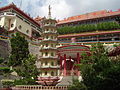
-
 Kapitan Keling Mosque, the largest mosque in the city.
 -
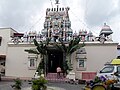
-
 Church of the Assumption, founded after Francis Light landed on Penang Island, considered as the oldest Roman Catholic church in the city.


Languages
English has been the main language for the city community during the British colonial before being changed back to Malay after the formation of Malaysia.[42] Today, Malay is the main language that connecting every different ethnic backgrounds in George Town, with the city Malay was strongly influenced by Tamil speakers; especially for the Jawi Peranakan, it remains distinctly different from the Malay in the southern Malay Peninsula.[18] As the Chinese majority in the city are mainly Hoklo people, the city also has an own variation of Hokkien language called the Penang Hokkien.[43] While the main language spoken by Indian community is Malaysian Tamil dialect of Tamil language in addition to the country's official and national language Malaysian (English is also widely spoken and understood). Besides Tamil, Urdu is also spoken by a small number of Indian Muslims and Telugu as well as Punjabi is also spoken by ethnic Telugu and Punjabi community. However, young people are more interested in speaking English and English-Tamil mixture macaronic language, Tanglish. Ethnic Jawi Peranakan, a Muslim creole ethnic group of mixed Indian, Malay and Arab ancestry with predominantly Indian origin mostly use Malay as their first language in addition to English.[18][44] Another distinct group of Indian Muslims known as Mamak use the Penang Malay (northern slang) variant as their first and daily language.
Economy

Historically, the British established George Town as an entrepôt, where products from Britain and India such as opium, textile, steel, gunpowder, and iron goods, were sold to local merchants to be distributed throughout the Malay Archipelago.[12] Today, the city economy is dominated by the tertiary-based industry as George Town has been one of the centre of medical tourism in Malaysia with an estimated 1,000 tourists travel to the city every day for medical treatment in addition to Penang as the fifth-largest economy amongst the states and federal territories of Malaysia after Selangor, Kuala Lumpur, Johor and Sarawak,[37][45] Most of the patients are come from Sumatra in Indonesia,[15][16] with the sector have generating about 70% of the country medical tourism revenue.[46] In addition, secondary-based industry of manufacturing also take a presence with the city became the hub for electric and electronics manufacturing.[14]

Since 1800s, international banks, chiefly Standard Chartered,[47] HSBC, and the Oversea-Chinese Banking Corporation, have opened branches in the city, with most of the banks still maintain their local headquarters on Beach Street, the historic commercial centre of George Town. Since the formation of Malaysia, more new banks have establish their presence, including ABN AMRO, Citibank, United Overseas Bank, Bank of China[48] and Bank Negara Malaysia (Malaysian central bank) together with other local banks such as the Public Bank, Maybank, Ambank and CIMB Bank.
Transport
The earliest modes of transportation in George Town was the horse hackney carriage which was popular throughout the last quarter of the 18th century until 1935, when the rickshaw gained popularity, until it in turn was rapidly superseded by the trishaw beginning in 1941.
Land

The city has an extensive road network since the British colonial rule. Outside the narrow streets of George Town, more modern roads link the city centre with the surrounding suburbs of Tanjung Tokong, Air Itam, Jelutong and Gelugor. The Jelutong Expressway connects the city to the Penang Bridge, the Bayan Lepas Free Industrial Zone and the Penang International Airport. As for the whole island, it is connected with the Malay Peninsula through the Penang Bridge and the Second Penang Bridge in the south area of the island, linking Batu Maung on the island with Batu Kawan on the mainland.
Public transport

The Rapid Penang is the sole bus company for the island of Penang. Almost every bus connects the city with other parts of the island, with Weld Quay being the main terminal while KOMTAR became the main hub. It is also operates a free daily bus service around the city, taking commuters and tourists on a drive along the heritage sites. Recently, open-air double decker buses, known as Hop-On Hop-Off buses, have been introduced for tourists.[49] Most of the express buses stop at the Sungai Nibong Bus Terminal at the southern suburbs of the city. There are several express bus companies operating round the clock, and the main destinations include Genting Highlands, Kuala Lumpur, Singapore and southern Thailand. Since 2015, the Uber company has been actively engaging customers for taxis services.[50]
George Town also has numerous cycle rickshaws and trishaws plying its streets. As well with rental bicycles, which are being introduced and marketed by several companies in the city.[51] More efforts are now being carried out by the Penang state government to make the city as a cyclists' haven and a pedestrian-friendly city by introducing dedicated cycling lanes.[52] The only rail-based transportation in the city is the Penang Hill Railway, a funicular railway to the top of Penang Hill. Since it was completed in 1923, the railway underwent an extensive upgrading in 2010 and was reopened in early 2011.[53] Since the colonial period, the city has experienced different types of public transportation system with electric trams, trolleybuses and double-decker buses. The first steam tramway started operations in the 1880s, while electrical trams were launched in 1905. Trolleybuses commenced operations in 1925 and they gradually supplanted the trams. The George Town Municipal Transport (GTMT) operated both the trams and the trolleybuses. The GTMT is famous for having operated the smallest public service trolleybuses. In the 1950s, GTMT bought ex-London Transport trolleybuses. Despite having purchased new Sunbeam British trolleybuses in 1956-57, the system was abandoned in 1961.[54] The use of double-decker buses ceased in the 1970s when George Town Transport ceased to trade, the network being taken over by private-owned buses.
In 2015, there is a planning for the return of trams in the streets of George Town,[55] The Light Rail Transit (Penang Rapid Transit) was also proposed to be built from Komtar passing through the Penang International Airport and the suburbs of Air Itam, Paya Terubong and Tanjung Tokong,[56] as well with a cable car project linking Komtar to the Penang Sentral in Butterworth.[56][57]
Air

The Penang International Airport (PEN, ICAO: WMKP) is one of the oldest airports in Malaysia, being opened in 1935 when Penang was governed under Straits Settlements. It serves as the main airport for the northern part of Malaysia. The airport connects the city with major Asian cities of Kuala Lumpur, Singapore, Bangkok, Jakarta, Guangzhou, Taipei and recently with a direct flights to Ho Chi Minh City (Saigon) and Yangon.[58][59] It is also the hub for two Malaysian low-cost carriers of AirAsia and Firefly. As the second busiest Malaysian airport in terms of cargo traffic, it serves as an important cargo hub due to the large presence of multinational factories in the nearby Bayan Lepas Free Trade Zone.
Water

The Port of Penang is one of the major ports of Malaysia with four terminals - one on the city northeastern coast (Swettenham Pier) while three on the mainland Seberang Perai. With Malaysia being one of the largest exporting nations in the world, the Port of Penang plays an important role in the nation's shipping industry, linking the city to more than 200 ports worldwide.[60] The Swettenham Pier Port accommodates cruise ships as cruise tourism is one of the major industries in the city. The port serves as to bring tourists into and out of the city towards other regional destinations of Singapore and Phuket. The Penang Ferry Service connects the city with the half side of Penang of Butterworth on the Malay Peninsula, becoming the convenient mode of transportation for local residents to travelling by sea. It is the oldest ferry service in Malaysia since 1920 with four ferries ply the Penang Strait between George Town and Butterworth daily. Separate ferry services also connect the city with the island of Langkawi of Kedah to the north and the Indonesian city of Medan in Sumatra.

Other utilities
Courts of law and legal enforcement
The city high court complex is located along Light Highway,[61] along with the Sessions and Magistrate Courts.[61] While a court for Sharia law is located on Batu Gantung Road.[62] The Penang Police Contingent Headquarters is located on Penang Road,[63] together with the North East District police headquarters.[64] There are around fourteen police stations and six police substations (Pondok Polis) around the city.[64]
Health care
.jpg)
As George Town is one of the centre for medical tourism in Malaysia, it features many hospitals in both public and private. There are one public hospital, eight publics health clinic[65] and two child and mother health clinics[66] in George Town. The Penang General Hospital is one of the oldest and second largest hospital in Malaysia built in 1812 with around 1,198 beds until present.[67] The Lam Wah Ee Hospital in Jelutong established since 1883 is the oldest and largest private hospital with 700 beds.[68] The Island Hospital near Peel Highway is the second largest private hospital with 300 beds since 1996.[69] The Penang Adventist Hospital is the second oldest private hospital built in 1924, located in Burma Road with 253 beds.[70] The Loh Guan Lye Specialist Centre located in the heart of the city was established in 1975 and has around 273 beds.[71] The Pantai Hospital in Bayan Lepas has 200 beds.[72] The Gleneagles Medical Centre located in Burma Road was opened on 1 July 1973 with just 70 beds before expanding to a total of 132 beds in 1975.[73] Other private hospitals include the Mount Miriam Cancer Hospital in Tanjung Tokong with 40 beds and the Tropicana Medical Centre in Bayan Lepas with 24 beds, both located in the city suburbs.[74][75]
Education
Many government or state schools are available in the city. Some of the secondary schools include Penang Free School, St. Xavier's Institution, St. George's Girls' School, Methodist Boys' School, Sekolah Menengah Kebangsaan Convent Green Lane, Sekolah Menengah Kebangsaan Convent Pulau Tikus and Convent Light Street.[76] There is also Chinese high schools like the Han Chiang High School, Phor Tay High School, Heng Ee High School, Penang Chinese Girls' High School, Convent Datuk Keramat, Chung Ling High School, Chung Hwa Confucian High School. The University of Science, Malaysia has its campus here and the Penang Medical College is known as the main medical college in the city. A number of other colleges and universities also has their campus such as the KDU University College (KDU),[77] SEGi College Penang,[78] Sentral College,[79] Olympia College,[80] INTI University College,[81] along with the state homegrown colleges of Equator Academy of Art and Han Chiang College and university like the Wawasan Open University. Beside that, the Penang Japanese (Supplementary) Saturday School (ペナン補習校, Penan Hoshūkō; PJSS), a supplementary Japanese school, holds its classes in the Moral Uplifting Society of Penang. Opened since January 2012, the Japanese school had six preschool and 25 primary students as of September 2013.[82]
Libraries
The Penang State Library Headquarters is located in Seberang Jaya of Seberang Perai. The city has its branch known as the George Town Branch Library, located in Scotland Road.[83][84] Other libraries or private libraries can be found in schools, colleges, or universities.
Culture and leisure
Attractions and recreational spots
Much of the attractions inside the city area is part of the Penang Heritage Trial.[85][86]
Cultural
As George Town is known as the UNESCO World Cultural Heritage City, there are a number of cultural venues. The Cheong Fatt Tze Mansion is an old mansion located at 14 Leith Street that was built in a traditional Hakka–Teochew architecture. The mansion was erected in the 1880s after a Hakka merchant from China, Cheong Fatt Tze commissioned its construction.[87] Another cultural attraction, the Cheah Kongsi is the first of five Penang Hokkien clan houses. Located in a block beside Khoo Kongsi, the clan house fuses Malay, traditional Straits Chinese and European cultural architectures. It was established in 1873 by Cheah Yam, an immigrant who came from the Sek Tong village in South China.[88] The Clan Jetties is a known Chinese settlements in the city. It was built after the construction of the Quay in 1882 with each jetty representing different clans due to constant rivalry over access and monopoly of work consignments. The jetties total are originally seven but one have destroyed by fire leaving it to six.[89]
Historical

The Fort Cornwallis is the main historical attraction as it is marking the founding of modern George Town city since the establishment by Francis Light. The Old Georgetown Streets is considered as the oldest heritage in Penang where Chinese and Indian cultures are presented. The area is where many Chinese shoplots, narrow roads, historical colonial-era mansions, clan houses, numerous schools, ornate temples and Little India districts are located.[90] Some historical religious buildings include the Kek Lok Si, Kong Hock Keong Temple, Han Jiang Ancestral Temple, Lebuh Aceh Mosque, Kapitan Keling Mosque, Nattukkottai Chettiar Temple, Sri Mahamariamman Temple, Church of the Assumption and the St. George's Church. Other historical attractions such as the Hainanese Mariners’ Lodge was built during the pre-World War II days when 49 Hainanese sailors pooled their resources to set up a common lodge and clubhouse they could stay,[91] while the Millionaire’s Row is used to be a European enclave during the British colonisation.[92]
Leisure and conservation areas
The main leisure attraction in the city is the Penang Botanic Gardens which featuring a lot of flower species and is the oldest gardens in the city. The gardens was establish by an English botanist Charles Curtis in 1884. Another nature attraction is the Penang Butterfly Farm which also showcases other insects and animals like beetles, lizards, frogs and snails.[93] The only main theme park in the city is the SIM Leisure Escape which opened since 2010.[94]
Other attractions


The Jubilee Clock Tower was built in 1897 and named after the Queen Victoria's 1897 Diamond Jubilee. The tower is sixty feet tall, with each foot representing a year of the Queen's 60-year reign. The P. Ramlee House located in P. Ramlee Road is the former house of the late Malaysian actor and singer P. Ramlee and is part of the state heritage.[95] The Penang Road feature a historical views of old shoplots starting from Farquhar Street into Gurdwara Road near the KOMTAR tower which also another attractions in the city.[96] The Penang Islamic Museum that was built in 1860 was once the residence of a powerful Acehnese pepper merchant. Near the Bahang Bay, located the Batik Factory that present cultural events and handicraft exhibitions.[97] The Penang’s Millionaires’ Row is one of two George Town grand heritage mansions together with Soonstead Mansion.[98]
The Penang Street Art in Armenian Street created by Lithuanian-artist Ernest Zacharevic is the main art attractions in the city, with the most popular graffiti featuring a children on a real bicycle and a boy on a real motorcycle.[99] The Penang State Museum and Art Gallery is also one of the oldest building since the British colonial time located in Farquhar Street. The Wonderfood Museum which located in Beach Street is a building where replica food made from synthetics, plastic, silicone and a mix of various chemicals and materials are displayed.[100] The Peranakan Mansion was once belong to Chung Keng Quee, a Kapitan from China who has a great influence to the Peranakan community.[101] The Sun Yat-sen Museum Penang in Armenian Street is another attraction that was known as the Southeast Asian base of progressive Chinese movement, the Tongmenghui. From this base Dr. Sun Yat-sen planned the Xinhai Revolution (Revolution of 1911).[25]
The Old Protestant Cemetery is the oldest Christian cemetery in the city that was maintained by the Penang Heritage Trust. The cemetery once served as a final resting place for a number of British administrators. Less than a mile away, the only Jewish cemetery in Malaysia is located between Burmah Road and Macalister Road behind high walls; the gates are locked most of the time, as the Jewish community in Penang is all but gone.[102]
Shopping

George Town is the main shopping destination in northern Malaysia due to its fast development with many new skyscrapers. While many newest landmarks have started to dominate the city, many centuries-old shophouses are still operating alongside flea markets. Since 2001, the city had a high supply of shophouses. In comparison, shopping complexes in George Town registered the biggest increases in Malaysia.[103] This increase can be seen in the many shopping malls in George Town, such as Gurney Plaza, 1st Avenue and Gurney Paragon. The combination of both old and new creates a unique bustling retail sector in George Town.[104]
Entertainment
There are four cinemas located in the city, with the largest is the Gurney Plaza cinema with 1,618 seats. The cinemas are either owned by Golden Screen Cinemas, TGV Cinemas and Lotus Five Star.
Sports
The city main football stadium, City Stadium has a capacity of around 40,000.[105] The stadium is the home ground of Penang FA.
International relations
Several countries have set up their consulates in George Town, including Australia,[106] Austria,[107] Canada,[107] China,[108] Denmark,[107] Finland,[107] Germany,[107] Indonesia,[109] Japan,[110] Poland,[111] Russia,[107] Sweden,[107] Thailand,[112] and the United Kingdom.[113]
Twin towns – Sister cities
George Town has six sister cities:


See also
Notes
- ^ Excluding the population in the whole administration area of Penang Island City Council, the city stand as the seventh largest city in Malaysia.
- ^ The new cenotaph is built in 11 November 1948 as a replaceable to an earlier cenotaph that have been destroyed by both the Japanese and Allied bombings in World War II.
References
- ^ Mike Aquino (30 August 2012). "Exploring Georgetown, Penang". Asian Correspondent. Retrieved 1 January 2016.
- ^ a b Goh Ban Lee (19 May 2014). "The Penang Island City agenda". The Sun. Retrieved 25 January 2016.
- ^ a b Looi Sue-Chern (24 March 2015). "George Town a city again". The Malaysian Insider. Archived from the original on 26 March 2015. Retrieved 24 January 2016.
{{cite web}}: Unknown parameter|deadurl=ignored (|url-status=suggested) (help) - ^ a b c d e Cavina Lim (25 March 2015). "Penang's first mayor a woman". The Star. Retrieved 24 January 2016.
- ^ "Malaysia Elevation Map (Elevation of George Town)". Flood Map : Water Level Elevation Map. Archived from the original on 16 March 2015. Retrieved 25 September 2015.
{{cite web}}: Unknown parameter|deadurl=ignored (|url-status=suggested) (help) - ^ a b c "Looking for a 2016 vacation? Here are 16 must-see destinations". Los Angeles Times. 26 December 2015. Archived from the original on 1 January 2016. Retrieved 1 January 2016.
{{cite web}}: Unknown parameter|deadurl=ignored (|url-status=suggested) (help) - ^ a b Toni Marie Ford. "Penang Beach Holiday". Tropical Sky. Retrieved 1 January 2016.
- ^ a b c d Usman Haji Yaakob; Nik Norliati Fitri Md Nor (2013). "The Process and Effects of Demographic Transition in Penang, Malaysia" (PDF). School of Humanities. University of Science, Malaysia. pp. 42, 45 6, 9/28. Retrieved 25 January 2016.
- ^ Homi Kharas; Albert Zeufack; Hamdan Majeed (September 2010). "Cities, People & the Economy — A Study on Positioning Penang" (PDF). Khazanah Nasional, World Bank. ThinkCity. pp. 5, 12/105. ISBN 978-983-44193-3-2. Archived from the original (PDF) on 26 January 2016. Retrieved 26 January 2016.
{{cite web}}: Unknown parameter|deadurl=ignored (|url-status=suggested) (help) - ^ Hamdan Abdul Majeed (11 April 2012). "Urban Regeneration : The Case of Penang, Malaysia (Putting Policy into Practice) - The Penang Metropolitan Region (George Town Conurbation)" (PDF). Khazanah Nasional. World Bank. pp. 10/20. Archived from the original (PDF) on 4 January 2016. Retrieved 4 January 2016.
{{cite web}}: Unknown parameter|deadurl=ignored (|url-status=suggested) (help) - ^ a b Wang Gungwu (7 April 2003). Anglo-Chinese Encounters Since 1800: War, Trade, Science and Governance. Cambridge University Press. pp. 121–. ISBN 978-0-521-53413-0.
- ^ a b c d e f Usman Yaakob; Tarmiji Masron; Fujimaki Masami (11 October 2015). "Ninety Years of Urbanization in Malaysia: A Geographical Investigation of Its Trends and Characteristics" (PDF). University of Science, Malaysia and Ritsumeikan University, Japan. Ritsumeikan. pp. 90, 99/23. Archived from the original (PDF) on 25 January 2016. Retrieved 25 January 2016.
{{cite web}}: Unknown parameter|deadurl=ignored (|url-status=suggested) (help) - ^ a b "Eight new sites, from the Straits of Malacca, to Papua New Guinea and San Marino, added to UNESCO's World Heritage List". UNESCO (World Heritage Site). 7 July 2008. Archived from the original on 6 September 2015. Retrieved 8 July 2008.
{{cite web}}: Unknown parameter|deadurl=ignored (|url-status=suggested) (help) - ^ a b Christina Oon Khar Ee; Khoo Suet Leng (2004). "Issues and challenges of a liveable and creative city: The case of Penang, Malaysia" (PDF). Development Planning and Management Programme, School of Social Sciences, University of Science, Malaysia. p. 1/11. ISSN 2180-2491. Archived from the original (PDF) on 26 January 2016. Retrieved 26 January 2016.
{{cite web}}: Unknown parameter|deadurl=ignored (|url-status=suggested) (help) - ^ a b Wardah Fajri (17 February 2014). "Mengapa Pasien Puas Berobat ke Penang?" (in Indonesian). Kompas. Archived from the original on 20 January 2016. Retrieved 20 January 2016.
{{cite web}}: Unknown parameter|deadurl=ignored (|url-status=suggested) (help) - ^ a b "Tamasya ke George Town" (in Indonesian). Aceh Kita. 29 October 2013. Archived from the original on 26 January 2016. Retrieved 26 January 2016.
{{cite web}}: Unknown parameter|deadurl=ignored (|url-status=suggested) (help) - ^ a b Abu Talib Ahmad (10 October 2014). Museums, History and Culture in Malaysia. NUS Press. pp. 233–. ISBN 978-9971-69-819-5.
- ^ a b c Editor Muhammad Haji Salleh (27 August 2015). Early History of Penang (Penerbit USM). Penerbit USM. pp. 39–40. ISBN 978-983-861-657-7.
{{cite book}}:|author=has generic name (help) - ^ a b Ashley Jackson (November 2013). Buildings of Empire. OUP Oxford. pp. 7–. ISBN 978-0-19-958938-8.
- ^ a b c d e f g h i j k l "History of Penang". Penang State Government. 14 September 2008. Archived from the original on 2 January 2016. Retrieved 8 January 2016.
{{cite web}}: Unknown parameter|deadurl=ignored (|url-status=suggested) (help) - ^ a b c "The Penang connection". The Hindu. 18 August 2014. Archived from the original on 8 January 2016. Retrieved 8 January 2016.
{{cite web}}: Unknown parameter|deadurl=ignored (|url-status=suggested) (help) - ^ a b c d Swettenham; Frank Athelstane (1850–1946). "Map to illustrate the Siamese question". W. & A.K. Johnston Limited. University of Michigan Library. Retrieved 9 January 2016.
- ^ a b c d e f Simon Richmond (2010). Malaysia, Singapore & Brunei. Lonely Planet. pp. 177–. ISBN 978-1-74104-887-2.
- ^ Robert K. Home (2013). Of Planting and Planning: The Making of British Colonial Cities. Routledge. pp. 69–. ISBN 978-0-415-54053-7.
- ^ a b c Streets of George Town, Penang. Areca Books. 2007. pp. 5–85. ISBN 978-983-9886-00-9.
- ^ a b Walter Makepeace; Gilbert E. Brooke; Roland St. J. Braddell; John Murray. "One hundred years of Singapore : being some account of the capital of the Straits Settlements from its foundation by Sir Stamford Raffles on the 6th February 1819 to the 6th February 1919". Library Bureau, University of Toronto Libraries. Internet Archive. Retrieved 9 January 2016.
- ^ Jin Seng Cheah (19 February 2013). Penang 500 Early Postcards. Editions Didier Millet. pp. 71–. ISBN 978-967-10617-1-8.
- ^ Ajay Kamalakaran (20 May 2015). "Battle of Penang: When Malay fishermen rescued Russian sailors". Russia Beyond the Headlines. Retrieved 12 January 2016.
- ^ a b c d Alan Warren (2006). Britain's Greatest Defeat: Singapore 1942. A&C Black. pp. 109–. ISBN 978-1-85285-597-0.
- ^ a b Nick Shepley (7 December 2015). Red Sun at War Part II: Allied Defeat in the Far East. Andrews UK Limited. pp. 21–. ISBN 978-1-78166-301-1.
- ^ Salma Nasution Khoo; Alison Hayes; Sehra Yeap Zimbulis (2010). Giving Our Best: The Story of St. George's Girls' School, Penang, 1885-2010. Areca Books. pp. 25–. ISBN 978-967-5719-04-2.
- ^ Paul H. Kratoska (1998). The Japanese Occupation of Malaya: A Social and Economic History. C. Hurst & Co. Publishers. pp. 296–. ISBN 978-1-85065-284-7.
- ^ Kim Hong Tan (2007). 檳榔嶼華人史圖錄 (in Chinese). Areca Books. pp. 123–. ISBN 978-983-42834-7-6.
- ^ a b Himanshu Bhatt (17 December 2014). "Cabinet approves city status for Penang island". The Malaysian Insider. Archived from the original on 2 January 2015. Retrieved 20 January 2016.
{{cite web}}: Unknown parameter|deadurl=ignored (|url-status=suggested) (help) - ^ "List of Parliamentary Elections Parts and State Legislative Assemblies on Every States". Ministry of Information Malaysia. Archived from the original on 18 May 2014. Retrieved 24 January 2016.
{{cite web}}: Unknown parameter|deadurl=ignored (|url-status=suggested) (help) - ^ Hairunnisa Md Arus; Dr. Mohd Effendi Daud; Najihah Remali (13–14 December 2012). "Seminar Teknikal Kebangsaan Gempa Bumi dan Tsunami (Study Area) — Implementing Thematic Indices Combination Technique for Tsunami Vulnerability Mapping in West Coast of Peninsula Malaysia using High-Resolution Imagery" (PDF). Faculty of Engineering and Environment, Tun Hussein Onn University of Malaysia, Penang State Government (in English and Malay). Petaling Jaya, Malaysia: Malaysian Meteorological Department. pp. 7/41. Archived from the original (PDF) on 21 January 2016. Retrieved 21 January 2016.
{{cite web}}: Unknown parameter|deadurl=ignored (|url-status=suggested) (help) - ^ a b Nathaniel Fernandez (26 July 2014). "Making Penang more liveable". The Star. Retrieved 20 January 2016.
- ^ The Penny Cyclopaedia of the Society for the Difussion of Useful Knowledge. Charles Knight. 1840. pp. 400–.
- ^ Tijs Neutens; Philippe de Maeyer (16 October 2009). Developments in 3D Geo-Information Sciences. Springer Science & Business Media. pp. 206–. ISBN 978-3-642-04791-6.
- ^ "Weatherbase — George Town". Weatherbase. Retrieved 18 January 2016.
- ^ Wong Chun Wai (11 October 2015). "Proud of being multiracial". The Star. Retrieved 25 January 2016.
- ^ Dr. Leo Semashko and 75 GHA co-authors from 26 countries (2013). The ABC of Harmony: for World Peace, Harmonious Civilization and Tetranet Thinking: Global Textbook. Lulu.com. pp. 148–. ISBN 978-1-304-11284-2.
{{cite book}}: CS1 maint: numeric names: authors list (link) - ^ Teh Chee Jye; Dr. Lim Yong Long (February 2014). "An Alternative Architectural Strategy to Preserve the Living Heritage and Identity of Penang Hokkien Language in Malaysia" (PDF). International Journal of Humanities and Social Science, Department of Architecture, Faculty of Built Environment. University of Technology, Malaysia. pp. 243, 1/6. Archived from the original (PDF) on 30 January 2016. Retrieved 30 January 2016.
{{cite web}}:|archive-date=/|archive-url=timestamp mismatch; 29 January 2016 suggested (help); Unknown parameter|deadurl=ignored (|url-status=suggested) (help) - ^ Naidu Ratnala Thulaja (13 January 2005). "Jawi Peranakan community". National Library Board. Archived from the original on 18 February 2016. Retrieved 18 February 2016.
{{cite web}}: Unknown parameter|deadurl=ignored (|url-status=suggested) (help) - ^ Imran Hilmy (5 December 2014). "Penang accounts for 50% of medical tourists". The Sun. Retrieved 20 January 2015.
- ^ OECD (29 March 2011). Higher Education in Regional and City Development Higher Education in Regional and City Development: State of Penang, Malaysia 2011. OECD Publishing. pp. 87–. ISBN 978-92-64-08945-7.
- ^ "About Us – Standard Chartered Bank Malaysia Berhad". Standard Chartered. Retrieved 3 January 2011.
- ^ "Bank of China (Malaysia) Berhad". Bank of China. Retrieved 13 September 2014.
- ^ "Free rides as 'Hop-On Hop-Off' starts". The Star. 17 November 2014. Retrieved 21 January 2016.
- ^ Arnold Loh (27 June 2015). "Uber makes presence felt in Penang". The Star. Retrieved 21 January 2016.
- ^ "Bicycle Rentals". Penang State Government. Archived from the original on 21 January 2016. Retrieved 21 January 2016.
{{cite web}}: Unknown parameter|deadurl=ignored (|url-status=suggested) (help) - ^ "Penang tourism: Promoting cycle lanes in urban heritage areas". The Sun. 24 January 2015. Retrieved 21 January 2016.
- ^ "Penang Hill train service to resume next year". Bernama. The Malaysian Insider. 6 October 2010. Archived from the original on 28 April 2015. Retrieved 3 January 2011.
{{cite web}}: Unknown parameter|deadurl=ignored (|url-status=suggested) (help) - ^ Ric Francis; Colin Ganley (2006). Penang Trams, Trolleybuses & Railways: Municipal Transport History, 1880s-1963. Areca Books. pp. 114–. ISBN 978-983-42834-0-7.
- ^ Tan Sin Chow (15 August 2015). "Trams making comeback under RM27bil Penang plan". The Star. Retrieved 15 August 2015.
- ^ a b David Tan (16 April 2015). "First LRT project in Penang next year". The Star. Retrieved 16 April 2015.
- ^ "Penang to ease island's transport woes". The Star/Asia News Network. The Straits Times. 17 April 2015. Retrieved 17 April 2015.
- ^ Looi Sue-Chern (25 January 2016). "After Ho Chi Minh, Yangon, let's have Hong Kong, says Lim". The Malaysian Insider. Archived from the original on 1 February 2016. Retrieved 30 January 2016.
{{cite web}}: Unknown parameter|deadurl=ignored (|url-status=suggested) (help) - ^ N. Trisha (28 January 2016). "First AirAsia plane flies in from Ho Chi Minh City". The Star. Retrieved 30 January 2016.
- ^ ""Market Watch 2010" The Environmental Sector in Malaysia" (PDF). Malaysian-German Chamber of Commerce and Industry. 2010. Archived from the original (PDF) on 24 January 2016. Retrieved 24 January 2016.
{{cite web}}: Unknown parameter|deadurl=ignored (|url-status=suggested) (help) - ^ a b "Hubungi Kami" (in Malay). Penang Law Courts Official Website. Archived from the original on 1 May 2013. Retrieved 13 February 2016.
{{cite web}}: Unknown parameter|deadurl=ignored (|url-status=suggested) (help) - ^ "Penang Syariah Court Directory". E-Syariah Malaysia. Retrieved 13 February 2016.
- ^ "Direktori PDRM (Pulau Pinang)" (in Malay). Royal Malaysia Police. Archived from the original on 12 September 2014. Retrieved 13 February 2016.
{{cite web}}: Unknown parameter|deadurl=ignored (|url-status=suggested) (help) - ^ a b "Direktori PDRM Pulau Pinang - Timur Laut" (in Malay). Royal Malaysia Police. Archived from the original on 13 September 2014. Retrieved 13 February 2016.
{{cite web}}: Unknown parameter|deadurl=ignored (|url-status=suggested) (help) - ^ "Clinics & Doctors in Penang — Clinics in George Town". Penang Travel Tips. Archived from the original on 29 January 2016. Retrieved 29 January 2016.
{{cite web}}: Unknown parameter|deadurl=ignored (|url-status=suggested) (help) - ^ "Senarai Klinik Kerajaan (List of Government Clinics)" (in Malay and English). Ministry of Health, Malaysia. Archived from the original on 29 January 2016. Retrieved 29 January 2016.
{{cite web}}: Unknown parameter|deadurl=ignored (|url-status=suggested) (help) - ^ "Pengenalan (Introduction)" (in Malay and English). Penang General Hospital. Archived from the original on 29 January 2016. Retrieved 29 January 2016.
{{cite web}}: Unknown parameter|deadurl=ignored (|url-status=suggested) (help) - ^ "Specialties & Services (Our Facilities & Services)". Lam Wah Ee Hospital. Archived from the original on 9 February 2016. Retrieved 9 February 2016.
{{cite web}}: Unknown parameter|deadurl=ignored (|url-status=suggested) (help) - ^ "About Us". Island Hospital. Archived from the original on 9 February 2016. Retrieved 9 February 2016.
{{cite web}}: Unknown parameter|deadurl=ignored (|url-status=suggested) (help) - ^ "About Us". Penang Adventist Hospital. Archived from the original on 9 February 2016. Retrieved 9 February 2016.
{{cite web}}: Unknown parameter|deadurl=ignored (|url-status=suggested) (help) - ^ "Services and Facilities Available". Loh Guan Lye Specialist Centre. Archived from the original on 9 February 2016. Retrieved 9 February 2016.
{{cite web}}: Unknown parameter|deadurl=ignored (|url-status=suggested) (help) - ^ "Our History". Pantai Hospitals (Gleneagles Hospitals). Archived from the original on 9 February 2016. Retrieved 9 February 2016.
{{cite web}}: Unknown parameter|deadurl=ignored (|url-status=suggested) (help) - ^ "The History - How It All Began". Gleneagles Penang. Archived from the original on 9 February 2016. Retrieved 9 February 2016.
{{cite web}}: Unknown parameter|deadurl=ignored (|url-status=suggested) (help) - ^ "Mount Miriam Cancer Hospital". Georgetown Penang Attractions. Archived from the original on 9 February 2016. Retrieved 9 February 2016.
{{cite web}}: Unknown parameter|deadurl=ignored (|url-status=suggested) (help) - ^ "Tropicana Medical Centre". Georgetown Penang Attractions. Archived from the original on 9 February 2016. Retrieved 9 February 2016.
{{cite web}}: Unknown parameter|deadurl=ignored (|url-status=suggested) (help) - ^ "SENARAI SEKOLAH MENENGAH DI NEGERI PULAU PINANG (List of Secondary Schools in Penang) – See Penang" (PDF). Educational Management Information System. Archived from the original (PDF) on 16 March 2015. Retrieved 4 August 2015.
{{cite web}}: Unknown parameter|deadurl=ignored (|url-status=suggested) (help) - ^ "Our Campuses". KDU University College. Archived from the original on 18 February 2016. Retrieved 18 February 2016.
{{cite web}}: Unknown parameter|deadurl=ignored (|url-status=suggested) (help) - ^ "About the Campus". SEGi College Penang. Retrieved 18 February 2016.
- ^ "Sentral College Penang (Main Page)". Sentral College Penang. Retrieved 18 February 2016.
- ^ "About Us". Olympia College. Archived from the original on 18 February 2016. Retrieved 19 February 2016.
{{cite web}}: Unknown parameter|deadurl=ignored (|url-status=suggested) (help) - ^ "Campuses (INTI International College Penang)". INTI International University. Retrieved 22 February 2016.
- ^ "ペナン日本人補習授業校 (Penang Japanese Saturday School)" (in Japanese and English). Penang Japanese Saturday School. Archived from the original on 17 January 2016. Retrieved 22 February 2016.
{{cite web}}: Unknown parameter|deadurl=ignored (|url-status=suggested) (help) - ^ "Introduction" (in Malay and English). Penang Public Library Corporation. Archived from the original on 30 January 2016. Retrieved 30 January 2016.
{{cite web}}: Unknown parameter|deadurl=ignored (|url-status=suggested) (help) - ^ "Perpustakaan Cawangan (Libraries Branch)" (in Malay and English). Penang Public Library Corporation. Archived from the original on 30 January 2016. Retrieved 30 January 2016.
{{cite web}}: Unknown parameter|deadurl=ignored (|url-status=suggested) (help) - ^ "Heritage Trail Around George Town". Penang State Government. 27 July 2009. Retrieved 23 February 2016.
- ^ "Penang Heritage Trail". Google Maps. Retrieved 23 February 2016.
- ^ Penny Wong. "Cheong Fatt Tze Mansion in Penang". Penang.ws. Archived from the original on 5 March 2016. Retrieved 5 March 2016.
{{cite web}}: Unknown parameter|deadurl=ignored (|url-status=suggested) (help) - ^ Penny Wong. "Cheah Kongsi in Penang". Penang.ws. Archived from the original on 5 March 2016. Retrieved 5 March 2016.
{{cite web}}: Unknown parameter|deadurl=ignored (|url-status=suggested) (help) - ^ Penny Wong. "Clan Jetties in Penang". Penang.ws. Archived from the original on 5 March 2016. Retrieved 5 March 2016.
{{cite web}}: Unknown parameter|deadurl=ignored (|url-status=suggested) (help) - ^ Penny Wong. "Old Georgetown Streets at Penang". Penang.ws. Archived from the original on 10 March 2016. Retrieved 10 March 2016.
{{cite web}}: Unknown parameter|deadurl=ignored (|url-status=suggested) (help) - ^ Penny Wong. "Hainanese Mariners' Lodge in Penang". Penang.ws. Archived from the original on 10 March 2016. Retrieved 10 March 2016.
{{cite web}}: Unknown parameter|deadurl=ignored (|url-status=suggested) (help) - ^ Penny Wong. "Millionaire's Row in Penang". Penang.ws. Archived from the original on 10 March 2016. Retrieved 10 March 2016.
{{cite web}}: Unknown parameter|deadurl=ignored (|url-status=suggested) (help) - ^ "Penang Butterfly Farm". Penang State Government. 7 June 2012. Archived from the original on 7 April 2016. Retrieved 7 April 2016.
{{cite web}}: Unknown parameter|deadurl=ignored (|url-status=suggested) (help) - ^ Opalyn Mok (5 November 2012). "'Hanging' out with nature". The Malaysian Insider. Archived from the original on 7 November 2012. Retrieved 7 April 2016.
{{cite web}}: Unknown parameter|deadurl=ignored (|url-status=suggested) (help) - ^ "P. Ramlee's Birthplace". National Archives of Malaysia. 9 June 2009. Archived from the original on 5 April 2016. Retrieved 5 April 2016.
{{cite web}}: Unknown parameter|deadurl=ignored (|url-status=suggested) (help) - ^ Penny Wong. "Penang Road". Penang.ws. Archived from the original on 5 April 2016. Retrieved 5 April 2016.
{{cite web}}: Unknown parameter|deadurl=ignored (|url-status=suggested) (help) - ^ Joe Bindloss; Celeste Brash (2008). Kuala Lumpur, Melaka & Penang. Ediz. Inglese. Lonely Planet. pp. 206–. ISBN 978-1-74104-485-0.
- ^ Opalyn Mok (4 September 2014). "Penang's Soonstead Mansion saved from demolition". The Malay Mail. Archived from the original on 5 April 2016. Retrieved 7 April 2016.
{{cite web}}:|archive-date=/|archive-url=timestamp mismatch; 7 April 2016 suggested (help); Unknown parameter|deadurl=ignored (|url-status=suggested) (help) - ^ Trinna Leong (15 June 2012). "No Sticker Lady Here: Malaysia Welcomes a New Banksy". The Wall Street Journal. Retrieved 5 April 2016.
- ^ Opalyn Mok (13 December 2015). "Be warned! A visit to Wonderfood Museum will make you hungry". The Malay Mail. Archived from the original on 2 April 2016. Retrieved 2 April 2016.
{{cite web}}: Unknown parameter|deadurl=ignored (|url-status=suggested) (help) - ^ "Pinang Peranakan Mansion". Penang State Government. 3 September 2009. Archived from the original on 6 April 2016. Retrieved 6 April 2016.
{{cite web}}: Unknown parameter|deadurl=ignored (|url-status=suggested) (help) - ^ Wong Chun Wai (6 July 2013). "The Jewish community in Penang is all but gone leaving only tombs behind". The Star. Retrieved 5 April 2016.
- ^ Lim Yoke Mui; Nurwati Badarulzaman; A. Ghafar Ahmad (20–22 January 2003). "Retail Activity in Malaysia : From Shophouse to Hypermarket" (PDF). School of Housing, Building and Planning, University of Science, Malaysia. Pacific Rim Real Estate Society (PRRES). Archived from the original (PDF) on 24 January 2016. Retrieved 24 January 2016.
{{cite web}}: Unknown parameter|deadurl=ignored (|url-status=suggested) (help) - ^ "Georgetown". University of Science, Malaysia. 19 February 2004. Archived from the original on 24 January 2016. Retrieved 24 January 2016.
{{cite web}}: Unknown parameter|deadurl=ignored (|url-status=suggested) (help) - ^ "Stadiums in Malaysia (Penang City)". World Stadiums. Archived from the original on 27 March 2014. Retrieved 12 February 2016.
{{cite web}}: Unknown parameter|deadurl=ignored (|url-status=suggested) (help) - ^ "Australian Consulate in Penang, Malaysia". Department of Foreign Affairs and Trade (Australia). Retrieved 20 December 2015.
- ^ a b c d e f g "Directory of Consulates". Penang State Government. Archived from the original on 6 January 2016. Retrieved 6 January 2016.
{{cite web}}: Unknown parameter|deadurl=ignored (|url-status=suggested) (help) - ^ Lim Guan Eng (8 October 2013). "The New China's Consulate-General Office In Penang Reflects The Burgeoning Increase In Chinese Arrivals By 50% For Tourism And Business Air Travellers At The Penang International Airport". Penang Chief Minister Office. Archived from the original on 20 December 2015. Retrieved 20 December 2015.
{{cite web}}: Unknown parameter|deadurl=ignored (|url-status=suggested) (help) - ^ "Consulate General of the Republic of Indonesia, Penang". Consulate General of Indonesia, Penang, Malaysia. Retrieved 20 December 2015.
- ^ "Consulate-General of Japan in Penang, Malaysia". Consulate-General of Japan in Penang, Malaysia. Retrieved 20 December 2015.
- ^ "Opening the first Consulate Honorary of the Republic of Poland in West Malaysia". Embassy of the Republic of Poland, Kuala Lumpur. 14 April 2014. Archived from the original on 20 December 2015. Retrieved 20 December 2015.
{{cite web}}: Unknown parameter|deadurl=ignored (|url-status=suggested) (help) - ^ "Royal Thai Consulate-General, Penang, Malaysia". Royal Thai Consulate-General, Penang, Malaysia. Retrieved 20 December 2015.
- ^ "Supporting British nationals in Malaysia". Government of the United Kingdom. Retrieved 20 December 2015.
Working with local partners and honorary representatives in Penang, Langkawi, Kota Kinabalu and Kuching to assist British nationals
- ^ a b c Hans Michelmann (28 January 2009). Foreign Relations in Federal Countries. McGill-Queen's Press - MQUP. pp. 198–. ISBN 978-0-7735-7618-6.
- ^ "Achievements of the Sister City Relationship". Adelaide City Council. Archived from the original on 20 December 2015. Retrieved 20 December 2015.
{{cite web}}: Unknown parameter|deadurl=ignored (|url-status=suggested) (help) - ^ "Malaysia-Xiamen trade volume gets a boost". New Straits Times. 21 November 2001. Retrieved 20 December 2015.
- ^ "Kunjungan Hormat oleh Konsul Jeneral ke atas Walikota Medan" (in Malay). Ministry of Foreign Affairs, Malaysia. 13 September 2012. Archived from the original on 20 December 2015. Retrieved 20 December 2015.
{{cite web}}: Unknown parameter|deadurl=ignored (|url-status=suggested) (help) - ^ "Malaysia: Taipei, Georgetown ink friendship memorandum". Central News Agency. Taiwan News. 29 March 2011. Archived from the original on 20 December 2015. Retrieved 20 December 2015.
{{cite web}}: Unknown parameter|deadurl=ignored (|url-status=suggested) (help) - ^ "Sister Cities Agreement, Georgetown". International Affairs Division, Bangkok Metropolitan Administration. Archived from the original on 20 December 2015. Retrieved 20 December 2015.
{{cite web}}: Unknown parameter|deadurl=ignored (|url-status=suggested) (help) - ^ Natthaphol Wittayarungrote (18 September 2014). "Phuket and Penang become twin cities". Phuket Gazette. Archived from the original on 20 December 2015. Retrieved 20 December 2015.
{{cite web}}: Unknown parameter|deadurl=ignored (|url-status=suggested) (help)
Literature
- Suet Leng Khoo; Narimah Samat; Nurwati Badarulzaman; Sharifah Rohayah Sheikh Dawood The Promise and Perils of the Island City of George Town (Penang) as a Creative City (archive link). Urban Island Studies. (2015).
- Francis, Ric; Ganley, Colin. Penang Trams, Trolleybuses & Railways: Municipal Transport History 1880s–1963. Penang: Areca Books. (2006, 2nd ed. 2012) ISBN 983-42834-0-7.
- Khoo Salma Nasution. More Than Merchants: A History of the German-speaking Community in Penang, 1800s–1940s. Areca Books. (2006). ISBN 978-983-42834-1-4
- Ooi Cheng Ghee. Portraits of Penang: Little India. Areca Books. (2011). ISBN 978-967-5719-05-9
External links
Places adjacent to George Town, Penang | ||||||||||||||||
|---|---|---|---|---|---|---|---|---|---|---|---|---|---|---|---|---|
| ||||||||||||||||


Capital: George Town | |||||||||||||||||||||||||||||||
| Topics | |||||||||||||||||||||||||||||||
| Society | |||||||||||||||||||||||||||||||
| Administrative divisions |
| ||||||||||||||||||||||||||||||

_Logo.png)


| International | |
|---|---|
| National | |
| Geographic | |
| Other | |
