




Robert E. Lee: Difference between revisions
198.54.202.195 (talk) |
m Reverted edits by 198.54.202.195 (talk) to last version by Discordanian |
||
| Line 28: | Line 28: | ||
These were not happy years for Lee, as he did not like to be away from his family for long periods of time, especially as his wife was becoming increasingly ill. Lee came home to see her as often as he could. |
These were not happy years for Lee, as he did not like to be away from his family for long periods of time, especially as his wife was becoming increasingly ill. Lee came home to see her as often as he could. |
||
i like pie |
|||
===Lee as slave holder=== |
===Lee as slave holder=== |
||
Revision as of 12:07, 8 March 2006
- For the author of Inherit the Wind and other works, see Robert Edwin Lee.

Portrait by Julian Vannerson
Robert Edward Lee (January 19, 1807 – October 12, 1870) was a career army officer and the most successful general of the Confederate forces during the American Civil War. He eventually commanded all Confederate armies as general-in-chief. Like Hannibal earlier and Erwin Rommel later, his victories against superior forces in an ultimately losing cause won him enduring fame. After the war, he urged sectional reconciliation, and spent his final years as president of the college that would come to bear his name. Lee remains an iconic figure of the Confederacy to this day.
Early life and career
Robert Edward Lee was born at Stratford Hall Plantation, in Westmoreland County, Virginia, the fourth child of Revolutionary War hero Henry Lee ("Lighthorse Harry") and Anne Hill (née Carter) Lee. He entered the United States Military Academy in 1825. When he graduated (second in his class of 46) in 1829, not only had he attained the top academic record, but he had no demerits, either. He was commissioned as a second lieutenant in the Corps of Engineers.
Engineering, family
Lee served for seventeen months at Fort Pulaski on Cockspur Island, Georgia. In 1831, he was transferred to Fort Monroe at the tip of the Virginia Peninsula and played a major role in the final construction of both Fort Monroe and its opposite, Fort Calhoun. Fort Monroe was completely surrounded by a moat. Fort Calhoun, later renamed Fort Wool, was built on a man-made island across the navigational channel from Old Point Comfort in the middle of the mouth of Hampton Roads. When construction was completed in 1834, Fort Monroe was referred to as the "Gibraltar of Chesapeake Bay."
While he was stationed at Fort Monroe, he married Mary Anna Randolph Custis (1808–1873), the great-granddaughter of Martha Washington, at Arlington House, her parents' home just across from Washington, D.C. They eventually had seven children, three boys and four girls: George Washington Custis, William H. Fitzhugh, Robert Edward, Mary, Annie, Agnes, and Mildred.
Lee served as an assistant in the chief engineer's office in Washington from 1834 to 1837, but spent the summer of 1835 helping to lay out the state line between Ohio and Michigan. In 1837, he got his first important command. As a first lieutenant of engineers, he supervised the engineering work for St. Louis harbor and for the upper Mississippi and Missouri rivers. His work there earned him a promotion to captain. In 1841, he was transferred to Fort Hamilton in New York Harbor, where he took charge of building fortifications. There he served as a vestryman at St. John's Episcopal Church, Fort Hamilton.
Mexican War, West Point, and Texas
Lee distinguished himself in the Mexican War (1846–1848). He was one of Winfield Scott's chief aides in the march from Veracruz to Mexico City. He was instrumental in several American victories through his personal reconnaissance as a staff officer; he found routes of attack that the Mexicans had not defended because they thought the terrain was impassable.
He was promoted to major after the Battle of Cerro Gordo in April, 1847. He also fought at Contreras, Churubusco, and Chapultepec, and was wounded at the latter. By the end of the war, he had been promoted to lieutenant colonel.
After the Mexican War, he spent three years at Fort Carroll in Baltimore harbor, after which he became the superintendent of West Point in 1852. During his three years at West Point, he improved the buildings, the courses, and spent a lot of time with the cadets. Lee's oldest son, George Washington Custis Lee, attended West Point during his tenure. Custis Lee graduated in 1854, first in his class.
In 1855, Lee became Lieutenant Colonel of the 2nd U.S. Cavalry (under the command of Colonel Albert Sidney Johnston) and was sent to the Texas frontier. There he helped protect settlers from attacks by the Apache and the Comanche.
These were not happy years for Lee, as he did not like to be away from his family for long periods of time, especially as his wife was becoming increasingly ill. Lee came home to see her as often as he could.
Lee as slave holder
As a member of the Virginia aristocracy, Lee had lived in close contact with slavery all of his life, but he never held more than about a half-dozen slaves under his own name—in fact, it was not positively known that he had held any slaves at all under his own name until the rediscovery of his 1846 will in the records of Rockbridge County, Virginia, which referred to an enslaved woman named Nancy and her children, and provided for their manumission in case of his death.[1]
However, when Lee's father-in-law, George Washington Parke Custis, died in October 1857, Lee came into a considerable amount of property through his wife, and also gained temporary control of a large population of slaves—sixty-three men, women, and children, in all—as the executor of Custis's will. Under the terms of the will, the slaves were to be freed "in such a manner as to my executors may seem most expedient and proper", with a maximum of five years from the date of Custis's death provided to arrange for the necessary legal details of manumission.[2]
Custis's will was probated on December 7, 1857. Although Robert Lee Randolph, Right Reverend William Meade, and George Washington Peter were named as executors along with Robert E. Lee, the other three men failed to qualify, leaving Lee with the sole responsibility of settling the estate, and with exclusive control over all of Custis's former slaves. Although the will provided for the slaves to be emancipated "in such a manner as to my executors may seem most expedient and proper", Lee found himself in need of funds to pay his father-in-law's debts and repair the properties he had inherited[3]; he decided to make money during the five years that the will had allowed him control of the slaves by working them on his plantation and hiring them out to neighboring plantations and to eastern Virginia (where there were more jobs to be found). The decision caused dissatisfaction among Custis's slaves, who had been given to understand that they were to be made free as soon as Custis died[4]. Lee, with no experience as a large-scale slave-driver, tried to hire an overseer, writing to his cousin "I am no farmer myself & do not expect to be always here. I wish to get an energetic honest farmer, who while he will be considerate & kind to the negroes, will be firm & make them do their duty"[5]. But Lee failed to find a man for the job, and had to take a two-year leave of absence from the army in order to drive the slaves himself.
Lee found the experience frustrating and difficult; the slaves were unhappy and demanded their freedom. In May 1858, Lee wrote to his son Rooney that "I have had some trouble with some of the people. Reuben, Parks & Edward, in the beginning of the previous week, rebelled against my authority--refused to obey my orders, & said they were as free as I was, etc., etc.--I succeeded in capturing them & lodging them in jail. They resisted till overpowered & called upon the other people to rescue them"[6]. Less than two months after they were sent to the Alexandria jail, Lee decided to remove these three men and three female house slaves from Arlington, and sent them down to the slave-trader William Overton Winston in Richmond, to be kept in jail until they could be hired out to "good & responsible" men in Virginia until they were emancipated under the terms of the will at the end of 1862.[7]
In 1859, three of the slaves—Wesley Norris, his sister Mary, and a cousin of theirs—fled for the North, but were captured a few miles from the Pennsylvania border and forced to return to Arlington. On June 24, 1859, the New York Daily Tribune published two anonymous letters (dated June 19, 1859[8] and June 21, 1859[9]), each of which claimed to have heard that Lee had had the Norrises whipped. Wesley Norris himself later stated — in an 1866 interview[10] printed in the National Anti-Slavery Standard — that Lee had the three of them whipped and their lacerated backs rubbed with brine.
Lee sent the Norrises to work on the railroad in Richmond, Virginia and Alabama. Wesley Norris gained his freedom in January 1863 by slipping through the Confederate lines near Richmond, Virginia to Union-controlled territory.[11]
Lee released Custis's other slaves after the end of the five year period in the winter of 1862, filing the deed of manumission on December 29, 1862[12].
Lee's views on slavery
Since the end of the Civil War, it has often been suggested that Lee was in some sense opposed to slavery. In the period following the Civil War and Reconstruction, Lee became a central figure in the Lost Cause interpretation of the war, and as succeeding generations came to look on slavery as a terrible wrong, the idea that Lee had always somehow opposed it helped maintain his stature as a symbol of Southern honor and national reconciliation.
The most common lines of evidence cited [citation needed] in favor of the claim that Lee opposed slavery are: (1) the manumission of Custis's slaves, as discussed above; (2) Lee's 1856 letter[13] to his wife in which he states that "There are few, I believe, in this enlightened age, who will not acknowledge that slavery as an institution is a moral and political evil," and (3) his support, towards the end of the Civil War, for enrolling slaves in the Confederate army, with manumission offered as an eventual reward for good service. Lee gave his public support to this idea two weeks before the war ended, and too late to do any good for the Confederacy.
Critics [citation needed] object that these interpretations mischaracterize Lee's actual statements and actions to imply that he opposed slavery. The manumission of Custis's slaves, for example, is often mischaracterized as Lee's own decision [citation needed], rather than a requirement of Custis's will. Similarly, Lee's letter to his wife is being misrepresented by selective quotation; while Lee does describe slavery as an evil, he immediately goes on to write[14]:
It is useless to expatiate on its disadvantages. I think it however a greater evil to the white man than to the black race, & while my feelings are strongly enlisted in behalf of the latter, my sympathies are more strong for the former. The blacks are immeasurably better off here than in Africa, morally, socially & physically. The painful discipline they are undergoing, is necessary for their instruction as a race, & I hope will prepare & lead them to better things. How long their subjugation may be necessary is known & ordered by a wise Merciful Providence.
— Robert E. Lee, to Mary Anna Lee, December 27, 1856, Quotation
In fact, the main topic of the letter—a comment in approval of a speech by President Franklin Pierce—is not the evils of slavery at all, but rather a condemnation of abolitionism, which Lee condemns as "unlawful & entirely foreign to them & their duty; for which they are irresponsible & unaccountable." Lee suggested that abolitionist criticism of slavery was an "intolerant" attempt to hasten the end of "the painful discipline ... necessary for their instruction as a race," an end which only God could properly determine:
While we see the Course of the final abolition of human Slavery is onward, & we give it the aid of our prayers & all justifiable means in our power, we must leave the progress as well as the result in his hands who sees the end; who Chooses to work by slow influences; & with whom two thousand years are but as a Single day. Although the Abolitionist must know this, & must See that he has neither the right or power of operating except by moral means & suasion, & if he means well to the slave, he must not Create angry feelings in the Master; that although he may not approve the mode which it pleases Providence to accomplish its purposes, the result will nevertheless be the same; that the reasons he gives for interference in what he has no Concern, holds good for every kind of interference with our neighbors when we disapprove their Conduct; Still I fear he will persevere in his evil Course. Is it not strange that the descendants of those pilgrim fathers who Crossed the Atlantic to preserve their own freedom of opinion, have always proved themselves intolerant of the Spiritual liberty of others?
— Robert E. Lee, to Mary Anna Lee, December 27, 1856
Suppression of the Harper's Ferry uprising and capture of John Brown
Lee happened to be in Washington at the time of John Brown's raid on the federal arsenal at Harpers Ferry, Virginia (now West Virginia) in October 1859. He was summoned by the Secretary of War on October 17, informed of that a slave uprising was taking place in Virginia, and given command of detachments of Maryland and Virginia militia, soldiers from Fort Monroe, and United States Marines, to suppress the uprising and arrest its leaders. Lieutenant J.E.B. Stuart, who happened to be in Washington at the time on business, was allowed to accompany Lee on his mission.[15] By the time Lee arrived later that night, the militia on the site had penned Brown and his supporters up in the fire-engine house at the armory with several white hostages they had taken from slave-holding families in the area. Lee surrounded the house with troops and sent Stuart to deliver a demand for immediate surrender early in the morning on October 18. When Brown refused and demanded safe passage out of the town as a condition for releasing the hostages, Stuart signalled Lee and Lee sent the marines to storm the fire-engine house. About three minutes later, the raid was over, with two marines shot and four of Brown's party dead. Brown himself was badly wounded and captured.
Lee participated in the interrogation of Brown later that day, and turned Brown and his party over to the state of Virginia on October 19. Lee returned home briefly, then was ordered back to Harper's Ferry in late November, to command a detachment of federal troops to protect the arsenal from any further attempts. On December 9, a week after Brown was hanged, Lee received orders to return home. He testified before the Senate hearings on the raid, and then returned to his regiment on February 10, 1860[16]. When Texas seceded from the Union in 1861, Lee was called back to Washington, D.C., to wait for further orders.
Civil War
On April 18, 1861, on the eve of the American Civil War, President Abraham Lincoln, through Secretary of War Simon Cameron, offered Lee command of the United States Army (Union Army) through an intermediary, Maryland Republican politician Francis P. Blair, at the home of Blair's son Montgomery, Lincoln's Postmaster-General, in Washington. Lee's sentiments were against secession, which he denounced in an 1861 letter as "nothing but revolution" and a betrayal of the efforts of the Founders. However his loyalty to his native Virginia led him to join the Confederacy.
At the outbreak of war, he was first appointed to command all of Virginia's forces and then as one of the first five full generals of Confederate forces. Lee, however, refused to wear the insignia of a Confederate General stating that, in honor to his rank of Colonel in the United States Army, he would only display the three stars of a Confederate Colonel until the Civil War had been won and Lee could be promoted, in peacetime, to a General in the Confederate Army.
After commanding Confederate forces in western Virginia, and then the coastal defenses along the Carolina seaboards, he became military adviser to Jefferson Davis, president of the Confederacy, whom he knew from West Point.
Commander, Army of Northern Virginia
In the spring of 1862, during the Peninsula Campaign, the Union Army of the Potomac under General George B. McClellan advanced upon Richmond from Fort Monroe, eventually reaching the eastern edges of the Confederate capital along the Chickahominy River. Following the wounding of Gen. Joseph E. Johnston at the Battle of Seven Pines, on June 1, 1862, Lee assumed command of the Army of Northern Virginia, his first opportunity to lead an army in the field. Newspaper editorials of the day objected to his appointment due to concerns that Lee would not be aggressive and would wait for the Union army to come to him. He oversaw substantial strengthening of Richmond's defenses during the first three weeks of June and then launched a series of attacks, the Seven Days Battles, against McClellan's forces. Lee's attacks resulted in heavy Confederate casualties and they were marred by clumsy tactical performances by his subordinates, but his aggressive actions unnerved McClellan, who retreated to a point on the James River where Union naval forces were in control. These successes led to a rapid turn-around of public opinion and the newspaper editorials quickly changed their tune on Lee's aggressiveness.
After McClellan's retreat, Lee defeated another Union army at the Second Battle of Bull Run. He then invaded Maryland, hoping to replenish his supplies and possibly influence the Northern elections that fall in favor of ending the war. McClellan obtained a lost order that revealed Lee's plans and brought superior forces to bear at Antietam before Lee's army could be assembled. In the bloodiest day of the war, Lee withstood the Union assaults, but withdrew his battered army back to Virginia.
Disappointed by McClellan's failure to destroy Lee's army, Lincoln named Ambrose Burnside as commander of the Army of the Potomac. Burnside ordered an attack across the Rappahannock River at Fredericksburg. Delays in getting bridges built across the river allowed Lee's army ample time to organize strong defenses, and the attack on December 12, 1862, was a disaster for the Union. Lincoln then named Joseph Hooker commander of the Army of the Potomac. Hooker's advance to attack Lee in May, 1863, near Chancellorsville, Virginia, was defeated by Lee and Stonewall Jackson's daring plan to divide the army and attack Hooker's flank. It was an enormous victory over a larger force, but came at a great cost as Jackson, Lee's best subordinate, was gravely wounded and died soon after from contracted pneumonia.
In the summer of 1863, Lee proceeded to invade the North again, hoping for a Southern victory that would compel the North to grant Confederate independence. But his attempts to defeat the Union forces under George G. Meade at Gettysburg, Pennsylvania, failed. His subordinates did not attack with the aggressive drive Lee expected, J.E.B. Stuart's cavalry was out of the area, and Lee's decision to launch a massive frontal assault on the center of the Union line—the disastrous Pickett's Charge—resulted in heavy Confederate losses. Lee was compelled to retreat again but, as after Antietam, was not vigorously pursued by Union forces. Following his defeat at Gettysburg, Lee sent a letter of resignation to Confederate President Jefferson Davis on August 8, 1863, but Davis refused Lee's request.
In 1864, the new Union general-in-chief Ulysses S. Grant sought to destroy Lee's army and capture Richmond. Lee and his men stopped each advance, but Grant had superior reinforcements and kept pushing each time a bit farther to the southeast. These battles in the Overland Campaign included the Wilderness, Spotsylvania Court House, and Cold Harbor. Grant eventually fooled Lee by stealthily moving his army across the James River. After stopping a Union attempt to capture Petersburg, Virginia, a vital railroad link supplying Richmond, Lee's men built elaborate trenches and were besieged in Petersburg. He attempted to break the stalemate by sending Jubal A. Early on a raid through the Shenandoah Valley to Washington, D.C., but Early was defeated by the superior forces of Philip Sheridan. The Siege of Petersburg would last from June 1864 until April, 1865.
General-in-chief

On January 31, 1865, Lee was promoted to general-in-chief of Confederate forces. In early 1865, he urged adoption of a plan to allow slaves to join the Confederate army in exchange for their freedom. The scheme never came to fruition in the short time the Confederacy had left before it ceased to exist.
As the Confederate army was worn down by months of battle, a Union attempt to capture Petersburg on April 2, 1865, succeeded. Lee abandoned the defense of Richmond and sought to join General Joseph Johnston's army in North Carolina. His forces were surrounded by the Union army and he surrendered to General Grant on April 9, 1865, at Appomattox Court House, Virginia. Lee resisted calls by some subordinates (and indirectly by Jefferson Davis) to reject surrender and allow small units to melt away into the mountains, setting up a lengthy guerrilla war.
After the War
.jpg)
Following the war, Lee applied for, but was never granted, the official postwar amnesty. After filling out the application form, it was delivered to the desk of Secretary of State William H. Seward, who, assuming that the matter had been dealt with by someone else and that this was just a personal copy, filed it away until it was found decades later in his desk drawer. Lee took the lack of response to mean that the government wished to retain the right to prosecute him in the future.
Lee's example of applying for amnesty encouraged many other former members of the Confederacy's armed forces to accept restored U.S. citizenship. In 1975, President Gerald Ford granted a posthumous pardon and the U.S. Congress restored his citizenship, following the discovery of his oath of allegiance by an employee of the National Archives in 1970.
Lee and his wife had lived at his wife's family home prior to the Civil War, the Custis-Lee Mansion. It was confiscated by Union forces, and is today part of Arlington National Cemetery. After his death, the courts ruled that the estate had been illegally seized, and that it should be returned to Lee's son. The government offered to buy the land outright, to which the family agreed.
Lee served as president of Washington College (now Washington and Lee University) in Lexington, Virginia, from October 2, 1865. Over five years, he transformed Washington College from a small, undistinguished school into one of the first American colleges to offer courses in business, journalism, and Spanish. He also imposed a sweeping and breathtakingly simple concept of honor — "We have but one rule, and it is that every student is a gentleman" — that endures today at Washington and Lee and at a few other schools that continue to maintain "honor systems." Importantly, Lee focused the college on attracting male students from the North as well as the South. The college, like most in the United States at the time, remained racially segregated. After John Chavis, admitted in 1795, Washington (or Washington and Lee) would not admit a second black student until 1966.
Final illness and death

On the evening of September 28, 1870, Lee fell ill, unable to speak coherently. When his doctors were called, the most they could do was help put him to bed and hope for the best. It is almost certain that Lee had suffered a stroke. The stroke damaged the frontal lobes of the brain, which made speech impossible. He was force-fed to keep up his strength, but he developed aspiration pneumonia, a common side effect of improper force feeding. Lee died from the effects of pneumonia, two weeks after the stroke on the morning of October 12, 1870, in Lexington, Virginia, and was buried underneath Lee Chapel at Washington and Lee University, where his body remains today. According to legend his last words were "Strike the Tent."
Trivia
- According to J. William Jones. Personal Reminiscences, Anecdotes, and Letters of Gen. Robert E. Lee, Lee spoke his last words on October 12, 1870, shortly before his death: "Tell Hill he must come up. Strike the Tent."
- The birth of Robert E. Lee is celebrated in the state of Virginia as part of Lee-Jackson Day, which was separated from the Martin Luther King, Jr. holiday there in 2001. The King holiday falls on the third Monday in January while the Lee-Jackson Day holiday is celebrated on the Friday preceding it. The state of Texas celebrates Confederate Heroes Day on January 19, Lee's actual birthday. The states of Alabama, Arkansas and Mississippi honor Lee's birthday along with Martin Luther King, Jr. on the third Monday in January. The state of Georgia observes Lee's birthday on the day after Thanksgiving.
- Traveller, Lee's favorite horse, accompanied Lee to Washington College after the war. He lost many hairs from his tail to admirers who wanted a souvenir of the famous horse and his general. In 1870, when Lee died, Traveller was led behind the General's hearse. Not long after Lee's death, Traveller stepped on a rusty nail and developed lockjaw. There was no cure, and he was shot. He was buried next to the Lee Chapel at Washington and Lee University. In 1907, his remains were disinterred and displayed at the Chapel, before being reburied outside the Lee Chapel in 1971.
- The General Lee, the souped-up 1969 Dodge Charger used in the television program in 1979 The Dukes of Hazzard and the 2005 The Dukes of Hazzard (film) was named after Robert E. Lee.
- A famous Mississippi River steamboat was named for Lee after the Civil War.
- Despite his presidential pardon by Gerald Ford and his continuing to being held in high regard by many Americans, Lee's portrayal on a mural on Richmond's Flood Wall on the James River was offensive to some, including some African-Americans, and was removed in the 1990s as part of a campaign to delegitimize the Confederate heritage of the South.
- Robert E. Lee was 5' 11" tall and wore a size 4-1/2 boot, equivalent to a modern 6-1/2 boot.
- In the movie Gods and Generals, Lee was played by actor Robert Duvall, who is descended from Lee.
- Two relatives of Lee were naval officers on opposing sides in the Civil War: Richard Lucian Page (Confederate States Navy and later a brigadier general in the Confederate States Army) and Samuel Phillips Lee (U.S. Navy Captain).
- A distant cousin was Confederate General Edwin Gray Lee, a son-in-law of William N. Pendleton.
- After the war Lee had financial difficulties. A Virginia insurance company offered Lee $10,000 to use his name, but he declined the offer, relying wholly on his university salary.[17]
Monuments and memorial
A number of geographic locations are named in Robert E. Lee's honor:
- Lee County, Alabama; Lee County, Arkansas; Lee County, Florida; Lee County, Kentucky; Lee County, Mississippi; Lee County, North Carolina; Lee County, South Carolina; and Lee County, Texas.
- The Leesville half of Batesburg-Leesville, South Carolina.
- Fort Lee in Prince George County, Virginia.
- Lee Highway, a National Auto Trail in the United States connecting New York City and San Francisco, California via the South and Southwest.
Arlington House, also known as the Custis-Lee Mansion and located in present-day Arlington National Cemetery, is maintained by the National Park Service as a memorial to the family.
A large, beautiful equestrian statue of Lee by French sculptor Jean Antonin Mercié is the centerpiece of Richmond, Virginia's famous Monument Avenue, which boasts four other statues to famous Confederates. This impressive monument to Lee was unveiled on May 29, 1890. Over 100,000 people attended this dedication.
The Virginia State Memorial at Gettysburg Battlefield is topped by an equestrian statue of Lee by Frederick William Sievers, facing roughly in the direction of Pickett's Charge.
In 1900, Lee was one of the first 29 individuals selected for the Hall of Fame for Great Americans (the first Hall of Fame in the United States), designed by Stanford White, on the Bronx, New York, campus of New York University, now a part of Bronx Community College.
-
 Robert Edward Lee, as a U.S. Army Colonel before the Civil War
 -
 Robert E Lee Monument, Charlottesville, VA, Leo Lentilli, sculptor, 1924
 -
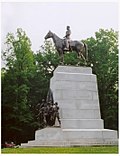 Robert E Lee, Virginia Monument, Gettysburg, PA, William Sievers, sculptor, 1917
 -
 Lee by Mercié, Monument Avenue, Richmond, Virginia, 1890


References
- Blassingame, John W (ed.) (1977), Slave Testimony: Two Centuries of Letters, Speeches, and Interviews, and Autobiographies. Baton Rouge: Louisiana State University Press (ISBN 0807102733).
- Eicher, John H., & Eicher, David J. (2001), Civil War High Commands, Stanford University Press (ISBN 0804736413).
- Fellman, Michael (2000), The Making of Robert E. Lee. New York: Random House (ISBN 0679456503).
- Freeman, Douglas S. (1934), R. E. Lee, A Biography (4 volumes), Scribners..
- Fuller, Maj. Gen. J. F. C. (1957), Grant and Lee, A Study in Personality and Generalship, Indiana University Press (ISBN 0253134005).
- Warner, Ezra J. (1959), Generals in Gray: Lives of the Confederate Commanders, Louisiana State University Press (ISBN 0807108235).
Notes
- ^ George Washington Parke Custis's Will Memo
- ^ Will of George Washington Parke Custis
- ^ Freeman 1934, Vol. I, p. 381.
- ^ Testimony of Wesley Norris, National Anti-Slavery Standard, April 14, 1866. Reprinted in Blassingame 1977, pp. 467-468.
- ^ Robert E. Lee to Edward C. Turner, Arlington, February 13, 1858. Alderman Library, University of Virginia, Charlottesville. Quoted in Fellman 2000, p. 65.
- ^ Robert E. Lee to William Henry Fitzhugh ("Rooney") Lee, Arlington, May 30, 1858, Virginia Historical Society, Richmond. Quoted in Fellman 2000, p. 65.
- ^ Fellman 2000, pp. 65–66.
- ^ Anonymous letter to the New York Tribune (dated June 19). New York Daily Tribune June 24, 1859, p. 6. Cf. Freeman 1934, p. 393.
- ^ "Some Facts That Should Come To Light," anonymous letter to the New York Tribune (dated June 21). New York Daily Tribune June 24, 1859, p. 6. Cf. Freeman 1934, pp. 390-393.
- ^ Testimony of Wesley Norris, National Anti-Slavery Standard, April 14, 1866. Reprinted in Blassingame 1977, pp. 467-468.
- ^ Ibid
- ^ Freeman 1934, Vol. I, p. 476.
- ^ Robert E. Lee to Mary Anna Lee, December 27, 1857. Reprinted in Freeman 1934, Vol. I, pp. 371-373.
- ^ Ibid
- ^ Freeman 1934, Vol. I, pp. 394-395.
- ^ Ibid, pp. 403-404.
- ^ Freeman 1934, Vol. IV, p. 244.
External links
- Lee Chapel at Washington and Lee University where Robert E. Lee is buried
- Notice of Robert E. Lee's Assignment to Command of Confederate Forces on the Coast of South Carolina, Georgia and Florida, 1861 From the State Library & Archives of Florida.
- Obituary of Robert E. Lee, with a retrospective from a Northern point of view. The New York Times; October 13, 1870