







Calaveras County, California
Calaveras County | |
|---|---|
 Flag  Seal | |
 Interactive map of Calaveras County | |
| Country | United States |
| State | California |
| Regions | Sierra Nevada, Gold Country |
| Incorporated | February 18, 1850[5] |
| Named after | Spanish word meaning "skulls" |
| County seat | San Andreas |
| Largest community | Rancho Calaveras (population) Mountain Ranch (area) |
| Government | |
| • Type | Council–CAO |
| • Body | Board of Supervisors[2] |
| • Chair | Martin Huberty |
| • Vice Chair | Benjamin Stopper |
| • Board of Supervisors[2] | Supervisors
|
| • County Administrative Officer[3] | Crista Voh Latta |
| Area | |
• Total | 1,037 sq mi (2,690 km2) |
| • Land | 1,020 sq mi (2,600 km2) |
| • Water | 17 sq mi (44 km2) |
| Highest elevation | 8,174 ft (2,491 m) |
| Population (2020) | |
• Total | 45,292 |
| • Density | 44.4/sq mi (17.1/km2) |
| GDP | |
| • Total | $1.642 billion (2022) |
| Time zone | UTC−08:00 (Pacific Time Zone) |
| • Summer (DST) | UTC−07:00 (Pacific Daylight Time) |
| Area code | 209 |
| FIPS code | 06-009 |
| GNIS feature ID | 1675885 |
| Congressional district | 5th |
| Website | calaverasgov |
_(cropped).jpg)
.jpg)


Calaveras County (Calaveras, Spanish for "Skulls"; /ˌkæləˈvɛrəs/ ⓘ), officially the County of Calaveras, is a county in both the Gold Country and High Sierra regions of the U.S. state of California. As of the 2020 census, the population was 45,292.[6] The county seat is San Andreas.[7] Angels Camp is the county's only incorporated city. The county was reportedly named for the remains of Native Americans discovered by the Spanish explorer Captain Gabriel Moraga in 1806.
Calaveras Big Trees State Park, a preserve of giant sequoia trees, is in the county several miles east of the town of Arnold on State Highway 4. Credit for the discovery of giant sequoias there is given to Augustus T. Dowd, a trapper who made the discovery in 1852 while tracking a bear. When the bark from the "Discovery Tree" was removed and taken on tour around the world, the trees became a worldwide sensation and one of the county's first tourist attractions. The uncommon gold telluride mineral calaverite was discovered in the county in 1861 and is named for it.
Mark Twain set his story "The Celebrated Jumping Frog of Calaveras County" in the county. The county hosts an annual fair and Jumping Frog Jubilee, featuring a frog-jumping contest, to celebrate the association with Twain's story. Each year's winner is commemorated with a brass plaque mounted in the sidewalk of downtown Historic Angels Camp and this feature is known as the Frog Hop of Fame. Lukas Foss used Twain's story for his 1950 opera The Jumping Frog of Calaveras County.
In 2015, Calaveras County had the highest rate of suicide deaths in the United States, with 49.1 per 100,000 people.[8]
Etymology
The Spanish word calaveras means "skulls." The county takes its name from the Calaveras River; it was said to have been named by Spanish explorer Gabriel Moraga, during his 1806–1808 expeditions, when he found many skulls of Native Americans along the banks of the stream. He believed they had either died of famine or been killed in tribal conflicts over hunting and fishing grounds. A more likely cause was a European epidemic disease, acquired from interacting with other tribes near the Missions on the coast. The Stanislaus River, which forms the southern boundary, is named for Estanislao, a Lakisamni Yokuts who escaped from Mission San José in the late 1830s. He is reported to have raised a small group of men with crude weapons, hiding in the foothills when the Mexicans attacked. The natives were quickly decimated by Mexican firearms.
In 1836, John Marsh, Jose Noriega, and a party of men went exploring in Northern California. They made camp along a river bed in the evening, and upon waking discovered that they had camped amid a great quantity of skulls and bones. They also gave the river the name Calaveras.[9][10][11]
Mark Twain spent 88 days in the county in 1865, during which he heard the story that became "The Celebrated Jumping Frog of Calaveras County" at the Angel Hotel. This story kicked off his career and put Calaveras County on the map.[12]
History
Calaveras County was one of the original counties of the state of California, created in 1850 at the time of admission to the Union. Parts of the county's territory were reassigned to Amador County in 1854 and to Alpine County in 1864.[5]
The county's geography includes landmarks, rolling hills, and giant valleys. It is also known for its friendly communities, and businesses such as agriculture management and construction engineering. It has numerous caverns, such as Mercer Caverns, California Cavern and Moaning Cavern that are national destinations for tourists from across the country. Other attractions include a thriving wine making industry, including the largest of the Calaveras wineries: Ironstone Vineyards, mountain sports recreation and the performing arts.
Gold prospecting in Calaveras County began in late 1848 with a camp founded by Henry Angel. Angel may have first arrived in California as a soldier, serving under Colonel Frémont during the Mexican War. After the war's end, he found himself in Monterey where he heard of the fabulous finds in the gold fields. He joined the Carson-Robinson party of prospectors and set out for the mines. The company parted ways upon reaching what later became known as Angels Creek. Henry Angel tried placer mining but soon opened a trading post. By the end of the year, over one hundred tents were scattered about the creek and the settlement was referred to as Angels Trading Post, later shortened to Angels Camp.
Placer mining soon gave out around the camp, but an extensive gold-bearing quartz vein of the area's Mother Lode was located by the Winter brothers during the mid-1850s, and this brought in the foundations of a permanent town. This vein followed Main Street from Angels Creek up to the southern edge of Altaville. Five major mines worked the rich vein: the Stickle, the Utica, the Lightner, the Angels, and the Sultana. These mines reached their peaks during the 1880s and 1890s, when over 200 stamp mills crushed quartz ore brought in by hand cars on track from the mines. By the time hard rock mining was done, the five mines had produced a total of over $20 million in gold.[13]
In December 1849 and January 1850 the county was the site of "Chile War of 1849" in which Anglo-American and Chilean miners raided each others camp and fought a legal battle. The conflict ended with three Chileans publicly executed in Mokelumne Hill on January 3, 1850.[14][15]
The telluride mineral calaverite was first recognized and obtained in 1861 from the Stanislaus Mine, Carson Hill, Angels Camp, in Calaveras Co., California.[16] It was named for the County of origin by chemist and mineralogist Frederick Augustus Genth who differentiated it from the known gold telluride mineral sylvanite, and formally reported it as a new gold mineral in 1868.[17][18]
Geography

According to the U.S. Census Bureau, the county has a total area of 1,037 square miles (2,690 km2), of which 1,020 square miles (2,600 km2) is land and 17 square miles (44 km2) (1.6%) is water.[19] A California Department of Forestry report lists the county's area in acres as 663,000, although the exact figure would be 663,477.949 acres (2,685.00000 km2). There are a number of caverns located in Calaveras County.
Adjacent counties
- Amador County – north
- Alpine County – northeast
- Tuolumne County – south
- Stanislaus County – southwest
- San Joaquin County – west
National protected area
- Stanislaus National Forest (part)
Demographics
| Census | Pop. | Note | %± |
|---|---|---|---|
| 1850 | 16,884 | — | |
| 1860 | 16,299 | −3.5% | |
| 1870 | 8,895 | −45.4% | |
| 1880 | 9,094 | 2.2% | |
| 1890 | 8,882 | −2.3% | |
| 1900 | 11,200 | 26.1% | |
| 1910 | 9,171 | −18.1% | |
| 1920 | 6,183 | −32.6% | |
| 1930 | 6,008 | −2.8% | |
| 1940 | 8,221 | 36.8% | |
| 1950 | 9,902 | 20.4% | |
| 1960 | 10,289 | 3.9% | |
| 1970 | 13,585 | 32.0% | |
| 1980 | 20,710 | 52.4% | |
| 1990 | 31,998 | 54.5% | |
| 2000 | 40,554 | 26.7% | |
| 2010 | 45,578 | 12.4% | |
| 2020 | 45,292 | −0.6% | |
| 2024 (est.) | 46,505 | [20] | 2.7% |
| U.S. Decennial Census[21] 1790–1960[22] 1900–1990[23] 1990–2000[24] 2010[25] 2020[26] | |||
2020 census
As of the 2020 census, the county had a population of 45,292. The median age was 51.6 years. 17.6% of residents were under the age of 18 and 28.2% of residents were 65 years of age or older. For every 100 females there were 101.0 males, and for every 100 females age 18 and over there were 99.6 males age 18 and over.[27]
The racial makeup of the county was 80.2% White, 0.8% Black or African American, 1.6% American Indian and Alaska Native, 1.6% Asian, 0.2% Native Hawaiian and Pacific Islander, 4.4% from some other race, and 11.1% from two or more races. Hispanic or Latino residents of any race comprised 12.9% of the population.[28]
18.0% of residents lived in urban areas, while 82.0% lived in rural areas.[29]
There were 18,758 households in the county, of which 23.1% had children under the age of 18 living with them and 22.1% had a female householder with no spouse or partner present. About 25.7% of all households were made up of individuals and 14.8% had someone living alone who was 65 years of age or older.[27]
There were 27,422 housing units, of which 31.6% were vacant. Among occupied housing units, 79.0% were owner-occupied and 21.0% were renter-occupied. The homeowner vacancy rate was 2.8% and the rental vacancy rate was 6.5%.[27]
Racial and ethnic composition
| Race / Ethnicity (NH = Non-Hispanic) | Pop 1980[30] | Pop 1990[31] | Pop 2000[32] | Pop 2010[25] | Pop 2020[26] | % 1980 | % 1990 | % 2000 | % 2010 | % 2020 |
|---|---|---|---|---|---|---|---|---|---|---|
| White alone (NH) | 19,271 | 29,288 | 35,465 | 38,074 | 34,668 | 93.05% | 91.53% | 87.45% | 83.54% | 76.54% |
| Black or African American alone (NH) | 72 | 180 | 300 | 355 | 334 | 0.35% | 0.56% | 0.74% | 0.78% | 0.74% |
| Native American or Alaska Native alone (NH) | 319 | 606 | 607 | 526 | 497 | 1.54% | 1.89% | 1.50% | 1.15% | 1.10% |
| Asian alone (NH) | 73 | 187 | 322 | 529 | 706 | 0.35% | 0.58% | 0.79% | 1.16% | 1.56% |
| Native Hawaiian or Pacific Islander alone (NH) | x | x | 36 | 71 | 75 | x | x | 0.09% | 0.16% | 0.17% |
| Other race alone (NH) | 64 | 23 | 40 | 68 | 268 | 0.31% | 0.07% | 0.10% | 0.15% | 0.59% |
| Mixed race or Multiracial (NH) | x | x | 1,019 | 1,252 | 2,879 | x | x | 2.51% | 2.75% | 6.36% |
| Hispanic or Latino (any race) | 911 | 1,714 | 2,765 | 4,703 | 5,865 | 4.40% | 5.36% | 6.82% | 10.32% | 12.95% |
| Total | 20,710 | 31,998 | 40,554 | 45,578 | 45,292 | 100.00% | 100.00% | 100.00% | 100.00% | 100.00% |
2010 census
The 2010 United States census reported that Calaveras County had a population of 45,578. The racial makeup of Calaveras County was 40,522 (88.9%) White, 383 (0.8%) African American, 689 (1.5%) Native American, 571 (1.3%) Asian, 79 (0.2%) Pacific Islander, 1,534 (3.4%) from other races, and 1,800 (3.9%) from two or more races. Hispanic or Latino of any race were 4,703 persons (10.3%).[33]
| Population reported at 2010 United States census | |||||||||
|---|---|---|---|---|---|---|---|---|---|
The County |
Total Population |
two or more races |
|||||||
| Calaveras County | 45,578 | 40,522 | 383 | 689 | 571 | 79 | 1,534 | 1,800 | 4,703 |
Total Population |
two or more races |
||||||||
| Angels Camp | 3,836 | 3,329 | 12 | 48 | 49 | 5 | 270 | 123 | 498 |
Total Population |
two or more races |
||||||||
| Arnold | 3,843 | 3,590 | 20 | 28 | 46 | 3 | 60 | 96 | 259 |
| Avery | 646 | 604 | 5 | 7 | 3 | 1 | 2 | 24 | 38 |
| Copperopolis | 3,671 | 3,318 | 31 | 43 | 36 | 12 | 83 | 148 | 454 |
| Dorrington | 609 | 576 | 0 | 2 | 11 | 1 | 1 | 18 | 33 |
| Forest Meadows | 1,249 | 1,198 | 0 | 4 | 14 | 0 | 7 | 26 | 60 |
| Mokelumne Hill | 646 | 571 | 3 | 12 | 4 | 0 | 26 | 30 | 66 |
| Mountain Ranch | 1,628 | 1,472 | 15 | 33 | 18 | 2 | 15 | 73 | 123 |
| Murphys | 2,213 | 2,045 | 9 | 17 | 7 | 10 | 82 | 43 | 223 |
| Rail Road Flat | 475 | 411 | 0 | 15 | 4 | 2 | 9 | 34 | 41 |
| Rancho Calaveras | 5,325 | 4,645 | 48 | 102 | 87 | 13 | 195 | 235 | 670 |
| San Andreas | 2,783 | 2,453 | 23 | 48 | 28 | 1 | 83 | 147 | 255 |
| Vallecito | 442 | 398 | 0 | 6 | 11 | 1 | 5 | 21 | 33 |
| Valley Springs | 3,553 | 3,047 | 35 | 39 | 70 | 6 | 179 | 177 | 454 |
| Wallace | 403 | 347 | 3 | 4 | 10 | 2 | 22 | 15 | 32 |
| West Point | 674 | 563 | 0 | 43 | 2 | 7 | 29 | 30 | 67 |
Other unincorporated areas |
Total Population |
two or more races |
|||||||
| All others not CDPs (combined) | 13,582 | 11,955 | 179 | 238 | 171 | 13 | 466 | 560 | 1,397 |
2000 census
As of the census[34] of 2000, there were 40,554 people, 16,469 households, and 11,742 families residing in the county. The population density was 40 people per square mile (15 people/km2). There were 22,946 housing units at an average density of 22 per square mile (8.5/km2). The racial makeup of the county was 91.2% White, 0.8% Black or African American, 1.7% Native American, 0.9% Asian, 0.1% Pacific Islander, 2.1% from other races, and 3.3% from two or more races. 6.8% of the population were Hispanic or Latino of any race. 15.7% were of German, 13.0% English, 10.7% Irish, 7.4% Italian and 7.0% American ancestry according to Census 2000. 94.5% spoke English and 4.0% Spanish as their first language.
There were 16,469 households, out of which 26.7% had children under the age of 18 living with them, 58.9% were married couples living together, 8.6% had a female householder with no husband present, and 28.7% were non-families. 23.3% of all households were made up of individuals, and 10.1% had someone living alone who was 65 years of age or older. The average household size was 2.44 and the average family size was 2.85.
In the county, the population was spread out, with 22.8% under the age of 18, 5.5% from 18 to 24, 22.4% from 25 to 44, 31.1% from 45 to 64, and 18.2% who were 65 years of age or older. The median age was 45 years. For every 100 females there were 98.5 males. For every 100 females age 18 and over, there were 95.7 males.
The median income for a household in the county was $41,022, and the median income for a family was $47,379. Males had a median income of $41,827 versus $28,108 for females. The per capita income for the county was $21,420. About 8.7% of families and 11.80% of the population were below the poverty line, including 15.6% of those under age 18 and 6.2% of those age 65 or over.
Economy
The major Calaveras County employers include:
250–499 employees:
- Calaveras County Government
- Forestry & Fire Protection
- Mark Twain St. Joseph's Hospital
100–249 employees:
- Bret Harte Union High School
- Ironstone Vineyards
- Calaveras High School
- Mark Twain Convalescent Hospital
- Mountain Machinery[35]
Government
Calaveras County is a general law county under the California Constitution. That is, it does not have a county charter. The county is governed by a five-member Board of Supervisors. Supervisors are elected by district at the Consolidated Primary Election and serve for four years. Current Board of Supervisors: Gary Tofanelli (District 1); Autumn Andahl (District 2); Martin Huberty (District 3); Amanda Folendorf (District 4) and Benjamin Stopper (District 5). In January 2023 Gary Tofanelli was elected chair of the board and Jack Garamendi was elected Vice Chair. Teresa Hitchcock is the County Executive Officer and Sarah Edwards is the County Counsel. Both are appointed by and serve at the pleasure of the Board of Supervisors.
Elections and politics
Voter registration statistics
| Population and registered voters | ||
|---|---|---|
| Total eligible population[36] | 36,563 | |
| Registered voters[36][note 1] | 32,172 | 87.9% |
| Democratic[36] | 8,529 | 23.3% |
| Republican[36] | 14,857 | 40.6% |
| Democratic–Republican spread[36] | -6,328 | -17.3% |
| American Independent[36] | 1,872 | 5.1% |
| Libertarian[36] | 610 | 1.6% |
| Green[36] | 159 | 0.4% |
| Peace and Freedom[36] | 129 | 0.3% |
| Unknown[36] | 120 | 0.3% |
| Other[36] | 304 | 0.8% |
| No party preference[36] | 5,592 | 15.2% |
Cities by population and voter registration
| Cities by population and voter registration | |||||||
|---|---|---|---|---|---|---|---|
| City | Population[37] | Registered voters[38] [note 1] |
Democratic[38] | Republican[38] | D–R spread[38] | Other[38] | No party preference[38] |
| Angels | 3,820 | 61.9% | 31.5% | 42.9% | -11.4% | 11.2% | 18.1% |
Overview
| Year | Republican | Democratic | Third party(ies) | |||
|---|---|---|---|---|---|---|
| No. | % | No. | % | No. | % | |
| 1892 | 1,355 | 49.69% | 1,276 | 46.79% | 96 | 3.52% |
| 1896 | 1,541 | 49.92% | 1,518 | 49.17% | 28 | 0.91% |
| 1900 | 1,600 | 54.59% | 1,288 | 43.94% | 43 | 1.47% |
| 1904 | 1,571 | 58.75% | 844 | 31.56% | 259 | 9.69% |
| 1908 | 1,323 | 55.54% | 833 | 34.97% | 226 | 9.49% |
| 1912 | 5 | 0.16% | 1,869 | 60.51% | 1,215 | 39.33% |
| 1916 | 1,175 | 40.91% | 1,524 | 53.06% | 173 | 6.02% |
| 1920 | 1,480 | 63.96% | 641 | 27.70% | 193 | 8.34% |
| 1924 | 872 | 39.44% | 333 | 15.06% | 1,006 | 45.50% |
| 1928 | 1,262 | 53.79% | 1,066 | 45.44% | 18 | 0.77% |
| 1932 | 754 | 29.01% | 1,744 | 67.10% | 101 | 3.89% |
| 1936 | 960 | 27.16% | 2,520 | 71.31% | 54 | 1.53% |
| 1940 | 1,649 | 40.39% | 2,405 | 58.90% | 29 | 0.71% |
| 1944 | 1,455 | 43.19% | 1,893 | 56.19% | 21 | 0.62% |
| 1948 | 1,888 | 46.77% | 1,995 | 49.42% | 154 | 3.81% |
| 1952 | 3,112 | 61.65% | 1,890 | 37.44% | 46 | 0.91% |
| 1956 | 2,843 | 57.91% | 2,049 | 41.74% | 17 | 0.35% |
| 1960 | 2,820 | 52.60% | 2,509 | 46.80% | 32 | 0.60% |
| 1964 | 2,244 | 41.58% | 3,145 | 58.27% | 8 | 0.15% |
| 1968 | 3,042 | 52.16% | 2,134 | 36.59% | 656 | 11.25% |
| 1972 | 4,119 | 60.76% | 2,268 | 33.46% | 392 | 5.78% |
| 1976 | 3,695 | 49.08% | 3,607 | 47.91% | 226 | 3.00% |
| 1980 | 6,054 | 58.92% | 3,076 | 29.94% | 1,145 | 11.14% |
| 1984 | 7,632 | 64.26% | 4,081 | 34.36% | 164 | 1.38% |
| 1988 | 7,640 | 56.28% | 5,674 | 41.80% | 260 | 1.92% |
| 1992 | 6,006 | 35.35% | 5,989 | 35.25% | 4,996 | 29.40% |
| 1996 | 8,279 | 48.12% | 6,646 | 38.63% | 2,281 | 13.26% |
| 2000 | 10,599 | 56.15% | 7,093 | 37.58% | 1,184 | 6.27% |
| 2004 | 13,601 | 60.87% | 8,286 | 37.09% | 456 | 2.04% |
| 2008 | 12,835 | 54.80% | 9,813 | 41.90% | 773 | 3.30% |
| 2012 | 12,365 | 56.56% | 8,670 | 39.66% | 827 | 3.78% |
| 2016 | 13,511 | 57.42% | 7,944 | 33.76% | 2,076 | 8.82% |
| 2020 | 16,518 | 60.57% | 10,046 | 36.84% | 708 | 2.60% |
| 2024 | 16,625 | 62.78% | 9,181 | 34.67% | 674 | 2.55% |
Calaveras County is in California's 5th congressional district, represented by Republican Tom McClintock.[39]
In the State Senate, Calaveras County is in the 4th senatorial district, represented by Republican Marie Alvarado-Gil.[40] In the State Assembly, it is mostly in the 8th Assembly district, represented by Republican David Tangipa, and partly in the 9th Assembly district, represented by Republican Heath Flora.[41]
Past presidential elections in Calaveras County have displayed preferences for Republican candidates; the last Democrat to win a majority in the county was Lyndon Johnson in 1964, although Democrat Bill Clinton lost the county by only 17 votes in 1992. In 2020, Republicans won 60% of the vote for the first time since 2004.
Crime
The following table includes the number of incidents reported and the rate per 1,000 persons for each type of offense.
| Population and crime rates | ||
|---|---|---|
| Population[37] | 45,794 | |
| Violent crime[42] | 84 | 1.83 |
| Homicide[42] | 1 | 0.02 |
| Forcible rape[42] | 16 | 0.35 |
| Robbery[42] | 14 | 0.31 |
| Aggravated assault[42] | 53 | 1.16 |
| Property crime[42] | 523 | 11.42 |
| Burglary[42] | 284 | 6.20 |
| Larceny-theft[42][note 2] | 405 | 8.84 |
| Motor vehicle theft[42] | 99 | 2.16 |
| Arson[42] | 8 | 0.17 |
Cities by population and crime rates
| Cities by population and crime rates | ||||||||
|---|---|---|---|---|---|---|---|---|
| City | Population[43] | Violent crimes[43] | Violent crime rate per 1,000 persons |
Property crimes[43] | Property crime rate per 1,000 persons | |||
| City of Angels | 3,826 | 14 | 3.66 | 86 | 22.48 | |||
Transportation
Major highways


Public transportation
Calaveras Connect provides service in Angels Camp, San Andreas, and other communities in the county. Intercounty connections are available to Columbia (Tuolumne County), Jackson (Amador County)
Airports
Calaveras County Airport is a general aviation airport located just southeast of San Andreas.
Communities
Cities
Angels Camp is the only incorporated city located in Calaveras County.
Census-designated places
Other communities
Former settlements
Special districts
- Altaville Cemetery District
- Altaville-Melones Fire District
- Angels Camp Fire District
- Bret Harte Union High School District
- Calaveras County Air Pollution Control District
- Calaveras Unified School District
- Central Calaveras Fire and Rescue Protection District
- Copperopolis Fire Protection District
- Ebbetts Pass Fire Protection District
- Foothill Fire District
- Jenny Lind Fire District
- Mark Twain Health Care District
- Mark Twain Union Elementary School District
- Mokelumne Hill Fire District
- Murphys Fire District
- San Andreas Fire District
- Vallecito Union Elementary School District
- Valley Springs Public Utilities District
- West Point Fire District.[44]
Population ranking
The population ranking of the following table is based on the 2020 census of Calaveras County.[45]
† county seat
| Rank | City/Town/etc. | Municipal type | Population (2020 census) |
|---|---|---|---|
| 1 | Rancho Calaveras | CDP | 5,590 |
| 2 | Valley Springs | CDP | 3,779 |
| 3 | Angels Camp | City | 3,667 |
| 4 | Copperopolis | CDP | 3,400 |
| 5 | Arnold | CDP | 3,288 |
| 6 | † San Andreas | CDP | 2,994 |
| 7 | Murphys | CDP | 1,995 |
| 8 | Forest Meadows | CDP | 1,276 |
| 9 | Mokelumne Hill | CDP | 691 |
| 10 | West Point | CDP | 688 |
| 11 | Avery | CDP | 636 |
| 12 | Dorrington | CDP | 519 |
| 13 | Wallace | CDP | 479 |
| 14 | Vallecito | CDP | 442 |
| 15 | Rail Road Flat | CDP | 316 |
| 16 | Mountain Ranch | CDP | 223 |
See also
- USS Calaveras County (LST-516)
- List of school districts in Calaveras County, California
- Calaveras Big Trees State Park
- Mercer Caverns
- Moaning Cavern
- National Register of Historic Places listings in Calaveras County, California
Notes
References
- ^ Corral Ridge
- ^ a b "Supervisors".
- ^ "Solano County – County Administrator".
- ^ "Gross Domestic Product: All Industries in Calaveras County, CA". Federal Reserve Economic Data. Federal Reserve Bank of St. Louis.
- ^ a b "Chronology". California State Association of Counties. Archived from the original on January 29, 2016. Retrieved February 6, 2015.
- ^ "Calaveras County, California". United States Census Bureau. Retrieved January 30, 2022.
- ^ "Find a County". National Association of Counties. Archived from the original on May 31, 2011. Retrieved June 7, 2011.
- ^ "Underlying Cause of Death, 1999–2015 Results". Centers for Disease Control and Prevention. Retrieved January 11, 2017.
- ^ Lyman, George D. John Marsh, Pioneer: The Life Story of a Trail-blazer on Six Frontiers, pp. 207–208, The Chautauqua Press, Chautauqua, New York, 1931.
- ^ Winkley, John W., Dr. John Marsh: Wilderness Scout, pp. 54–5, The Parthenon Press, Nashville, Tennessee, 1962.
- ^ Thompson, Thomas Hinkley, and West, Albert Augustus. History of San Joaquin County, California, p. 13, 1879.
- ^ Parvini, Sarah (February 28, 2018). "A rural county legalized marijuana farms. It took their tax money – then voted to ban them". Los Angeles Times. Retrieved October 3, 2019.
- ^ Koeppel, Elliot H. (December 1996). "Angels Camp". The California Gold Country: Highway 49 Revisited. Malakoff & Co. ISBN 0-938121-12-X.
- ^ Lara, Emilio (April 16, 2020). "Linchamentos y cortes de oreja: choza simboliza el cruel trato a inmigrantes chilenos en California". Radio Bío-Bío (in Spanish). Retrieved November 12, 2025.
- ^ Purcell, Fernando (2009). "Becoming Dark: The Chilean Experience in California, 1848-1870". In Cobas, José A.; Duany, Jorge; Feagin, Joe R. (eds.). How the United States Racializes Latinos: White Hegemony and Its Consequences. doi:10.4324/9781315634104-4.
- ^ "Calaverite: Calaverite mineral information and data". www.mindat.org. Retrieved March 25, 2018.
- ^ American Journal of Science. (2). xlv, p. 314.
- ^ http://www.libraries.psu.edu/content/dam/psul/up/emsl/documents/circulars/circular27.pdf Archived March 4, 2012, at the Wayback Machine Biographical paper on F. A. Genth
- ^ "2010 Census Gazetteer Files". United States Census Bureau. August 22, 2012. Retrieved September 24, 2015.
- ^ "Annual Estimates of the Resident Population for Counties: April 1, 2020 to July 1, 2024". United States Census Bureau. Retrieved May 9, 2025.
- ^ "Census of Population and Housing from 1790-2000". US Census Bureau. Retrieved January 24, 2022.
- ^ "Historical Census Browser". University of Virginia Library. Retrieved September 24, 2015.
- ^ Forstall, Richard L., ed. (March 27, 1995). "Population of Counties by Decennial Census: 1900 to 1990". United States Census Bureau. Retrieved September 24, 2015.
- ^ "Census 2000 PHC-T-4. Ranking Tables for Counties: 1990 and 2000" (PDF). United States Census Bureau. April 2, 2001. Retrieved September 24, 2015.
- ^ a b "P2: Hispanic or Latino, and Not Hispanic or Latino by Race – 2010: DEC Redistricting Data (PL 94-171) – Calveras County, California". United States Census Bureau.
- ^ a b "P2: Hispanic or Latino, and Not Hispanic or Latino by Race – 2020: DEC Redistricting Data (PL 94-171) – Calveras County, California". United States Census Bureau.
- ^ a b c "2020 Decennial Census Demographic Profile (DP1)". United States Census Bureau. 2021. Retrieved December 21, 2025.
- ^ "2020 Decennial Census Redistricting Data (Public Law 94-171)". United States Census Bureau. 2021. Retrieved December 21, 2025.
- ^ "2020 Decennial Census Demographic and Housing Characteristics (DHC)". United States Census Bureau. 2023. Retrieved December 21, 2025.
- ^ "California: 1980, General Social and Economic Characteristics, Part 1" (PDF). United States Census Bureau.
- ^ "California: 1990, Part 1" (PDF). United States Census Bureau. Retrieved July 14, 2024.
- ^ "P004: Hispanic or Latino, and Not Hispanic or Latino by Race – 2000: DEC Summary File 1 – Calveras County, California". United States Census Bureau.
- ^ "2010 Census P.L. 94-171 Summary File Data". United States Census Bureau.
- ^ "U.S. Census website". United States Census Bureau. Retrieved May 14, 2011.
- ^ "Calaveras County Largest Employers". usaINFO. January 2008. Archived from the original on May 13, 2006. Retrieved March 10, 2008.
- ^ a b c d e f g h i j k l "Statement of Vote, November 8, 2022, General Election" (PDF). California Secretary of State. California Secretary of State. Retrieved May 5, 2023.
- ^ a b U.S. Census Bureau. American Community Survey, 2011 American Community Survey 5-Year Estimates, Table B02001. U.S. Census website . Retrieved October 26, 2013.
- ^ a b c d e f California Secretary of State. February 10, 2013 – Report of Registration Archived November 3, 2013, at the Wayback Machine. Retrieved October 31, 2013.
- ^ "California's 5th Congressional District - Representatives & District Map". Civic Impulse, LLC. Retrieved March 1, 2023.
- ^ "Senators". State of California. Retrieved November 4, 2025.
- ^ "Members Assembly". State of California. Retrieved November 4, 2025.
- ^ a b c d e f g h i j Office of the Attorney General, Department of Justice, State of California. Table 11: Crimes – 2009 Archived December 2, 2013, at the Wayback Machine. Retrieved November 14, 2013.
- ^ a b c United States Department of Justice, Federal Bureau of Investigation. Crime in the United States, 2012, Table 8 (California). Retrieved November 14, 2013.
- ^ "Largest Calaveras County Employers". infoUSA. January 2008. Archived from the original on May 13, 2006. Retrieved March 10, 2008.
- ^ "2020 U.S. Census website". United States Census Bureau. Retrieved November 4, 2025.
Further reading
- A Memorial and Biographical History of the Counties of Merced, Stanislaus, Calaveras, Tuolumne and Mariposa, California. Chicago: Lewis Publishing Co., 1892.
- "Tuolumne-Calaveras Unit: 2005 Pre-Fire Management Plan September 28, 2005 Edition," California Department of Forestry and Fire Protection, September 28, 2005, pp. 16, 17
- United States Department of Education, National Center for Education Statistics.
External links
- Official website

- Calaveras County Visitors Bureau
- Angels Camp, Calaveras County, weather
- Arnold, Calaveras County, weather
- Calaveras County Superior Court
- Map of fire stations in Calaveras County
Places adjacent to Calaveras County, California | ||||||||||||||||
|---|---|---|---|---|---|---|---|---|---|---|---|---|---|---|---|---|
| ||||||||||||||||


Municipalities and communities of Calaveras County, California, United States | ||
|---|---|---|
| City | 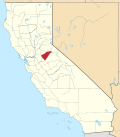 | |
| CDPs | ||
| Unincorporated communities | ||
| Former settlements | ||

| International | |
|---|---|
| National | |
| Geographic | |
| Other | |