








Tao Đàn Park
| Tao Đàn Park | |
|---|---|
| Jardin de la Ville | |
| Công viên Tao Đàn, Vườn Tao Đàn | |
 An entrance gate of the park | |
 Interactive map of Tao Đàn Park | |
| Type | Urban Park |
| Location | Bến Thành, District 1, Ho Chi Minh City |
| Area | 10 hectares (25 acres) |
| Public transit access | L1 L2 L3 L4 Bến Thành station (not on Line 3), Tao Đàn station (not on Line 1 and 4) |
Tao Đàn Park or fully known as Tao Đàn Cultural Park (Vietnamese: Công viên Tao Đàn, Công viên Văn Hóa Tao Đàn), also known as Tao Đàn Garden (Vườn Tao Đàn) is an urban park in District 1, Ho Chi Minh City, Vietnam behind the Independence Palace with an address 55C Nguyễn Thị Minh Khai, Bến Thành.[1][2] It is one of the largest parks in the city, covering 10 hectares.[3] Part of the park will be used for the entrance of the underground Ho Chi Minh City Metro's Tao Dan Station for Line 2 and 3.[4][5]
History
.jpg)

The whole park was the garden of the Saigon Governor's Palace (Dinh Toàn quyền) of France. In 1869, when the French Miss Clavell Street (now is Huyền Trân Công Chúa Street), the left three roads adjacent to the park are rue Chasseloup-Laubat in the north (now is Nguyễn Thị Minh Khai Street), rue Verdun (now is Cách Mạng Tháng Tám Stret) in the west, and rue Taberd in the south (now is Nguyễn Du Street), the Trương Định Street goes through the park was opened after 1957 in the South Vietnam era, it was renamed from rue Admiral Roze and connected with rue Lareyniere (which was named as Đoàn Thị Điểm Street in South Vietnam period and renamed into Trương Định Street after 1975).
After the separation from the palace and renamed Jardin de la Ville (means 'The City Garden'), but the Vietnamese people prefer to called it as Vườn Ông Thượng[6] (as this is the garden in the Governor's Palace and the local people commonly referred to the residences or workplaces of high-ranking officials as "Ông Thượng" or "Quan Thượng") or Vườn Bồ-Rô, maybe it was taken from préau (means the "covered ground" in French).
Next, the city built additional facilities in the garden for the Philharmonic Society (Société philharmonique) in 1896, the Freemasonry (Franc-maçonnerie) in 1897, and the Saigon Sports Circle (Cercle Sportif Saigonnais; now is the Ho Chi Minh City Cultural Palace for Labors) in 1902 including a football pitch, a swimming pool, and tennis court. At the time, that football pitch was the only one that met the standards to host foreign teams. In 1926, at the corner of Chasseloup-Laubat and Verdun streets, the government built an Institute of Childcare (Institut de puériculture) to educate children. After the French Indochina is over in Vietnam, The Governor-General's Palace became the Presidential Palace (Independence Palace), and the garden was renamed Tao Đàn Garden (Vườn Tao Đàn). The four surrounding streets were also renamed Huyền Trân Công Chúa Street, Hồng Thập Tự Street (means 'Red Cross'), Lê Văn Duyệt Street, and Nguyễn Du Street in the South Vietnam time. The Institute of Childcare (Viện Dục Nhi) was used as the Ministry of Health of the Republic of Vietnam era and now is the Ho Chi Minh City Department of Health.[7] The garden remains the central park of the city.
After the Reunification Day

Tao Đàn Garden was renamed as "Công viên Văn hoá Tao Đàn" ('Tao Đàn Cultural Park'), and have a distinct kids playground area. Saigon Sports Club also renamed as Câu lạc bộ Văn hóa 'Cultural Club'), with some kiosk and the Ho Chi Minh City Cultural Palace for Labors. Food Company Saigon (or Ho Chi Minh City, shortened as FOODCOSA) headquarter was here at 57 Nguyễn Thị Minh Khai but now has relocated to Bình Tiên (District 6, Ho Chi Minh City). However, the garden is still known for its abundance of greenery. The remaining park is where Spring Flowers Festival in Tao Đàn Park (Hội Hoa Xuân) are held every year before the Tết. Currently, a parking lot and shopping center project is underway beneath the park, invested in by a domestic company. In 1992, the Hùng King Memorial Temple was built within the park and was first renovated in 2011.
Gallery
-
-
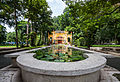
 Hùng King Memorial Temple.
 -

-

-
 A small Champa Temple in the park
 -

-
![An ancient mausoleum has been officially recognized by the city[8]](http://upload.wikimedia.org/wikipedia/commons/thumb/6/66/M%E1%BB%99_c%E1%BB%95_trong_v%C6%B0%E1%BB%9Dn_Tao_%C4%90%C3%A0n.jpg/120px-M%E1%BB%99_c%E1%BB%95_trong_v%C6%B0%E1%BB%9Dn_Tao_%C4%90%C3%A0n.jpg) An ancient mausoleum has been officially recognized by the city[8]
An ancient mausoleum has been officially recognized by the city[8] -
 Group of practitioners of Tai Chi in the park in the morning.
 -
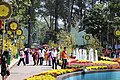 Spring Flowers Festival in Tao Đàn Park
 -
 Spring Flowers Festival in Tao Đàn Park


![An ancient mausoleum has been officially recognized by the city[8]](http://en.wikipedia.org/wiki/File:M%E1%BB%99_c%E1%BB%95_trong_v%C6%B0%E1%BB%9Dn_Tao_%C4%90%C3%A0n.jpg)


Bird cafe

The park formerly hosted an outdoor bird cafe that served coffee and attracted songbird owners, who would hang their birdcages and listen to them sing.[9] Now a construction site for the metro station, the cafe was moved across the street from the park to Công Đoàn Cafe.[10][11]
References
- ^ "What to know before you go to Ho Chi Minh City". Roads & Kingdoms. 2019-08-22. Retrieved 2022-08-05.
- ^ VnExpress. "HCMC to get more parks - VnExpress International". VnExpress International – Latest news, business, travel and analysis from Vietnam. Retrieved 2022-08-05.
- ^ VnExpress. "Where have Saigon's green spaces gone? - VnExpress International". VnExpress International – Latest news, business, travel and analysis from Vietnam. Retrieved 2022-08-05.
- ^ "Part of Tao Dan Park to be used for Saigon metro station". VietNamNet News (in Vietnamese). Retrieved 2022-08-05.
- ^ "HCMC may have to cut down 150-year-old trees in central park for metro line". Thanh Nien Daily. 2015-10-18. Archived from the original on October 19, 2015. Retrieved 2022-08-05.
- ^ Theo Học giả Vương_Hồng_Sển, vì dân chúng ngưỡng mộ và tôn thờ ông Lê_Văn_Duyệt làm Thượng công, nên lấy miếng đất trước thuộc lãnh vực chỗ ông ngồi ngự trị để đặt là Vườn Ông Thượng. Và nhà văn Sơn_Nam đã "sơ sót" khi viết rằng Ông Thượng là ám chỉ Toàn quyền Pháp Maurice Long. Ông Sển cho biết cái tên "Vườn ông Thượng" đã có từ trước khi Maurice Long qua Việt_Nam. Ông ấy làm Toàn quyền hai lượt: lần đầu từ 21_tháng_2 năm 1920 đến 17_tháng_12 năm 1920, lần thứ hai từ ngày 1_tháng_4 năm 1921 đến 14_tháng_4 năm 1992 (Vương_Hồng_Sển, Nửa đời còn lại. Nhà xuất bản Tổng hợp Thành_phố_Hồ_Chí_Minh, tr. 26). Xem thêm bài viết trên website báo Lao động: [1].
- ^ Phụng Nghi. Sài-gòn trong mắt tôi. Westminster, CA: Văn-nghệ, 1997. trang 103-6.
- ^ Tương truyền đây là mộ ông Lâm Tam Lang (tự "Nguyên thất", mất vào Mùa_thu Ất_Mão, 1795) và bà Mai Thị Xã (vợ ông). Họ Lâm người gốc Quảng_Đông, Trung_Quốc. Hậu duệ của ông đáng chú ý có: Phó lãnh binh Lâm_Quang_Ky (đời thứ 4) và Lâm Đình Phùng (tức nhạc sĩ Lam_Phương, đời thứ 7). Theo sách Danh mục kiểm kê di tích lịch sử-văn hóa trên địa bàn Thành phố Hồ Chí Minh giai đoạn 2010-2020 của Sở Văn hóa - Thể thao - Du lịch Thành phố Hồ Chí Minh , thì ngôi mộ cổ này được xây dựng năm Ất_Mùi (1895). Nguồn: "Bí mật cụm mộ cổ ở công viên Tao Đàn", đăng trên báo Thanh niên ngày 16 tháng 10 năm 2003 [2].
- ^ Best Ever Food Review Show (2016-10-06). Tao Dan Park Bird Cafe in Saigon, Vietnam. Retrieved 2024-10-16 – via YouTube.
- ^ Kirsty (2020-03-25). "Birdsong at Saigon Bird Cafe in Ho Chi Minh, Vietnam". Kathmandu & Beyond. Retrieved 2022-08-06.
- ^ "Tao Dan Park Review - Ho Chi Minh City Vietnam - Sights | Fodor's Travel". www.fodors.com. Retrieved 2022-08-06.
10°46′28″N 106°41′33″E / 10.77444°N 106.69250°E