





War in Gotland (1288)
| War in Gotland | |||||||||
|---|---|---|---|---|---|---|---|---|---|
 City wall of Visby | |||||||||
| |||||||||
| Belligerents | |||||||||
| Visby |
 Gotlandic peasants Gotlandic peasants  Sweden Sweden Livonian Order | ||||||||
| Commanders and leaders | |||||||||
| Unknown |
Magnus Ladulås | ||||||||
| Strength | |||||||||
| Unknown | Unknown | ||||||||
| Casualties and losses | |||||||||
| Heavy | Heavy | ||||||||
The War in Gotland was an armed conflict between the rural farmers of the island of Gotland and the burghers of its town of Visby; two battles were fought, one at Högebro, at which the burghers emerged victorious and Roma, in which neither side won. However, the war concluded with the Treaty of Gotland which was mediated by King Magnus Ladulås.
Background
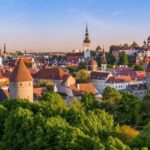
In order to prevent the peasants on Gotland from trading in Visby, the burghers of the city constructed a ring wall around it,[1] and the wall was the main casus belli for the peasants.[2] The peasants asked the German military leader in Livonia for help; he and a few knights are said to have traveled to Gotland to help the peasants.[3][2]
Prelude
Possibly with support from Livonian knights, the peasants armed themselves marched toward Visby, planning to attack it. In response, the burghers of Visby also mobilized their forces.[2]
War
The peasant's assault surprised Visby's defenders, and once they entered the city, they plundered it and fled with their booty. The burghers soon organized to counterattack. Visby's forces mainly consisted of well-trained German mercenaries.[4] The two sides eventually met at Högebro; fighting lasting the entire day. The burghers eventually won due to their superior weapons. The peasants were tailed through a forest, resulting in several being taken captive and brought to Sjönem. However, they did not lose hope, and mobilized for another battle.[2]

Another battle occurred at Roma Abbey where both sides suffered heavy casualties, but the battle was inconclusive.[2] The priests in Roma Abbey managed to broker a truce after the battle.[5]
However, the peasants withdrew from peace negotiations, but the priests prevented another battle. Finally, it was announced by Bodel Kallin and Gerved of Martebo that Edvard von Lode and several knights wanted to enter the city themselves and confirm the peace.[2] Soon after, news reached king Magnus Ladulås about the events and he sent word that diplomats for both parties should come to him.[2] Magnus also landed troops on the island, taking the side of the peasants.[4]

Aftermath
In August 1288, representatives from both sides came to Nyköping to negotiate peace. The envoys said that the burghers of Visby had gone against the king's will when they constructed the wall and consequently paid 2,000 marks of silver and 500 marks assorted silver in penance which was all to be paid before Midsummer the following year.[6]
It was also agreed that any later disagreements would be brought up to the Swedish king, before it escalated into hostility against the peasants. However, this was unnecessary if the burghers were forced to reciprocate violence from the peasants.[7]
No complaints would be prevented from reaching the king, and only he would be their master. If the king was ever rejected, Visby would fight the peasants. It was also agreed that Visby would open the gates to the king and give him assistance if the peasants rebelled against him.[5][7] Additionally, the king split between Visby and the countryside.[8]
Result
The exact victor in the war is disputed. Historian Mats Adolfsson says that the peasants won the war,[8] while Edward Miller and Christine Peel say that the burghers of Visby won the war.[9][10] Peel adds how the burghers suffered a humiliating surrender to the king.[10]
See also
Citations
- ^ "Medeltidsstaden -1500". Region Gotland (in Swedish). Retrieved 2023-08-19.
- ^ a b c d e f g Starbäck & Bäckström 1885, p. 489.
- ^ "Inbördeskriget mellan staden och landet 1288". www.gotlandsforsvarshistoria.se. Retrieved 2023-10-09.
{{cite web}}: CS1 maint: url-status (link) - ^ a b Adolfsson 2010, p. 99.
- ^ a b Sundberg 1999, p. 95.
- ^ Starbäck & Bäckström 1885, pp. 489–490.
- ^ a b Starbäck & Bäckström 1885, p. 490.
- ^ a b Adolfsson 2010, p. 100.
- ^ Miller 1965, p. 388.
- ^ a b Peel 2015, p. xxi.
References
- Sundberg, Ulf (1999). Medeltidens svenska krig [Swedish wars in the Middle Ages] (in Swedish) (1st ed.). Stockholm: Hjalmarson & Högberg. ISBN 9789189080263.
- Starbäck, Carl Georg [in Swedish]; Bäckström, Per Olof [in Swedish] (1885). Sagoåldern, Medeltiden till Kalmare-Unionen [The Fairy Tale Age, the Middle Ages to the Kalmar Union]. Berättelser ur svenska historien (in Swedish). Vol. 1. Stockholm: F. & G. Beijers förlag.
- Adolfsson, Mats (2010). När borgarna brann [When the castles burned]. Svenska uppror (in Swedish). Vol. 1. Natur & Kultur. ISBN 9789127128088.
- Peel, Christine (2015). Guta Lag and Guta Saga: The Law and History of the Gotlanders. New York City: Routledge. ISBN 9780367870928.
- Miller, Edward (1965). Postan, Michael Moissey; Rich, Edwin Ernest; Miller, Edward (eds.). Economic Organization and Policies in the Middle Ages. The Cambridge Economic History of Europe. London: Cambridge University.