








Papaver orientale
| Oriental poppy | |
|---|---|
.jpg)
| |
Scientific classification 
| |
| Kingdom: | Plantae |
| Clade: | Tracheophytes |
| Clade: | Angiosperms |
| Clade: | Eudicots |
| Order: | Ranunculales |
| Family: | Papaveraceae |
| Genus: | Papaver |
| Species: | P. orientale
|
| Binomial name | |
| Papaver orientale | |
| Synonyms[1] | |
| |
Papaver orientale, the Oriental poppy,[2] is a perennial flowering plant[3] native to the Caucasus, northeastern Turkey, and northern Iran.[4]
Oriental poppies grow a mound of leaves that are hairy and finely dissected in spring. They gather energy and bloom in mid-summer. After flowering, the foliage dies away entirely, a property that allows their survival in the summer drought of Central Asia. Gardeners can place late-developing plants nearby to fill the developing gap.
Taxonomy
The scientific name Papaver orientale was established in 1753 by Linnaeus.[5] The species is classified in the genus Papaver within the wider family Papaveraceae. It has no varieties that are accepted, but does have four among its thirteen synonyms.[1]
| Name | Year | Rank | Notes |
|---|---|---|---|
| Calomecon orientale (L.) Spach | 1838 | species | ≡ hom. |
| Papaver dzeghamicum Medw. | 1915 | species | = het. |
| Papaver grandiflorum Moench | 1794 | species | = het. |
| Papaver lateritium subsp. monanthum (Trautv.) Kadereit | 1996 | subspecies | = het. |
| Papaver monanthum Trautv. | 1866 | species | = het. |
| Papaver oreophilum var. monanthum (Trautv.) N.Busch | 1905 | variety | = het. |
| Papaver orientale f. flavolactescens Kuntze | 1887 | form | = het. |
| Papaver orientale var. monanthum (Trautv.) Trautv. | 1876 | variety | = het. |
| Papaver orientale var. normale Kuntze | 1887 | variety | = het. |
| Papaver orientale var. parviflora N.Busch | 1905 | variety | = het. |
| Papaver orientale var. paucifoliatum Trautv. | 1876 | variety | = het. |
| Papaver paucifoliatum (Trautv.) Fedde | 1909 | species | = het. |
| Papaver spectabile Salisb. | 1796 | species | ≡ hom., nom. superfl. |
| Notes: ≡ homotypic synonym ; = heterotypic synonym | |||
Cultivation
Papaver orientale usually thrives in soil pH 6.5 to 7.5 and in full sun or part shade. Seeds are sown after the potential of frost has passed, the average temperature is approximately 21 °C and when soil has thoroughly warmed. The seeds are sown at a depth of about one centimeter, or less as light may stimulate germination. Oriental Poppies do not handle transplanting or over-watering well. Germination period is 10–20 days. Mulch can be used to protect the plant over the winter and deadheading will produce a second flower.[citation needed]
Cultivars
Cultivars (those marked agm have gained the Royal Horticultural Society's Award of Garden Merit):-[6]
|
|
Gallery
-
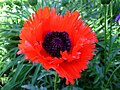 Türkenlouis red, highly fringed
 -
 Olympia orange
 -
 Papillon pink
 -
 Papaver Orientale (Fruit Punch Poppy) found at the Coastal Maine Botanical Gardens
 -
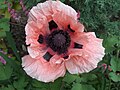 Cedric Morris salmon pink
 -
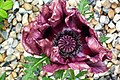 Pattys Plum plum


_found_at_the_Coastal_Maine_Botanical_Gardens.jpg)


See also
Oriental Poppies, 1927 painting by Georgia O'Keeffe
References
- ^ a b POWO (2025). "Papaver orientale L." Plants of the World Online. Royal Botanic Gardens, Kew. Retrieved 26 December 2025.
- ^ BSBI List 2007 (xls). Botanical Society of Britain and Ireland. Archived from the original (xls) on 2015-06-26. Retrieved 2014-10-17.
- ^ USDA Profile
- ^ "Papaver orientale". Germplasm Resources Information Network. Agricultural Research Service, United States Department of Agriculture. Retrieved 10 January 2018.
- ^ Linne, Carl von (1753). Species Plantarum. Vol. 1. Holmiae :Impensis Laurentii Salvii. p. 508.
{{cite book}}: CS1 maint: publisher location (link) - ^ "AGM Plants - Ornamental" (PDF). Royal Horticultural Society. July 2017. p. 71. Retrieved 17 April 2018.
- ^ "RHS Plant Selector - Papaver orientale 'Ajaga'". Retrieved 16 January 2021.
- ^ "RHS Plant Selector - Papaver orientale 'Black and White'". Retrieved 16 January 2021.
- ^ "RHS Plant Selector - Papaver orientale 'Cedric Morris'". Retrieved 16 January 2021.
- ^ "RHS Plant Selector - Papaver orientale 'Effendi'". Retrieved 16 January 2021.
- ^ "RHS Plant Selector - Papaver orientale 'John III'". Retrieved 16 January 2021.
- ^ "RHS Plant Selector - Papaver orientale 'Karine'". Retrieved 16 January 2021.
- ^ "RHS Plant Selector - Papaver orientale 'Khedive'". Retrieved 16 January 2021.
- ^ "RHS Plant Selector - Papaver orientale 'Leuchtfeuer'". Retrieved 16 January 2021.
- ^ "RHS Plant Selector - Papaver orientale 'Lighthouse'". Retrieved 16 January 2021.
Sources
External links
 Media related to Papaver orientale at Wikimedia Commons