





Bard College
 | |
Former name | St. Stephen's College (1860–1934) |
|---|---|
| Motto | Dabo tibi coronam vitae (Latin) |
Motto in English | I shall give thee the crown of life (Revelation 2:10) |
| Type | Private liberal arts college |
| Established | March 1860 |
Religious affiliation | Episcopal Church |
Academic affiliation | Annapolis Group |
| Endowment | $1.416 billion |
| President | Leon Botstein |
| Provost | Deirdre d’Albertis |
Academic staff | 231 FT/ 142 PT |
| Students | 2,303 (2025) |
| Undergraduates | 2,186 (2025) |
| Postgraduates | 117 (2025) |
| Location | , United States 42°1′13″N 73°54′36″W / 42.02028°N 73.91000°W |
| Campus | Rural, 1,260 acres (510 ha) |
| Colors | Red and white[1] |
| Nickname | Raptors[2] |
Sporting affiliations | NCAA Division III Liberty League |
| Website | bard.edu |
 | |
 | |
Bard College is a private liberal arts college in Annandale-on-Hudson, New York, United States. The campus overlooks the Hudson River and Catskill Mountains within the Hudson River Historic District and is a National Historic Landmark.
Founded in 1860, the institution consists of a liberal arts college and a conservatory. The college offers undergraduate and graduate programs. It participates in a network of many affiliated programs internationally.
History
Origins and early years

During much of the nineteenth century, the land since owned by Bard was mainly composed of several country estates. These estates were called Blithewood, Bartlett, Sands and Ward Manor/Almont.[3]

In 1853, John Bard and Margaret Bard purchased a part of the Blithewood estate and renamed it Annandale. John Bard was the grandson of Samuel Bard, a prominent doctor, a founder of Columbia University's medical school, and physician to George Washington.[4] John Bard was also the nephew of John McVickar, a professor at Columbia University.[5] The family had strong connections with the Episcopal Church.[6]
The following year, in 1854, John and Margaret established a parish school on their estate in order to educate the area's children. A wood-frame cottage, known today as Bard Hall, served as a school on weekdays and a chapel on weekends. In 1857, the Bards expanded the parish by building the Chapel of the Holy Innocents next to Bard Hall.[7] During this time, John Bard remained in close contact with the New York leaders of the Episcopal Church. The church suggested that he found a theological college.[8]
With the promise of outside financial support, John Bard donated the unfinished chapel, and the surrounding 18 acres (7.3 ha), to the diocese in November 1858. In March 1860, "St. Stephen's College" was founded. In 1861, construction began on the first St. Stephen's College building, a stone collegiate Gothic dormitory called Aspinwall, after early trustee John Lloyd Aspinwall, brother of William Henry Aspinwall. During its initial years, the college relied on wealthy benefactors, like trustee Cornelius Vanderbilt, for funding.[9]
The college began taking shape within four decades. In 1866, Ludlow Hall, an administrative building, was erected. Preston Hall was built in 1873 and used as a refectory. A set of four dormitories, collectively known as Stone Row, were completed in 1891. And in 1895, the Greek Revival Hoffman Memorial Library was built.[10] The school officially changed its name to Bard College in 1934 in honor of its founder.[11]
20th century growth and secularization
In the 20th century, social and cultural changes amongst New York's high society would bring about the demise of the great estates. In 1914, Louis Hamersley purchased the fire-damaged Ward Manor/Almont estate and erected a Tudor style mansion and gatehouse, or what is today known as Ward Manor.[12] Hamersley expanded his estate in 1926 by acquiring the abandoned Cruger's Island estate. That same year, after Hamersley's combined estate was purchased by William Ward, it was donated to charity and served as a retirement home for almost four decades.[13]
By the mid-1900s, Bard's campus significantly expanded. The Blithewood estate was donated to the college in 1951, and in 1963, Bard purchased 90 acres (36 ha) of the Ward Manor estate, including the main manor house. The rest of the Ward Manor estate became the 900-acre (360 ha) Tivoli Bays nature preserve.[14][15]
In 1919, Bernard Iddings Bell became Bard's youngest president at the age of 34. His adherence to classical education, decorum, and dress eventually clashed with the school's push towards Deweyism and secularization, and he resigned in 1933.[16]
In 1928, Bard merged with Columbia University, serving as an undergraduate school similar to Barnard College. Under the agreement, Bard remained affiliated with the Episcopal Church and retained control of its finances. The merger raised Bard's prestige; however, it failed to provide financial support to the college during the Great Depression.[17] So dire was Bard's financial situation that in 1932, then-Governor of New York and College trustee Franklin D. Roosevelt sent a telegram to the likes of John D. Rockefeller Jr., George Eastman, and Frederick William Vanderbilt requesting donations for the college.[18]
On May 26, 1933, Donald Tewksbury, a Columbia professor, was appointed dean of the college. Although dean for only four years, Tewksbury had a lasting impact on the school. Tewksbury, an educational philosopher, had extensive ideas regarding higher education. While he was dean, Tewksbury steered the college into a more secular direction and changed its name from St. Stephen's to Bard. He also emphasized the arts, something atypical of colleges at the time, and set the foundations for Bard's Moderation and Senior Project requirement.[17][19] While Tewksbury never characterized Bard's curriculum as "progressive," the school would later be considered an early adopter of progressive education. In his 1943 study of early progressive colleges, titled General Education in the Progressive College, Louis T. Benezet used Bard as one of his three case studies.[17][20]
During the 1940s, Bard provided a haven for intellectual refugees fleeing Europe. These included Hannah Arendt, the political theorist, Stefan Hirsch, the precisionist painter; Felix Hirsch, the political editor of the Berliner Tageblatt; the violinist Emil Hauser; the linguist Hans Marchand; the noted psychologist Werner Wolff; and the philosopher Heinrich Blücher.[17] Arendt is buried at Bard, alongside her husband Heinrich Blücher, as is eminent novelist Philip Roth.[21]
In 1944, as a result of World War II, enrollment significantly dropped putting financial stress on the college. In order to increase enrollment, the college became co-educational, thereby severing all ties with Columbia. The college became an independent, secular, institution in 1944. Enrollment more than doubled, from 137 students in 1944, to 293 in 1947.[22]
Donald Fagen and Walter Becker's experiences at Bard prompted them to write the 1973 song "My Old School" for their rock group, Steely Dan.[23] The song was motivated by the 1969 drug bust at Bard in which the college administration colluded.[24] The DA involved was G. Gordon Liddy of Watergate notoriety.[25] Fagen wrote another Steely Dan song, "Rikki Don't Lose That Number", about novelist, artist and former Bard faculty spouse Rikki Ducornet.[26]
21st century
In 2020, Bard College and Central European University became the founding members of the Open Society University Network, a collaborative global education initiative endowed with US$1 billion. As part of this new initiative, the college received a US$100 million gift from the Open Society Foundations which ranks among the largest financial contributions to a U.S. institution in recent history.[27][28] In 2021, philanthropist George Soros made a $500 million endowment pledge to Bard College. It is one of the largest pledges of money ever made to higher education in the United States.[29]
In June 2021, Bard College was declared an "undesirable organization" in Russia, becoming the first international higher education organization to be branded with this designation.[30] Bard president Botstein hypothesized that this tag was due to their association with and funding from the Open Society Foundations which was also classified as undesirable in Russia and related conspiracy theories about George Soros.[31]
Throughout the early 2010s, Bard College president Leon Botstein maintained a relationship with financier, child sex offender, and human trafficker Jeffrey Epstein, from whom he received gifts and donations to Bard totaling $150,000. Epstein had presented himself as a philanthropist interested in Bard's educational programs, particularly its arts and music programs, as well as taking an interest in Bard's high school early college model for young gifted individuals ready to start college 2 years earlier than typically normal. Epstein made an endowment gift to the flagship Bard High School Early College in the Lower East Side of Manhattan, to which he added 30% to the High School's endowment that operates separate finances from Bard College. [32][33] Epstein repeatedly visited Bard, by helicopter, landing the helicopter on the south end of Bard's Campus, on the Blithewood lawn, a popular gathering sight for Bard's students.[32]
College leaders
At various times, the leaders of the college have been titled president, warden or dean.[34] They are listed below:
- George Franklin Seymour (1860–1861)
- Thomas Richey (1861–1863)
- Robert Brinckerhoff Fairbairn (1863–1898)
- Lawrence T. Cole (1899–1903)
- Thomas R. Harris (1904–1907)
- William Cunningham Rodgers (1909–1919)
- Bernard Iddings Bell (1919–1933)
- Donald George Tewksbury (1933–1937)
- Harold Mestre (1938–1939)
- Charles Harold Gray (1940–1946)
- Edward C. Fuller (1946–1950)
- James Herbert Case Jr. (1950–1960)
- Reamer Kline (1960–1974)
- Leon Botstein (1975–present)
Campus
The campus of Bard College is in Annandale-on-Hudson, a hamlet in Dutchess County, New York, United States, in the town of Red Hook. It contains more than 70 buildings with a total gross building space of 1,167,090 sq ft (108,426 m2) and was listed as a census-designated place in 2020.[35][36] Campus buildings represent varied architectural styles, but the campus remains heavily influenced by the Collegiate Gothic and Postmodern styles.
Bard's historic buildings are associated with the early development of the college and the history of the Hudson River estates (see Bard College History).[12] During a late twentieth-century building boom, the college embraced a trend of building signature buildings designed by prominent architects like Venturi, Gehry, and Viñoly.[37]
In January 2016, Bard purchased Montgomery Place, a 380-acre (150 ha) estate adjacent to the Bard campus, with significant historic and cultural assets. The estate consists of a historic mansion, a farm, and some 20 smaller buildings. The college purchased the property from Historic Hudson Valley, the historical preservation organization that had owned Montgomery Place since the late 1980s. The addition of this property brings Bard's total campus size to nearly 1,000 acres (400 ha) along the Hudson River in Annandale-on-Hudson, New York.[38]
In late 2023, Bard purchased 260 acres of land adjacent to the Montgomery Place campus in Barrytown, which used to be the campus of the Unification Theological Seminary. The property, originally owned by the Livingston and later Aspinwall families, features a mansion designed by William Appleton Potter. It was acquired by the De La Salle Brothers in 1928, who completed a large seminary and normal institute there in 1931. In turn, the property was sold in 1974 to the Unification Church.[39] Bard College at Simon's Rock announced that it would be moving into the property in fall 2025.[40] The purchase of the property brings Bard's total acreage to 1260 acres (510 ha).[41]
The area around the campus first appeared as a census-designated place (CDP) in the 2020 Census,[42] with a population of 358.[43]
The college has some housing for faculty members.[44] School-age dependents in this faculty housing are in the Red Hook Central School District.[45]
-
 Stone Row, a dormitory built in 1891
 -
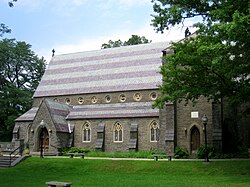 The Chapel of the Holy Innocents, built in 1857, serves several denominations on campus.
 -
 Tewksbury Hall, a dormitory
 -
 The Ravines, dormitories
 -
 Alumni Houses, dormitories
 -
 Stewart and Lynda Resnick Commons, a residential village with dormitories
 -
 Cruger Hall, a dormitory
 -
 Hessel Museum, museum of contemporary art
 -
 Blithewood Garden, Italianate walled garden
 -
 Ward Manor, built in 1918 and now used as a dormitory
 -
 Fisher Center at Bard, performance hall designed by Frank Gehry
 -
 Montgomery Place, a historic mansion purchased by the college in 2016
 -
 Blithewood Manor, a historic estate housing the Levy Economics Institute dating to 1899
 -
 Reem-Kayden Center for Science and Computation
 -
 The Massena complex, currently home to Simon's Rock at Bard College


Academics
Rankings and awards
| Academic rankings | |
|---|---|
| Liberal arts | |
| U.S. News & World Report[46] | 71 |
| Washington Monthly[47] | 50 |
| National | |
| Forbes[48] | 230 |
| WSJ/College Pulse[49] | 264 |
In its 2025 edition of college rankings, U.S. News & World Report ranked Bard 71st overall, 5th in "Most Innovative Schools", tied at 33rd for "Best Undergraduate Teaching", tied at #38 in "Top Performers on Social Mobility", tied at #19 in "First-Year Experiences", and 19th for "Best Value" out of 211 "National Liberal Arts Colleges" in the United States.[50] In 2024, Washington Monthly ranked Bard 50th among 194 liberal arts colleges in the U.S. based on its contribution to the public good, as measured by social mobility, research, and promoting public service.[51]
Bard's Master of Fine Arts program was ranked one of ten most influential Master of Fine Arts programs in the world by Artspace Magazine in 2023.[52]
Bard has been named a top producer of U.S. Fulbright Scholars.[53] Many Bard alumni have also been named Watson Fellows, Critical Language Scholarship recipients, Davis Projects for Peace winners, Rhodes Scholars, Marshall Scholars, and Peace Corps fellows, among other postgraduate awards.[54][55][56][57]
Undergraduate programs
In the undergraduate college, Bard offers Bachelor of Arts and Bachelor of Science degrees. There are 23 academic departments that offer over 40 major programs, as well as 12 interdisciplinary concentrations. The college was the first in the nation to offer a human rights major.[58] Its most popular undergraduate majors, based on 2021 graduates, were:[59] Fine/Studio Arts (106), English Language and Literature/Letters (81), and Biological and Physical Sciences (80).
Undergraduate admissions
For the academic year 2022–2023, Bard's acceptance rate stands at 46%. Out of the total 6,482 students who applied, 2,982 were admitted to the school.[60] For the 2022–2023 academic year 447 students enrolled representing a yield rate of 15%. Admission trends note a 25% increase in applications in the 2022–2023 academic year.[61] Bard does not require applicants to submit SAT or ACT test scores in order to apply.[62] As an alternative, applicants may take an examination composed of 19 essay questions in four categories: Social Studies; Languages and Literature; Arts; and Science, Mathematics, and Computing, with applicants required to complete three 2,500-word essays covering three of the four categories.[63] For admitted students who submitted test scores, 50% had an SAT score between 1296 and 1468 or an ACT score between 28 and 33, with a reported average GPA of 3.79. Admissions officials consider a student's GPA a very important academic factor. Honors, AP, and IB classes are important, an applicant's high school class rank is considered, and letters of recommendation are considered very important for admissions officials at Bard.[64][65]
Graduate programs
Bard College offers a range of postgraduate degree programs, including the Bard MFA, Bard Graduate Center, Center for Curatorial Studies, Center for Human Rights and the Arts, Center for Environmental Policy, Bard MBA in Sustainability, Levy Economics Institute, the Master of Arts in Teaching, and the Master of Arts in Global Studies.[66]
Bard MFA
Milton Avery Graduate School of the Arts is a nontraditional graduate school for interdisciplinary study in the visual and creative arts. The program takes place over two years and two months, with students residing on campus during three consecutive summers, and two winter sessions of independent study completed off campus.[67] Notable artists and writers that have been affiliated with the Bard MFA as faculty and visiting artists include Marina Abramovic, Eileen Myles, Paul Chan, Robert Kelly, Tony Conrad, Okkyung Lee, Yto Barrada, Carolee Schneemann, Lynne Tillman, and Ben Lerner.[68]
Bard Graduate Center
The Bard Graduate Center: Decorative Arts, Design History, Material Culture is a graduate research institute and gallery located in New York City. Established in 1993, the institute offers a two-year MA program and a PhD program that began in 1998. The institute's facilities include a gallery space at 18 West 86th Street and an academic building with a library at 38 West 86th Street.[69]
Center for Curatorial Studies

The Center for Curatorial Studies, Bard College (CCS Bard) established in 1990, is a museum and research center dedicated to the study of contemporary art and exhibition practices from the 1960s to the present. In 1994, CCS Bard launched its (MA) Master of Arts in Curatorial Studies program.[70] The center also hosts public events throughout the year including lectures and panel discussions on topics in contemporary art.[71]
The museum, spanning an area of 55,000 square feet, offers a variety of exhibitions accessible to the general public throughout the year. It houses two distinct collections, the CCS Bard Collection and the Marieluise Hessel collection, which has been loaned to CCS Bard on a permanent basis. Artists such as Keith Haring, Julian Schnabel, Wolfgang Tillmans, Stephen Shore, and Cindy Sherman, among numerous others, are featured within these collections.[72]
The CCS Bard Library is a research collection for contemporary art with a focus on post-1960s contemporary art, curatorial practice, exhibition histories, theory, and criticism. in 2023 historian Robert Storr donated over 25,000 volumes to the Center for Curatorial Studies, Bard College, nearly doubling the total collection size to 63,000 volumes.[73]
In 2022 CCS Bard received $50 million from a $25 million donation from the Gochman Family Foundation to form a Center for American and Indigenous Studies at CCS Bard and a matching donation of $25 million from George Soros.[74] This followed two 2021 gifts of $25 million, one from Marieluise Hessel and a matching donation from Soros.[75]
Levy Economics Institute

Levy Economics Institute is a public policy think tank focused on generating public policy responses to economic problems. Through research, analysis, and informed debate, the institute aims to enable scholars and leaders from business, labor, and government to collaborate on common interest issues.
Endowment
Bard has access to multiple, distinct endowments. Bard, along with Central European University, is a founding member of the Open Society University Network, endowed with $1 billion from philanthropist George Soros, which is a network of universities to operate throughout the world to better prepare students for current and future global challenges through integrated teaching and research.[76][77] As of 2025 Bard maintained its own endowment of approximately $395,986,151[78]. In July 2020, Bard received a gift of $100 million from the Open Society Foundations, which will dispense $10 million yearly over a period of ten years.[79] In April 2021, Bard received a $500 million endowment challenge grant from George Soros. On January 21 2026 the Open Society Foundation and Bard College published a joint newsletter signaling the successful completion of the endowment drive, Bard raised $520 of the $500 million over 5 years meeting the pledge amount set by George Soros and the Open Society Foundation, bringing Bard's endowment to $1.4 billion[80].
Programs, centers, and associated institutes
Bard has developed several graduate programs and research institutes, including the Milton Avery Graduate School of the Arts, the Levy Economics Institute which began offering a Masters of Science in Economic Theory and Policy in 2014, the Center for Curatorial Studies and Art in Contemporary Culture, the Bard Center for Environmental Policy, the Bard College Conservatory of Music, the ICP-Bard Program in Advanced Photographic Studies in Manhattan,[81] the Master of Arts in Teaching Program (MAT), the Bard College Clemente Program, and the Bard Graduate Center in Manhattan.

In 1990, Bard College acquired, on permanent loan, art collector Marieluise Hessel's substantial collection of important contemporary artwork. In 2006, Hessel contributed another $8 million (USD) for the construction of a 17,000-square-foot addition to Bard's Center for Curatorial Studies building, in which the collection is exhibited.[82]
The Bard Prison Initiative (BPI) provides a liberal arts degree to incarcerated individuals (prison education) in five prisons in New York State, and enrolls nearly 200 students.[83] Since federal funding for prison education programs was eliminated in 1994,[84]
In February 2009, Bard announced the first dual degree program between a Palestinian university and an American institution of higher education. The college entered into a collaboration with Al-Quds University involving an honors college, a master's program in teaching and a model high school.[85]
In accordance with AlQuds-Bard requirements, students are not allowed to decide their major during the first year of their studies; instead, as a liberal arts college, students are advised to diverge in different classes that would allow them to decide what program they would like to take interest in as in the following year. Students are encouraged to look upon different classes to help them decide the subject they would mostly enjoy studying.[citation needed]
In June 2011, Bard acquired the Longy School of Music in Cambridge, Massachusetts,[86] and in November 2011, Bard took ownership of the European College of Liberal Arts in Berlin, Germany, to become Bard College Berlin.[87]
Student life
Over 120 student clubs are financed through Bard's Convocation Fund, which is distributed once a semester by an elected student body and ratified during a public forum.[88] Bard College has one print newspaper, the Bard Free Press, which was awarded a Best in Show title by the Associated Collegiate Press in 2013.[89] In 2003, the Bard Free Press won Best Campus Publication in SPIN Magazine's first annual Campus Awards.[90]
College radio station WXBC was founded in 1947.[91] In 2006, it was nominated for "Station of the Year" and "Biggest Improvement" in the CMJ College Radio Awards.[92]
Athletics

Bard College teams (nicknamed the Raptors)[93] participate as a member of the National Collegiate Athletic Association's Division III. The Raptors are a member of the Liberty League. Prior conference affiliations include the Skyline Conference and the former Hudson Valley Athletic Conference. Women's sports include basketball, cross country, lacrosse, soccer, swimming & diving, tennis, track & field, volleyball and squash. Men's sports include baseball, basketball, cross country, soccer, squash, swimming & diving, tennis, track & field and volleyball.[94]
Bard College Rugby Football Club fields men's and women's teams that compete in the Tristate Conference, affiliated with National Collegiate Rugby. Additional club sports include: ultimate frisbee, fencing, and equestrian.[95]
Alumni and faculty
References
- ^ "Student Services". Bard.edu. Archived from the original on August 10, 2014. Retrieved August 9, 2014.
- ^ "Bard Athletics and Recreation". Bard.edu. Archived from the original on December 26, 2010. Retrieved July 8, 2011.
- ^ "Annandale-on-Hudson's Historic Estates and their Landscapes - HRVI". www.hudsonrivervalley.org. Retrieved December 12, 2024.
- ^ Hirsch, Felix (October 1941). "The Bard Family". Columbia University Quarterly. Bard College Archives, Annandale-on-Hudson, NY.
- ^ Hopson, George Bailey (1910). Reminiscences of St. Stephen's College, Annandale, New York. Cornell University Library. New York : E.S. Gorham.
- ^ Hopson, George Bailey (1910). Reminiscences of St. Stephen's College, Annandale, New York. Cornell University Library. New York : E.S. Gorham.
- ^ Kline, Reamer (1982). Education for the Common Good: A History of Bard College The First 100 Years, 1860-1960. Annandale-on-Hudson, NY: Bard College. p. 15. Archived from the original on June 1, 2013. Retrieved July 12, 2012.
- ^ Hopson, George (1910). Reminiscences of St. Stephen's College. New York, NY: Edwin S. Gorham. pp. 16–17.
- ^ Magee, Christopher (1950). The History of St. Stephen's College 1860-1933. Annandale-on-Hudson, NY: Bard College Senior Project. p. 38.
- ^ John Milner Associates Inc. (December 2008). Bard College Master Preservation Plan (Report). p. 27.
- ^ College, Bard. "Bard College History". www.bard.edu. Retrieved December 12, 2024.
- ^ a b Kline, Reamer (1982). Education for the Common Good: A History of Bard College The First 100 Years, 1860-1960. Annandale-on-Hudson, NY: Bard College. Archived from the original on June 1, 2013. Retrieved July 12, 2012.
- ^ "Ward Manor | New York Heritage". nyheritage.org. Retrieved December 12, 2024.
- ^ "Bard College Archives". Bard College. Archived from the original on June 1, 2013. Retrieved July 11, 2012.
- ^ John Milner Associates Inc. (December 2008). Bard College Master Preservation Plan (Report). p. 34.
- ^ Kirk, Russell (1963). Confessions of a Bohemian Tory. Fleet Publishing Corporation. p. 162.
- ^ a b c d "About Bard | History of Bard". Bard.edu. May 21, 2011. Archived from the original on June 14, 2011. Retrieved July 8, 2011.
- ^ Kline, Reamer (1982). Education for the Common Good: A History of Bard College The First 100 Years, 1860-1960 (PDF). Annandale-on-Hudson, NY: Bard College. p. 99. Archived (PDF) from the original on September 23, 2015. Retrieved July 12, 2012.
- ^ Kline, Reamer (1982). Education for the Common Good: A History of Bard College The First 100 Years, 1860-1960 (PDF). Annandale-on-Hudson, NY: Bard College. p. 104. Archived (PDF) from the original on September 23, 2015. Retrieved July 12, 2012.
- ^ Kline, Reamer (1982). Education for the Common Good: A History of Bard College The First 100 Years, 1860-1960 (PDF). Annandale-on-Hudson, NY: Bard College. p. 106. Archived (PDF) from the original on September 23, 2015. Retrieved July 12, 2012.
- ^ "Hannah Arendt Center News". hac.bard.edu. Archived from the original on December 30, 2018. Retrieved December 29, 2018.
- ^ Kline, Reamer (1982). Education for the Common Good: A History of Bard College The First 100 Years, 1860-1960 (PDF). Annandale-on-Hudson, NY: Bard College. p. 120. Archived (PDF) from the original on September 23, 2015. Retrieved July 12, 2012.
- ^ Brunner, Rob (March 17, 2006). "The origins of Steely Dan". Entertainment Weekly. Archived from the original on December 8, 2014. Retrieved December 12, 2019.
- ^ "Back to Annandale". March 17, 2006. Archived from the original on March 27, 2023. Retrieved March 27, 2023.
- ^ "G. Gordon Liddy (Yes, the Watergate guy), Bard College, & Steely Dan". Poughkeepsie Journal. April 6, 1968. p. 1. Archived from the original on March 27, 2023. Retrieved March 27, 2023.
- ^ McCormack, J.W. (May 20, 2016). "The Burden of Strangeness: Rikki Ducornet". PWxyz, LLC. Archived from the original on December 12, 2019. Retrieved December 12, 2019.
- ^ "Open Society Foundations Gives Bard $100 Million | Inside Higher Ed". Inside Higher Ed. July 2, 2020. Archived from the original on July 31, 2022. Retrieved July 2, 2020.
- ^ "Major Private Gifts to Higher Education - the Chronicle of Higher Education". Archived from the original on July 5, 2020. Retrieved July 2, 2020.
- ^ Relations, Bard Public. "Bard College Receives $500 Million Endowment Pledge from Investor and Philanthropist George Soros". www.bard.edu. Retrieved May 31, 2023.
- ^ Redden, Elizabeth (July 9, 2021). "Bard College Declared 'Undesirable' in Russia". Inside Higher Ed. Archived from the original on August 5, 2021. Retrieved August 5, 2021.
- ^ Fischer, Karin (June 22, 2021). "Bard President Is 'Heartbroken' About Russian Blacklisting". Chronicle of Higher Education. Archived from the original on August 5, 2021. Retrieved August 5, 2021.
- ^ a b Patel, Vimal (February 9, 2026). "New Email Shows Bard President Leon Botstein Thanked Epstein for Caribbean Trip". The New York Times. ISSN 0362-4331. Retrieved February 11, 2026.
- ^ "Epstein Files | United States Department of Justice". www.justice.gov. Retrieved February 11, 2026.
- ^ College, Bard. "Bard College History at Bard College". www.bard.edu. Retrieved September 4, 2023.
- ^ "GHG Report for Bard College". American College & University Presidents' Climate Commitment. Archived from the original on January 27, 2013. Retrieved April 24, 2013.
- ^ "State of New York Census Designated Places - Current/BAS20 - Data as of January 1, 2019". U.S. Census Bureau. January 1, 2019. Archived from the original on February 24, 2020. Retrieved February 8, 2020.
- ^ "Facilities". Bard College. Archived from the original on April 8, 2015. Retrieved April 24, 2013.
- ^ Kemble, William J. (January 13, 2016). "Bard College completes $18M purchase of Montgomery Place". dailyfreeman.com. Daily Freeman. Archived from the original on March 12, 2016. Retrieved February 29, 2016.
- ^ "A Short History of Unification Theological Seminary: The Barrytown Years, 1975-2019". www.journals.uts.edu. Retrieved September 8, 2024.
- ^ "Message from the Provost and Vice President of Simon's Rock". simons-rock.edu. Retrieved March 10, 2025.
- ^ Larson, Jamie (September 14, 2023). "Bard College Announces $14 Million Purchase of Former Unification Church Compound After Months of Rumors". The Hudson Valley Pilot. Retrieved January 26, 2024.
- ^ "2020 CENSUS - CENSUS BLOCK MAP: Bard College CDP, NY" (PDF). U.S. Census Bureau. Retrieved December 17, 2023.
- ^ "Bard College CDP, New York". United States Census Bureau. Retrieved March 13, 2022.
- ^ "The Faculty Handbook 2019-2020" (PDF). Bard College. July 2019. p. 79 (PDF p. 83/150). Retrieved December 17, 2023.
- ^ "2020 CENSUS - SCHOOL DISTRICT REFERENCE MAP: Dutchess County, NY" (PDF). U.S. Census Bureau. p. 1 (PDF p. 2/7). Retrieved December 17, 2023.
Bard College[...]UNI 24240*
- ^ "2025-2026 National Liberal Arts Colleges Rankings". U.S. News & World Report. September 23, 2025. Retrieved November 12, 2025.
- ^ "2025 Liberal Arts Colleges Rankings". Washington Monthly. August 25, 2025. Retrieved November 12, 2025.
- ^ "America's Top Colleges 2025". Forbes. August 26, 2025. Retrieved November 12, 2025.
- ^ "2026 Best Colleges in the U.S." The Wall Street Journal/College Pulse. September 29, 2025. Retrieved November 12, 2025.
- ^ "Bard College Rankings". U.S. News & World Report. 2023. Archived from the original on February 2, 2021. Retrieved March 11, 2025.
- ^ "2024 Liberal Arts Colleges Ranking". Washington Monthly. Retrieved March 12, 2025.
- ^ "10 of the Most Influential MFA Programs in the World". Artspace. Retrieved May 31, 2023.
- ^ Relations, Bard Public. "Bard College Named a Top Producer of Fulbright U.S. Students and U.S. Scholars for 2019–20". www.bard.edu. Archived from the original on October 27, 2020. Retrieved December 5, 2020.
- ^ Relations, Bard Public. "Two Bard College Seniors Win Prestigious Watson Travel Fellowships | Bard College Public Relations". www.bard.edu. Archived from the original on July 2, 2020. Retrieved July 2, 2020.
- ^ Relations, Bard Public. "Two Bard College Students Win Critical Language Scholarships for Foreign Language Study Abroad | Bard College Public Relations". www.bard.edu. Archived from the original on July 3, 2020. Retrieved July 2, 2020.
- ^ Relations, Bard Public. "Bard College Student Wins Davis Projects For Peace Prize". www.bard.edu. Archived from the original on February 2, 2021. Retrieved December 5, 2020.
- ^ Relations, Bard Public. "Bard College Alumnus Ronan S. Farrow '04 Awarded Prestigious Rhodes Scholarship | Bard College Public Relations". www.bard.edu. Archived from the original on July 3, 2020. Retrieved July 3, 2020.
- ^ "Bard College Catalogue". Bard College. Archived from the original on September 23, 2015. Retrieved July 11, 2012.
- ^ "Bard College". nces.ed.gov. U.S. Dept of Education. Archived from the original on April 13, 2023. Retrieved February 22, 2023.
- ^ "Bard College Acceptance Rate and SAT/ACT Scores". www.collegetuitioncompare.com. Retrieved July 1, 2023.
- ^ "How Bard College's Acceptance Rate Changes". College Tuition Compare. Retrieved July 1, 2023.
- ^ "Undergraduate Admission". bard.edu. Bard College. Archived from the original on January 5, 2023. Retrieved January 5, 2023.
- ^ "The Bard Entrance Examination". bard.edu. Bard College. Archived from the original on January 5, 2023. Retrieved January 5, 2023.
- ^ "Bard College Admissions". U.S. News & World Report. Archived from the original on January 5, 2023. Retrieved January 5, 2023.
- ^ "Bard College SAT Scores and GPA". prepscholar.com. PrepScholar. Archived from the original on January 5, 2023. Retrieved January 5, 2023.
- ^ College, Bard. "Graduate Programs at Bard College". www.bard.edu. Retrieved December 12, 2024.
- ^ "Program". www.bard.edu. Retrieved June 1, 2023.
- ^ "People". www.bard.edu. Retrieved June 1, 2023.
- ^ "Bard Graduate Center". www.bgc.bard.edu. Retrieved May 31, 2023.
- ^ Solomon, Tessa (September 23, 2022). "After a $50 M. Gift to Celebrate 30 Years, Bard's Center for Curatorial Studies Looks Toward the Future". ARTnews.com. Retrieved May 31, 2023.
- ^ "Events". CCS Bard. Retrieved December 12, 2024.
- ^ "Collections – eMuseum". bard.emuseum.com. Retrieved May 31, 2023.
- ^ "Robert Storr Donates Archive to CCS Bard". www.artforum.com. March 29, 2023. Retrieved May 31, 2023.
- ^ Nietzel, Michael T. "Bard College Receives $50 Million For Indigenous Studies". Forbes. Retrieved May 31, 2023.
- ^ Block, Fang. "Marieluise Hessel Foundation and George Soros Each Donate $25 Million to Bard College". www.barrons.com. Retrieved May 31, 2023.
- ^ Communications (January 23, 2020). "George Soros Launches Global Network to Transform Higher Education". Open Society Foundations. Archived from the original on November 16, 2020. Retrieved January 5, 2023.
- ^ Relations, Bard Public. "Bard College and Partners Establish Global Network to Transform Higher Education". www.bard.edu. Archived from the original on October 27, 2020. Retrieved December 5, 2020.
- ^ Roberts, Andrea Suozzo, Alec Glassford, Ash Ngu, Brandon (May 9, 2013). "Bard College, Full Filing - Nonprofit Explorer". ProPublica. Retrieved January 21, 2026.
{{cite web}}: CS1 maint: multiple names: authors list (link) - ^ "Open Society Foundations Invest $100 Million in Bard College: Strengthening the Global Network". Archived from the original on July 4, 2020. Retrieved July 2, 2020.
- ^ "Bard College Completes Its Landmark Endowment Challenge". www.opensocietyfoundations.org. Retrieved January 21, 2026.
- ^ "ICP-Bard MFA". May 16, 2016. Archived from the original on March 27, 2015. Retrieved July 26, 2018.
- ^ Bloomberg (November 10, 2006). "Marieluise Hessel Builds a Museum at Bard for Her Collection". Bloomberg.com. Archived from the original on February 2, 2014. Retrieved November 20, 2013.
- ^ "Bard Prison Initiative". Bard.edu. Archived from the original on August 9, 2011. Retrieved July 8, 2011.
- ^ "Maximum Security Education". CBS News. April 15, 2007. Archived from the original on December 15, 2012. Retrieved April 19, 2007.
- ^ Palestinian Campus Looks to East Bank (of Hudson) Archived January 26, 2018, at the Wayback Machine, New York Times, February 14, 2009
- ^ Eichler, Jeremy (September 12, 2011). "After Longy-Bard merger, a music school peers into its future". Boston Globe. Archived from the original on June 2, 2015. Retrieved August 9, 2014.
- ^ "History". Bard College Berlin. Archived from the original on May 2, 2015. Retrieved August 9, 2014.
- ^ "Club Head Info and Spending Guide Fall 2024 - Spring 2025" (PDF).
- ^ Associated Collegiate Press. "ACP Best of Show Winners". Studentpress.org. Archived from the original on December 3, 2013. Retrieved November 19, 2013.
- ^ "The Bard Free Press". August 26, 2007. Archived from the original on July 19, 2011. Retrieved July 8, 2011.
- ^ "About WXBC Archived December 12, 2018, at the Wayback Machine", WXBC. Retrieved March 11, 2019.
- ^ CMJ College Radio Awards Nominees Archived May 16, 2009, at the Wayback Machine College Music Journal November 16, 2006
- ^ Bard College on NCAA.com
- ^ "Bard College Athletics - Official Athletics Website". Bard College Athletics. Retrieved December 12, 2024.
- ^ "Club Sports". Bard College Athletics. Archived from the original on August 26, 2019. Retrieved October 18, 2019.
External links

Municipalities and communities of Dutchess County, New York, United States | ||
|---|---|---|
| Cities |  | |
| Towns | ||
| Villages | ||
| CDPs |
| |
| Other hamlets | ||
| Former communities | ||
| Footnotes | ‡This populated place also has portions in an adjacent county or counties | |
| International | |
|---|---|
| National | |
| Geographic | |
| Other | |

