








Açai bowl
 | |
| Type | Smoothie, cream |
|---|---|
| Place of origin | Brazil |
| Region or state | Pará and in some parts of North Brazil; nowadays widespread through the country and internationally |
| Serving temperature | Cold |
| Main ingredients | Açaí palm fruit |

 |
| Part of a series on |
| Brazilian cuisine |
|---|
| Types of food |
| See also |


An açai bowl (açaí na tigela, lit. 'Açaí in the bowl') is a sweet Brazilian snack food from Pará and Amazonas.[1][2] It is a dish made with the frozen and mashed fruit of the açaí palm, described as having an "earthy" or creamy taste.[3] Its texture is granular before blending and it has a tartness from its acidity, creating a favorable taste.[4] It is served as a smoothie in a bowl,[5] sometimes mixed with guaraná syrup or other sweeteners, and is commonly topped with granola and banana.[6]
Original regions and preparation
Although açaí na tigela is commonly consumed in Brazil,[3][7] it has become more regionalized mainly in Pará, Rio de Janeiro, Florianópolis, São Paulo, Goiás, and along the northeastern coast, where it is sold in kiosks lining the beach promenade and in juice bars in many cities.[8]
International marketing
After a surge of scientific interest in the 1990s around the supposed health effects of açaí berries, starting around 2000, companies including Sambazon began importing açaí pulp to the United States and other countries.[9][10] Initially consumed in Hawaii and Southern California, açaí bowls (as they are widely known outside Brazil) are available in many countries.[11] Other variations, including açaí soft serve and similar desserts, have been developed.[12]
By 2023, açaí exports from Brazil had risen over 16,000% over the prior decade, largely driven by aggressive marketing and increased consumption of açaí bowls.[9] Açai and derivative exports from Brazil grew from 60kg in 1999 to over 15,000 tonnes by 2021.[10]
While marketing for açaí bowls purports health benefits, there is little clinical research to justify any health claims from consuming açaí bowls.[12][13] While the berries are relatively low in sugar compared to other fruits, commercially available açaí bowls are often high in calories and added sugars, with sweeteners added to mask the natural bitter flavour of the berries.[14]
Australian variety

In Australia during the 2010s, a local variety of açaí bowls became common in Sydney, particularly within the gym and fitness culture.[15] Extending into the 2020s, açaí bowls are commonly consumed as street food, particularly among Lebanese-Australian communities, such as in Bankstown.[16] The Australian açaí bowl is a thick, soft serve treat topped with fruit, granola, and sweet sauces, including Nutella or peanut butter.[17] In Landsdowne, an açaí food truck known as Acai Underworld became known for its gang culture-affiliated branding and controversial owner, stimulating further mainstream interest for the Australian variety of açaí bowls, with the food truck eventually expanding into a store in St Marys.[17]
Gallery
-
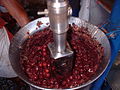 Mincing açaí berries into a pulp

See also
References
- ^ Greene, Aislyn (19 June 2015). "The Surprising History of the Açaí Bowl". AFAR. Archived from the original on 12 July 2015. Retrieved 26 September 2020.
- ^ "Amazon Açaí Bowl · Global Gastros". Global Gastros. 30 June 2017. Archived from the original on 9 May 2021. Retrieved 27 September 2020.
- ^ a b Huddleston, Justina (21 June 2018). "Who Really Invented the Açaí Bowl?". Brit + Co. Archived from the original on 27 October 2022. Retrieved 14 January 2024.
- ^ Bogatin, Adam (9 March 2020). "What Does Acai Taste Like?". Purple Foods. Archived from the original on 13 March 2020. Retrieved 8 October 2020.
- ^ Kugel, Seth (23 February 2010). "Açaí, a Global Super Fruit, Is Dinner in the Amazon". The New York Times. Cametá. ISSN 1553-8095. Archived from the original on 25 February 2010.
- ^ The Rough Guide to South America On A Budget, Rough Guides, 1 August 2011, p. 257, ISBN 978-1-84836-774-6
- ^ "History of the Acai Bowl". Tambor. 3 March 2014. Archived from the original on 7 October 2014. Retrieved 26 September 2020.
- ^ "Culinary Encyclopedia: Acai Berry". Retrieved 24 November 2012.
{{cite web}}: CS1 maint: deprecated archival service (link) - ^ a b Dias Carneiro, Júlia (14 December 2023). "Acai is a nutritious superfood—but is it good for the planet?". National Geographic. Retrieved 15 July 2025.
- ^ a b "Acai berry craze boosts incomes in the Brazilian Amazon, but at a cost". Al Jazeera. 28 August 2023. Retrieved 15 July 2025.
- ^ Dupuy, Lisa (12 May 2015). "Dining Review: Juicers have a sweet spot for Acai berries". Glendale News-Press. Retrieved 15 July 2025.
- ^ a b Jordan, Nicholas (22 April 2024). "Purple reign: it was big in Australia 15 years ago, so why is acai popular again?". The Guardian. ISSN 0261-3077. Retrieved 15 July 2025.
- ^ "Acai: Usefulness and Safety". NCCIH. Retrieved 15 July 2025.
- ^ "Acai bowls might not be as healthy as they look". BYUH Ke Alaka'i. 8 August 2024. Retrieved 15 July 2025.
- ^ Evans, Simon (21 November 2024). "The muscle and clout behind Australia's $750m acai boom". Australian Financial Review. Retrieved 15 February 2026.
- ^ Jordan, Nicholas (22 April 2024). "Purple reign: it was big in Australia 15 years ago, so why is acai popular again?". The Guardian. ISSN 0261-3077. Retrieved 15 February 2026.
- ^ a b Baker, Jordan (16 April 2025). "Trad trades gangster life for acai berry business". The Sydney Morning Herald. Retrieved 15 February 2026.