








Portal:Netherlands
Welcome to the Netherlands Portal
Welkom bij het Nederlandportaal!

|

|

| |
The Netherlands, informally Holland, is a country in Northwestern Europe, with overseas territories in the Caribbean. It is the largest of the four constituent countries of the Kingdom of the Netherlands. The Netherlands consists of twelve provinces; it borders Germany to the east and Belgium to the south, with a North Sea coastline to the north and west. It shares maritime borders with the United Kingdom, Germany, and Belgium. The official language is Dutch, with West Frisian as a secondary official language in the province of Friesland. Dutch, English, and Papiamento are official in the Caribbean territories. People from the Netherlands are referred to as Dutch.
The Netherlands has been a parliamentary constitutional monarchy with a unitary structure since 1848. The country has a tradition of pillarisation (separation of citizens into groups by religion and political beliefs) and a long record of social tolerance, having legalised prostitution and euthanasia, along with maintaining a liberal drug policy. The Netherlands allowed women's suffrage in 1919 and was the first country to legalise same-sex marriage in 2001. Its mixed-market advanced economy has the eleventh-highest per capita income globally. The Hague holds the seat of the States General, cabinet, and Supreme Court. The Port of Rotterdam is the busiest in Europe. Schiphol is the busiest airport in the Netherlands, and the fourth busiest in Europe. Being a developed country, the Netherlands is a founding member of the European Union, eurozone, G10, NATO, OECD, and WTO, as well as a part of the Schengen Area and the trilateral Benelux Union. It hosts intergovernmental organisations and international courts, many of which are in The Hague. (Full article...)
 Featured articles -

-
![Image 1 Windmill at Wijk bij Duurstede (c. 1670) Jacob Isaackszoon van Ruisdael (Dutch pronunciation: [ˈjaːkɔp fɑn ˈrœyzdaːl] ⓘ; c. 1629 – 10 March 1682) was a Dutch painter, draughtsman, and etcher. He is generally considered the pre-eminent landscape painter of the Dutch Golden Age, a period of great wealth and cultural achievement when Dutch painting became highly popular. Prolific and versatile, Ruisdael depicted a wide variety of landscape subjects. From 1646 he painted Dutch countryside scenes of remarkable quality for a young man. After a trip to Germany in 1650, his landscapes took on a more heroic character. In his late work, conducted when he lived and worked in Amsterdam, he added city panoramas and seascapes to his regular repertoire. In these, the sky often took up two-thirds of the canvas. In total he produced more than 150 Scandinavian views featuring waterfalls. (Full article...)](http://upload.wikimedia.org/wikipedia/en/d/d2/Blank.png)
Jacob Isaackszoon van Ruisdael (Dutch pronunciation: [ˈjaːkɔp fɑn ˈrœyzdaːl] ⓘ; c. 1629 – 10 March 1682) was a Dutch painter, draughtsman, and etcher. He is generally considered the pre-eminent landscape painter of the Dutch Golden Age, a period of great wealth and cultural achievement when Dutch painting became highly popular.
Prolific and versatile, Ruisdael depicted a wide variety of landscape subjects. From 1646 he painted Dutch countryside scenes of remarkable quality for a young man. After a trip to Germany in 1650, his landscapes took on a more heroic character. In his late work, conducted when he lived and worked in Amsterdam, he added city panoramas and seascapes to his regular repertoire. In these, the sky often took up two-thirds of the canvas. In total he produced more than 150 Scandinavian views featuring waterfalls. (Full article...) -
Soeara Berbisa ([suˈara bərˈbisa]; Perfected Spelling: Suara Berbisa; Indonesian for Venomous Voice) is a 1941 film from the Dutch East Indies. Produced by Ang Hock Liem for Union Films and directed by R Hu, this black-and-white film stars Raden Soekarno, Ratna Djoewita, Oedjang, and Soehaena. The story, written by Djojopranoto, follows two young men who compete for the affections of a woman before learning that they are long-lost brothers.
Filmed in September and October 1941, Soeara Berbisa features keroncong music and was shot partly in western Java. It was released to coincide with the Eid al-Fitr holiday and rated for all ages. Advertisements emphasised the film's appeal to both native and Dutch audiences, and a review in De Indische Courant was positive. Although the film—Union's penultimate production—was screened as late as 1949, it is now likely lost. (Full article...) -
Drama dari Krakatau ([ˈdrama daˈri kraˈkatau]; Drama of Krakatoa) is a 1929 vernacular Malay novel written by Kwee Tek Hoay. Inspired by Edward Bulwer-Lytton's 1834 novel The Last Days of Pompeii and the 1883 eruption of Krakatoa, the sixteen-chapter book centres on two families in 1920s Batam that are unknowingly tied together by siblings who were separated in 1883. The brother becomes a political figure, while the sister marries a Baduy priest-king. Ultimately, these families are reunited by the wedding of their children, after which the priest sacrifices himself to calm a stirring Krakatoa.
First published as a serial in Kwee's magazine Panorama between 7 April and 22 December 1928, Drama dari Krakatau was written over a period of two months after the author was asked to prepare a "sensational" story for a film. Before the final instalment had been published, the novel had already been adapted for the stage. Although Kwee was known as a realist and researched the volcano before writing, Drama dari Krakatau is replete with mysticism. Thematic analyses have focused on the depiction of indigenous cultures by Kwee (himself ethnic Chinese), as well as geography and nationalism. As with other works of Chinese Malay literature, the book is not considered part of the Indonesian literary canon. (Full article...) -
Sorga Ka Toedjoe ([ˈsɔrɡa kə ˈtudʒu]; vernacular Malay for Seventh Heaven; also advertised under the Dutch title In Den Zevenden Hemel) is a 1940 film from the Dutch East Indies (present-day Indonesia) directed by Joshua and Othniel Wong for Tan's Film. It follows an older couple (Kartolo and Annie Landouw) who are reunited by another, younger couple (Roekiah and Djoemala) after years of separation. The black-and-white film, the first production by Tan's Film after the departure of Rd Mochtar, featured kroncong music and was targeted at lower-class native audiences. It was a commercial and critical success. Roekiah and Djoemala took leading roles in three more films before Tan's closed in 1942. Sorga Ka Toedjoe is now thought lost. (Full article...) -

Hieronymus Bosch, The Garden of Earthly Delights, oil on oak panels, 205.5 cm × 384.9 cm (81 in × 152 in), Museo del Prado, Madrid
The Garden of Earthly Delights (Dutch: De tuin der lusten, lit. 'The garden of lusts') is the modern title given to a five-panel triptych (three oil-painted panels when open, two oak panels when closed) by the Early Netherlandish master Hieronymus Bosch, between 1490 and 1510, when Bosch was between 40 and 60 years old. Because of Bosch's religious beliefs, interpretations of the work typically assume it is a warning against the perils of temptation. The outer panels place the work on the Third Day of Creation. The intricacy of its symbolism, particularly that of the central panel, has led to a wide range of scholarly interpretations over the centuries.
Twentieth-century art historians are divided as to whether the triptych's central panel is a moral warning or a panorama of the paradise lost. He painted three large triptychs (the others are The Last Judgment of c. 1482 and The Haywain Triptych of c. 1516) that can be read from left to right and in which each panel was essential to the meaning of the whole. Each of these three works presents distinct yet linked themes addressing history and faith. Triptychs from this period were generally intended to be read sequentially, the left and right panels often portraying Eden and the Last Judgment respectively, while the main subject was contained in the centerpiece. (Full article...) -
Harta Berdarah ([harˈta bərˈdarah]; Indonesian for Bloody Treasure) is a 1940 action film from the Dutch East Indies (now Indonesia). Set in the Middle Ages, the film stars R Sukran and Hadidjah as a pirate and a princess who fall in love. Union Films, the country's first indigenous film production house, produced the film with Rd Ariffien and R Hu as directors. It was written by Saeroen, one of the country's most prolific screenwriters.The film, which stars Zonder and Soelastri, tells of a young man who convinces a stingy hadji to be more charitable and, in the process, falls in love with the man's daughter.
Released during Eid al-Fitr, Harta Berdarah was advertised as a "magnificent Indonesian action hit" and used Zonder's silat skills and Soelastri's fame as a keroncong singer to draw audiences. Reviews for the work were positive, with praise focused on its acting and story. Although Harta Berdarah was screened as late as 1944, as with most contemporary productions it is now likely lost. (Full article...) -
Terang Boelan (Indonesian pronunciation: [t̪əˌraŋ ˈbulan]; Indonesian for "Full Moon", Terang Bulan in the Enhanced Spelling System) is a 1937 film from the Dutch East Indies (now Indonesia). Written by Saeroen, directed by Albert Balink, and starring Rd Mochtar, Roekiah and Eddie T. Effendi, Terang Boelan follows two lovers who elope after one is almost forced to marry an opium smuggler. The film was shot in the Indies and Singapore, and was partially inspired by the 1936 Hollywood film The Jungle Princess. It was aimed at native audiences and included keroncong music, which was popular at the time, and several actors from Balink's previous work Pareh (1936).
Terang Boelan was a commercial success in both the Indies and abroad, earning 200,000 Straits dollars in British Malaya. This success revived the faltering domestic film industry and inspired films aimed at Malay audiences in Malaya, creating a formula of songs, beautiful scenery and romance that was followed for decades afterwards. The Indonesian film historian Misbach Yusa Biran described it as a turning point in the history of Indonesian cinema for its catalytic effect on the industry's growth. Like many Indonesian films of the era, Terang Boelan has been lost since at least the 1970s. (Full article...) -
Si Ronda is a 1930 silent film from the Dutch East Indies which was directed by Lie Tek Swie and starred Bachtiar Effendi. Based on contemporary Betawi oral tradition, it follows the exploits of a bandit, skilled in silat (traditional Malay martial arts), known as Si Ronda. In the lenong stories from which the film was derived, Ronda was often depicted as a Robin Hood type of figure. The production, now thought lost, was one of a series of martial arts films released between 1929 and 1931. Si Ronda received little coverage in the media upon its release. A second adaptation of the tale, Si Ronda Macan Betawi, was made in 1978. (Full article...)
-
Annelies Marie Frank (12 June 1929 – c. February or March 1945) was a German-born Jewish diarist and Holocaust victim. She gained worldwide fame posthumously for keeping a diary documenting her life in hiding during the German occupation of the Netherlands. In the diary, she regularly described her family's everyday life in their hiding place in an Amsterdam attic from 1942 until their arrest in 1944.
Frank was born in Frankfurt, Germany, in 1929. In 1934, when she was four and a half, Frank and her family moved to Amsterdam after Adolf Hitler and the Nazi Party gained control of Germany. By May 1940, the family was trapped in Amsterdam due to Germany's occupation. Frank lost her German citizenship in 1941 and became stateless. Despite spending most of her life in the Netherlands and being a de facto Dutch national, she never officially became a Dutch citizen. As persecutions of the Jewish population increased in July 1942, the family went into hiding in rooms concealed behind a bookcase in the building where Frank's father, Otto Frank, worked. The family was arrested two years later by the Gestapo, on 4 August 1944. (Full article...) -
Air Mata Iboe (Perfected spelling: Air Mata Ibu; Malay for A Mother's Tears) is a 1941 film from the Dutch East Indies (now Indonesia) directed and written by Njoo Cheong Seng. Starring Fifi Young, Rd Ismail, Ali Sarosa, and Ali Joego, it followed a mother who raises her children lovingly but is ultimately betrayed by her eldest sons when she falls upon hard times. The film, billed as a musical extravaganza, featured a soundtrack by R Koesbini, and an eponymous title song written by Njoo.
The last production completed by Fred Young's Majestic Film Company, Air Mata Iboe was released in December 1941, shortly before the Japanese occupation of the Dutch East Indies. This film, now possibly lost, received positive reviews. A remake was produced under the same title in 1957; Young reprised her role. (Full article...)
![Image 1 Windmill at Wijk bij Duurstede (c. 1670) Jacob Isaackszoon van Ruisdael (Dutch pronunciation: [ˈjaːkɔp fɑn ˈrœyzdaːl] ⓘ; c. 1629 – 10 March 1682) was a Dutch painter, draughtsman, and etcher. He is generally considered the pre-eminent landscape painter of the Dutch Golden Age, a period of great wealth and cultural achievement when Dutch painting became highly popular. Prolific and versatile, Ruisdael depicted a wide variety of landscape subjects. From 1646 he painted Dutch countryside scenes of remarkable quality for a young man. After a trip to Germany in 1650, his landscapes took on a more heroic character. In his late work, conducted when he lived and worked in Amsterdam, he added city panoramas and seascapes to his regular repertoire. In these, the sky often took up two-thirds of the canvas. In total he produced more than 150 Scandinavian views featuring waterfalls. (Full article...)](http://en.wikipedia.org/wiki/File:Blank.png)


.jpg)
.jpg)
Featured lists
-
The Amsterdam Tournament (Dutch: Amsterdam Toernooi) was a pre-season association football competition, held in Amsterdam, Netherlands. The competition was hosted by Eredivisie club Ajax at the Amsterdam Arena. It was inaugurated in 1975 as the Amsterdam 700 Tournament to celebrate 700 years of history in the city. It was held annually each summer until 1992, when the last edition of the original tournament was played. It returned in 1999 with the backing of the International Event Partnership (IEP). Four teams participate in the competition, played in a league format since 1986.
Since its return, the tournament has used an unusual point scoring system. As with most league competitions, three points are awarded for a win, one for a draw and zero for a loss. An additional point, however, is awarded for each goal scored. The system is designed to reward teams that adopt a more attacking style of play. Each entrant plays two matches, with the winner being the club that finishes at the top of the table. The original competition was held at Amsterdam's Olympic Stadium, where Ajax played its international games until 1996. The Amsterdam Arena, now named the Johan Cruyff Arena, has played host to the event since the return until 2009. (Full article...) -

The Wong brothers (one pictured) were the first ethnic Chinese directors in the Indies.
Twenty-nine people are recorded as having directed fictional films in the Dutch East Indies between 1926, when L. Heuveldorp released Loetoeng Kasaroeng, the colony's first domestically produced film, and 1949, when the Dutch formally recognised Indonesia's sovereignty after a four-year revolution, leaving the Dutch East Indies defunct. Thirteen directors active in the Indies continued to direct films after 1950, including Usmar Ismail: his 1950 film Darah dan Doa (The Long March) is generally considered the first truly Indonesian film.
The colony's first directors, L. Heuveldorp and George Krugers, were of European or mixed descent. They were followed by ethnic Chinese soon after, when Nelson Wong made his debut in 1928 with Lily van Java; other Chinese directors included Lie Tek Swie (1929), Wong's brothers Joshua and Othniel (1930), and The Teng Chun (1931). Ethnic Chinese directors dominated the colony's cinema for the remainder of its existence. The first native director, Bachtiar Effendi, made his debut in 1932 with the talkie Njai Dasima; another native director would not appear until Andjar Asmara and Rd Ariffien made their debuts in 1940. (Full article...) -

Film poster for Loetoeng Kasaroeng, the first locally produced film released in the Dutch East Indies
A total of 112 fictional films are known to have been produced in the Dutch East Indies (modern-day Indonesia) between 1926 and the colony's dissolution in 1949. The earliest motion pictures, imported from abroad, were shown in late 1900, and by the early 1920s imported serials and fictional films were being shown, often with localised names. Dutch companies were also producing documentary films about the Indies to be shown in the Netherlands. The first reports of fictional film production in the Indies date from 1923, although the work in question was not completed. The first locally produced film, Loetoeng Kasaroeng, was directed by L. Heuveldorp and released on 31 December 1926.
Between 1926 and 1933 numerous other local productions were released. Although Dutchmen like Heuveldorp and George Krugers continued to be active in the industry, the majority of filmmakers and producers were ethnic Chinese. The Tan brothers (Khoen Yauw and Khoen Hian) and The Teng Chun were major producers during this period, while the Wong brothers (Nelson, Othniel, and Joshua) were among the more prominent directors. During the mid-1930s, production dropped as a result of the Great Depression. The release of Albert Balink's commercially and critically successful Terang Boelan (Full Moon) in 1937 led to renewed interest in filmmaking, and 1941 saw thirty locally produced films. This rate of production declined after the Japanese occupation beginning in early 1942, closing all but one film studio; this resulted in several films which had begun production in 1941 being released several years later. The majority of films produced during the occupation were short propaganda pieces. Following the Proclamation of Indonesian Independence in 1945 and during the ensuing revolution several films were made, by both pro-Dutch and pro-Indonesian backers; the Dutch formally recognised Indonesia's sovereignty on 27 December 1949, leaving the Dutch East Indies defunct. (Full article...) -
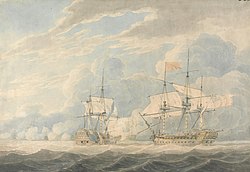
1799 painting of the Battle of Camperdown by Robert Cleveley
The Battle of Camperdown was an important naval action of the French Revolutionary Wars, fought off Camperduin on the North Holland coast on 11 October 1797 between a Royal Navy fleet under Admiral Adam Duncan and a Batavian Navy fleet under Vice-Admiral Jan Willem de Winter. France had overrun the Dutch Republic two years earlier, which was replaced by the Batavian Republic. In early 1797, the Batavian Navy was ordered to sail to Brest and unite with the French Atlantic Fleet in preparation for an invasion of Ireland. Shortly afterwards, the British navy was paralysed by the Spithead and Nore mutinies, in which the navy's sailors refused to take their ships to sea until they were awarded better pay and conditions. For two months[citation needed] the English Channel was undefended, but the Batavian navy failed to take the opportunity to sail from their harbour in the Texel as their preparations were not complete; furthermore, a small squadron of loyal ships under Duncan convinced de Winter that the British navy was at sea by sending nonsensical signals to fictitious ships over the horizon.
By October 1797, the plan to invade Ireland had been abandoned and the British North Sea Fleet was again at full strength. During a brief period replenishing supplies at Yarmouth, news reached Duncan on 10 October that de Winter had set sail with his fleeton a raiding cruise[citation needed] and he returned to the Dutch coast, intercepting the Batavian fleet on its way back to the Texel. The Batavians formed a line of battle in shallow coastal waters to meet Duncan's attack, which was conducted in a confused mass, the British fleet separating into two groups that struck the vanguard and rear of the Batavian fleet, overwhelming each in turn and capturing eleven ships, including de Winter's flagship Vrijheid. On the return journey, three of the captured ships were lost, and none of the surviving prizes were ever suitable for active service again[citation needed]. Both sides suffered heavy casualties during the battle as each fleet had been trained to aim at the hulls of their opponents, maximising the damage to personnel. (Full article...) -
Since 1 January 2023, there are 342 regular municipalities (Dutch: gemeenten [ɣəˈmeːntə(n)] ⓘ; sing. gemeente [xəˈmeːntə] ⓘ) and three special municipalities (Dutch: bijzondere gemeenten [biˈzɔndərə -]) in the Netherlands. The latter is the status of three of the six island territories that make up the Dutch Caribbean. Municipalities are the second-level administrative division, or public bodies (Dutch: openbare lichamen), in the Netherlands and are subdivisions of their respective provinces. Their duties are delegated to them by the central government and they are ruled by a municipal council that is elected every four years. Municipal mergers have reduced the total number of municipalities by two-thirds since the first official boundaries were created in the mid 19th century. Municipalities themselves are informally subdivided into districts and neighbourhoods for administrative and statistical purposes.
These municipalities come in a wide range of sizes, Westervoort is the smallest with a land area of 7.01 km2 (2.71 sq mi) and Súdwest-Fryslân the largest with a land area of 522.7 km2 (201.8 sq mi). Schiermonnikoog is both the least populated, with 972 people, and the least densely populated municipality at 23/km2 (60/sq mi). Amsterdam has the highest population with 931,298 residents as of January 2024, whereas The Hague is the most densely populated with a density of 6,868/km2 (17,790/sq mi). (Full article...) -
This page is a list of films that received the Golden Film since its introduction in 2001 by the Netherlands Film Festival and the Netherlands Film Fund. In 2001 and 2002, films from the Netherlands received the award once they had sold 75,000 tickets. From 2003 to date, the Golden Film is awarded to films from the Netherlands once they have sold 100,000 tickets. This page shows, for both audience criteria, which films received the Golden Film and how soon they received it after their releases.
In the following tables, the 'year' column contains the years in which the films received the Golden Film, the '#' column contains the number of the Golden Film, the 'film title' column contains the titles of the receiving films, the 'film release' column contains the dates on which the films were first released in the cinemas, and the 'Golden Film' column contains the days when the Netherlands Film Festival and the Netherlands Film Fund announced that the receiving films reached the audience criterion of the Golden Film. (Full article...) -
Twenty-two people are recorded as having produced fictional films in the Dutch East Indies between 1926, when L. Heuveldorp released Loetoeng Kasaroeng, the colony's first domestically produced film, and 1949, when the Dutch formally recognised Indonesia's sovereignty after a four-year revolution, leaving the Dutch East Indies defunct. Altogether, they are credited for 93 of all known films produced in the Indies, and four of them remained active after independence. All were men; the first female film producer in Indonesia, Ratna Asmara, produced her first film in 1953.
The colony's first producer, Heuveldorp, was of European descent. He was followed in 1928 by the ethnic Chinese businessmen Tjan Tjoen Lian and Liem Goan Lian, who began work on Lily van Java but soon pulled out, to be replaced by David Wong. By 1930 Chinese producers had dominated the industry. The most active of these, The Teng Chun, made his debut in 1931 with Boenga Roos dari Tjikembang; he would go on to produce another 27 films before independence. No native Indonesian film producers are recorded from this period, although several productions were credited only to companies. (Full article...)


Selected biography

Muller started his career as a businessman, trading with East and West Africa. In his mid-twenties he travelled to Zanzibar, Mozambique, and South Africa for business purposes, but showed himself a keen ethnographer as well, collecting ethnographic artifacts and writing reports about the societies and people he encountered on his way. In 1890, Muller retired from business for personal reasons, and went to Germany to study ethnography and geography. He graduated with a Ph.D. dissertation four years later.
Featured pictures -
-
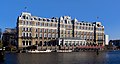 Photo credit: Massimo CatarinellaThe InterContinental Amstel Amsterdam is a five-star hotel in Amsterdam, Netherlands, on the east bank of the river Amstel. It opened in 1867 and was the first Grand Hotel in the country. The hotel underwent significant renovations in 1992 at a cost of 70 million guilders.
 -
 Photograph credit: Dominicus Johannes BergsmaClitocybe nebularis, commonly known as the clouded agaric or the cloud funnel, is a common gilled fungus that grows both in conifer-dominated forests and broad-leaved woodland in Europe and North America. This C. nebularis mushroom was photographed growing among fallen beech leaves in Famberhorst nature reserve, the Netherlands.
 -
 A self-portrait of Louis-Marie Autissier (1772–1830), a French-born Belgian portrait miniature painter. He is considered the founder of the Belgian school of miniature painting in the nineteenth century. Born at Vannes, in Brittany, he joined the French Revolutionary Army at Rennes in 1791. On leaving the army in 1795, Autissier went to Paris and trained his art by studying paintings at the Louvre. In 1796 he settled in Brussels, but continued to divide his time between Belgium, the Netherlands, and France. Although he enjoyed great success in his career, serving as court painter to Louis Napoleon, French King of the Netherlands, and later to Willem I, Autissier died penniless.
 -
 Photo: Massimo CatarinellaThe Munttoren, a tower in Amsterdam, the Netherlands, as seen from the river Amstel at dusk. The tower was originally part of the Regulierspoort, one of the main gates in Amsterdam's medieval city wall, dating to 1487. After a fire destroyed the gate in 1618, the tower was rebuilt in the Amsterdam Renaissance style, with an eight-sided top half and open spire designed by Hendrick de Keyser, featuring a clock with four faces and a carillon of bells. The name ("Mint Tower") refers to the time when it was temporarily used to mint coins in the Rampjaar ("disastrous year") of 1672 when both England and France declared war on the Dutch Republic, and silver and gold could not be safely transported to Dordrecht and Enkhuizen, where coins were normally minted.
 -
 Photograph: Andreas TrepteA juvenile pied avocet (Recurvirostra avosetta) near Oosterend, Texel Island, the Netherlands. While adults are black and white, juveniles of this species have more greyish and sepia tones.
 -
 Photograph: Andrew ShivaThe memorial tower at the Netherlands American Cemetery, a World War II war cemetery in Margraten, the Netherlands. Administered by the American Battle Monuments Commission, the cemetery holds 8,301 graves in an area of 65.5 acres (26.5 ha). The site includes a reflecting pool, museum, and a Court of Honor, the walls of which contain the Tablets of the Missing, on which are recorded the names of 1,722 American missing.
 -
 William I (1772–1843) was a Prince of Orange and the first King of the Netherlands and Grand Duke of Luxembourg. William implemented controversial language policies, founded many trade institutions and universities, and adopted a new constitution. However, the southern Netherlands became increasingly marginalized, and in 1830 the Belgian Revolution broke out. The war against the newly-declared Belgium caused considerable economic distress for the Netherlands, and in 1839 William signed the Treaty of London, which recognized Belgium. William abdicated the following year.
 -
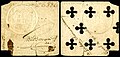 Card: Government of Dutch Guiana; image courtesy of the National Numismatic CollectionCard money, printed on plain cardboard or playing cards, was issued from the 17th to the 19th century to supplement the supply of money in several countries and colonies.
This playing card from Dutch Guiana (now Suriname), dated 1801, has a face value of one guilder. In that colony, card money was first issued in 1761, initially backed by bills of exchange from the Netherlands; but later it was released unsecured, and inflation was an issue for much of the currency's lifetime, with the value fluctuating wildly until it was replaced with paper money in 1826 and formally discontinued two years later. -
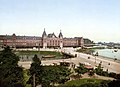 Image: Detroit Publishing Co.; Restoration: Lise BroerA ca. 1890–1900 photochrom print of Amsterdam Centraal railway station, one of the main railway hubs of the Netherlands, soon after its opening in 1889. The station is situated on three artificial islands at the head of the city, along the IJ. Its location was highly controversial, as it effectively cut the city off from its own waterfront, making it, for all purposes, an inland city.
 -
 Queen Wilhelmina and Princess Juliana of the NetherlandsPhoto credit: Bain News ServiceQueen Wilhelmina of the Netherlands with her daughter and successor Princess Juliana, circa 1914. Wilhelmina was queen regnant from 1890 to 1948, longer than any other Dutch monarch. Outside the Netherlands she is primarily remembered for her role in the Second World War, in which she proved to be a great inspiration to the Dutch resistance, as well as a prominent leader of the Dutch government in exile. Juliana became queen regnant in 1948 after her mother's abdication and ruled until her own abdication in 1980, succeeded by her daughter, Beatrix.
 -
![Image 11 Indonesian rupiah Banknotes: Bank of Indonesia The rupiah is the national currency of Indonesia. Introduced in 1946 by Indonesian nationalists fighting for independence, the currency replaced a version of the Netherlands Indies gulden which had been introduced during the Japanese occupation in World War II. In its early years the rupiah was used in conjunction with other currencies, including a new version of the gulden introduced by the Dutch. Since 1950, it has had a lengthy history of inflation and revaluation. As of August 2018[update] '"`UNIQ--nowiki-0000002A-QINU`"' , the currency—which is issued and controlled by the Bank of Indonesia—is trading for more than 14,600 rupiah to the United States dollar. This note, denominated 20,000 rupiah, is from a 2011 revision of an earlier series. It depicts Oto Iskandar di Nata, a National Hero of Indonesia, on its obverse, and Sundanese tea farmers on its reverse. See other denominations: Rp 1,000, Rp 2,000, Rp 5,000, Rp 10,000, Rp 50,000, Rp 100,000 More selected pictures](http://upload.wikimedia.org/wikipedia/commons/thumb/0/0c/20000_rupiah_bill%2C_2011_revision_%282013_date%29%2C_processed%2C_obverse%2Breverse.jpg/120px-20000_rupiah_bill%2C_2011_revision_%282013_date%29%2C_processed%2C_obverse%2Breverse.jpg) Banknotes: Bank of IndonesiaThe rupiah is the national currency of Indonesia. Introduced in 1946 by Indonesian nationalists fighting for independence, the currency replaced a version of the Netherlands Indies gulden which had been introduced during the Japanese occupation in World War II. In its early years the rupiah was used in conjunction with other currencies, including a new version of the gulden introduced by the Dutch. Since 1950, it has had a lengthy history of inflation and revaluation. As of August 2018
Banknotes: Bank of IndonesiaThe rupiah is the national currency of Indonesia. Introduced in 1946 by Indonesian nationalists fighting for independence, the currency replaced a version of the Netherlands Indies gulden which had been introduced during the Japanese occupation in World War II. In its early years the rupiah was used in conjunction with other currencies, including a new version of the gulden introduced by the Dutch. Since 1950, it has had a lengthy history of inflation and revaluation. As of August 2018
'"`UNIQ--nowiki-0000002A-QINU`"'
, the currency—which is issued and controlled by the Bank of Indonesia—is trading for more than 14,600 rupiah to the United States dollar.
This note, denominated 20,000 rupiah, is from a 2011 revision of an earlier series. It depicts Oto Iskandar di Nata, a National Hero of Indonesia, on its obverse, and Sundanese tea farmers on its reverse.
See other denominations: Rp 1,000, Rp 2,000, Rp 5,000, Rp 10,000, Rp 50,000, Rp 100,000 -
 Japanese occupation of the Dutch East Indies registration cardDocument: Japanese occupation government; scan by the National Archives of the NetherlandsA registration card for Louis Wijnhamer (1904–1975), an ethnic Dutch humanitarian who was captured soon after the Empire of Japan occupied the Dutch East Indies in March 1942. Prior to the occupation, many ethnic Europeans had refused to leave, expecting the Japanese occupation government to keep a Dutch administration in place. When Japanese troops took control of government infrastructure and services such as ports and postal services, 100,000 European (and some Chinese) civilians were interned in prisoner-of-war camps where the death rates were between 13 and 30 per cent. Wijnhamer was interned in a series of camps throughout Southeast Asia and, after the surrender of Japan, returned to what was now Indonesia, where he lived until his death.
 -
 Painting: Johannes VermeerWoman Reading a Letter is an oil-on-canvas painting by the Dutch painter Johannes Vermeer, produced in around 1663. The central element of the painting is a woman in blue standing in front of an unseen window, reading a letter. The woman appears to be pregnant, although as pregnancy was rarely depicted in art during this period, some scholars have argued that the woman's rounded figure is simply a result of the fashions of the day. While the contents of the letter are not depicted, the composition of the painting is revealing. The map of the Netherlands on the wall behind the woman has been interpreted as suggesting that the letter she reads was written by a traveling husband. Alternatively, the box of pearls barely visible on the table before the woman might suggest a lover, as pearls are sometimes a symbol of vanity. The painting is unique among Vermeer's interiors in that no fragment of corner, floor or ceiling can be seen. Part of the collection of the city of Amsterdam as part of the Van der Hoop bequest, it has been in the Rijksmuseum since its inception.
 -
 Photograph credit: Savyasachi, retouched by ukexpatLaura Dekker (born 1995) is a New Zealand–born Dutch sailor who completed a solo circumnavigation of the globe in a 12.4-metre (41-foot) two-masted ketch from 2010 to 2012. Dekker was fourteen years old when she set off from Gibraltar rather than the Netherlands, because the Dutch shipping regulations did not permit anyone under the age of sixteen to skipper a boat of that size in Dutch waters. After crossing the Atlantic Ocean, she started her record-breaking attempt from Sint Maarten in the Caribbean, passing through the Panama Canal and traversing the Pacific, Indian and Atlantic Oceans before completing her circumnavigation back at Sint Maarten. This picture shows Dekker attending the 2011 Hiswa Boat Show in Amsterdam.
 -
![Image 15 Indonesian rupiah Banknotes: Bank of Indonesia The rupiah is the national currency of Indonesia. Introduced in 1946 by Indonesian nationalists fighting for independence, the currency replaced a version of the Netherlands Indies gulden which had been introduced during the Japanese occupation in World War II. In its early years the rupiah was used in conjunction with other currencies, including a new version of the gulden introduced by the Dutch. Since 1950, it has had a lengthy history of inflation and revaluation. As of August 2018[update] '"`UNIQ--nowiki-0000002B-QINU`"' , the currency—which is issued and controlled by the Bank of Indonesia—is trading for more than 14,600 rupiah to the United States dollar. This note, denominated 5,000 rupiah, is part of the 2009 series. It depicts Tuanku Imam Bonjol, a National Hero of Indonesia, on its obverse, and a West Sumatran weaver on its reverse. See other denominations: Rp 1,000, Rp 2,000, Rp 10,000, Rp 20,000, Rp 50,000, Rp 100,000 More selected pictures](http://upload.wikimedia.org/wikipedia/commons/thumb/8/88/5000_rupiah_bill%2C_2001_series_%282009_date%29%2C_processed%2C_obverse_and_reverse.jpg/120px-5000_rupiah_bill%2C_2001_series_%282009_date%29%2C_processed%2C_obverse_and_reverse.jpg) Banknotes: Bank of IndonesiaThe rupiah is the national currency of Indonesia. Introduced in 1946 by Indonesian nationalists fighting for independence, the currency replaced a version of the Netherlands Indies gulden which had been introduced during the Japanese occupation in World War II. In its early years the rupiah was used in conjunction with other currencies, including a new version of the gulden introduced by the Dutch. Since 1950, it has had a lengthy history of inflation and revaluation. As of August 2018
Banknotes: Bank of IndonesiaThe rupiah is the national currency of Indonesia. Introduced in 1946 by Indonesian nationalists fighting for independence, the currency replaced a version of the Netherlands Indies gulden which had been introduced during the Japanese occupation in World War II. In its early years the rupiah was used in conjunction with other currencies, including a new version of the gulden introduced by the Dutch. Since 1950, it has had a lengthy history of inflation and revaluation. As of August 2018
'"`UNIQ--nowiki-0000002B-QINU`"'
, the currency—which is issued and controlled by the Bank of Indonesia—is trading for more than 14,600 rupiah to the United States dollar.
This note, denominated 5,000 rupiah, is part of the 2009 series. It depicts Tuanku Imam Bonjol, a National Hero of Indonesia, on its obverse, and a West Sumatran weaver on its reverse.
See other denominations: Rp 1,000, Rp 2,000, Rp 10,000, Rp 20,000, Rp 50,000, Rp 100,000

_tussen_afgevallen_beukenblad_(d.j.b.)_01.jpg)


_card_money.jpg)


![Image 11 Indonesian rupiah Banknotes: Bank of Indonesia The rupiah is the national currency of Indonesia. Introduced in 1946 by Indonesian nationalists fighting for independence, the currency replaced a version of the Netherlands Indies gulden which had been introduced during the Japanese occupation in World War II. In its early years the rupiah was used in conjunction with other currencies, including a new version of the gulden introduced by the Dutch. Since 1950, it has had a lengthy history of inflation and revaluation. As of August 2018[update] '"`UNIQ--nowiki-0000002A-QINU`"' , the currency—which is issued and controlled by the Bank of Indonesia—is trading for more than 14,600 rupiah to the United States dollar. This note, denominated 20,000 rupiah, is from a 2011 revision of an earlier series. It depicts Oto Iskandar di Nata, a National Hero of Indonesia, on its obverse, and Sundanese tea farmers on its reverse. See other denominations: Rp 1,000, Rp 2,000, Rp 5,000, Rp 10,000, Rp 50,000, Rp 100,000 More selected pictures](http://en.wikipedia.org/wiki/File:20000_rupiah_bill,_2011_revision_(2013_date),_processed,_obverse%2Breverse.jpg)


.jpg)
![Image 15 Indonesian rupiah Banknotes: Bank of Indonesia The rupiah is the national currency of Indonesia. Introduced in 1946 by Indonesian nationalists fighting for independence, the currency replaced a version of the Netherlands Indies gulden which had been introduced during the Japanese occupation in World War II. In its early years the rupiah was used in conjunction with other currencies, including a new version of the gulden introduced by the Dutch. Since 1950, it has had a lengthy history of inflation and revaluation. As of August 2018[update] '"`UNIQ--nowiki-0000002B-QINU`"' , the currency—which is issued and controlled by the Bank of Indonesia—is trading for more than 14,600 rupiah to the United States dollar. This note, denominated 5,000 rupiah, is part of the 2009 series. It depicts Tuanku Imam Bonjol, a National Hero of Indonesia, on its obverse, and a West Sumatran weaver on its reverse. See other denominations: Rp 1,000, Rp 2,000, Rp 10,000, Rp 20,000, Rp 50,000, Rp 100,000 More selected pictures](http://en.wikipedia.org/wiki/File:5000_rupiah_bill,_2001_series_(2009_date),_processed,_obverse_and_reverse.jpg)
Did you know (auto-generated)

- ... that priest Suitbert Mollinger served five years for fraud in a Dutch prison before founding one of the world's largest relic chapels in the United States?
- ... that two American officers bribed Japanese troops with their watches to have Dutch medical officer Henri Hekking allocated to their prisoner of war camp?
- ... that after leading the Khoikhoi in war against the Dutch at the Cape of Good Hope, Doman returned to Dutch service as an interpreter?
- ... that the Dutch edition of Endgame: Inside the Royal Family and the Monarchy's Fight for Survival was recalled?
- ... that Leonie ter Braak made her film debut in The Marriage Escape, the film of Dutch origin with the most cinema ticket sales in 2020?
- ... that, of the three presidents of the Chamber of Dutch Culture, two were arrested and one was assassinated?
Categories

Related portals


.svg)
Featured content
Extended content
| ||
|---|---|---|
|
This page gives an overview of all featured content ( Featured articles
Featured lists
|


-Vincent-van-Gogh-Met.jpg)

_-_Google_Art_Project_-_edited.jpg)


.jpg)


.jpg)

.jpg)


_-_Google_Art_Project.jpg)


_-_Google_Art_Project.jpg)


_-_Google_Art_Project.jpg)


.jpg)


.jpg)


_-_Google_Art_Project.jpg)


_%E2%80%93_cropped.jpg)


.jpg)


-1-Dutch_Administration-1_Gulden_(1815).jpg)
.jpg)
.jpg)
.jpg)
.jpg)
.jpg)
.jpg)
.jpg)


.jpg)
.jpg)

(Jan_Abrahamsz._Beerstraten).jpg)


,_Queen_of_Hungary.jpg)


.jpg)

,_koning_der_Nederlanden,_Nicolaas_Pieneman,_1856_-_Rijksmuseum.jpg)


Things you can do

Wikiprojects
|
|
You are invited to participate in the WikiProject Netherlands, a WikiProject dedicated to developing and improving articles about the Netherlands. |


