








Talk:Halo (religious iconography)
 | This article is rated B-class on Wikipedia's content assessment scale. It is of interest to the following WikiProjects: | ||||||||||||||||||||||||||||||
| |||||||||||||||||||||||||||||||


.svg)

Pope
The picture of the Pope does not contain a halo, it is the back of the Seat of Peter. —Preceding unsigned comment added by 75.149.140.5 (talk) 17:51, 23 January 2011 (UTC)
- No, it isn't. Johnbod (talk) 20:24, 19 January 2012 (UTC)
Etymology
I would suggest a much older origin for the etymology of "halo" meaning "a corona of light around an object". In an updated version of Julius Pokorny's Proto-Indo-European (PIE) wordlist [available from Univ. of Texas site <http://www.utexas.edu/cola/centers/lrc/ielex/PokornyMaster-X.html> ], the entry # 58 al (6) = 'white, gleaming' This homo-organic phonetic etymon derivation for "halo" also coincides very well with the Hebrew Semitic "halal" ( see root הלל) in Hebrew <E. Klein, A comprehensive Etymological Dictionary of the Hebrew Language, Jerusalem 1987 ISBN 965-220-093-X> ] meaning "shining". Therefore, considering these considerably older sources, I would submit that an ancient etymon “al or hal” was used to describe the “halo” phenomenon and was most likely the precursor of the Latin "halo" AND the Greek "halos" which are later Indo-European languages.79.179.30.25 (talk) 19:40, 19 January 2012 (UTC)Rosinskyb
- Well find sources making the connection & it can go in. Johnbod (talk) 20:24, 19 January 2012 (UTC)
Somewhat back down to earth
Read Aristophanes' Birds and Dunbar's commentary to 1114-5. The oldest sacred statues had bronze halos (known in Greek as moons) to stop birds shitting on them! — Preceding unsigned comment added by 81.129.245.255 (talk) 07:46, 15 August 2013 (UTC)
Requested move 6 February 2016
- The following is a closed discussion of a requested move. Please do not modify it. Subsequent comments should be made in a new section on the talk page. Editors desiring to contest the closing decision should consider a move review. No further edits should be made to this section.
The result of the move request was: Not moved per a lack of support to establish religious iconography as the primary topic. As such, the current disambiguation page is the most appropriate target for now. (non-admin closure) Tiggerjay (talk) 04:34, 14 February 2016 (UTC)
– Primary topic. The Oxford Dictionary definition for halo is the following. Shhhhwwww!! (talk) 06:35, 6 February 2016 (UTC)
A disk or circle of light shown surrounding or above the head of a saint or holy person to represent their holiness.
- Oppose I'd love to support - this gets about 140K views a year, vs 160K for the disam page. But Halo (series) dwarfs both figures. Johnbod (talk) 06:44, 6 February 2016 (UTC)
- Oppose The video game series should be the main topic, not this arts obscurity. Dimadick (talk) 09:57, 6 February 2016 (UTC)
- Ha, ha! You're joking of course, especially as there are several different articles on the franchise. But Halo (series) should be better named. Johnbod (talk) 11:21, 6 February 2016 (UTC)
- Strong oppose a halo is a visual phenomenon. IT appears all over the place, halos around the sun and the moon abound in photography, St. Elmo's Fire halos frequently appear on vehicles. -- 70.51.200.135 (talk) 16:54, 6 February 2016 (UTC)
- Comment on everyone Even if the company has more views than the fruit and the singer more than the color, "apple" and "pink" are the titles for the common nouns not the proper ones. It is established by more than thousands of years, at least five thousand, that a "halo" refers to the object on a person's head that signifies holiness. The reference to the video game simply reeks of Recentism and Western bias and is a symptom of the problems that arise in the Criticism of Wikipedia. Any dictionary has the religious iconography placed first as the definition. The scientific term came much later and still less prominent in definitions. Shhhhwwww!! (talk) 10:06, 7 February 2016 (UTC)
a circle of light that is shown in a religious painting, drawing, etc., around the head of a holy figure (such as an angel, saint, or god)
1.
a. A luminous ring or disk of light surrounding the heads or bodies of sacred figures, such as saints, in religious paintings; a nimbus.
b. A ring or disk resembling the halo of a sacred figure
a ring of light around the head of a holy person in a religious drawing or painting
Noun (plural) -loes or -los a disc or ring of light around the head of an angel, saint, etc, as in painting or sculpture
- That's not how WP:PTOPIC works. Johnbod (talk) 03:46, 8 February 2016 (UTC)
- Weak oppose. The visual phenomenon, while derived from the usage in religious iconography, is the actual primary topic. The video game series certainly is not. 64.105.98.115 (talk) 03:36, 8 February 2016 (UTC)
- No, the point is there's no primary topic. That we already have 3 different suggestions for what the primary topic is confirms that there isn't one! It certainly wouldn't be the visual phenomenon. Johnbod (talk) 03:46, 8 February 2016 (UTC)
- Oppose. I agree that the etymology arises from the religious concept. However, after reviewing sources, I do not believe any of the topics are primary. Thus the page is best left as disambiguation. --Regards, James(talk/contribs) 00:00, 12 February 2016 (UTC)
- The above discussion is preserved as an archive of a requested move. Please do not modify it. Subsequent comments should be made in a new section on this talk page or in a move review. No further edits should be made to this section.
Halo in art??
Why the discussion is only about the presence of the Halo in the religious iconography? So many saints and people have experienced/are experiencing this, why there's not an entry about this? The religious iconography should be just a historical section and not the whole entry devoted to the entry Halo. People meditating in our times are experiencing Halos', there should be a definite entry on this issue. — Preceding unsigned comment added by Viperalus (talk • contribs) 09:16, 26 November 2016 (UTC)
Lead image
There has recently been edit-warring over this, with a group(?) of banned sock-puppets and temporary ips pushing Jain Indian POV (see User_talk:GB_fan#Halo_(religious_iconography)). As I promised there, I'm raising the issue here (for the first time) so a consensus can be formally established. I'll put up 3 possibilities, but others can be added.
-
 Jesus and nine of the Twelve Apostles depicted with "Floating" disk haloes in perspective (detail from The Tribute Money, illustrating Matthew 17:24–27, by Masaccio, 1424, Brancacci Chapel). A the old one
 -
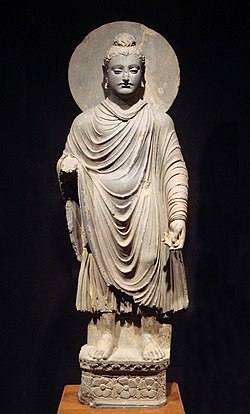 Standing Buddha with a halo, 1st–2nd century AD (or earlier), Greco-Buddhist art of Gandhara. B old #2
 -
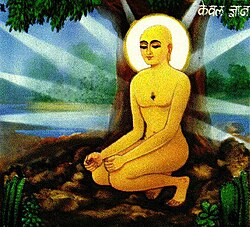 Mahavira with a halo, attaining enlightenment. C The "new" one - Jain figure

.jpeg)

Please say what you think below. Johnbod (talk) 16:32, 11 July 2018 (UTC)
- A or B Johnbod (talk) 16:34, 11 July 2018 (UTC)
- B Modernist (talk) 23:58, 13 July 2018 (UTC)
- A or B. Widely recognized art masterpieces and works that have passed the test of time should be preferred. Ewulp (talk) 06:03, 14 July 2018 (UTC)
- A or B Vexations (talk) 12:27, 14 July 2018 (UTC)
- B - both B or A would work, but a lead image's main purpose is the visual identification of the article topic. B has less additional details and is slightly better for this purpose (especially in a minimized thumbnail view). C is a low-res image with no verifiable information about the artist and the image's origin, thus not suitable. GermanJoe (talk) 12:35, 14 July 2018 (UTC)
- Thanks all! Gone with B. Johnbod (talk) 18:37, 19 July 2018 (UTC)
Halos being depicted much earlier
halos are depicted but before the greeks here are some halos from indus valley civilization.
indus seal lord of animals halo on top
one halo on top with peepal leaves, one halo on bottom
lord of animals depicted with halos
indus valley civilization halo — Preceding unsigned comment added by 202.188.53.210 (talk) 03:27, 11 December 2018 (UTC)
Reverts
@Johnbod: Hi, what's the problem. Why do you keep reverting? Wolfdog (talk) 00:10, 12 January 2022 (UTC)
- Because your edits are not improvements - you added a section called "In Sumerian art " for a single sentence that says nothing at all about Sumerian art. Get real. Johnbod (talk) 04:34, 12 January 2022 (UTC)
@Johnbod: Why are you continuing to ignore my requests for discussion? You can't keep reverting and then refuse to engage in conversation. Not how it works here. Wolfdog (talk) 16:29, 15 January 2022 (UTC)
- I apologize, I didn't see that you responded after all. MY problem was actually with the grammar, not really the semantic details. All other sections follow the "In [blank] art" convention. That's what I'm pushing for. I'll make the appropriate changes (though I'm still not sure why commentary about Sumer is being placed in the Ancient Greece section). Wolfdog (talk) 16:42, 15 January 2022 (UTC)
- Because it isn't worth a section for one sentence with only literary stuff. Note that "Ancient Greek world" better covers the Hellenistic mentions in modern Turkey etc, and also Iraq, the Greco-Buddhist art of the lead image, and the Indo-Greek coin illustrated. There is no real reason for consistency in section titles, and there is no issue of grammar here. See the discussion above re the best lead image. Johnbod (talk) 17:03, 15 January 2022 (UTC)
- I appreciate the commentary on the Ancient Greek world issue. An alternative to the structure "In [blank] art" (which is indeed, a grammatical structure) would be that we simply remove "in" from the other sections. It's hard for me to fathom why you would want to decrease consistency, except a general desire to control every aspect of the page. MOS:HEADINGS briefly urges aligning to a "consistent style" (though it mostly focuses on what not to do). Wolfdog (talk) 18:41, 15 January 2022 (UTC)
- I've no objection to removing the "In"s (something none of your edits did. Johnbod (talk) 20:53, 15 January 2022 (UTC)
- Yes. This was a new idea I was proposing. A compromise. Wolfdog (talk) 23:46, 15 January 2022 (UTC)
- I've no objection to removing the "In"s (something none of your edits did. Johnbod (talk) 20:53, 15 January 2022 (UTC)
- I appreciate the commentary on the Ancient Greek world issue. An alternative to the structure "In [blank] art" (which is indeed, a grammatical structure) would be that we simply remove "in" from the other sections. It's hard for me to fathom why you would want to decrease consistency, except a general desire to control every aspect of the page. MOS:HEADINGS briefly urges aligning to a "consistent style" (though it mostly focuses on what not to do). Wolfdog (talk) 18:41, 15 January 2022 (UTC)
- Because it isn't worth a section for one sentence with only literary stuff. Note that "Ancient Greek world" better covers the Hellenistic mentions in modern Turkey etc, and also Iraq, the Greco-Buddhist art of the lead image, and the Indo-Greek coin illustrated. There is no real reason for consistency in section titles, and there is no issue of grammar here. See the discussion above re the best lead image. Johnbod (talk) 17:03, 15 January 2022 (UTC)
A Commons file used on this page or its Wikidata item has been nominated for deletion
The following Wikimedia Commons file used on this page or its Wikidata item has been nominated for deletion:
Participate in the deletion discussion at the nomination page. —Community Tech bot (talk) 00:07, 9 April 2022 (UTC)
Note 16. Page cited is incorrect.
Have book. Checked page. Nothing on that page regarding the statement in the article. 12McCurdy (talk) 00:28, 6 September 2023 (UTC)
- Has wind. But not direction. Moved ref a bit. Johnbod (talk) 17:37, 6 September 2023 (UTC)