






George Town, Penang: Difference between revisions
Polopaladin04 (talk | contribs) →International relations: Fixed typo Tags: canned edit summary Mobile edit Mobile app edit |
Herman Jaka (talk | contribs) remove ADVERT/PROMOTION, garbage & excessive overprouded statement, bego amatt!! |
||
| Line 74: | Line 74: | ||
George Town's historic centre is a [[UNESCO]] [[World Heritage Site]]. The enclave consists of colonial architecture built during the heyday of [[British Empire|British]] rule over the [[Straits Settlements]], mixed with Chinese shophouses, [[five foot way]]s and places of worship of various religions. George Town is awarded the UNESCO listing for its "unique architectural and cultural townscape without parallel anywhere in [[East Asia|East]] and [[Southeast Asia]]". |
George Town's historic centre is a [[UNESCO]] [[World Heritage Site]]. The enclave consists of colonial architecture built during the heyday of [[British Empire|British]] rule over the [[Straits Settlements]], mixed with Chinese shophouses, [[five foot way]]s and places of worship of various religions. George Town is awarded the UNESCO listing for its "unique architectural and cultural townscape without parallel anywhere in [[East Asia|East]] and [[Southeast Asia]]". |
||
Currently George Town is one of the important [[medical tourism]] hub and financial centre of Malaysia. |
|||
Likewise, George Town is one of the most popular tourist destinations in Malaysia. It has been listed as one of the top global travel destinations by the likes of [[The Guardian]],<ref name="straitstimes.com">{{cite web|url=http://www.straitstimes.com/asia/se-asia/penangs-georgetown-named-no-4-in-lonely-planets-list-of-top-10-cities-for-travel|title=Penang's Georgetown named No. 4 in Lonely Planet's list of top 10 cities for travel|work=The Straits Times}}</ref> [[CNN]],<ref name="travel.cnn.com">{{cite web|url=http://travel.cnn.com/explorations/eat/asia-street-food-cities-612721/|title=Asia's 10 greatest street food cities|publisher=}}</ref> [[Los Angeles Times]]<ref name="latimes.com">{{cite web|url=http://www.latimes.com/travel/la-tr-d-16-places-20151227-story.html|title=Looking for a 2016 vacation? Here are 16 must-see destinations|author=Los Angeles Times|date=26 December 2015|work=latimes.com}}</ref> and [[Forbes]],<ref>{{cite web|url=http://www.thesundaily.my/news/1652607|title=Penang one of 2016's 'best budget travel destinations'|publisher=}}</ref> which also listed George Town as one of the best budget cities to retire in.<ref name="theantdaily.com">{{cite web|url=http://www.theantdaily.com/Main/Penang-is-third-best-place-to-retire-in-ahead-of-Chiang-Mai-why|title=Penang is third best place to retire in, ahead of Chiang Mai, why?|author=Ng Kee Seng|publisher=}}</ref> George Town was also ranked 8th. in the ECA International's list of most liveable cities in [[Asia]].<ref>{{cite web|url=https://www.eca-international.com/news/press_releases/7650/#.Voc57fl97IU|title=Hong Kong: Asia's third most liveable city, but among the world's worst for air quality|publisher=}}</ref> Additionally, George Town is the most important [[medical tourism]] hub and the northern financial centre of Malaysia. |
|||
==History== |
==History== |
||
| Line 232: | Line 232: | ||
=== [[Penang State Legislative Assembly|Penang State Government]] === |
=== [[Penang State Legislative Assembly|Penang State Government]] === |
||
Since the [[Malaysian general election, 2008|March 2008 elections]], the [[Penang State Legislative Assembly|Penang state government]] has been controlled by an alliance of the [[Democratic Action Party]] and the [[Parti Keadilan Rakyat]] (People's Justice Party). It is the second time in [[Penang]]'s history that Penangites voted opposition parties into power. |
Since the [[Malaysian general election, 2008|March 2008 elections]], the [[Penang State Legislative Assembly|Penang state government]] has been controlled by an alliance of the [[Democratic Action Party]] and the [[Parti Keadilan Rakyat]] (People's Justice Party). It is the second time in [[Penang]]'s history that Penangites voted opposition parties into power. |
||
After decades of neglect and bias by the ruling [[Barisan Nasional]], the successes of the new [[Penang State Legislative Assembly|Penang state government]], especially in greatly cutting state debt, successfully attracting one of the highest investments in Malaysia and in enhancing George Town's appeal as a clean, artistic historical city, have further raised political tensions between the [[Government of Malaysia|Malaysian federal government]] and the [[Penang State Legislative Assembly|Penang state government]].<ref>https://www.malaysiakini.com/letters/159425</ref> The [[Barisan Nasional]]-led [[Government of Malaysia|Malaysian federal government]] has, in turn, intensified its bias against [[Penang]], notably by denying financial assistance for the Penang Transport Master Plan<ref name="themalaysianinsider.com">http://www.themalaysianinsider.com/malaysia/article/penang-says-budget-2016-snub-malicious-discrimination</ref> and George Town's further development.<ref>http://www.themalaymailonline.com/malaysia/article/again-penang-ignored-in-five-year-malaysia-plan-guan-eng-says</ref> |
|||
List of George Town representatives in the [[Penang State Legislative Assembly]]. |
List of George Town representatives in the [[Penang State Legislative Assembly]]. |
||
| Line 785: | Line 783: | ||
* Mt Miriam Hospital |
* Mt Miriam Hospital |
||
* Carl Corrynton Medical Centre |
* Carl Corrynton Medical Centre |
||
==Non-Governmental Organisations (NGOs)== |
|||
George Town is one of the hotbeds of social activism in the country. [[Anwar Fazal]], one of the world's leading social advocate, together with several individuals, founded the Consumers Association of [[Penang]] (CAP) in 1969.<ref>{{cite web|url=http://www.anwarfazal.net/about.php|title=About Anwar Fazal |accessdate=13 September 2014}}</ref> The country's most vocal and active consumer protection group, CAP strives to protect the interests of consumers. It publishes the ''Utusan Konsumer'', ''Utusan Pengguna'', ''Utusan Cina'', ''Utusan Tamil'', and ''Majalah Pengguna Kanak-kanak''. It established the [[Third World Network]] (TWN) in 1984 to connect NGOs in developing countries.<ref>{{cite web | url=http://biz.thestar.com.my/news/story.asp?file=/2010/1/30/business/5512568&sec=business | title=Up close & personal with Martin Khor | publisher=Star Publications | date=30 January 2010 | accessdate=26 April 2012 | author=JIN, SOO E WE}}</ref> |
|||
The [[Penang]] Heritage Trust is an NGO whose objective is to promote the conservation of [[Penang]]'s heritage, and to foster cultural education about the history and heritage of [[Penang]]. PHT worked to enlist the historic enclave of George Town as a [[World Heritage Site]] and had played an important role in saving many heritage buildings in [[Penang]] from demolition.<ref>{{cite web|url=http://www.pht.org.my/|title=Penang Heritage Trust - Preserve heritage for future generations|publisher=|accessdate=13 September 2014}}</ref> |
|||
Friends of the [[Penang Botanic Gardens]] Society is a voluntary organisation dedicated to supporting the botanic, horticultural, educational and recreational objectives of the [[Penang Botanic Gardens]].<ref>{{cite web|url=http://www.botanikapenang.tripod.com/|title=Persatuan Sahabat Kebun Botanik Pulau Pinang Friends of the Penang Botanic Gardens Society|publisher=|accessdate=13 September 2014}}</ref> |
|||
The [[Penang]] Institute (formerly the Socio-Economic and Environmental Research Institute) is a non-profit George Town-based [[think tank]] and research institute with a focus on facilitating dynamic and sustainable development for [[Penang]].<ref>{{cite web|url=http://www.seri.com.my/v3/|title=Socio-Economic and Environmental Research Institute (SERI) – Home|publisher=|accessdate=13 September 2014}}</ref> It publishes the ''Penang Economic Monthly''. |
|||
Aliran is a national reform and human rights movement which began in 1977 in George Town. It publishes the ''Aliran Monthly''.<ref>{{cite web|url=http://aliran.com/about-us|title=About us « ALIRAN|work=ALIRAN|accessdate=13 September 2014}}</ref> |
|||
==International Relations== |
==International Relations== |
||
| Line 830: | Line 817: | ||
*{{flagu|Thailand}}<ref>{{cite web|url=http://www.thaiembassy.org/penang/|title=Royal Thai Consulate-General, Penang, Malaysia|publisher=Royal Thai Consulate-General, Penang, Malaysia|accessdate=20 December 2015}}</ref> |
*{{flagu|Thailand}}<ref>{{cite web|url=http://www.thaiembassy.org/penang/|title=Royal Thai Consulate-General, Penang, Malaysia|publisher=Royal Thai Consulate-General, Penang, Malaysia|accessdate=20 December 2015}}</ref> |
||
*{{flagu|United Kingdom}}<ref>{{cite web|url=https://www.gov.uk/government/priority/supporting-british-nationals-in-malaysia|title=Supporting British nationals in Malaysia|quote=Working with local partners and honorary representatives in Penang, Langkawi, Kota Kinabalu and Kuching to assist British nationals|publisher=[[Government of the United Kingdom]]|accessdate=20 December 2015}}</ref> |
*{{flagu|United Kingdom}}<ref>{{cite web|url=https://www.gov.uk/government/priority/supporting-british-nationals-in-malaysia|title=Supporting British nationals in Malaysia|quote=Working with local partners and honorary representatives in Penang, Langkawi, Kota Kinabalu and Kuching to assist British nationals|publisher=[[Government of the United Kingdom]]|accessdate=20 December 2015}}</ref> |
||
==George Town's Firsts== |
|||
[[File:St. George's Church Penang Dec 2006 001.jpg|thumb|St. George's Church, the oldest Anglican church in [[Southeast Asia]].]] |
|||
* George Town became the first [[British Empire|British]] settlement in [[Southeast Asia]] in 1786. |
|||
* George Town became a city by a royal charter granted by Her Majesty [[Queen Elizabeth II]] on 1 January 1957, becoming the first town in the [[Federation of Malaya]] to become a city. |
|||
* George Town and [[Malacca]] are the first cities in Malaysia to be granted the [[World Heritage Site|UNESCO World Heritage Site]] status. |
|||
* The [[Penang Island City Council]] (''Majlis Bandaraya Pulau Pinang''), is the successor of the Municipal Council of George Town, which was established in 1857 as Malaysia's first local council. |
|||
* [[Standard Chartered Bank]], the oldest bank in Malaysia, opened its doors in 1875. |
|||
* The [[Penang Hill Railway]], opened in 1923, is the first [[funicular]] hill railway in Malaysia. |
|||
* The [[Penang Ferry Service]] is the oldest ferry service in Malaysia, commencing operations in 1920. |
|||
* The [[Sultan Abdul Halim Muadzam Shah Bridge|Second Penang Bridge]] is the longest bridge in [[Southeast Asia]]. |
|||
* On 1 January 1906, Malaysia's first electric tramway began operations in George Town.<ref name="ReferenceA">{{cite web|url=http://www.visitpenang.gov.my/portal3/about-penang/history.html|title=History of Penang|author=Administrator III|publisher=|accessdate=13 September 2014}}</ref> |
|||
* The [[Penang Botanic Gardens]], established in 1884, is the first botanic gardens in Malaysia. |
|||
* The [[Royal Malaysian Police]] traces its roots to the 1807 "Charter of Justice" awarded by [[George III of the United Kingdom|King George III]] for [[Penang]] to form the police force and the Court of Justice. |
|||
* The country's first newspaper was published in George Town in 1805 – the ''Prince of Wales Island Gazette''. This was followed by the ''Penang Gazette'', first published in 1837.<ref>{{cite web|url=http://www.penang.gov.my/index.php?ch=16&pg=99&ac=2&lang=eng&format |title=Penang State Government |publisher=Penang.gov.my |accessdate=3 January 2011}}</ref> |
|||
* The [[Penang Free School]] founded by Rev. Sparke Hutchings in 1816, is the first and the oldest [[missionary school|English school]] in Southeast Asia. But the very first school was a Malay-language school started by Father Antonio Garnault in 1786 which evolves into today's [[St. Xavier's Institution]].<ref>See St. Xavier's Wiki for citations/support</ref> |
|||
* The [[St Xavier's Institution]], established in 1852, is the first school established in [[Southeast Asia]] to be administered and fully owned by the La Salle Brothers.<ref>{{cite web| url=http://thestar.com.my/news/story.asp?file=/2008/10/26/nation/2381338&sec=nation|title=St Xavier's marks a new chapter after 156 years|work=[[The Star (Malaysia)|The Star]]}}{{dead link|date=January 2016}}</ref> |
|||
* [http://www.stgeorgespg.org/ St George's Anglican Church] on Farquhar Street, established in 1816, is the oldest Anglican Church in [[Southeast Asia]] and the only building from [[Penang]] that was declared one of the 50 National Treasures by the [[Government of Malaysia|Malaysian federal government]]. |
|||
* The Sekolah Kebangsaan Gelugor, founded in 1826, is the first Malay school to be established in Malaysia.<ref>{{cite web|url=http://www.penang.gov.my/index.php?ch=16&pg=99&ac=4&lang=eng&format= |title=Penang State Government |publisher=Penang.gov.my |accessdate=3 January 2011}}</ref> |
|||
* [http://clsprimary.edu.my/ Convent Light Street] or the Convent of the Holy Infant Jesus, a girls' school established by a French Sisters' Mission in 1852, is the oldest girls' school in [[Southeast Asia]]. |
|||
* [[Chung Hwa Confucian School]] founded by [[Cheong Fatt Tze]] in 1904, is one of the oldest formal Chinese schools established in [[Southeast Asia]] as a result of influence by the educational reforms in [[Qing China]] in the early 1900s. [[Standard Chinese|Mandarin]] is the school's medium of instruction. |
|||
* [[Phor Tay High School]], founded in 1940, is the first Buddhist school in Malaysia. |
|||
* The [[Penang Turf Club]], established in 1864, is Malaysia's oldest [[horse racing]] and [[Equestrianism|equestrian]] centre. |
|||
* Malaysia's oldest Chinese newspaper still in circulation today, ''[[Kwong Wah Yit Poh]]'' or ''Kwong Wah Daily'' (光华日报) was founded on 20 December 1910 by Dr. [[Sun Yat-sen]] in George Town. |
|||
* St. Nicholas' Home Penang, a social outreach ministry under the Anglican Church founded in 1926, is first charitable organisation serving the needs of the blind and visually impaired community of Malaysia. St. Nicholas' Home also started the first blind school in Malaysia. |
|||
* George Town Dispensary is the earliest dispensary in the then [[British Malaya|Malaya]]. It was opened in 1895. |
|||
* [[Penang]] is the first state in Malaysia to launch the "No Plastic Bag Day" campaign. |
|||
* [http://www.butterfly-insect.com/ Penang Butterfly Farm], established in 1986, is the world's first butterfly and insect sanctuary to be set up in the tropical world. |
|||
* [https://www.facebook.com/PenangCameraMuseum The Camera Museum], newly established in 2012, is [[Southeast Asia]]'s first and only camera museum with extensive collections & the origin of the invention. |
|||
* [[Federation School for the Deaf]], founded in April 1954, is the first deaf school in [[Federation of Malaya]]. |
|||
==References in Popular Culture== |
|||
George Town was the shooting location for a number of movies, most notably: |
|||
* ''[[Indochine (film)|Indochine]]'' (France, 1992), featuring [[Catherine Deneuve]] and [[Vincent Perez]]. |
|||
* ''[[Beyond Rangoon]]'' (US/UK, 1995). |
|||
* ''[[Paradise Road (1997 film)|Paradise Road]]'' (US/Australia – 1997), starring [[Glenn Close]] and [[Frances McDormand]]. |
|||
* ''[[Anna and the King]]'' (US, 1999) featuring [[Jodie Foster]] and [[Chow Yun-fat]]. |
|||
* ''[[Ibu Mertuaku]]'' (Malaysia, 1962), featuring [[P Ramlee]] and [[Sarimah]]. |
|||
* ''[[The Touch (2002 film)|The Touch]]'' (Hong Kong, 2002), featuring [[Michelle Yeoh]]. |
|||
* ''[[Lust, Caution]]'' (Taiwan, 2007), directed by [[Ang Lee]]. |
|||
* [[Sun Yat-sen]] biography film ''[[Road to Dawn]]'' (China, 2007), featuring [[Winston Chao]] and [[Angelica Lee]]. |
|||
* ''[[The Blue Mansion]]'' ([[Singapore]], 2010), featuring [[Patrick Teoh]]. |
|||
* ''[[Ice Kacang Puppy Love]]'' (Malaysia, 2010), featuring [[Ah Niu]] and [[Angelica Lee]]. |
|||
Other than that, several television series were also shot in George Town. |
|||
* ''[[The Little Nyonya]]'' ([[Singapore]], 2008) |
|||
* ''[[The Journey: Tumultuous Times]]'' ([[Singapore]], 2014) |
|||
* ''[[The Amazing Race 16]]'' Episode 8. |
|||
* ''[[Asia's Next Top Model (cycle 2)]]'' Episode 8. |
|||
* ''[[Indian Summers]]'' (UK, 2015) |
|||
==Image gallery== |
==Image gallery== |
||
Revision as of 01:01, 7 January 2016
George Town
| |
|---|---|
City Centre | |
.jpg) | |
.svg) Flag  | |
| Motto(s): Leading We Serve (Memimpin Sambil Berkhidmat) | |
 | |
| Country | Malaysia |
| State | Penang |
| District | North-East Penang Island |
| Founded | 1786 |
| Municipality established | 1857 |
| Granted city status | 1957 |
| UNESCO World Heritage Site listing | 2008 |
| Government | |
| • Mayor (Datuk Bandar) | Dato' Patahiyah Ismail |
| Area | |
• City Centre | 305.773 km2 (118.060 sq mi) |
| • Metro | 2,740.000 km2 (1,057.920 sq mi) |
| Elevation | 4 m (13 ft) |
| Population (2012) | |
• City Centre | 529,400 |
| • Density | 4,299/km2 (11,130/sq mi) |
| • Metro | 2.5 million |
| Human Development Index | |
| • HDI (2010) | 0.773 (high) (3rd) |
| Time zone | UTC+8 (MST) |
| • Summer (DST) | Not observed |
| Postal code | 10000–11900, 14300 |
| Calling code | +60 4-2××××××, +60 4-6××××××, +60 4-8×××××× |
| Vehicle registration | P |
| Website | www |
George Town is the capital city of Penang, Malaysia. Named after Britain's King George III, George Town was the first British settlement in Southeast Asia and is a UNESCO World Heritage Site. The metropolitan area, known as the George Town Conurbation,[1][2] has a combined population of 2.5 million, making it the second largest metropolitan area in Malaysia after Greater Kuala Lumpur.[3]
George Town was founded in 1786 by Captain Francis Light. It initially was the capital of the British crown colony of the Straits Settlements, which consisted of Penang, Singapore and Malacca. As a centre of trade, George Town grew rapidly and served as a melting pot for various cultures which traded on its shores. The settlement was declared a city in 1957 by Her Majesty Queen Elizabeth II, becoming Malaysia's first and only city in its early years (other than Singapore between 1963 and 1965).[4] In 2015, Penang island, on which George Town is located, was also awarded city status.
George Town's historic centre is a UNESCO World Heritage Site. The enclave consists of colonial architecture built during the heyday of British rule over the Straits Settlements, mixed with Chinese shophouses, five foot ways and places of worship of various religions. George Town is awarded the UNESCO listing for its "unique architectural and cultural townscape without parallel anywhere in East and Southeast Asia".
Currently George Town is one of the important medical tourism hub and financial centre of Malaysia.
History
Founding of George Town


George Town was founded on 11 August 1786 by Captain Francis Light, a trader for the British East India Company, as a base for the company in the Malay Peninsula. He had arrived at the then uninhabited Penang Island on 17 July 1786. Fort Cornwallis was later built on the spot where he landed. Light then obtained the island from the Sultan of Kedah, took formal possession of the island "in the name of His Britannic Majesty, King George III and the Honourable East India Company", and founded a settlement at the northeast point of the island.
On 12 August 1786, Light renamed the island Prince of Wales Island in honour of the heir to the British throne, as well as naming the new settlement George Town in honour of King George III.
George Town was Britain's first settlement in Southeast Asia, as well as the first crown colony in Malaya. This also marked the beginning of more than a century of British involvement in Malaya.
For Light, Penang Island was a "convenient magazine for trade" and an ideal location to curtail further French expansion in Indochina and to check the Dutch foothold in nearby Sumatra. Penang Island's strategic location on the northern edge of the Strait of Malacca, which was then an important shipping route to Qing China, also compelled him to form a British trading post on Penang Island.
Light established George Town as a free port to entice traders away from Dutch trading posts in the region. Trade in George Town soon grew exponentially - incoming ships and boats to Penang rose from 85 in 1786 to 3,569 in 1802.[5] Light also encouraged immigrants by firing silver dollars from his ship's cannons into the jungle and promising them as much land as they could clear. By 1792, just six years after Light first arrived on the island, the population had grown from under 100 to over 10,000.
In its early years, the borders of George Town were demarcated at four streets - Light Street, Pitt Street, Chulia Street and Beach Street. The historic commercial centre around Beach Street was arranged in a grid-like pattern and segmented into the banking and trading areas related to port activities which included shipping companies, import and export trades, and the wholesalers who dominate the southern section of Beach Street. Government buildings and European residences were erected towards the north-western coast of the town facing the Andaman Sea. Villages dominated the southern part of the town and beyond.[6]
A committee of assessors was established in George Town in 1800. It was the first local authority established in British Malaya.
Colonial George Town

In 1826, George Town was made the capital of the newly established Straits Settlements, which consisted of Penang, Singapore and Malacca. However, the capital was moved to Singapore in 1832 due to Singapore's booming trade. In spite of this, Penang retained a secondary importance after Singapore, serving as an important feeder to Singapore - funneling the exports meant for global shipping lines by ocean-going ships which had bypassed other regional ports.
George Town also served as an intra-Straits gateway to the Malay Peninsula for many Chinese migrants, especially after the discovery of tin in the sultanates of Perak and Selangor.[6]
The Municipal Council of George Town was formed in 1857, when the local government was placed in the hands of five municipal commissioners, three of whom were elected by taxpayers.
The rapid population growth stemming from economic development created problems such as sanitation, inadequate urban infrastructure, transportation and public health. Main roads were extended from the capital into the fertile cultivated spice farms further inland. But to sate the severe labour shortages in public works, the government began the practice of employing Indian convict workers as low-cost labourers since 1796. A great number of them worked on George Town's streets, draining swamps and clearing forests, constructing drainage ditches, and laying pipeworks for clean water.[7] Indeed, convict labour was key to Penang's successful colonisation as many found employment in the civil service, military, and even as private servants to the colonial officials and private individuals.[7]
For ten days in August 1867, George Town was gripped with civil unrest during what was known as the Penang Riot. The riot was caused by fights between rival Chinese secret societies Kean Teik Tong (the Tua Pek Kong Hoey) and Ghee Hin Kongsi. The British authorities under newly appointed lieutenant-governor Col. Edward Anson put down the riot with sepoy reinforcement after days of chaos.[8]
At the turn of the century, George Town, with her large population of Chinese immigrants, was a natural place for the Chinese nationalist Sun Yat-sen to raise funds for his revolutionary efforts in Qing China. These frequent visits culminated in the famous 1910 Penang conference which paved the way to the ultimately triumphant Wuchang Uprising which overthrew the Manchu government.[9] Today, Sun Yat-sen's legacy is preserved in the form of the Sun Yat-sen Museum Penang, which was once used by Sun Yat-sen to form plans to overthrow the Qing dynasty.
World Wars


During World War I, in the Battle of Penang, the German cruiser SMS Emden surreptitiously sailed to George Town and sank two Allied warships off its coast – the Russian cruiser Zhemchug and the French destroyer Mousquet.[10][11]
In the interwar years and during the Great Depression, business elites in George Town suffered numerous setbacks but also witnessed the rise of the nouveau-riche such as the legendary Lim Lean Teng. Rice-milling, opium syndicates, and pawnbroking were among the most lucrative businesses. In 1922, the Prince of Wales (later King Edward VIII) visited George Town amid much splendour.[12]
During World War II, George Town suffered devastating Japanese aerial bombardments beginning 11 December 1941. As casualties mounted from the indiscriminate aerial raids, the British authorities decided to silently evacuate Penang's European population, leaving the rest of Penang's native population to their fates. British forces also started to withdraw from Penang, abandoning a complex fortification at the southern tip of Penang Island, and declared George Town an open city.[13] The defenceless island was left in the hands of a State Committee which had to subdue a three-day civil unrest. The British withdrawal and the covert evacuation of Europeans caused much disillusionment and injury to the British prestige and image of invincibility. Historians judge that "the moral collapse of British rule in Southeast Asia came not at Singapore, but at Penang".[14]
George Town finally fell to the invading Imperial Japanese Army on 19 December 1941. George Town under Japanese occupation was marked by widespread fear, hunger and massacres which targeted the local Chinese populace.[13][15] Especially feared was the Japanese military police Kempeitai and its network of informants. The Japanese also took Malay and Chinese girls as comfort women.
George Town also served as a U-boat base for the Monsun boats in the Indian Ocean for Japan's ally, Nazi Germany during the War.[16]
The United States Army's Twentieth Air Force began bombing raids on George Town in 1944. The destruction of the Penang Secretariat building by Allied bombers in the final months of the occupation caused the loss of the greater part of the British and Japanese records concerning the island, causing enormous difficulties to compile a comprehensive history of Penang.[17] In addition, the Battle of the Malacca Strait took place off Penang Island in May 1945, in which the Royal Navy sank a Imperial Japanese Navy warship.
Following Japanese surrender in the War, on 21 August 1945 the Penang Shimbun published the statement of capitulation issued by the Emperor of Japan. Under Operation Zipper, a British party reached George Town on 1 September. After a meeting between the Commander-in-Chief of the East Indies Fleet and Rear-Admiral Uzumi on 2 September, a detachment of the Royal Marines occupied Penang Island on 3 September. A formal ceremony to signify British repossession of Penang took place on Swettenham Pier on 5 September 1945.[17]
Independence

George Town's historic buildings remarkably survived virtually unscathed despite the bombings during World War II. Before civilian rule returned to Penang, the state was administered by two successive British military governors from 1945 to 1946.
The political landscape had changed irreversibly in the aftermath of the war. British prestige and an image of invincibility were severely dented, and the end of British imperialism seemed inevitable. In 1946, the Straits Settlements were dissolved, with Sir Shenton Thomas being the last governor. The British consolidated their possessions on Malaya, including Penang but excluding Singapore, into a single administrative entity called the Malayan Union in 1946. Opposition to the Malayan Union resulted in its replacement by the Federation of Malaya in 1948.
Nonetheless, the idea of the absorption of the British crown colony of Penang into the vast Malay heartland alarmed some quarters of the population. The Penang Secessionist Movement (active from 1948 to 1951) was formed to preclude Penang's merger with Malaya, but was ultimately unsuccessful due to British disapproval. Another attempt by the secessionists to join Penang with Singapore as a crown colony was also unfruitful.[18] The movement was spearheaded by, among others, the Penang Chinese Chamber of Commerce, the Penang Indian Chamber of Commerce, and the Penang Clerical and Administrative Staff Union.[19]
In 1951, the British authorities reintroduced local elections of nine of the fifteen municipal commissioners for George Town, the first municipal council in Malaya to do so. By 1956, George Town had become the first municipality in the Malaya to have a fully elected council.
On 1 January 1957, George Town was declared a city by Her Majesty Queen Elizabeth II, becoming the first city in the Federation of Malaya, and the only city in Malaysia (other than Singapore between 1963 and 1965) until 1972, when Kuala Lumpur was granted city status.[4] The first Mayor of George Town was D. S. Ramanathan.
Penang, as a state in the Federation of Malaya gained independence in 1957, and subsequently became a member state of Malaysia in 1963.[20]
Post Independence

In 1965, the Malaysian federal government suspended local elections as a result of the Indonesian Confrontation. The George Town City Council was at the time the richest local authority in Malaysia, with annual revenue almost double that of the Penang state government.[21] In response to allegations of maladministration and misconduct, a Royal Commission of Enquiry was set up by the federal government under Senator Athi Nahappan, while the functions of the City Council were temporarily transferred to the Chief Minister of Penang. The Royal Commission recommended the restoration of elected local councils. However, this was never carried out.
The remaining local authorities in Penang, including the Penang Rural District Council, were taken over by the Penang state government in 1971.[22] Following the passing of the Local Government Act 1976, which provided for non-elected local councils, local councils in Penang were permanently merged into the two municipal councils, Penang Island (Majlis Perbandaran Pulau Pinang) and Province Wellesley (Majlis Perbandaran Seberang Perai).
The merger of Penang's local councils led to the controversy of George Town's city status. In the eyes of the Malaysian federal government, George Town no longer existed as a city. However, most citizens of Penang contended that George Town remains a city to this day. In addition, several federal ordinances and acts refer to the City of George Town, such as the City of George Town Ordinance 1957. According to Penang Heritage Trust (PHT) trustee, Datuk Anwar Fazal, a lawyer by profession, George Town "legally has been and is still a city because the City of George Town Ordinance 1957 had not been repealed".[23]
Since the first days of British rule, George Town had been a free port. This free port status was suddenly revoked in 1969, causing massive unemployment in the city and setting the stage for George Town's decline.
The Malaysian federal government then began to focus on developing Port Klang and Kuala Lumpur, directing economic development through its control over investment in communication, transport, education and health. Consequently, Kuala Lumpur began replacing George Town as Malaysia's financial hub. Younger residents in George Town moved out into the suburbs.[6]
In 1974, the KOMTAR project was launched to revitalise George Town. Hundreds of historical shophouses, schools and temples were demolished and damaged to build Penang's tallest skyscraper, but it failed to revitalise George Town.[24]
Renaissance

The pre-War houses in the historic centre of George Town was for half a century until January 2001 protected from urban development due to the Rent Control Act which prohibited landlords from arbitrarily raising rentals as a measure to provide affordable housing to the low-income population.[25] Its eventual repeal visibly changed the landscape of George Town's demographic pattern and economic activity: it led to overnight appreciation of house and real estate prices, forcing out tenants of multiple generations out of their homes to the city outskirts and the development of new townships and hitherto sparsely populated areas of Penang. Unperturbed development, which caused the demolition of many pre-war houses and the mushrooming of high-rise residences and office buildings, as well as the emptying out and dilapidation of many areas in the city centre, sparked concerns of the continued existence of heritage buildings and George Town's collection of pre-war houses (Southeast Asia's largest), leading to more vigorous conservation efforts.
The efforts were paid handsomely when on 7 July 2008, George Town was formally inscribed as a UNESCO World Heritage Site, alongside Malacca. It is officially recognised as having "a unique architectural and cultural townscape without parallel anywhere in East and Southeast Asia".[26]
The Indian Ocean tsunami in 2004 hit the northern coasts of George Town, claiming 52 lives.[27]
Whilst George Town had been declared a city by Her Majesty Queen Elizabeth II in 1957,[4] Penang island as a whole was awarded city status by the Malaysian federal government in 2015.[28] Thus, George Town is the only city in Malaysia to have been conferred city status twice, firstly by the British monarch, and later, by the Malaysian federal government.

| UNESCO World Heritage Site | |
|---|---|
 Interactive map of Melaka and George Town, Historic Cities of the Straits of Malacca | |
| Criteria | Cultural: ii, iii, iv |
| Reference | 1223 |
| Inscription | 2008 (32nd Session) |
On 7 July 2008, George Town was formally inscribed as a UNESCO World Heritage Site. It is officially recognised as having a unique architectural and cultural townscape without parallel anywhere in East and Southeast Asia.[26] George Town has Southeast Asia's largest collection of pre-war buildings.
The heritage core of George Town reflects the city's multicultural and multireligious heritage. Baroque colonial buildings, such as the City Hall, the Penang State Museum, the Eastern and Oriental Hotel, the Jubilee Clock Tower, St George's Anglican Church and the banks' headquarters at Beach Street, stand side-by-side with Chinese shophouses and mansions like the Cheong Fatt Tze Mansion, Hindu temples and Muslim mosques. The zone also covers the Esplanade, the Chinese clan jetties at Weld Quay and Penang Road.
The heritage zone also exudes an atmosphere akin to 1960s Singapore, with hawker stalls, bazaars and markets a part of daily life.[29]
Due to strict rent controls before 2000, George Town retains many of its colonial-era shophouses to this day and is often considered an architectural gem. An 18-metre (five storey) building height restriction is in effect within the zone to preserve the landscape of the heritage zone.
Government


George Town was the birthplace of local councils in Malaysia, with a history stretching all the way back to 1800. In 1857, the Municipal Council of George Town was established.
A century later, George Town became the first city in the Federation of Malaya when Her Majesty Queen Elizabeth II granted it city status. George Town was the only city in Malaysia (other than Singapore between 1963 and 1965) until 1972, when Kuala Lumpur was granted city status.
However, in 1976, the George Town City Council was merged with the Penang Rural District Council to form the Penang Island Municipal Council.
In 2015, the entire Penang island (on which George Town is located) was also granted city status, thus upgrading the municipal council into the Penang Island City Council (Majlis Bandaraya Pulau Pinang).[30]
The Penang Island City Council consists of a mayor, a secretary and 24 councillors. The Mayor of Penang Island is appointed by the state government for a two-year term, while the councillors are appointed for one-year terms of office.[31] The city council is responsible, among others, for regulating traffic and parking, maintaining public parks, upkeeping cleanliness and drainage, managing waste disposal, issuing business licenses, and overseeing public health.
List of Mayors
Mayors of George Town
Between 1 January 1957 and 1966, George Town was led by three successive mayors. The mayors are listed below.
| # | Name of Mayors | In office |
|---|---|---|
| 1. | D. S. Ramanathan | 1957–1961 |
| 2. | Ooi Thiam Siew | 1961–1964 |
| 3. | Choy Chooi Yew | 1964–1966 |
In 1966, the functions of the George Town City Council were taken over by the then Chief Minister of Penang, Wong Pow Nee. Penang would not have another mayor until 2015.
Mayors of Penang Island
| # | Name of Mayors | In office |
|---|---|---|
| 1. | Dato' Patahiyah binti Ismail | 2015–present |
Since the March 2008 elections, the Penang state government has been controlled by an alliance of the Democratic Action Party and the Parti Keadilan Rakyat (People's Justice Party). It is the second time in Penang's history that Penangites voted opposition parties into power.
List of George Town representatives in the Penang State Legislative Assembly.
| Parliament | State | Seat name | State assemblyman | Party |
|---|---|---|---|---|
| P.048 | N.22 | Tanjong Bunga | Teh Yee Cheu | DAP |
| P.048 | N.23 | Air Puteh | Lim Guan Eng | DAP |
| P.048 | N24 | Kebun Bunga | Cheah Kah Peng | PKR |
| P.048 | N.25 | Pulau Tikus | Yap Soo Huey | DAP |
| P.049 | N.26 | Padang Kota | Chow Kon Yeow | DAP |
| P.049 | N.27 | Pengkalan Kota | Lau Keng Ee | DAP |
| P.049 | N.28 | Komtar | Teh Lai Heng | DAP |
| P.050 | N.29 | Dato Keramat | Jagdeep Singh Deo | DAP |
| P.050 | N.30 | Sungai Pinang | Lim Siew Khim | DAP |
| P.050 | N.31 | Batu Lanchang | Law Heng Kiang | DAP |
| P.051 | N.32 | Seri Delima | Nethaji Rayer | DAP |
| P.051 | N.33 | Air Itam | Wong Hon Wai | DAP |
| P.051 | N.34 | Paya Terubong | Yeoh Soon Hin | DAP |
Federal Parliamentary Representation
George Town is represented in the Malaysian federal Parliament by four seats.
List of George Town representatives in the Malaysian federal Parliament.
| Parliament | Seat name | Member of parliament | Party |
|---|---|---|---|
| P.048 | Bukit Bendera | Zairil Khir Johari | DAP |
| P.049 | Tanjong | Ng Wei Aik | DAP |
| P.050 | Jelutong | Ooi Chuan Aun | DAP |
| P.051 | Bukit Gelugor | Ramkarpal Singh A/L Karpal Singh | DAP |
Urban Geography


George Town is one of the densest cities in the nation, due to its compact size and a relatively large population. Indeed, Penang Island is only about 40% the size of Singapore Island and has a population density of 2,559.7/square km, the highest among Malaysian islands.
The city centre, which, as the most historical part of George Town, is a UNESCO World Heritage Site, is located at the northeastern tip of Penang Island. Since an 18-metre (five storey) building height restriction is in effect in the World Heritage Site,[32] the historical city centre remains relatively untouched by modern urban development, hence preserving the unique colonial-era architecture and cityscape.
Outside the heritage enclave, amidst the more modern urban landscape, skyscrapers can be found to the south, such as KOMTAR (the tallest skyscraper in Penang), and to the west, around Gurney Drive.
Throughout history, urban development has been ongoing in such a way that George Town radiates out across the northeastern plains of Penang Island, towards Air Itam and Paya Terubong suburbs in the valleys between the central hill ranges, and towards the south linking up Jelutong, Gelugor, Sungai Nibong and Batu Uban suburbs with the Bayan Lepas Free Industrial Zone at the southeastern portion of Penang Island. As a result, almost the entire eastern plains of Penang Island have been extensively developed. The contiguous hotel and resort belts of Tanjung Tokong, Batu Ferringhi and Tanjung Bungah along the northern beaches of Penang Island also form the northwestern edges of George Town. Meanwhile, the central hills, including Penang Hill, serve as a giant green lung for George Town and an important forested catchment area.[33]
The shortage of land typical of island cities has led to the mushrooming of the ubiquitous residential high-rises across the city. Land reclamation projects were undertaken to provide more low-lying land in high-demand areas, such as Tanjung Tokong, Jelutong and Queensbay.
Street Names

Like Singapore, and unlike other Malaysian cities, George Town still officially retains most of its colonial street names. Most streets in the city centre were built and named during British rule, and the original English names are still in general use by most local Penangites.
To date, George Town is the only city in Malaysia to have bilingual street signs, reflecting its rich multicultural heritage. In 2008, following George Town's entry into UNESCO's World Heritage Site list, the Penang state government put up new bilingual street signs with either Chinese, Arabic or Tamil names throughout George Town, despite opposition from Malay extremists.[34]
George Town's Suburbs


The Greater Penang Conurbation is the second largest metropolitan area in Malaysia after Greater Kuala Lumpur, with a population of approximately 2.5 million. The metropolitan area is centred in George Town and covers the entire state of Penang, along with the surrounding areas in the neighbouring state of Kedah.[35]
Other than George Town, among the areas covered under the conurbation are as follows.
On Penang Island :
In Seberang Perai :
In Kedah :
Cityscape

Climate
George Town features a tropical rainforest climate, under the Köppen climate classification. As is the norm for many cities with this climate, George Town experiences relatively consistent temperatures throughout the course of the year, with an average high temperature of about 31 degrees Celsius and an average low of 24 degrees Celsius. While George Town does not have a true dry season, its driest months are from December through February. The city sees on average around 2,550 mm (100.4 in) of precipitation annually.
| Climate data for George Town | |||||||||||||
|---|---|---|---|---|---|---|---|---|---|---|---|---|---|
| Month | Jan | Feb | Mar | Apr | May | Jun | Jul | Aug | Sep | Oct | Nov | Dec | Year |
| Mean daily maximum °C (°F) | 32 (89) |
32 (89) |
32 (89) |
32 (89) |
31 (88) |
31 (88) |
31 (87) |
31 (87) |
30 (86) |
30 (86) |
31 (87) |
31 (88) |
31 (88) |
| Mean daily minimum °C (°F) | 24 (75) |
24 (75) |
24 (76) |
24 (76) |
24 (76) |
24 (76) |
24 (75) |
24 (75) |
23 (74) |
24 (75) |
24 (75) |
24 (75) |
24 (75) |
| Average precipitation mm (inches) | 70 (2.8) |
90 (3.5) |
140 (5.5) |
230 (9.1) |
240 (9.4) |
170 (6.7) |
190 (7.5) |
240 (9.4) |
350 (13.8) |
390 (15.4) |
240 (9.4) |
110 (4.3) |
2,540 (100.0) |
| Source: http://www.weatherbase.com/weather/weather.php3?s=10684&refer=&units=metric | |||||||||||||
Parks and Green Zones
The Penang Botanic Gardens serves as George Town's green lung. Formed in 1903, the botanic garden also consists of a youth park for youth recreational activities and a waterfall. The waterfall is currently still a part of Penang's water supply.
To the west of the suburb of Air Itam, lies Penang Hill, the tallest peak of Penang Island at 735 metres above sea level. Penang Hill is a dominant feature in George Town's landscape, often forming a lush, verdant backdrop of the city when seen from the sea.
Economy
As the capital city of Penang, George Town is one of the top contributors to Malaysia in terms of Gross Domestic Product. George Town is also one of the most popular tourist attractions in Malaysia.
Banking

George Town was once the centre of banking of Malaysia at a time when Kuala Lumpur was still a small outpost. The oldest bank in Malaysia, Standard Chartered Bank (then the Chartered Bank of India, Australia and China) opened its doors in 1875 to cater to the financial requirements of early European traders.[36] The Hongkong and Shanghai Banking Corporation, now known as HSBC, opened its first branch in George Town in 1885.[37] This was followed by the UK-based Royal Bank of Scotland (then ABN AMRO) in 1888. Many banks still maintain their local headquarters on Beach Street, the historic commercial centre of George Town.
Today, George Town remains the banking hub of northern Malaysia, with branches of Oversea-Chinese Banking Corporation, Citibank, United Overseas Bank, Bank of China,[38] and Bank Negara Malaysia (the Malaysian central bank) together with local banks such as Public Bank, Maybank, Ambank and CIMB Bank.
Medical Tourism

George Town has been Malaysia's centre of medical tourism, receiving at least half of medical tourist arrivals in Malaysia.[39] An estimated 1,000 tourists travel to George Town every day for medical treatment,[40] generating about 70% of Malaysia's medical tourism revenue.[41] Most tourists come from neighbouring countries such as Indonesia and Singapore.
George Town's numerous private hospitals, such as the Penang Adventist Hospital and the Lam Wah Ee Hospital, offer treatments conducted by well-trained health professionals at more affordable costs.
Wholesale and Retail Trade

George Town is the main shopping destination for northern Malaysia. George Town has a unique retail scene, with centuries-old shophouses still operating alongside flea markets and numerous modern shopping malls in the city.
As of 2001, George Town still had a high supply of shophouses. In comparison, shopping complexes in George Town registered the biggest increases in Malaysia.[42] This increase can be seen in the many shopping malls in George Town, such as Gurney Plaza, 1st. Avenue and Gurney Paragon. The combination of both old and new creates a unique bustling retail sector in George Town, with the best of both worlds.
Services
As George Town is a major tourist attraction, its services sector has been contributing significantly to Penang's economy. Nearly two thirds of Penang's workforce are employed in this sector.[43] Other than the booming wholesale and retail trade, the establishment of hotels and budget hostels has been picking up pace in George Town, along with boutique cafes and restaurants in the heritage zone. Its several shopping malls have also created opportunities in George Town as the entertainment centre for northern Malaysia.
Tourism
Visited by Somerset Maugham, Rudyard Kipling, Queen Elizabeth II and Lee Kuan Yew[44] among many others, George Town has always been a popular tourist destination, both domestically and internationally.[45][46][47] As of 2014, Penang attracted 6.84 million tourists.[48] George Town is well known for its rich heritage, its multicultural society and as the food capital of Malaysia, as well as its nearby beaches and hills.
In recent years, George Town has been acclaimed internationally. Among some of the plaudits are as follows.
- The Los Angeles Times has placed Penang island as one of the 16 must-see destinations of 2016, citing the city's most historic architecture and its lively food scene.[49]
- The Lonely Planet has named George Town as one of the top 10 cities for travel in 2016.[50] Previously in 2014, Robin Barton of the Lonely Planet listed George Town as the top culinary destination in the world.[51]
- Forbes has named George Town the best budget tourist destination for 2016. In 2014, Forbes had also listed George Town as one of the best budget cities for retirement.[52]
- CNN has placed George Town as one of Asia's top street food cities.[53]
- The British newspaper, The Guardian had also listed Penang as a top 10 destination in 2014.[50]
Beaches


The most popular beaches are located at the northwest edge of George Town. The contiguous beaches of Tanjung Bungah, Batu Ferringhi and Teluk Bahang are home to George Town's famed hotel and resort belt.
Food

As the food capital of Malaysia, George Town is frequented by the Malaysian locals as well as foreign tourists. Penang cuisine reflects the city's history as a cultural melting pot, offering a diverse and exotic mix of Chinese, Malay, Indian, Peranakan, European and Thai influences.
Some of the best of Penang food can be sampled at Gurney Drive. The popular seafront promenade offers both delightful street and high-end cuisine. At the food court, you can find local favourites, such as Penang asam Laksa, bak kut teh (a herbal stew of pork ribs and meat), Oh Chien (fried oyster omelette), grilled squid, nasi lemak and chendol. Great Penang cuisine can also be found in various parts of the city, such as Chulia Street, Kimberley Street, Penang Road and Pulau Tikus. Several tau sar pneah shops can also be found throughout the city, selling delectable bean paste biscuits.
Penang was recognised as having the Best Street Food in Asia by the Time magazine in 2004, citing that "nowhere else can such great tasting food be so cheap".[54] In 2014, Penang was named the top food destination worldwide by Robin Barton of the Lonely Planet. According to Barton, "its food reflects the intermingling of the many cultures that arrived after it was set up as a trading port in 1786, from Malays to Indians, Acehenese to Chinese, Burmese to Thais. State capital Georgetown is its culinary epicentre."[55]
The CNN has also listed Penang as one of Asia's 10 greatest street food cities, alongside Singapore, Bangkok and Hanoi.[53]
Heritage and Culture


The Cheong Fatt Tze Mansion was built in the 1880s by master craftsmen brought in especially from China. The famous indigo-blue Chinese Courtyard House in George Town was the residence of Cheong Fatt Tze, and was built with 38 rooms, 5 granite-paved courtyards, 7 staircases and 220 windows and possesses splendid Chinese timber carvings, Gothic louvre windows, russet brick walls and porcelain cut & paste decorative shard works, art nouveau stained glass panels, Stoke-on-Trent floor tiles and Scottish cast iron work. It is filled with rare a collection of sculptures, carvings, tapestries and other antiques.[56]
Also known as the Temple of Supreme Bliss, Kek Lok Si is said to be the largest Buddhist temple in Southeast Asia. Its main draw is the striking seven-storey Pagoda of Rama VI (Pagoda of 10,000 Buddhas) and 30.2m bronze statue of Kuan Yin, the Goddess of Mercy.[57]
The Pinang Peranakan Mansion is the former residence and office of Chinese Kapitan Chung Keng Kwee, and incorporates various Chinese architecture. Here you can find more than 1,000 antiques and collectibles.[58]
Creative forms of street art can be found throughout the city. The trend was started by Lithuanian artist, Ernest Zacharevic, who began painting a series of wall murals in various parts of the city in 2012. They now stand as celebrated cultural landmarks of George Town, with Children on a Bicycle being one of the most photographed spots in the city. Since then, the arts scene has flourished, with the addition of humourous wrought iron caricatures and an exhibition centre at the former Hin Bus Depot.
In addition, George Town plays host to a unique form of Chingay parade. Popular throughout Malaysia and Singapore, Penang's version of Chingay parade contains the unique giant flag-balancing performance.
Historical
Fort Cornwallis, named after Charles Cornwallis, is one of the historical landmarks in George Town. The fort's walls are roughly 10 feet tall and shaped like a star. Some of the original structures built over a century ago are still standing, such as a chapel, prison cells, ammunitions storage area, a harbour light once used to signal incoming ships, the original flagstaff and several old bronze cannons, one of which is a Dutch cannon called the Seri Rambai, dated 1603.[59]
Nearby, the Jubilee Clock Tower is another prominent landmark within the heritage zone. Built to commemorate Queen Victoria's 1897 Diamond Jubilee, the clock tower is slightly tilted as a result of bombings during World WWar II.
The city centre has been accorded the UNESCO World Heritage Site status since 2008, due to its "unique architectural and cultural townscape without parallel anywhere in East and Southeast Asia". The enclave consists of colonial architecture built during the heyday or British rule over the Straits Settlements, such as the baroque Penang City Hall, Chinese shophouses with their ubiquitous five foot ways and places of worship of various religions.
The Sun Yat-sen Museum was once the site where Sun Yat-sen himself formulated plans to overthrow the Qing dynasty.
Shopping
George Town serves as the main shopping destination in the northern region of Peninsular Malaysia. It has several modern shopping malls offering a wide range of merchandise. Among the more popular ones are Queensbay Mall (Penang's largest), Gurney Plaza and Gurney Paragon at the famed Gurney Drive, 1st Avenue Penang a brand new mall in the heart of George Town, KOMTAR (Penang's first modern shopping mall) and Penang Times Square (an integrated commercial and residential complex near KOMTAR).
Traditional bazaars such as the Chowrasta Market and Campbell Street, and makeshift open-air night markets known as pasar malam, were the precursors to today's shopping malls. They offer goods ranging from modern electronics and textiles to foodstuffs and local produce.
Traditional Chinese and European shophouses are still active, offering tourists a unique retail experience with an old world charm. Several traditional shophouses have also been refurbished into trendy boutique cafes, restaurants and budget hostels, adding to the vibe of George Town.
Culture and Heritage


Jan/Feb | |
Birthday |
|
Heritage City Day |
|
the Koran Day |
|
(variable) | |
Street Art

In 2012, as part of the George Town Festival of Arts and Culture, Lithuanian artist Ernest Zacharevic created a series of wall murals depicting local culture, inhabitants and lifestyles.[60] They now stand as celebrated cultural landmarks of George Town, with the Children on a Bicycle being one of the most photographed spots in the city.
Since then, the street art scene has blossomed. Currently, cultural centres such as the Hin Bus Depot are curating exciting exhibitions and inviting international artists to visit and paint murals, building on the existing reputation George Town is creating for being a vibrant arts and culture centre. The art scene is growing beyond this, too, in the funny and entertaining 'Marking George Town' exhibition of wrought iron caricatures waiting to be discovered among the streets.
Performance Arts
There are two major Western orchestras in George Town – the Penang Philharmonic (formerly Penang State Symphony Orchestra and Chorus (PESSOC), and the Penang Symphony Orchestra (PSO).[61][62] The ProArt Chinese Orchestra is an orchestra playing traditional Chinese musical instruments.[63] There are also many other chamber and school-based musical ensembles. The Actors Studio at Straits Quay is a theatre group which started in 2002.[64] Dewan Sri Pinang at the Esplanade and the Performing Arts Centre of Penang (Penangpac) at Straits Quay are two of the major performing venues in George Town.
Boria is another traditional dance drama indigenous to Penang featuring singing accompanied by violin, maracas and tabla.[65]
Chinese opera (usually the Teochew and Hokkien versions) is frequently performed throughout George Town, often in specially built platforms, especially during the annual Hungry Ghost Festival. There are also puppetry performances, although they are less performed today.
Museums and Galleries

The Penang Museum and Art Gallery in George Town, houses relics, photographs, maps, and other artefacts that document the history and culture of Penang and its people.[66]
George Town also houses several other museums such as the Camera Museum, Batik Painting Museum, the Sun Yat-sen Museum and the Penang Islamic Museum.
Architecture


The architecture of George Town is a durable testament of her history – a culmination of over a century and a half of British presence, as well as the confluence of immigrants and the culture they brought with them.
Fort Cornwallis at the Esplanade was the first structure the British built in George Town.[67][68] Outstanding examples of colonial period buildings include the City Hall, European-style buildings in the old commercial district along Beach Street, the Penang State Museum, the Eastern and Oriental Hotel, and St George's Anglican Church – all of which are part of the UNESCO World Heritage Site.
The Suffolk House, the former residence of Penang's British governors, on the banks of the Air Itam river is an example of the Anglo-Indian garden house.[69] The stately Seri Mutiara (formerly known as the Residency), completed in 1890 as the residence of Penang's British Resident Councillors, is today the official residence of the Governor.[70]
Chinese influence is visible at the many ornate clan houses, temples, pre-war shophouses, and mansions such as the Cheong Fatt Tze Mansion. The Clan Jetties are a collection of water villages at Weld Quay.
The Indian community built many elaborate temples such as the Mahamariamman temple, while Muslim influence can be seen at the Kapitan Keling Mosque, the Acheh Mosque, and the Penang Islamic Museum. Meanwhile, the P. Ramlee Museum is an excellent example of traditional Malay stilt houses.
Siamese and Burmese architecture can be appreciated at the Sleeping Buddha and Dharmikarama temples.
Modern structures and skyscrapers also abound in George Town, sometimes side by side with heritage buildings. To this day, the KOMTAR tower remains the tallest skyscraper in Penang.
Festivals


The cultural mosaic of George Town naturally means that there are a great many number of festivals to celebrate in any given year.
The Chinese celebrate, among others, the Chinese New Year, Mid-Autumn Festival, Hungry Ghost Festival, Qing Ming, and the feast days of various deities.
The Malays and Muslims celebrate Hari Raya Aidilfitri, Hari Raya Haji, and Maulidur Rasul while the Indians observe Deepavali, Thaipusam and Thai Pongal.
Christmas, Good Friday and Easter are celebrated by Christians. Buddhists in George Town also observe Wesak Day while the Sikhs celebrate Vaisakhi.
Many of these cultural and religious festivals are celebrated in a large scale and are also public holidays in Penang. A typical celebration could be held in the form of an open house.
Aside from these festivities, George Town plays host to a unique form of street parade, known as the Chingay. George Town hosted the first ever Chingay parade in Southeast Asia in 1905. Since then, Chingay parades have spread throughout Singapore and Malaysia. Penang's version of the Chingay parade is unique in that the balancing of giant flags on the forehead or hands is an essential performance, compared to the Chingay parades elsewhere in Malaysia. It was said that after the 1972 ban on firecrackers in Singapore had dampened the Chinese New Year festive mood, the then Prime Minister Lee Kuan Yew suggested the staging of a Chingay parade similar to those held in George Town, even to the extent of borrowing the flag-balancing performance from the Penang version.[71]
The Penang state government organises the annual George Town Festival which celebrates the city's World Heritage Site status with arts and live cultural performances throughout the month of July or August. With over one hundred unique events each year, the George Town Festival is quickly becoming one of Asia’s must-see cultural events.
New Year's Day festivities are usually held at various spots throughout George Town, including Gurney Drive, the Esplanade, Penang Times Square and Karpal Singh Drive.
Bon Odori is an annual event held at the Esplanade by the expatriate Japanese population.
The famous Pesta Pulau Pinang (Penang Fest) is a combination of trade expo, family-oriented carnival and cultural events held throughout the month of December since the 1960s primarily at the Pesta site in Sungai Nibong and other locations in the state.[72]
Media
The mainstream newspapers in George Town include the English dailies The Star, The Sun and The New Straits Times, the Malay dailies Berita Harian, Harian Metro, and Kosmo!, the Chinese dailies Kwong Wah Yit Poh, Sin Chew Daily, China Press, and Oriental Daily News, and the Tamil dailies Tamil Nesan, Malaysia Nanban, and Makkal Osai. The Malay Mail is an English weekly. Nanyang Siang Pau is a Chinese-language financial daily while The Edge is an English-language financial weekly newspaper. All of them are in national circulation.
In 2011, the Chief Minister of Penang Lim Guan Eng officiated the launch of Time Out Penang.[73] The Penang edition of the international listings magazine is currently published in three versions: a yearly printed guide, a regularly updated website, and mobile app.[74]
In addition, Penang also publishes its own multilingual newspaper, the Mutiara, which is published every fortnight.
George Town's well-preserved urban landscape has been used as a backdrop in several movies, notably Anna and the King and Lust, Caution. Some Singaporean Chinese drama series, such as The Little Nyonya and The Journey: Tumultuous Times, were also shot in George Town, due to the similar old-world architecture that both former fellow Straits Settlements used to share, but which was lost in Singapore after decades of urban development.
Transportation
Getting to George Town from within and outside Malaysia is easy, as Penang is well-connected by land, air and sea transportation modes. Flights to Penang are made available by local and regional carriers such as AirAsia,[75] Tigerair and Dragonair.
George Town's compact size, its well-developed road network and the various modes of public transportation, make it easy for locals and tourists alike to travel within the city.
History
In the past, George Town could boast of having the best public transportation system in Malaysia, with electric trams, trolleybuses and also double-decker buses plying its streets. The first steam tramway started operations in the 1880s, while electrical trams were launched in 1905. Trolleybuses commenced operations in 1925 and they gradually supplanted the trams. The George Town Municipal Transport operated both the trams and the trolleybuses. The GTMT is famous for having operated the smallest public service trolleybuses. In the 1950s, GTMT bought ex-London Transport trolleybuses. Despite having purchased new Sunbeam British trolleybuses in 1956/7, the system was abandoned in 1961.[76] The use of double-decker buses ceased in the 1970s when George Town Transport ceased to trade, the network being taken over by private-owned buses.
One of the earliest modes of transportation in George Town was the horse hackney carriage which was popular throughout the last quarter of the 18th century until 1935, when the rickshaw (jinriksha) gained popularity, until it in turn was rapidly superseded by the trishaw beginning in 1941. Cycle rickshaws and trishaws are still in use today, mostly for sightseeing rides.[77][78]
Meanwhile, George Town's air and sea links were also developed during the colonial era. Under the Straits Settlement government, the Penang International Airport was opened in 1935. The Penang Ferry Service began its operations in 1920, linking the city with the town of Butterworth on the mainland.
Roads, Highways and Bridges
George Town has an extensive road network dating back to the first days of British colonial rule. Outside the narrow streets of George Town, more modern roads link the city centre with the surrounding suburbs of Tanjung Tokong, Air Itam, Jelutong and Gelugor.
The Jelutong Expressway connects the city to the Penang Bridge, the Bayan Lepas Free Industrial Zone and the Penang International Airport. With this highway, trips to the airport were cut short to 30 minutes instead of almost an hour in the past.
Penang Island is connected to the Malay Peninsula by the Penang Bridge and the Second Penang Bridge. The Second Penang Bridge is located further south, linking Batu Maung on the southeastern part of Penang Island to Batu Kawan on the mainland. Opened for public use in early 2014, it is currently the longest bridge in Southeast Asia.
Public Transportation

Contemporary public transportation in George Town is operated by Rapid Penang, the sole bus company in Penang. Almost every bus connects George Town to other parts of Penang, with Weld Quay being Rapid Penang's main terminal on Penang Island and KOMTAR being the main hub. Rapid Penang also operates a free daily bus service around George Town, taking commuters and tourists on a drive along George Town's famous heritage sites. Recently, open-air double decker buses, known as Hop-On Hop-Off buses, have been introduced for tourists in George Town.[79]
George Town also has numerous cycle rickshaws and trishaws plying its streets. It is one of the few cities in Southeast Asia where cycle rickshaws and trishaws still ply the streets.
To facilitate easier and more flexible movement for tourists in George Town's heritage zone, rental bicycles are being introduced and marketed by several companies in George Town.[80] Efforts are being carried out by the Penang state government to make George Town a cyclists' haven and a pedestrian-friendly city, including by introducing dedicated cycling lanes.[81]
Since 2015, Uber (company) has been in widespread use throughout Penang.[82]
Express buses now stop at the Sungai Nibong Bus Terminal at the southern suburbs of the city, instead of KOMTAR previously. There are several express bus companies operating round the clock, and the main destinations include Genting Highlands, Kuala Lumpur, Singapore and southern Thailand.
Rail
George Town used to operate both trams and trolleybuses. The early tramway system had been steadily replaced in the mid-20th century by trolleybuses, first introduced in 1925. In the 1950s, ex-London Transport trolleybuses were brought into the city. Despite having purchased new Sunbeam British trolleybuses in 1956/7, the system was abandoned in 1961. To this day, tram lines can still be seen in the city centre.[83]
The only rail-based transportation currently available on Penang Island is the Penang Hill Railway, a funicular railway to the top of Penang Hill. It is also the only cable car rail system of its kind in Malaysia. It was an engineering feat of sorts when completed in 1923. The railway underwent an extensive upgrading in 2010 and was reopened in early 2011.[84]
Penang Transport Master Plan
Beginning 2015, the Penang Transport Master Plan is to be implemented by the Penang state government. The plan envisages, among others :
- The return of trams in the streets of George Town,[85]
- Light Rail Transit (Penang Rapid Transit) lines from Komtar to the Penang International Airport and the suburbs of Air Itam, Paya Terubong and Tanjung Tokong,[86] and
- An overhead cable car linking Komtar to the Penang Sentral in Butterworth.[87]
With the completion of the plan in 2030, the Penang state government aims to have multiple public transportation systems on the ground, at sea and even in the air.
Due to intensifying political conflicts, as of 2016, the Barisan Nasional-led Malaysian federal government has refused to fund the project.[88] It is understood that the Penang state government intends to continue with the plan, with or without federal assistance.[89]
Airport

The Penang International Airport is one of the oldest airports in Malaysia, being opened in 1935 when Penang was governed under Straits Settlements. Also one of the busiest airports in Malaysia, it serves as the main airport of the northern part of Malaysia. The Penang International Airport has good connections to major Asian cities, such as Kuala Lumpur, Singapore, Bangkok, Jakarta, Hong Kong, Guangzhou and Taipei.
The airport is the hub of two Malaysian low-cost carriers, Airasia and Firefly.[90] As the second busiest Malaysian airport in terms of cargo traffic, the Penang International Airport also serves as an important cargo hub due to the large presence of multinational factories in the nearby Bayan Lepas Free Trade Zone.
The Penang International Airport won the Best Emerging Airport (Asia) award in the 23rd annual Asian Freight and Supply Chain Awards 2009 (AFSCA) and Airport of the Year (below 15 million passenger annually) in the 2009 Frost and Sullivan Asia Pacific Aerospace and Defence Awards.
The airport has been a source of contention between the Penang state government and the Malaysian federal government. In recent years, calls by the Penang state government to expand the airport largely went unheeded by the Malaysian federal government, even though the airport is reaching its maximum capacity of 6.5 million passengers.[91]
Ferries

The Penang Ferry Service connects George Town with Butterworth on the Malay Peninsula. It is the oldest ferry service in Malaysia; it commenced operations in 1920. Currently, four ferries ply the Penang Strait between George Town and Butterworth every day.[92] Although the ferry service, which is run by a federal government-linked commission, has been incurring losses,[93] the ferry service continues to be a convenient mode of transportation for local Penangites travelling specifically to Butterworth.
Separate ferry services also connect George Town with the island of Langkawi to the north and the Indonesian city of Medan in Sumatra.
Seaports and Shipping


The Port of Penang is one of the major ports of Malaysia, although the Port of Singapore's pre-eminence as the Southeast Asia's entrepot, the loss of George Town's free port status and the development of Port Klang have reduced its importance somewhat. The former Straits Settlement harbour is now operated by the Penang Port Commission. There are four terminals - one on George Town's northeastern coast (Swettenham Pier) and three on the mainland. With Malaysia being one of the largest exporting nations in the world,[94] the Port of Penang plays a leading role in the nation's shipping industry, linking George Town to more than 200 ports worldwide.
The Swettenham Pier Port also accommodates cruise ships. Cruise tourism is one of the major industries in George Town; as of 2014, the Swettenham Pier attracted 1.2 million tourists to George Town and drew some of the largest cruise liners in the world, such as the RMS Queen Mary 2.[48] A number of cruise ships also call the Swettenham Pier as their homeport, bringing tourists into and out of George Town towards regional destinations such as Singapore and Phuket.
On occasion, the Swettenham Pier plays host to warships of several navies, such as the Republic of Singapore Navy,[95] the Royal Australian Navy,[96] the Royal Thai Navy[97] and the United States Navy.[98]
Sports
A number of sporting facilities are located in the city, including the Nicol David International Squash Centre. The top squash player was born in Penang.
The City Stadium is currently the home of the Penang state football team and is famous for vociferous home support dubbed the "Keramat Roar".
The Penang Turf Club is the oldest of its kind in Malaysia.
The Tanjung City Marina, located near the historic Weld Quay, can accommodate up to 140 yatches and boats of various sizes.
Education
George Town is home to some of the oldest schools in the region; these schools were established during the earliest days of British rule and has educated the most influential lawmakers, politicians, professionals and businessmen.
In recent years, several international schools have been established in the city to cater for a sizeable expatriate population. International schools, which offer up to A-level and International Baccalaureate curriculum, also serve as a higher-quality alternative for local Penangites seeking to send their children abroad for further studies.
In terms of tertiary education, George Town has a public university - Universiti Sains Malaysia, which is located at the souhern suburb of Gelugor. Universiti Sains Malaysia is one of the top research universities in Malaysia. Other than that, George Town is the northern centre for many private colleges in Malaysia.
George Town's relatively well-educated populace is reflected in the fact that Penang has the third highest Human Development Index in the nation.
English Schools
- Penang Free School, the oldest English school in the country.
- St. Xavier's Institution, the oldest Catholic school in Southeast Asia with links to similar schools throughout the region.
- St. George's Girls' School
- Methodist Boys' School
- Convent Green Lane
- Convent Pulau Tikus
- Convent Light Street
Chinese schools
- Han Chiang High School
- Phor Tay High School
- Heng Ee High School
- Penang Chinese Girls' High School
- Convent Datuk Keramat
- Chung Ling High School
- Chung Hwa Confucian High School
Tamil Schools
- SJK(T) Azad
- SJK(T) Ramakrishna[99]
- SJK(T) Jalan Sungai[100]
Colleges
- Penang Medical College
- KDU College[101]
- SEGi College Penang[102] (Penang branch of SEGi University)
- SENTRAL College[103]
- Olympia College[104]
- INTI University College[105]
- Equator Academy of Art
- Han Chiang College
- Wawasan Open University
Tertiary Education
Miscellaneous Education
The Penang Japanese (Supplementary) Saturday School (ペナン補習校, Penan Hoshūkō; PJSS), a supplementary Japanese school, holds its classes in the Moral Uplifting Society of Penang. It opened in January 2012 and had six preschool and 25 primary students as of September 2013.[106]
Health Care
.jpg)
Health care in George Town is provided by public as well as private hospitals. The public health care system, first established by the colonial authorities, was supplemented by health care provided by local Chinese charities, and Christian missionaries such as Roman Catholics and the Seventh-day Adventist.
The Penang General Hospital is George Town's only public hospital and a tertiary-care regional referral centre. In addition, community clinics (klinik kesihatan) and private practices can be found throughout the city.
As the centre of Malaysia's medical tourism, George Town has several private hospitals which offer better facilities, well-trained health professionals and speedier care. These hospitals cater to local Penangites as well as medical tourists from neighbouring countries such as Indonesia and Singapore.[107] George Town has been receiving at least half of medical tourist arrivals in Malaysia.[39] An estimated 1,000 tourists a day travel to George Town for medical treatment.[40] As of 2010, 250,000 foreign patients were treated in George Town, bringing in an estimated revenue of RM 230 million. Indeed, 70% of Malaysia's medical tourism revenue came from the private hospitals of George Town.[41]
Hospices are also increasingly becoming the choice for long-term and terminal care. Infant mortality rate at present is 0.4% while life expectancy at birth is 71.8 years for men and 76.3 years for women.[108]
Private hospitals
- Island Hospital
- Gleneagles Medical Centre
- Pantai Mutiara Hospital
- Loh Guan Lye Specialist Centre
- Lam Wah Ee Hospital
- Penang Adventist Hospital
- Tanjung Medical Centre
- Mt Miriam Hospital
- Carl Corrynton Medical Centre
International Relations
Sister Cities
George Town currently has eight sister cities:


Consulates
Several countries have set up their consulates in George Town.
 Australia[118]
 Austria
 Canada
 China[119]
 Denmark
 Germany
 Finland
 Indonesia[120]
 Japan[121]
 Poland[122]
 Thailand[123]
 United Kingdom[124]
Image gallery
-
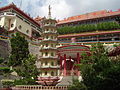 Kek Lok Si Temple
 -
 Kapitan Keling Mosque
 -
 Islamic Museum
 -
 Khoo Kongsi Temple
 -
 Seh Tek Tong Cheah Kongsi at Armenian Road
 -
 Jewish Cemetery on Jalan Zainal Abidin (formerly Jewish Street)
 -
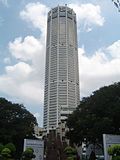 Komtar Tower the highest building of George Town and the state of Penang
 -
 Penang Road
 -
 A part of the old town
 -
 Gurney Drive


.jpg)
See also
- Architecture of Penang
- City Hall, Penang
- Penang Museum and Art Gallery
- List of cities in Malaysia by population
- List of twin towns and sister cities in Malaysia
- Trolleybuses in George Town, Penang
- Little India, Penang
References
- ^ = The Georgetown Conurbation Plan
- ^ = Georgetown-Sungai Petani-Kulim Growth Management Plan
- ^ "Population Distribution and Basic Demographic Characteristics, 2010" (PDF). Department of Statistics, Malaysia. Retrieved 19 April 2012.[dead link]
- ^ a b c "Where is George Town?". The Malay Mail. 4 April 2015. Retrieved 10 July 2015.
- ^ "Trade and Society in the Straits of Melaka".
- ^ a b c http://profile.nus.edu.sg/fass/socgohd/trans_2.1.pdf
- ^ a b Google Drive Viewer. Docs.google.com. Retrieved on 27 September 2013.
- ^ "Influential Muslim leaders who shaped Penang in its early history". Penangheritagecity.com. 4 October 1994. Retrieved 3 January 2011.
- ^ Dr Sun Yat-sen's historic Penang conference. Biz.thestar.com.my. Retrieved on 11 August 2011.
- ^ Mücke, Hellmuth von. The Emden-Ayesha Adventure: German Raiders in the South Seas and Beyond, 1914. Annapolis: Naval Institute Press, 2000. ISBN 1-55750-873-9
- ^ Raymond, Boon. (3 May 2011) Penang, Penang lang(槟城人) lah : Penang WW1 German Naval War, 1914. Teochiewkia2010.blogspot.com.[unreliable source?] Retrieved on 11 August 2011.
- ^ "Malaya Study Group". Retrieved 13 September 2014.
- ^ a b C. Peter Chen. "Invasion of Malaya and Singapore | World War II Database". Ww2db.com. Retrieved 3 January 2011.
- ^ Bayly/Harper, p. 119
- ^ "War and Occupation in Penang, 1941–1945". Webcache.googleusercontent.com. Retrieved 3 January 2011.[dead link]
- ^ "U-boat Operations- The Monsun U-boats – 3. Monsun boats". Retrieved 13 September 2014.
- ^ a b War and Occupation in Penang, 1941–1945, Paul H. Kratoska, Department of History, National University of Singapore
- ^ Raymond, Boon. (7 March 2010) Penang, Penang lang(槟城人) lah : Penang Secessionist Movement (1948–1951). Teochiewkia2010.blogspot.com.[unreliable source?] Retrieved on 11 August 2011.
- ^ Noordin Sopiee, M. (1973). "The Penang Secession Movement, 1948–1951". Journal of Southeast Asian Studies. 4 (1): 52–71. doi:10.1017/S0022463400016416.
- ^ "History of Penang". Visitpenang.gov.my. 14 September 2008. Retrieved 3 January 2011.
- ^ "The Snuffing Out of Local Democracy in Malaysia". Saravanamuttu. Retrieved 6 January 2010. [dead link]
- ^ Goh Ban Lee, Report of the Local Elections Working Group, 20 April 1999
- ^ "Penang Forgetting Its History", The Star, January 1, 2007)
- ^ Perkins 2008: 119–21
- ^ "Asia Times: Wreckers ball rips heart out of city: Car Rentals at www.The-Car-Reservations-Desk.com". Retrieved 13 September 2014.
- ^ a b "Eight new sites, from the Straits of Malacca, to Papua New Guinea and San Marino, added to UNESCO's World Heritage List". UNESCO. 7 July 2008. Retrieved 7 July 2008.
- ^ "Welcome geoscience-environment.com - BlueHost.com" (PDF).
- ^ Looi Sue-Chern (24 March 2015). "George Town a city again". The Malaysian Insider. Retrieved 10 July 2015.
- ^ http://www.myhoponhopoff.com/pg/index.php?pageid=5
- ^ "Cabinet approves city status for Penang island".
- ^ "Laman Web Rasmi Majlis Perbandaran Pulau Pinang – Latar Belakang". Mppp.gov.my. Retrieved 3 January 2011.
- ^ "Penang World Heritage Fiasco Penang tourism's dilemma: To build or retain its UNESCO status - ..."
- ^ Nasution, Khoo: The sustainable Penang initiative. Penang: IIED, 2001|
- ^ "Multilingual road signs put up to boost Penang's tourism". The Star (Malaysia). Retrieved 31 December 2008.
- ^ [1][dead link]
- ^ "About Us – Standard Chartered Bank Malaysia Berhad". Standardchartered.com.my. 29 February 1984. Retrieved 3 January 2011.
- ^ "Fullcontact: About Malaysia". Fullcontact.nl. 22 April 2010. Retrieved 3 January 2011.
- ^ "Bank of China(Malaysia) Berhad". Retrieved 13 September 2014.
- ^ a b "Medical tourism: A billion-ringgit industry for Penang". Penang Monthly.
- ^ a b "Penang accounts for 50% of medical tourists".
- ^ a b "Medical tourism hale and hearty". The Star. 29 January 2011. Retrieved 29 January 2011.[dead link]
- ^ http://www.prres.net/papers/lim_etal_retail_activity_in_malaysia_from_shophouse_to_hypermarket.pdf
- ^ http://penanginstitute.org/v3/files/research_papers/PEI_Jan%202015.pdf
- ^ "Lee Kuan Yew's visit a trip down memory lane". South China Morning Post.
- ^ Crossette, Barbara (30 June 1985). "Correspondent'S Choice – Correspondent'S Choice – On Penang Island, A Legend Lives". The New York Times. Penang Island (Malaysia); Malaysia. Retrieved 3 January 2011.
- ^ "Following Maugham's Footsteps–Malaysia " A Guy's Moleskine Notebook". Mattviews.wordpress.com. 10 April 2009. Retrieved 3 January 2011.
- ^ "History | 'Respect for self; respect for others'". Uplands.org. Retrieved 3 January 2011.
- ^ a b "Is Penang's tourism on the right track?". Penang Monthly.
- ^ Cite error: The named reference
latimes.comwas invoked but never defined (see the help page). - ^ a b Cite error: The named reference
straitstimes.comwas invoked but never defined (see the help page). - ^ Robin Barton, Lonely Planet (17 February 2014). "Where are the foodies going in 2014?". The Independent.
- ^ Cite error: The named reference
theantdaily.comwas invoked but never defined (see the help page). - ^ a b Cite error: The named reference
travel.cnn.comwas invoked but never defined (see the help page). - ^ Fitzpatrick, Liam (15 November 2004). "TIMEasia Magazine: Best of Asia – Best Street Food". TIME. Retrieved 3 January 2011.[dead link]
- ^ http://www.independent.co.uk/travel/news-and-advice/where-are-the-foodies-going-in-2014-9094744.html. Retrieved 14 February 2015.
{{cite news}}: Missing or empty|title=(help) - ^ "Cheong Fatt Tze Mansion". Tourism Malaysia. Retrieved 22 May 2014.[dead link]
- ^ "Kek Lok Si". Tourism Malaysia. Retrieved 22 May 2014.[dead link]
- ^ "Pinang Peranakan Mansion". Tourism Malaysia. Retrieved 22 May 2014.[dead link]
- ^ "Fort Cornwallis". Tourism Malaysia. Retrieved 22 May 2014.[dead link]
- ^ Lim, Serene (24 April 2015). "The good, bad and ugly of street artist Ernest Zacharevic's murals". Today. Retrieved 26 April 2015.
- ^ "Official Website of Penang Philharmonic". Pessoc.com. 23 December 2010. Retrieved 3 January 2011.
- ^ woonviolincollections.com. woonviolincollections.com. Retrieved on 11 August 2011.
- ^ "ProArt Chinese Orchestra :: About Us : Profile". Proart.com.my. Retrieved 3 January 2011.
- ^ Archived 2010-12-24 at the Wayback Machine
- ^ Minni Ang. "Boria". Musicmall-asia.com. Retrieved 3 January 2011.
- ^ asiarooms.com. "Penang Museums, Malaysia Travel Information, Penang Travel Guide". Asiarooms.com. Retrieved 3 January 2011.
- ^ Virtual Malaysia. "Fort Cornwallis | Malaysia Destination | Malaysia Tourism". Virtualmalaysia.com. Retrieved 3 January 2011.[dead link]
- ^ "Fort Cornwallis, Penang Colonial Heritage | Malaysia AsiaExplorers". Asiaexplorers.com. Retrieved 3 January 2011.
- ^ [2][dead link] Archived 2011-09-29 at the Wayback Machine[dead link]
- ^ "Seri Mutiara, Penang". Retrieved 13 September 2014.
- ^ National Library Board, Singapore. "Chingay".
- ^ Penang Trade and Commerce http://www.penangtrade.com/1007/
- ^ Criz, Penang-based blogger (19 June 2011). "The Official Launch of TimeOut Penang". Retrieved 26 February 2014.
- ^ "Time Out Penang". Malaysia. Retrieved 26 February 2014.
- ^ "Welcome to AirAsia.com... Now everyone can fly". Airasia.com. Retrieved 3 January 2011.
- ^ Penang Trams, Trolleybuses and Railways:Ric Francis and Colin Ganley:2006. Areca Books:ISBN 978-983-42834-0-7
- ^ Penang Museum display information
- ^ "The Legacy of Penang Trishaw". Penang-vacations.com. Retrieved 3 January 2011.
- ^ "Penang Hop-On Hop-Off".
- ^ "myPenang - Bicycle Rentals".
- ^ "Penang tourism: Promoting cycle lanes in urban heritage areas".
- ^ "Uber - Penang".
- ^ "The Star Online - Through the wheels of time".
- ^ "Penang Hill train service to resume next year". The Malaysian Insider. 6 October 2010. Retrieved 3 January 2011.
- ^ "Trams making comeback under RM27bil Penang plan - Nation - The Star Online".
- ^ "First LRT project in Penang next year - Nation - The Star Online".
- ^ "Penang to ease island's transport woes". The Straits Times.
- ^ Cite error: The named reference
themalaysianinsider.comwas invoked but never defined (see the help page). - ^ https://www.malaysiakini.com/news/325243
- ^ "AirAsia to turn Penang into fourth hub in Malaysia". The Star. 8 July 2009.
- ^ "Guan Eng demands Putrajaya approve Penang International Airport expansion now".
- ^ admin. "Penang Forum: Hand over Penang port, including ferries, to state government". Aliran.
- ^ "Cutting Penang ferries will not save costs, Guan Eng claims".
- ^ "Market Watch 2010" The Environmental Sector in Malaysia. http://malaysia.ahk.de/fileadmin/ahk_malaysia/Dokumente/Sektorreports/Market_Watch_2010/Environmental_2010__ENG_.pdf
- ^ "Newspaper Article - S'pore gunboats call at Penang".
- ^ "A Pleasant Sub-prise for Penang Ferry". Marine Link.
- ^ Administrator II. "Royal Thai Navy's Visit to Penang".
- ^ "USS New Orleans Visits Penang".
- ^ SJKT Ramakrishna. Facebook. Retrieved on 27 September 2013.
- ^ Tamil school data – Penang |. Mynadi.wordpress.com. Retrieved on 27 September 2013.
- ^ KDU College Malaysia, Penang Campus. Kdupg.edu.my (5 June 2013). Retrieved on 27 September 2013.
- ^ SEGi College Penang | SEGi University. Segi.edu.my. Retrieved on 27 September 2013.
- ^ Sentral college
- ^ olympia college
- ^ INTI international college
- ^ "English" (Archive). Penang Japanese (Supplementary) Saturday School. Retrieved on 22 June 2014.
- ^ "Getting back its mojo". The Economist. 13 August 2011.
- ^ "Stay in Penang under Malaysia My Second Home Programme" (PDF).[dead link]
- ^ a b c Hans Michelmann (28 January 2009). Foreign Relations in Federal Countries. McGill-Queen's Press - MQUP. pp. 198–. ISBN 978-0-7735-7618-6.
- ^ "Achievements of the Sister City Relationship". Adelaide City Council. Archived from the original on 20 December 2015. Retrieved 20 December 2015.
{{cite web}}: Unknown parameter|deadurl=ignored (|url-status=suggested) (help) - ^ "Malaysia-Xiamen trade volume gets a boost". New Straits Times. 21 November 2001. Retrieved 20 December 2015.
- ^ "Kunjungan Hormat oleh Konsul Jeneral ke atas Walikota Medan" (in Malay). Ministry of Foreign Affairs, Malaysia. 13 September 2012. Archived from the original on 20 December 2015. Retrieved 20 December 2015.
{{cite web}}: Unknown parameter|deadurl=ignored (|url-status=suggested) (help) - ^ "Malaysia: Taipei, Georgetown ink friendship memorandum". Central News Agency. Taiwan News. 29 March 2011. Archived from the original on 20 December 2015. Retrieved 20 December 2015.
{{cite web}}: Unknown parameter|deadurl=ignored (|url-status=suggested) (help) - ^ changwon. "home".
- ^ "Sister Cities Agreement, Georgetown". International Affairs Division, Bangkok Metropolitan Administration. Archived from the original on 20 December 2015. Retrieved 20 December 2015.
{{cite web}}: Unknown parameter|deadurl=ignored (|url-status=suggested) (help) - ^ Natthaphol Wittayarungrote (18 September 2014). "Phuket and Penang become twin cities". Phuket Gazette. Archived from the original on 20 December 2015. Retrieved 20 December 2015.
{{cite web}}: Unknown parameter|deadurl=ignored (|url-status=suggested) (help) - ^ http://www.visitpenang.gov.my/portal3/penang-tourism-news/2161-signing-of-mou-to-promote-culture-and-tourism-between-busan-metropolitan-city-republic-of-korea-and-penang-malaysia.html
- ^ "Australian Consulate in Penang, Malaysia". Department of Foreign Affairs and Trade (Australia). Retrieved 20 December 2015.
- ^ Lim Guan Eng (8 October 2013). "The New China's Consulate-General Office In Penang Reflects The Burgeoning Increase In Chinese Arrivals By 50% For Tourism And Business Air Travellers At The Penang International Airport". Penang Chief Minister Office. Archived from the original on 20 December 2015. Retrieved 20 December 2015.
{{cite web}}: Unknown parameter|deadurl=ignored (|url-status=suggested) (help) - ^ "Consulate General of the Republic of Indonesia, Penang". Consulate General of Indonesia, Penang, Malaysia. Retrieved 20 December 2015.[dead link]
- ^ "Consulate-General of Japan in Penang, Malaysia". Consulate-General of Japan in Penang, Malaysia. Retrieved 20 December 2015.
- ^ "Opening the first Consulate Honorary of the Republic of Poland in West Malaysia". Embassy of the Republic of Poland, Kuala Lumpur. 14 April 2014. Archived from the original on 20 December 2015. Retrieved 20 December 2015.
{{cite web}}: Unknown parameter|deadurl=ignored (|url-status=suggested) (help) - ^ "Royal Thai Consulate-General, Penang, Malaysia". Royal Thai Consulate-General, Penang, Malaysia. Retrieved 20 December 2015.
- ^ "Supporting British nationals in Malaysia". Government of the United Kingdom. Retrieved 20 December 2015.
Working with local partners and honorary representatives in Penang, Langkawi, Kota Kinabalu and Kuching to assist British nationals
Further reading
- Francis, Ric; Ganley, Colin. Penang Trams, Trolleybuses & Railways: Municipal Transport History 1880s–1963. Penang: Areca Books. (2006, 2nd ed. 2012) ISBN 983-42834-0-7.
- Khoo Salma Nasution. More Than Merchants: A History of the German-speaking Community in Penang, 1800s–1940s. Areca Books. (2006). ISBN 978-983-42834-1-4
- Ooi Cheng Ghee. Portraits of Penang: Little India. Areca Books. (2011). ISBN 978-967-5719-05-9
External links
Capital: George Town | |||||||||||||||||||||||||||||||
| Topics | |||||||||||||||||||||||||||||||
| Society | |||||||||||||||||||||||||||||||
| Administrative divisions |
| ||||||||||||||||||||||||||||||

_Logo.png)


