








Talk:Seven-dimensional cross product: Difference between revisions
Brews ohare (talk | contribs) →OR & synthesis: Blackburne: Before beginning a free-for-all on the article page, let's discuss it. |
Sławomir Biały (talk | contribs) comment →OR & synthesis |
||
| Line 617: | Line 617: | ||
:As I anticipate little agreement over your proposed actions, I'd like to see them presented here first, and moved to the Talk page only after adequate discussion. |
:As I anticipate little agreement over your proposed actions, I'd like to see them presented here first, and moved to the Talk page only after adequate discussion. |
||
:To begin, there is little doubt that there is a strong connection between octonions and the 7D cross-product, some of which is already mentioned in the article. I'd anticipate any confusion over what is appropriate to octonions and not readily extended to the 7D cross product can be readily assessed on this Talk page and any confusions straightened out. [[User:Brews ohare|Brews ohare]] ([[User talk:Brews ohare|talk]]) 05:32, 14 July 2010 (UTC) |
:To begin, there is little doubt that there is a strong connection between octonions and the 7D cross-product, some of which is already mentioned in the article. I'd anticipate any confusion over what is appropriate to octonions and not readily extended to the 7D cross product can be readily assessed on this Talk page and any confusions straightened out. [[User:Brews ohare|Brews ohare]] ([[User talk:Brews ohare|talk]]) 05:32, 14 July 2010 (UTC) |
||
:I find the section on the octonions most appropriate. This is actually how I am most familiar with the 7D cross product, so I think the concern over [[WP:OR]] is perhaps unwarranted, at least as far as this section goes. [[User:Sławomir Biały|<span style="text-shadow:grey 0.3em 0.3em 0.1em; class=texhtml">Sławomir Biały</span>]] ([[User talk:Sławomir Biały|talk]]) 13:51, 14 July 2010 (UTC) |
|||
Revision as of 13:51, 14 July 2010

Recent revisions
In the current version several useful points were dropped that appear in the earlier version:
- The squared magnitude of the cross-product is the Gram determinant of the vectors. That connection to another article is useful, as is the connection of the Gram determinant to the squared area of the parallelogram defined by the two vectors.
- The introduction of the angle θ which was carefully referred to Hildebrand previously and connected to the Cauchy-Schwarz inequality has simply been sloughed over in the new version.
- The useful expression of the cross product in terms of three-dimensional cross products has been dropped.

There is advantage in keeping these items: they provide additional background for the reader, they connect the article to other topics on WP, and they take very little space or explanation. Brews ohare (talk) 03:43, 1 July 2010 (UTC)
- The article had a number of problems, mostly formatting but also editorial so I've tried fixing it: making the formatting and notation consistent, separating out the arguments for existence/references to the proof, removing duplication and fixing some errors.
- The Gramian matrix is an unnecessary complication in two dimensions as it simplifies to (xy)2 - (x⋅y)2, i.e. the expression given which depends only on the dot product and norm/length. It's useful for generalising to more than two vectors but not for two - that's how Lounesto uses it for example. Other than that it duplicated the information given a few lines down about the area of a parallelogram (and again unnecessarily stated the general case of that).
- I missed out saying what the angle is so have added that in, with a link in case anyone does not know what an angle is. There wasn't anything about the Cauchy-Schwarz inequality and I don't see how it's related.
- That expression was unclear: it said "the sum of seven 3-dimensional cross products" but did not specify them, i.e. did not say what 3-dimensional space they were over, what handedness (the "right handed rule") they use, etc.. To fully specify all that would be quite difficult and as a calculation method it's far more complicated than any of the others, because of the repeated projections. The article still gives four or five ways to calculate the product, all simpler and clearer.
- --JohnBlackburnewordsdeeds 09:43, 1 July 2010 (UTC)
- The point of mentioning the Gram matrix is to make that connection; that is, to indicate that this particular dot-product expression has deeper roots, and is not an isolated invention. A major value of WP is its capacity to link across related subjects, enabling readers to see connections between a topic they are looking at and other topics.
- I'm a bit surprised that you are unaware of the connection of angle to the Cauchy-Schwarz inequality; at any rate I don't see the reference to Hildebrand restored.
- If you find the expression of the cross product in terms of three-dimensional cross products would benefit, just provide a source rather than deleting the connection. Brews ohare (talk) 11:19, 1 July 2010 (UTC)
- But it doesn't have "deeper roots", i.e. it doesn't depend on the Gram matrix. The gram matrix simplifies to the right hand side, but there are many things that simplify to the RHS, all of them by definition more complex. If they help illustrate the 7D cross product it makes sense to include them - e.g. if they provide some geometric insight - but otherwise it's just an irrelevant algebraic coincidence.
- I really don't see in the version before I changed it any mention of the Cauchy-Scwarz inequality. But it's of little use anyway as it only shows the RHS is non-negative, correct but not enough to show anything, and trivially true from the LHS being |x × y|2.
- The expression in terms of three-dimensional cross products had no source, and was not mentioned in the sources I consulted (if it were it might be straightforward to improve it so it makes sense).
- --JohnBlackburnewordsdeeds 12:21, 1 July 2010 (UTC)
Apparently we disagree, largely because we are looking at the matter from different perspectives. (i) Gram determinant: the Gram determinant obviously is an object in the mathematical universe, it has a well-known interpretation as the volume of a solid object, and it has a WP article. IMO it is helpful to the reader to see this peculiar equation is not an invention, but an example of a class of such formulas. That linkage, again IMO, is a major function of WP: let readers know of connections they may be unaware of. (ii) the definition of angle is well-understood by yourself, but it is certainly reasonable to provide the definition and a source to that definition for any reader that needs a bit of of a jog in this department. (iii) Obviously the expression in terms of 3D cross products did not arise from the blue. I'd undertake to track a source down if that really satisfied your objections, and did not simply raise some new ones in an unending list. Brews ohare (talk) 20:53, 3 July 2010 (UTC)
The unit vector notation
I was wondering would it be better for the 21 multiplications to use the i, j, k, l, m, n, and o notations for the unit vectors, rather than e1, e2, e3, e4, e5, e6, and e7? A reader who has never heard of the seven dimensional cross product before usually likes to see it explicitly stated in the language that they are familiar with when using the 3D cross product. It makes it easier to grasp the concept. What do you say? David Tombe (talk) 17:07, 1 July 2010 (UTC)
- As it was it said "the familiar i, j, and k, unit vector notation" then added four more letters without explaining them, and was inconsistent with the rest of the article. The e1, ... notation are much preferred for higher dimensions: they generalise to any dimension, while the alphabet starting at i only goes up to 18. If you used more letters you would not be able to use them for other things – (x, y, z) for example – without confusion, while still others like l and o are easily confused with numbers. Also formulae like

- are only possible with ei notation. For these reasons higher dimensions (and even lower dimensions once you start using them) are usually described using ei or things like them. It's also consistent: it means the different ways of calculating the product use the same notation, which is much clearer as it's easier to see that they're all the same product (not automatic in seven dimensions).--JohnBlackburnewordsdeeds 18:03, 1 July 2010 (UTC)
John, That's fair enough. It's actually alot clearer now than it was before, but I'm going to re-arrange the relative positions of the 21 operations so as to have all the e1's along the top row etc. The idea will be to emphasize the fact that e1 can be the product of three different pairs from the other six. I'll do that sometime over the weekend because it's going to be a very fiddly job. David Tombe (talk) 17:17, 2 July 2010 (UTC)
- There's no need to do that. It already presents that information clearly in the vector expansion, i.e. this
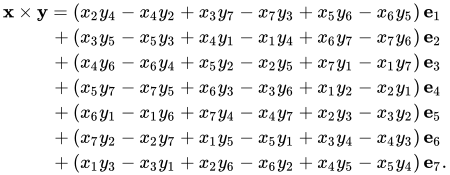
- shows how the e1 term is produced from the other six, and so on. The point of the 21 operations is to show the symmetry of the product modulo 7 and by groups of 3, which also makes it easier to see that the product is not unique. It's the same as Lounesto, page 96, except as we're not constrained by page count I've written it out in full.--JohnBlackburnewordsdeeds 21:58, 2 July 2010 (UTC)
John, what I have just done is fully consistent with your intentions here. By the way, I do believe that the 21 operations should appear higher up in the article, even before the issue of properties and caracteristics. General readers may like to see the end product first because it is likely that they will want to quickly compare the concept to how they understand the 3D cross product. You and I can both follow the line of reasoning as it is presented in this article, but it did take me quite a while to do so. I suggest we make it easier for future readers to do so. David Tombe (talk) 14:47, 4 July 2010 (UTC)
Using label ‘Pythagorean theorem’ to describe the Gram determinant
At present, the equation:

is labeled with the notation (Pythagorean theorem). The basis for using this label is that the author Pertti Lounesto labels this equation this way in his book ‘Clifford Algebras and Spinors’.
It may be noted that:
- (i) Lounesto provides absolutely no reason for using this label, and never discusses this choice in any manner whatsoever.
- (ii) Nowhere is this description of this equation used in any other book by any other author anywhere.
- (iii) The Pythagorean theorem describes the magnitude of a vector as the square root of the sum of the squares of its pairwise orthogonal components, which has no apparent connection to this equation.
- (iv) This equation is well known as the Gram determinant of the vectors x and y.
- (v) It also is well known that the Gram determinant is related to the square of the area of the parallelogram defined by the vectors x and y, which is exactly the role of this equation in this context in determining the magnitude of the cross product.
- (vi) Berger ‘Geometry I, Volume 2’ lists the magnitude of the cross product as one of its defining properties and states:
- Other authors do likewise: e.g. Exercise 1.76 in Nasar, Gallier, Problem 7.10, Part 2 (p vectors in a space with n ≥ p) Gallier refers to this equation as the "Lagrange identity".

- (vii) Lounesto, p. 98 also uses the Gram determinant label to describe this equation in his §7.5 : ‘Cross products of k vectors in ℝn’.
In view of these facts that show this labeling is
- (i) used only by one author and without justification,
- (ii) has no apparent connection to the Pythagorean theorem, and is therefore useless and misleading,
- (iii) can readily be replaced by a reference to the Gram determinant, for which there is clear application in this context,
it would seem reasonable to either (i) provide an explanation for the use of this label so the reader knows why it is used, or (ii) remove this label and substitute a reference to the Gram determinant as done by Berger, or (iii) simply remove the label altogether, or change it to something else, e.g. the ‘Lagrange identity in 3-D and 7-D’. What is unreasonable is to leave this label in place without explanation for its use.
John, if you insist upon making no changes in this regard, I suggest that this issue be prepared for an RfC. Brews ohare (talk) 14:36, 4 July 2010 (UTC)
- Brews, I believe that Lagrange identity would be the best all round name for this equation. I'm fully sympathetic with Lounesto's use of the name Pythagoras in relation to the 3D case. In fact, in the 3D case, I would prefer Pythagoras to Lagrange. But in relation to the 7D case, the use of the term Pythagoras is alot more grey, and as you rightly point out, Lounetso seems to be unique in using this term in the circumstances. David Tombe (talk) 14:51, 4 July 2010 (UTC)
- (edit conflict)this is about an entirely different cross product, the n-1 in n dimensions version. this is not even in the body of a text, it's an exercise, again nothing to do with this topic. The only one on the 7D cross product is Louneso, except he doesn't use the Gram determinant for it either, it's used in a later section. It's not needed for the 7D cross product and is just a further complication: You can't use it directly, all you can do is simplify it to the form that is already given, which as it's a familiar form in itself, as Pythagoras's theorem and the same as the identity in 3D, there's no need to supply a more complex thing that simplifies to it.
- The topic, which is the 7D cross product, is covered very well in a number of sources already referenced in the article. There is no need to use sources on entirely unrelated topic. Of course they will use a different approach, different notation and different reasoning appropriate to their subject and readership, but to include them will just lead to a confusing and difficult to follow article. No-one is going to consult "Solved Problems in Electromagnetics" to learn about the 7D cross product, and I don't know how you came across it when looking for references on this subject.
- David, no. your two examples illustrate my point perfectly. There are multiple more complex things that simplify algebraically to the expression given. Do we need to give them all, with multiple sources, even though they are useless until simplified to what's already there? What's there is straightforward and clear. I'm sorry if you don't understand it and think it's "grey" but introducing more complex expressions, unsupported by the sources on the 7D cross product, will make it even more difficult to understand.--JohnBlackburnewordsdeeds 15:21, 4 July 2010 (UTC)
John: I find you to ramble here. If you look at Lounesto §7.5 : ‘Cross products of k vectors in ℝn’ and put n=7 and k=2 that is what I'd recommend here. Likewise, Gallier, Problem 7.10, Part 2 (p vectors in a space with n ≥ p) with n=7 and p=2. I just don't understand your attachment to the label ‘Pythagorean theorem’, whose applicability is explained neither by Lounesto or by yourself in this article. Your discarding of all other sources, all of which follow a different path, is not convincing, and this labeling of the equation is misleading and confusing, most especially with absolutely no explanation of why the label is used. Brews ohare (talk) 15:42, 4 July 2010 (UTC)
- (edit conflict)Again both those sources are on the more general case, of n not two vectors, and only Lounesto is on the 7D cross product. As for "Pythagorean theorem", to me it says the quantities |x||y|, |x×y| and x⋅y are related by the theorem, so form a right angled triangle. One angle of the triangle is the angle between the vectors so it can be formed with two sides parallel to the vectors, i.e. "Pythagorean theorem" has both geometric and algebraic meaning, and it relates also to the Pythagorean trigonometric identity later. It's not required for much of the theory but is useful as a way to think about what is essentially a geometric construct.--JohnBlackburnewordsdeeds 15:51, 4 July 2010 (UTC)
The Pythagorean theorem says c2 = a2 + b2; if I try to recast the equation in this form, c = ||x||2||y||2 and a = ||x×y||2 while b= (x·y)2. Question 1: How is that seen to be an application of Pythagoras' theorem? Question 2: What explanation of it are you going to put into the article so it makes a modicum of sense to the general reader (or to me)? Brews ohare (talk) 16:00, 4 July 2010 (UTC)
The fact is, it cannot be done unless one posits ||x × y|| = ||x|| ||y|| sin θ instead of the posit ||x × y||2 = ||x||2||y||2 -(x·y)2. And, if you do that, the connection is to the Pythagorean trigonometric identity, not to Pythagoras' theorem. It also would require a reorganization of the article to derive the relation ||x × y||2 = ||x||2||y||2 -(x·y)2, which still would not be the "Pythagorean theorem". Brews ohare (talk) 16:12, 4 July 2010 (UTC)
This "reverse" approach is not favored by Lounesto, Massey or, in fact, any author. All prefer to start with the Gram determinant form. That probably is because norms and dot-products are more fundamental than the notion of "angle" in n-dimensions. In fact, angle is defined in terms of dot-product. Brews ohare (talk) 16:27, 4 July 2010 (UTC)
- No it's not. The angle in n dimensions is defined as in two or three dimensions. It's related to the dot product and so can be calculated using it, but it does not depend on it for definition. An alternative approach is to determine the simple rotation that rotates from one vector to the other and take its log. Or as in 3D if you had a protractor in e.g. 7D you could simply measure the angle. And there's no need to derive ||x × y||2 = ||x||2||y||2 -(x·y)2. It's a condition require for the cross product, so it's simply asserted, then other things are derived from it. It's not the only condition that could be used, it's just the most useful one. --JohnBlackburnewordsdeeds 16:36, 4 July 2010 (UTC)
John: You are creating conflict where none exists. As noted in my remarks, one can assume ||x × y||2 = ||x||2||y||2 -(x·y)2 (that is what ‘posit’ means) and in fact that is what Lounesto, Massey and (it seems) most (if not all) others do. As for defining angle by a rotation, that is not the standard approach in n-dimensions, which is to define it in terms of the dot product, as you know. It would seem that determining an axis of rotation in 7D for the 2D cross product is not straightforward. However, all of this is arguing around the point, and not addressing it. The point is, again, that Pythagoras' theorem has nothing to do with it, no matter which way you go. And no-one except Lounesto (and John Blackburne) ever mentions Pythagoras' theorem in connection with the magnitude of the cross-product. Brews ohare (talk) 19:01, 4 July 2010 (UTC)
- John, If this was only about the 3D case, I'd be supporting you. But it's about the 7D case. It seems that the clash between us in this regard originates with your belief that Pythagoras's theorem is a theorem of 2D space, whereas I believe it is a theorem of 3D space. But let's put that aside for a minute. Let's recall our discussion over at the 'Curl' article. We were basically in agreement that curl could not exist in 7D, at least in a way that would connect to geometry. I of course could actually set up a 7D binary curl based on the idea of making up a differential operator as d/si + d/tj + d/duk +d/dvl + d/wm + d/dxn + d/dyo and distributing it out over a 7D vector as per the rules of the 21 operation table. But as you have agreed already, this operation would have lost all connection with geometry.
- Likewise, I believe that this 7D cross product has lost all connection with geometry, sine, Pythagoras etc. David Tombe (talk) 19:11, 4 July 2010 (UTC)
RfC: Does ‘Pythagorean theorem’ appropriately designate the definition of the magnitude of a vector cross product?
- Does the label ‘Pythagorean theorem’ appropriately designate the definition of the magnitude of a vector cross product?
At present, the equation:
is labeled with the notation (Pythagorean theorem). The basis for using this label is that the author Pertti Lounesto labels this equation this way in his book ‘Clifford Algebras and Spinors’. However, it may be noted that:
- (i) Lounesto provides absolutely no reason for using this label, and never discusses this choice in any manner whatsoever.
- (ii) Nowhere is this description of this equation used in any other book by any other author anywhere.
- (iii) The Pythagorean theorem describes the magnitude of a vector as the square root of the sum of the squares of its pairwise orthogonal components, which has no apparent connection to this equation.
Because this labeling is:
- (i) used only by one author and without justification or explanation,
- (ii) has no apparent connection to the Pythagorean theorem, and is therefore useless and misleading,
is it reasonable to either (i) provide an explanation for the use of this label so the reader knows why it is used, or (ii) remove this label and/or substitute something else? Brews ohare (talk) 20:10, 4 July 2010 (UTC)
Remarks
In a subsequent section of the same book, Lounesto, p. 98 labels the equation as ‘Gram determinant’, a designation also used by several other authors, and a designation in keeping with the standard interpretation of Gram determinant of two vectors as the squared area of their contained parallelogram. Brews ohare (talk) 19:26, 4 July 2010 (UTC)
- As noted by me above, but reproduced here to save others having to find it, I can't see the problem with using "Pythagorean theorem" as
- It's sourced, from a good source on the 7D cross product (of which there are few - it's not like there are dozens of sources that don't use this)
- It's not as if there's another better name for it
- It matches the algebra of the Pythagorean theorem, i.e. a2 + b2 = c2
- It matches the geometry: a right triangle can be constructed with the sides in the formula with two sides parallel to the two vectors, so the angle between them is an angle of the triangle
- This leads directly to the Pythagorean trigonometric identity using this triangle, and so to the xy sin θ form of the magnitude
- I would say it is not discussed in the source as the algebraic and geometric properties are obvious, or at least straightforward and so helps the reader visualise the cross product, in the source as here. I don't see what the problem with it is.--JohnBlackburnewordsdeeds 20:28, 4 July 2010 (UTC)
- The label is applied by Lounesto, but not discussed, justified, or motivated in any way. Is this really what ‘a source’ means? All sources (including Lounesto) derive the same results from the same equations, while absolutely none of them (except Lounesto) uses the Pythagorean label for the dot-product equation.
- No construction is described in the article (or in Lounesto) indicating the dot-product formulation is the same assumption as the Pythagorean equation a2 + b2 = c2.
- John has things exactly backwards: it is the posit that ||x × y|| = ||x ||y|| sin θ that introduces the triangle, and that assumption taken as an axiom can be run backward to derive the form in terms of the dot product by use of the Pythagorean trigonometric identity. If one wishes to run things backward, that's what the article should do. However, no author does it this way.
- If ‘the properties’ are obvious to John, maybe he can help the reader by describing them in the article? Brews ohare (talk) 21:56, 4 July 2010 (UTC)
- The bottom line: whatever the connection of the dot-product equation to Pythagoras' theorem, the two things are not the same thing, and the label confuses at least some readers by suggesting that somehow these two different things are the same thing. Brews ohare (talk) 22:04, 4 July 2010 (UTC)
Comment. It does seem a little confusing: it may follow from the Pythagorean Theorem, but that's not the same as saying it is the Pythagorean Theorem. Nor is the connection immediate, since it relates a square (i.e. an area) to something more complex. If it's possible to produce a good diagram that actually shows the triangle, then it might be justified. -- Radagast3 (talk) 08:01, 5 July 2010 (UTC)
- I'm not sure I could draw a good diagram of it, but the triangle has sides xy, xy sin θ and xy cos θ. If it is drawn in the plane of x and y, so one of them lies along the hypotenuse, then scaling that side by the length of the other puts it along the hypotenuse and the other two sides are then projections of this parallel and perpendicular to the to the second vector (which is therefore parallel to the other side with length xy cos θ). The squares are part of the Pythagorean formula, i.e. it's not about areas it's about the ratio of the lengths or magnitudes.--JohnBlackburnewordsdeeds 08:43, 5 July 2010 (UTC)
- Well, xy, xy sin θ and xy cos θ gives a Pythagorean triangle all right, but doesn't immediately seem relevant to . It all makes sense after the next few lines, but as it stands, the "Pythagorean theorem" comment just adds confusion. -- Radagast3 (talk) 11:43, 5 July 2010 (UTC)
- Comment the formula is a few logical steps from what most people regard as the Pythagorean Theorem, so it seems fine to say that Lounesto has called it Pythagorean Theorem, but not to say that it is PT. I see no compelling need to give the equation a name especially where it introduces confusion.--Salix (talk): 11:22, 5 July 2010 (UTC)
- Comment We have a three way dispute here. Brews opposes the term 'Pythagoras' in both the 3D case and the 7D case. John supports the use of the name 'Pythagoras' in both the 3D case and the 7D case. I support the use of the name 'Pythagoras' only in the 3D case. Hence if this article was about the 3D cross product, I'd be quite happy to leave it at 'Pythagoras's theorem'. It may not technically be Pythagoras's theorem, but I can fully understand Lounesto's poetic licence in the circumstances. But this article is about the 7D cross product, and in the 7D case, the fact that the equation holds at all seems to be somehwhat of an anomaly. It is based on a miraculous cancellation of 168 terms on distribution. I'm not as yet sure what this is trying to tell us. There is clearly something of the spirit of Pythagoras's theorem there, yet it falls short of being the full Pythagoras's theorem. Lounesto seems to have overlooked the fact that the Jacobi identity restricts the sine relationship to the 3D case. I seem to recall that the Encylopaedia Britannica source where I first read about the 7D cross product did not actually give a name for the equation in question. It merely stated the equation as a desired condition, without giving it a name. It may be that in order to settle this issue that we will have to simply remove the name altogether and present the equation without a name. David Tombe (talk) 11:40, 5 July 2010 (UTC)
- Comment the formula is a few logical steps from what most people regard as the Pythagorean Theorem, so it seems fine to say that Lounesto has called it Pythagorean Theorem, but not to say that it is PT. I see no compelling need to give the equation a name especially where it introduces confusion.--Salix (talk): 11:22, 5 July 2010 (UTC)
Comment: As it stands the label is confusing. It seems to falsely indicate that the identity is an immediate consequence of the Pythagorean theorem. The result is that the reader is left trying to puzzle out a mental proof of the identity with no success. The article on the 3-dimensional cross product starts with the length as xy sin θ, from which the identity follows easily, but this article presents the material in a different order. In any case, the terminology used in articles should reflect the most common usage in the literature and that doesn't appear to be the case here. There is only one source that uses the terminology and inconsistently at that. It's also questionable how much benefit there is in having a label, so including it despite the potential confusion it may cause does not seem like a good idea.--RDBury (talk) 11:39, 5 July 2010 (UTC)
- Rather than remove "Pythagorean theorem" it has been replaced with Gram determinant, with Lounesto as a source. This makes no sense as Lounesto is the source that has "Pythagorean theorem" as a label for that expression. The Gram determinant isn't used at all for the 7D cross product - it is used in a later section when discussing generalisations to products of more than two vectors. No other source uses it as a label for this expression either.--JohnBlackburnewordsdeeds 09:05, 6 July 2010 (UTC)
- It is interesting that yourself, a mathematician, refuses to see an argument for general integers k, namely Lounesto, p. 98 cannot understand that it applies to the case k = 2. Lounesto, in seeking a general formulation, says: ‘a natural thing to do is to consider a vector valued product a1 × … × ak satisfying:
- . ’
- It is interesting that yourself, a mathematician, refuses to see an argument for general integers k, namely Lounesto, p. 98 cannot understand that it applies to the case k = 2. Lounesto, in seeking a general formulation, says: ‘a natural thing to do is to consider a vector valued product a1 × … × ak satisfying:

- He goes on to say ‘The solution to this problem is that there are vector valued cross products in ’ a variety of cases including the case of k=2 n=7. That is extremely clear. Contrary to your assertions, this point of view is also adopted by other authors, for example Gallier and several others you pooh-poohed earlier because they mentioned the approach in exercises , rather than the main text (for example, Nasser, Exercise 1.76, p. 14).
- These matters could be discussed at length in the article under a section "Generalization to k vectors", where Lounesto could be quoted verbatim in the article if that is your preference. That might be a good idea anyway.
- In any event, John, you haven't a leg to stand on here, and are presuming to distort the position in the literature. Brews ohare (talk) 11:49, 6 July 2010 (UTC)
- I have settled this matter by introducing a section called "Generalizations". Brews ohare (talk) 12:27, 6 July 2010 (UTC)
Bringing the 21 operations to the introduction
The first thing that any curious reader will want to see is what the 7 dimensional cross product looks like when expressed in the same language as the familiar 3 dimensional cross product. Previously the article somewhat resembled Rolf Harris painting one of his masterpieces. We were all kept in suspense as regards what it's all leading up to. David Tombe (talk) 22:09, 4 July 2010 (UTC)
- I've moved it back: as per MOS:LEAD the introduction should be an accessible overview of the subject, so should avoid detailed technical content. More generally it makes sense to present the properties first before giving the detailed expression of the product, which anyway is over limited use: most of the results can be derived from the defining properties, as they clearly do not depend on the particular version of the product used.
- There were problems too with the changes made while it was moved. First it was changed to a different product: there is not just one 7D cross product but many, and changing it made other parts of the article wrong and the whole article inconsistent. Also the table was unclear - the cross product is not associative so the order matters, but in a table like that the order is unclear. Better to simply write out the products as there's no limit to space. The information about the "completely antisymmetric tensor" also had to be removed as it too was about a different product.--JohnBlackburnewordsdeeds 11:34, 6 July 2010 (UTC)
- A Wikitable is a much clearer and more elegant presentation of the multiplication rule. The rule shown is that from Octonion which has the value that it agrees with the standard cross product from 3 dimension in making i x j = k etc. That alone makes the order of factors clear, but a simple note can add further clarity (it was already given in terms of the εijk rule from the source summarizing the table) without abandoning the table for a messy term by term presentation. And, of course, it agrees with the Octonion article. Your arguments favor rewriting the article to suit this table, not the reverse. Brews ohare (talk) 13:13, 6 July 2010 (UTC)
- (edit conflict)It's not clearer: as noted above the table was unclear and renders the rest of the article incorrect. Whether it's more elegant and the term by term expansion is "messy" is entirely subjective, and I would remind you again that changing the formatting just because you like it a different way is according to ArbCom unacceptable.--JohnBlackburnewordsdeeds 13:21, 6 July 2010 (UTC)
- A Wikitable is a much clearer and more elegant presentation of the multiplication rule. The rule shown is that from Octonion which has the value that it agrees with the standard cross product from 3 dimension in making i x j = k etc. That alone makes the order of factors clear, but a simple note can add further clarity (it was already given in terms of the εijk rule from the source summarizing the table) without abandoning the table for a messy term by term presentation. And, of course, it agrees with the Octonion article. Your arguments favor rewriting the article to suit this table, not the reverse. Brews ohare (talk) 13:13, 6 July 2010 (UTC)
As noted above, the table is not unclear in any way, and you have not presented any argument to support that view. As pointed out, the rule behind the table is presented algebraically, so no confusion is possible, and an example of the first component is provided as further aid to interpreting the table. This table agrees with Octonion, is sourced, and is more readily understood because it incorporates the standard unit vector i × j =k relations for the first 3 unit vectors.
The Lounesto form for the multiplication rule is left intact, so the remainder of the article still makes perfect sense. What would improve matters and be very helpful, would be an explanation of how the two rules both can be shown to be valid, a point that you could make that would help the reader considerably, and a very useful addition. How about that, John? Brews ohare (talk) 13:35, 6 July 2010 (UTC)
- Written out fully it incorporates the product i × j = k: just take any such triplet of vectors. It's unclear because the product is anticommutative so depending which way you do the multiplication the result is different. But again, even without that objection changing the format just because you like it a different way is unacceptable.
- As for some information on how the different versions of the 7D cross product are related I don't think it's necessary but if you think it's useful it's in the sources so feel free to add something.--JohnBlackburnewordsdeeds 14:20, 6 July 2010 (UTC)
- John: Perhaps you are unfamiliar with the standard notation ijk to represent unit vectors along the x- y- and z-axes? This corner of the table is the same as in 3-D. I don't think Lounesto's rule has that similarity.
- Yes, I'd like to add the information relating different rules. Perhaps you can help me with that? How would you go about it? Brews ohare (talk) 14:31, 6 July 2010 (UTC)
- It's all in the sources so I'd start with them - I assume you are familiar with them.--JohnBlackburnewordsdeeds 14:45, 6 July 2010 (UTC)
John, The table should go in the introduction because a reader will want to quickly see the end product. This is after all an encyclopaedia and not a pure maths textbook. A pure maths textbook has a different purpose from that of an encyclopaedia. A pure maths textbook will be aimed at students who are being trained in logical processes and who are accustomed to building up to an end result. David Tombe (talk) 16:45, 6 July 2010 (UTC)
- According to MOS:LEAD the lead should provide an accessible overview, so avoid too much technical content such as that. It's also unclear (what is i' × i or j x i for example), is yet another version of the 7D cross product (different from the other two) and uses inconsistent formatting with the rest of the article. As already noted above the i, j, k notation is generally reserved for 3D, as it generalises poorly to higher dimensions: for the same reason we use (x, y, z) in 3D but use e.g. (x1, x2, x3, ,,, xn) for n dimensions.--JohnBlackburnewordsdeeds 17:36, 6 July 2010 (UTC)
John, I agree that we shouldn't have too much technical content in an introduction, but not to the extent of eliminating the main item itself. The seven dimensional cross product is the very set of 21 operations itself, and as such it should appear in the introduction in some form or other. The 3D cross product is familiar in i, j, and k notation. The 7D cross product is not familiar at all, and the fact that it exists at all comes somewhat as a surprise, even to many graduates. The first thing that anybody will want to know is 'what does it look like in relation to the 3D cross product?'. The encyclopaedia article needs to address that question right in the introduction. David Tombe (talk) 17:55, 6 July 2010 (UTC)
- It isn't "the very set of 21 operations" that you give. That is just one of many possible sets that satisfy the conditions, and without that being specified what's there is incorrect and misleading. Most calculations done with the 7D cross product do not involve the term by term expansion - they can't as if you e.g. proved something from one such rule you could not be sure if it were valid for all others. It's also inconsistent with both versions given later on (the one that was there, the one that Brews added), does not give all the products you can form, and uses inconsistent formatting. It also seems to be unsourced.--JohnBlackburnewordsdeeds 18:27, 6 July 2010 (UTC)
I've Wikitabled an ijklmno form of the multiplication table, not the same one David suggested, which is yet another form. I don't like this approach because it leads to considerable duplication, or an inelegant splitting of the topic and revisiting it later. Also, the numbered-subscript form allows a simple summary expression in terms of algebra, while the ijklmno form does not. I'd favor the multiplication be internally cross-linked to the later section, and not be explicitly listed in the introductions. That approach avoids these difficulties and still directs the reader to an explicit listing. Brews ohare (talk) 20:40, 6 July 2010 (UTC)
- John, The version which I put into the introduction was identical to your own version. I simply replaced e1 with i, e2 with j etc. because I wanted to use the same notation which is used in the more familiar 3D cross product. The 21 operations were put in as an example of what the 7D cross product looks like. It was never intended to be the unique example, and if I didn't make that clear, it would have been easy to have re-worded it to make it clear.
- Brews, since you wish to avoid duplication, I suggest that you only have one table. Since both you and John prefer the e1, e2, notation, then go for that notation, but I do believe that a table is necessary in the introduction. A reader will want to see at a glance an example of what the 7D cross product might look like. The article as it stands after the introduction is good as a pure maths textbook. It builds up to the final product in a series of arguments. But the '21 operation table' is the natural starting point for the encyclopaedia reader. The starting point for the 3D cross product is the i, j, k inscription that Sir William Rowan Hamilton made at Brougham Bridge in 1843. The first thing that any reader wants to see is how that set of relationships between i, j, and k, expands into 7 dimensions. David Tombe (talk) 23:40, 6 July 2010 (UTC)
- (edit conflict)I doubt very much that any reader will want to start with one of the many different ways of calculating the product. As I've already said it's of no use for proving anything as, unlike in 3D, it's not unique. So if you use one particular expansion to prove a result you can't be sure it will work for all others. That's why if you want to prove anything or understand the product fully you need to start from the defining properties and proofs. More generally this is postgraduate, not high school, algebra so would normally be done abstractly, independent of the basis vectors, even independent of the dimension. It's useful to write down one expansion to show one exists, after the general existence of the product has been proved, but I don't see the need for any more. And it's best to do so with consistent notation - you yourself wrote "it's a lot clearer" after I made the formatting and products consistent.--JohnBlackburnewordsdeeds 00:24, 7 July 2010 (UTC)
- I'd guess that David is representative of some readers that want to see a concrete version of the cross product up front. Therefore, I moved the table to the Introduction and put in some caveats about non-uniqueness of the table. Then by way of a parallel development, I made a table for Lounesto's version for the later section. The two versions are contrasted in the section on Fano planes. Brews ohare (talk) 04:00, 7 July 2010 (UTC)
- You might find this Fano plane link interesting. Brews ohare (talk) 04:09, 7 July 2010 (UTC)
- I'd guess that David is representative of some readers that want to see a concrete version of the cross product up front. Therefore, I moved the table to the Introduction and put in some caveats about non-uniqueness of the table. Then by way of a parallel development, I made a table for Lounesto's version for the later section. The two versions are contrasted in the section on Fano planes. Brews ohare (talk) 04:00, 7 July 2010 (UTC)
John, The version of the 21 operations which you did was very good. Brews's table was also very good, and it happens to be in the exact format that I used to work out what a 7D cross product would look like when I first read about it in Encyclopaedia Britannica. If the two of you prefer to use e1, e2, e3, then that's fine with me. I will not object, although I would have preferred i, j, and k. But the most important thing is that the readers can see at a glance what the 7D cross product looks like. The 21 operation table, whether in your preferred format, or mine, or Brews's, tells a reader at a glance practically everything that they may ever ask about 7D cross product. Yes, this is a postgraduate topic, but the job of an encyclopaedia is to make the best attempt possible at making such advanced topics accessible to a more general readership. It's more about letting the readers have a basic idea of what the subject entails, rather than having a full understanding of it. But having said that, there is no reason why we can't do the latter also. In this case, the latter has already been reasonably well done.
In many respects, there is an analogy between the idea of putting the 21 operation table in the introduction and putting a picture of the Four-handed chess board in the introduction of that article. One can see at a glance what it's all about as compared to the more familiar version. But with words alone, it takes some explaining. You might say that the 21 operation table is the diagram. David Tombe (talk) 09:53, 7 July 2010 (UTC)
More on multiplication tables
John, I wonder if you could beef up the discussion of Fano planes? For instance, is it true that I could simply label the nodes in the Fano diagram any way I like and get a valid multiplication table? How many valid multiplications tables (Fano diagrams) are out there? Brews ohare (talk) 17:36, 7 July 2010 (UTC)
- If you want it added I suggest you do it yourself: I have not come across Fano planes in relation to the 7D cross product. And there are far more important things to do in this article such as fix the errors, unclear mathematics and unencyclopaedic writing and presentation added by you and David in the last few days.--JohnBlackburnewordsdeeds 23:33, 7 July 2010 (UTC)
- John: Your comments about the Fano plane strike me as a bit off. You are doubtless aware that the Fano plane is used often in terms of the Octonions, and its role here is very similar indeed, as must be very clear to you as mathematician used to seeing patterns. It also is clear that there are many multiplication tables, and that they're all connected through the Fano diagram. It would be nice to tidy that up a bit.
- I don't agree with you that the most important things left to do in this article are to "correct" contributions and "clarify" mathematics by David and I, which, I am afraid, simply means forgetting the general reader and writing for the specialist only. It would be nice if you could try to collaborate and pack up the put-downs and snide remarks. Brews ohare (talk) 05:07, 8 July 2010 (UTC)
- I don't see how it is "snide" to state the fact that I've not come across Fano planes used for the 7D cross product. Perhaps you could post the source that relates them for my and other editors benefit – it will be easier then for another editor to look at this. --JohnBlackburnewordsdeeds 06:59, 8 July 2010 (UTC)
- John: The word "snide" means "slyly disparaging" and refers to your attitude, although your phrase “fix the errors, unclear mathematics and unencyclopaedic writing and presentation added by you and David” is more accurately described as insulting. Brews ohare (talk) 14:03, 8 July 2010 (UTC)
- I don't see how it is "snide" to state the fact that I've not come across Fano planes used for the 7D cross product. Perhaps you could post the source that relates them for my and other editors benefit – it will be easier then for another editor to look at this. --JohnBlackburnewordsdeeds 06:59, 8 July 2010 (UTC)
- I don't agree with you that the most important things left to do in this article are to "correct" contributions and "clarify" mathematics by David and I, which, I am afraid, simply means forgetting the general reader and writing for the specialist only. It would be nice if you could try to collaborate and pack up the put-downs and snide remarks. Brews ohare (talk) 05:07, 8 July 2010 (UTC)
- More generally I've already pointed out the problems with the tables and having multiple product rules I've tried fixing this but you simply [1] reverted to a broken and confusing version again without reason. I've just restored a correct version version, please don't change it again to a broken version or without good reason (as already noted changing the format just because you prefer it another way is simply unacceptable).--JohnBlackburnewordsdeeds 06:59, 8 July 2010 (UTC)
- A multiplication table is hardly a “broken and confusing version” when compared to a listing of some products. A table is easier to use and shows the pattern of the multiplication rule at a glance, something that cannot be said of your listing. Brews ohare (talk) 14:03, 8 July 2010 (UTC)
- No it doesn't. The product is non-commutative so the order matters. The order is clear when you write e1 × e2 = e4, it's not at all clear from a table like that. Writing out the product also lets you organise them so the symmetry and periodicity is obvious: the rule ei × ei + 1 = ei + 3 stands out immediately. The same is not true of either table. The shading only shows the product is anticommutative, but otherwise looks random suggesting that anticommutativity is the only symmetry, which is clearly not the case. --JohnBlackburnewordsdeeds 15:20, 8 July 2010 (UTC)
- John: the rule ei × ei + 1 = ei + 3 is a particular symmetry well-expressed by this formula, and that's about it. This rule suffices to determine the table, but not directly because it applies only for adjacent unit vectors. For example, e1 × e3 = e7 can be found from this rule only by applying some identities. The table is helpful because such products can be found by inspection, without the need for manipulations. Brews ohare (talk) 17:21, 8 July 2010 (UTC)
- No it doesn't. The product is non-commutative so the order matters. The order is clear when you write e1 × e2 = e4, it's not at all clear from a table like that. Writing out the product also lets you organise them so the symmetry and periodicity is obvious: the rule ei × ei + 1 = ei + 3 stands out immediately. The same is not true of either table. The shading only shows the product is anticommutative, but otherwise looks random suggesting that anticommutativity is the only symmetry, which is clearly not the case. --JohnBlackburnewordsdeeds 15:20, 8 July 2010 (UTC)
- A multiplication table is hardly a “broken and confusing version” when compared to a listing of some products. A table is easier to use and shows the pattern of the multiplication rule at a glance, something that cannot be said of your listing. Brews ohare (talk) 14:03, 8 July 2010 (UTC)
- More generally I've already pointed out the problems with the tables and having multiple product rules I've tried fixing this but you simply [1] reverted to a broken and confusing version again without reason. I've just restored a correct version version, please don't change it again to a broken version or without good reason (as already noted changing the format just because you prefer it another way is simply unacceptable).--JohnBlackburnewordsdeeds 06:59, 8 July 2010 (UTC)
John, I don't agree with your objections. However, your multiplication table is good, and so I will support its retention in the main body of the text. Equally I support the retention of Brews's table in the introduction. I see Brews's table as playing the role of 'the diagram' for the article. In fact, Brews's table ought to be beefed up somewhat into diagram format. When a general encyclopaedia browser is familiar with a topic such as chess or 3D cross product, they will have a picture of it in their minds. In the case of 3D cross product, that picture is the plaque on the wall at Brougham Bridge. When a more complex variant of such basic themes is ever mentioned, the first thing that a reader will want to have is a mental picture of how the extended concept looks in comparison to the standard well known theme. David Tombe (talk) 10:24, 8 July 2010 (UTC)
- "In the case of 3D cross product, that picture is the plaque on the wall at Brougham Bridge." I don't agree with this statement at all. When I think of the 3D cross product I think of a bilinear map that takes any pair of vectors to a third vector perpendicular to both of them. In my opinion this is what the concept of "cross product" is about, and that should be in the introduction- not one possible multiplication table. Actually, I wonder if it might be a good compromise to put the multiplication table in a side bar like the chess board in the chess article that David brought up. Holmansf (talk) 13:23, 8 July 2010 (UTC)
- Holmansf: Of course you have stated one of the two general requirements for a cross product, the other being the relation for its magnitude. However, you might agree that these statements of properties that appear in the section "Definition" are not immediately and intuitively translatable to a multiplication table of any kind. That is why a concrete example in the intro may be useful in the Intro, especially to the naive reader. It is clearly pointed out along with the table that it is not unique and that the properties in the "Definition" section are primary. Brews ohare (talk) 14:03, 8 July 2010 (UTC)
- I'd like to repeat my suggestion that the multiplication table in the intro be moved to a side bar near the introduction (maybe sidebar isn't the right term- I'm not a wikipedia expert). What do you think about that? Holmansf (talk) 15:15, 8 July 2010 (UTC)
- I implemented this suggestion by formatting the Wikitables to float at the right of the text. Brews ohare (talk) 17:26, 8 July 2010 (UTC)
Holmansf, Regarding the plaque at Brougham Bridge, you are right. I'm actually disappointed that Hamilton didn't inscribe i×j=k, j×k=i, k×i=j, because that was the most interesting aspect of his inspiration. David Tombe (talk) 18:14, 8 July 2010 (UTC)
The distributive law
The sentence “These unit vectors can be multiplied out distributively in both three and seven dimensions” appears in the section Expansion in unit vectors. Clearly, it is true, but what exactly is the point in bringing it up in this context? Maybe a little elaboration would illuminate its relevance? Brews ohare (talk) 17:56, 7 July 2010 (UTC)
- Brews, It certainly can be elaborated on. In fact I was coming to that very point next. If you look further up the talk page, you will see that the issue of the distributive law has been raised in the past. The distributive law holds in the case of the 3D cross product and also the 7D cross product, but in a typical 3D cross product course, this fact would be proved using geometry. As the article stands right now, there is nothing that overtly deals with the proof that the distributive law holds for the 7D cross product. But we need to know that the distributive law is valid before we can multiply two vectors out distributively in terms of their unit vector components.
- So something important is missing from the article. I have argued further up that the prooof that the distributive law holds is in fact the same thing as proving that the Lagrange identity holds. In fact, that is the full significance of desiring that the Lagrange identity is one of the defining properties. If the Lagrange identity doesn't hold, as it wouldn't in the case of a 5D cross product, then the distributive law will not hold, and so we could not multiply a 5D vector out distributively using the 5D cross product. David Tombe (talk) 00:00, 8 July 2010 (UTC)
- The distributive property is part of the definition of a cross product- a cross product is bilinear. You then use this as part of the definition of a particular cross product when you write down a multiplication table. That's what the comment refers to I believe (ie. the multplication table is extended to arbitrary vectors by using bilinearity). Probably the wording should be changed, IMO. Holmansf (talk) 13:23, 8 July 2010 (UTC)
- Holmansf: Perhaps your suggestion is that “These unit vectors can be multiplied out distributively in both three and seven dimensions” is meant to tell the reader how general vector multiplication is effected using the multiplication rule for unit vectors? Brews ohare (talk) 14:07, 8 July 2010 (UTC)
- I changed the sentence to say that. Brews ohare (talk) 14:36, 8 July 2010 (UTC)
- Yes that is what I meant. I am changing the paragraph again because I think it is still confusing. In particular the stuff about vectors from different planes giving the same product is in the wrong place. Holmansf (talk) 15:15, 8 July 2010 (UTC)
- Brews: In regard to the different planes thing- to me it just seems like a random comment that serves to distract and possibly confuse. Why do you think it's important? Why do you think it should be placed right there? That section is about how to define and calculate cross products in 7D using an orthonormal basis, not about contrasts between the 7D and 3D cross products. Holmansf (talk) 16:33, 8 July 2010 (UTC)
Hi Holmansf: This comment was put there originally by Blackburne. If you can find a better home for it, go ahead. It is important because it marks a very different behavior from the 3D case, and suggests that physical interpretation of the 7D cross product may be a problem, because it is a many-to-one mapping. Brews ohare (talk) 16:59, 8 July 2010 (UTC) I moved it; see what you think. Brews ohare (talk) 17:03, 8 July 2010 (UTC)
- Actually it looks like David Tombe added it here
- Before this edit it made sense IMO. I'm going to change to better reflect the old version. Holmansf (talk) 17:29, 8 July 2010 (UTC)
Holmansf, Before that edit was made, the lack of uniqueness referred to the fact that for every plane spanned by two vectors, there is more than one other vector perpendicular to that plane. I changed it to refer to the lack of uniqueness of the cross product itself, in that any unit vector can be the product of different pairs from amongst the remaining six. For example look along the top row of the table below that sentence and you can see that the unit vector e1 is the cross product of three distinct pairs from the other six.
Both aspects of lack of uniqueness are correct, but only the latter specifically relates to the cross product, as in the cross product being the vector that is the product of two other vectors. David Tombe (talk) 17:49, 8 July 2010 (UTC)
- Holmansf: There are two aspects involved here. Your changes are fine, including revision of the header, but I've reinserted the paragraph further down that points out different vectors have the same cross product, which seems to me to be not quite the same thing as saying there are multiple normals for each plane, and fits in as a discussion of the multiplication table itself. Brews ohare (talk)
- BTW, if a plane is described by two vectors that lie in it, the statement that there are multiple vectors orthogonal to it is a bit obvious in 7 dimensions, because there are 5 vectors orthogonal to the two defining the plane. Brews ohare (talk) 18:02, 8 July 2010 (UTC)
That's it Brews, there are two aspects. But only the latter is important. The former can only become important if we assume a geometrical connection. And just as there is no geometrical connection with the 7D curl, neither is there a geometrical connection with the 7D cros product. The aspect which I dealt with is the one that is important in relation to the distributive law, and that is the one that is relevant for the multiplication table. And we cannot assume the distributive law just because of bilinearality. The distributive law follows from the Lagrange identity, and that is why we choose the Lagrange identity as one of the defining properties. David Tombe (talk) 18:05, 8 July 2010 (UTC)
- Holmansf: I apologize, but I removed the two leading sentences. One is a digression (non-uniqueness) and is better described later (as now it is) and the other is a trivial unrelated observation (multiple normals for a plane: a 2D space in a 7D world). Brews ohare (talk) 18:14, 8 July 2010 (UTC)
- Hmm, well maybe the stuff about non-uniqueness should not go there, but I think it should go somewhere. Let me elaborate. The non-uniqueness that is important is the non-uniqueness of the cross product itself. This means that there are actually different maps from V x V to V that satisfy the requirements to be called a cross product, and these maps are not just the same as each other up to a factor of -1 (ie. up to signs). It doesn't mean that a particular cross product is not injective in some sense. The non-uniqueness of the cross product itself stems from the fact that given a plane spanned by say the first two basis vectors e_1 and e_2 you could choose any unit vector perpendicular to this plane (infinitely many in 7D!) to be the product e_1 x e_2 and then continue to build a cross product based on that initial choice (that's probably not the only choice required ...). Thus there are actually infinitely many possible 7D cross products. This is in contrast to the 3D case where there are only 2 unit vectors perpendicular to the plane spanned by e_1 and e_2, and so only two choices of cross product.
- With these comments in mind I am removing the other material we have been discussing.
- Also, David, what do you mean by "distributive law?"Holmansf (talk) 18:39, 8 July 2010 (UTC)
Holmansf, On non-uniqueness, I was focusing on the fact that vector e1 can be the cross product of three different pairs from amongst the other six. That is the only aspect of non-uniqueness that is important as regards the multiplication table. On the distributive law, a vector a is given by a1i + a2j + a3k + a4l + a5m + a6n + a7o and a vector b is given by b1i + b2j + b3k + b4l + b5m + b6n + b7o. In order to work out a×b as per the chosen multiplication table, we need to know that the operation a×b is distributive. If the operation satisfies the Lagrange identity,

then it will be distributive. This can be checked by distributing it out in the terms of the Lagrange identity. It only works in 3 and 7 dimensions. But I see that you have assumed the distributive law on the basis of bilinearality. I can't see how you can do that, because if you could, you could then define a 5D multiplication table and multiply it out distributively only to discover that it would clash with the Lagrange identity. David Tombe (talk) 19:20, 8 July 2010 (UTC)
- David, the assumption that a cross product is bilinear (part of the definition), implies that it is distributive. Are you saying that you can omit the bilinearity from the definition and still have the same result?
- Also, if you really feel strongly about it you can put the stuff about "vector e1 can be the cross product of three different pairs from amongst the other six" back in and I won't remove it again. However, I don't see why it's important. Holmansf (talk) 20:07, 8 July 2010 (UTC)
Holmansf: Your language “However, unlike in three dimensions, there is no unique (up to sign) cross product defined in seven dimensions. This is because in seven dimensions there are more than two unit vectors perpendicular to any given plane.” is inadequate. Obviously, having more than two vectors perpendicular to a plane does not deny uniqueness of the cross product, unless one cannot pick which one. As you can see in concrete terms from the multiplication tables, any unit vector is the cross product of three choices for its constituent pairs. That is a consequence of both requirements: magnitude and perpendicularity. There are therefore three planes with the same cross product, and this cross product is unique. What isn't unique is there is not a single pair of vectors (a single plane) leading to this cross product. Brews ohare (talk) 20:10, 8 July 2010 (UTC)
- You have it the wrong way round. Don't try and derive or understand anything from any particular multiplication rule, as they are not unique, so anything you work out from one rule will be different for another.
- The uniqueness of the 3D cross product arises as any two non-parallel vectors define a plane, and there's only one vector, its normal (and its negative), perpendicular to that plane. This does not happen in 7D as there are five independent dimensions perpendicular to each plane, and an infinity of directions, so an infinity of possible 7D cross products - though it's usual to only consider those that can be written in terms of simple products of the basis elements. In addition it's easy to write down different products that satisfy the definition, so to demonstrate the product isn't unique.User:JohnBlackburne (talk) 20:26, 8 July 2010 (UTC)
- John: Yes, I see that there are an infinity of directions perpendicular to a plane made up of any combination of the five unit vectors perpendicular to that plane. However, I see that every multiplication table has the property that any unit vector can act as the cross product of three and only three other pairs. Any independent vectors x and y in the plane of ei em will have a cross product involving ei × em and therefore parallel to this cross product, which cross product is therefore certainly unique to this plane. What am I missing? Brews ohare (talk) 20:41, 8 July 2010 (UTC)
- It would appear that a vector's being perpendicular to a plane is not sufficient to make it a cross-product of vectors in that plane. Brews ohare (talk) 20:47, 8 July 2010 (UTC)
- Well perhaps it should be explained differently. However, I think you are missing the point. Given any unit vector v perpendicular to the plane spanned by e_1 and e_2, you could define a cross product such that e_1 x e_2 = v. Therefore there are at least as many distinct seven dimensional cross products as there are unit vectors perpendicular to the plane containing e_1 and e_2, which is to say infinitely many.
- I think some of the confusion here is coming from the imprecise use of the term "cross product." I am trying to use "cross product" to consistently refer to the map from V x V to V (this is the definition given in the article ...). You and David use "cross product" to refer to the image of a certain pair of vectors under a particular version of the cross product (the map). Holmansf (talk) 21:04, 8 July 2010 (UTC)
- Holmansf: I do not follow your reasoning. Given any multiplication table whatsoever, and selecting the e1 e2 of that table, there is one and only one vector e1 × e2. Consequently there is one and only one normal to that plane that is in the direction of a cross-product to that plane (apart from sign). The cross product is not simply a map; it has two defining properties. Don't we agree on this? Brews ohare (talk) 21:16, 8 July 2010 (UTC)
- Perhaps you are suggesting something different: for any vector V I can find a plane perpendicular to it and construct a basis such that e1 × e2 is parallel to V? Then what you are saying amounts to this: one can construct an infinity of coordinate systems. That is not a statement about cross products. Brews ohare (talk) 21:21, 8 July 2010 (UTC)
- Let me try to put it into your language. For any V perpendicular to the plane containing e1 and e2 there is a multiplication table that defines a cross product such that e1 × e2 = V. Since there are infinitely many such V, there are infinitely many possible 7D cross products. Holmansf (talk) 23:26, 8 July 2010 (UTC)
In short, the paragraph:
Notice that any one of the seven unit vectors can result from the cross product of three distinct pairs (representing three distinct planes) from among the other six. For example, from the first row of the listing above one finds e1 is given by e2 × e4, e3 × e7, and e5 × e6. Thus, unlike the 3-dimensional cross product, the same 7-dimensional cross product can result from multiplying pairs of vectors residing in different planes.
is beyond controversy, a simple observation based upon the multiplication table, and should be reinserted in the discussion of the table. Brews ohare (talk) 20:25, 8 July 2010 (UTC)
- No, you can't look at one product rule (or multiplication table) and deduce a general property about the product. What you're seeing is something quite different, that multiple pairs of vectors multiply to give the same vector. This happens in 3D too, they just have to be in the same plane, not three.--JohnBlackburnewordsdeeds 20:57, 8 July 2010 (UTC)
- John, you are mistaken about what is claimed here. All that is said is that for this multiplication table, three pairs lead to the same cross product, a fact nobody can possibly dispute. Then it is said that in general the possibility exists for the same cross product to result from several planes. Again, this is incontrovertible as a concrete example is presented where exactly this happens. There is no false extrapolation beyond the example involved here. Brews ohare (talk) 21:09, 8 July 2010 (UTC)
- The cross product in 7D can be considered as a map from planes to lines, i.e. from bivectors to vectors, as every pair of vectors has a plane/bivector associated with it, and the map from these vectors to bivectors is bilinear.
- But while in 3D to get from the bivectors to vectors you take the dual you can't do this in 7D as bivectors and vectors aren't dual. Instead bivectors form a 21-dimensional space. So a map from the bivectors to vectors will naturally associate three directional bivectors with each direction vector. So vectors in three planes multiply to give each vector. But this has nothing to do with uniqueness: even if there were just one product all of the above would be true.--JohnBlackburnewordsdeeds 21:18, 8 July 2010 (UTC)
- John: Your response is oblique and unnecessarily abstract. From the given table (and any other table, in fact) a unit vector is the cross product of three other pairs of unit vectors. There is nothing complicated about this: it means that the cross-product of vectors in any of three planes all are parallel to the same direction. Period. Hence, given we have here an example where this occurs, the statement can be made that in general the possibility exists for the same cross product to result from several planes. There is simply no argument, however abstract, that can contradict this point. If you wish, you can try to put this observation is a general context, but that will not controvert the example, just illuminate it. Brews ohare (talk) 21:31, 8 July 2010 (UTC)
- I am not even sure what you mean. The 7D cross product is the whole product, so it makes no sense to talk of the "the same cross product" referring to different parts of this whole. And again, arguing from observations made of a particular rule will get you nowhere as nothing about the general product can be proved from it. More importantly arguing from your own observations is OR and strictly forbidden. So unless you have a source it has no place here. --JohnBlackburnewordsdeeds 21:39, 8 July 2010 (UTC)
- John: Your response is oblique and unnecessarily abstract. From the given table (and any other table, in fact) a unit vector is the cross product of three other pairs of unit vectors. There is nothing complicated about this: it means that the cross-product of vectors in any of three planes all are parallel to the same direction. Period. Hence, given we have here an example where this occurs, the statement can be made that in general the possibility exists for the same cross product to result from several planes. There is simply no argument, however abstract, that can contradict this point. If you wish, you can try to put this observation is a general context, but that will not controvert the example, just illuminate it. Brews ohare (talk) 21:31, 8 July 2010 (UTC)
- John, you are mistaken about what is claimed here. All that is said is that for this multiplication table, three pairs lead to the same cross product, a fact nobody can possibly dispute. Then it is said that in general the possibility exists for the same cross product to result from several planes. Again, this is incontrovertible as a concrete example is presented where exactly this happens. There is no false extrapolation beyond the example involved here. Brews ohare (talk) 21:09, 8 July 2010 (UTC)
John: There is no OR in looking at the first line of your listed multiplication rule and observing that three different cross products lead to e1. Calling this "parts of the whole" seems to suggest that one can talk only of general x × y and not about particular vectors like the unit vectors, which of course means a multiplication table and the distributive law are not useful ideas. And finally, suggesting that a concrete instance cannot be taken as proof of the possibility of existence of such an instance is simply a logical error. Brews ohare (talk) 21:54, 8 July 2010 (UTC)
Holmansf, The reason why I made the change which you highlighted in the link above, is because the kind of non-uniqueness that was mentioned in the older version was not relevant to the issue which followed on. Furthermore, I don't like getting involved in the subject of 'planes' in relation to the 7D cross product. The 7D cross product is pure algebra with no connection to geometry. But if you do insist on considering 'planes' enclosed by two unit vectors, then of course it is a trivial fact that the remaining 5 unit vectors will all be orthogonal to that plane, even the ones which aren't actually the cross product of the two vectors which define that plane. But this piece of trivial information has got nothing to do with the multiplication table, and the section was about the multiplication table and its operation under the distributive law as between two vectors x and y. That's why I changed it to the more relevant point about uniqueness, which is that that each unit vector is uniquely given by three different pairs from the remaining six, within the context of a particular multiplication table. I am not overly worried whether that material is restored or not because it is manifestly obvious from looking at the multiplication table. But the other aspect of non-uniqueness, if it needs to be mentioned at all, should be mentioned elsewhere in the article.
- the 7D cross product is very geometric: it's definition is in terms of orthogonality and area, and most of its properties have geometric interpretations. 7D space may not have much practical use but Euclidian geometry works as well in 7D as in 3 or 4D.--JohnBlackburnewordsdeeds 21:39, 8 July 2010 (UTC)
As regards the distributive law, it's best to look at my reply to Brews in the section below. David Tombe (talk) 21:22, 8 July 2010 (UTC)
- John, It's better not to intersperse your replies. Anyway, how come that over on the 'curl' page, you were quite comfortable with the idea that a 7D curl would have no geometrical significance? David Tombe (talk) 21:45, 8 July 2010 (UTC)
- I was just pointing out a flaw in your reasoning, which if you take it on board might help you understand the broader picture. And curl doesn't exist in 7D, as you know, so there's nothing to have geometric significance and so to relate to here.--JohnBlackburnewordsdeeds 21:58, 8 July 2010 (UTC)
John, I can define a 7D curl based on the multiplication tables for the 7D cross product. I can set up a 7D differential operator and multiply it out distributively on a 7D vector and call it a 7D curl. But it will have no more connection to geometry than the 7D cross product of this article. What's the difference? David Tombe (talk) 22:07, 8 July 2010 (UTC)
Distributive law and Lagrange identity
David: Can you elaborate upon the connection between the distributive law and the Lagrange identity?
I take the distributive law to be:

I'm guessing you mean by the Lagrange identity

which, in 7 dimensions, results in:

Plugging in b = c + d:

and I guess formal manipulation of the sum results in

to demonstrate the distributive law holds. Is that the idea? Brews ohare (talk) 19:56, 8 July 2010 (UTC)
- Brews, Yes, that's the basic idea. The Lagrange identity is the proof of the distributive law in the context, which is why it is a desired defining property. Let's look at it another way. Let's cast the Lagrange identity aside and define a cross product which doesn't need it. Let's make up a bilinear 5D multiplication table and assume the distributive law. What's stopping us from doing that? Here we have a perfectly good bilinear 5D cross product which seems to be perfectly functional.
- The answer is that we cannot assume the distributive law. The very reason why the Lagrange identity is chosen as a defining property is because it brings the distributive law with it, and that limits us to 3D and 7D.
- In a 3D cross product course, we prove the distributive law using geometry. The distributive law must be established as legitimate before we do any expansions of vectors in their unit vectors. Likewise with the 7D cross product, we need to prove that the distributive law is valid before we do any unit vector expansions. We cannot assume the distributive law just from bilinearality. That's why I said something along the lines of 'As a result of the defining properties, vectors in 3 and 7 dimensions can be multiplied out distributively in terms of their unit vectors - - - -'.
- But as regards your specific manipulations, I was thinking more in terms of what I wrote higher up, in that if we distribute everything out within the Lagrange identity, it balances only in 3 and 7 dimensions.

- In 3D the left hand side becomes,
- (x2y3-x3y2)2 + (x3y1-x1y3)2 + (x1y2-x2y)2 which happens to equate to z12 + z22 + z32 in the cross product.
- In 7D the left hand side becomes,
- (x2y4-x4y2)2 + (x3y7-x7y3)2 + (x6y5-x5y6)2 + (x1y4-x4y1)2 + (x3y5-x5y3)2 + (x6y7-x7y6)2 + (x1y7-x7y1)2 + (x2y5-x5y2)2 + (x4y6-x6y4)2 + (x1y2-x2y1)2 + (x3y6-x6y3)2 + (x5y7-x7y5)2 + (x1y6-x6y1)2 + (x2y3-x3y2)2 + (x4y7-x7y4)2 + (x1y5-x5y1)2 + (x3y4-x4y3)2 + (x2y7-x7y2)2 + (x1y3-x3y1)2 + (x2y6-x6y2)2 + (x4y5-x5y4)2
- which happens to be equal to z12 + z22 + z32 + z42 + z52 + z62 + z72 in the cross product. It's just a question of taking,
- z1 = x2y4-x4y2+x5y6-x6y5+x3y7+x7y3
- z2 = x3y5-x5y3+x6y7-x7y6+x4y1-x1y4
- z3 = x4y6-x6y4+x7y1-x1y7+x5y2-x2y5
- z4 = x5y7-x7y5+x1y2-x2y1+x6y3-x3y6
- z5 = x6y1-x1y6+x2y3-x3y2+x7y4-x4y7
- z6 = x7y2-x2y7+x3y4-x4y3+x1y5-x5y1
- z7 = x1y3-x3y1+x4y5-x5y4+x2y6-x6y2
- and squaring each of the z terms. You will get 252 terms in total. 168 of these will mutually cancel. In fact, the 168 terms will be 2x84 terms, with each group of 84 containing two groups of 42 mutually cancelling terms. The remaining uncancelled 84 terms can then be reduced to the 21 squared terms. David Tombe (talk) 22:00, 8 July 2010 (UTC)
- Actually you can just "assume" the distributive law from bilinearity as it follows immediately: because it's a linear product and because it's over vectors which you can add. It's bilinear and there are vectors on both sides so it's left and right distributive (the two are not the same property for non-commutative products). As all the properties depend on this it makes no sense to try and prove the distributive law from the properties: you would at best have a circular argument, proving what you started with or proving something you rely on. And as noted in reply to Brews earlier, unless it's properly sourced you can't insert your own reasoning like the above into the article as that would be OR.--JohnBlackburnewordsdeeds 22:09, 8 July 2010 (UTC)
John: You beg the question. The cross product is defined using two requirements, and it cannot be assumed that an arbitrary definition involving two arguments is bilinear. Clearly some definitions involving two arguments could be quadratic or whatever. You have to establish consistency of the definitions with the requirement of linearity. Brews ohare (talk) 22:34, 8 July 2010 (UTC)
It's interesting that Lounesto and Massey do not specify that the cross product must be linear in their definitions. Brown and Gray do make that a separate stipulation. Nobody I've found attempts to show consistency between linearity and the two fundamental properties of any cross product. So it seems this is an unreported point, although all authors I found assume its truth. Brews ohare (talk) 15:57, 9 July 2010 (UTC)
Introduction of a paragraph
The paragraph:
Notice that any one of the seven unit vectors can result from the cross product of three distinct pairs (representing three distinct planes) from among the other six. For example, from the first row of the listing above one finds e1 is given by e2 × e4, e3 × e7, and e5 × e6. Thus, unlike the 3-dimensional cross product, the same 7-dimensional cross product can result from multiplying pairs of vectors residing in different planes.
is beyond controversy, a simple observation based upon the multiplication table, and should be reinserted in the discussion of the table. Brews ohare (talk) 22:24, 8 July 2010 (UTC)
So far the following objections have been raised:
- The cross product is not unique. That is, the multiplication table is misleading in indicating that there is only one possible cross product that applies to a given plane. Every multiplication table will lead to a different conclusion. —The response here is that every possible multiplication table has this property: they all lead to a unique cross product for any two vectors. And that in any case, the paragraph is describing only this particular table, nothing more general.
- There are actually infinitely many cross products associated with a plane. —This statement confuses "infinitely many" normals to the plane with "infinitely many" directions for cross products. In fact, there is only one direction of a cross product (within a sign) for each plane. That is clear from the given multiplication tables, and holds for every multiplication table. By definition, a plane consists of all vectors that can be made up as a linear combination of two independent vectors. Whatever two vectors one selects, they have a unique cross product, and hence the plane has a unique direction associated with this cross product.
- One cannot make general statements based upon a particular multiplication table. —The only general statement made is that this example shows cross products from various planes point in the same direction, which is an existence proof that this phenomenon does occur.
If there are other objections not listed or if the objections have been inadequately refuted, please comment. Otherwise, the paragraph should be reinstated. Brews ohare (talk) 22:37, 8 July 2010 (UTC)
- No, it confuses multiple things, is confusingly worded and is OR as you are using flawed arguments and not sources to justify it. This has already been explained to you, please review these previous replies as they go into it in more than enough detail.--JohnBlackburnewordsdeeds 22:43, 8 July 2010 (UTC)
- There is no OR here, as has been pointed out earlier. Here is that response:
- John: There is no OR in looking at the first line of your listed multiplication rule and observing that three different cross products lead to e1. Calling this "parts of the whole" seems to suggest that one can talk only of general x × y and not about particular vectors like the unit vectors, which of course means a multiplication table and the distributive law are not useful ideas. And finally, suggesting that a concrete instance cannot be taken as proof of the possibility of existence of such an instance is simply a logical error. Brews ohare (talk) 21:54, 8 July 2010 (UTC)
- The multiplication tables are sourced, and that is all that is used here, so no further source is required.
- No flawed arguments are employed, although the above listed claims have been advanced, they are soundly refuted. If you continue to disagree, present valid arguments. Brews ohare (talk) 23:07, 8 July 2010 (UTC)
RfC: Is the following paragraph confusing or misleading?
Is the following paragraph confusing or misleading?
Based upon a sourced multiplication table displayed on the Talk page below this request, the following observations are made:
- “Notice that any one of the seven unit vectors can result from the cross product of three distinct pairs (representing three distinct planes) from among the other six. For example, from the first row of the listing above one finds e1 is given by e2 × e4, e3 × e7, and e5 × e6. Thus, unlike the 3-dimensional cross product, the same 7-dimensional cross product can result from multiplying pairs of vectors residing in different planes.”
It would seem useful to include these observations in the article as a description of some of the consequences of this particular multiplication table. Please comment. Brews ohare (talk) 23:16, 8 July 2010 (UTC)
- Remark
Below is the table in question:





It is taken directly from Lounesto. Brews ohare (talk) 23:16, 8 July 2010 (UTC)
- I don't think it should be reinstated. The last sentence confuses multiple things as John said. The rest is a trivial observation which obscures the fact that pairs of vectors from many planes (not just three) map to e_1, or any particular vector, under any 7D cross product. Holmansf (talk) 23:20, 8 July 2010 (UTC)
Holmansf: The last statement says “the same 7-dimensional cross product can result from multiplying pairs of vectors residing in different planes”. Now the first line of the multiplication table shows an example of exactly this:

So please, say what is being confused? Your second claim that many planes (not just three) map to e1, not just those listed in the first line of the table, is manifestly contradicted by the table. All vectors v = x2 e2 + x4 e4 in the plane e2 e4 have cross products in the direction e1. Likewise for the two other planes in the top row of the table. No planes other than these three have cross products in this direction, as the listing of all the other cross products shows clearly.Brews ohare (talk) 23:55, 8 July 2010 (UTC)
- It is the various meanings of "cross product" that are being confused. From the definition in the article, a 7D cross product is a mapping that satisfies certain properties. In this sentence "7-dimensional cross product" is apparently being used to refer to a vector.
- On the other point- Using the cross product defined by Lounesto, (1/2)*(e_2 + e_3) x (e_4 + e_7) = (1/2)*( (e_2 x e_4) + (e_2 x e_7) + (e_3 x e_4) + (e_3 x e_7) ) = 1/2 * (e_1 - e_6 + e_6 + e_1) = e_1. Apparently the plane spanned by e_2 + e_3 and e_4 + e_7 is not the same as any of the three you already know give e_1. So more than three planes map to e_1. Holmansf (talk) 00:25, 9 July 2010 (UTC)
- Looks that way. However, the paragraph is still 100% accurate. It doesn't state (as I mistakenly did above) that the matter is limited to the three planes mentioned. Brews ohare (talk) 03:41, 9 July 2010 (UTC)
- BTW, the seven-dimensional cross product is normally understood to be a vector. See here and here. Brews ohare (talk) 04:09, 9 July 2010 (UTC)
- I added verbiage to this effect to the article quoting Massey, a definitive source already cited there. Brews ohare (talk) 15:10, 9 July 2010 (UTC)
- (edit conflict) :See already here and here for example, and also user:Holmansf's reply here. And yes, it is OR to draw conclusions from your own observations - from WP:OR (my emphasis):
Wikipedia does not publish original research. The term "original research" refers to material—such as facts, allegations, ideas, and stories—not already published by reliable sources. It also refers to any analysis or synthesis by Wikipedians of published material, where the analysis or synthesis advances a position not advanced by the sources.
- So please name the source that presents the same arguments you are making. Otherwise it is OR and has no place here (even if it made sense, which it doesn't).--JohnBlackburnewordsdeeds 23:22, 8 July 2010 (UTC)
JohnBlackburne: If you wish to make accusations of OR, it is necessary to say exactly what constitutes the OR you are objecting to. My understanding is that you are objecting to the observation of the first row of the multiplication table, which is sourced to Lounesto. Or is it OR in your opinion to say two orthonormal vectors such as e2 e4 define a plane? What exactly is the OR? Brews ohare (talk) 23:55, 8 July 2010 (UTC)
- Perhaps you both would enjoy this quote from Lounesto (page 97)
“...for the cross product a × b in R7 there are also other planes than the linear span of a and b giving the same direction as a × b”
— Pertti Lounesto, Clifford algebras and spinors, p. 97
Brews ohare (talk) 00:25, 9 July 2010 (UTC)
- I would support putting this quote, or something almost exactly the same as it somewhere in the article. 108.1.37.152 (talk) 02:31, 9 July 2010 (UTC) Whoops, that was me. Holmansf (talk) 02:32, 9 July 2010 (UTC)
- Changing the order of the list in order to make a point that is not explicitly in the source is elementary WP:OR. DVdm (talk) 09:26, 9 July 2010 (UTC)
- Having had some time to think this matter over, I can see now that there has been an initial problem of cross purposes, and that as a consequence it has now degenerated into a turf war. The issue of non-uniqueness which John and Holmansf want to highlight relates to the issue of convention as regards setting up a multiplication table. There are many ways of setting up a multiplication table. The issue of uniqueness/non-uniqueness which Brews and I wish to highlight is an issue that arises within the context of a given multiplication table. Both of these points can be covered within the same section. But it seems now that since the latter was not the issue which John and Holmansf originally had in mind that it now becomes necessary to obliterate all mention of it and to unsort the example multiplication table so as to hide this fact. David Tombe (talk) 09:35, 9 July 2010 (UTC)
Product rule from Lounesto
I've just restored the product rule from Lounesto to as I first entered it. Not only is this the version from the source but it flows logically to the next point, the observation of the pattern, also from the source. Rearranging it breaks this reasoning and is unnecessary as the product is expressed term by term, with e.g. the e1 term on the first line and so on, immediately below and in the matrix straight after that. There is no need to have all of them arranged the same way, as to do so loses valuable information contained in the arrangement in the source.--JohnBlackburnewordsdeeds 23:36, 8 July 2010 (UTC)
- I hope your rearrangement of the table will not confuse readers who look at the RfC, which uses your original tabulation. Brews ohare (talk) 00:09, 9 July 2010 (UTC)
John, I've restored the table to the version which highlights the point which you have decided that you don't want to be mentioned in the article. You cannot unsort a table that somebody else has taken the care to sort, and then try to argue that somehow there is more merit to the unsorted version. Just because Lounesto didn't sort it doesn't mean that it forever has to remain unsorted. As you yourself have stated in the section below, you do not change the format of something from one legitimate form to another without having some valis reason for doing so. David Tombe (talk) 09:27, 9 July 2010 (UTC)
- I have undone this rather blatant piece of WP:OR. DVdm (talk) 09:28, 9 July 2010 (UTC)
DVdm has got to it already, but his point here and in the above section is correct: rearranging content differently from the source to make a point is original research. The reason for my change was to undo your invalid change of properly sourced content, without giving a reason other than one based on WP:OR.--JohnBlackburnewordsdeeds 09:39, 9 July 2010 (UTC)
- John, Unfortunately you seem to have forgotten that this is an encyclopaedia for general readers. It is not about copying chunks out of pure maths textbooks verbatim. The purpose of the requirement of sources is to confirm material facts. Do you have some problem with the ordered version of the table? Do you wish to unsort it because it speaks too loudly of the point about that any one unit vector can be the product of three pairs from the other six? Do you have a problem with that fact? David Tombe (talk) 09:45, 9 July 2010 (UTC)
- And when these general readers check the source and notice that someone changed the list in order to demonstrate a point that is not mentioned in that source, they will have second thoughts about whether this is an encyclopedia or a textbook. DVdm (talk) 09:48, 9 July 2010 (UTC)
DVdm, There is no requirement that one must copy verbatim from textbooks. In fact the rules are quite the opposite, and John Blackburne has on occasions recently re-ordered wordings in order to avoid direct copying. He admitted it himself. But on this ocasion you are both insisting that the table must be copied verbatim from Lounesto right down to the ordering. And in doing so, you are concealing a point. David Tombe (talk) 10:00, 9 July 2010 (UTC)
- David, please stop adding your original research to this encyclopedia and stop disrupting article talk pages by persistently pushing moot points. DVdm (talk) 10:10, 9 July 2010 (UTC)
DVdm, You have contributed nothing but disruption to this article. I have been trying to make it accessible to the general reader, whereas others have been trying to cloud the article up in cryptic pure maths speak. David Tombe (talk) 10:31, 9 July 2010 (UTC)
DVdm: It is amazing to learn that sorting of a sourced table is OR. You could claim that using the sorted table to make a new claim was OR, but not the sorting. And in this case (which I doubt you actually looked at, because it is such a simple matter you would never involve yourself) sorting isn't necessary anyway. What is done is to look at a sourced table and notice that a particular entry occurs in the table three times. Blackburne says that is OR, but he is a little overwrought. As you are an uninvolved editor, I would guess that you'd agree that a statement that an entry appears 3 times in a sourced table does not quite rise to the level of OR, even if the author did not point out that fact, eh? Brews ohare (talk) 13:23, 9 July 2010 (UTC) To save you a moment, here is the so-called OR reworded from the listing that Blackburne altered to refer to the table instead:
For example, from the tabulated multiplication table to the right one finds e1 occurs three times; it is given by e2 × e4, e3 × e7, and e5 × e6. Thus, unlike the 3-dimensional cross product, the same 7-dimensional cross product can result from multiplying pairs of vectors residing in different planes.
Brews ohare (talk) 13:43, 9 July 2010 (UTC)
- Brews, you asked for comments. You got comments. Together with Tombe you are trying to push your original research into an article. Please stop. My being involved or uninvolved has nothing to do with this. DVdm (talk) 13:59, 9 July 2010 (UTC)
- DVdm: You disappoint. Rather than make a specific comment (namely, about applicability of OR to the above text) you skip to vague generalities in order to sermonize. Brews ohare (talk) 14:13, 9 July 2010 (UTC)
- You got comments from three editors. If you find comments disappointing, then don't ask for them. DVdm (talk) 14:49, 9 July 2010 (UTC)
- DVdm: Rhetorical trickery, eh? It is not comments in general that disappoint, but your particular evasion referred to in particular just above. Brews ohare (talk) 16:01, 9 July 2010 (UTC)
- Brews you have comments from multiple editors now explaining how your and David's interpretations, rearrangements and extrapolations are all OR. That some of it is mathematically wrong as well is not important, except to highlight the problem with doing amateur research rather than trusting reliable sources. But it's all OR and you've had the comments. Don't then accuse others of "trickery" because you don't like what they say. It simply suggests that you yourself have run out of reasonable arguments, if you are resorting to disparaging others' replies instead of responding properly.--JohnBlackburnewordsdeeds 16:10, 9 July 2010 (UTC)
- "Rhetorical trickery, eh?" => Brews, I have no idea where this comes from or what it means, but it surely sounds ugly. Anyway, your referring to my ignoring your comment just above as "evasion" shows that you still have not understood the simple concept of original research in the context of Wikipedia. You should know better by now. DVdm (talk) 16:26, 9 July 2010 (UTC)
- Ah me. DVdm, it would be constructive and instructive if you would point out to me specifically what is OR in the following sentences:
For example, from the tabulated multiplication table to the right one finds e1 occurs three times; it is given by e2 × e4, e3 × e7, and e5 × e6. Thus, unlike the 3-dimensional cross product, the same 7-dimensional cross product can result from multiplying pairs of vectors residing in different planes.
- Of course, you aren't under any obligation to instruct me, but I honestly do not see anything here that is OR by any stretch of imagination. The first sentence is simply description of the sourced table. The second involves only the notion that two vectors define a plane. Please enlighten me with some detailed comment pertinent to this text, and not generalities that I may be unable to apply. Brews ohare (talk) 16:38, 9 July 2010 (UTC)
- DVdm: Rhetorical trickery, eh? It is not comments in general that disappoint, but your particular evasion referred to in particular just above. Brews ohare (talk) 16:01, 9 July 2010 (UTC)
- You got comments from three editors. If you find comments disappointing, then don't ask for them. DVdm (talk) 14:49, 9 July 2010 (UTC)
- DVdm: You disappoint. Rather than make a specific comment (namely, about applicability of OR to the above text) you skip to vague generalities in order to sermonize. Brews ohare (talk) 14:13, 9 July 2010 (UTC)
Reply to Blackburne 16:10, 9 July 2010: Vague references to discredited earlier OR challenges as though they were now established is specious. Critique the text supplied above specifically, rather than sermonizing on unsupported generalities. Brews ohare (talk) 18:40, 9 July 2010 (UTC)
unnecessary formatting changes
I have just undone some changes that only changed the formatting of references. This is the third or fourth time I've brought this up in recent days but the manual of style is clear: editors should not change the formatting from one valid format to another without a very good reason, i.e. some other reason than their personal preferences. This is especially true of of footnotes where the differences between them are largely a matter of preference.--JohnBlackburnewordsdeeds 07:55, 9 July 2010 (UTC)
- Pardon me John. The formatting changes I made had the effect of leaving exactly the same footnotes as before, but adding a link to the source they refer to in the list of references. That is, you could click on the footnote and be taken to the full listing of the reference details. That obviously is an aid to the reader, and changes absolutely no content. You reversion of this assistance to the reader is purely an act of annoyance and disservice. To justify this action as a priority of your preference to mine is just silly. Brews ohare (talk) 13:15, 9 July 2010 (UTC)
Non-sequitor
I took out the two sentences below:
‘However, unlike in three dimensions, there is no unique (up to sign) cross product defined in seven dimensions. This is because in seven dimensions there are more than two unit vectors perpendicular to any given plane.’
My reasoning is as follows:
- It is not clear what is meant by "no unique cross product". A probable interpretation is that two vectors x and y can be associated with several different vectors x × y, making x × y not unique. Based upon any multiplication table, that interpretation is mistaken, as every specific pair of vectors (x, y) is mapped by the operation x × y to one and only one vector in the space.
- The second sentence is meant to serve as justification for the first. It is obvious that a plane is described by two non-parallel vectors, and as there are seven dimensions, that means there are 5 normals for any plane. However, that fact bears no apparent connection to the statement it is intended to support, as the multiplicity of normals to a plane does not clearly and simply imply a multiplicity of cross products for any selected two vectors in a plane.
Perhaps these sentences are meant to convey the different fact that a particular direction in ℝ7 may be realized by a variety of cross products, that is, a variety of vector pairs? For example, using the table in the Intro, e1 = e2 × e3 = e4 × e5 = e7 × e6, which demonstrates three different cross products have the same result.
Whatever meaning these two sentences intend, it must be rephrased to make sense. Brews ohare (talk) 18:21, 9 July 2010 (UTC)
It may be that I am misled by intuition based upon 3D, and multiple x × y do exist by virtue of the failure of x × y to be invariant under SO(7). If that is the case, a more elaborate explanation is needed than the fact that any two-space has five normals. Brews ohare (talk) 17:59, 9 July 2010 (UTC)
A multiplicity of x × y has the interesting implication that various multiplication tables are not simple changes in coordinate systems as they are in 3D, where they all can be mapped into each other by SO(3). Brews ohare (talk) 18:21, 9 July 2010 (UTC) For example, coordinate changes in 7-D due to rotations are related by SO(7). Suppose a multiplication table in one coordinate system leads to a particular x × y. Then in a rotated coordinate system, despite x and y being the same vectors, x × y is not the same vector cross-product found in the first coordinate system, unless the rotation belongs to G2. Brews ohare (talk) 19:07, 9 July 2010 (UTC)
- your reasoning is wrong: the 3D cross product is unique up to a sign, i.e. you also need a right-handed rule" to specify the orientation. Geometrically this comes down to choosing one of the vectors normal to the plane x and y lie in. Algebraically it's the dual of the bivector x ∧ b. So it makes sense looked at in all those ways. In 7D none of that is true and the 7D cross product is not unique. That's what it means: there's more than two opposite choices for the product, so more than just a single product, or two differing only by handedness or orientation. It may not be clear to you but it's a perfectly clear statement.--JohnBlackburnewordsdeeds 19:14, 9 July 2010 (UTC)
- John: Simple assertion of non-uniqueness doesn't aid understanding, for me or for readers. It seems probable that the issue is as I have described it: Suppose a multiplication table in one coordinate system leads to a particular x × y. Then in a rotated coordinate system, despite x and y being the same vectors, x × y possibly is not the same vector cross-product found in the first coordinate system. Do you disagree with that statement? Brews ohare (talk) 19:57, 9 July 2010 (UTC)
- I'm sorry if you don't understand it, but the benefit of this being WP is you can look at other articles, look at the references, and ask here if you don't. As for the behaviour under rotation this is already covered in the section titled Rotations is a good and well sourced way. Your interpretation would add nothing to it.--JohnBlackburnewordsdeeds 20:07, 9 July 2010 (UTC)
- A yes or a no would be an answer to my question. I gather that you have nothing to say on this matter. It is odd that an obvious point such as there being multiple vectors x × y for every pair of vectors x and y receives no mention in the literature. That makes such an assertion OR, and suggests that your statement in the article should be removed. I have placed a request for a citation in this regard, and of course, if none can be found, the statement will be removed according to WP:OR. Brews ohare (talk) 20:38, 9 July 2010 (UTC)
- This is beginning to look like a clear case of WP:POINT. DVdm (talk) 20:40, 9 July 2010 (UTC)
- DVdm: What the above requests is clarification and documentation. So far the assertion that x × y is not unique is not clarified (for example, does it actually mean there are multiple vectors x × y for every pair of vectors x and y, or not), and also is not sourced. There is no need for you to escalate matters beyond that. Brews ohare (talk) 21:48, 9 July 2010 (UTC)
- It is my opinion that the statement does indeed mean that there are multiple vectors x × y for every pair of vectors x and y based on the view that there are multiple normals to the plane of x and y and that besides orthogonality to the plane, all that the definition requires is a particular length, which it would seem could be achieved by a vector in any of the infinity of directions available in the 5-D space of vectors orthogonal to the plane. However, for reasons unknown, Blackburne will neither confirm nor deny such an extended explanation, and no source that says such a thing can be located. Brews ohare (talk) 22:07, 9 July 2010 (UTC)
- Now each and every multiplication table provides its own uniquely directed cross product. An intriguing question then is the relation between these various multiplication tables that quite possibly lead to different choices for the direction of the cross product even for exactly the same vectors x and y. Are there an infinity of such tables corresponding to the infinity of possible normals to a plane? I'd guess there are limitations, because the Fano plane will restrict choices. However, Blackburne remains adamant that he will not exert himself upon this question. Alas! Brews ohare (talk) 22:22, 9 July 2010 (UTC)
- Don't be so dramatic. If you want answers to questions about the topic they are in the sources, don't expect anyone else to do the work of reading them for you if you can't or won't take time to understand them yourself. Insisting other editors carry out your requests is very poor etiquette.--JohnBlackburnewordsdeeds 23:03, 9 July 2010 (UTC)
- I do not feel that trying to elicit your help exhibits lack of etiquette; however, I gather you are not able to help without doing some reading and understanding that is not to your taste. I understand that. You might simply have told me so. I had thought you were more conversant. Brews ohare (talk) 12:15, 10 July 2010 (UTC)
- This is beginning to look like a clear case of WP:POINT. DVdm (talk) 20:40, 9 July 2010 (UTC)
- A yes or a no would be an answer to my question. I gather that you have nothing to say on this matter. It is odd that an obvious point such as there being multiple vectors x × y for every pair of vectors x and y receives no mention in the literature. That makes such an assertion OR, and suggests that your statement in the article should be removed. I have placed a request for a citation in this regard, and of course, if none can be found, the statement will be removed according to WP:OR. Brews ohare (talk) 20:38, 9 July 2010 (UTC)
- I'm sorry if you don't understand it, but the benefit of this being WP is you can look at other articles, look at the references, and ask here if you don't. As for the behaviour under rotation this is already covered in the section titled Rotations is a good and well sourced way. Your interpretation would add nothing to it.--JohnBlackburnewordsdeeds 20:07, 9 July 2010 (UTC)
The Introduction
Brews, that was very interesting about the number 480. I had actually begun to wonder just how many conventions we could have in total. But much as this material in the introduction is very informative, I was thinking that perhaps some of it really ought to be blended into the section entitled 'coordinate expressions'. I can se a bit of duplication arising, and we do need to keep the introduction to key facts. See what you can do and I'll help out. If you get the details down to the lower section, I'll attempt to write a short summary of the same information in the introduction. David Tombe (talk) 16:50, 11 July 2010 (UTC)
- I'm in accord with streamlining the introduction as you have done. The article now covers the basics, but the deeper connections are hardly touched upon.
- I moved the Lounesto quote to what seemed to me a better spot. Brews ohare (talk) 17:17, 11 July 2010 (UTC)
- I don't know what else you want to move out of the intro: most of it simply explains the properties of the table. As this is where the table is located, it can't be put elsewhere. An alternative is to describe the later Lounesto table instead, and leave this material out of the intro. Is that your suggestion? Brews ohare (talk) 18:09, 11 July 2010 (UTC)
Brews, That's better now. It's necessary to have some of that stuff in the introduction because the reader needs to have a rough picture in their mind of the end product before starting at the first principles. Hence that material has to be split between the introduction and the special section further down. But the most of the details should be further down. It's just a question of striking the correct balance. David Tombe (talk) 22:47, 11 July 2010 (UTC)
Nonuniqueness
The edit here is intended to show a multiplicity of cross products x × y exists for each pair x, y. It states that a particular table produces e1 × e2 = e3. To make the point, it must be noted that the Lounesto table produces e1 × e2 = e4, which obviously is different when e3 ≠ e4. This approach avoids making any unsupported statements, however logical, but requires some changes from the reverted edit, and of course, is much less basic. Brews ohare (talk) 21:30, 11 July 2010 (UTC)
- Brews, I think the current wording is very bad. Really this non-uniqueness is a minor point since all the cross products are the same up to isomorphism, and I don't want to waste my time on it much longer. I will try to explain to you one more time my thoughts on this, and then you can just do whatever you want.
- A cross product is a map (or a function if you like) that assigns to any vectors x and y a third vector x×y and satisfies some properties. So when I say (or you say in the article) that the cross product is unique, I mean that there is only one map with these properties. If I say the cross product is not unique, then I mean that there is more than one map with these properties.
- Now let me carefully parse some of the current wording and attempt to explain in detail why I think it's bad. The current wording says, "In contrast with three dimensions where the cross product is unique (apart from sign), the cross product of two vectors that exists in seven dimensions is not unique." The first part of the sentence says the cross product in three dimensions is unique up to sign. This means that there are exactly two maps that satisfy the properties required to be a cross product in three dimensions, and they differ by a factor of -1. That is clear. Now the second part says, "the cross product of two vectors that exists in seven dimensions is not unique." Recall a cross product is a map, so when you say the cross product of two vectors you are (presumably, although I think it gets unclear here) referring to a particular cross product applied to a pair of vectors. This is the same as how we might call a function f, and then talk about that function acting on an element of its domain as f of x. Just like in the case of a function f, it makes no sense to then say f of x is not unique. Similarly, it makes no sense to say, "the cross product of two vectors that exists in seven dimensions is not unique." Really what you're trying to say is that the cross product (the map) is not unique, but your doing it in a rather confusing way.
- Next sentence, "Instead, there are multiple vectors x × y for every pair of vectors x and y because there are multiple normals to the plane of x and y and, apart from the requirement for orthogonality to the plane of x and y, all the definition requires of the cross product is a particular length." To write x × y you are implicitly (in my reading) saying you have chosen a particular cross product, and so the beginning of this sentence suffers from the same problems as the previous sentence. Really it's trying to say that for any x,y, and v orthonormal, it's possible to define a cross product so x × y = v. This is the language I've tried to put in.
Next, let me discuss "There is also another aspect of non-uniqueness with the seven-dimensional cross product which does not arise in three dimensions." Only in a very obscure manner is this an "aspect of non-uniqueness." The quote is somehow a statement about non-uniqueness of the inverse of the cross product considered on some sort quotient space (ie. the set of oriented planes). I don't think this should be referred to as non-uniqueness.
Finally, let me point out that the multiplication table currently in the intro says e_1 × e_2 = e_3. Holmansf (talk) 22:33, 11 July 2010 (UTC)
- Holmansf: First, I appreciate your effort to explain to me your position. Second, I hope your patience might extend further, as I don't yet fully understand. Let me take things slowly, and hope for eventual clarity.
- Map vs. cross product. You raise an interesting contrast in view. As an engineer I am very used to thinking of x × y as a real thing, independent of coordinates. Hence my notion that e1 × e2 is a "thing" and the result that e1 × e2 = e3 (Cayley table) and e1 × e2 = e4 (Lounesto table) struck me as the meaning of Blackburne's phrase that cross-products were not unique. However, I get your point that what is involved here is multiple mappings, so a better statement is to avoid the "uniqueness" idea, and talk about 480 possible multiplication tables with who knows how many different results for e1 × e2; certainly more than one and probably more than the two exhibited. One can say that for any chosen map, e1 × e2 is unique, but that there are many maps, and they don't all do that. Would that be clear?
- "Instead, there are multiple vectors x × y for every pair of vectors x and y because there are multiple normals to the plane of x and y and, apart from the requirement for orthogonality to the plane of x and y, all the definition requires of the cross product is a particular length." This sentence would translate into a comment about why different multiplication tables (mappings) are allowed to have different entries for e1 × e2. How's that?
- I'd say that Lounesto's statement is illustrated by the observation that e1 occurs six times in every multiplication table (as does every unit vector), as opposed to the three-D case where it can occur only once. I said exactly that in earlier attempts, and Blackburne and yourself called it OR. However, it is an easier statement to follow and verify.
- Are we on the same page?? Brews ohare (talk) 23:22, 11 July 2010 (UTC)
- "One can say that for any chosen map, e1 × e2 is unique, but that there are many maps, and they don't all do that." This statement is close to being correct, although the second part should be changed to " ... and not all of them take the pair e1 and e2 to the same vector." As you wrote it it contradicted itself (it seemed by "do that" you meant "map e1 × e2 to a unique vector").
- I'd also like to stress that a cross product is a map by the definition in the article. This is not some new idea I'm bringing up, it's what the article is talking about. Further, the non-uniqueness of these maps is exactly what both I and John Blackburne have been talking about for some time (we should not avoid it).
- "Instead, there are multiple vectors x × y for every pair of vectors x and y because there are multiple normals to the plane of x and y and, apart from the requirement for orthogonality to the plane of x and y, all the definition requires of the cross product is a particular length." This sentence would translate into a comment about why different multiplication tables (mappings) are allowed to have different entries for e1 × e2." I do agree with this, although I think part of the point with putting the definition in terms of a map with certain properties is that we don't need the crutch of the multiplication table to talk about the existence and uniqueness of a cross product.
- On the last point, if you look back through the comments you will see that I never claimed this was OR. I just don't think it should be referred to as "non-uniqueness" and I thought the way you worded it was confusing and obscured certain facts as I mentioned earlier.Holmansf (talk) 23:59, 11 July 2010 (UTC)
OK, I've rewritten these sections in an attempt to meet your objections. I'm inclined to feel that it shows a love affair with the words "map" and "mapping" that was previously implied by the term cross product, and really didn't need special emphasis. However, now we have it. Please comment. Brews ohare (talk) 00:54, 12 July 2010 (UTC)
- Your recent revision states that for any v perpendicular to a plane, an x × y = v can be found with x and y in that plane. Translating the statement in to your more careful language, this would read: ‘for any v perpendicular to a plane, a mapping can be found such that x × y = v with x and y in that plane’ I believe this wording is preferable, in that it makes clear that the statement does not apply to a particular multiplication table but to the ensemble of such tables.. Brews ohare (talk) 01:55, 12 July 2010 (UTC)
- I think it's better how I have it now. In particular, I think "an x × y = v can be found with x and y in that plane," is rather confusing. I am not going to edit this page anymore. Holmansf (talk) 02:16, 12 July 2010 (UTC)
I changed this statement to refer to a general choice of x, y and v, not restricted to orthonormal triads. Brews ohare (talk) 14:09, 12 July 2010 (UTC)
Multiplication tables that preserve the basis
The phrase “that preserve the basis” has been inserted as a modifier of multiplication tables. Frankly, I cannot imagine a multiplication table that changes the basis, assuming the "basis" refers to the index column and index row that frame the table, and are by no stretch of imagination considered to be altered by doing the multiplication.
I removed this phrase as just padding. Brews ohare (talk) 21:36, 11 July 2010 (UTC)
- The reference given there states that "... there are 480 distinct multiplication tables for which e_a e_b = e_c ... " The phrase you removed is expressing the requirement e_a e_b = e_c in a different way. Probably it or something like it should be added.Holmansf (talk) 21:49, 11 July 2010 (UTC)
I'd suggest putting it in as done in the source. Brews ohare (talk) 23:25, 11 July 2010 (UTC)
- Fine, do it that way. Holmansf (talk) 00:02, 12 July 2010 (UTC)
- By the way, this is a real requirement. You can have multiplication tables that do not meet this requirement. Holmansf (talk) 00:38, 12 July 2010 (UTC)
Implemented as in the source. Brews ohare (talk) 14:07, 12 July 2010 (UTC)
Non-bilinear cross products
Holmansf, There is another kind of 7 dimensional cross product which involves seven vectors being multiplied together at once, and which is established from the determinant of a 7x7 matrix. This is mentioned in the main article cross product in the section entitled 'extension to higher dimensions' and there are plenty of sources about it in the literature. That is why I made that minor amendment to the wording. The way that you have worded it wrongly implies that a cross product has to be bilinear. It doesn't. But the particular cross product of this article is bilinear. David Tombe (talk) 22:43, 11 July 2010 (UTC)
- Okay, well then change it back with a reference, and a comment in the definition section about alternate uses. I would suggest something like this, "For the purpose of this article we define, following Massey(reference), a cross product to be ... " Then after the current definition give a brief mention of and perhaps a reference to the "generalizations" section.Holmansf (talk) 23:18, 11 July 2010 (UTC)
- By the way, I think you actually mean 6 vectors multiplied together in 7D.Holmansf (talk) 23:23, 11 July 2010 (UTC)
These recommendations have been implemented. Brews ohare (talk) 14:06, 12 July 2010 (UTC)
OR & synthesis
A lot has been added to the article in the last few days that does not seem to be properly sourced: in particular a lot of material seems not to be based on sources on the 7D cross product but rather on other areas, such as the octonions. This causes multiple problems. First without proper sources it's impossible to confirm the accuracy of the content. Second use of inconsistent and confusing notation, from different sources and some entirely original, makes the article much more confusing and less clear. Third it misrepresents the importance of the topic: the reason why no source covers this topic at length is it's a really obscure topic that merits a few paragraphs even where it's relevant. If that is the case, i.e. it really is that obscure, then the article should reflect that. It should not be extended using sources on other topics, with results from those topics manipulated to make them look like published results on the 7D cross product.
So I propose going through the article and removing all such content, at the same time removing the irrelevant sources it seems to be drawn from. I am happy to do this, as I already have a fair idea what can be written from the sources that cover the 7D cross product.--JohnBlackburnewordsdeeds 14:27, 13 July 2010 (UTC)
- As I anticipate little agreement over your proposed actions, I'd like to see them presented here first, and moved to the Talk page only after adequate discussion.
- To begin, there is little doubt that there is a strong connection between octonions and the 7D cross-product, some of which is already mentioned in the article. I'd anticipate any confusion over what is appropriate to octonions and not readily extended to the 7D cross product can be readily assessed on this Talk page and any confusions straightened out. Brews ohare (talk) 05:32, 14 July 2010 (UTC)
- I find the section on the octonions most appropriate. This is actually how I am most familiar with the 7D cross product, so I think the concern over WP:OR is perhaps unwarranted, at least as far as this section goes. Sławomir Biały (talk) 13:51, 14 July 2010 (UTC)