





Roșia Poieni copper mine
 | |
Location in Romania | |
| Location | |
|---|---|
| Location | Roşia Montană |
| Commune | Alba County |
| Country | Romania |
| Coordinates | 46°18′53″N 23°10′17″E / 46.31472°N 23.17139°E |
| Production | |
| Products | Copper |
| Production | 11,000 tonnes |
| Financial year | 2008 |
| History | |
| Opened | 1929 |
| Owner | |
| Company | CupruMin |
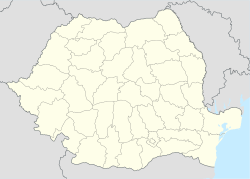


The Roșia Poieni copper mine is a large open pit copper mine in the centre of Romania's Transylvania region, 90 km (56 mi) northwest of Alba Iulia and 484 km (301 mi) north of the capital Bucharest. Geographically the mine is located in the Apuseni Mountains, 7 km (4.3 mi) south of the Arieș River in Lupșa commune.[1]
The Roșia Poieni deposit was developed between the 1950s and 1970s within the Abrud–Mușca–Bucium area (the Golden Quadrilateral) from the Metaliferi ('Ore') Mountains, part of the Apuseni Mountains. As of 2009, the mine produced around 11,000 tonnes of copper a year and the mineral deposit represented 65% of the total copper reserves in Romania. The mine is owned by CupruMin, a state-owned company.[2]
Location and access
Access to the site is made through a south-west industrial haul road from Cornii Valley that crosses the National Road no. 74 Alba-Iulia – Zlatna – Abrud when entering Abrud and through a north industrial haul road from Mușca Valley that crosses the National Road DN75 Câmpeni – Turda in Mușca village, Lupșa commune.[1]
Geology
As of 2022, Roșia Poieni represented the largest copper and gold reserve in Romania, and as the second largest in Europe, having estimated reserves of 1.5 billion tonnes of ore grading 0.36% copper.[3][4][2] It is enclosed by eruptive sub-volcanic Miocene rocks (micro-diorite or Fundoaia andesites).[5][2]
The Fundoaia body has the shape of a vertical column of 1,180 m (3,870 ft) in height (+1,030 m (3,380 ft) → −150 m (−490 ft)) and in horizontal plane having the following dimensions: 660 m (2,170 ft)÷740 m (2,430 ft)/820 m (2,690 ft)÷956 m (3,136 ft).[3][2] The eruptive body comes in contact (through the tectonic breccia) with andesite necks (Poieni, Curmătura, Melciu, Piatra Tichileu, and Jgheabului Hills) and with sedimentary Cretaceous rocks.[3][2] The porphyry copper deposit is made up mainly of fine disseminations, nests and veinlets (0.02÷3 cm) of pyrite, chalcopyrite, and magnetite; gold included in the chalcopyrite and pyrite, and secondary minerals: bornite, covellite, chalcocite, sphalerite, galena, molybdenite, germanite, malachite, azurite and is developed in microdioritic rocks.[2]
Ore processing
The ore extracted from the open pit is crushed in a gyratory crusher after being transported and stored in the crushed ore storage facility located within the processing plant site.[6] As of 2009, the processing plant had a design capacity of 9 million tonnes extracted and processed per year, the process being made on 4 technological lines of 7,500 tonnes per day.[citation needed] The plant was launched between 1983 and 1987.[1] The ore is subsequently processed through a classical processing flow, with a two-stage grinding phase in two autogenous mills and in two ball mills, followed by flotation, which is performed in pneumomechanical cells (17 m2 (180 sq ft)) where the primary concentrate is obtained, which subsequently is flotated in cells of 5.7 m2 (61 sq ft) where a copper concentrate is obtained with a content between 16.5 and 20% copper. The concentrate is thickened in sided thickeners and filtered through a pressure filter (Larox).[7]
Pollution
Roșia Poieni ore is sulphide ore, requiring seveal steps to extract the copper. Also, the ore contains only 0.38% copper, so the tailing (the residue sludge) amount is very large. This is pumped into a nearby valley, once the site of the now buried village of Geamăna. The valley is per 2026 still filling up with a rate of approximately 1,0 m/year.[8]
As the ore is sulphuric, the sludge contains high amounts of sulphide minerals, such as chalcocite (Cu2S), pyrrhotite (Fe(1-x)S) and pyrite (FeS2), the latter dissolving into sulphuric acid when in contact with air. The pH levels of the sludge pond is currently about 1,5-2,0[citation needed]. However, the sludge from the mine also contains pH regulating materials, notably lime used in the ore cleansing process. Stopping the sludge would therefore also stop the pH regulating of the sludge, which in turn would lower the pH value even more, resulting in damage to the blocking dam constructed to the north of the valley to stop the highly toxic sludge from spilling into the river systems leading into the Danube and the Black Sea.
Geamăna


The village of Geamăna was located in a nearby valley. The village population of over 1,000 residents were evicted in the 1970s as the valley was to be used as a decantation basin for the runoff of the mine.[9][10][11] The basin has continued to fill with toxic runoff, and as of 2015 was 90 meters deep and covered approximately 130 hectares.[9][12][4] The flooded village is located at 46°19′41″N 23°12′36″E / 46.32806°N 23.21000°E. In 2019, Arte released the series ARTE Re: which included a film about the village and the expulsion of the last inhabitants.[13] In 2025 an independent horror game was released exploring the story of Geamăna.[14]
References
- ^ a b c Cujba & Lazăr 2024, p. 41.
- ^ a b c d e f Cujba & Lazăr 2024, p. 42.
- ^ a b c Toderas 2021, p. 44.
- ^ a b Gherman, Naomi (4 June 2022). "The Heartbreaking Story of Geamăna, the Sinking Village". 3 Seas Europe. Archived from the original on 14 June 2025. Retrieved 23 June 2025.
- ^ Toderas 2021, pp. 44–45.
- ^ Cujba & Lazăr 2024, pp. 41, 43–44.
- ^ Cujba & Lazăr 2024, p. 44.
- ^ "If This Dam Fails, It Pollutes Half of Europe". YouTube. What On Earth Is This?. 20 February 2026. Retrieved 1 March 2026.
- ^ a b Besliu, Raluca (19 March 2015). "Romania's unsolved communist ecological disaster". openDemocracy. Archived from the original on 7 September 2019.
- ^ "Romania's sinking village". Radio Free Europe/Radio Liberty. Archived from the original on 24 March 2025.
- ^ Birchler, Gail (22 May 2012). "The Shared Fate of Treece, Kan., and Geamana, Romania". The 6th Floor. The New York Times. Archived from the original on 17 December 2024.
- ^ Deutsches Jahrbuch für Rumänien 2018 [German Yearbook for Romania 2018] (in German). ADZ Bukarest. 2018. ISSN 2559-4869.
- ^ "Re: Das versunkene Dorf" [Re: The Sunken Village]. programm.ARD.de (in German). Archived from the original on 15 April 2021.
- ^ "Geamana Village". Kotaku.
Works cited
- Cujba, Rodica Stepanek; Lazăr, Maria (December 2024). "Copper Mining's Green Revolution – Sustainable Techniques and Technologies Shaping the Future" (PDF). Revista Minelor – Mining Revue. 30 (s1): 32–50. doi:10.2478/minrv-2024-0038. ISSN 2247-8590.
- Toderas, Mihaela (December 2021). "Optimization study of blasting operations in Roşia Poieni open pit mine, Romania". Mining of Mineral Deposits. 15 (4): 43–55. doi:10.33271/mining15.04.043. ISSN 2415-3443.
Further reading
- André-Mayer, Anne-Sylvie; Sausse, Judith (2007). "Thickness and spatial distribution of veins in a porphyry copper deposit, Rosia Poieni, Romania". Journal of Structural Geology. 29 (10): 1695–1708. doi:10.1016/j.jsg.2007.06.010. ISSN 0191-8141.
- Dezso, Tamas; Szablyar, Eszter (2019). "Notes for an Epilogue". Photography and Culture. 12 (2): 279–295. doi:10.1080/17514517.2019.1596604. ISSN 1751-4525.
- Lazăr, Maria; Faur, Florin (January 2013). Identification and assessment of the risk and impact generated by Roşia Poieni quarry and Dealul Piciorului processing plant. Annals of the University of Petroşani, Mining Engineering. Vol. 14.
- Levei, Erika; Senila, Marin; Miclean, Mirela; Abraham, Bela; Roman, Cecilia; Stefanescu, Lucrina; Teodora, Oana (January 2011). "Influence of Rosia Poieni and Rosia Montana Mining Areas on the Water Quality of the Aries River". Environmental Engineering and Management Journal. 10 (1): 23–29.
- Milu, Viorica; Milesi, Jean-Pierre; Leroy, Jacques Léon (2004). "Rosia Poieni copper deposit, Apuseni Mountains, Romania: advanced argillic overprint of a porphyry system". Miner Deposita. 39: 173–188. doi:10.1007/s00126-003-0390-z.
