









Galileo Galilei Planetarium
Planetario Galileo Galilei | |
 | |
 | |
  Location within Buenos Aires | |
| Established | December 20, 1966 |
|---|---|
| Location | Palermo Woods, Palermo, Buenos Aires, Argentina |
| Coordinates | 34°34′11″S 58°24′42″W / 34.56972°S 58.41167°W |
| Type | Planetarium |
| Architect | Enrique Jan |
| Website | Official Website |
The Galileo Galilei planetarium, commonly known as Planetario, is located in Parque Tres de Febrero in the Palermo district of Buenos Aires, Argentina.
History
The idea that Buenos Aires should have a planetarium began to take shape in 1958 by an agreement between Socialist Councilman José Luis Peña and the municipal Secretary of Culture, Dr. Aldo Cocca. Construction began under the direction of architect Enrique Jan in 1962, and it was inaugurated on December 20, 1966. The first function was carried out on June 13, 1967 for the students of "Escuela Comercial Nº 1" of Banfield and "Santa Unión de los Sagrados Corazones" of Capital Federal. Professor of geography and mathematics Antonio Cornejo showed them the sky over Buenos Aires, Argentine Antarctica and the South Pole, as well as demonstrating the orientation of the southern cross. The facility was officially opened to the public on April 5, 1968.[1]
The planetarium was built in the same exact site from where the Buenos Aires Football Club and the Buenos Aires Cricket Club were evicted in the very late 1940s.[2]
Structure

The building has five floors, six staircases and a 20 metres (66 ft) diameter room with 360 seats.[3][4] The inside of the 20 m semispherical dome is covered with reflective aluminium.
The planetarium itself is located in the centre. The projection array once had over 100 projectors and was approximately 5 metres (16 ft) in height and 2.5 tons in weight, but now hosts only six Barco I600-4K10 projectors.[5] It consists of a cylindrical framework with independent projectors for the Moon, the Sun and the visible planets (Mercury, Venus, Mars, Jupiter and Saturn) and two spheres in the extremes that project 8,900 stars, constellations and nebulas.
Collections
- The museum has a piece of lunar rock which was brought back to Earth by the Apollo 11 mission and gifted to the planetarium by Richard Nixon.
- The museum is also home to a collection of 100-million-year-old sea life and amonite fossils from Neuquén Province.
- A metallic meteorite from Chaco Province is displayed on the entrance terrace.[4]
Gallery
-
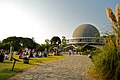 View of the Planetarium during the Buenos Aires Pillow Fight
 -
 The Planetarium at dusk
 -
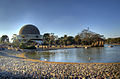 The Planetarium and the artificial lake in the foreground
 -
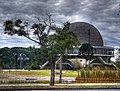 The Planetarium in a cloudy day
 -
 Infrared image of The Planetarium
 -
 The building during the day


.jpg)


.jpg)
See also
References
- ^ "La estructura futurista que se convirtió en postal de Palermo". lanacion.com.ar (in Spanish). Archived from the original on 11 February 2012. Retrieved 25 February 2019.
- ^ Urfeig, Viviana (2022-06-03). "Cumple 55 años. Curiosidades e historia de uno de los edificios de la modernidad porteña que visitó Ray Bradbury y aterrizó en Palermo: el planetario". La Nación (Buenos Aires). Retrieved 2022-06-03.
- ^ "Galileo Galilei Planetarium". www.pinta.art. Retrieved 2025-12-27.
- ^ a b "Experience the Stars at Galileo Galilei Buenos Aires Planetarium". 2023-11-07. Archived from the original on 2025-04-23. Retrieved 2025-12-27.
- ^ Coates, Charlotte. "Barco supports tech upgrade at Galileo Galilei Planetarium in Buenos Aires | blooloop". blooloop.com. Retrieved 2025-12-27.
34°34′11″S 58°24′42″W / 34.56972°S 58.41167°W


| International | |
|---|---|
| National | |
| Geographic | |
| Other | |
