








Askey–Gasper inequality
In mathematics, the Askey–Gasper inequality is an inequality for Jacobi polynomials proved by Richard Askey and George Gasper (1976)[1] and used in the proof of the Bieberbach conjecture.
Statement
It states that if , , and then


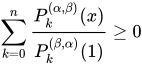
where

is a Jacobi polynomial.
The case when can also be written as


In this form, with α a non-negative integer, the inequality was used by Louis de Branges in his proof of the Bieberbach conjecture.
Proof
Ekhad gave a short proof of this inequality in 1993,[2] by combining the identity

with the Clausen inequality.
Generalizations
Gasper and Rahman (2004)[3] give some generalizations of the Askey–Gasper inequality to basic hypergeometric series.
See also
References
- ^ Askey, Richard; Gasper, George (1976), "Positive Jacobi polynomial sums. II", American Journal of Mathematics, 98 (3): 709–737, doi:10.2307/2373813, ISSN 0002-9327, JSTOR 2373813, MR 0430358
- ^ Ekhad, Shalosh B. (1993), Delest, M.; Jacob, G.; Leroux, P. (eds.), "A short, elementary, and easy, WZ proof of the Askey-Gasper inequality that was used by de Branges in his proof of the Bieberbach conjecture", Theoretical Computer Science, Conference on Formal Power Series and Algebraic Combinatorics (Bordeaux, 1991), 117 (1): 199–202, doi:10.1016/0304-3975(93)90313-I, ISSN 0304-3975, MR 1235178
- ^ Gasper, George; Rahman, Mizan (2004), Basic hypergeometric series, Encyclopedia of Mathematics and its Applications, vol. 96 (2nd ed.), Cambridge University Press, ISBN 978-0-521-83357-8, MR 2128719
- Askey, Richard; Gasper, George (1986), "Inequalities for polynomials", in Baernstein, Albert; Drasin, David; Duren, Peter; Marden, Albert (eds.), The Bieberbach conjecture (West Lafayette, Ind., 1985), Math. Surveys Monogr., vol. 21, Providence, R.I.: American Mathematical Society, pp. 7–32, ISBN 978-0-8218-1521-2, MR 0875228