








Thyatira
Θυάτειρα | |
 Remains of the colonnaded street in Thyatira | |
  Shown within Turkey | |
| Location | Akhisar, Manisa Province, Turkey |
|---|---|
| Region | Lydia |
| Coordinates | 38°55′12″N 27°50′11″E / 38.920090°N 27.836253°E |
| Altitude | 103 m (338 ft) |
| Type | Settlement |
| History | |
| Builder | Lydians; Macedonian colonists (3rd century BC) |
| Material | Stone, brick |
| Founded | Early Bronze Age; re-colonized 3rd century BC |
| Periods | Bronze Age, Hellenistic period, Roman Empire, Byzantine Empire |
| Cultures | Seha River Land, Lydian, Greek, Persian, Roman, Byzantine |
| Site notes | |
| Condition | Ruined |
| Ownership | Public |
| Public access | Yes |
| Architecture | |
| Architectural styles | Hellenistic, Roman |
| One of the seven churches mentioned in the Book of Revelation | |
Thyateira (also Thyatira; Ancient Greek: Θυάτειρα) was the name of an ancient Greek city in Asia Minor, now the modern Turkish city of Akhisar ("white castle"), Manisa Province. The name is probably Lydian. It lies in the far west of Turkey, southwest of Istanbul and east-northeast of Athens. It is about 50 miles (80 km) from the Aegean Sea.
History
It was an ancient Greek city called Pelopia (Ancient Greek: Πελόπεια) and Semiramis (Ancient Greek: Σεμίραμις),[1] before it was renamed to Thyateira (Θυάτειρα), during the Hellenistic era in 290 BC, by the King Seleucus I Nicator. He was at war with Lysimachus when he learned that his wife had given birth to a daughter. According to Stephanus of Byzantium, he called this city "Thuateira" from Greek θυγάτηρ, θυγατέρα (thugatēr, thugatera), meaning "daughter", although it is likely that it is an older, Lydian name.[2][3] In classical times, Thyatira stood on the border between Lydia and Mysia. During the Roman era, (1st century AD), it was famous for its dyeing facilities and was a center of the purple cloth trade.[citation needed] Among the ancient ruins of the city, inscriptions have been found relating to the guild of dyers in the city. Indeed, more guilds συντεχνία syntechnia (syndicate) are known in Thyatira than any other contemporary city in the Roman province of Asia (inscriptions mention the following: wool-workers, linen-workers, makers of outer garments, dyers, leather-workers, tanners, potters, bakers, slave-dealers, and bronze-smiths).[4]
In early Christian times, Thyateira was home to a significant Christian church, mentioned as one of the seven Churches of the Book of Revelation.[5] In Revelation, a character called Jezebel persuades the Christians of Thyateira to commit sexual immorality and to eat food sacrificed to idols.[6] Some commentators such as Benson and Doddridge have concluded that what is being here practised in this prophetic Thyatira is the same apostasy promoted in the Kingdom of Israel by Jezebel as mentioned in the Books of Kings and that use of her name here is a direct reference to such. Indeed, as Doddridge notes, "the resemblance appears so great" that, in his view, it is the "same heresy which is represented".[7]
According to Acts of the Apostles, the Apostle Paul and Silas visit Philippi during Paul's second or third journey. While there, Paul and Silas meet a woman named Lydia of Thyatira who hosts them to meet church members.[8]
In 366, a battle fought near Thyateira saw the army of Roman emperor Valens defeat Roman usurper Procopius.
Notable people
Artemidorus (Ancient Greek: Ἀρτεμίδωρος) of Thyateira was an athlete who won the Stadion race in the 193rd Olympiad (8 BC).[9]
Nicander (Ancient Greek: Νίκανδρος), also known as Nicander of Thyateira (Ancient Greek: Νίκανδρος ὁ Θυατειρηνός) was an ancient Greek grammarian.[10][11]
Lydia of Thyatira, businesswoman in the Acts of the Apostles chapter 16 verse 11–40.[12]
Bishopric
The city was home to a Christian community from the apostolic period. The community continued until 1922, when the Orthodox Christian population was deported.
In 1922, the Ecumenical Patriarch of Constantinople appointed an exarch for Western and Central Europe with the title Archbishop of Thyateira. The current archbishop of Thyateira (since 2019) is Nikitas Lulias.[13] The Archbishop of Thyateira resides in London and has pastoral responsibility for the Greek Orthodox Church in Great Britain.
The see of Thyatira is also included, without archiepiscopal rank, in the Roman Catholic Church's list of titular sees.[14]
-
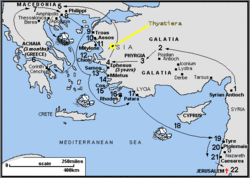 Paul's third journey
 -
![19th-century Thyatira[15]](https://upload.wikimedia.org/wikipedia/commons/thumb/f/f7/A_dictionary_of_the_Bible.._%281887%29_%2814595164770%29.jpg/250px-A_dictionary_of_the_Bible.._%281887%29_%2814595164770%29.jpg) 19th-century Thyatira[15]
19th-century Thyatira[15] -
 Byzantine basilica of Thyatira
 -
 Ruins of the city

![19th-century Thyatira[15]](https://en.wikipedia.org/wiki/File:A_dictionary_of_the_Bible.._(1887)_(14595164770).jpg)


See also
References
- ^ Stephanus of Byzantium, Ethnica, Th319.1
- ^ Stephanus of Byzantium, De Urbibus ("On cities") [1]
- ^ Θυγάτηρ, Henry George Liddell, Robert Scott, A Greek-English Lexicon, at Perseus project
- ^ W.M. Ramsey, The Letters to the Seven Churches of Asia, (Hodder, 1904), pp. 324–35.
- ^ Rev. 1:11; 2:18–28.
- ^ Rev. 2:20
- ^ Benson. "Revelation 2 Benson Commentary". Biblehub. Retrieved 24 August 2019.
- ^ Acts 16:13–15, 40
- ^ Eusebius, Chronography, 79
- ^ Harpokration, Lexicon of the Ten Orators, Th33
- ^ Athenaeus, Deipnosophistae, § 11.5
- ^ Acts 16:14.
- ^ [2] – Biography at the website of the Archdiocese of Thyateira and Great Britain
- ^ Annuario Pontificio 2013 (Libreria Editrice Vaticana, 2013, ISBN 978-88-209-9070-1), p. 988.
- ^ Schaff, Philip (1887). A Dictionary of the Bible.

