Liquor (/ˈlɪkər/LIK-ər, sometimes hard liquor), spirits, distilled spirits, or spiritous liquor are alcoholic drinks produced by the distillation of grains, fruits, vegetables, or sugar that have already gone through alcoholic fermentation. While the word liquor usually refers to distilled alcoholic spirits rather than drinks produced by fermentation alone, it can sometimes be used more broadly to refer to any alcoholic beverage (or even non-alcoholic ones produced by distillation or some other practices, such as the brewed liquor of a tea).
The distillation process concentrates the alcohol, so the resulting condensate has an increased alcohol by volume. As liquors contain significantly more alcohol (ethanol) than other alcoholic drinks, they are considered "harder". In North America, the term hard liquor is sometimes used to distinguish distilled alcoholic drinks from non-distilled ones, whereas the term spirits is more commonly used in the United Kingdom. Some examples of liquors are vodka, rum, gin and tequila. Liquors are often aged in barrels, such as for the production of brandy, tequila, and whiskey, or are infused with flavorings to form flavored liquors, such as absinthe. (Full article...)
Samai Gold Rum (left) and Samai Kampot Pepper Rum (right)
Samai Rum Distillery (Khmer: សិប្បកម្មកែច្នៃស្រារ៉ោមសម័យ) is a Cambodian premium rum manufacturer in Phnom Penh founded in 2014. The first rum distillery in the country, it was founded by Diego Wilkins, Daniel Pacheco and Antonio Lopez.
Samai Distillery was selected as one of 10 startup distilleries for Diageo's distillery incubation programme. Since then, its rums have won numerous awards from across the world such as San Francisco World Spirits Competition, the London International Spirits Challenge, the Singapore World Spirits Competition and the Miami International Rum Conference. Currently, the distillery exports around 30% of its production to Singapore, France and Spain, while the remaining 70% is sold domestically.
In 2020, after the start of the COVID-19 pandemic, Samai Distillery began producing hand sanitizer from the distillation fraction previously used for disinfecting equipment. (Full article...)
Marvin "Popcorn" Sutton (October 5, 1946 – March 16, 2009) was an American Appalachianmoonshiner and bootlegger. Born in Maggie Valley, North Carolina, he grew up, lived and died in the rural areas around Maggie Valley and nearby Cocke County, Tennessee. He wrote a self-published autobiographical guide to moonshining production, self-produced a home video depicting his moonshining activities, was the subject of several documentaries, including one that received a Regional Emmy Award, and is the subject of the award-winning biography and photobook The Moonshiner Popcorn Sutton.
Sutton died by suicide in March 2009, aged 62, rather than report to federal prison
after being convicted of offenses related to moonshining and illegal firearm possession. Since his death, a new company and associated whiskey brand have been named after him. (Full article...)
Whisky or whiskey is a type of liquor made from fermentedgrainmash. Various grains (which may be malted) are used for different varieties, including barley, corn, rye, and wheat. Whisky is typically aged in wooden casks, commonly of charred white oak. Uncharred white oak casks previously used for the aging of port, rum, or sherry may be employed during storage to impart a unique flavour and colour.
Whisky is a strictly regulated spirit worldwide with many classes and types. The typical unifying characteristics of the different classes and types are the fermentation of grains, distillation, and aging in wooden barrels. (Full article...)
Image 2
Reservoir glass with naturally coloured verte absinthe and an absinthe spoon
Absinthe (/ˈæbsɪnθ,-sæ̃θ/, French:[apsɛ̃t]ⓘ) is an anise-flavoured spirit derived from several plants, including the flowers and leaves of Artemisia absinthium ("grand wormwood"), together with green anise, sweet fennel, and other medicinal and culinary herbs. Historically described as a highly alcoholic spirit, it is 45–74% ABV or 90–148 proof in the US. Absinthe traditionally has a natural green colour but may also be colourless. It is commonly referred to in historical literature as la fée verte'the green fairy'. While sometimes casually referred to as a liqueur, absinthe is not traditionally bottled with sugar or sweeteners. Absinthe is traditionally bottled at a high level of alcohol by volume, but it is normally diluted with water before being consumed.
The whiskey-based Manhattan is one of five cocktails named for a New York City borough. It is closely related to the Brooklyn cocktail, which uses dry vermouth and Maraschino liqueur in place of the Manhattan's sweet vermouth, and Amer Picon in place of the Manhattan's angostura bitters. (Full article...)
The Bramble is a cocktail created by Dick Bradsell in 1980s London, England. Best described as a spring cocktail, the Bramble brings together dry gin, lemon juice, sugar syrup, crème de mûre, and crushed ice. Bradsell also suggests finishing off the cocktail with some fresh red fruits (such as blackberries, cranberries) and a slice of lemon.
If crème de mûre is unavailable, many bartenders will substitute creme de cassis for it. (Full article...)
In a broader sense, the term brandy also denotes liquors obtained from the distillation of pomace (yielding pomace brandy), or mash or wine of any other fruit (fruit brandy). These products are also called eau de vie (literally "water of life" in French). (Full article...)
The Illegal is an IBA official cocktail. This cocktail is named after the mezcal brand Ilegal Mezcal, which is one of its key ingredients. Mezcal is a type of Mexican distilled spirit made from agave plants, similar to tequila but with a distinct smoky flavor. (Full article...)
A negroni served with a dash of freshly squeezed orange juice was named a negroni malato ("sick negroni") at Bar Piccolino in Exchange Square, London during the 2008 financial crisis, by Italian bankers employed at nearby RBS offices.
Rakia, rakija, rakiya, rachiu or rikea (/ˈrɑːkiə,ˈræ-,rəˈkiːə/), is the collective term for fruit spirits or fruit brandy popular in the Balkans. The alcohol content of rakia is normally 40% ABV, but home-produced rakia can be stronger (typically 50–80%). (Full article...)
Image 12
The paloma (Spanish for "dove") is a tequila-based cocktail. This drink is most commonly prepared by mixing tequila, lime juice, and a grapefruit-flavored soda such as Fresca, Squirt, or Jarritos and served with ice and a lime wedge. Adding salt to the rim of the glass is also an option.
Related to the martini, the tuxedo has had many variations since its inception in the 1880s. The cocktail is named after the Tuxedo Club in Orange County, New York where it was first mixed. Tuxedo Park, the planned community where the club was built, is itself a derivation of the Lenape word tucseto. The form of menswear by the same name originated at the same country club around the same time. (Full article...)
Image 14
Pisco punch is an alcoholic beverage made famous by Duncan Nicol at the Bank Exchange Saloon at the end of the 19th century, in San Francisco, California. The Bank Exchange Saloon was located on the southeast corner of the intersection of Montgomery and Washington Streets, in the Montgomery Block building, where the Transamerica Pyramid now stands. (Full article...)
The English loanword "schnapps" is derived from the colloquial German word Schnaps[ʃnaps]ⓘ (plural: Schnäpse), which is used in reference to spirit drinks. The word Schnaps stems from Low German and is related to the German term "schnappen", meaning "snap", which refers to the spirit usually being consumed in a quick slug from a small glass (i.e., a shot glass). (Full article...)
A lemon drop is a vodka-based cocktail that has a lemony, sweet and sour flavor, prepared using vodka, triple sec, and fresh lemon juice. It has been described as a variant of, or as "a take on", the vodka martini, but is in fact closer to a daisy or a white lady variant. It is typically prepared and served straight up – chilled with ice and strained.
The drink was invented sometime in the 1970s by Norman Jay Hobday, the founder and proprietor of Henry Africa's bar in San Francisco, California. Variations of the drink exist, such as blueberry and raspberry lemon drops, and some recipes that call for simple syrup. It is served at some bars and restaurants in the United States, and in such establishments in other areas of the world. (Full article...)
Image 18
A sherry cobbler is a classic American cocktail made with sherry, sugar and citrus. Its origins are not known in detail, but is believed to have originated sometime in the early 19th century. The earliest known mention is from an 1838 diary of a Canadian traveler to the United States, Katherine Jane Ellice, but it did not gain international name recognition until Charles Dickens included the drink in The Life and Adventures of Martin Chuzzlewit.
To make the drink, orange and lemon are muddled with simple syrup, sherry is added, and the mixture is shaken with ice in a cocktail shaker and strained into a highball glass filled with crushed ice. Garnishes include mint leaves, raspberry, and orange and lemon slices. It can also be garnished with pineapple wedges or any seasonal berries. Some recipes add pineapple juice. (Full article...)
Image 19
Caipirinha
Caipirinha (/ˌkaɪpɪˈriːnjə/KY-pi-REEN-yə; Brazilian Portuguese pronunciation:[kajpiˈɾĩɲɐ]) is a Brazilian cocktail made with cachaça, sugar, lime, and ice. The drink is prepared by mixing the fruit and the sugar together, then adding the liquor. Known and consumed nationally and internationally, caipirinha is one of the most famous components of Brazilian cuisine, being the most popular national recipe worldwide and often considered the best drink in the country and one of the best cocktails/drinks in the world, having reached third place in 2024, according to the specialized website TasteAtlas.
Moonshine is high-proofliquor, traditionally made or distributed illegally. The name was derived from a tradition of distilling the alcohol at night to avoid detection. In the first decades of the 21st century, commercial distilleries have adopted the term for its outlaw cachet and have begun producing their own legal "moonshine", including many novelty flavored varieties, that are said to continue the tradition by using a similar method or locale of production.
In 2013, moonshine accounted for about one-third of global alcohol consumption. (Full article...)
Image 21
A gin fizz is the best-known cocktail in the fizz family. A gin fizz contains gin, lemon juice, and sugar, which are shaken with ice, poured into a tumbler and topped with carbonated water. The drink is similar to a Tom Collins, with a possible distinction being a Tom Collins historically used "Old Tom gin" (a slightly sweeter precursor to London Dry Gin), whereas the kind of gin historically used in a gin fizz is unknown.
Traditional distillation of tsikoudia Tsikoudia (Greek: τσικουδιά, romanized: tsikoudiá, literally "terebinth") is an alcoholic beverage, a fragrant, grape-based pomace brandy of Cretan origin that contains 40% to 65% alcohol by volume. Tsikoudia is made by distilling of pomace, what remains of grapes pressed in winemaking. In the eastern part of Crete, tsikoudia is often informally called raki (Greek: ρακή, romanized: rakí), a name originating from the Turkish 'raki', derived from the 17th-century Arabic 'arak', meaning 'distilled'.
The pomace ferments for about six weeks in a tightly sealed barrel, and is then distilled. It is similar to tsipouro from mainland Greece, and is part of a family of Mediterranean grape-based distilled spirits, including Spanish: orujo, Italian: grappa, French: marc, Georgian: chacha, Portuguese: bagaceira, Bulgarian: ракия, romanized: rakiya, Macedonian: ракија, romanized: rakija, Turkish rakı, Albanian: rakia, Serbo-Croatian: rakija / ракија (in Istria: grappa), Romanian: tescovină, Hungarian: törköly. However, unlike the above spirits which are typically double-distilled and often include additional spices such as anise, tsikoudia undergoes a single distillation process. This method preserves more of the original grape flavor without the addition of flavorings, resulting in a lower alcohol content and a distinct flavor profile compared to its counterparts. (Full article...)
... that the former Natick station building became the basement of a liquor store?
... that instead of drinking liquor with prospective clients, Arthur Harrison Motley sent them notes written in red pencil crayon, 10,000 times a year?
... that a liquor-drinking celebrity goat named Ioiô won an election for city councilman in Fortaleza?
This is a Good article, an article that meets a core set of high editorial standards.
Stork Club was a nightclub in Manhattan, New York City. During its existence from 1929 to 1965, it became one of the most prestigious clubs in the world. A symbol of café society, the wealthy elite, including movie stars, celebrities, showgirls, and aristocrats all mixed in the VIP 'Cub' Room. The club was established on West 58th Street in 1929 by Sherman Billingsley, a former bootlegger from Enid, Oklahoma. After an incident when Billingsley was kidnapped and held for ransom by Mad Dog Coll, a rival of his mobster partners, he became the sole owner of the Stork Club. It remained at its original location until it was raided by Prohibition agents in 1931 after which it moved to East 51st Street. From 1934 until its closure in 1965, it was located at 3 East 53rd Street, just east of Fifth Avenue, when it became world-renowned with its celebrity clientele and luxury. Billingsley was known for his lavish gifts, which brought a steady stream of celebrities to the club and also ensured that those interested in the famous would have a reason to visit.
Until World War II, the club consisted of a dining room and bar with restrooms on upper floors with many mirrors and fresh flowers throughout. Billingsley originally built the well-known Cub Room as a private place where he could play cards with friends. Described as a "lopsided oval", the room had wood paneled walls hung with portraits of beautiful women and had no windows. A head waiter known as "Saint Peter" determined who was allowed entry to the Cub Room, where Walter Winchell wrote his columns and broadcast his radio programs from Table 50. (Full article...)
Image 13Map of Europe with individual countries grouped by preferred type of alcoholic drink, based on recorded alcohol consumption per capita (age 15+) (in liters of pure alcohol) in 2016.
Image 10A whiskey sour, served in a coupe glass, is garnished with a spiral of lemon peel and two maraschino cherries on a cocktail pick, along with drops of bitters swirled into the foam (from egg white) atop the drink. (from Cocktail garnish)






.svg)

.png)
.jpg)


.jpg)


.jpg)


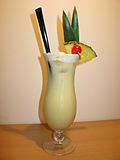 A piña colada (from List of cocktails)
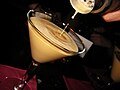 A Brandy Alexander being served (from List of cocktails)
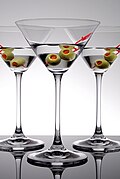 A martini is a classic gin-based cocktail. (from List of cocktails)
 A grasshopper (from List of cocktails)
 A display of various liquors in a supermarket (from Liquor)
 A cosmopolitan (from List of cocktails)
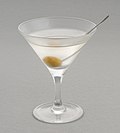 A martini cocktail (from List of cocktails)
 An illustration of brewing and distilling industry methods in England, 1858 (from Liquor)
 These flaming cocktails illustrate that some liquors will readily catch fire and burn. (from Liquor)
 A Ramos gin fizz (from List of cocktails)
 Map of Europe with individual countries grouped by preferred type of alcoholic drink, based on recorded alcohol consumption per capita (age 15+) (in liters of pure alcohol) in 2016.WineBeerSpirits(from Liquor)


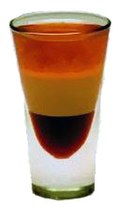 A B-52 (from List of cocktails)
 Bee's knees (from List of cocktails)
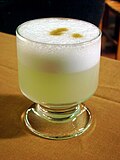 A pisco sour (from List of cocktails)
 Some single-drink liquor bottles available in Germany (from Liquor)
 A Caipirinha with lime (from List of cocktails)
 Reservoir glass with naturally coloured verte absinthe and an absinthe spoon (from List of cocktails)
 Negroni (from List of cocktails)
 Mulled wine steeping (Swedish glögg) (from List of cocktails)
 Aviation (from List of cocktails)
.jpg)


.jpg)


.svg)


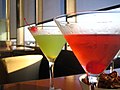
 Pineapple wedge (from Cocktail garnish)
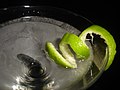 Lime twist (from Cocktail garnish)
 Shrimp (from Cocktail garnish)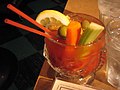
 Lemon slice (from Cocktail garnish)
 Cocktail olive (from Cocktail garnish)
 Raspberry (from Cocktail garnish)
 A whiskey sour, served in a coupe glass, is garnished with a spiral of lemon peel and two maraschino cherries on a cocktail pick, along with drops of bitters swirled into the foam (from egg white) atop the drink. (from Cocktail garnish)


.jpg)


 Commons
 Wikibooks
 Wikidata
 Wikinews
 Wikiquote
 Wikisource
 Wikiversity
 Wikivoyage
 Wiktionary


