







Kaiju
.jpg)
.jpg)

_(cropped).JPG)
.jpg)
.jpg)
- Top left: Gorgo (1961)
- Top right: The Beast from 20,000 Fathoms (1953)
- Middle left: King Kong (1933)
- Middle right: Reptilicus (1961)
- Lower left: Tarantula (1955)
- Lower right: Attack of the 50 Foot Woman (1958)
Kaiju (from Japanese: 怪獣, romanized: kaijū, lit. 'strange beast'), or giant movie monster, are terms used in film and media for monsters, and the like, of enormous size, mainly belonging to a designated genre, known as kaiju movies, or giant monster movies, where they are usually depicted attacking major cities, and battling either the military or other creatures, mixing creature features with the disaster film genre, but also often involving science fiction. Such may include famous movie monsters like King Kong, Godzilla and Gamera, cult classics like The Beast from 20,000 Fathoms, It Came from Beneath the Sea, Them!, The Giant Claw, and modern examples like Cloverfield, among more. Related media may include "mecha", which often revolve around giant robots fighting giant monsters, such as Voltron, Power Rangers, Evangelion, Megas XLR, Pacific Rim, etc.
The Japanese term "kaijū" (lit. 'strange beast') initially refers to "movie monsters" of any kind, but has subsequently come to be the term for giant such. Historically, giant movie monsters where initially called daikaijū (大怪獣), lit. 'giant movie monster', which has since fallen out of use. It can refer to the monsters themselves, and the movie genre in which they appear. In contrast to "giant movie monster", the term "kaiju" can also be used to specifically refer to the Japanese style of giant monster movie media, which traditionally uses actors in monster suits, trampling around scale model sets. Its widespread contemporary use is credited to tokusatsu (special effects) director Eiji Tsuburaya and filmmaker Ishirō Honda, who popularized the Japanese kaiju film genre by creating the Godzilla franchise and its spin-offs.[1]
The first "giant monster movie" is debatable. The 1921 animated shortfilm The Pet (1921) features a giant monster attacking a city, and the 1925 silent feature film The Lost World famously features a dinosaur being brought to the streets of London, subsequently inspiring the creators to make the 1933 movie King Kong. The Japanese style of giant monster movies with suitmation starts as early as the 1930s with movies such as Wasei Kingu Kongu (1933), The Great Buddha Arrival (1934), and The King Kong That Appeared in Edo (1938). The first Japanese "kaiju movie" to see international success is the 1954 feature Godzilla. When developing it, creators drew inspiration from the character of King Kong, both in its influential 1933 film and in the conception of a giant monster, establishing it as a pivotal precursor in the evolution of the genre.[2] During their formative years, kaiju movies were generally neglected by Japanese critics, who regarded them as "juvenile gimmick", according to authors Steve Ryfle and Ed Godziszewski.[1]
Kaiju are often somewhat metaphorical in nature; Godzilla, for example, initially served as a metaphor for nuclear weapons, reflecting the fears of post-war Japan following the atomic bombings of Hiroshima and Nagasaki and the Lucky Dragon 5 incident. Other notable examples of kaiju include Rodan, Mothra, King Ghidorah, Gamera, and King Kong.[2]
Etymology
The Japanese word kaijū (怪獣, [kai(d)ʑɯː]) translates literally as "strange beast",[3] and originally referred to monsters and creatures from ancient Japanese legends;[4] it earlier appeared in the Chinese Classic of Mountains and Seas.[5] There are no traditional depictions of kaijū or kaijū-like creatures among the yōkai of Japanese folklore,[6] although it is possible to find megafauna in their mythology (e.g., Japanese dragons). After sakoku ended and Japan was opened to foreign relations in the mid-19th century, the term kaijū came to be used to express concepts from paleontology and legendary creatures from around the world. For example, the extinct Ceratosaurus-like cryptid featured in The Monster of "Partridge Creek" (1908) by French writer Georges Dupuy[7] was referred to as kaijū.[8]
It is worthy to note that in the Meiji era, Jules Verne's works were introduced to the Japanese public, achieving great success around 1890.[9]
History
Early history


.jpg)
Right: The giant that slept for 5,000 years, by John Bauer (1882–1918).
The idea of giant monsters in city environments appear variously before the 20th century. A noteworthy example includes Camille Flammarion's Le Monde avant la création de l'homme ("The World Before Man's Creation") series in 1886, which includes several illustrations that depict appearances of bipedal dinosaurs in period society.
A 7000 word feature article published in the Chicago Tribune and other American newspapers on April the 1st, 1906 told the story of a purported recent invasion of Chicago by "hordes of prehistoric monsters, dealing death and destruction". The article included eight doctored photographs showing gigantic sauropods, tyrannosaurs, pterosaurs and other creatures attacking or otherwise interacting with famous Chicago landmarks such as the Art Institute of Chicago, the Montgomery Ward Building tower and the Lincoln Park Zoo.[citation needed]
Genre elements were present at the end of Winsor McCay's 1921 animated short The Pet in which a mysterious giant animal starts destroying the city, until it is countered by a massive airstrike. It was based on a 1905 episode of McCay's comic strip series Dreams of the Rarebit Fiend.[10] It is likely the earliest "giant monster attacking a city" on film.[11]
-
The Pet (1921)
Prehistoric monster era (1920s–1940s)
_-_film_poster_(cropped).jpg)

The first feature films starring giant movie monsters made their debut during the interwar period. The period is defined by its use of prehistoric creatures that survived to modern times in undiscovered natural areas or through prolonged hibernation, such as natural cryopreservation in caves and icebergs, which then come into contact with troublesome humans and then begin their rampage.[12]
The 1925 film The Lost World (adapted from Arthur Conan Doyle's 1912 novel of the same name), featured many dinosaurs, including a brontosaurus that breaks loose in London and destroys Tower Bridge. The film's layout was revolutionary and laid the foundation for future giant monster films. The film takes place on an unexplored mountain plateau like a deserted island teeming with prehistoric dinosaurs. The dinosaurs of The Lost World were animated by pioneering stop motion techniques by Willis H. O'Brien, who would some years later animate the giant gorilla-like creature breaking loose in New York City in the 1933 film King Kong. The enormous success of King Kong can be seen as the definitive breakthrough of giant monster movies. This influential achievement of King Kong paved the way for the emergence of the giant monster genre, serving as a blueprint for future kaiju productions. Its success reverberated in the film industry, leaving a lasting impact and solidifying the figure of the giant monster as an essential component in genre cinematography.[2]
The 1942 Superman animated short The Arctic Giant features a cryopreserved Tyrannosaurus which thaws out and attacks Metropolis. It is one of pioneering productions to depict a Godzilla-esque character to attack a modern civilization.[13]
-
The Lost World (1925)
-
 King Kong (1933)
 -
The Arctic Giant (1942)
_movie_poster_(1).jpg)
First Japanese kaiju movies (1930s)
The Japanese style of making giant monster movies, where the monster is portrayed by actors in monster suits, so called "suitmation", appears in the early 1930s. Early examples includes the 1933 King King spoof Wasei Kingu Kongu, the 1934 feature The Great Buddha Arrival, and 1938 feature and The King Kong That Appeared in Edo.[14] Although all three films became lost during World War II, stills of the films have survived, and are some of the earliest examples of kaiju movies in Japanese cinematic history.[14] The 1934 film presumably influenced the production of the Ultraman franchise.[15]
-
 Wasei Kingu Kongu (1933)
 -
 The Great Buddha Arrival (1934)
 -


Mutant and atomic monster era (1950s)


After World War II, the roots of giant movie monsters started to shift from giant prehistoric monsters to monsters stemming from animals which had been exposed to strong radiation and then mutated into gigantic monsters, a result of the fear of nuclear proliferation that spread around the world during the Cold War.[16]
One of the early prolific examples is Ray Bradbury's short story published in the Saturday Evening Post, June 23, 1951, "The Beast from 20,000 Fathoms", which came to serve as the basis for the film of the same name from 1953, featuring a fictional dinosaur, called a Rhedosaurus (animated by Ray Harryhausen), which is released from its frozen, hibernating state by an atomic bomb test within the Arctic Circle. The American movie was released in Japan in 1954 under the title The Atomic Kaiju Appears, marking the first use of the genre's name in a film title.[17] It directly inspired Godzilla, released in 1954 (subtitled: "H-Bomb Giant Monster Movie", 水爆大怪獣映画, Suibaku Daikaiju Eiga), and many more giant monster movies of similar nature, such as Them! (featuring giant ants), Tarantula, and Attack of the 50 Foot Woman, etc.
Godzilla from 1954 is a rather unique example of the era, as it's not simply representing fear of nuclear proliferation, but also reflecting the experience that Japan faced upon the atomic bombings of Hiroshima and Nagasaki at the end of World War II. Tomoyuki Tanaka, a producer for Toho Studios in Tokyo, needed a film to release after his previous project was halted. Seeing how well the Hollywood giant monster movie genre films King Kong and The Beast from 20,000 Fathoms had done in Japanese box offices, and himself a fan of these films, he set out to make a new movie based on them and created Godzilla.[18] Tanaka aimed to combine Hollywood giant monster movies with the re-emerged Japanese fears of atomic weapons that arose from the Daigo Fukuryū Maru fishing boat incident; and so he put a team together and created the concept of a giant radioactive creature emerging from the depths of the ocean, a creature that would become the monster Godzilla.[19] Godzilla initially had commercial success in Japan, inspiring other kaiju movies.[20]
Following the success of Godzilla's first appearance, Toho followed up the following year with a sequel, called Godzilla Raids Again, which introduced the concept of the "monster fight", in which two Kaiju fights one another.[21] In the movie, Godzilla faces off with another kaiju monster called Anguirus, which is the first monster, aside Godzilla, to be introduced into the Godzilla franchise.[21]
-

-
 Godzilla (1954)
 -
 Them! (1954)
 -
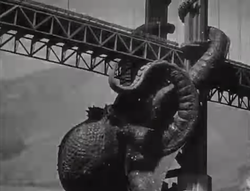 It Came from Beneath the Sea (1955)


.jpg)
_trailer_-_Sixtopus_2.png)
Space Age era (1960s-1970s)


During the 1960s, the Japanese studio Toho started to experiment with having kaiju from different movies fight one another, culminating in RKO Pictures later licensing King Kong to Toho, resulting in the co-productions King Kong vs. Godzilla (1962) and King Kong Escapes (1967), both directed by Ishirō Honda.
With the advent of the Space Race and Space Age, themes of giant monsters from outer space and alien invasions started to appear in kaiju movies. Examples include the Godzilla film Ghidorah, the Three-Headed Monster, where the "space dragon" King Ghidorah is introduced for the first time, but also more obscure films such as The X from Outer Space. Giant monsters from outer space are traditionally associated with fictional aliens who bring them to Earth to conquer the planet or similar.
During the 1960s, a rival franchise to Godzilla would also be launched by Japanese studio Daiei Film, introducing the giant monster turtle Gamera, which have come to play a significant role in forming the genre along with the Godzilla franchise and the Ultra Series.
Terminology

Kaiju
In Japanese media, the term kaijū generally refers to large monsters and thereof, but in Western popculture it has been borrowed as a synonym for "giant (movie) monster" and thereof, but it can also specifically refer to ditto in Japanese popculture.[22]
Such can be antagonistic, protagonistic, or a neutral force of nature. Some are, in essence, merely "big animals", such as King Kong, and the Rhedosaurus from The Beast from 20,000 Fathoms, while others are more alien, like "Hail Mary" from the Invincible series, a giant quadruped animal with squid-tentacles on the face.[23][24] Others are often preternatural creatures of divine power. Godzilla, for example, from its first appearance in the initial 1954 entry in the Godzilla franchise, has manifested all of these aspects. Other examples of kaiju include Rodan, Mothra, King Ghidorah, Anguirus, Gamera, Megalon, The Cloverfield Monster, The Giant Claw, Gappa, Guilala, and Yonggary.
As a noun, kaijū is an invariant, as both the singular and the plural expressions are identical: "a kaiju" and "several kaiju".
-
 Mothra (1961)
 -
 King Ghidorah (1964)
 -
 Gamera (1965)


Daikaiju
Daikaijū (大怪獣) is the Japanese term equivalent to "giant movie monster" and literally translates as "giant kaiju" or "great kaiju". This hyperbolic term was used to denote greatness of the subject kaiju, the prefix dai- emphasizing great size, power, and/or status. The first known appearance of the term daikaiju in the 20th Century was in the publicity materials for the original 1954 release of Godzilla. Specifically, in the subtitle on the original movie poster, Suibaku Daikaiju Eiga (水爆大怪獣映画), lit. 'H-Bomb Giant Monster Movie'.[citation needed]
Gamera, the Giant Monster, the first film of the Gamera franchise in 1965, also utilized the term, where the Japanese title of the film is Daikaijū Gamera (大怪獣ガメラ; lit. 'Giant Monster Gamera'), as did The X from Outer Space from 1967, where the Japanese title is Uchū Daikaijū Girara (宇宙大怪獣ギララ; lit. 'Cosmic Giant Monster Guilala').
Mecha kaiju
Mecha kaiju (Meka-Kaijū) are robotic or cybernetic kaiju. Such may be unique characters, like Moguera, but also robot counterparts of an already existing kaiju, such as Mechani-Kong and Mechagodzilla, mainly produced by a foe to fight the real kaiju. Other forms includes cyborg modifications to already existing kaiju to improve its abilities, such as Mecha-King Ghidorah.
One of the first mecha kaiju was "Mechani-Kong" (Mecha-Kong) in King Kong Escapes (1967), but the most famous example is "Mechagodzilla", introduced in the apply named Godzilla vs. Mechagodzilla (1974).
-
 Moguera (1957)
 -
 Mechani-Kong (1967)
 -
 Mechagodzilla (1974)
 -
 Artwork of Mecha-King Ghidorah
.png)


Ultra Kaiju
Ultra-Kaiju (Urutora-Kaijū) is a separate strata of kaijū that specifically refers to kaiju in the long-running Ultra Series franchise.
Kaijin
Kaijin (怪人 lit. 'Strange person') refers to distorted human beings or humanoid-like creatures. The origin of kaijin goes back to the early 20th Century Japanese literature, starting with Edogawa Rampo's 1936 novel, The Fiend with Twenty Faces. The story introduced Edogawa's master detective, Kogoro Akechi's arch-nemesis, the eponymous "Fiend", a mysterious master of disguise, whose real face was unknown; the Moriarty to Akechi's Sherlock. Catching the public's imagination, many such literary and movie (and later television) villains took on the mantle of kaijin. To be clear, kaijin is not an offshoot of kaiju. The first-ever kaijin that appeared on film was The Great Buddha Arrival a lost film, made in 1934. After the Pacific War, the term was modernized when it was adopted to describe the bizarre, genetically engineered and cybernetically enhanced evil humanoid spawn conceived for the Kamen Rider Series in 1971. This created a new splinter of the term, which quickly propagated through the popularity of superhero programs produced from the 1970s, forward. These kaijin possess rational thought and the power of speech, as do human beings. A successive kaijin menagerie, in diverse iterations, appeared over numerous series, most notably the Super Sentai programs premiering in 1975 (later carried over into Super Sentai's English iteration as Power Rangers in the 1990s).
This created yet another splinter, as the kaijin of Super Sentai have since evolved to feature unique forms and attributes (e.g., gigantism), existing somewhere between kaijin and kaiju.[citation needed]
Seijin
Seijin (星人 lit. 'star people'), appears within Japanese words for extraterrestrial aliens, such as Kaseijin (火星人), which means "Martian". Aliens can also be called uchūjin (宇宙人) which means "spacemen". Among the best known Seijin in the genre can be found in the Ultra Series, such as Alien Baltan from Ultraman, a race of cicada-like aliens who have gone on to become one of the franchise's most enduring and recurring characters other than the Ultras themselves.[citation needed]
Toho has produced a variety of kaiju films over the years (many of which feature Godzilla, Rodan, and Mothra), but other Japanese studios contributed to the genre by producing films and shows of their own: Daiei Film (Kadokawa Pictures), Tsuburaya Productions, and Shochiku and Nikkatsu Studios.[citation needed]
Monster fight
Monster fights simply refers to fights in movies were kaiju fights each other or equivalent, which can be divided further. Monster fights are extremely common in kaiju movies overall, and most Godzilla, King Kong, and Gamera movies, etc, features such.
A common motif in regards to monster fights is when the main kaiju fights the opposing monsters as a defender of mankind. King Kong infamously fought a tyrannosaur to defend the love interest Ann Darrow. Gamera, despite being the bad guy in the first movie, featured elements as a guardian of children, which eventually became his main trait.[25]
Monster duel
Monster duels refers to monster fights where two kaiju duels one another, a subgenre of its own, combining the versus movie genre with the kaiju genre. The first monster duels occurred in early dinosaur movies, such as The Lost World (1925) and King Kong (1933), especially the latter, where King Kong famously fights a tyrannosaur. The first movie revolving around a monster duel was Godzilla Raids Again from 1955, featuring Godzilla facing off with another kaiju monster called Anguirus.[21]
-
 King Kong vs tyrannosaurus (1933)
 -
 King Kong vs dinosaur (1933)
 -
 King Kong vs Mechani-Kong (1967)


.jpg)
Monster rumble

Monster rumbles refers to monster fights where several kaiju fights each other, a subgenre of its own. The first movie to introduce this concept was Ghidorah, the Three-Headed Monster (1964), where Godzilla, Rodan, and King Ghidorah fight each other.[26]
Monster techniques
_Anguirus_suit.jpg)
Eiji Tsuburaya, who was in charge of the special effects for Godzilla, developed a technique to animate the kaiju that became known colloquially as "suitmation".[27] Where Western monster movies often used stop motion to animate the monsters, Tsubaraya decided to attempt to create suits, called "creature suits", for a human (suit actor) to wear and act in.[28] This was combined with the use of miniature models and scaled-down city sets to create the illusion of a giant creature in a city.[29] Due to the extreme stiffness of the latex or rubber suits, filming would often be done at double speed, so that when the film was shown, the monster was smoother and slower than in the original shot.[18]
-
 Wasei Kingu Kongu (1933), one of the earliest cases of suitmation

Kaiju films also used a form of puppetry interwoven between suitmation scenes for shots that were physically impossible for the suit actor to perform. From the 1998 release of Godzilla, American-produced kaiju films strayed from suitmation to computer-generated imagery (CGI). In Japan, CGI and stop-motion have been increasingly used for certain special sequences and monsters, but suitmation has been used for an overwhelming majority of kaiju films produced in Japan of all eras.[29][30]
Selected media
Films
Manga
- Cloverfield/Kishin (Kadokawa Shoten; 2008)
- Godzilla manga (Toho, Shogakukan, Kodansha; 1954–present)
- Go Nagai Creator of Kaijus
- Attack on Titan (Kodansha; 2009–2021)
- Kaiju Girl Caramelise (2018)
- Neon Genesis Evangelion (Kadokawa Shoten; 1994 – 2013)
- ULTRAMAN (Shogakukan; 2011–present)
- Kaiju No. 8 (Shueisha; 2020–present)
- Snowball Earth (Shogakukan; 2021–present)
Novels
- Nemesis Saga by Jeremy Robinson (St Martins Press/Breakneck Media; 2013–2016). A series of six novels featuring Nemesis, Karkinos, Typhon, Scylla, Drakon, Scryon, Giger, Lovecraft, Ashtaroth and Hyperion (Mechakaiju)
- The Kaiju Preservation Society by John Scalzi (Tor; 2022).
Comics
- Godzilla comics (Toho, Marvel Comics, Dark Horse Comics, IDW; 1976–present)
- Tokyo Storm Warning (Wildstorm; 2003)
- Enormous (Image Comics; 2012, 2014, 2021–present)
- The Kaiju Score (AfterShock; 2020–present)
- The Stone King (ComiXology Original; 2018–present)
- Dinosaurs Attack! (Topps Comics/IDW; 1988, 2013)
- The Nemesis Saga comics by Jeremy Robinson and Matt Frank (American Gothic Press/IDW Publishing; 2015–2016)
- Behemoth (Dark Horse Comics; 2025–present)
Video games
- Godzilla video games (Toho, Pipeworks, Bandai; 1983–present)
- Ultraman video games (Tsuburaya; 1984–present)
- Gamera Video games (Kadokawa of Games; 1995–present as North American released)
- Time Gal (Taito; 1985)
- Shadow of the Colossus (developed by SCE Japan Studio and Team Ico, and published by Sony Computer Entertainment, 2005)
- Shadow of the Colossus remake (developed by Bluepoint Games, and published by Sony Interactive Entertainment, 2018)
- King of the Monsters (SNK; 1991)
- Rampage (1986) (formerly owned by Midway Games and now owned by its successor Warner Bros. Interactive Entertainment; 2021)
- Dawn of the Monsters (Developed by 13AM Games and published by WayForward, 2022) as a spiritual successor to SNK's King of the Monsters
- Megaton Musashi (Developed by Level-5, 2021, 2022)
- Roarr! The Adventures of Rampage Rex – Jurassic Edition (Born Lucky Games, 2018)
- Terror of Hemasaurus (Developed by Loren Lemcke and published by Digerati Distribution, 2022, 2023)
- GigaBash (Passion Republic, 2022)
- Robot Alchemic Drive (Sandlot; 2002)
- DEMOLITION ROBOTS K.K. (, 2020, 2021) – Mechas A Former Dystopian Wars/Robot Killer.
- War of the Monsters (Sony, Incognito Entertainment; 2003)
- Peter Jackson's King Kong (2005)
- Pacific Rim video game (Yuke's/Reliance; 2013)
- City Shrouded in Shadow (Bandai Namco Entertainment; 2017)
- Colossal Kaiju Combat (Sunstone Games; Cancelled)
- 13 Sentinels: Aegis Rim (Sega, Atlus, Vanillaware, 2019)
- Fight Crab (2020–21, – stage City rampage)
- DAIKAIJU DAIKESSEN (2019, 2021, 2024 OneSecretPseudo)
- Attack of the Giant Crab (2022)
- I am Titan (2024, Entity3)
Board games
- Godzilla Game
- Godzilla: Tokyo Clash
- Smash Up
- Monsterpocalypse
- King of Tokyo
- King of New York
- Monsters Menace America
- Smash City
- The Creature That Ate Sheboygan
- Campy Creatures
Television
- Marine Kong (Nisan Productions; April 3 – September 25, 1960)
- Ultra Series (Tsuburaya Productions; January 2, 1966–present)
- Ambassador Magma (P Productions; July 4, 1966 – September 25, 1967)
- The King Kong Show (Toei Animation; September 10, 1966 – August 31, 1969)
- Kaiju Booska (Tsuburaya Productions; November 9, 1966 – September 27, 1967)
- Captain Ultra (Toei Company; April 16 – September 24, 1967)
- Kaiju ouji (P Productions; October 2, 1967 – March 25, 1968)
- Giant Robo (Toei Company; October 11, 1967 – April 1, 1968)
- Giant Phantom Monster Agon (Nippon Television; January 2–8, 1968)
- Mighty Jack (Tsuburaya Productions; April 6 – June 29, 1968)
- Spectreman (P Productions; January 2, 1971 – March 25, 1972)
- Kamen Rider (Toei Company; April 3, 1971–present)
- Silver Kamen (Senkosha Productions; November 28, 1971 – May 21, 1972)
- Mirrorman (Tsuburaya Productions; December 5, 1971 – November 26, 1972)
- Redman (Tsuburaya Productions; April 3 – September 8, 1972)
- Thunder Mask (Nippon Television; October 3, 1972 – March 27, 1973)
- Ike! Godman (Toho Company; October 5, 1972 – April 10, 1973)
- Assault! Human!! (Toho Company; October 7 – December 30, 1972)
- Iron King (Senkosha Productions; October 8, 1972 – April 8, 1973)
- Jumborg Ace (Tsuburaya Productions; January 17 – December 29, 1973)
- Fireman (Tsuburaya Productions; January 17 – July 31, 1973)
- Demon Hunter Mitsurugi (International Television Films and Fuji TV; January 8, 1973 – March 26, 1973)
- Zone Fighter (Toho Company; April 2 – September 24, 1973)
- Super Robot Red Baron (Nippon Television; July 4, 1973 – March 27, 1974)
- Kure Kure Takora (Toho Company; October 1, 1973 – September 27, 1974)
- Ike! Greenman (Toho Company; November 12, 1973 – September 27, 1974)
- Super Sentai (Toei Company; April 3, 1975–present)
- Daitetsujin 17 (Toei Company; March 18, 1977 - November 11, 1977)
- Super Robot Mach Baron (Nippon Television; October 7, 1974 – March 31, 1975)
- Dinosaur War Izenborg (Tsuburaya Productions; October 17, 1977 – June 30, 1978)
- Spider-Man (Toei Company and Marvel Comics; May 17, 1978 – March 14, 1979)
- Godzilla (Hanna-Barbera; September 9, 1978 – December 8, 1979)
- Megaloman (Toho Company; May 7 – December 24, 1979)
- Metal Hero Series (Toei Company; March 5, 1982 - January 24, 1999)
- Godzilland (Toho Company; 1992 – 1996)
- Gridman the Hyper Agent (Tsuburaya Productions; April 3, 1993 – January 8, 1994)
- Power Rangers (Saban Entertainment and Toei Company; August 28, 1993–present)
- Neon Genesis Evangelion (Gainax; October 4, 1995 – March 27, 1996)
- Godzilla Kingdom (Toho Company; October 1, 1996 – August 15, 1997)
- Godzilla Island (Toho Company; October 6, 1997 – September 30, 1998)
- Godzilla: The Series (Sony Pictures Television; September 12, 1998 – April 22, 2000)
- Godzilla TV (Toho Company; October 1999 – March 2000)
- Betterman (Sunrise; April 1, 1999 – September 30, 1999)
- Dai-Guard (Xebec; October 5, 1998 – March 28, 2000)
- Kong: The Animated Series (BKN; September 9, 2000 – March 26, 2001)
- Tekkōki Mikazuki (Media Factory; October 23, 2000 – March 24, 2001)
- SFX Giant Legend: Line (Independent; April 25 – May 26, 2003)
- Chouseishin Series (Toho Company; October 4, 2003 – June 24, 2006)
- Bio Planet WoO (Tsuburaya Productions; April 9 – August 13, 2006)
- Daimajin Kanon (Kadokawa Pictures; April 2 – October 1, 2010)
- SciFi Japan TV (ACTV Japan; August 10, 2012–present)
- Attack on Titan (Wit Studio and MAPPA; April 7, 2013 – scheduled)
- Kong: King of the Apes (Netflix; April 15, 2016 – May 4, 2018)
- Mech-X4 (Disney XD; November 11, 2016 – August 20, 2018)
- Darling in the Franxx (Studio Trigger; January 13, 2018 – July 7, 2018)
- SSSS.Gridman (Tsuburaya Productions and Studio Trigger; October 7, 2018 – December 23, 2018)
- Godziban (Toho Company; August 9, 2019–present)
- I'm Home, Chibi Godzilla (Toho Company; July 15, 2020–present)
- Pacific Rim: The Black (Polygon Pictures; March 4, 2021 – April 19, 2022)
- Godzilla Singular Point (Toho Company; April 1, 2021 – June 24, 2021)
- SSSS.Dynazenon (Tsuburaya Productions and Studio Trigger; April 2, 2021 – June 18, 2021)
- Super Giant Robot Brothers (Reel FX Creative Studios, Assemblage Entertainment; Netflix; August 4, 2022)
- Monarch: Legacy of Monsters (Legendary Television; Apple TV; 2023–present)
- Skull Island (Legendary Television; Netflix; 2023)
- Gamera Rebirth (Kadokawa Studio; Netflix; 2023–Present)
Other appearances
- Steven Spielberg cited Godzilla as an inspiration for Jurassic Park (1993), specifically Godzilla, King of the Monsters! (1956), which he saw in his youth.[31] During its production, Spielberg described Godzilla as "the most masterful of all the dinosaur movies because it made you believe it was really happening."[32] One scene in the second movie (The Lost World: Jurassic Park), the T-Rex is rampaging through San Diego. One scene shows Japanese businessmen fleeing. One of them states that they left Japan to get away from this, hinting that Godzilla shares the same universe as the Jurassic Park movies. Godzilla also influenced the Spielberg film Jaws (1975).[33][34]
- The popular Pokémon media franchise has been inspired by kaiju culture since its inception, and many of its monster designs are based on kaiju.[35]
- The music video for the Beastie Boys' 1998 song "Intergalactic", directed by band member Adam Yauch and featuring a giant robot battling a giant octopus-headed monster, causing destruction to a city in the process, is inspired by Japanese kaiju films and TV series such as Godzilla and Giant Robo.[36]
- In the Japanese-language original of the Cardcaptor Sakura anime series, Sakura's brother Toya likes to tease her by regularly calling her "kaiju", relating to her noisily coming down from her room for breakfast every morning.[37]
- The Polish cartoon TV series Bolek and Lolek makes a reference to the kaiju film industry in the miniseries "Bolek and Lolek's Great Journey" by featuring a robot bird (similar to Rodan) and a saurian monster (in reference to Godzilla) as part of a Japanese director's monster star repertoire.[citation needed]
- The Inspector Gadget film had Robo-Gadget attacking San Francisco à la kaiju monsters. In addition, similar to The Lost World, it shows a Japanese man while fleeing from Robo-Gadget declaring in his native tongue that he left Tokyo specifically to get away from this.
- Alternate versions of several kaiju – Godzilla, Mothra, Gamera, King Ghidorah, and Daimajin – appear in the Usagi Yojimbo "Sumi-e" story arc.[38]
- In the second season of Star Wars: The Clone Wars, there is a story arc composed of two episodes entitled "The Zillo Beast" and "The Zillo Beast Strikes Back", mostly influenced by Godzilla films, in which a huge reptilian beast is transported from its homeworld Malastare to the city-covered planet Coruscant, where it breaks loose and goes on a rampage.[39][40]
- In Return of the Jedi, the rancor was originally to be played by an actor in a suit similar to how kaiju films like Godzilla were made. However, the rancor was eventually portrayed by a puppet filmed in high speed.[41]
- The South Park episode "Mecha-Streisand" features parodies of Mechagodzilla, Gamera, Ultraman, and Mothra.[42]
- Aqua Teen Hunger Force Colon Movie Film for Theaters features the "Insanoflex", a giant robot exercise machine rampaging downtown.[43]
- In the 2009 film Crank: High Voltage, there is a sequence parodying kaiju films using the same practical effects techniques used for tokusatsu films such as miniatures and suitmation.[citation needed]
- The Japanese light novel series Gate makes use of the term kaiju as a term for giant monsters – specifically an ancient Fire Dragon – in the Special Region. Also, one of the Japanese protagonists refers to the JSDF's tradition to fight such monsters in the films, as well as comparing said dragon with King Ghidorah at one point.[44][45]
- Godzilla and Gamera had been referenced and appear many times throughout the Dr. Slump series.[citation needed]
- In Penn Zero: Part-Time Hero, there is a dimension that is filled with giant monsters that live on one island where they co-exist with humans that live on a city island.[citation needed]
- In the "Sorcerous Stabber Orphen" series kaiju are sent as a form of punishment for the breakage of everlasting laws of the world by the Goddesses of Fate.[46]
- Batholith the Summit Kaiju (Japanese: バソリス) is a mountain (kaiju) originating from "Summit Kaiju International", an American media company based in Denver, Colorado. Batholith was first introduced to Godzilla fan during G-Fest 2017, which is an annual convention devoted to the Godzilla film franchise. Batholith the Summit Kaiju has appeared in various print media, including Famous Monsters of Filmland "Ack-Ives: Godzilla Magazine, MyKaiju Godzilla Magazine MyKaiju Godzilla Magazine, Summit Kaiju online video series, and other online media related to the Godzilla and kaiju genre.
- In the Nemesis Saga series of novels, Kaiju, also known as "Gestorumque", are genetic weapons sent by an alien race.
- Naoki Urasawa's 2013 one-shot manga "Kaiju Kingdom" follows a "kaiju otaku" in a world where kaiju actually exist.[47]
- In the 2019 Vanillaware video game 13 Sentinels: Aegis Rim, protagonists battle large mechanized aliens called Kaiju.[48]
- In John Scalzi's 2022 book The Kaiju Preservation Society, kaiju are a species of gigantic monsters that exist in a parallel earth accessible through radiation sources.
- In What If...? season 3 episode "What If... the Hulk Fought the Mech Avengers?", Bruce Banner attempts to cure himself from the Hulk by bombarding himself with Gamma radiation, only to a kaiju-like monster called the "Apex Hulk", which serves as the episode's antagonist.
References
- ^ a b Ryfle, Steve; Godziszewski, Ed (2017). Ishiro Honda: A Life in Film, from Godzilla to Kurosawa. Wesleyan University Press. pp. xiii–xiv. ISBN 9780819570871.
- ^ a b c d King Kong’s influence on the giant monster genre:
- Newby, Richard (December 9, 2023). "20 Godzilla Monsters, Ranked From Best to Worst". The Hollywood Reporter.
- Del Palacio, Guillermo (April 6, 2015). "Top 25 best monster movies". IGN.
- Amiguet, Teresa (July 3, 2013). "King Kong, a bestial love". La Vanguardia.
- Vallin Madrid, Pedro (February 6, 2023). "Tiny men face colossi". La Vanguardia.
- Jiménez, Jesús (August 11, 2016). "The true story of Godzilla and his friends". RTVE.
- "Disney+ plans to produce a new "King Kong" series". El Espectador. August 24, 2022.
- Sosa, Kike (July 19, 2013). "King of Monsters". ABC Color.
- "Five kaiju movies you can watch on Netflix". Red Bull. May 30, 2019.
- Meyer, Joshua (March 29, 2021). "How The Original 'King Kong' Influenced 'Godzilla' (And How Lesser-Known Dino Movies Influenced Them Both)".
- Rahman, Abid (December 3, 2023). "'Godzilla x Kong: The New Empire' Trailer Sees Epic Kaiju Team Up". The Hollywood Reporter.
- Newby, Richard (April 2, 2021). "'Godzilla vs. Kong' and the Future of the MonsterVerse". The Hollywood Reporter.
- "Next Monsterverse film titled 'Godzilla x Kong: The New Empire'". The Hindu. April 20, 2023. Archived from the original on 2023-04-20.
- Di Placido, Dani (January 24, 2021). "There Will Be No Winner In 'Godzilla Vs. Kong'". Forbes.
- Draven, Derek (June 13, 2021). "Godzilla: The 15 Most Iconic Kaiju, Ranked". Screen Rant.
- ^ Yoda, Tomiko; Harootunian, Harry (2006). Japan After Japan: Social and Cultural Life from the Recessionary 1990s to the Present. Duke University Press Books. p. 344. ISBN 9780822388609.
- ^ "Les monstres japonais du 10 mai 2014 - France Inter". May 10, 2014.
- ^ 中根, 研一 (September 2009). "A Study of Chinese monster culture – Mysterious animals that proliferates in present age media [in Japanese]". The Journal of Hokkai Gakuen University. 141 (141). Hokkai-Gakuen University: 91–121. Retrieved March 9, 2017.
- ^ Foster, Michael (1998). The Book of Yokai: Mysterious Creatures of Japanese Folklore. Oakland: University of California Press.
- ^ Bissette, Steven R. (July 19, 2017). "A Brief History of Cowboys and Dinosaurs". In Lansdale, Joe R. (ed.). Red Range: A Wild Western Adventure. IDW Publishing. ISBN 978-1684062904. Retrieved May 26, 2018.
- ^ "怪世界 : 珍談奇話". NDL Digital Collections.
- ^ "日本ペンクラブ電子文藝館". bungeikan.jp. 7 February 2017. Retrieved 2023-08-30.
- ^ Moody Katie; Bissette Stephen R. (November 22, 2010). "Survey 1 Comic Strip Essays: Katie Moody on Winsor McCay's "Dream of the Rarebit Fiend"". Center for Cartoon Studies. Archived from the original on May 30, 2013. Retrieved January 10, 2021.
- ^ "Here's The Oldest Film Showing NYC Being Destroyed By A Monster". gothamist.com. Retrieved 2026-02-04.
- ^ James Rolfe (16 October 2014). "The Beast from 20,000 Fathoms - movie review". cinemassacre.com. Cinemassacre.
- ^ Spencer Bollettieri (July 25, 2023). "Superman Predicted DC's Godzilla Crossover Over 80 Years Ago". cbr.com. CBR.
- ^ a b "Amazon.com: The Great Buddha Arrival : Hiroto Yokokawa: Prime Video". www.amazon.com. Retrieved 2023-04-30.
- ^ Natalie, September 10, 2020, 「大仏廻国」はウルトラマンの原点と古谷敏が語る、マッハ文朱も来場して変身ポーズ
- ^ "The Genius of Monster Movies". medium.com. 15 August 2017. Retrieved 2025-01-04.
- ^ Mustachio, Camille; Barr, Jason, eds. (September 29, 2017). Giant Creatures in Our World: Essays on Kaiju and American Popular Culture. McFarland & Company. ISBN 978-1476668369. Retrieved April 14, 2018.
- ^ a b Martin, Tim (May 15, 2014). "Godzilla: Why the Japanese original is no joke". Telegraph. Archived from the original on January 11, 2022. Retrieved July 30, 2017.
- ^ Harvey, Ryan (December 16, 2013). "A History of Godzilla on Film, Part 1: Origins (1954–1962)". Black Gate. Retrieved December 16, 2013.
- ^ Ryfle, Steve (1998). Japan's Favorite Mon-Star: The Unauthorized Biography of the Big G. ECW Press.
- ^ a b c James Rolfe (16 September 2008). "Godzilla Raids Again (1955) – Episode 2". cinemassacre.com. Cinemassacre.
- ^ "Definition of 'kaiju'". collinsdictionary.com. Retrieved 2026-02-04.
- ^ "Mortal Kombat: Omni Man's Animality is a Monster Who Nearly Killed Him in Invincible Season 1 and It's Absolutely Terrifying". fandomwire.com. Retrieved 2026-02-04.
- ^ "Invincible – Season 1 Episode 7 Recap & Review". thereviewgeek.com. Retrieved 2026-02-04.
- ^ "Gamera - barnens beskyddare". ungafakta.se. Retrieved 2026-01-24.
- ^ James Rolfe (22 September 2008). "Ghidorah The Three Headed Monster (1964) GodzillaThon - Monster Madness (Episode 5)". cinemassacre.com. Cinemassacre.
- ^ Weinstock, Jeffery (2014) The Ashgate Encyclopedia of Literary and Cinematic Monsters. Farnham: Ashgate Publishing.
- ^ Archived at Ghostarchive and the Wayback Machine: Godziszewski, Ed (September 5, 2006). "Making of the Godzilla Suit". Classic Media 2006 DVD Special Features. Retrieved July 30, 2017.
- ^ a b Allison, Anne (2006) Snake Person Monsters: Japanese Toys and the Global Imagination. Oakland: University of California Press
- ^ Failes, Ian (October 14, 2016). "The History of Godzilla Is the History of Special Effects". Inverse. Retrieved July 30, 2017.
- ^ Ryfle, Steve (1998). Japan's Favorite Mon-Star: The Unauthorized Biography of the Big G. ECW Press. p. 15. ISBN 9781550223484.
- ^ Ryfle, Steve (1998). Japan's Favorite Mon-star: The Unauthorized Biography of "The Big G". ECW Press. p. 17. ISBN 9781550223484.
- ^ Freer, Ian (2001). The Complete Spielberg. Virgin Books. p. 48. ISBN 9780753505564.
- ^ Derry, Charles (1977). Dark Dreams: A Psychological History of the Modern Horror Film. A. S. Barnes. p. 82. ISBN 9780498019159.
- ^ Seitz, Dod (2023-02-21). "10 Pokemon Designs Based On Kaiju". TheGamer. Retrieved 2023-08-31.
- ^ "5 Great Beastie Boys Music Videos Directed By Adam "MCA" ..." Complex. 4 May 2012.
- ^ Cardcaptor Sakura, season 1 episode 1: "Sakura and the Mysterious Magic Book"; season 1 episode 15: "Sakura and Kero's Big Fight"
- ^ Usagi Yojimbo Vol.3 #66–68: "Sumi-e, Parts 1–3"
- ^ ""The Zillo Beast" Episode Guide". Archived from the original on July 4, 2015. Retrieved October 5, 2014.
- ^ ""The Zillo Beast Strikes Back" Episode Guide". Archived from the original on June 28, 2015. Retrieved October 5, 2014.
- ^ "The Cinema Behind Star Wars: Godzilla". September 29, 2014. Retrieved October 5, 2014.
- ^ Stone, Matt (2003). South Park: The Complete First Season: "Mecha-Streisand" (Audio commentary) (CD). Comedy Central.
- ^ "Aqua Teen Hunger Force Colon Movie Film for Theaters". AFI Catalog of Feature Films. American Film Institute. Retrieved February 21, 2021.
- ^ Gate: Jieitai Kano Chi nite, Kaku Tatakaeri, book I: "Contact", chapters II and V
- ^ Gate: Jieitai Kano Chi nite, Kaku Tatakaeri (anime series) episode 2: "Two Military Forces", episode 3: "Fire Dragon", and episode 4: "To Unknown Lands"
- ^ Mizuno, Ryou (2019). Sorcerous Stabber Orphen Anthology. Commentary (in Japanese). TO Books. p. 236. ISBN 9784864728799.
- ^ Silverman, Rebecca (October 20, 2020). "Sneeze: Naoki Urasawa Story Collection – Review". Anime News Network. Retrieved November 29, 2020.
- ^ 十三機兵防衛圏 – System. Atlus (in Japanese). Archived from the original on November 19, 2019. Retrieved November 19, 2019.
External links
 Media related to Kaiju at Wikimedia Commons


