







Prime Minister of Portugal
| Prime Minister of the Portuguese Republic | |
|---|---|
| Primeiro-Ministro da República Portuguesa | |
 Government logo | |
 | |
_(cropped).jpg) | |
| Style |
|
| Type | Head of government |
| Member of | |
| Reports to | |
| Residence | São Bento Mansion |
| Seat | Lisbon, Portugal |
| Appointer | President |
| Term length | Four years no term limits |
| Constituting instrument | Constitution of Portugal (1976) |
| Precursor | Secretary of State |
| Inaugural holder | Dom Pedro de Sousa Holstein |
| Formation | 24 September 1834 |
| Succession | Minister appointed by the President[1] |
| Salary | €116,144 annually[2] |
| Website | portugal.gov.pt |
 |
|---|
| Constitution |


The prime minister of Portugal[a] is the head of government of Portugal. As head of government, the prime minister coordinates the actions of ministers, represents the Government of Portugal to the other bodies of state, is accountable to parliament and keeps the president informed. The prime minister can hold the role of head of government with the portfolio of one or more ministries. As Portugal is a semi-presidential parliamentary republic, the prime minister is the country's leading political figure and de facto chief executive.
There is no limit to the number of terms a person can serve as prime minister. The prime minister is appointed by the president following legislative elections, after having heard the parties represented in the parliament. Usually, the person named is the leader of the largest party in the previous election, but there have been exceptions over the years.
History
Since the Middle Ages, some officers of the Portuguese Crown gained precedence over the others, serving as a kind of prime ministers. Over time, the role of principal officer of the Crown fell upon the chancellor,[b] the mayor of the palace,[c] and the king's private secretary.[d]
The first modern prime minister of Portugal was the 1st Duke of Palmela, who was sworn in on 24 September 1834, as president of the Council of Ministers.[e] In 1911, with the Republic, the official title of the prime minister became president of the Ministry.[f] In 1933, with the Estado Novo regime, it became again president of the Council of Ministers.
The present title prime minister,[g] attributed to the head of the Government of Portugal, was officially established by the Constitution of 1976 after the revolution of 25 April 1974.
Powers
Nominated by the President, the Prime Minister leads the Government, the entity that conducts all general policy of the country, with its composition being its responsibility, as well as the competencies that each ministry will have. As head of the Government, it coordinates policy action with all ministries, as well as all relations with every state body. In theory, the Prime Minister isn't hierarchically superior to the other members of the Government, however, in political terms, he is, since he is appointed by the President and any government member is proposed, and only responds, to the Prime Minister.[3]
As the main political figure of the country, the Prime Minister is the sole executive leader, proposing policies to the Assembly of the Republic via cabinet approval, signing executive decrees (proposed by cabinet that can bypass an Assembly vote[4]), with his acts as head of the government being scrutinized by the Assembly of the Republic on several ocasions, from presenting the Government's program before MPs, a bi-weekly debate where the Prime Minister is confronted on several issues, possible motions of no confidence to annual budget votes.[5] The Prime Minister, as the conductor of the country's foreign policy, represents the country abroad (in coordination with the President) and also leads diplomatic efforts on behalf of the country.[6]
Officeholders
The incumbent prime minister of Portugal is Luís Montenegro, who took office on 2 April 2024 as the 14th prime minister of the Third Portuguese Republic.[7]
Prime minister's residence
The official residence of the prime minister is the São Bento Mansion, a mansion next to São Bento Palace, which, in confusion, is sometimes also called "São Bento Palace".
-
 Facade of the São Bento Mansion.
 -
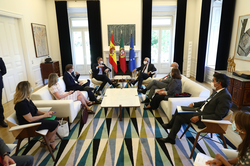 Interior of the Mansion.
.jpg)
.png)
Located behind the main building of the Assembly of the Republic, in the parish of Estrela, Lisbon, the mansion serves as residence and office for the prime minister of Portugal, and its family if that's the case. The mansion, dated from 1877, was built within the garden of the old monastery that held the Portuguese parliament. It has been the prime minister's official residence since 1938, when Salazar moved in. Although it is the official residence of the prime minister, not all incumbents have lived in the mansion during their term in office. Of the 17 Prime Ministers since 1974, only six used the mansion as its residence.[8] The incumbent Prime Minister, Luís Montenegro, currently resides in the mansion.[9]
List of prime ministers of Portugal
Term of office in years
Graphical timeline (since 1976)

Living former prime ministers of Portugal
Living former prime minister showing periods in office with dates of birth and age. Currently there are 7 former Prime Ministers alive:
_(cropped).jpg)

.png)


_(cropped).jpg)
Historical rankings of prime ministers
In 2012 and 2014 newspaper i and the polling agency Pitagórica conducted polls asking for the best Portuguese prime minister among the seven most recent ones (i.e. in the previous 30 years). The results revealed that the public clearly separated the seven evaluated prime ministers between the three best ones (each receiving more than 20% of the votes) and the four worst (each receiving from 4 to 8% of the votes).[10][11] In both polls, António Guterres (1995–2002) ranked as the best prime minister. Mário Soares (1976–78 and 1983–85) and Aníbal Cavaco Silva (1985–95) were also among the best prime ministers. On the other hand, José Manuel Durão Barroso (2002–04), Pedro Santana Lopes (2004–05), José Sócrates (2005–11) and Pedro Passos Coelho (2011–15, incumbent at the time of the polls) ranked as the worst prime ministers. Pedro Santana Lopes was ranked the worst in the 2012 poll[12] while Barroso ranked as the worst in the 2014 one.[11] Together, the three best prime ministers ruled Portugal uninterruptedly from 1983 to 2002, while the four worst ruled from 2002 to 2015.
| Prime Minister | Party | Tenure | 1981[13] | 2012[14] | 2014[12] |
|---|---|---|---|---|---|
| Adelino da Palma Carlos | Ind. | 1974 | 0.4% | N/a | N/a |
| Vasco Gonçalves | Ind. | 1975–1976 | 8.0% | N/a | N/a |
| Pinheiro de Azevedo | Ind. | 1976 | 0.8% | N/a | N/a |
| Mário Soares | PS | 1976–1978 1983–1985 |
15.2% | 22.7% | 23.9% |
| Alfredo Nobre da Costa | Ind. | 1978 | 1.0% | N/a | N/a |
| Carlos Mota Pinto | Ind. | 1978–1979 | 1.0% | N/a | N/a |
| Maria de Lourdes Pintasilgo | Ind. | 1979–1980 | 13.4% | N/a | N/a |
| Francisco Sá Carneiro | PSD | 1980 | 37.4% | N/a | N/a |
| Francisco Pinto Balsemão | PSD | 1981–1983 | 1.8% | N/a | N/a |
| Aníbal Cavaco Silva | PSD | 1985–1995 | N/a | 23.7% | 23.6% |
| António Guterres | PS | 1995–2002 | N/a | 26.8% | 24.2% |
| José Manuel Durão Barroso | PSD | 2002–2004 | N/a | 8.1% | 6.7% |
| Pedro Santana Lopes | PSD | 2004–2005 | N/a | 4.0% | 6.9% |
| José Sócrates | PS | 2005–2011 | N/a | 6.2% | 7.7% |
| Pedro Passos Coelho | PSD | 2011–2015 | N/a | 8.4% | 6.8% |
See also
Notes
- ^ Portuguese: primeiro-ministro; pronounced [pɾiˈmɐjɾu miˈniʃtɾu]
- ^ Chanceler-mor
- ^ Mordomo-mor
- ^ Escrivão da puridade
- ^ Presidente do Conselho de Ministros
- ^ Presidente do Ministério
- ^ Prime Minister
References
- ^ "Article 185 (Substitution of members of the Government), Constitution of the Portuguese Republic" (PDF). Assembly of the Republic. October 10, 2010. Retrieved April 1, 2025.
- ^ "Remunerações dos Cargos Políticos em Portugal". MaisLiberdade (in Portuguese). Lisbon. 6 May 2024. Retrieved 31 December 2024.
Em Portugal, o cargo político com maior salário bruto, e que serve de referência para o cálculo dos restantes salários, é o de Presidente da República, que aufere 9.833€ mensais, seguindo-se o de Presidente da Assembleia da República, com 8.849€, e o de Primeiro-ministro, com 8.296€.
- ^ "Primeiro-Ministro". Diário da República (in Portuguese). Retrieved 24 February 2026.
- ^ "Decreto-Lei". Diário da República (in Portuguese). Retrieved 24 February 2026.
- ^ "Competência". Assembly of the Republic (in Portuguese). Retrieved 24 February 2026.
- ^ "Decreto-Lei n.º 32/2024, de 10 de maio". Diário da República (in Portuguese). 10 May 2024. Retrieved 24 February 2026.
- ^ "Presidente deu posse ao primeiro-ministro e ministros do XXIV Governo Constitucional" [President swears in the Prime Minister and ministers of the XXIV Constitutional Government] (in Portuguese). 2 April 2024.
- ^ "Luís Montenegro está a viver em São Bento. Mas em que estado é que está o palacete?". Sábado. 15 March 2025. Retrieved 24 February 2026.
- ^ "Como é a residência oficial do primeiro-ministro e por que é que ninguém quer lá morar?". TVI. 12 March 2025. Retrieved 19 May 2025.
- ^ "E o prémio de melhor primeiro-ministro português vai para..." [And the award for the best Portuguese Prime Minister goes to...] (in Portuguese). Notícias ao Minuto. 28 November 2012. Retrieved 26 August 2018.
- ^ a b "António Guterres o melhor primeiro-ministro da democracia e Durão Barroso o pior" [Guterres was the best Prime Minister of the democracy and Durão Barroso was the worst] (in Portuguese). i. 10 April 2014. Retrieved 26 August 2018.
- ^ a b "Barómetro Pitagórica Março 2014" (in Portuguese). 1 April 2014. Retrieved 13 February 2024.
- ^ "Sondagem Tempo-Antropos" (PDF). Tempo. 1981-07-23. p. 13. Retrieved 2025-12-17.
- ^ "Barómetro Pitagórica Novembro 2012" (in Portuguese). 26 November 2012. Retrieved 13 February 2024.
External links
| |


