




Second World

| Eastern Bloc |
|---|
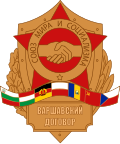 |
The Second World[a] was one of the "Three Worlds" during the Cold War, which described those countries aligned with the Soviet Union and allies in the Warsaw Pact and Eastern Bloc. This grouping was directly opposed to the First World, which grouped countries aligned with the United States and its allies in NATO and the Western Bloc.
The term is also sometimes used to describe either 20th century socialist states or middle-income countries broadly, rather than based on Soviet alignment.
Origins
During the Cold War, the Three Worlds Model was used to rank the development of countries and their economies. First World countries were capitalist and industrial; they shared similar political and economic institutions, and retained influence over parts of the former colonial world. Second World countries generally advocated state socialism and shared certain characteristics such as centrally planned economic systems, single-party states, and medium income levels.[2] The First World and the Second World were competing for political and economic influence over the Third World, which was neither aligned with the United States nor the Soviet Union in the Cold War.
| Country | Start | End | Description |
|---|---|---|---|
 Soviet Union Soviet Union |
1922 | 1991 | Founded in 1922; dissolved in 1991. |
 Mongolia Mongolia |
1924 | 1990 | Soviet-backed Mongolian People's Republic established in 1924. One-party rule and Soviet alignment ended with the Mongolian Revolution of 1990. |
 Yugoslavia Yugoslavia |
1945 | 1948 | Initially aligned with the Soviet Union after World War II. Expelled from the Cominform in 1948 following the Tito–Stalin split; became a founding member of the Non-Aligned Movement. |
 Bulgaria Bulgaria |
1946 | 1989 | Communist government established under Soviet occupation in 1946. Fell during the Revolutions of 1989. |
 Albania Albania |
1946 | 1961 | Communist government established in 1946 with Soviet backing. Broke with the USSR during the Albanian–Soviet split in 1961 and aligned with China. |
 Poland Poland |
1947 | 1989 | Communist government established under Soviet influence in 1947. Fell during the Revolutions of 1989. |
 Romania Romania |
1947 | 1989 | Communist government established under Soviet occupation in 1947. Pursued an increasingly independent foreign policy from the mid-1960s under Nicolae Ceaușescu, while remaining formally in the Warsaw Pact. The regime fell during the Romanian Revolution of 1989. |
 North Korea North Korea |
1948 | 1991 | Soviet-backed government established in 1948. Balanced between the USSR and China throughout the Cold War. Soviet alignment ended with the dissolution of the Soviet Union in 1991. |
 Czechoslovakia Czechoslovakia |
1948 | 1989 | Communist government established via the 1948 coup. Fell during the Velvet Revolution of 1989. |
 East Germany East Germany |
1949 | 1989 | Established as a Soviet-backed state in 1949. The communist government fell following the fall of the Berlin Wall in 1989, leading to German reunification in 1990. |
 Hungary Hungary |
1949 | 1989 | Communist government established under Soviet influence in 1949. Fell during the Revolutions of 1989. |
 China China |
1949 | 1961 | The Chinese Communist Revolution established the People's Republic in 1949 with Soviet support. The Sino-Soviet split from the late 1950s ended alignment by 1961. |
 Vietnam Vietnam |
1950 | 1991 | The USSR recognized the Democratic Republic of Vietnam (North Vietnam) in 1950 and provided extensive military aid. After reunification in 1975, the Socialist Republic of Vietnam remained Soviet-aligned until the dissolution of the Soviet Union in 1991. |
 Egypt Egypt |
1955 | 1972 | Egypt received extensive Soviet military and economic aid from the mid-1950s, including during construction of the Aswan Dam, but was never a Marxist-Leninist state. President Anwar Sadat expelled Soviet advisors in 1972 and realigned with the United States. |
 Guinea Guinea |
1958 | 1984 | Under Ahmed Sékou Touré, Guinea turned to the Soviet Union after France withdrew all support upon independence. Touré oscillated between Soviet and Western alignment throughout his rule, expelling the Soviet ambassador in 1961 but quickly restoring relations. Guinea provided the USSR with strategic airport and naval access through the mid-1970s. Touré died in 1984 and a military coup ended the regime. |
 Ghana Ghana |
1960 | 1966 | Under Kwame Nkrumah, Ghana received significant Soviet aid and pursued socialist policies. Alignment ended with the 1966 coup. |
 Mali Mali |
1960 | 1968 | Under Modibo Keïta, Mali pursued socialist policies and received Soviet aid. Alignment ended with the 1968 coup. |
 Cuba Cuba |
1961 | 1991 | Aligned with the Soviet Union following the Cuban Revolution. Soviet alignment ended with the dissolution of the Soviet Union in 1991. |
 South Yemen South Yemen |
1967 | 1990 | Marxist-Leninist government established upon independence in 1967. Ceased to exist upon Yemeni unification with North Yemen in 1990. |
 Congo Congo |
1969 | 1991 | Marxist-Leninist government established following a 1968 military coup. Abandoned Marxism-Leninism and transitioned to a multi-party system in 1991. |
 Somalia Somalia |
1969 | 1977 | Soviet-aligned following Siad Barre's 1969 coup; signed a Treaty of Friendship in 1974. Expelled Soviet advisors and abrogated the treaty in 1977 after the Soviet Union backed Ethiopia in the Ogaden War. |
 Libya Libya |
1976 | 1991 | Under Muammar Gaddafi, Libya became a major purchaser of Soviet arms and hosted thousands of Soviet military advisors from the mid-1970s, but was formally non-aligned. |
 Iraq Iraq |
1972 | 1991 | Signed a Treaty of Friendship and Cooperation with the USSR in 1972. Iraq increasingly diversified toward the Western Bloc and France from the mid-1970s, and restored diplomatic relations with the United States in 1984, but the Soviet Union remained Iraq's largest arms supplier throughout the Iran–Iraq War. The relationship ended with the dissolution of the Soviet Union in 1991. |
 Angola Angola |
1975 | 1990 | The Soviet- and Cuban-backed MPLA government was established upon independence in 1975. Abandoned Marxism-Leninism and transitioned to a multi-party system around 1990–1991. |
 Benin Benin |
1975 | 1990 | Marxist-Leninist government proclaimed in 1975. Abandoned Marxism-Leninism and transitioned to a multi-party system in 1990. |
 Mozambique Mozambique |
1975 | 1990 | The Soviet-backed FRELIMO government was established upon independence in 1975. Abandoned Marxism-Leninism and transitioned to a multi-party system in 1990. |
 Laos Laos |
1975 | 1991 | The communist Pathet Lao seized power in 1975. Soviet alignment ended with the dissolution of the Soviet Union in 1991. |
 Madagascar Madagascar |
1975 | 1991 | Under President Didier Ratsiraka, Madagascar pursued socialist policies and granted the Soviet Union naval access, but was formally non-aligned. Ratsiraka accepted multiparty reforms in 1991 amid mass protests and the dissolution of the Soviet Union. |
 Ethiopia Ethiopia |
1977 | 1991 | The Derg seized power in 1974, but Soviet alignment began in 1977 when Ethiopia switched from American to Soviet backing during the Ogaden War. The regime was overthrown by the Ethiopian People's Revolutionary Democratic Front in 1991. |
 Seychelles Seychelles |
1977 | 1991 | Under President France-Albert René, the Seychelles had a one-party socialist government and granted the Soviet Union naval access, but maintained a formally non-aligned position. Transitioned to multiparty politics in 1991. |
 Afghanistan Afghanistan |
1978 | 1991 | Communist government established in the 1978 Saur Revolution. The Soviet Union invaded in 1979 and withdrew in 1989. Soviet alignment ended with the dissolution of the Soviet Union in 1991; the government collapsed the following year. |
 Kampuchea Kampuchea |
1979 | 1989 | Vietnamese-backed government established after the overthrow of the Khmer Rouge in 1979. Reconstituted as the State of Cambodia in 1989, abandoning Marxism-Leninism, declaring neutrality and non-alignment, and liberalising the economy, amid the collapse of Soviet support for Vietnam. The 1991 Paris Agreements led to UN administration and free elections in 1993. |
 Nicaragua Nicaragua |
1979 | 1990 | The Sandinista government came to power in the 1979 revolution and received Soviet and Cuban support. Lost the 1990 general election and transferred power to the opposition. |
 Grenada Grenada |
1979 | 1983 | Revolutionary government established in a 1979 coup. Collapsed following an internal power struggle and the subsequent United States invasion in October 1983. |
 Syria Syria |
1980 | 1991 | Signed a Treaty of Friendship and Cooperation with the USSR in 1980 and was a major recipient of Soviet arms, but maintained significant foreign policy independence. Soviet alignment ended with the dissolution of the Soviet Union in 1991. |
 Burkina Faso Burkina Faso |
1983 | 1987 | Under Thomas Sankara, Burkina Faso pursued socialist and pan-Africanist policies and received some Soviet and Cuban support, but was more closely associated with the Non-Aligned Movement than the Soviet bloc. Sankara was assassinated in a 1987 coup. |
Evolution
The scope of the "Second World" has varied substantially over time, and across interpretations.
Socialist states
Though most socialist states remained aligned with the Soviet Union until either dissolved, the Tito–Stalin, Sino-Soviet, and Albanian–Soviet splits in the mid-20th century led to a substantial decline in Soviet influence. Thus, the geographical scope of the Soviet-led Second World shrunk significantly. However, many continued to include communist states which were not aligned with the Soviet Union in the "Second World," such as Yugoslavia, China, Albania, and the Khmer Rouge.[2]
By 1991, upon the dissolution of the Soviet Union and after the fall of many communist regimes, defining the Second World around Soviet influence or socialism in general became obsolete in a post-Cold War context.[3]
Economic position
Subsequently, the colloquial meaning of the first, second, and third worlds changed from being based on political alignment to the US or USSR, to an economic definition.[4] In particular, the second world has been applied as a synonym for middle-income countries, also known as newly industrialized countries, as those countries historically aligned with the Soviet Union or other communist states tended to be poorer and less industrialized than the Western-aligned first world (largely developed countries), but wealthier and more industrialized than the non-aligned third world (largely least developed countries).
This redefinition would therefore include non-communist, Western-aligned, and non-aligned states, such as the Russian Federation, India, Iran, Ukraine, Mexico, Brazil, and South Africa.[5]
Criticism
The three-world theory has been criticized as crude and relatively outdated for its nominal ordering, and some sociologists have instead used the words "developed", "developing", and "underdeveloped" as replacement terms for global stratification (which have been criticized as displaying a colonialist mindset);[6] nevertheless, the three-world theory is still popular in contemporary literature and media. This might also cause semantic variation of the term between describing a region's political entities and its people.[7]
See also
Footnotes
References
- ^ "SECOND WORLD Definition & Meaning | Dictionary.com". www.dictionary.com. Retrieved 28 February 2026.
- ^ Andrews, Evan (22 August 2018). "Why are countries classified as First, Second or Third World?". History. A&E Television Networks. Archived from the original on 21 February 2020. Retrieved 21 February 2020.
- ^ Andersen, Margaret L.; Taylor, Howard Francis (2006). Sociology: Understanding a Diverse Society. Thomson/Wadsworth. p. 250. ISBN 978-0-534-61716-5.
- ^ Khanna, Parag (2008). The Second World: How Emerging Powers Are Redefining Global Competition in the Twenty-first Century. Random House. ISBN 9780141027784.
- ^ Silver, Marc (4 January 2015). "If You Shouldn't Call It The Third World, What Should You Call It?". NPR. Archived from the original on 1 April 2020. Retrieved 17 March 2018.
- ^ Giddens, Anthony (2006). Sociology. Polity. p. 42]. ISBN 978-0-7456-3379-4.
Economic classification of countries | |||||
|---|---|---|---|---|---|
| Three/Four-World Model | |||||
| Gross domestic product (GDP) |
| ||||
| Gross national income and Income | |||||
| Wages and salary | |||||
| Wealth | |||||
| Other national accounts | |||||
| Human development | |||||
| Digital divide | |||||
| Net international investment position (NIIP) | |||||

