Hieronymus Bosch, The Garden of Earthly Delights, oil on oak panels, 205.5 cm × 384.9 cm (81 in × 152 in), Museo del Prado, Madrid
The Garden of Earthly Delights (Dutch: De tuin der lusten, lit.'The garden of lusts') is the modern title given to a five-panel triptych (three oil-painted panels when open, two oak panels when closed) by the Early Netherlandish master Hieronymus Bosch, between 1490 and 1510, when Bosch was between 40 and 60 years old. Because of Bosch's religious beliefs, interpretations of the work typically assume it is a warning against the perils of temptation. The outer panels place the work on the Third Day of Creation. The intricacy of its symbolism, particularly that of the central panel, has led to a wide range of scholarly interpretations over the centuries. (Full article...)
The Third of May 1808 in Madrid (commonly known as The Third of May 1808) and also known, in Spanish, as El tres de mayo de 1808 en Madrid or Los fusilamientos de la montaña del Príncipe Pío, or Los fusilamientos del tres de mayo, is a painting completed in 1814 by the Spanish painter Francisco Goya, now in the Museo del Prado, Madrid. In the work, Goya sought to commemorate Spanish resistance to Napoleon's armies during the occupation of Madrid in 1808 at the start of the Peninsular War. Along with its companion piece of the same size, The Second of May 1808 (or The Charge of the Mamelukes), it was commissioned by the provisional government of Spain at Goya's own suggestion shortly after the ousting of the French occupation and the restoration of King Ferdinand VII. (Full article...)
Image 5
The Western Mediterranean just before the start of the war in 264 BC: Rome is shown in red, Carthage in grey, and Syracuse in green
The First Punic War (264–241 BC) was the first of three wars fought between Rome and Carthage, the two main powers of the western Mediterranean in the early 3rd century BC. For 23 years, in the longest continuous conflict and greatest naval war of antiquity, the two powers struggled for supremacy. The war was fought primarily on the Mediterranean island of Sicily and its surrounding waters, and also in North Africa. After immense losses on both sides, the Carthaginians were defeated and Rome gained territory from Carthage. (Full article...)
Image 6
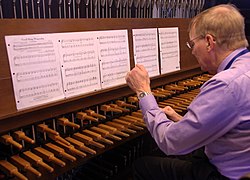
A carillonist plays the 56-bell carillon of the Plummer Building, Rochester, Minnesota, US A carillon is a pitched percussion instrument that is played with a keyboard and consists of at least 23 bells. The bells are cast in bronze, hung in fixed suspension, and tuned in chromatic order so that they can be sounded harmoniously together. They are struck with clappers connected to a keyboard of wooden batons played with the hands and pedals played with the feet. Often housed in bell towers, carillons are usually owned by churches, universities, or municipalities. They can include an automatic system through which the time is announced and simple tunes are played throughout the day. (Full article...)
Image 7
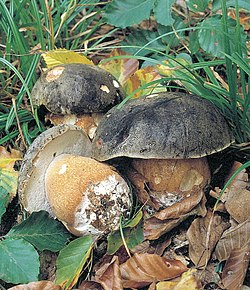
Boletus aereus, commonly known as the queen bolete, dark cep, or bronze bolete, is a species of fungus in the family Boletaceae. Described in 1789 by French mycologist Pierre Bulliard, it is closely related to several other European boletes, including B. reticulatus, B. pinophilus, and the popular B. edulis. Some populations in North Africa have in the past been classified as a separate species, B. mamorensis, which has been shown to be phylogenically conspecific to B. aereus and is now regarded as a synonym. (Full article...)
Image 8
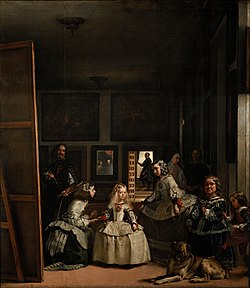
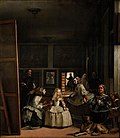
Las Meninas (Spanish for 'The Ladies-in-waiting'pronounced[lasmeˈninas]) is a 1656 painting in the Museo del Prado in Madrid, by Diego Velázquez, the leading artist in the court of King Philip IV of Spain and Portugal, and of the Spanish Golden Age. It has become one of the most widely analyzed works in Western painting for the way its complex and enigmatic composition raises questions about reality and illusion, and for the uncertain relationship it creates between the viewer and the figures depicted. (Full article...)
Image 9
The Oran fatwa was a responsumfatwa, or an Islamic legal opinion, issued in 1502 to address the crisis that occurred when Muslims in the Crown of Castile, in present-day Spain, were forced to convert to Christianity in 1500–1502. It was authored by a malikimuftiAhmad ibn Abi Jum'ah, an Algerian scholar of Islamic law of the Maliki school; the term "Oran fatwa" was applied by modern scholars, due to the word "Al-Wahrani" ("of Oran") that appears in the text as part of the author's name. (Full article...)
Image 10
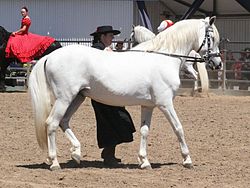
The Andalusian or Pura Raza Española, also known as the Pure Spanish Horse or PRE, is a Spanish breed of riding horse from the Iberian Peninsula, where its ancestors have lived for thousands of years. The Andalusian has been recognized as a distinct breed since the 15th century, and its conformation has changed very little over the centuries. Throughout its history, it has been known for its prowess as a war horse, and was prized by the nobility. The breed was used as a tool of diplomacy by the Spanish government, and kings across Europe rode and owned Spanish horses. During the 19th century, warfare, disease, and crossbreeding reduced herd numbers dramatically, and despite some recovery in the late 19th century, the trend continued into the early 20th century. Exports of Andalusians from Spain were restricted until the 1960s, but the breed has since spread throughout the world, despite its low population. In 2010, more than 185,000 registered Andalusians existed worldwide. (Full article...)
The black stork (Ciconia nigra) is a large bird in the stork family Ciconiidae. It was first described by Carl Linnaeus in the 10th edition of his Systema Naturae. Measuring on average 95 to 100 cm (37 to 39 in) from beak tip to end of tail with a 145-to-155 cm (57-to-61 in) wingspan, the adult black stork has mainly black plumage, with white underparts, long red legs and a long pointed red beak. A widespread but uncommon species, it breeds in scattered locations across Europe (predominantly in Portugal and Spain, and central and eastern parts), and east across the Palearctic to the Pacific Ocean. It is a long-distance migrant, with European populations wintering in tropical Sub-Saharan Africa, and Asian populations in the Indian subcontinent. When migrating between Europe and Africa, it avoids crossing broad expanses of the Mediterranean Sea and detours via the Levant in the east, the Strait of Sicily in the center, or the Strait of Gibraltar in the west. An isolated non-migratory population lives in Southern Africa. (Full article...)
Image 12
An AMX-30E on display at the Museum of Armored Vehicles of El Goloso, in Spain
The AMX-30E (E stands for España, Spanish for Spain) is a Spanish main battle tank based on France's AMX-30. Although originally the Spanish government sought to procure the German Leopard 1, the AMX-30 was ultimately awarded the contract due to its lower price and the ability to manufacture it in Spain. 280 units were manufactured by Santa Bárbara Sistemas for the Spanish Army, between 1974 and 1983. (Full article...)
Plate 34: Por una navaja (For a clasp knife). A garroted priest grasps a crucifix in his hands. Pinned to his chest is a description of the crime for which he was killed—possession of a knife.
The Disasters of War (Spanish: Los desastres de la guerra) is a series of 82 prints created between 1810 and 1820 by the Spanish painter and printmakerFrancisco Goya (1746–1828). Although Goya did not make known his intention when creating the plates, art historians view them as a visual protest against the violence of the 1808 Dos de Mayo Uprising, the subsequent cruel war that ended in Spanish victory in the Peninsular War of 1808–1814 and the setbacks to the liberal cause following the restoration of the Bourbon monarchy in 1814. During the conflicts between Napoleon's French Empire and Spain, Goya retained his position as first court painter to the Spanish crown and continued to produce portraits of the Spanish and French rulers. Although deeply affected by the war, he kept private his thoughts on the art he produced in response to the conflict and its aftermath. (Full article...)
Image 15
Muhammad II (Arabic: محمد الثاني) (also known by the epithet al-Faqih, "the canon-lawyer", c. 1235 – 8 April 1302; reigned from 1273 until his death) was the second Nasrid ruler of the Emirate of Granada in Al-Andalus on the Iberian Peninsula, succeeding his father, Muhammad I. Already experienced in matters of state when he ascended the throne, he continued his father's policy of maintaining independence in the face of Granada's larger neighbours, the Christian kingdom of Castile and the Muslim Marinid state of Morocco, as well as an internal rebellion by his family's former allies, the Banu Ashqilula. (Full article...)
The Battle of Barrosa (Chiclana, 5 March 1811, also known as the Battle of Chiclana or Battle of Cerro del Puerco) was part of an unsuccessful manoeuvre by an Anglo-Iberian force to break the French siege of Cádiz during the Peninsular War. During the battle, a single British division defeated two French divisions and captured a regimental eagle. (Full article...)
Image 18
An M48 Patton tank of the Spanish Army on display at the El Goloso Museum of Armored Vehicles in October 2007. Tanks in the Spanish Army have over 90 years of history, from the French Renault FTs first delivered in 1919 to the Leopard 2 and B1 Centauro models of the early 21st century. The Spanish FTs took part in combat during the Rif War and participated in the first amphibious landing with tanks in history, at Alhucemas. In 1925, the Spanish Army began to undertake a program to develop and produce a Spanish tank, an upgraded version of the Renault FT, called the Trubia A4. Although the prototype performed well during testing, the tank was never put into mass production. Spain also experimented with the ItalianFiat 3000, acquiring one tank in 1925, and with another indigenous tank program called the Landesa. However, none of these evolved into a major armor program, and as a result the FT remained the most important tank, in numbers, in the Spanish Army until the beginning of the Spanish Civil War. (Full article...)
Image 19
Muhammad III (Arabic: محمد الثالث; 15 August 1257 – 21 January 1314) was the ruler of the Emirate of Granada in Al-Andalus on the Iberian Peninsula from 8 April 1302 until 14 March 1309, and a member of the Nasrid dynasty. He ascended the Granadan throne after the death of his father Muhammad II, which according to rumours, was caused by Muhammad III poisoning him. He had the reputation of being both cultured and cruel. Later in his life, he became visually impaired—which caused him to be absent from many government activities and to rely on high officials, especially the powerful VizierIbn al-Hakim al-Rundi. (Full article...)
The Lince (Spanish pronunciation:[ˈlinθe], meaning "Lynx") was a Spanish development programme for a proposed main battle tank that unfolded during the late 1980s and early 1990s. The intention was to replace the M47 and M48 Patton tanks that the Spanish Army had received under the U.S. Mutual Defense Assistance Act between 1954 and 1975, and to complement the AMX-30E tanks manufactured for the army during the 1970s. Companies from several nations, such as German Krauss-Maffei, Spanish Santa Bárbara, and French GIAT, made bids for the development contract. The main priorities were mobility and firepower, with secondary priority placed on protection; the Lince tank was to have been lighter and faster than its competitors. To achieve a sufficient level of firepower and protection, the Lince was to use Rheinmetall's120 mm L/44 tank-gun and German composite armour from the Leopard 2A4. (Full article...)
Image 22
View of Badajoz, across the Guadiana river from the foothills of the San Cristóbal heights, by Eugène-Ferdinand Buttura
Nasr (1 November 1287 – 16 November 1322), full name Abu al-Juyush Nasr ibn Muhammad (Arabic: أبو الجيوش نصر بن محمد), was the fourth Nasrid ruler of the Emirate of Granada from 14 March 1309 until his abdication on 8 February 1314. He was the son of Muhammad II al-Faqih and Shams al-Duha. He ascended the throne after his brother Muhammad III was dethroned in a palace revolution. At the time of his accession, Granada faced a three-front war against Castile, Aragon and the Marinid Sultanate, triggered by his predecessor's foreign policy. He made peace with the Marinids in September 1309, ceding to them the African port of Ceuta, which had already been captured, as well as Algeciras and Ronda in Europe. Granada lost Gibraltar to a Castilian siege in September, but successfully defended Algeciras until it was given to the Marinids, who continued its defense until the siege was abandoned in January 1310. James II of Aragon sued for peace after Granadan defenders defeated the Aragonese siege of Almería in December 1309, withdrawing his forces and leaving the Emirate's territories by January. In the ensuing treaty, Nasr agreed to pay tributes and indemnities to Ferdinand IV of Castile and yield some border towns in exchange for seven years of peace. (Full article...)
She and her husband legally adopted five children, two of whom had their families murdered but she now has 13 children in her care, all of whom accompanied her to Nicaragua on January 27, 2006, the day she ceased being first lady. She will work there with Nicaraguan children in need, and will help the wife of Nicaragua's President Enrique Bolaños. The five children legally adopted are called Leidy Jackeline, Kevin Josué, Francis, Joan and Jackie. During 2003, Ocaña Navarro returned to live in Spain for a short period of time, sparking rumours that she and her husband were about to divorce. The separation was allegedly provoked because Ricardo Maduro named a former girlfriend, Mireya Batres, to be Honduras' Minister of Culture. Batres was sacked and she returned.
Ferdinand I, Holy Roman Emperor, is represented in this anonymous portrait as a young archduke in his native Spain. He left Spain in his early twenties, to start his life as future King of the Romans and successor to his grandfather, Maximilian I. His older brother Charles eventually succeeded as Holy Roman Emperor, but Ferdinand was elected after Charles's abdication. Philip, Charles's son, inherited Spain and became King Philip II of Spain. Ferdinand ruled between 1558 and 1564, for nearly six years.
A stitchedpanorama taken from St Jerome, the summit of Montserrat, a 1,236 m (4,055 ft) mountain near Barcelona, Spain. The mountain's name means "jagged mountain" and is used because of the peculiar aspect of the formation, which is visible from a great distance.
Moros is a municipality in the province of Zaragoza, Spain. Located in the Sistema Ibérico mountain range, the village lies on a hill, with the church and former town hall at the top, the residences in the middle, and the sheep pens at the bottom. The population of Moros has been steadily decreasing in recent decades, and was 478 in 2006.
The Torre Agbar is a landmark skyscraper and the third tallest building in Barcelona, Spain. It was designed by FrencharchitectJean Nouvel, who stated that the shape of the Torre Agbar was inspired by the mountains of Montserrat that surround Barcelona, and by the shape of a geyser of water rising into the air. Its design combines a number of different architectural concepts, resulting in a striking structure built with reinforced concrete, covered with a facade of glass, and over 4,500 window openings cut out of the structural concrete.
The harbor entrance to Cala Figuera, a district of Mallorca in the Balearic Islands. The town is located approximately 60 kilometers north of Palma de Mallorca. The earliest records of the town date back to 1306, although houses were not built on the land until the early 19th century.
Amalia de Llano (April 29, 1822 – July 6, 1874) was a Spanish countess and writer. This 1853 oil-on-canvas portrait by Federico de Madrazo y Kuntz shows her seated in a fine armchair wearing sumptuous clothes, with her youth and beauty accentuated by the dark background, and is quite unlike a traditional Spanish portrait of the period.
The Madrid Metro is a rapid transit system serving the Spanish capital, Madrid. It was inaugurated in 1919 by King Alfonso, with a single line which ran for 3.48 km (2.16 mi) between Puerta del Sol and Cuatro Caminos, with eight stops. The present system has 301 stations on 13 lines plus one branch line, totalling 294 km (183 mi).
A three-month old Spanish ibex (Capra pyrenaica) in Sierra de Gredos, Spain. These ibexes are strong mountain animals characterized by their large and flexible hooves and short legs. The two sexes of adults form separate social groups; juveniles stay with the female groups from birth until the following birth season, when they leave. Yearling males then join male groups, while females eventually return to their mothers' groups and stay several years.
The Spanish peseta is a former currency of Spain and, alongside the French franc, a former de facto currency in Andorra. It was introduced in 1868, replacing the peso, at a time when Spain was considering joining the Latin Monetary Union. Spain joined the euro in 1999, and the peseta was replaced by euro notes and coins in 2002.
A Río Nervión patrol boat of the Civil Guard, pictured moving along the waters of Bilbao. The Spanish civil guard was created in numerous different stages between 1835 and 1844, and was established as an operational force in 1855.
Ana Santos Aramburo (born 1957) has been the director of the National Library of Spain since February 2013. Having received a degree in geography and history from the University of Zaragoza in Spain, she has spent much of her career working at the Complutense University of Madrid, first at the library of the Faculty of Economics and Business Sciences, and later serving as deputy director of the university library. Later she served as Director of the Historical Library Marquis of Valdecilla, General Director of Libraries and Archives of the City of Madrid, and Director of Cultural Action at the National Library. This photograph of Santos shows her at the headquarters of the National Library of Spain in Madrid.
Charles IV of Spain and His Family is a portrait of the royal family of Spain painted by Francisco Goya in 1800 and 1801. King Charles IV, his wife Maria Luisa of Parma, and his children and relatives are dressed in the height of contemporary fashion, lavishly adorned with jewelry and the sashes of the order of Charles III. The artist does not attempt to flatter the family; instead the group portrait is unflinchingly realist, both in detail and tone. The artist, seated at his easel, is visible in the background. The painting is in the collection of the Museo del Prado in Madrid.
The Alhambra (Arabic: الحمراء = Al-Ħamrā; literally "the red") is a palace and fortress complex of the Moorish monarchs of Granada in southern Spain (known as Al-Andalus when the fortress was constructed), occupying a hilly terrace on the southeastern border of the city of Granada.
... that Luis Aranaz was named an "adopted son" of Sabadell after captaining the city's football club to two Spanish second-division titles in the 1940s?
The First Battle of Algeciras was fought on 6 July 1801 between a Royal Navy squadron and a smaller French Navy squadron lying at anchor in the Spanish port of Algeciras during the Algeciras campaign of the War of the Second Coalition. The British outnumbered their opponents, but the French position was protected by Spanish gun batteries and the complicated shoals that obscured the entrance to Algeciras Bay. The French squadron, under Counter-Admiral Charles-Alexandre Léon Durand Linois, had stopped at Algeciras en route to the major Spanish naval base at Cádiz, where they were to form a combined French and Spanish fleet for operations against Britain and its allies in the French Revolutionary Wars. The British, under Rear-Admiral Sir James Saumarez, sought to eliminate the French squadron before it could reach Cádiz and form a force powerful enough to overwhelm Saumarez and launch attacks against British forces in the Mediterranean Sea. (Full article...)
Image 2
De Lucía performing in 2007
Francisco Gustavo Sánchez Gómez (Spanish:[fɾanˈθiskoɡusˈt̪a.β̞oˈsantʃeθˈɣomeθ]; 21 December 1947 – 25 February 2014), known as Paco de Lucía (Spanish:[ˈpakoðeluˈθi.a]), was a Spanish virtuosoflamenco guitarist, composer, and record producer. A leading proponent of the new flamenco style, he was one of the first flamenco guitarists to branch into classical and jazz. Richard Chapman and Eric Clapton, authors of Guitar: Music, History, Players, describe de Lucía as a "titanic figure in the world of flamenco guitar", and Dennis Koster, author of Guitar Atlas, Flamenco, has referred to de Lucía as "one of history's greatest guitarists". (Full article...)
Image 3
"Nunca Te Olvidaré" (transl. "I'll Never Forget You") is a song by Spanish singer Enrique Iglesias for his third studio album Cosas del Amor (1998). It was written by Iglesias with Rafael Pérez-Botija handling its production. A power ballad, it is a confessional song of staying in love through time and other lovers. Upon its release, it was met with generally positive reactions from music critics, although one reviewer was less impressed with it along with the other ballads from the album. The song was featured as the main theme for the 1999 Mexican telenovela of the same name. (Full article...)
Image 4
Ciutat Morta ([siwˈtatˈmɔr.tə], "Dead City") is a 2013 Catalan documentary about the 4F case, directed by Xavier Artigas and Xapo Ortega. The film covers the repercussions of the events of February 4, 2006, when a Guàrdia Urbana officer in Barcelona was grievously injured and several people were arrested. This resulted in a long court-case and ultimately four people were convicted and imprisoned, one of whom committed suicide. (Full article...)
The 2011 season for Euskaltel–Euskadi began in January at the Tour Down Under and ended in October at the Giro di Lombardia. It was the team's eighteenth season as a professional cycling team, and its eleventh with UCI ProTeam – Trade Team 1 between 2001 and 2004 – status. As a UCI ProTeam, they were automatically invited and obligated to send a squad to every event on the UCI World Tour calendar. For the second year in a row, the traditionally all-Basque team added a French rider. This year, it was second-year professional Pierre Cazaux, who rode for FDJ in 2010. (Full article...)
The siege of Almería was an unsuccessful attempt by Aragon to capture the city of Almería from the Emirate of Granada in 1309. Almería, a Mediterranean port in the southeast of the emirate, was the initial Aragonese target in a joint Aragonese-Castilian campaign aimed at conquering Granada. The Aragonese troops led by their King James II arrived on 11 August, blockading the city and employing siege engines. The city, led by governor Abu Maydan Shuayb and naval commander Abu al-Hasan al-Randahi, prepared for the siege by strengthening its defenses and stockpiling food. Throughout the siege, both sides exchanged shots from siege engines and engaged in fields battles and skirmishes with varying results. James ordered multiple unsuccessful assaults. A Granadan relief column under Uthman ibn Abi al-Ula arrived nearby in September and harassed the besiegers. (Full article...)
Indigenous ethnic groups of El Salvador, prior to Spanish conquest
The Spanish conquest of El Salvador was the campaign undertaken by the Spanishconquistadores against the Late PostclassicMesoamerican polities in the territory that is now incorporated into the modern Central American country of El Salvador. El Salvador is the smallest country in Central America, and is dominated by two mountain ranges running east–west. Its climate is tropical, and the year is divided into wet and dry seasons. Before the conquest the country formed a part of the Mesoamerican cultural region, and was inhabited by a number of indigenous peoples, including the Pipil, the Lenca, the Xinca, and Maya. Native weaponry consisted of spears, bows and arrows, and wooden swords with inset stone blades; they wore padded cotton armour. (Full article...)
The moonlight Battle off Cape St Vincent, 16 January 1780 Francis Holman, 1780
The Battle of Cape St. Vincent (Spanish: Batalla del Cabo de San Vicente) was a naval battle that took place off the southern coast of Portugal on 16 January 1780 during the American Revolutionary War. In 1779 Spain had joined its ally France, which was allied with the Americans, in war against Britain. A British fleet under Admiral Sir George Rodney defeated a Spanish squadron under Don Juan de Lángara. The battle is sometimes referred to as the Moonlight Battle (batalla a la luz de la luna) because it was unusual for naval battles in the Age of Sail to take place at night. It was also the first major naval victory for the British over their European enemies in the war and proved the value of copper-sheathing the hulls of warships. (Full article...)
Image 20
Picture by Johann Jakob Wick illustrating his report about the Battle of Zutphen, published on 12 October 1586
Richard Worsam Meade (June 23, 1778 – June 25, 1828) was an American merchant and art collector, and the father of Civil War General George Gordon Meade. After growing up in his father George Meade's shipping business, he became successful in his own right in the American–Spanish trade. Meade lived in Cádiz, Spain, from 1803 to 1820, and was the U.S. naval agent there. He became quite wealthy and was one of the first American collectors of European art. (Full article...)
Image 32Wedding portrait of the Catholic Monarchs (from History of Spain)
Image 33The Port of Seville in the late 16th century. Seville became one of the most populous and cosmopolitan European cities after the expeditions to the New World. (from History of Spain)
Image 44El paseo de las Delicias, a 1784–1785 painting by Ramón Bayeu depicting a meeting of members of the aristocracy in the aforementioned location. (from History of Spain)
Image 45Royal Site of San Lorenzo de El Escorial. Built between 1563 and 1584 by order of King Philip II (from Spanish Golden Age)
Image 581894 satirical cartoon depicting the tacit accord for seamless government change (turnismo) between the leaders of two dynastic parties (Sagasta and Cánovas del Castillo), with the country being lied in an allegorical fashion. (from History of Spain)
Image 59Visigothic Hispania and its regional divisions in 700, prior to the Muslim conquest (from History of Spain)
Image 60Recognition of the Duke of Anjou as King of Spain, under the name of Philip V, November 16, 1700 (from History of Spain)
Image 65The pro-independence forces delivered a crushing defeat to the royalists and secured the independence of Peru in the 1824 battle of Ayacucho. (from History of Spain)
The Sagrada Família in Barcelona, Spain, reaches its designed height of 172.5 metres (566 feet) after beginning construction in 1882, ahead of the completion of the main building expected later in 2026. (The Guardian)





.svg)
 Featured article –




 Artist: UnknownFerdinand I, Holy Roman Emperor, is represented in this anonymous portrait as a young archduke in his native Spain. He left Spain in his early twenties, to start his life as future King of the Romans and successor to his grandfather, Maximilian I. His older brother Charles eventually succeeded as Holy Roman Emperor, but Ferdinand was elected after Charles's abdication. Philip, Charles's son, inherited Spain and became King Philip II of Spain. Ferdinand ruled between 1558 and 1564, for nearly six years.
 Photograph: Diego DelsoMoros is a municipality in the province of Zaragoza, Spain. Located in the Sistema Ibérico mountain range, the village lies on a hill, with the church and former town hall at the top, the residences in the middle, and the sheep pens at the bottom. The population of Moros has been steadily decreasing in recent decades, and was 478 in 2006.
 Photo credit: DiliffThe Torre Agbar is a landmark skyscraper and the third tallest building in Barcelona, Spain. It was designed by French architect Jean Nouvel, who stated that the shape of the Torre Agbar was inspired by the mountains of Montserrat that surround Barcelona, and by the shape of a geyser of water rising into the air. Its design combines a number of different architectural concepts, resulting in a striking structure built with reinforced concrete, covered with a facade of glass, and over 4,500 window openings cut out of the structural concrete.
 Photograph: Diego DelsoThe Assut de l'Or Bridge is a white single-pylon cable-stayed bridge in the City of Arts and Sciences, Valencia, Spain. Completed in 2008, it was designed by Valencian architect and civil engineer Santiago Calatrava as a variant of his cantilever spar cable-stayed bridge in Seville.
 Painting: Francisco GoyaThe Third of May 1808 is a painting completed in 1814 by the Spanish master Francisco Goya, now in the Museo del Prado, Madrid. Along with its companion piece of the same size, The Second of May 1808 (or The Charge of the Mamelukes), it was commissioned by the provisional government of Spain at Goya's suggestion. Goya sought to commemorate Spanish resistance to Napoleon's armies during the Peninsular War.
 Painting credit: Federico de Madrazo y KuntzAmalia de Llano (April 29, 1822 – July 6, 1874) was a Spanish countess and writer. This 1853 oil-on-canvas portrait by Federico de Madrazo y Kuntz shows her seated in a fine armchair wearing sumptuous clothes, with her youth and beauty accentuated by the dark background, and is quite unlike a traditional Spanish portrait of the period.
 Photo credit: David IliffThe Tagus River, seen here passing through the World Heritage listed city of Toledo, Spain. It is the longest river on the Iberian Peninsula at 1,038 kilometres (645 mi). It begins its journey in the Albarracín mountains in Spain, and follows a very constricted course for much of its length before reaching the Atlantic Ocean in Portugal.
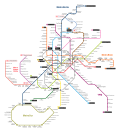 The Madrid Metro is a rapid transit system serving the Spanish capital, Madrid. It was inaugurated in 1919 by King Alfonso, with a single line which ran for 3.48 km (2.16 mi) between Puerta del Sol and Cuatro Caminos, with eight stops. The present system has 301 stations on 13 lines plus one branch line, totalling 294 km (183 mi).
 Photograph: J.Ligero & I.BarriosA three-month old Spanish ibex (Capra pyrenaica) in Sierra de Gredos, Spain. These ibexes are strong mountain animals characterized by their large and flexible hooves and short legs.
 Banknote: Bank of SpainThe Spanish peseta is a former currency of Spain and, alongside the French franc, a former de facto currency in Andorra. It was introduced in 1868, replacing the peso, at a time when Spain was considering joining the Latin Monetary Union. Spain joined the euro in 1999, and the peseta was replaced by euro notes and coins in 2002.
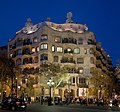 Photo credit: David IliffThe Casa Milà, a 1912 work by Catalán architect Antoni Gaudi, in the Eixample district of Barcelona, Spain. Gaudí's fascination with trencadís-influenced decoration and curves (predating biomorphism by almost 20 years) can be seen here.

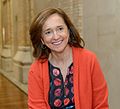 Photograph credit: Biblioteca Nacional de EspañaAna Santos Aramburo (born 1957) has been the director of the National Library of Spain since February 2013. Having received a degree in geography and history from the University of Zaragoza in Spain, she has spent much of her career working at the Complutense University of Madrid, first at the library of the Faculty of Economics and Business Sciences, and later serving as deputy director of the university library. Later she served as Director of the Historical Library Marquis of Valdecilla, General Director of Libraries and Archives of the City of Madrid, and Director of Cultural Action at the National Library. This photograph of Santos shows her at the headquarters of the National Library of Spain in Madrid.
 Painting credit: Francisco GoyaCharles IV of Spain and His Family is a portrait of the royal family of Spain painted by Francisco Goya in 1800 and 1801. King Charles IV, his wife Maria Luisa of Parma, and his children and relatives are dressed in the height of contemporary fashion, lavishly adorned with jewelry and the sashes of the order of Charles III. The artist does not attempt to flatter the family; instead the group portrait is unflinchingly realist, both in detail and tone. The artist, seated at his easel, is visible in the background. The painting is in the collection of the Museo del Prado in Madrid.
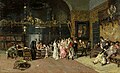 Painting: Marià FortunyThe Spanish Wedding is an oil on panel painting by Marià Fortuny completed over a two-year period ending in 1870. It depicts the signing of a wedding contract in 18th century Spain and was influenced heavily by the works of Francisco Goya, whom the artist admired. It is currently exhibited at the National Art Museum of Catalonia.


.jpg)


.jpg)


.jpg)
 Good article –




.jpg)
.jpg)


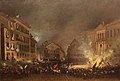 Episode of the 1854 Spanish Revolution in the Puerta del Sol, by Eugenio Lucas Velázquez. (from History of Spain)
 Façade of the Cathedral of Valladolid (from Spanish Golden Age)
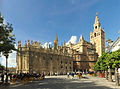 Cathedral of Saint Mary of the See in Sevilla. (from Culture of Spain)
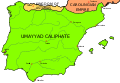 al-Andalus at its greatest extent, 720 (from History of Spain)
 Panoramic view of the lower level patio of the Palace (from Spanish Golden Age)
 The promulgation of the Constitution of 1812, oil painting by Salvador Viniegra. (from History of Spain)
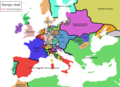 A map of Europe in 1648, after the Peace of Westphalia (from History of Spain)
 Visigothic church, San Pedro de la Nave. Zamora. Spain (from History of Spain)
 Map of territories that were once part of the Spanish Empire (from History of Spain)
![Image 11Detail of the votive crown of Recceswinth from the Treasure of Guarrazar, (Toledo-Spain) hanging in Madrid. The hanging letters spell [R]ECCESVINTHVS REX OFFERET [King R. offers this]. (from History of Spain)](https://upload.wikimedia.org/wikipedia/commons/thumb/f/f2/Corona_de_%2829049230050%29.jpg/60px-Corona_de_%2829049230050%29.jpg) Detail of the votive crown of Recceswinth from the Treasure of Guarrazar, (Toledo-Spain) hanging in Madrid. The hanging letters spell [R]ECCESVINTHVS REX OFFERET [King R. offers this]. (from History of Spain)
Detail of the votive crown of Recceswinth from the Treasure of Guarrazar, (Toledo-Spain) hanging in Madrid. The hanging letters spell [R]ECCESVINTHVS REX OFFERET [King R. offers this]. (from History of Spain)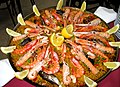 Paella mixta (from Culture of Spain)
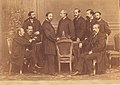 Members of the provisional government after the 1868 Glorious Revolution, by Jean Laurent. (from History of Spain)
 The successful 1925 Alhucemas landing turned the luck in the Rif War towards Spain's favour. (from History of Spain)
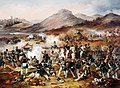 Battle of the First Carlist War, by Francisco de Paula Van Halen (from History of Spain)
 Plaza Mayor built in 1619 during the reign of Philip III. (from Spanish Golden Age)
 The realms of Philip II of Spain (from Spanish Golden Age)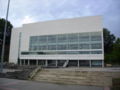
 Jamón ibérico (from Culture of Spain)
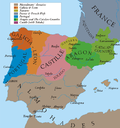 The Christian kingdoms of Hispania and the Islamic Almohad empire c. 1210
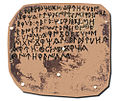 Illustration depicting the (now lost) Luzaga's Bronze, an example of the Celtiberian script. (from History of Spain)
 The Defence of Cádiz Against the English oil on canvas by Francisco de Zurbarán (from Spanish Golden Age)
 The title page of the Gramática de la lengua castellana (1492), the first grammar of a modern European language to be published. (from History of Spain)

 Inner view of Granada Cathedral (from Spanish Golden Age)
 The Third of May 1808, Napoleon's troops shoot hostages. Goya (from History of Spain)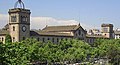
 Charles I of Spain (better known in the English-speaking world as the Holy Roman Emperor Charles V) was the most powerful European monarch of his day. (from History of Spain)
 Wedding portrait of the Catholic Monarchs (from History of Spain)
 The Port of Seville in the late 16th century. Seville became one of the most populous and cosmopolitan European cities after the expeditions to the New World. (from History of Spain)
 Roman Empire, 3rd century (from History of Spain)
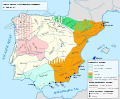 The Iberian Peninsula in the 3rd century BC (from History of Spain)
 The Second of May 1808 was the beginning of the popular Spanish resistance against Napoleon. (from History of Spain)
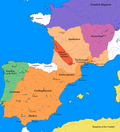 The greatest extent of the Visigothic Kingdom of Toulouse, c. 500, showing Territory lost after Vouillé in light orange (from History of Spain)
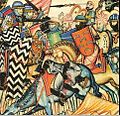 A battle of the Reconquista from the Cantigas de Santa Maria (from History of Spain)
 People's militias attacking on a Rebel position in Somosierra in the early stages of the war. (from History of Spain)
 Landing of Columbus by John Vanderlyn, 1847. Christopher Columbus leads expedition to the New World, 1492, sponsored by Spanish crown (from History of Spain)
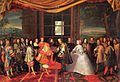 Louis XIV of France and Philip IV of Spain at the Meeting on the Isle of Pheasants in June 1660, part of the process to put an end to the Franco-Spanish War (1635–59). (from History of Spain)
 El paseo de las Delicias, a 1784–1785 painting by Ramón Bayeu depicting a meeting of members of the aristocracy in the aforementioned location. (from History of Spain)
 Royal Site of San Lorenzo de El Escorial. Built between 1563 and 1584 by order of King Philip II (from Spanish Golden Age)
 Celebrations of the proclamation of the 2nd Republic in Barcelona. (from History of Spain)
 Two women and a man during the siege of the Alcázar (from History of Spain)
 Ruins of Guernica (from History of Spain)
 Ethnology of the Iberian Peninsula c. 200 BC (from History of Spain)
 Visigothic King Roderic haranguing his troops before the Battle of Guadalete (from History of Spain)
 The Virgin of the Rosary (1675–80) by Bartolomé Esteban Murillo (from Spanish Golden Age)
 An 18th-century map of the Iberian Peninsula (from History of Spain)
 Old artistic rendering of the Monastery of El Escorial, historic 16th-century Renaissance complex near Madrid (from History of Spain)
 1894 satirical cartoon depicting the tacit accord for seamless government change (turnismo) between the leaders of two dynastic parties (Sagasta and Cánovas del Castillo), with the country being lied in an allegorical fashion. (from History of Spain)
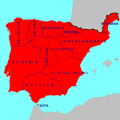 Visigothic Hispania and its regional divisions in 700, prior to the Muslim conquest (from History of Spain)
 Recognition of the Duke of Anjou as King of Spain, under the name of Philip V, November 16, 1700 (from History of Spain)
 Execution of Torrijos and his men in 1831. Ferdinand VII took repressive measures against the liberal forces in his country. (from History of Spain)
 Taking of Oran by Francisco Jiménez de Cisneros in 1509. (from History of Spain)
 Proclamation of the Spanish Republic in Madrid (from History of Spain)
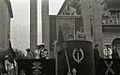 Franco visiting Tolosa in 1948 (from History of Spain)
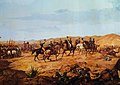 The pro-independence forces delivered a crushing defeat to the royalists and secured the independence of Peru in the 1824 battle of Ayacucho. (from History of Spain)
 The Conquest of Tenochtitlán (from History of Spain)
 Cabeza de Luis Buñuel, sculptor's work by Iñaki, in the center Buñuel Calanda. (from Culture of Spain)

 Felipe González signing the treaty of accession to the European Economic Community on 12 June 1985. (from History of Spain)
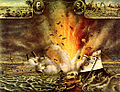 The explosion of the USS Maine launched the Spanish–American War in April 1898 (from History of Spain)
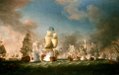 The Battle of Cape Passaro, 11 August 1718 (from History of Spain)
.JPG)


.svg)
![Image 11Detail of the votive crown of Recceswinth from the Treasure of Guarrazar, (Toledo-Spain) hanging in Madrid. The hanging letters spell [R]ECCESVINTHVS REX OFFERET [King R. offers this]. (from History of Spain)](https://en.wikipedia.org/wiki/File:Corona_de_(29049230050).jpg)

.jpg)


.jpg)


_en_Prins_Juan_Carlos,_Bestanddeelnr_254-9762.jpg)


.jpg)


_(cropped).jpg)

.jpg)


.jpg)


.jpg)
.jpeg)

_-_Fondo_Car-Kutxa_Fototeka.jpg)
.jpg)


.svg)

 Commons
 Wikibooks
 Wikidata
 Wikinews
 Wikiquote
 Wikisource
 Wikiversity
 Wikivoyage
 Wiktionary


