









Portal:India

Introduction

.svg)
India, officially the Republic of India, is a country in South Asia. It is the seventh-largest country by area; the most populous country since 2023; and, since its independence in 1947, the world's most populous democracy. Bounded by the Indian Ocean on the south, the Arabian Sea on the southwest, and the Bay of Bengal on the southeast, it shares land borders with Pakistan to the west; China, Nepal, and Bhutan to the north; and Bangladesh and Myanmar to the east. In the Indian Ocean, India is near Sri Lanka and the Maldives; its Andaman and Nicobar Islands share a maritime border with Myanmar, Thailand, and Indonesia. (Full article...)

 Featured article –

-
![Image 1 Tiruchirappalli (Tamil pronunciation: [ˈt̪iɾɯtːʃiɾapːaɭːi] ⓘ), also known as Trichy or historically as Trichinopoly, is a major tier II city in the Indian state of Tamil Nadu and the administrative headquarters of Tiruchirappalli district. The city is credited with being the best livable and the cleanest city of Tamil Nadu, as well as the fifth safest city for women in India. It is the fourth largest urban agglomeration in the state. Located 322 kilometres (200 mi) south of Chennai and 374 kilometres (232 mi) north of Kanyakumari, Tiruchirappalli sits almost at the geographic centre of Tamil Nadu. The Cauvery Delta begins 16 kilometres (9.9 mi) west of the city where the Kaveri river splits into two, forming the island of Srirangam which is now incorporated into the Tiruchirappalli City Municipal Corporation. The city occupies an area of 167.23 square kilometres (64.57 sq mi) and had a population of 916,857 in 2011. Tiruchirappalli's recorded history begins under Chola rule in the 3rd century BC. The city has also been ruled by the Pallavas, Pandyas, Vijayanagar Empire, Nayak Dynasty, the Carnatic state and the British. The most prominent historical monuments in Tiruchirappalli include the Rockfort at Teppakulam, the Ranganathaswamy temple at Srirangam dedicated to the reclining form of Hindu God Vishnu, and is also the largest functioning temple in the world, and the Jambukeswarar Temple at Thiruvanaikaval, which is also the largest temple for the Hindu God Shiva in the world. The archaeologically important town of Uraiyur, capital of the Early Cholas, is now a neighbourhood in Tiruchirappalli. The city played a critical role in the Carnatic Wars (1746–1763) between the British and the French East India companies. (Full article...)](https://upload.wikimedia.org/wikipedia/en/d/d2/Blank.png)

Tiruchirappalli (Tamil pronunciation: [ˈt̪iɾɯtːʃiɾapːaɭːi] ⓘ), also known as Trichy or historically as Trichinopoly, is a major tier II city in the Indian state of Tamil Nadu and the administrative headquarters of Tiruchirappalli district. The city is credited with being the best livable and the cleanest city of Tamil Nadu, as well as the fifth safest city for women in India. It is the fourth largest urban agglomeration in the state. Located 322 kilometres (200 mi) south of Chennai and 374 kilometres (232 mi) north of Kanyakumari, Tiruchirappalli sits almost at the geographic centre of Tamil Nadu. The Cauvery Delta begins 16 kilometres (9.9 mi) west of the city where the Kaveri river splits into two, forming the island of Srirangam which is now incorporated into the Tiruchirappalli City Municipal Corporation. The city occupies an area of 167.23 square kilometres (64.57 sq mi) and had a population of 916,857 in 2011.
Tiruchirappalli's recorded history begins under Chola rule in the 3rd century BC. The city has also been ruled by the Pallavas, Pandyas, Vijayanagar Empire, Nayak Dynasty, the Carnatic state and the British. The most prominent historical monuments in Tiruchirappalli include the Rockfort at Teppakulam, the Ranganathaswamy temple at Srirangam dedicated to the reclining form of Hindu God Vishnu, and is also the largest functioning temple in the world, and the Jambukeswarar Temple at Thiruvanaikaval, which is also the largest temple for the Hindu God Shiva in the world. The archaeologically important town of Uraiyur, capital of the Early Cholas, is now a neighbourhood in Tiruchirappalli. The city played a critical role in the Carnatic Wars (1746–1763) between the British and the French East India companies. (Full article...) -

The Kingdom of Mysore was a geopolitical realm in southern India founded in around 1399 in the vicinity of the modern-day city of Mysuru and prevailed until 1950. The territorial boundaries and the form of government transmuted substantially throughout the kingdom's lifetime. While originally a feudal vassal under the Vijayanagara Empire, it became a princely state in British Raj from 1799 to 1947, marked in-between by major political changes.
The kingdom, which was founded and ruled for the most part by the Wadiyars, initially served as a feudal vassal under the Vijayanagara Empire. With the gradual decline of the Empire, the 16th-century Timmaraja Wodeyar II declared independence from it. The 17th century saw a steady expansion of its territory and, during the rules of Narasaraja Wodeyar I and Devaraja Wodeyar II, the kingdom annexed large expanses of what is now southern Karnataka and parts of Tamil Nadu, becoming a formidable power in the Deccan. (Full article...) -
Kahaani (IPA: [kəˈɦaːni]; transl. Story) is a 2012 Indian Hindi-language mystery thriller film co-written, co-produced, and directed by Sujoy Ghosh. It stars Vidya Balan as Vidya Bagchi, a pregnant woman looking for her missing husband in Kolkata during the festival of Durga Puja, assisted by Assist Sub-Inspector Satyoki "Rana" Sinha (Parambrata Chatterjee) and Inspector General A. Khan (Nawazuddin Siddiqui).
Made on a budget of ₹80 million (US$950,000), Kahaani was conceived and developed by Ghosh, who co-wrote the film with Advaita Kala. The crew often employed guerrilla-filmmaking techniques on Kolkata's streets to avoid attracting attention. Its creative portrayal of the city and its use of local crew and cast made it a notable film. Kahaani explores themes of feminism and motherhood in a male-dominated Indian society. The film also makes several allusions to Satyajit Ray's films, such as Charulata (1964), Aranyer Din Ratri (1970), and Joi Baba Felunath (1979). The film's musical score and soundtrack were composed by Clinton Cerejo and Vishal–Shekhar respectively, with cinematography handled by Setu and editing done by Namrata Rao. (Full article...) -
Eega (transl. The Fly) is a 2012 Indian Telugu-language fantasy action film written and directed by S. S. Rajamouli. The film was produced by Sai Korrapati under Vaaraahi Chalana Chitram. It was filmed simultaneously in Tamil with the title Naan Ee (transl. I, the Fly). The film stars Nani, Samantha, and Sudeepa. M. M. Keeravani composed the songs and the background score, while K. K. Senthil Kumar was the director of photography. Janardhana Maharshi and Crazy Mohan wrote the dialogue for the Telugu and Tamil versions, respectively.
The film follows a bedtime story narrated by a father to his daughter. Its protagonist, Nani, who is in love with his neighbour Bindu, is murdered by a wealthy industrialist named Sudeep, who is attracted to Bindu and considers Nani a rival. Nani reincarnates as a housefly and tries to avenge his death and protect Bindu from an obsessive Sudeep. (Full article...) -
Keechaka Vadham (transl. The Extermination of Keechaka) is an Indian silent film produced, directed, filmed and edited by R. Nataraja Mudaliar. The first film to have been made in South India, it was shot in five weeks at Nataraja Mudaliar's production house, India Film Company. As the members of the cast were Tamils, Keechaka Vadham is considered to be the first Tamil film. No print of it is known to have survived, making it a lost film.
The screenplay, written by C. Rangavadivelu, is based on an episode from the Virata Parva segment of the Hindu epic Mahabharata, focusing on Keechaka's attempts to woo Draupadi. The film stars Raju Mudaliar and Jeevarathnam as the central characters. (Full article...) -
Muhammad Ali Jinnah (born Mahomedali Jinnahbhai; 25 December 1876 – 11 September 1948) was a barrister, politician, and the founder of Pakistan. Jinnah served as the leader of the All-India Muslim League from 1913 until the inception of Pakistan on 14 August 1947 and then as Pakistan's first governor-general until his death a year later in 1948.
Born at Wazir Mansion in Karachi, Jinnah was trained as a barrister at Lincoln's Inn in London, England. Upon his return to India, he enrolled at the Bombay High Court, and took an interest in national politics, which eventually replaced his legal practice. Jinnah rose to prominence in the Indian National Congress in the first two decades of the 20th century. In these early years of his political career, Jinnah advocated for Hindu–Muslim unity, helping to shape the 1916 Lucknow Pact between the Congress and the All-India Muslim League, in which Jinnah had also become prominent. Jinnah became a key leader in the All-India Home Rule League, and proposed a fourteen-point constitutional reform plan to safeguard the political rights of Muslims in the Indian subcontinent. In 1920, however, Jinnah resigned from the Congress when it agreed to follow a campaign of satyagraha, which he regarded as political anarchy. (Full article...) -

Reginald Heber (21 April 1783 – 3 April 1826) was an English Anglican bishop, a man of letters, and hymn-writer. After 16 years as a country parson, he served as Bishop of Calcutta until his death at the age of 42. The son of a rich landowner and cleric, Heber gained fame at the University of Oxford as a poet. After graduation he made an extended tour of Scandinavia, Russia and Central Europe. Ordained in 1807, he took over his father's old parish, Hodnet, Shropshire. He also wrote hymns and general literature, including a study of the works of the 17th-century cleric Jeremy Taylor.
He was consecrated Bishop of Calcutta in October 1823. He travelled widely and worked to improve the spiritual and general living conditions of his flock. Arduous duties, a hostile climate and poor health led to his collapse and death after less than three years in India. Memorials were erected there and in St Paul's Cathedral, London. A collection of his hymns appeared soon after his death. "Holy, Holy, Holy! Lord God Almighty" remains popular for Trinity Sunday, while "Brightest and Best" is frequently sung during Epiphany. (Full article...) -
Dilwale Dulhania Le Jayenge (transl. The Brave-Hearted Will Take the Bride), also known by the initialism DDLJ, is a 1995 Indian Hindi-language musical romance film written and directed by Aditya Chopra in his directorial debut and produced by his father Yash Chopra. The film stars Shah Rukh Khan and Kajol as Raj and Simran, two young non-resident Indians, who fall in love during a vacation through Europe with their friends. Raj tries to win over Simran's family so the couple can marry, but Simran's father has long since promised her hand to his friend's son.
The film was shot in India, London, and Switzerland, from September 1994 to August 1995. (Full article...) -
Ganesha or Ganesh (Sanskrit: गणेश, IAST: Gaṇeśa, IPA: [ɡɐˈɳeːɕɐ]), also known as Ganapati, Vinayaka and Pillaiyar, is one of the best-known and most revered and worshipped deities in the Hindu pantheon and is the Supreme God in the Ganapatya sect. His depictions are found throughout India. Hindu denominations worship him regardless of affiliations. Ganesha also holds the Title of "Pratham Pujya" (the god to be worshipped initially before the worship of any other Deity). Devotion to Ganesha is widely diffused and extends to Jains and Buddhists and beyond India.
Although Ganesha has many attributes, he is readily identified by his elephant head and four arms. He is widely revered, more specifically, as the remover of obstacles and bringer of good luck; the patron of arts and sciences; and the deva of logic, intellect, and wisdom. As the god of beginnings, he is honoured at the start of rites and ceremonies. Ganesha is also invoked during writing sessions as a patron of letters and learning. Several texts relate anecdotes associated with his birth and exploits. (Full article...) -
Shah Rukh Khan (pronounced [ˈʃaːɦɾʊx xäːn] ⓘ; born as Shahrukh Khan on 2 November 1965), popularly known by the initials SRK, is an Indian actor and film producer renowned for his work in Hindi cinema. Referred to in the media as the "Baadshah of Bollywood" and "King Khan", he has appeared in more than 100 films and earned numerous accolades, including a National Film Award and 15 Filmfare Awards. He has been awarded the Padma Shri by the Government of India, as well as the Order of Arts and Letters and Legion of Honour by the Government of France. Khan has a significant following in Asia and among the Indian diaspora worldwide. In terms of income, several media outlets have described him as one of the most successful film stars in the world.
Khan began his career with appearances in several television series in the late 1980s and made his Hindi film debut in 1992 with the musical romance Deewana. He was initially recognised for playing villainous roles in the films Baazigar (1993) and Darr (1993). Khan established himself by starring in a series of top-grossing romantic films, including Dilwale Dulhania Le Jayenge (1995), Dil To Pagal Hai (1997), Kuch Kuch Hota Hai (1998), Mohabbatein (2000), Kabhi Khushi Kabhie Gham (2001), Kal Ho Naa Ho (2003), Veer-Zaara (2004), and Kabhi Alvida Naa Kehna (2006). He earned critical acclaim for his portrayal of an alcoholic in the period romantic drama Devdas (2002), a NASA scientist in the social drama Swades (2004), a hockey coach in the sports drama Chak De! India (2007), and a man with Asperger syndrome in the drama My Name Is Khan (2010). Further commercial successes came with the romances Om Shanti Om (2007) and Rab Ne Bana Di Jodi (2008), and with his expansion to comedies in Chennai Express (2013) and Happy New Year (2014). Following a brief setback and hiatus, Khan made a career comeback with the 2023 action thrillers Pathaan and Jawan, both of which rank among the highest-grossing Indian films. For Jawan, he received the National Film Award for Best Actor in a Leading Role. (Full article...) -

Darjeeling (/dɑːrˈdʒiːlɪŋ/, Nepali: [ˈdard͡ziliŋ], Bengali: [ˈdarˌdʒiliŋ]) is a city in the northernmost region of the Indian state of West Bengal. Located in the Eastern Himalayas, it has an average elevation of 2,045 metres (6,709 ft). To the west of Darjeeling lies the easternmost province of Nepal, to the east the Kingdom of Bhutan, to the north the Indian state of Sikkim, and farther north the Tibet Autonomous Region of China. Bangladesh lies to the south and southeast, and most of the state of West Bengal lies to the south and southwest, connected to the Darjeeling region by a narrow tract. Kangchenjunga, the world's third-highest mountain, rises to the north and is prominently visible on clear days.
In the early 19th century, during East India Company rule in India, Darjeeling was identified as a potential summer retreat for British officials, soldiers and their families. The narrow mountain ridge was leased from the Kingdom of Sikkim, and eventually annexed to British India. Experimentation with growing tea on the slopes below Darjeeling was highly successful. Thousands of labourers were recruited chiefly from Nepal to clear the forests, build European-style cottages and work in the tea plantations. The widespread deforestation displaced the indigenous peoples. Residential schools were established in and around Darjeeling for the education of children of the domiciled British in India. By the late-19th century, a novel narrow-gauge mountain railway, the Darjeeling Himalayan Railway, was bringing summer residents into the town and carrying a freight of tea out for export to the world. After India's independence in 1947, as the British left Darjeeling, its cottages were purchased by wealthy Indians from the plains and its tea plantations by out-of-town Indian business owners and conglomerates. (Full article...) -
Nil Battey Sannata (lit. 'Zero Divided by Zero Equals Nothing'; slang for "Good for Nothing"), released internationally as The New Classmate, is a 2015 Indian Hindi-language comedy drama film directed by Ashwiny Iyer Tiwari in her feature debut. Produced by Aanand L. Rai, Ajay Rai, and Alan McAlex under the banners of Colour Yellow Productions and JAR Pictures, the film was co-written by Iyer, Neeraj Singh, Pranjal Choudhary, and Nitesh Tiwari. Swara Bhaskar starred as Chanda Sahay, a high-school drop-out household maid and single mother of a sullen young girl named Apeksha, played by Riya Shukla. The film's theme is a person's right to dream and change their lives, irrespective of social status.
Released in India on 22 April 2016, Nil Battey Sannata was distributed by Eros International and garnered critical and audience acclaim. Reviewers praised most aspects of the production, especially its narrative and realism, and the performances of the cast, Bhaskar's in particular. At the 62nd Filmfare Awards, Iyer won the Filmfare Award for Best Debut Director, while Bhaskar and Shukla won the Screen Awards for Best Actress (Critics) and Best Child Artist respectively. The film did well at the box-office, collecting a total of around ₹69 million (US$820,000) during its entire theatrical run. The same year, the film was remade in Tamil as Amma Kanakku, with Iyer returning to direct. The following year, it was remade in Malayalam as Udaharanam Sujatha. (Full article...) -
Osbert Guy Stanhope Crawford CBE FBA FSA (28 October 1886 – 28 November 1957) was a British archaeologist who specialised in the archaeology of prehistoric Britain and Sudan. A keen proponent of aerial archaeology, he spent most of his career as the archaeological officer of the Ordnance Survey (OS) and also wrote a range of books on archaeological subjects.
Born in Bombay, British India, to a wealthy middle-class Scottish family, Crawford moved to England as an infant and was raised by his aunts in London and Hampshire. He studied geography at Keble College, Oxford, and worked briefly in that field before devoting himself professionally to archaeology. Employed by the philanthropist Henry Wellcome, Crawford oversaw the excavation of Abu Geili in Sudan before returning to England shortly before the First World War. During the conflict he served in both the London Scottish Regiment and the Royal Flying Corps, where he was involved in ground and aerial reconnaissance along the Western Front. After an injury forced a period of convalescence in England, he returned to the Western Front, where he was captured by the German Army in 1918 and held as a prisoner of war until the end of the conflict. (Full article...) -
Deepika Prakash Padukone (pronounced [d̪iːpɪkaː pəɖʊkoːɳeː]; born 5 January 1986) is an Indian actress who works predominantly in Hindi films. Her accolades include three Filmfare Awards. Time named her one of the 100 most influential people in the world in 2018 and awarded her the Time100 Impact Award in 2022.
Padukone, the daughter of the badminton player Prakash Padukone, was born in Copenhagen and raised in Bangalore. As a teenager, she played badminton in national level championships but left her career in the sport to become a fashion model. She soon received offers for film roles and made her acting debut in 2006 as the title character of the Kannada film Aishwarya. Padukone then played a dual role opposite Shah Rukh Khan in her first Bollywood release, the romance Om Shanti Om (2007), which won her the Filmfare Award for Best Female Debut. Padukone received praise for her starring role in the romance Love Aaj Kal (2009), but this was followed by a brief setback. (Full article...) -
Priyanka Chopra Jonas (née Chopra; born 18 July 1982) is an Indian actress and producer. The winner of the Miss World 2000 pageant, she is India's highest-paid actress and her accolades include two National Film Awards and five Filmfare Awards. In 2016, the Government of India honoured her with the Padma Shri, and Time named her one of the 100 most influential people in the world. Forbes listed her among the World's 100 Most Powerful Women, and in 2022, she was named in the BBC 100 Women list.
Chopra accepted offers to join the Indian film industry following her pageant wins. Her acting debut came in the Tamil film Thamizhan (2002), followed by her first Bollywood feature in The Hero: Love Story of a Spy (2003). She played the leading lady in the box-office hits Andaaz (2003) and Mujhse Shaadi Karogi (2004) and had her breakout role in the 2004 romantic thriller Aitraaz. Chopra established herself with starring roles in the top-grossing productions Krrish and Don (both 2006), and later reprised her role in their successful sequels Krrish 3 (2013) and Don 2 (2011). For playing a troubled model in the drama Fashion (2008), Chopra won a National Film Award and a Filmfare Award for Best Actress. Chopra gained further praise for portraying a range of characters in the films Kaminey (2009), 7 Khoon Maaf (2011), Barfi! (2012), Mary Kom (2014), Dil Dhadakne Do (2015), and Bajirao Mastani (2015). (Full article...) -
Aitraaz (transl. Objection) is a 2004 Indian Hindi-language romantic psychological thriller film directed by Abbas–Mustan and produced by Subhash Ghai. It stars Akshay Kumar, Priyanka Chopra and Kareena Kapoor.
Aitraaz tells the story of a man accused of sexual harassment by his female superior, and was released on 12 November 2004 to positive reviews. Chopra received widespread critical acclaim for her performance. Loosely based on the 1994 film Disclosure, the film was moderately successful at the box office, doing a business of ₹26 crores at the box office against a budget of ₹11 crores, and has been noted for its bold subject of male sexual harassment. (Full article...) -
Margaret Ives Abbott (June 15, 1878 – June 10, 1955) was an American amateur golfer. She was the first American woman to win an Olympic event: the women's golf tournament at the 1900 Summer Olympics.
Born in Calcutta (now Kolkata), British Raj, in 1878, Abbott moved with her family to Chicago in 1884. She joined the Chicago Golf Club in Wheaton, Illinois, where she received coaching from Charles B. Macdonald and H. J. Whigham. In 1899, she traveled with her mother to Paris to study art. The following year, along with her mother, she signed up for a women's golf tournament without realizing that it was the second modern Olympics. Abbott won the tournament with a score of 47 strokes; her mother tied for seventh place. Abbott received a porcelain bowl as a prize. (Full article...) -
The 2003 Sri Lanka cyclone was a moderately powerful tropical cyclone that produced the worst flooding in Sri Lanka in 56 years. The first storm of the 2003 North Indian Ocean cyclone season, it developed over the Bay of Bengal on May 10. Favorable environmental conditions allowed the system to intensify steadily while moving northwestward. The storm reached peak maximum sustained winds of 140 km/h (85 mph) on May 13, making it a very severe cyclonic storm according to the India Meteorological Department (IMD), which is the official Regional Specialized Meteorological Center for the basin. The cyclone drifted north over the central Bay of Bengal, gradually weakening due to heightened wind shear. Turning eastward, the storm deteriorated to a deep depression on May 16 before it curved northeastward and re-intensified into a cyclonic storm. It came ashore in western Myanmar and dissipated over land the following day.
In the wake of prolonged precipitation during the first half of May, the cyclone produced torrential rains across southwest Sri Lanka while stationary in the central Bay of Bengal. The storm drew extensive moisture that coalesced in the mountainous portion of the island. A station at Ratnapura recorded 366.1 mm (14.41 in) of rainfall in 18 hours on May 17, including 99.8 mm (3.93 in) in one hour. In southwestern Sri Lanka, the rainfall caused flooding and landslides that destroyed 24,750 homes and damaged 32,426 others, displacing about 800,000 people. Overall damage totaled about $135 million (2003 USD), and there were 260 deaths. The cyclone also produced some rainfall in the Andaman and Nicobar Islands of India and along the country's eastern coast. The storm funneled moisture away from the mainland, which possibly contributed to a heat wave that killed 1,900 people, and dropped heavy rainfall in Myanmar. (Full article...) -

Map 1: Mysore and Coorg in a map of peninsular India showing shifting boundaries
The political history of the region on the Deccan Plateau in west-central peninsular India (Map 1) that was later divided into Mysore state and Coorg province saw many changes after the fall of the Hindu Vijayanagara Empire in 1565. The rise of Sultan Haidar Ali in 1761 introduced a new period.
At the height of the Vijayanagara Empire, the Mysore and Coorg region was ruled by diverse chieftains, or rajas ("little kings"). Each raja had the right to govern a small region, but also an obligation to supply soldiers and annual tribute for the empire's needs. After the empire's fall and the subsequent eastward move of the diminished ruling family, many chieftains tried to loosen their imperial bonds and expand their realms. Sensing opportunity amidst the new uncertainty, various powers from the north invaded the region. Among these were the Sultanate of Bijapur to the northwest, the Sultanate of Golconda to the northeast, the newly-formed Maratha Empire farther northwest, and the major contemporary empire of India, the Mughal, which bounded all on the north. For much of the 17th century the tussles between the little kings and the big powers, and amongst the little kings, culminated in shifting sovereignties, loyalties, and borders. By the turn of the 18th century, the political landscape had become better defined: the northwestern hills were being ruled by the Nayaka rulers of Ikkeri, the southwestern—in the Western Ghats—by the Rajas of Coorg, the southern plains by the Wodeyar rulers of Mysore, all of which were Hindu dynasties; and the eastern and northeastern regions by the Muslim Nawabs of Arcot and Sira. Of these, Ikkeri and Coorg were independent, Mysore, although much-expanded, was formally a Mughal dependency, and Arcot and Sira, Mughal subahs (or provinces). (Full article...) -
Lage Raho Munna Bhai (pronounced [ləˈɡeː rəˈɦoː mʊnːaːˈbʱaːi] ⓘ; translation: Keep Going, Munna Bhai) is a 2006 Indian Hindi-language satirical comedy drama film written, edited and directed by Rajkumar Hirani, who also co-wrote the screenplay with Abhijat Joshi, and produced by Vidhu Vinod Chopra under the banner Vinod Chopra Films. A sequel to Munna Bhai M.B.B.S. (2003), the film is the second installment of the Munna Bhai series. Sanjay Dutt and Arshad Warsi reprised their roles as the titular Munna Bhai and Circuit, respectively. New additions to the cast include Vidya Balan, Dilip Prabhavalkar and Dia Mirza, while several actors from the original, notably Jimmy Sheirgill and Boman Irani, appear in new roles.
In this film, the eponymous lead character, a don in the Mumbai underworld, begins to see visions of Mahatma Gandhi. Through his interactions with Gandhi, he begins to practice what he refers to as "Gandhigiri" (a neologism for "Gandhism") to help ordinary people solve their problems. (Full article...) -
The red panda (Ailurus fulgens), also known as the lesser panda, is a small mammal native to the eastern Himalayas and southwestern China. It has dense reddish-brown fur with a black belly and legs, white-lined ears, a mostly white muzzle and a ringed tail. Its head-to-body length is 51–63.5 cm (20.1–25.0 in) with a 28–48.5 cm (11.0–19.1 in) tail, and it weighs between 3.2 and 15 kg (7.1 and 33.1 lb). It is well adapted to climbing due to its flexible joints and curved semi-retractile claws.
The red panda was formally described in 1825. The two recognised subspecies, the Himalayan and the Chinese red panda, genetically diverged about 250,000 years ago. The red panda's place on the evolutionary tree has been debated, but modern genetic evidence places it in close affinity with raccoons, weasels, and skunks. It is not closely related to the giant panda, which is a bear, though both possess elongated wrist bones or "false thumbs" used for grasping bamboo. The evolutionary lineage of the red panda (Ailuridae) stretches back around 25 to 18 million years ago, as indicated by extinct fossil relatives found in Eurasia and North America. (Full article...) -
Sonam Kapoor Ahuja (pronounced [soːnəm kəˈpuːr]; born 9 June 1985) is an Indian actress who works in Hindi films. She has received several awards, including a National Film Award and a Filmfare Award. Kapoor appeared in Forbes India's Celebrity 100 list from 2012 to 2016.
The daughter of actor Anil Kapoor, Sonam began her career as an assistant director on filmmaker Sanjay Leela Bhansali's 2005 film Black. She made her acting debut in Bhansali's romantic drama Saawariya (2007), a box office flop, and had her first commercial success with the romantic comedy I Hate Luv Storys (2010). This was followed by a series of commercial failures and repetitive roles, which garnered her negative reviews. The 2013 box office hit Raanjhanaa marked a turning point in Kapoor's career, garnering her praise and Best Actress nominations at several award ceremonies. (Full article...) -
The 44th Chess Olympiad (28 July – 10 August 2022) was a FIDE-organised international team chess event held in Chennai, the capital of Tamil Nadu, India. It consisted of two main tournaments—an Open event, enabling participation of players from all genders, and a Women's event, enabling participation of female players only—as well as several events to promote chess. The Olympiad was initially supposed to take place in Khanty-Mansiysk, Russia, the host of the Chess World Cup 2019, in August 2020, but it was later moved to Moscow. However, it was postponed due to the COVID-19 pandemic and then relocated to Chennai following Russia's invasion of Ukraine. This was the first Chess Olympiad to take place in India.
The total number of participants was 1,737: 937 in the Open and 800 in the Women's event. The number of registered teams was 188 from 186 nations in the Open section and 162 from 160 nations in the Women's section; being the host nation, India had three teams participating in each section. Both sections set team participation records. The main venue of the Chess Olympiad was the convention centre at the Four Points by Sheraton, while the opening and closing ceremonies were held at the Jawaharlal Nehru Stadium. The Chief Arbiter of the event was France's Laurent Freyd. (Full article...) -
Vithoba (IAST: Viṭhobā), also known as Vitthala (IAST: Viṭṭhala), and Panduranga (IAST: Pāṇḍuraṅga), is a Hindu deity predominantly worshipped in the Indian states of Maharashtra and Karnataka. He is a form of the Hindu deity Vishnu in his avatar: Krishna. Vithoba is often depicted as a dark young boy, standing arms akimbo on a brick, sometimes accompanied by his consort Rakhumai.
Vithoba is the focus of an essentially monotheistic, non-ritualistic bhakti-driven Varkari faith in Maharashtra and the Haridasa sect established in Dvaita Vedanta in Karnataka. Vithoba Temple, Pandharpur is his main temple. Vithoba legends revolve around his devotee Pundalik who is credited for bringing the deity to Pandharpur, and around Vithoba's role as a saviour to the poet-saints of the Varkari faith. The Varkari poet-saints are known for their unique genre of devotional lyric, the abhang, dedicated to Vithoba and composed in Marathi. Other devotional literature dedicated to Vithoba includes the Kannada hymns of the Haridasa and the Marathi versions of the generic aarti songs associated with rituals of offering light to the deity. The most important festivals of Vithoba are held on Shayani Ekadashi in the month of Ashadha, and Prabodhini Ekadashi in the month of Kartika. (Full article...) -
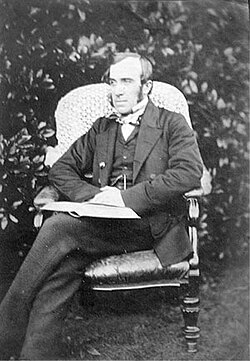
Monier Williams, elected as the second Boden Professor of Sanskrit in 1860; this photograph was taken by Lewis Carroll.
The election in 1860 for the position of Boden Professor of Sanskrit at the University of Oxford was a competition between two candidates offering different approaches to Sanskrit scholarship. One was Monier Williams, an Oxford-educated Englishman who had spent 14 years teaching Sanskrit to those preparing to work in British India for the East India Company. The other, Max Müller, was a German-born lecturer at Oxford specialising in comparative philology, the science of language. He had spent many years working on an edition of the Rig Veda (an ancient collection of Vedic Sanskrit hymns) and had gained an international reputation for his scholarship. Williams, in contrast, worked on later material and had little time for the "continental" school of Sanskrit scholarship that Müller exemplified. Williams regarded the study of Sanskrit as a means to an end, namely the conversion of India to Christianity. In Müller's opinion, his own work, while it would assist missionaries, was also valuable as an end in itself.
The election came at a time of public debate about British rule in India in the wake of the Indian Rebellion of 1857. Opinions were divided on whether greater efforts should be made to convert India or whether to remain sensitive to local culture and traditions. Both men battled for the votes of the electorate (the Convocation of the university, consisting of over 3,700 graduates) through manifestos and newspaper correspondence. Williams laid great stress in his campaign on the intention of the original founder of the chair, that the holder should assist in converting India through dissemination of the Christian scriptures. Müller's view was that his work on the Rig Veda was of great value for missionary work, and published testimonials accordingly. He also wanted to teach wider subjects such as Indian history and literature to assist missionaries, scholars, and civil servants – a proposal that Williams criticised as not in accordance with the original benefactor's wishes. The rival campaigns took out newspaper advertisements and circulated manifestos, and different newspapers backed each man. Although generally regarded as superior to Williams in scholarship, Müller had the double disadvantage (in the eyes of some) of being German and having liberal Christian views. Some of the newspaper pronouncements in favour of Williams were based on a claimed national interest of having an Englishman as Boden professor to assist with the work of governing and converting India. (Full article...)
![Image 1 Tiruchirappalli (Tamil pronunciation: [ˈt̪iɾɯtːʃiɾapːaɭːi] ⓘ), also known as Trichy or historically as Trichinopoly, is a major tier II city in the Indian state of Tamil Nadu and the administrative headquarters of Tiruchirappalli district. The city is credited with being the best livable and the cleanest city of Tamil Nadu, as well as the fifth safest city for women in India. It is the fourth largest urban agglomeration in the state. Located 322 kilometres (200 mi) south of Chennai and 374 kilometres (232 mi) north of Kanyakumari, Tiruchirappalli sits almost at the geographic centre of Tamil Nadu. The Cauvery Delta begins 16 kilometres (9.9 mi) west of the city where the Kaveri river splits into two, forming the island of Srirangam which is now incorporated into the Tiruchirappalli City Municipal Corporation. The city occupies an area of 167.23 square kilometres (64.57 sq mi) and had a population of 916,857 in 2011. Tiruchirappalli's recorded history begins under Chola rule in the 3rd century BC. The city has also been ruled by the Pallavas, Pandyas, Vijayanagar Empire, Nayak Dynasty, the Carnatic state and the British. The most prominent historical monuments in Tiruchirappalli include the Rockfort at Teppakulam, the Ranganathaswamy temple at Srirangam dedicated to the reclining form of Hindu God Vishnu, and is also the largest functioning temple in the world, and the Jambukeswarar Temple at Thiruvanaikaval, which is also the largest temple for the Hindu God Shiva in the world. The archaeologically important town of Uraiyur, capital of the Early Cholas, is now a neighbourhood in Tiruchirappalli. The city played a critical role in the Carnatic Wars (1746–1763) between the British and the French East India companies. (Full article...)](https://en.wikipedia.org/wiki/File:Blank.png)


.png)
.jpg)
.jpg)


Selected pictures
-
 Photograph credit: Prathyush ThomasMacrotyloma uniflorum, commonly known as horse gram, is a legume native to tropical southern Asia. The plant grows from a rhizome, sending up annual shoots to a height of 60 cm (24 in). The flowers are cream, yellow or pale green and are followed by short pods. The seeds, pictured here, have been consumed in India for at least 4,000 years and are used both for animal feed and human consumption, including Ayurvedic cuisine. In other tropical countries in southeastern Asia, and in northern Australia, the plant is grown mainly as a fodder crop and for use as green manure. It is a drought-tolerant plant, largely cultivated in areas with low rainfall.
 -
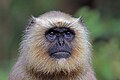 Photograph credit: Charles J. SharpThe southern plains gray langur (Semnopithecus dussumieri) is a species of Old World monkey native to the Indian subcontinent. It is about 62 cm (24 in) tall and lives in groups in various forest habitats, feeding mainly on leaves, fruit and flowers in the canopy, supplementing these with insects, gum, grasses, herbs and roots. The monkeys are considered sacred in India, and some are used by Hindu priests for religious purposes. They have adapted to living in close proximity to humans in urban settings; they are often fed by humans and accept cakes, millet, and other foods. The species is protected by law in India, but some are still persecuted for damaging crops, hunted for food and captured for pets.
This photograph of a female southern plains gray langur was taken in Kanha Tiger Reserve, in the Indian state of Madhya Pradesh. The park was created on 1 June 1955 and was designated a tiger reserve in 1973. -
 A statue of the Hindu god Shiva as Nataraja, the Lord of Dance. In this form, Shiva performs his divine dance to destroy a weary universe and make preparations for the god Brahma to start the process of creation. A Telugu and Tamil concept, Shiva was first depicted as Nataraja in the famous Chola bronzes and sculptures of Chidambaram. The form is present in most Shiva temples in South India, and is the main deity in Chidambaram Temple, the foremost Shaivist temple.
 -
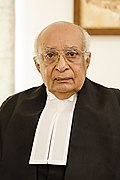 Photograph credit: Augustus BinuK. T. Thomas (born 30 January 1937) is a former judge of the Supreme Court of India, known for his strong opinions on Indian socio-political matters. He was selected as a district and sessions judge in 1977, and became a judge of the Kerala High Court in 1985. A decade later, he was appointed a judge of the Supreme Court, on which he served until retiring in 2002. He was awarded the Padma Bhushan by the Indian government in 2007 for services in the field of social affairs.
 -
 Photograph credit: Charles J. SharpThe Indian roller (Coracias benghalensis) is a member of the bird family Coraciidae, the rollers. It occurs widely from the Arabian Peninsula to the Indian subcontinent and is designated as Least Concern on the IUCN Red List. The bird is best known for the aerobatic displays of males during the breeding season. It is commonly found in open grassland and scrub forest habitats, and is often seen perched on roadside bare trees and wires, which give it a good view of the ground below where it finds its prey. Its diet consists mainly of insects such as beetles and grasshoppers, but also includes spiders, scorpions, amphibians and small reptiles. The largest population occurs in India, and several states in India have chosen it as their state bird.
This picture shows an Indian roller of the benghalensis subspecies, photographed in Kanha Tiger Reserve in the Indian state of Madhya Pradesh. -
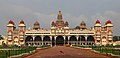 Photograph: Muhammad Mahdi KarimMysore Palace, the official residence and seat of the Wodeyars — the rulers of the Kingdom of Mysore. Located in southern India, the kingdom is traditionally believed to have been founded in 1399 as a vassal state to the Vijayanagara Empire before becoming independent in the 16th century.
 -
 Photograph credit: Augustus BinuPomegranate juice is a beverage made from the fruit of the pomegranate. It is used in cooking both as a fresh juice and as a concentrated syrup. The fruit originated in the region extending from Iran to northern India and has been cultivated since ancient times. The fruit has a hard outer husk and a spongy mesocarp in which the seeds in their fleshy seedcoats are embedded. Pomegranate juice can be sweet or sour, but most fruits are moderate in taste. The juice has long been a popular drink in Europe and the Middle East, and is now widely distributed in the United States and Canada.
 -
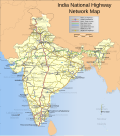 Map credit: PlaneMadA map of Network of National Highways in India, including NHDP projects up to phase IIIB, which is due to be completed by December 2012. The National Highways are the main long-distance roadways and constitute a total of about 58,000 km (36,250 mi), of which 4,885 km (3,053 mi) are central-separated expressways. Highways in India are around 2% of the total road network in India, but carry nearly 40% of the total road traffic.
 -
 A potter at work in Jaura, Madhya Pradesh, India. Pottery, defined by ASTM International as "all fired ceramic wares that contain clay when formed, except technical, structural, and refractory products", originated during the Neolithic period.
 -
 Photograph credit: Charles James SharpDanaus genutia, the common tiger or striped tiger, is a species of brush-footed butterfly found in Sri Lanka, India, Myanmar, south-eastern Asia and Australia. It prefers areas of moderate to heavy rainfall, and typical habitats include scrubby jungle, deciduous forests and fallow land near habitations. The insect sequesters toxins from plants, and advertises its unpalatability by having prominent markings and striking colour patterns. This adult male common tiger, of the subspecies D. g. genutia, was photographed in Kerala, India.
 -
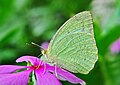 Photo: JoydeepCatopsilia pyranthe is a medium sized butterfly of the family Pieridae. It is found in South Asia, Southeast Asia and parts of Australia. This male was photographed in West Bengal, India.
 -
 Photograph: Jorge RoyanAn Indian merchant holding green chickpeas (Cicer arietinum). One of the earliest cultivated legumes, chickpeas are ingredients in a number of dishes around the world. India is the largest producer of this nutrient-dense food, accounting for 64% of global production in 2016.
 -
 Papilio demoleus matingPhotograph: JkadavoorA mating pair of Papilio demoleus, a common and widespread Swallowtail butterfly, photographed at Kadavoor, Kerala, India. After successful mating the female goes from plant to plant, laying a single egg at a time on top of a leaf, and flies off as soon as the egg is laid.
 -
 Photograph credit: Rucha Karkarey; edited by John HarrisonThe round ribbontail ray (Taeniura meyeni) is a species of stingray in the family Dasyatidae, found throughout the nearshore waters of the tropical Indo-Pacific region. Reaching 1.8 m (6 ft) across, this large ray is characterized by a thick, rounded pectoral fin disc covered by small tubercles on top, and a relatively short tail bearing a single venomous spine. The ray is well-camouflaged when lying on the seabed; it is largely nocturnal, and preys on molluscs, crustaceans and bony fish. Mature females bear litters of up to seven pups, which are fed during gestation on "uterine milk", a product secreted by the walls of the oviduct. This round ribbontail ray was photographed in Lakshadweep, India.
 -
 Al-Ameen College of PharmacyPhoto: Muhammad Mahdi KarimAl-Ameen College of Pharmacy is a pharmacy college in Bangalore, India. Established in 1983, it is under the purview of the Al-Ameen Educational Society.

_female_head.jpg)


.jpg)

.jpg)


_male_underside.jpg)


Featured list –
-

The Padma Bhushan is the third-highest civilian award of the Republic of India. Instituted on 2 January 1954, the award is given for "distinguished service of a high order", without distinction of race, occupation, position, or sex. The recipients receive a Sanad, a certificate signed by the President of India and a circular-shaped medallion with no monetary association. The recipients are announced every year on Republic Day (26 January) and registered in The Gazette of India—a publication used for official government notices and released weekly by the Department of Publication, under the Ministry of Urban Development. The conferral of the award is not considered official without its publication in the Gazette. The names of recipients whose awards have been revoked or restored, both of which processes require the authority of the president, are archived and they are required to surrender their medal when their name is struck from the register; none of the conferments of Padma Bhushan during 2000–2009 have been revoked or restored. The recommendations are received from all the state and the union territory governments, as well as from Ministries of the Government of India, the Bharat Ratna and the Padma Vibhushan awardees, the Institutes of Excellence, the Ministers, the Chief Ministers and the Governors of State, and the Members of Parliament including private individuals.
When instituted in 1954, the Padma Bhushan was classified as "Dusra Varg" (Class II) under the three-tier Padma Vibhushan awards, which were preceded by the Bharat Ratna in hierarchy. On 15 January 1955, the Padma Vibhushan was reclassified into three different awards as the Padma Vibhushan, the Padma Bhushan and the Padma Shri. The criteria included "distinguished service of a high order in any field including service rendered by Government servants", but excluded those working with the public sector undertakings with the exception of doctors and scientists. The 1954 statutes did not allow posthumous awards; this was subsequently modified in the January 1955 statute. The design was also changed to the form that is currently in use; it portrays a circular-shaped toned bronze medallion 1+3⁄4 inches (44 mm) in diameter and 1⁄8 inch (3.2 mm) thick. The centrally placed pattern made of outer lines of a square of 1+3⁄16 inches (30 mm) side is embossed with a knob carved within each of the outer angles of the pattern. A raised circular space of diameter 1+1⁄16 inches (27 mm) is placed at the centre of the decoration. A centrally located lotus flower is embossed on the obverse side of the medal and the text "Padma" is placed above and the text "Bhushan" is placed below the lotus written in Devanagari script. The State Emblem of India is displayed in the centre of the reverse side, together with the national motto of India, "Satyameva Jayate" (Truth alone triumphs) in Devanagari script, which is inscribed on the lower edge. The rim, the edges and all embossing on either side is of standard gold with the text "Padma Bhushan" of gold gilt. The medal is suspended by a pink riband 1+1⁄4 inches (32 mm) in width with a broad white stripe in the middle. It is ranked fifth in the order of precedence of wearing of medals and decorations of the Indian civilian and military awards. (Full article...) -

Since Brabourne hosted its first international match in 1948, 35 Test centuries and 2 ODI centuries have been scored at the ground.
Brabourne Stadium is a cricket ground in Mumbai, India. It is the home of the Cricket Club of India and has played host to Ranji Trophy matches (including seventeen finals) and Indian Premier League matches, as well as being a Test, One Day International and Twenty20 International (T20) venue. It has a capacity of 20,000 spectators. The ground has hosted eighteen Test matches, the first in 1948 when India played the West Indies. It has also staged nine One Day International matches, the first of which was in 1989 when Australia lost to Pakistan by 66 runs. One T20 International has been played at the ground when India beat Australia by 7 wickets in 2007 (first T20 International to be played in India). Of the nine One Day Internationals played at the stadium, five matches (including the final) were staged during the ICC Champions Trophy in 2006.
The first Test century (100 or more runs in a single innings) scored at the ground was in 1948 by the West Indian Allan Rae in the first innings of the first Test match played at Brabourne Stadium. The first Indian to score a century at the Brabourne was Rusi Modi in the third innings of the same match. In total, 35 Test centuries have been scored at the ground in 18 Test matches. Virender Sehwag's 293, scored against Sri Lanka in 2009, is the highest Test innings achieved at the ground. The highest Test score by an overseas player is 194 by the West Indian Everton Weekes in 1948. Vijay Hazare has scored the most Test centuries at the ground with four. (Full article...) -

Several governors, lieutenant governors and administrators pose with the President of India at the ‘2024 Governors Conference’, at Rashtrapati Bhawan, in New Delhi in 3 - 4 August 2024.
In the Republic of India, according to the Article 154 of the Constitution of the Republic of India, a governor is the constitutional head of each of the twenty-eight states. They rank 4th in the order of the precedence of India. The governor is appointed by the President of the Republic of India for a term of five years, and holds office at the president's pleasure. They also may not have the 5 years term and is seen very rarely.
The governor is de jure head of the state government; all its executive actions are taken in the governor's name. However, the governor must act on the advice of the popularly elected council of ministers, headed by the chief minister, which thus holds de facto executive authority at the state-level. This situation is analogous to that of the President and the Prime Minister at the national level. The Constitution of India also empowers the governor to appoint or dismiss a ministry, recommend president's rule, or reserve bills for the president's assent. Acharya Devvrat, the Governor of Gujarat, is currently the longest-serving officeholder. He is also the recent most assumed office in Maharashtra. Two governors are currently holding additional charge of two different states. Ajay Kumar Bhalla, Governor of Manipur holding the additional charge as Governor of Nagaland, while Acharya Devvrat, the Governor of Gujarat holds the additional charge as Governor of Maharashtra. Anandiben Patel, the Governor of Uttar Pradesh (aged 84 years) is the oldest whereas Ajay Kumar Bhalla, the Governor of Manipur and Nagaland (aged 65 years) is the youngest. (Full article...) -
The Pampa Award (or Pampa Prashasti) is a literary award in the Indian state of Karnataka. The award was established in 1987 by the government of Karnataka. It is the highest literary honor conferred by the Department of Kannada and Culture, Government of Karnataka State, and recognises works written in the Kannada language (1 of the 22 official languages of India).
The award is named after the first Kannada poet Adikavi Pampa. The award originally comprised a cash prize of ₹1 lakh (US$1,200), a shawl, a citation and a memento. The cash prize was increased to ₹3 lakh (US$3,500) in 2008. Prior to 1996, the awards were given for a best single work by a Kannada writer. Since then, the award has been given to writers for their lifetime contribution to the Kannada literature. The Pampa Prashasti is presented by the Chief Minister, during the Kadambotsava, a cultural festival held annually in Pampa's hometown of Banavasi in Uttara Kannada district. (Full article...) -

The Mizoram Legislative Assembly is the unicameral legislature of Mizoram state in Northeast India. The seat of the legislative assembly is at Aizawl, the capital of the state. The assembly comprises 40 members directly elected from single-seat constituencies. It sits for a term of five years, unless it is dissolved early. Early dissolution of state assemblies happens when the governing party (or alliance) loses confidence of the assembly. This leads to either the President's Rule being imposed on the state, or early elections being called. Mizoram is the fourth-smallest state in India, covering 21,081 km2 (8,139 sq mi); and the second-least populous state with a population of 1.10 million. The Mizoram Legislative Assembly has existed since 1972, when it had 30 constituencies.
Since the independence of India, the Scheduled Castes (SC) and Scheduled Tribes (ST) have been given reservation status, guaranteeing political representation, and the Constitution lays down the general principles of positive discrimination for STs and SCs. The 2011 census of India stated that the indigenous population constitutes 95% of the state's total population. The Scheduled Tribes have been granted a reservation of 39 seats in the Mizoram assembly, leaving only one (Aizawl East-I) unreserved. (Full article...) -
The AIFF Player of the Year Awards are the annual awards presented to the best footballers in India by the All India Football Federation (AIFF). The AIFF first announced the award for Men's Player of the Year in 1992; I. M. Vijayan was the inaugural winner. No winner was announced in 1998 and 1999. It was re-introduced in 2000 and Vijayan won it for the second time becoming the first player to do so. Sunil Chhetri has won the award a record seven times. Jo Paul Ancheri, Bhaichung Bhutia and Lallianzuala Chhangte have each won the award twice. Subhasish Bose is the most recent winner in the men's category.
The AIFF Women's Player of the Year Award was introduced in 2001. Bembem Devi was its first recipient. No winner was given out from 2002 up to 2012. In 2013, the award was re-introduced and Bembem Devi won it for the second time. Other than Bembem Devi, Bala Devi and Manisha Kalyan have won the award multiple times. Bala Devi has won the award thrice, whereas Kalyan won the award twice. Soumya Guguloth is the most recent winner in this category. (Full article...) -

Dil Dhadakne Do (transl. Let the Heart Beat) is a 2015 Indian comedy-drama film directed by Zoya Akhtar. Produced by Ritesh Sidhwani and Farhan Akhtar, the film features an ensemble cast consisting of Anil Kapoor, Shefali Shah, Priyanka Chopra, Ranveer Singh, Anushka Sharma and Farhan Akhtar. The supporting cast also includes Rahul Bose, Zarina Wahab, Vikrant Massey, Ridhima Sud, Pawan Chopra, Parmeet Sethi, Dolly Mattdo and Manoj Pahwa. Akhtar co-wrote the screenplay with her friend and longtime collaborator Reema Kagti. The soundtrack was composed by the trio Shankar–Ehsaan–Loy while the cinematography was provided by Carlos Catalan. Anand Subaya and Manan Mehta edited the film.
The film tells the story of the Mehras, a dysfunctional Punjabi family who invite their family and friends along on a cruise trip to celebrate the parents' 30th wedding anniversary. Dil Dhadakne Do was released worldwide on 5 June 2015 to positive reviews from critics. The film grossed ₹1.45 billion at global box office on a budget of ₹580 million. The film garnered awards and nominations in a variety of categories with particular praise for Akhtar's direction, the performances, the music and costume design. (Full article...) -
Test cricket is the longest form of cricket. The women's variant of the game includes four innings to be completed over four days of play with eleven players in each side. The first women's Test was played between England and Australia in 1934. However, India did not play Test cricket until 1973 when the Women's Cricket Association of India was formed. The Indian women's team played their first Test match in 1976, against the West Indies. The Women's Cricket Association of India was merged with the Board of Control for Cricket in India in 2006 as part of the International Cricket Council's initiative to develop women's cricket.
India have played 41 Tests, starting with their first Test in 1976. They first won a Test in Patna (1976), in front of over 25,000 spectators, against the West Indies but did not win again until 2002, when they won against South Africa. The team has remained unbeaten since 2006, over the course of three Test matches. (Full article...) -
Shah Rukh Khan is an Indian actor, producer and television personality who works in Hindi films. He began his acting career by playing a soldier in the Doordarshan series Fauji (1988), a role that garnered him recognition and led to starring roles in more television shows. He soon started receiving film offers and had his first release with the romantic drama Deewana (1992). Khan subsequently played villainous roles in the 1993 thrillers Baazigar and Darr, box office successes that established his career in Bollywood. In 1995, Khan starred opposite Kajol in Aditya Chopra's romance Dilwale Dulhania Le Jayenge, that became the longest running Indian film of all time. He continued to establish a reputation in romantic roles by playing opposite Madhuri Dixit in Dil To Pagal Hai (1997), and Kajol in the Karan Johar-directed Kuch Kuch Hota Hai (1998) and Kabhi Khushi Kabhie Gham (2001).
In 1999, Khan collaborated with Aziz Mirza and Juhi Chawla to start a production company, Dreamz Unlimited, whose first release was the comedy-drama Phir Bhi Dil Hai Hindustani (2000) starring Khan and Chawla. The film was a commercial failure as was their next production, Aśoka (2001), leading to a setback. His career prospects improved in 2002 when he starred alongside Dixit and Aishwarya Rai in Devdas, a period romance that garnered him critical acclaim. In 2004, he collaborated with his wife Gauri Khan to launch another company, Red Chillies Entertainment, whose first feature was the box office hit Main Hoon Na (2004). Khan's popularity continued to increase in the 2000s as he played the romantic lead opposite Preity Zinta, in Kal Ho Naa Ho (2003) and Veer-Zaara (2004). He also played against type as a NASA scientist in the drama Swades (2004), a hockey coach in the sports film Chak De! India (2007), and an autistic man in the drama My Name Is Khan (2010). (Full article...) -

The Madhya Pradesh Legislative Assembly or the Madhya Pradesh Vidhan Sabha is the unicameral state legislature of the state of Madhya Pradesh in India. It is housed in the Vidhan Bhavan, a building located at the center of the Capital Complex, in the Arera Hill locality of Bhopal, the capital of the state. Madhya Pradesh is the second-largest state in India, covering 308,245 km2 (119,014 sq mi); and the sixth-most populous state with a population of 72.6 million. The term of the assembly is five years, unless it is dissolved early. Since 2001, it has had 230 members who are directly elects, from single-seat constituencies.
Since the independence of India, the Scheduled Castes (SC) and Scheduled Tribes (ST) have been given reservation status, guaranteeing political representation, and the Constitution lays down the general principles of positive discrimination for SCs and STs. The 2011 census of India stated that the Scheduled Castes and the Scheduled Tribes constitute a significant portion of the population of the state, at 15.6% and 21.1%, respectively. The Scheduled Tribes have been granted a reservation of 47 seats in the assembly, while 35 constituencies are reserved for candidates of the Scheduled Castes. (Full article...) -

A flotilla led by destroyers of the Indian Navy during Exercise Tropex 2023
In naval terminology, a destroyer is a fast, manoueverable, long-distance warship intended to escort larger vessels in a fleet, convoy or battle group and defend them against smaller, short-range attackers. Seventeen destroyers have served, or currently serve, in the Indian Navy. The navy operates 13 guided-missile destroyers from four classes: Visakhapatnam class, Kolkata class, Delhi class, and Rajput class. Six other destroyers (three R class and three Hunt class) have been decommissioned and scrapped.
India did not have any destroyers of its own until 1949. The R-class INS Ranjit, built in the United Kingdom, was the first destroyer commissioned in the Indian Navy. Two more of the R-class were later commissioned. Three Hunt-class destroyers were commissioned in 1953 to succeed the R-class destroyers. These ships (all of which were built in the United Kingdom) were decommissioned by 1976, with the Hunt-class INS Godavari the last. (Full article...) -
Tamannaah Bhatia is an Indian actress known for her work in Telugu, Tamil and Hindi cinema. She debuted as a leading lady in the Hindi film Chand Sa Roshan Chehra in 2005. That same year marked her Telugu debut with Sree, followed by her Tamil debut in Kedi the subsequent year. She experienced a breakthrough in her career with the success of Happy Days and Kalloori in 2007, portraying college students in both films. Her journey continued with box-office hits like Ayan, 100% Love, Siruthai, Tadakha, Oosaravelli, Racha and Veeram as well as setbacks such as Ananda Thandavam, Endukante Premanta, Himmatwala, Humshakals and Aagadu. Additionally, while she received critical acclaim and several accolades for her role in 100% Love, her performances in Himmatwala and Humshakals faced criticism.
In 2015, Bhatia received praised for her role in Baahubali: The Beginning, which earned over ₹600 crore. She was praised for her performances in Oopiri and Dharma Durai, and her double role in Devi was well received. However, Vasuvum Saravananum Onna Padichavanga, Bengal Tiger and Kaththi Sandai were less successful. In 2017, she reprised her role in Baahubali 2: The Conclusion, which grossed over ₹1700 crore worldwide, while Anbanavan Asaradhavan Adangadhavan was a box office failure. In 2018, Sketch received mixed reviews, but her performance was praised, while Naa Nuvve and Next Enti? were poorly received. In 2019, she starred in the blockbuster F2: Fun and Frustration and delivered notable performances in Kanne Kalaimaane, Devi 2, Khamoshi, Sye Raa Narasimha Reddy and Petromax. (Full article...) -
Mersal (transl. Zapped) is a 2017 Indian vigilante action film directed by Atlee Kumar, who co-wrote the screenplay with V. Vijayendra Prasad and S. Ramana Girivasan. Produced by N. Ramasamy and Hema Rukmani under the banner of Thenandal Studio Limited, Mersal features Vijay in triple roles for the first time in his career. Nithya Menen, S. J. Surya, Kajal Aggarwal and Samantha Akkineni play the other lead roles while Vadivelu, Kovai Sarala and Sathyaraj feature as supporting characters. A. R. Rahman composed the film's soundtrack, while also handling the background score along with Qutub-E-Kripa. Ruben and G. K. Vishnu were in charge of the editing and cinematography respectively. The film follows two brothers, Vetri (Vijay), a renowned magician, and Maaran (Vijay), a doctor who charges meagre amounts for his patients, who try to expose the corrupt dealings and medical crimes of another doctor, Daniel Arockiaraj (Surya), who also happens to be the same person that killed their parents, Vetrimaaran (Vijay) and Aishwarya (Menen).
Produced on a budget of ₹1.2 billion (about US$17.5 million in 2017), Mersal was released on 18 October 2017 and received positive reviews. It was also a commercial success, grossing ₹2.6 billion (about US$39.3 million in 2017) worldwide. The film won 35 awards from 57 nominations; its direction, screenplay, music and Vijay's performances received the most attention from award groups. (Full article...) -

Roshan in 2024
Hrithik Roshan is an Indian actor known for his work in Hindi-language films. As a child, he made uncredited appearances in three films directed by his maternal grandfather, J. Om Prakash, the first of which was in Aasha (1980). In 1986, Roshan played the adopted son of Rajinikanth's character in Prakash's crime drama Bhagwaan Dada. Roshan subsequently worked as an assistant director on four films, including Khudgarz (1987) and Karan Arjun (1995), all of which were directed by his father, Rakesh.
Roshan's first leading role came opposite Ameesha Patel in Kaho Naa... Pyaar Hai (2000), a highly successful romantic drama directed by his father, for which he won two Filmfare Awards—Best Male Debut and Best Actor. In 2001, Roshan played a supporting role in Karan Johar's lucrative ensemble melodrama Kabhi Khushi Kabhie Gham. This initial success was followed by roles in a series of critical and commercial failures, including Aap Mujhe Achche Lagne Lage (2002) and Main Prem Ki Diwani Hoon (2003), leading critics to believe that Roshan's career was over. His career prospects improved in 2003 when he played the role of a mentally disabled teenager in his father's science fiction film Koi... Mil Gaya. The film emerged as one of the highest-grossing Bollywood film of that year and earned Roshan the Best Actor – Critics and the Best Actor awards at Filmfare. His next release, the war drama Lakshya (2004), performed poorly at the box office despite earning positive reviews. (Full article...) -

Virender Sehwag scored 23 centuries in Test matches and 15 in One Day Internationals for India.
Virender Sehwag is an Indian cricketer whose aggressive batting has found success at the top of the batting order. He has scored centuries (100 or more runs) on 23 occasions in Test cricket and in 15 One Day International (ODI) matches but has not scored a century in a Twenty20 international.
In Tests, Sehwag has scored centuries against all the Test-cricket playing nations except Bangladesh and Zimbabwe, and is fifth on the list of leading Test century makers for India. In 2001, he became the eleventh Indian player to score a century on Test debut, with 105 runs against South Africa. His centuries have been scored at fourteen cricket grounds, eight of which were outside India. He has made six scores of 200 runs or more, of which a record three have come against Pakistan. One such innings, the 254 in Lahore, had him involved in a 410-run partnership with Rahul Dravid, which came within 3 runs of breaking the record for the highest first-wicket partnership in Tests, set by Pankaj Roy and Vinoo Mankad. The innings took only 247 balls and was the highest score at faster than a run a ball. Sehwag is the first Indian to score a triple century (300 or more runs), and has done so twice—309 against Pakistan in Multan in 2004 and 319 against South Africa in Chennai in 2008. The latter is the fastest triple century in Test cricket, the 300 coming up off just 278 balls, and is also the highest score with a strike rate over 100. It was also rated as one of the top 10 Test innings of all time by the ICC rankings, and received special mention along with his 201* in Galle, in which he carried his bat as he was named the Wisden Leading Cricketer in the World in 2008. He is one of the only four batsmen to score two triple centuries, alongside Sir Donald Bradman, Brian Lara and Chris Gayle. He scored 12 centuries that have been converted to scores of 150 or greater, a record for the most consecutive hundreds of over 150. He has been dismissed five times in the nineties. (Full article...) -
Ajay Devgn is an Indian actor, director and producer who works in Hindi films. He debuted as an actor in Phool Aur Kaante (1991), which won him the Filmfare Award for Best Male Debut. Devgn then played a kickboxer in the martial arts film Jigar (1992) and a blind in Vijaypath (1994) and starred in Suhaag (1994), Dilwale (1994), Diljale (1996), Jaan (1996), Ishq (1997), Pyaar To Hona Hi Tha (1998), and Hum Dil De Chuke Sanam (1999). He garnered Filmfare Best Actor nominations for Naajayaz and Hum Dil De Chuke Sanam and also won his first National Film Award for Best Actor for his performance in Zakhm (1998). In 2000, Devgn started Ajay Devgn FFilms, producing and headlining the commercially unsuccessful Raju Chacha. He received a Filmfare Best Supporting Actor nomination for enacting a dacoit in the ensemble film Lajja (2001).
2002 proved to be a banner year for Devgn as he received universal acclaim for his performances in Company, The Legend of Bhagat Singh and Deewangee. He won his second National Award for portraying revolutionary Bhagat Singh in The Legend of Bhagat Singh and the Filmfare Critics Award for Best Actor for it and Company, along with a Filmfare Best Villain Award for Deewangee. In 2003, he acted in the Bhoot, a sleeper hit, and played a police officer in Gangaajal, which earned him another Filmfare Best Actor nomination. He was next featured in Yuva (2004), Kaal (2005), and Omkara (2006). Rohit Shetty's Golmaal series established Devgn in comic roles, producing Golmaal (2006), Golmaal Returns (2008) and Golmaal 3 (2010). However Devgn was highly panned for Aag (2007), based on the 1975 cult classic Sholay. Today, it is considered one of the worst films. In 2008, he made his directorial debut with his own production U Me Aur Hum. 2010 proved to be a milestone year for him as he delivered his first 100 Crore Club film with Golmaal 3 and received positive feedback for the top-grossing films Raajneeti and Once Upon a Time in Mumbaai. The latter fetched him a Filmfare Best Actor nomination, as like his next Singham (2011), the first part of Shetty's Cop Universe, which was later reprised in Singham Returns (2014) and briefly in other standalone films of the universe, culminating in Singham Again (2024). (Full article...) -
The Indian National Congress (INC) is one of the two major parties in the political system of the Republic of India.
As of 20 November 2024, INC is in power in the three states: Himachal Pradesh, Karnataka and Telangana. In Tamil Nadu, Jharkhand and Jammu and Kashmir, it shares power with alliance partners Dravida Munnetra Kazhagam, Jharkhand Mukti Morcha and Jammu & Kashmir National Conference respectively. In the post-independence era, the party has governed most of India's states and union territories, and by extension, has the status of a "national party" in India.
According to the Constitution of India, at the state level, the governor is de jure head, but de facto executive authority rests with the chief minister. Therefore, the chief minister is considered the head of government in his jurisdiction. Following elections to the state legislative assembly, the governor usually invites the party or coalition with a majority of seats to form the government. The chief minister is appointed by the governor, who also appoints other ministers, known as the council of ministers, based on the chief minister's advice. The council of ministers is collectively responsible to the state legislative assembly, ensuring unified support for all governmental decisions. The Chief Minister's term is normally limited to five years if they have the assembly's confidence. There are no limits to the number of terms the chief minister can serve. The deputy chief minister is a member of the state government and usually the second highest ranking executive officer of their state's council of ministers. Because the deputy chief minister is not a constitutional office, the Chief Minister has significant influence over the scope of authority and duties the deputy chief minister can perform. A deputy chief minister usually holds a cabinet portfolio such as home minister or finance minister. In the parliamentary system of government, the chief minister is treated as the "first among equals" in the cabinet; the position of deputy chief minister is used to bring political stability and strength within a coalition government. (Full article...) -
Lagaan (English: Taxation) is a 2001 Indian sports drama film, written and directed by Ashutosh Gowariker. The film stars Aamir Khan, who also produced the film, and Gracy Singh in the lead roles. Yashpal Sharma, Raghubir Yadav, Rachel Shelley, and Paul Blackthorne feature in supporting roles. The film was edited by Ballu Saluja, with music and cinematography provided by A. R. Rahman, and Anil Mehta respectively. Lagaan is set in India in 1893, during the British Raj. The film tells the story of a small village whose inhabitants are oppressed by high taxes. They are challenged to a cricket match by an arrogant officer as a wager to avoid the taxes.
Lagaan was released on 15 June 2001. The film grossed over ₹1.3 billion (US$15 million) globally on a production budget of ₹250 million (US$3.0 million). It received nominations, and awards in several categories both in India and internationally, with particular praise for its direction, acting and landscapes. (Full article...) -
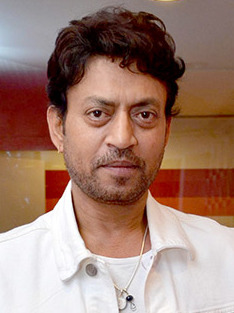
Khan in 2015
Irrfan Khan (7 January 1967– 29 April 2020) was an Indian actor who worked in Indian and British-American films. His on-screen debut was a minor role in Mira Nair's Salaam Bombay! in 1988. He followed this with appearances in a variety of television shows in the late 1980s to 1990s including playing ʽAbd al-Qadir Badayuni in Bharat Ek Khoj (1988), Makhdoom Mohiuddin in Kahkashan (1991), Vladimir Lenin in Lal Ghas Per Neele Ghodey (1992), a dual role in Chandrakanta (1994), and Valmiki in Jai Hanuman (1997). Khan found his television work unfulfilling and considered quitting acting.
His career experienced a turnaround with his breakthrough role as the lead in Asif Kapadia's The Warrior (2001), which won the BAFTA Award for Outstanding British Film. He followed this with critically acclaimed villainous roles in Haasil and Maqbool (both in 2003). For the former performance, where he played a devious politician, Khan received the Filmfare Award for Best Performance in a Negative Role. In 2006, Khan portrayed a first-generation Bengali immigrant in the Nair-directed film The Namesake with Tabu and a hitman in The Killer. The following year, he won the Filmfare Award for Best Supporting Actor for his performance as a 38-year-old man waiting to marry the right woman in Life in a... Metro, directed by Anurag Basu. In 2008, he received international recognition for his role as a police inspector in Danny Boyle's Slumdog Millionaire, which won the Academy Award for Best Picture. (Full article...) -

The National Film Award for Best Actor in a Leading Role is an honour presented annually at the National Film Awards of India instituted since 1967 to actors who have delivered the best performance in a leading role within the Indian film industry. Called the "State Awards for Films" when established in 1954, the National Film Awards ceremony is older than the Directorate of Film Festivals. The State Awards instituted the individual award in 1968 as the "Bharat Award for the Best Actor"; in 1975, it was renamed as the "Rajat Kamal Award for the Best Actor". As of 2024, accounting for ties and repeat winners, the Government of India has presented a total of 64 "Best Actor" awards to 49 actors. Until 1974, winners of the National Film Award received a figurine and certificate; since 1975, they have been awarded with a "Rajat Kamal" (silver lotus), certificate and a cash prize. Since the 70th National Film Awards, the name was changed to "National Film Award for Best Actor in a Leading Role".
Although the Indian film industry produces films in around 20 languages and dialects, the actors whose performances have won awards have worked in eight major languages: Hindi (twenty-seven awards), Malayalam (thirteen awards), Tamil (nine awards), Bengali (five awards), Kannada (four awards), Marathi (three awards), English (two awards), and Telugu (one award). (Full article...) -
Padmaavat is a 2018 Indian Hindi-language epic period drama film directed and produced by Sanjay Leela Bhansali. The film stars Deepika Padukone as Rani Padmavati, Shahid Kapoor as Maharawal Ratan Singh and Ranveer Singh as Sultan Alauddin Khilji and features Aditi Rao Hydari, Jim Sarbh, Raza Murad, and Anupriya Goenka in supporting roles. The film's screenplay was written by Bhansali and Prakash Kapadia. Bhansali also composed the soundtrack of the film, with lyrics written by A. M. Turaz, Siddharth-Garima and Swaroop Khan. The original score of the film is composed by Sanchit Balhara. Padmaavat was edited by Rajesh G. Pandey while Sudeep Chatterjee is its cinematographer. Set in medieval Rajasthan in 1303 AD, Queen Padmavati of Mewar is married to a noble king and they live in a prosperous fortress with their subjects until an ambitious Sultan hears of Padmavati's beauty and becomes obsessed with having her.
Made on a budget of ₹2.15 billion (US$25 million), Padmaavat was released on 25 January 2018 in 2D, 3D and IMAX 3D formats, making it the first Indian film to be released in IMAX 3D. Despite not being released in some states of India, it grossed over ₹5.85 billion (US$69 million) at the box office, becoming a commercial success and one of the highest-grossing Indian films of all time. The film won 25 awards from 68 nominations; its music, and the performance of Singh have received the most attention from award groups. (Full article...) -

Surya Kant, the current CJI since 24 November 2025
The chief justice of India is the highest-ranking officer of the Indian judiciary and the chief judge of the Supreme Court of India. As head of the Supreme Court, the chief justice is responsible for the allocation of cases and appointment of constitutional benches which deal with important matters of law. In accordance with Article 145 of the Constitution of India and the Supreme Court Rules of Procedure of 1966, the chief justice allocates all work to the other judges.
A new chief justice is appointed by the president of India with recommendations by the outgoing chief justice in consultation with other judges. The chief justice serves in the role until they reach the age of sixty-five or are removed by the constitutional process of impeachment. As per convention, the name suggested by the incumbent chief justice is almost always the next senior-most judge in the Supreme Court. This convention has been broken twice: in 1973, Justice A. N. Ray was appointed superseding three senior judges and in 1977, Justice Mirza Hameedullah Beg was appointed as the chief justice superseding Justice Hans Raj Khanna. (Full article...) -
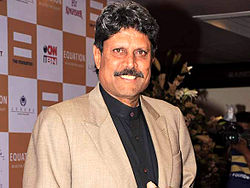
Kapil Dev is India's third highest wicket-taker in Test cricket.
Kapil Dev is a former Test and One Day International (ODI) cricketer who represented India between 1978 and 1994. He took 24 five-wicket hauls during his international career. In cricket, a five-wicket haul—also known as a five-for or fifer—refers to a bowler taking five or more wickets in a single innings. This is regarded as a notable achievement, and as of October 2024, only 54 bowlers have taken 15 or more five-wicket hauls at international level in their cricketing careers. A right-arm fast bowler, Kapil Dev took 434 wickets in Test cricket and 253 in ODIs. With 23 five-wicket hauls in Tests, he has the third highest number of international five-wicket hauls among Indian cricketers as of 2012, after Anil Kumble and Harbhajan Singh. Kapil Dev was named by the Wisden as one of their Cricketers of the Year in 1983 and Indian Cricketer of the Century in 2002. Eight years later, the International Cricket Council (ICC) inducted him into the ICC Cricket Hall of Fame. As of 2012, Kapil Dev also holds the record for being the only player to have taken more than 400 wickets and scored over 5,000 runs in Tests.
Kapil Dev made his Test and ODI debuts against Pakistan, both in 1978. His first five-wicket haul came a year later against England during the first Test of India's tour. His career-best bowling figures in an innings of nine for 83 was achieved in 1983 against the West Indies in Ahmedabad. In Tests, Kapil Dev was most successful against Pakistan and Australia, with seven five-wicket hauls against each of them. He took his only five-wicket haul in ODIs against Australia during the 1983 Cricket World Cup. (Full article...) -

Haasan in 2014
Shruti Haasan is an Indian actress and singer who works in Telugu, Tamil and Hindi films. She started her career as a playback singer at the age of six in the 1992 Tamil film Thevar Magan. She had a brief role in her father, Kamal Haasan's Tamil-Hindi directorial Hey Ram (2000) as a child artist. Haasan's first major appearance was in the Hindi film Luck (2009), in which she played a dual role of a woman avenging her twin sister's death. She played the female lead in the films Anaganaga O Dheerudu and 7 Aum Arivu; both were released in 2011 and together earned her the Best Female Debut – South at the 59th Filmfare Awards South ceremony.
Haasan's subsequent releases Oh My Friend (2011) and 3 (2012) were commercially unsuccessful. The latter earned her a nomination for the Best Actress – Tamil at the 60th Filmfare Awards South ceremony. A turning point came in Haasan's career with Harish Shankar's commercially successful Telugu film Gabbar Singh (2012). The release was followed by a series of successful films such as Balupu (2013) and Yevadu (2014). She received her first Filmfare Award for Best Actress – Telugu for her performance in Race Gurram (2014). (Full article...) -

The Indian Test team that toured England in 1932
In cricket, a five-wicket haul (also known as a "five–for" or "fifer") refers to a bowler taking five or more wickets in a single innings. A five-wicket haul on debut is regarded by critics as a notable achievement. As of September 2024, 174 cricketers have taken a five-wicket haul on Test match debut, out of which nine are from the India national cricket team. The five-wicket hauls were taken against four different opponents – three each against Australia and West Indies, twice against England, and once Pakistan. The nine occasions have resulted in five wins, two losses and two draws. The five-wicket hauls were taken at eight different venues, six in India, three of which were taken at the M. A. Chidambaram Stadium, Chennai.
The first Indian to take a five-wicket haul was Mohammad Nissar who took 5 wickets for 93 runs during India's first Test, in June 1932 against England. Vaman Kumar, a leg spinner, was the next to achieve this feat. His figures of 5 wickets for 64 runs took India close to winning a match against Pakistan during the latter's tour of India in 1960–61. In December 1967, Syed Abid Ali took 6 wickets for 55 runs against Australia. The figures remain the best by an Indian fast bowler on debut. Narendra Hirwani's 8 wickets for 61 runs against the West Indies, in January 1988, are the best bowling figures by an Indian on Test debut. His aggregate of 16 wickets for 136 runs in the match are a record for any bowler on debut. As of February 2021, he is the only Indian cricketer to take ten or more wickets in a Test match on debut. (Full article...)


.jpg)

.jpg)


.jpg)
.jpg)
.jpg)


.jpg)


 Good article –

-
The 1999 Odisha cyclone (IMD designation BOB 06, JTWC designation 05B) was the most intense tropical cyclone ever recorded in the North Indian Ocean and among the most destructive in the region. The cyclone organized into a tropical depression in the Andaman Sea on 25 October, though its origins could be traced back to an area of convection in the Sulu Sea four days prior. The disturbance gradually strengthened as it took a west-northwesterly path, reaching cyclonic storm strength the next day. Aided by highly favorable conditions, the storm rapidly intensified, attaining super cyclonic storm intensity on 28 October, before peaking on the next day with winds of 260 km/h (160 mph) and a record-low pressure of 912 hPa mbar 26.93 inHg). The storm maintained this intensity as it made landfall on Odisha on 29 October. The cyclone steadily weakened due to persistent land interaction and dry air, remaining quasi-stationary for two days before slowly drifting offshore as a much weaker system; the storm dissipated on 4 November over the Bay of Bengal.
Although its primary effects were felt in a localized area of India, the outer fringes of the super cyclone impacted Myanmar and Bangladesh. Ten people were killed in the former, while two were killed in the latter by the storm's rainbands. The storm was the most severe to strike Odisha in the 20th century, raking the state and adjacent areas with high storm surge, powerful winds, and torrential rainfall. The storm's impacts exacerbated the damage caused by a very severe cyclone that struck the same region less than two weeks earlier. The 5–6 m (16–20 ft) surge brought water up to 35 km (22 mi) inland, carrying along with it coastal debris, inundating towns and villages. The surge combined with heavy rains to produce widespread flooding, damaging around 1.6 million homes and causing rivers to breach 20,005 flood embankments. The storm's effects destroyed numerous crops, including sugar cane, rice, and other winter-time harvests. Although estimates of the death toll varied significantly—at times suggesting 30,000 fatalities—the Government of India enumerated 9,887 fatalities in the country, of which a majority were caused by storm surge; over 8,000 deaths occurred in Jagatsinghpur. The total damage cost of the destruction wrought by the super cyclone amounted to US$4.44 billion. (Full article...) -
Safdarjung's tomb is a sandstone and marble mausoleum in Delhi, India. It was built in 1754 in the late Mughal Empire style for Nawab Safdarjung. The monument has an ambience of spaciousness and an imposing presence with its domed and arched red, brown and white coloured structures. Safdarjung, Nawab of Awadh, was made prime minister of the Mughal Empire (Wazir ul-Mamlak-i-Hindustan) when Ahmed Shah Bahadur ascended the throne in 1748.
The tomb, within a garden, is in a late version of the style of earlier Mughal imperial tombs, most famously the Taj Mahal, with inside "eight paradises" (hasht bihisht) or eight rooms around the main chamber under the dome, and a garden divided into four parts outside. This was the first time someone outside the immediate imperial Mughal family built themselves such a tomb and garden complex, reflecting the greatly diminished powers of the emperors by this date. (Full article...) -
Mah Laqa Bai (7 April 1768 – August 1824), born Chanda Bai, and sometimes referred to as Mah Laqa Chanda, was an Indian 18th century Urdu poet, courtesan (tawaif)
and philanthropist based in Hyderabad. In 1824, she became the first female poet to have a diwan (collection of poems) of her work, a compilation of Urdu Ghazals named Gulzar-e-Mahlaqa, published posthumously. She lived in a period when Dakhini (a version of Urdu) was making its transition into the highly Persianized Urdu. Her literary contributions provide insight into such linguistic transformations in southern India.
Mah Laqa Bai was an influential courtesan of the Deccan; the Nizam, ruler of Hyderabad, appointed her to the omarah (the highest nobility), and as a close affiliate at the court, she was discussed on state policies and accomplished assigned diplomatic engagements. An expert in spear throwing, tent pegging and archery, she accompanied Nizam II in three battles, hunting expeditions and camping. She moved in palanquin with guards and drummers announcing her arrival. (Full article...) -
Blue Pilgrims is an organised group of football fans who support the India national football men's team, women's team, and all the other age–group national teams at almost every home and away game. Founded in 2017 before the commencement of the 2017 FIFA U-17 World Cup, which was held in India, the group based their name on the nickname of the national team, the "Blue Tigers". They consider travelling with the national teams to wherever the teams play as their pilgrimage. They often display flags, banners, and tifos in support of the national team. (Full article...)
-
Ponnar Shankar, also known as Kalaignarin Ponnar-Shankar, is a 2011 Indian Tamil-language period action drama film produced and directed by Thiagarajan. It is a fictionalised account of the Ponnar Shankar epic, adapted from M. Karunanidhi's novel of the same name. It stars Thiagarajan's son Prashanth in lead dual roles as the titular warrior princes, with Jayaram featuring in an important role alongside debutantes Pooja Chopra and Divya Parameshwaran, and Prakash Raj as the main antagonist. The film also features an extensive cast of supporting actors with Prabhu, Khushbu Sundar, Sneha, Vijayakumar, Nassar, Rajkiran, Napoleon, and Ponvannan, amongst others.
Filming, although significantly delayed, began in August 2009 at Valluvar Kottam in Chennai, where an ancient township film set with temples, forts, a lake and palaces had been built. The film's producers encountered difficulties in making prompt payments to its crew that consisted of more than 1000 members during the filming in the forests of Pollachi. The filming then shifted to Guindy National Park in Chennai, with the battle sequences shot in Kerala and Karnataka. The background score and soundtrack of the film was composed by Ilaiyaraaja, with cinematography handled by Shaji Kumar and editing done by Don Max. (Full article...) -
The Nagore Dargah, also known as the Nagore Dargah Shareef, the Nagoor Dargah, the Syed Shahul Hamid Dargah, or the Nagore Andavar dargah, is a dargah complex built over the tomb of the Sufi saint Nagore Syed Abdul Qadir Shahul Hamid, located in Nagore, a coastal town in the Nagapattinam district of the state of Tamil Nadu, India.
Shahul Hamid is believed to have performed many miracles in Nagore, and cured the physical affliction of king Achuthappa Nayak, a 16th-century Hindu ruler of Thanjavur. He is locally referred to as Nagore Andavar, meaning the "Ruler of Nagore" and Qadir wali baba. Nagore dargah as it stands now, is believed to have been built by ardent devotees of Shahul Hamid, with major contribution from Hindus. There are five minarets in the dargah, with the Hindu Maratha ruler of Thanjavur Pratap Singh (1739–1763 CE), building the tallest minaret. The dargah is a major pilgrimage centre that attracts pilgrims from both sufi Islam and Hinduism, symbolizing peaceful coexistence between the two religions. (Full article...) -
The Padma Vibhushan (IAST: Padma Vibhūṣaṇa pronounced [pəd̪mə ʋɪbʱuːɕəɳə], lit. "Lotus Grandeur") is the second-highest civilian award of the Republic of India, after the Bharat Ratna. Instituted on 2 January 1954, the award is given for "exceptional and distinguished service." All persons without distinction of race, occupation, position or sex are eligible for these awards. However, government servants including those working with public sector undertakings, except doctors and scientists, are not eligible for these Awards. As of 2024, the award has been bestowed on 336 individuals, including 31 posthumous and 21 non-citizen recipients.
During 1 May and 15 September of every year, the recommendations for the award are submitted to the Padma Awards Committee, constituted by the Prime Minister of India. The recommendations are received from all the state and union territory governments, the Ministries of the Government of India, the Bharat Ratna and previous Padma Vibhushan award recipients, the Institutes of Excellence, the Ministers, the Chief Ministers and the Governors of State, and the Members of Parliament including private individuals. The committee later submits their recommendations to the Prime Minister and the President of India for further approval. The award recipients are announced on Republic Day. (Full article...) -
INS Saryu is the first Saryu-class patrol vessel of the Indian Navy, designed and constructed indigenously by the Goa Shipyard Limited. The ship is home-ported at Port Blair, under the Andaman and Nicobar Command (ANC). She is the largest offshore patrol vessel in the navy. (Full article...) -
Vyāsatīrtha (c. 1460 – c. 1539), also called Vyasaraja or Chandrikacharya, was a Hindu philosopher, scholar, polemicist, commentator and poet belonging to the Madhwacharya's Dvaita order of Vedanta. As the rajaguru of Vijayanagara Empire, Vyasatirtha was at the forefront of a golden age in Dvaita which saw new developments in dialectical thought, growth of the Haridasa literature under bards like Purandara Dasa and Kanaka Dasa and an increased spread of Dvaita across the subcontinent. He himself composed many kīrtanas in Kannada and Sanskrit.
Three of his polemically themed doxographical works Nyayamruta, Tatparya Chandrika and Tarka Tandava (collectively called Vyasa Traya) documented and critiqued an encyclopaedic range of sub-philosophies in Advaita, Visistadvaita, Mahayana Buddhism, Mimamsa and Nyaya, revealing internal contradictions and fallacies. His Nyayamruta caused a stir in the Advaita community across the country requiring a rebuttal by Madhusudhana Saraswati through his text, Advaitasiddhi. He is considered as an amsha of Prahlada in the Madhva Parampara. (Full article...) -
Durga Shakti Nagpal (born 25 June 1985) is an Indian bureaucrat and Indian Administrative Service (IAS) officer of Uttar Pradesh cadre and 2010 batch. She's currently posted as a DM & Collector of Lakhimpur Kheri. She came into public view after launching a massive drive against corruption and illegal sand mining within her jurisdiction of Gautam Budh Nagar as Joint Magistrate. In July 2013, she was suspended by the Akhilesh Yadav led Government of UP for allegedly demolishing an illegal mosque wall in Kadalpur village near Jewar, which resulted in severe opposition as it was perceived to be based on flimsy grounds.
There was a growing demand from various political parties, associations of Indian bureaucrats, and by the general public on online social media for her suspension to be revoked. Her suspension was revoked by the Government of UP on 26 September 2013 and she was transferred to Kanpur Dehat. (Full article...) -
The siege of Arrah (27 July – 3 August 1857) took place during the Indian Mutiny (also known as the Indian Rebellion of 1857). It was the eight-day defence of a fortified outbuilding, occupied by a combination of 18 civilians and 50 members of the Bengal Military Police Battalion, against 2,500 to 3,000 mutinying Bengal Native Infantry sepoys from three regiments and an estimated 8,000 men from irregular forces commanded by Kunwar Singh, the local zamindar or chieftain who controlled the Jagdishpur estate.
An attempt to break the siege failed, with around 290 casualties out of around 415 men in the relief party. Shortly afterwards, a second relief effort consisting of 225 men and three artillery guns—carried out despite specific orders that it should not take place—dispersed the forces surrounding the building, suffering two casualties, and the besieged party escaped. Only one member of the besieged group was injured. (Full article...) -

Boroline is an over-the-counter antiseptic cream sold in India by G. D. Pharmaceuticals. The cream is marketed as a natural and ayurvedic solution for various skin issues such as cuts, cracked lips, rough skin, and infections.
The product traces its origins to the Swadeshi movement prevalent in India in the 1920s. First produced in 1929 by Gour Mohan Dutta, the product gained popularity since it was one of the first antiseptic creams to be made in India. Dutta strategically marketed Boroline as a reflection of Bengali culture, tapping into nationalistic sentiments. The packaging of the cream in green tubes featuring an elephant logo allowed it to be easily identified by consumers, especially those in rural areas. Post-independence, the company faced competition but adapted through branding and marketing efforts, including event sponsorship. Despite challenges such as production halts, Boroline is still in circulation as of 2024, and the brand accounted for over 60% of the parent company's revenue in 2016. It maintains a significant presence in Bengali culture and is known to evoke a sense of nostalgia amongst members of the community. (Full article...) -

The 1970 North Indian Ocean cyclone season was an extremely devastating North Indian cyclone season. It saw a total of seven cyclonic storms, of which three developed into severe cyclonic storms. The Bay of Bengal was more active than the Arabian Sea during 1970, with all of the three severe cyclonic storms in the season forming there. Unusually, none of the storms in the Arabian Sea made landfall this year. The most significant storm of the season was the Bhola cyclone, which formed in the Bay of Bengal and hit Bangladesh on November 12. The storm killed at least 500,000, making it the deadliest tropical cyclone in recorded history. The season was also the deadliest tropical cyclone season globally, with 500,805 fatalities, mostly due to the aforementioned Bhola cyclone. (Full article...) -

Chennai International Airport (IATA: MAA, ICAO: VOMM) is an international airport serving the city of Chennai, the capital of Tamil Nadu, India. It is located in Tirusulam in Chengalpattu district, in the Greater Chennai Metropolitan Area around 21 km (13 mi) southwest of the city centre. The first air service was operated in 1915 and the airport was commissioned in 1930. The airport serves as the southern regional headquarters of the Airports Authority of India (AAI) for South India comprising the states of Andhra Pradesh, Karnataka, Kerala, Tamil Nadu and Telangana, and the union territories of Lakshadweep and Puducherry.
The airport is the fifth-busiest airport in India by passenger traffic and aircraft movements, and fourth-busiest by cargo handled in India and international traffic. In the financial year 2024–25, the airport handled over 22 million passengers and 0.37 million tonnes of cargo. The airport has two asphalt runways and offers direct flights to three continents. Terminals 1 and 4 handle domestic traffic and Terminal 2, which is being expanded to replace the older Terminal 3, handles international operation. A new satellite terminal is also under construction. A dedicated air cargo complex operates out of the old passenger terminal at Meenambakkam. The airport serves as a hub for Blue Dart Aviation, a focus city for Air India, and an operating base for IndiGo. (Full article...) -
IndiGo is an Indian low-cost hybrid airline headquartered in Gurgaon, Haryana. It is the largest airline in India by passengers carried, with a 64.2% domestic market share as of August 2025. It is one of the largest in the world in terms of passengers carried, with 31.9 million passengers carried in the fourth quarter of 2025. It is the sixth busiest airline in the world, as per data from RadarBox. As of November 2025, IndiGo operates over 2,700 daily flights to 137 destinations – 94 domestic and 43 international. It operates cargo services under its subsidiary, IndiGo CarGo. Its primary hub is at the Indira Gandhi International Airport, Delhi.
The airline was established as a private company by Rakesh Gangwal and Rahul Bhatia in 2005. It took delivery of its first aircraft in July 2006 and commenced operations a month later, on 4 August 2006. The airline became the largest Indian carrier by passenger market share in December 2012. The company went public in October 2015. IndiGo was ranked the 15th most punctual airline globally in 2022 by OAG. (Full article...) -
Mysore Airport (IATA: MYQ, ICAO: VOMY), also known as Mandakalli Airport, is a domestic airport serving Mysore in Karnataka, India. It is located eight kilometres (5 mi) south of the city in the village of Mandakalli and is owned and operated by the Airports Authority of India. The Princely State of Mysore constructed it in 1940. The airport was later refurbished and inaugurated in May 2010. (Full article...) -
South India, also known as Southern India or Peninsular India, is the southern part of the Deccan Peninsula in India encompassing the states of Andhra Pradesh, Karnataka, Kerala, Tamil Nadu and Telangana as well as the union territories of Lakshadweep and Puducherry, occupying 19.31% of India's area (635,780 km2 or 245,480 sq mi) and 20% of India's population. It is bound by the Bay of Bengal in the east, the Arabian Sea in the west and the Indian Ocean in the south. The geography of the region is diverse, with two mountain ranges, the Western and Eastern Ghats, bordering the plateau heartland. The Godavari, Krishna, Kaveri, Penna, Tungabhadra and Vaigai rivers are important non-perennial sources of water. Chennai, Bengaluru, Hyderabad, Coimbatore and Kochi are the largest urban areas in the region.
The majority of the people in South India speak at least one of the four major Dravidian languages: Telugu, Tamil, Kannada and Malayalam. During its history, a number of dynastic kingdoms ruled over parts of South India, and shaped the culture in those regions. Major dynasties that were established in South India include the Cheras, Cholas, Pandyas, Pallavas, Satavahanas, Chalukyas, Hoysalas, Rashtrakutas and Vijayanagara. European countries entered India through Kerala and the region was colonized by Britain, Portugal and France. (Full article...) -
Sir Chandrasekhara Venkata Raman (/ˈrɑːmən/ RAH-muhn; (IAST: Candraśēkhara Veṅkaṭarāmaṉ; 7 November 1888 – 21 November 1970) was an Indian physicist known for his work in the field of light scattering. Using a spectrograph that he developed, he and his student K. S. Krishnan discovered that when light traverses a transparent material, the deflected light changes its wavelength. This phenomenon, a hitherto unknown type of scattering of light, which they called modified scattering was subsequently termed the Raman effect or Raman scattering. In 1930, Raman received the Nobel Prize in Physics for this discovery and was the first Asian and non-White person to receive a Nobel Prize in Physics.
Born to Tamil Brahmin parents, Raman was a precocious child, completing his secondary and higher secondary education from St Aloysius' Anglo-Indian High School at the age of 11 and 13, respectively. He topped the bachelor's degree examination of the University of Madras with honours in physics from Presidency College at age 16. His first research paper, on diffraction of light, was published in 1906 while he was still a graduate student. The next year he obtained a master's degree. He joined the Indian Finance Service in Calcutta as Assistant Accountant General at age 19. There he became acquainted with the Indian Association for the Cultivation of Science (IACS), the first research institute in India, which allowed him to carry out independent research and where he made his major contributions in acoustics and optics. (Full article...) -
Ahmad Shah Durrani (Ahmad Khan Abdali; c. 1720–1722 – 16–23 October 1772) was the first ruler and founder of the Durrani Empire. He is often regarded as the founder of modern Afghanistan. As Shah, he relentlessly led military campaigns for over 25 years across West Asia, Central Asia, and South Asia, creating one of the largest Islamic empires in the world, encompassing Afghanistan, much of Pakistan, Iranian Khorasan, and parts of Northern India.
Born between 1720 and 1722, Ahmad Shah accompanied Nader Shah in his campaigns until Nader's assassination in 1747, resulting in the division of the Afsharid Empire. Ahmad Shah took advantage and was crowned near Kandahar, establishing his rule in Afghanistan and founding the Durrani Empire. (Full article...) -
Ebrahim Ismail Ebrahim OLG (1 July 1937 – 6 December 2021) was a South African anti-apartheid activist of Indian origin who was a member of the African National Congress's armed wing uMkhonto we Sizwe. He was tried in the Pietermaritzburg sabotage trials of 1963 and was sentenced to a 15-year imprisonment at the Robben Island Maximum Security Prison.
Popularly known as Ebie, he served as a lawmaker in the first democratically elected government of South Africa in 1994 and also served as the country's deputy minister for international relations between 2009 and 2014. (Full article...) -
The Indian flying fox (Pteropus medius), also known as the greater Indian fruit bat, is a species of flying fox native to the Indian subcontinent. It is one of the largest bats in the world. It is of interest as a disease vector, as it is capable of transmitting several viruses to humans. It is nocturnal and feeds mainly on ripe fruits, such as mangoes and bananas, and nectar. This species is often regarded as vermin due to its destructive tendencies towards fruit farms, but the benefits of its pollination and seed propagation often outweigh the impacts of its fruit consumption. (Full article...) -
The Chenab Rail Bridge is a railway bridge over the Chenab River in Reasi district of the union territory of Jammu and Kashmir in the Indian administered Kashmir region. It is a steel and concrete bridge spanning 1,315 m (4,314 ft) across the river gorge. The structure consists of an approach bridge which is 530 m (1,740 ft) long and a 785 m (2,575 ft)-long deck arch bridge. With a deck height of 359 m (1,178 ft) from the river bed, the arch bridge is the highest rail bridge in the world. It is located between Kauri and Bakkal rail stations on the Jammu–Baramulla line.
The Jammu–Baramulla railway project was initiated with the laying of its foundation stone in 1983, but construction commenced only in the mid-1990s after funds were allocated. The project progressed in phases: the Jammu–Udhampur section opened in April 2005, and the Udhampur–Katra section opened in July 2014, with the line set to extend beyond Srinagar to connect with the Baramulla–Banihal section that was completed between 2008 and 2013. (Full article...) -
Swami Vivekananda (/ˈswɑːmi ˌvɪveɪˈkɑːnəndə/) (12 January 1863 – 4 July 1902), born Narendranath Datta, was an Indian Hindu monk, philosopher, author, religious teacher, and the chief disciple of the Indian mystic Ramakrishna. Vivekananda was a major figure in the introduction of Vedanta and Yoga to the Western world, and is credited with raising interfaith awareness and elevating Hinduism to the status of a major world religion.
Vivekananda showed an early inclination towards religion and spirituality. At the age of 18, he met Ramakrishna and became his devoted disciple, and later took up the vows of a sannyasin (renunciate). Following Ramakrishna’s death, Vivekananda travelled extensively across the Indian subcontinent as a wandering monk, gaining first-hand knowledge of the often harsh living conditions endured by the Indian masses under then British India, he sought a way to alleviate their suffering by establishing social services but lacked capital. In 1893, he travelled to the United States to participate in the Parliament of the World's Religions in Chicago, where he delivered a landmark speech beginning with the words "Sisters and brothers of America...". His powerful message introduced Hindu spiritual thought and advocated for both religious tolerance and universal acceptance. The speech made a profound impression; an American newspaper described him as "an orator by divine right and undoubtedly the greatest figure at the Parliament". (Full article...) -
Rajasaurus (/rɑːdʒə/lit. 'King lizard') is a genus of carnivorous abelisaurid theropod dinosaur from the Late Cretaceous of India, containing one species: Rajasaurus narmadensis. The bones were excavated from the Lameta Formation in the Gujarat state of Western India, probably inhabiting what is now the Narmada River Valley. It was formally described by palaeontologist Jeffrey A. Wilson and colleagues in 2003 based on a partial skeleton comprising the braincase, spine, hip bone, legs, and tail–a first for an Indian theropod. The dinosaur likely measured 6.6 metres (22 ft), and had a single horn on the forehead which was probably used for display and head-butting. Like other abelisaurids, Rajasaurus was probably an ambush predator.
India at this time was an island, due to the break-up of the supercontinent Gondwana, though it is possible animals still were able to migrate to and from nearby continents. The creation of the subfamily Majungasaurinae, and its inclusion of abelisaurids from India, Madagascar, and Europe–including Rajasaurus–further reiterates this. The Lameta Formation has yielded several other dinosaur species, including abelisaurids and titanosaurian sauropods, similar to other Gondwanan landmasses. The area during the Cretaceous was probably forested, and served as nesting grounds for several creatures. (Full article...) -
Jainism (/ˈdʒeɪnɪzəm, ˈdʒaɪnɪzəm/ JAY-niz-əm, JYE-niz-əm), also known as Jain Dharma, is an Indian religion which teaches a path toward spiritual purity and enlightenment through disciplined non-violence (ahimsa) to all living creatures. The tradition is spiritually guided by twenty-four tirthankaras (ford-makers), supreme teachers who have conquered the cycle of rebirth and attained omniscience (kevala jnana). The core of Jain philosophy is established on three ethical pillars: ahiṃsā (nonviolence), anekāntavāda (non-absolutism or many-sided reality), and aparigraha (non-possession). While its ultimate spiritual goal is moksha (liberation from karma), these ethical principles have historically fostered a community renowned for its high literacy, trusted role in commerce, and distinct intellectual culture.
Jain philosophy distinguishes itself through the doctrine of anekāntavāda, which asserts that truth and reality are complex and always have multiple aspects; thus, no single viewpoint can claim absolute truth. This framework encourages intellectual humility and conflict resolution, contrasting with the "one-sided" (ekānta) views rejected by the tradition. Ethically, the vow of aparigraha (non-attachment) requires monks to renounce all property, while encouraging laypersons to limit their possessions and voluntarily limit their desires (iccha-parimana). Historically, the application of non-violence drove the Jain community away from agriculture and warfare toward trade and banking, where they became a dominant mercantile force in ancient and medieval India, supporting a vast network of temples, libraries, and charitable institutions. (Full article...)


_(28915135713).jpg)


.jpg)


News
- 18 January 2026 –
- Five people are killed and over 80 others are injured after a bus overturned due to brake failure in Latehar district, India. (Devdiscourse)
- 12 January 2026 –
- Authorities say a wild Asian elephant has killed 20 people since the start of the year in the Indian state of Jharkhand and remains on the loose. A search operation involving more than 100 park rangers is underway to locate the elephant. (BBC News)
- 9 January 2026 –
- Fourteen people are killed and over 30 others are injured after a bus plunges into a gorge near Nahan, Himachal Pradesh, India. (Hindustan Times)
- 2 January 2026 –
- At least Fourteen people die and several people are hospitalised after drinking contaminated water in Indore, Madhya Pradesh, India. (The Hindu)
- 30 December 2025 – Search for Malaysia Airlines Flight 370
- The search for the wreckage of Malaysia Airlines Flight 370 resumes in the southern Indian Ocean under a contingent fee agreement between the Malaysian government and Ocean Infinity, which has deployed autonomous underwater vehicles. (AFP via France 24)
Did you know...
- ... that an Indian rhinoceros, sent as a gift to Pope Leo X
- ... that Amrita Shah found that the introduction of television to India led to more women aspiring to become independent?
- ... that Arthur France founded the Leeds West Indian Carnival, the first Caribbean carnival in Europe, in 1967?
- ... that in the 1932 baseball game in which pitcher Eddie Rommel won his last game, he pitched 17 innings in relief, an American League record?
- ... that the first Indian-American mayor of Fremont, California, succeeded its first female and first Asian-American mayor?
- ... that of the 146 Conestoga wagons employed by the Braddock Expedition in the French and Indian War, only one remained intact by the campaign's end?
Topics related to India
Timeline of Indian history, Indus Valley Civilisation, Dholavira, Science and technology in ancient India, Meluhha, Aryan invasion theory, Out of India theory, Greek conquests in India, Indian maritime history, Maurya Empire, Ashoka, Shunga Empire, Hoysala Empire, Vijayanagara, Satavahana dynasty, Indo-Greek Kingdom, Indo-Scythians, Indo-Parthian Kingdom, Kushan Empire, Western Satraps, Gupta Empire, Chola dynasty, Pala Empire, Islamic incursions in India, Mughal Empire, Maratha Empire, British Raj, East India Company, Governor-General, Viceroy, War of Independence, 1857, Indian independence movement, Indian National Army, Azad Hind, Quit India Movement, Partition of India, History of Republic of India, Non-Aligned Movement, Sino-Indian War, Indo-Pakistani War of 1947–1948, Indo-Pakistani War of 1965, Indo-Pakistani War of 1971, Kargil War, 2001–02 India–Pakistan standoff, Military, Demographic
Law, Hindu law, Constitution, Political parties (Indian National Congress, Bharatiya Janata Party), Foreign relations, Elections, Political divisions, Reservation in India
Government agencies, Legislative branch (Lok Sabha, Rajya Sabha) Executive branch (President & Vice President, Prime Minister & Deputy Prime Minister, Cabinet Ministers, Cabinet Secretary, Election Commission, Foreign Minister; Law enforcement: CBI, CID, Intelligence: IB, RAW), Directorate General of Income Tax Investigation Judicial branch (Supreme Court), Armed Forces (Army, Navy, Air Force, Border Security Force, Coast Guard)
Himalayas, Western Ghats, Eastern Ghats, Indo-Gangetic Plain, Deccan Plateau, Thar Desert, Ganges, Rann of Kutch, Brahmaputra River, Northeast India; Mountains, Valleys, Islands, Rivers; States and union territories, Cities, Districts, Regions, Fauna, Flora
Rupee, Bombay Stock Exchange, National Stock Exchange, Standard of living, Companies, Reserve Bank of India, Energy policy (Solar, Wind, Nuclear), Tourism, Transport (Expressways, Rail transport, Auto rickshaw),
Languages, Standard of living, Religion
Music (Carnatic, Hindustani, Indi-pop), Dance, Languages, Literature, Architecture, Film & TV, Cuisine, Holidays, Folklore, Education, Media, Indian martial arts
Indian Council of Agricultural Research (ICAR), Indian Institute of Astrophysics, National Centre for Software Technology, AIIMS, IISc, IIT, NIT, BITS-Pilani, INRegistry, Indian numbering system, Indian Space Research Organisation, National Internet Exchange of India, ICRISAT, International Institute of Information Technology, Hyderabad
Indian English, Indian nationality law, Numbering system, Indian Space Research Organisation, Telecommunications, National Highways Development Project, Flag, Vehicle registration plates, Indian nationalism, Metrication in India
Categories

Related portals


.svg)

Religions in India


.svg)

Indian Subcontinent


Other countries


_in_Amritsar,_India.jpg)


Wikipedias in Indian languages
- অসমীয়া (Assamese)
- বাংলা (Bengali)
- भोजपुरी (Bhojpuri)
- বিষ্ণুপ্রিয়া মণিপুরী (Bishnupriya Manipuri)
- गोंयची कोंकणी / Gõychi Konknni (Konkani)
- ગુજરાતી (Gujarati)
- हिन्दी (Hindi)
- ಕನ್ನಡ (Kannada)
- कॉशुर/كشميري (Kashmiri)
- मैथिली (Maithili)
- മലയാളം (Malayalam)
- मराठी (Marathi)
- नेपाली (Nepali)
- नेपाल भाषा
- (Newari)
- ଓଡ଼ିଆ (Odiya)
- ਪੰਜਾਬੀ (Punjabi)
- पालि (Pali)
- संस्कृत (Sanskrit)
- ᱥᱟᱱᱛᱟᱲᱤ (Santali)
- سنڌي (Sindhi)
- தமிழ் (Tamil)
- తెలుగు (Telugu)
- ತುಳು (Tulu)
- اردو (Urdu)
Associated Wikimedia
The following Wikimedia Foundation sister projects provide more on this subject:
-
 Commons
Free media repository -
 Wikibooks
Free textbooks and manuals -
 Wikidata
Free knowledge base -
 Wikinews
Free-content news -
 Wikiquote
Collection of quotations -
 Wikisource
Free-content library -
 Wikiversity
Free learning tools -
 Wikivoyage
Free travel guide -
 Wiktionary
Dictionary and thesaurus


